Why mentorship matters to the South African architecture profession
Abstract
This article investigates mentorship within South Africa's architecture profession, a field grappling with retention and demographic transformation amidst historical sociopolitical complexities. While mentorship has evolved from discretionary to a near-mandatory practice prescribed by the South African Council for the Architectural Profession (SACAP), its actual impact on the architecture profession remains understudied. Employing a pragmatic mixed-methods approach, this study integrates document reviews and survey results from 430 participants, and 46 key informant interviews to explore perceptions on mentorship. The study reveals that positive, neutral, and negative mechanics and sentiments on mentorship co-exist, highlighting the contingent and variable effects of mentorship on career trajectories. These findings challenge the conventional 'mentorship-is-good' paradigm, suggesting that traditional mentorship models may inadvertently perpetuate hierarchical relationships, thereby hindering transformation efforts. The implications point to a need for intensified scholarship to underpin mentorship approaches that are relevant, effective and informed, address power dynamics, and promote equitable professional development in post-apartheid South Africa. The identified lack of research on the nuances of mentorship dynamics on professions fields, especially from a lobal South perspective, shows a need for the profession to engage more critically with the topic. This could pave the way for mentorship to be less a symbolic or outdated practice and serve as a tool for more meaningful progress.
Mentorship; architecture profession; South Africa; professional development; retention; transformation; diversity; demographic representation
Abstract
Hierdie artikel ondersoek mentorskap binne Suid-Afrika se argitektuurberoep - 'n veld wat sukkel met personeelbehoud en demografiese transformasie te midde van 'n komplekse historiese en sosiopolitiese konteks. Terwyl mentorskap oor tyd ontwikkel het van 'n diskresionêre na 'n byna verpligte praktyk, soos voorgeskryf deur die Suid-Afrikaanse Raad vir die Argitektuurberoep (SACAP), bly die werklike impak daarvan op die argitektuurberoep grootliks onderbestudeer. Deur 'n pragmatiese gemengde-metode-benadering te gebruik, integreer hierdie studie dokumentontledings, opname-resultate van 430 deelnemers, en 46 onderhoude met sleutel-informante om persepsies rondom mentorskap te ondersoek. Die studie toon dat positiewe, neutrale en negatiewe meganismes en houdings teenoor mentorskap gelyktydig bestaan, wat die wisselende en konteksgebonde uitwerkings van mentorskap op loopbaantrajekte beklemtoon. Hierdie bevindinge daag die konvensionele aanname uit dat 'mentorskap altyd goed is' en dui daarop dat tradisionele mentorskapmodelle onbedoeld hiërargiese verhoudings kan versterk, wat transformasie-inisiatiewe belemmer. Die implikasies hiervan dui op die behoefte aan meer intensiewe navorsing om mentorskapbenaderings te ondersteun wat relevant, effektief en ingelig is - benaderings wat magsdinamika aanspreek en billike professionele ontwikkeling in postapartheid Suid-Afrika bevorder. Die geïdentifiseerde gebrek aan navorsing oor die genuanseerde dinamika van mentorskap in professionele velde, veral vanuit 'n globale suidelike perspektief, toon die noodsaaklikheid dat die beroep kritieser met hierdie onderwerp omgaan. Dit kan die weg baan vir mentorskap om minder 'n simboliese of verouderde praktyk te wees, en eerder 'n instrument vir meer betekenisvolle vooruitgang te word.
1. INTRODUCTION
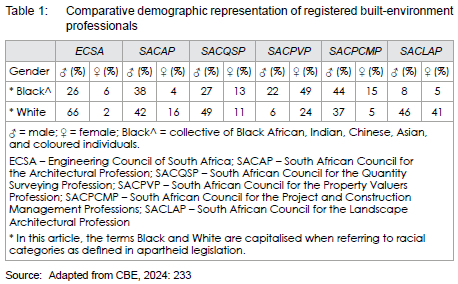
Like all built-environment professions, architectural professionals registered with the South African Council for the Architectural Profession (SACAP) do not yet nearly reflect the national population demographics for gender or race (see Table 1) (CBE, 2024). This is despite a host of innovative interventions aimed at transforming its membership since the end of apartheid over 30 years ago. These have included the introduction of additional professional categories, expansion of recognised architectural learning sites, and instruments for recognition of prior learning (SACAP, 2023: 1-2; De Jager, 2025: 130-132). Chronic attrition aggravated the problem, with estimates indicating that over a third of graduates2 were lost before they entered the pool of potential registered professionals.
Mentorship is considered to play a crucial role in professional development of young graduates and practitioners and is routinely practised across many professions and disciplines. It has been a staple of the architecture field since its emergence as a modern profession (Marsh, 2011). In South Africa, mentorship has evolved from being largely discretionary to being a near-mandatory requirement. The regulator, SACAP, prescribes that prospective architectural professionals in any recognised category must first register as candidates and complete monthly training records (MTRs)3verified by a mentor or employer before they can progress (SACAP, 2025).4This institutionalisation of mentorship signals a shift in its role from optional enhancement to formal professional obligation.
Despite mentorship's prominence, its assumed benefits have increasingly been called into question. Emerging international scholarship suggests that mentorship's outcomes depend on context, structure, and power relations rather than on the act of mentoring itself (Pennanen et al., 2016; Castanheira, 2016). These findings challenge the traditional assumption that mentorship is inherently good, raising critical questions for the South African profession, where historical inequities persist. The demographic composition of mentors - predominantly White and male, due to the apartheid legacy - further complicates the transformative potential of mentorship in a post-apartheid society.
Bourdieu's (1986) concepts of habitus, field, and capital provide a useful lens to interrogate the ways in which mentorship can both reproduce and disrupt entrenched professional hierarchies. Through mentorship, mentees acquire cultural capital (profession-specific knowledge and norms) and social capital (networks and relationships that enable opportunities). However, these same processes may perpetuate established hierarchies and power relations by reinforcing doxa5 - unquestioned professional norms - rather than challenging them (Van Louw & Waghid, 2008). Understanding mentorship as both a mechanism of professional reproduction and a potential catalyst for transformation is, therefore, central to this study.
A growing body of scholarship examines retention, attrition, and transformation among students and professionals, including in architecture. While many authors note that these issues remain underexplored, especially in developing countries (Letseka et al., 2010; Branson & Whitelaw, 2024; Saidi & Nazier, 2011; Payne, 2015; Adendorff, 2015), emerging local and international studies are beginning to address these gaps (Aljohani, 2016). Despite these contributions, research remains limited on mentorship's effects on retention, attrition, and transformation in professions, particularly in architecture and in Global South contexts. Traditional mentorship models often adopt a functionalist perspective, privileging unidirectional transmission and hierarchical relationships (Van Louw & Waghid, 2008), which may be inherently anti-transformatory. Social exchange theory further highlights that mentorship relationships involve negotiated benefits and costs, where power asymmetries can affect the equitable distribution of developmental opportunities (Cable & Judge, 1996).
Although mentorship is widely regarded as a benign and beneficial practice, limited research has examined its effects within the South African architecture profession, particularly concerning its role in demographic transformation and professional retention. Much of the available literature focuses on Global North contexts, leaving a significant knowledge gap regarding mentorship's impact in the Global South. Addressing this gap is essential, given the ongoing challenges of transformation and retention within the profession.
This article explores how mentorship operates within the South African architecture profession, examining whether it serves primarily as a mechanism for reproducing established hierarchies or whether it holds potential as an agent of transformation. The study forms part of a broader doctoral investigation into retention and demographic transformation in architecture and draws on document reviews, a survey of 430 participants, and 46 key informant interviews. Addressing the current lack of research may help reposition mentorship as a meaningful driver of change rather than an uncritically adopted vestige of the past.
2.1 Historical context
The establishment of the South African Native College in 19166 began the formalised separation of education provision based on race, foreshadowing official apartheid (Mabokela, 1997). The Extension of University Education Act (Act 45 of 1959) (O'Malley, n.d.) criminalised the registration of Black^ (Black African, Indian, Chinese, Asian, and coloured)7 students at formerly open universities. From then until 1983, strict segregation was exercised in South Africa's higher education institutions. With rare exceptions such as the ML Sultan Technical College, which offered architectural draughting courses to its predominantly Indian students from 1956, Black^ institutions of higher learning did not offer architecture or engineering studies (Jansen, 2023: 24). The Universities Amendment Act 24 (South Africa, 1968) allowed for the admission of small quotas of Black^ students into White universities. However, as lamented by Bryer (1977: 35-36), this was rarely exercised:
It is true that since the passing of the Extension of University Education Act in 1959, ministerial permission for Asiatics, Coloureds and Blacks to be enrolled as students in the faculty of architecture has in fact never been withheld. But the fact that such permission is necessary... has had a deleterious effect on the university academically as well as in every other respect.
In the 1970s, architectural schools such as those at the University of the Witwatersrand, the University of Cape Town, and the University of Natal did admit small numbers of Black students (De Jager, 2025), but these were very minimal. In addition to not having open access to tertiary institutions with architecture courses, Black^ practitioners were also precluded from practising as architects during apartheid (The Archive of Design and Architecture, 2023; South Africa, 1951).8 A small number such as Phill Mashabane and Luyanda Mpahlwa retreated into exile9 to pursue their dreams of being architects (D5 Magazine, n.d.; Lee, 2023), returning after the democratic elections to set up celebrated practices. Architects under apartheid and immediately thereafter were, therefore, overwhelmingly White and male. Until the pipeline could be transformed, the available mentors were overwhelmingly White.
'Born-frees'10 would start graduating from high (secondary) school in 2012, although even before this, the pipeline began racially transforming. As an indication of pipeline transformation, the first universal opportunity to access architectural learning programmes in 1995 (immediately following the first democratic election) would have been eligible for Pr. Arch registration11 in 2002. The first 'born-frees' would graduate high (secondary) school in 2012 and be eligible to enrol in the Pr. Arch category in 2020. The transition from apartheid to a mixed social environment provided expanding opportunities for supporting connections across diverse backgrounds. This diversity could enrich the learning experience and promote creativity and innovation through the exchange of varied perspectives. Mentors from the previously dominant class needed to develop skills to navigate these 'new' relationships effectively, including cultural competence and sensitivity to different social contexts. Being at liberty to participate, mentors could select mentees based on principles of concordance, which could be based on shared values, kinship, or anything else. However, it does not follow that all mentors are well-supported, incentivised and enabled to perform these roles.
2.2 Contemporary perspectives
2.2.1 Theoretical perspectives: Bourdieu and social reproduction
Bourdieu's (1986) theory of social reproduction provides a useful framework for examining social processes and their transmission. His concepts of field, habitus, and capital describe how social structures persist through the transmission of resources and norms. Agents internalise a field's unquestioned, taken for granted beliefs (or doxa), developing a habitus (or internalised professional outlook and behaviour shaped by experience) that aligns their dispositions with prevailing power relations. Institutional practices and interpersonal interactions then reproduce hierarchies, by legitimising norms and restricting access to resources. Conversions among capital forms (economic, social and cultural) reinforce symbolic authority. Examining the interplay of field, habitus, and capital reveals the mechanisms of social continuity, as well as disruption that enables transformative change.
Mentorship has a clear role in the perpetuation of existing professional practices. In Bourdieusian terms, mentors enhance mentees' ability to generate 'cultural capital' (profession-specific knowledge and norms) and 'social capital' (networks and relationships that enable opportunities) (Bourdieu, 1986). Well-mentored newcomers may acquire a profession-congruent habitus more readily, by emulating behaviours, assimilating attitudes and beliefs, and acquiring the skills and expertise of the established professional community. Mentees gradually master their 'feel for the game' and internalise a sense of belonging in the field. Protégés benefit from social and patronage networks, probably not otherwise available (Stevens, 1998: 177). Per doxa, mentorship is incorporated into the imaginary of the body profession as self-evident, natural, and generally held to be beneficial (or, at a minimum, benign) (Van Louw & Waghid, 2008). Mentorship processes often transmit cultural capital (knowledge, values, and norms) and social capital (networks and relationships) that reinforce institutional continuity. Yet, these same mechanisms also provide openings for change, as new entrants reinterpret professional norms through evolving social contexts. This dual capacity - both reproduction and disruption - renders Bourdieu's framework particularly relevant to mentorship in post-apartheid South Africa.
2.2.2 Mentorship models in professional development
Dyad mentorship is the traditional and most prevalent model of mentorship, and the one most widely adopted by the architecture profession. It involves a single mentor-mentee pairing characterised by mutual responsiveness and shared responsibility for developmental support (Nowell et al., 2017). Unlike peer mentorship, which entails mutual guidance and support between individuals of similar rank or experience, dyad mentorship is typically hierarchical, with the mentor providing expertise and guidance to the less experienced mentee. In contrast to group mentorship models, where one mentor supports multiple mentees simultaneously, dyadic relationships focus intensively on personalised interactions within the pair (Nowell et al., 2017).
Building on this, distinctions between supervision, sponsorship, and mentorship further clarify the range of professional development relationships. Supervisors are appointed within organisations to oversee day-to-day performance and ensure compliance with institutional standards. They exercise hierarchical authority, assign tasks, evaluate outputs, and certify that trainees meet prescribed competencies. Sponsors, by contrast, go beyond oversight, by actively advocating for a protege's advancement, leveraging their positional power and networks to secure visibility or promotion (AIA, 2020). Meanwhile, mentors offer long-term developmental support that combines career guidance with psychosocial functions such as role modelling, identity formation, and emotional encouragement (Kram, 1985). While supervision and sponsorship are typically hierarchical and outcome-driven, mentorship tends to be reciprocal, developmental, and identity-shaping.
Distance mentorship diverges, by enabling mentor and mentee separated by physical distance to engage through technology-mediated communication, while constellation mentorship (support from multiple mentors covering different skills) expands the concept, by comprising multiple mentors collaborating to support a single mentee across various developmental domains. Dyad mentorship thus remains uniquely centred on a singular developmental alliance, often foundational in early career stages or academic settings, supporting in-depth, sustained, and reciprocal growth (Nowell et al., 2017).
Contemporary mentorship scholarship encompasses theoretical frameworks that explain both its transformative potential and inherent limitations. Mentorship functions as a developmental relationship, providing both career and psychosocial support functions, where mentors offer technical guidance, emotional support, and professional integration assistance (Allen et al., 2004). Mentorship can be understood, through the lens of Bourdieu's (1986; 1990) concepts of social capital and cultural reproduction, to reveal how mentorship relationships operate within existing power structures, where mentors control access to valuable resources, networks, and cultural knowledge necessary for professional advancement. This perspective is particularly relevant in the post-apartheid context, where social capital remains unevenly distributed along historical lines of privilege and exclusion (Freund & Padayachee, 2021).
SACAP's Practical Training Policy specifies the role of the employer and/or mentor, stipulating that
[t]he employers/mentors are morally obligated to assist candidates to obtain the required breadth of training by providing opportunities for a variety of experiences and by actively imparting knowledge. The employers/mentors should verify and sign off on the monthly training records, submitted online by the candidate, indicating that he/she is in agreement with the nature and level of work performed and the competence displayed by the candidate (SACAP, 2020: 3).
The policy places the onus on the candidate to "ensure that his/her training meets the prescribed requirements. In the event that the candidate experiences difficulty with the training, he/she shall attempt to resolve these with his/her employer and or mentor". A clear hierarchical structure is thus established for mentorship of candidates.
2.2.2 Mentorship, social networks, and homophily theory
Social network theory provides crucial insights into how mentorship relationships form and function within professional communities. McPherson, Smith-Lovin & Cook's (2001) seminal work on homophily - the principle that 'similarity breeds connection' - reveals a fundamental challenge for diversity initiatives in mentorship programmes. The theory posits that individuals feel more comfortable and demonstrate greater propensity to maintain relationships with demographically congruent mentors and role models (Afolabi & Akinola, 2021). Recent empirical research in network science has demonstrated how homophily creates structural advantages for majority groups, while systematically disadvantaging minorities in professional networks (Murase et al., 2019). The implications of homophily theory extend beyond individual relationships to systemic professional transformation. Research shows that networks characterised by homophily can become 'legacy chambers for the amplification of dynamics and hierarchies of residual power', perpetuating historically dominant narratives and reinforcing inequalities (Dasgupta, 2011), providing a useful theoretical perspective in understanding mentorship's role in post-apartheid professional transformation.
Although notionally voluntary, there can be an expectation from the professional field and society for individuals to volunteer for developmental activities based on their demographic identity or 'representing'. These contributions, which can include an imperative to mentor, are frequently under-recognised, unpaid, and (posited as) obligatory (Harris, 2013; Ahmed, 2012). This concern is exemplified in this quote from an unnamed participant in Adendorff's thesis:
We also became a "prominent black practice" and with it came expectations, like "don't let the side down" ("25:32" in Adendorff, 2015: 241).
Individuals who experience this pressure to undertake duties based on some contingent demographic characteristic may also develop a sense that their involvement is tokenistic, and observers may similarly view their participation as such.
2.2.3 Contemporary developments: Network approaches and transformation models
Recent scholarship has moved beyond dyadic mentorship models toward network-based approaches that recognise the complexity of professional development in diverse societies. Research suggests that formal mentorship programmes may have unintended consequences when they replace organic, emergent mentoring relationships with bureaucratised obligations (Jena & Pradhan, 2018). However, emerging models propose structured approaches that address power imbalances, while maintaining developmental effectiveness. Contemporary retention research identifies multiple factors influencing professional persistence, including workplace belonging, career development opportunities, and organisational culture (Kossyva et al., 2024). This broader perspective suggests that mentorship functions as one element within complex systems of professional support, with implications for retention and transformation.
2.2.4 Mentorship in architecture: Global perspectives and local challenges
Mentorship in architecture reveals a complex landscape, where voluntary participation dominates, universal benefits are increasingly questioned, and transformational potential drives contemporary programme development. Across many architectural jurisdictions, mentorship operates primarily as a voluntary enhancement rather than a mandatory requirement. The United Kingdom exemplifies this approach, where mentorship is embedded within specific pathways such as Level 7 architect apprenticeships and work-integrated learning routes, but remains optional for traditional academic graduates (Goodricke & Murray, 2024). Similarly, the United States positions mentorship as a form of structured professional development rather than a regulatory requirement (AIA, 2020). In Canada, both a supervising architect and a mentor are required in the mandatory internship programme. A mentor may not be employed at the intern's place of work, a feature that enhances impartiality and establishes the mentor as an independent guide and advocate (Canadian Architectural Licensing Authorities, 2012: 8). Preliminary evidence suggests that, in India, mentorship is discretionary (jobs.archi, 2024).
Comparative research highlights how cultural context shapes mentorship outcomes. Scandinavian countries such as Finland demonstrate collegial, peer-based models of professional mentorship (Pennanen et al., 2016). The AlA's International Global Mentorship Program includes regular group sessions open to all emerging professionals. These cohort meetings function as peer-to-peer forums, enabling participants to both give and receive advice from equals as well as more senior volunteers.
AIA Knowledge Communities (US) formally organise peer networks around specialisms - sustainability, technology, practice management -so members mentor one another horizontally, tapping weak ties to surface new insights and collaborate on projects. Collectively, these examples illustrate how mentorship can operate as a collaborative and networked practice rather than a hierarchical transfer of expertise, reflecting deeper cultural differences in how authority, learning, and professional identity are constructed within architectural practice.
The assumption that mentorship is universally beneficial faces increasing scrutiny. A comparative study of Finnish and Australian programmes shows that Finland's mentoring is rooted in informal, egalitarian peer networks, whereas Australia's is shaped by formal, top-down, transmissive frameworks (Pennanen et al., 2016). The study argues that these culturally embedded implementation designs critically influence mentoring's effectiveness (Pennanen et al., 2016).
A meta-synthesis of mentoring studies emphasises that positive outcomes require careful mentor selection, training, and programme design rather than assuming inherent benefits (Castanheira, 2016). Kaba et al. (2023) observe that, in health research in low- and middle-income countries, including Nigeria and South Africa, mentorship often remains project-based and externally funded, highlighting implementation challenges that question universal applicability (Kaba et al., 2023). Recent scholarship frames mentorship as a potential agent of professional transformation rather than merely supportive relationships (Hwang et al., 2022; Watt & Van Dyck, 2023). Obianuju and Diyenaan (2019) note that architectural training and practice in Nigeria traditionally relies on a hierarchical mentor-mentee model and identify the paucity of female mentors as a key barrier to women's advancement in Nigerian architecture.
International scholarship on mentorship in architecture reveals both its potential for professional development and its limitations in addressing systemic inequalities. Recent studies have documented mentorship's positive impact on retention and career advancement in the architecture profession (Hwang et al., 2022), while simultaneously revealing persistent challenges in achieving demographic transformation. Gender-specific research demonstrates that female-to-female mentorship relationships in architecture yield particular benefits for career confidence and professional integration (Afolabi & Akinola, 2021), supporting theoretical arguments about the importance of demographic concordance in mentoring relationships.
Turning to the South African context, the professional landscape presents unique challenges for understanding mentorship's role in demographic transformation. South African research reveals that mentorship proves particularly crucial for graduates struggling to adapt to workplace expectations and language demands in professional environments (Nkomo & Thwala, 2014). However, the broader economic context of high graduate unemployment and skills-biased labour demand patterns creates additional complexity for professional mentorship programmes (Mahlangu, 2020; NDPWI, 2022).
Leading diversity scholars in architecture demonstrate varying perspectives on mentorship's transformative potential. While some researchers identify mentorship as instrumental for professional advancement (Anthony, 2001; Obianuju & Diyenaan, 2019), others focus on structural and systemic barriers without emphasising mentorship's role (De Graft-Johnson, Manley & Greed, 2005; Möller, Dupré & Fernando, 2022). This divergence in scholarly emphasis reflects broader debates about whether mentorship serves as a mechanism for transformation or merely reproduces existing professional hierarchies. Comparable insights emerge from adjacent professions. Lawless' (2016) studies of South African municipal engineering highlight the scarcity of effective mentorship and its consequences for graduate development. The absence of experienced mentors was found to hinder skill transfer and professional confidence among young engineers, illustrating sector-wide challenges that likely also extend to architecture.
3. RESEARCH METHODS
3.1 Research design
This study employed a pragmatic mixed-methods research design, combining quantitative surveys and qualitative interviews, to examine the complex and multifaceted nature of mentorship within South Africa's architecture profession. Mixed-methods research involves the collection and integration of both quantitative and qualitative data (Creswell & Plano Clark, 2018). This study implemented a convergent parallel mixed-methods design (Creswell, 2014: 32), whereby quantitative survey data and qualitative interview data were collected concurrently, analysed separately, and then merged during interpretation to provide complementary insights into mentorship dynamics. The research questions demanded both the measurement of attitudes and perceptions across the profession (quantitative) and the exploration of nuanced experiences and meanings attributed to mentorship relationships (qualitative). A mixed-methods approach enabled the triangulation of findings (using multiple data sources taken together) to enhance the credibility and comprehensiveness of results (Teddlie & Tashakkori, 2009).
3.2 Population, sample, and response rate
For the survey, target individuals were those who had embarked on a SACAP recognised course (architectural studies) or endeavoured to enter the profession through apprenticeship. Participants were recruited through multiple channels, including SACAP's member database, referrals, voluntary professional associations, university alumni offices, and social media platforms. The study considered only the professional phase and did not consider mentorship during the course of formal study, or mentorship outside the context of the professional setting. Based on cumulative graduation data (Division for Institutional Strategy, Research and Analytics, 2025), the overall population size of 17,639 was calculated (comprising 11,913 registered professionals and 5,726 individuals who had left the profession). The purposive sampling approach yielded 430 responses to capture diverse perspectives from the architecture profession across career stages, geographical locations, and demographic backgrounds (Ahmad & Wilkins, 2025). According to Krejcie and Morgan's (1970) formula, a population of 15,000 requires a sample size of 375; therefore, the sample of 430 respondents with mentorship experience is statistically adequate for this study.
For the interviews, from the initial recruitment records, 47 key informants were purposively selected, of whom 46 consented to be acknowledged for their participation. The sample comprised predominantly respected 'pracademics' and recognised professionals across sectors, provinces, and the diaspora, including extensively cited authors and thought leaders, thereby enhancing the validity and credibility of the data, despite some demographic limitations.
3.3 Data collection
Between 19 March and 6 June 2023, an electronic survey entitled "YOUR JOURNEY in South Africa's Architecture Profession" was conducted to capture diverse personal accounts within the profession. The survey aimed to document race- and gender-disaggregated trajectories, self-reported perceptions of belonging or exclusion, and broader patterns of habitus.
The survey was distributed via professional networks (registration bodies, voluntary associations, LinkedIn, and Facebook) and circulated further through peer-sharing. Its design was informed by international instruments, most notably the NCARB/NOMA Baseline on Belonging (2021) and was hosted on SurveyMonkey (SurveyMonkey Inc., 2024). A skip logic function routed respondents through relevant questions, all of which were optional.
The instrument comprised over 30 core questions and 418 branching items addressing demographics, work experience, professional contexts, and perceptions of discrimination, career mobility, and registration with SACAP. Mentorship was a key theme, with questions establishing whether participants currently were, had, or lacked mentors, complemented by five Likert-scale items measuring mentorship quality across dimensions such as support, respect, professional engagement, and freedom to express contrary views. Additional Likert questions asked respondents to indicate their level of agreement (from strongly disagree to strongly agree) with statements on factors encouraging or discouraging professional participation. Open-ended questions provided qualitative insights into mentorship and professional development support from workplaces, educational institutions, family, and peers.
Interviews were semi-structured, conducted face-to-face, virtually, or telephonically, and averaged two hours in duration. The interview schedule consisted of 12 core questions with follow-up probes, covering topics including career trajectories, mentorship experiences, professional challenges, and views on transformation within the architecture profession. Participants were guided through discussions about their personal experiences, while maintaining flexibility to explore emergent themes on mentorship transition, homophily, and volunteerism. Key informants could opt to remain anonymous or to be acknowledged in the research.
3.4 Data analysis
3.4.1 Survey data analysis
Survey data were imported into Microsoft Excel, cleaned, and coded for gender, race, and age (Meyer & Avery, 2009). The following demographic notation was used: female ('♀'), male ('♂'), and gender diverse ('◇'); 'o' for other, 'un' for unspecified, and 'X' for combined 'o' and 'un' categories. 'Black^' represented the collective of Black African, Indian, Chinese, Asian, and Coloured participants. Descriptive statistics (frequencies and percentages) were used to summarise demographic profiles and quantitative survey data from Likert-style questions (strongly agree, agree, neutral, disagree, strongly disagree) on mentorship participation and experience (Harpe, 2015). Participation rates per question were calculated as a proportion of total responses. For qualitative data from open-ended questions, selected participant quotes were presented verbatim to preserve authenticity and provide insight into perceptions of mentorship participation and experience.
3.4.2 Interview data analysis
Interview recordings were transcribed verbatim and imported into Microsoft Excel for analysis (Meyer & Avery, 2009). A keyword-focused approach was employed to identify all mentions of 'mentor', 'mentors', 'mentorship', or 'mentees', capturing unprompted, participant-driven discussions. Extracted excerpts were coded for sentiment (positive, negative, neutral) and type of experience, and were analysed thematically (Braun & Clarke, 2021). Excel facilitated systematic searching, contextual extraction, and organisation of the dataset. Although dedicated qualitative analysis software provides advanced features for complex coding, Excel was suitable for this targeted analysis, given the manageable dataset and the focus on capturing authentic, emergent perspectives on mentorship, including aspects of transition, homophily, and volunteerism within the broader discussions of professional development and career experiences.
3.5 Limitations
Given the purposive sampling strategy used - drawing participants from SACAP's member database, professional associations and social media referrals - the sample may not fully represent all architectural practitioners, especially those outside formal networks or who have left the profession. A reliance on self-reported survey responses introduces potential recall and social-desirability biases. The cross-sectional design provides insight into only a moment in time, precluding assessment of developmental trends or causal relationships. Despite these constraints, the research design provides for methodological triangulation, lending robustness and depth to the findings, by offsetting individual method limitations. Future research employing longitudinal designs and probability-based sampling will be useful to validate and extend these insights.
4. FINDINGS
4.1 Participant profile
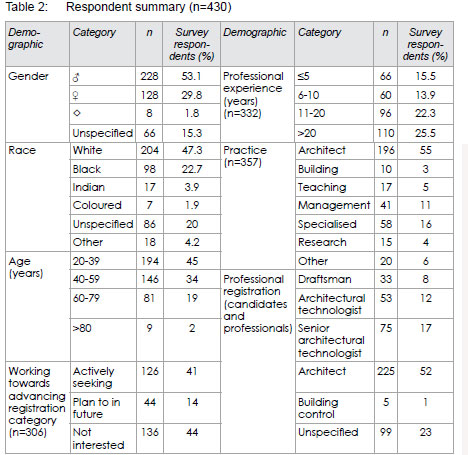
Table 2 shows the characteristics of the survey participants (n=430). The participant demographics reflected a diverse professional cohort, with males comprising 53.1% (♂=228), females 29.8% (♀=128), gender-diverse individuals 1.8% (◇=8), and unspecified gender identification 15.3% (n=66). Racial demographics showed White professionals representing 47.3% (n=204), Black professionals 22.7% (n=98), with smaller representations of Indian (3.9%, n=17), Coloured (1.6%, n=7), and other racial identities (4.2%, n=18), while 20.0% (n=86) chose not to specify racial identity. Respondents demonstrated substantial professional experience, with a mean of 17.6 years and median of 15.0 years in the architectural profession. Experience distribution showed 15.5% with 0-5 years, 13.9% with 6-10 years, 22.3% with 11-20 years, and 25.5% with 20+ years of professional experience. The age range spanned from recent graduates in their early twenties to retired octogenarians.
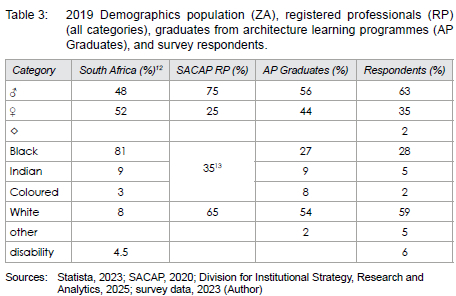
There has been a persistent mismatch between the characteristics of the general South African population, architecture practitioners, and registered professionals. In Table 3, to support the validity of this study, the demographic representativity of the survey respondents was compared with those of the South African national background population, registered professionals, and architectural graduates, highlighting the percentage differences in each category.
As shown in Table 3, female survey respondent representation of 35% was greater than SACAP registered proportions (25%), less than graduate proportions (44%), and 17% less than national demographics (52%). Proportionally, Black^ survey respondents (35%) matched registered professionals (35%) and graduates (44%), and 38% lower than national demographics (which are 81%). This suggests that the survey was successful in reaching non-active individuals, despite anticipated challenges in reaching this segment of the target population.
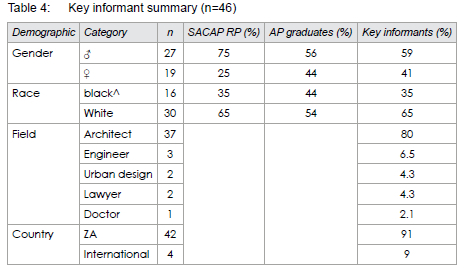
Table 4 shows that a total of 46 key informants participated in the study. The sample comprised 27 males (59%) and 19 females (41%), compared to 75% male and 25% female among registered professionals (SACAP RP) and 56% male and 44% female among AP graduates. In terms of race, 16 participants (35%) identified as Black^ (including Black African, Indian, Chinese, Asian, and Coloured) and 30 (65%) as White, reflecting the same distribution observed among SACAP RPs (35% Black^, 65% White) and similar to AP graduates (44% Black^, 54% White). Most of the informants were architects (n=37, 80%), with smaller representations from engineering (n=3, 6.5%), urban design (n=2, 4.3%), law (n=2, 4.3%), and medicine (n=1, 2.1%). The majority were based in South Africa (n=42, 91%), with four participants (9%) residing internationally.
Overall, the survey sample reflected the broader professional population in terms of gender and racial composition, while the key informant group captured an additional diversity of professional fields and international perspectives. This profile provides a credible and informed basis for exploring mentorship experiences within the architecture profession.
4.2 Mentorship participation
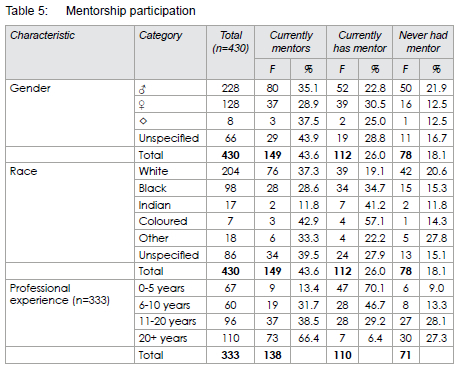
Survey findings revealed significant mentorship engagement within the profession, with 60.6% (n=261) of the respondents having experienced some form of mentorship relationship. At the time of the survey, 43.6% (n=149) reported serving as mentors to others, while 26.0% (n=112) had mentors. Notably, only 18.1% (n=78) reported never having had a mentor, indicating widespread exposure to mentorship practices. Gender analysis revealed differential mentorship patterns, as shown in Table 5. While males demonstrated higher absolute numbers of current mentors, females showed higher participation rates as mentees (30.5% vs 22.8%) and significantly lower rates of never having experienced mentorship (12.5% vs 21.9%). Gender diverse individuals demonstrated comparable mentorship engagement to the broader cohort, although with very small sample size.
Racial demographics revealed notable patterns in mentorship participation, as shown in Table 5. Black professionals demonstrated higher rates of mentors currently having (34.7%) compared to White professionals (19.1%), while White professionals showed higher rates of serving as mentors (37.3% vs 28.6%), in line with their higher presence in the profession. Indian and Coloured professionals demonstrated particularly high rates of current mentorship receipt (41.2% and 57.1%, respectively), although with smaller sample sizes. Professional experience significantly influenced mentorship participation patterns, as shown in Table 5. Senior professionals (20+ years) demonstrated the highest rates of serving as mentors (66.4%), while early-career professionals (0-5 years) showed the highest rates of currently having mentors (70.1%). Although some testimonies suggested lifelong mentorship relationships, this pattern suggests directional flow of mentorship from experienced to emerging professionals. Notably, the 11-20-year experience group showed the highest rate of never having mentors (28.1%), suggesting potential gaps in mentorship provision during this career transition period.
Among respondents who currently have a mentor, 53.4% reported that they were now a mentor of junior staff. The corresponding figure for practitioners without a mentor is only 19.7%. A plausible interpretation is that, when mentoring is modelled well, it propagates downwards, expanding mentoring capacity organically. Of the architects actively advancing their registration category, 68% have an active mentor. Only 24% of those not interested in further registration report having a mentor. Conversely, 72% of practising mentors themselves hold the highest SACAP category available to them.
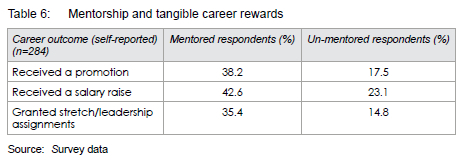
As shown in Table 6, tangible career rewards appear to track closely with mentor participation status.
The gap reaches 20% on every metric, implying that mentorship matters not merely for "soft" development but for objective career progress. It appears that registration and mentorship reinforce each other.
It appears that mentorship participation is both a 'driver' and a 'by-product' of professional credentialling. The only group, in which "never had a mentor" exceeds 25%, is practitioners with 11-20 years' experience (28.1%) (see Table 5). Open-ended question responses indicated that many in this cohort entered practice when SACAP first made mentorship compulsory, finding themselves "too senior to be assigned" yet "too junior to mentor". They form a latent pool of future mentors who may, however, lack the role-model or experience to reproduce the practice.
4.3 Mentorship experience
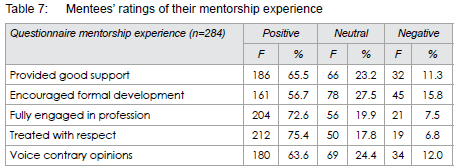
Questionnaire data analysis revealed that mentees had enjoyed mixed mentorship experiences, as set out in Table 7. Overall, 65.5% reported that mentors provided good support for skills and experience development, while 75.4% felt treated with respect by their mentors. Professional engagement of mentors was highly rated, with 72.6% agreeing that their mentors were fully engaged in the profession. However, formal professional development encouragement showed more mixed results, with only 56.7% reporting positive experiences. The ability to voice contrary opinions was positive for 63.6% of the respondents, suggesting reasonable openness in mentorship relationships, although 12.0% experienced negative dynamics in this area.
The study revealed that mentorship experiences across the profession were complex and varied. Questionnaire analysis of mentor ratings across five key dimensions indicated mixed, although generally positive, outcomes.
Positive mentorship experiences emerged as the dominant narrative among questionnaire respondents who had meaningful mentoring relationships. As one professional noted: "Long-term and hugely valuable. It's been 29 years." Another described his/her experience: "I was fortunate to have been mentored by a seasoned professional. We hardly agreed :) but as long as I was willing to do the work, to prove and execute the work within due process, he was happy to support and even cheer from time to time." A respondent highlighted the reciprocal nature of effective mentorship: "I've mentored five candidates who are now registered professionals. Till this day we keep a very good relationship." Less frequent negative mentorship revealed concerning patterns of inadequate support and hierarchical dysfunction. One respondent's experience exemplified these challenges: "My current mentor is unusual. I have not had many, and most of them are really weak. They were either disengaged or too busy or really bad leaders." Power dynamics and resistance to change emerged as significant issues, with another professional noting: "I get the sense that my mentor felt threatened by me and so I could not voice my opinions (or even provable FACTS) without risk of being shut down. Hence, I left as soon as I could because the mentor had an 'old school' mentality and would not actively try and learn new ideas or implement new ideas (with only one exception)."
The neutral and mixed experiences reflected the evolution of mentorship practices and individual agency. One veteran professional observed: "In my youth mentorship was less formal, but the work environment itself was a superb school, offering ample opportunities to grasp, with less spoonfeeding." Another demonstrated professional self-reliance: "I did not need a mentor when I entered the profession. I had prepared myself to hit the ground running."
Women were 8% more likely than men to report having a mentor, yet their qualitative comments seem to register more frustration with mentor availability ("too busy to meet"), and higher praise when mentoring is effective ("ground-breaking female architects ... keep challenging me"). The data suggest that women seek mentors more actively but experience wider variance in quality. Black^ respondents were less likely than Whites to serve as mentors (28.6% vs 37.3%), yet more likely to have mentors (34.7% vs 19.1%). Narrative answers reveal three recurrent motives for mentees entering into a mentorship arrangement. The first is for compliance (it is required), and the second is for navigation in decoding hidden rules of a historically White profession. The third is for social capital-building opportunities such as introductions to client networks that remain gate kept. Mentorship experiences for long-serving professionals (20+ years) frequently contrasted contemporary prescribed, document-heavy mentor system with the past's "apprenticeship of proximity". Positive comments overwhelmingly describe emergent, voluntary relationships; negative ones describe assigned, perfunctory pairings.
4.4 Mentorship transition, homophily, and volunteerism
Mentorship's transition from something voluntary, emergent, and organic to a formal obligation emerged as a significant theme in key informant interviews and in the electronic survey open-ended responses. One respondent suggested that, in order to retain professionals,
I believe mentorship should be taken more seriously (especially by the mentors) and not only see it as a tick box exercise in the MTRs process. It should continue throughout professional life (but not as a regulated institution). I believe the free-will choice to mentor and be mentored will make for better future architectural professionals (37-year-old Black male).
This transition raised questions about whether formalisation enhanced or diminished mentorship effectiveness. The formal requirements introduced by SACAP appeared to create compliance-oriented relationships that may lack the genuine commitment and mutual benefit characteristic of organic mentoring partnerships. Some respondents expressed concerns about mentorship becoming a "box-ticking" exercise rather than supporting meaningful professional development.
A 36-year-old respondent remarked that an "employer is not necessarily a mentor". This truism is poignant: as mentorship has become structurally embedded as a prerequisite for professional progression, the roles of employer and mentor have tended to conflate.14
The role of homophily in mentorship was acknowledged. Advocates of diversity in the workplace such as SAIA President Amira Osman (SAIA, 15 June 2021) and key informant Davis (29 April 2024), among others, have acknowledged their White male mentors and expressed appreciation for the role in their professional development, whilst nevertheless supposing that some individuals would prefer to have a mentor of similar age, gender and race. The opportunity to access concordant mentor/mentee relationships should have been on an upward trend, due to a transforming professional pipeline. However, an increasing tendency to practise solo has reduced the overall pool of available mentors, whereas need (number of architecture students graduating) is growing. As mentorship is a requirement to enter the profession, this poses a barrier for newcomers to progress in the field. Key informants cited failure to find mentors or employment as a reason for not registering (n=2) and for leaving the field (n=3).
An interesting aspect emerged in that some respondents described volunteerism as 'pressure to participate in mentorship'. Key informants felt that, in circumstances of being part of a minority, or the only, available person in an underrepresented demographic identity group, such approaches may coalesce, may be unwelcome, burdensome, and contribute to a sense of being singled out on grounds of some demographic contingency (Miller, personal communication, 27 September 2021). Architecture professionals may not generally have the desire or capacity to 'represent' their demographic group, by being exemplary role models, participating in voluntary social and peer support groups, or assuming additional duties. Indeed, testimony by key informants has it that, based on their assumed membership to some rights or interest groups, individuals may be called upon to contribute beyond their 'normal' roles and responsibilities in the workplace. These include activities such as contributing to organisational policy reform, serving on transformation committees, or engaging in extraordinary mentoring activities. Some individuals welcome these opportunities (Miller, 2021). However, according to two key informants' testimony, individuals may at times feel that such tasks fall outside their area of expertise, interest, strength, or responsibility; they may have competing priorities or undue pressure to perform, contributing to a sense of tokenism.
5. DISCUSSION
This study revealed that mentorship in South Africa's architecture profession is complex, varied, and deeply shaped by historical, organisational, and interpersonal factors. While survey results indicated widespread participation in mentorship, experiences ranged from highly supportive to inaccessible or ineffective. Positive outcomes included enhanced professional confidence, increased 'voice' in workplace decision-making, and better alignment between skills and project roles, particularly among those given supervisory responsibilities early in their careers. However, access to quality mentorship was uneven, with some respondents reporting an inability to secure a mentor, suggesting that matching remains largely a matter of chance. Two important trends may make this worse, namely the increasing number of unemployed graduates (Diale, 2019; Mahlangu, 2020; Kigotho, 2020) and the growth of small and solo practices (SAIA, 2020). Both trends could create barriers that make it harder for some people to enter and stay in the profession.
The diaspora of South African architects, many now in senior roles abroad, represents an untapped source of potential e-mentors. Similarly, supervisory-track rotations emerged as a practical substitute for mentorship in contexts where mentors are scarce.
These findings align with established scholarship recognising mentorship as a driver of professional development (Allen et al., 2004; Ariffin & Amar, 2019), offering both technical guidance and psychosocial support. Consistent with Bohnet (2016), mentors often acted as advocates, facilitating access to opportunities otherwise out of reach. Yet, as Van Louw and Waghid (2008) caution, mentorship can also reproduce hierarchical power imbalances and, in some instances, enable exploitation. This may be attributed to the hierarchical nature of traditional mentorship models. The potential for exploitation was present as an extension of broader societal issues of discrimination against younger, less experienced individuals.
The results also resonate with Lazarsfeld and Merton's theory of homophily (McPherson et al., 2001) and Bourdieu's concepts of social reproduction (1986; 1990). Lazarsfeld and Merton's seminal work identified homophily - the tendency for people to associate with others who are similar to themselves - as a key driver of social connections. Building on this, McPherson et al. (2001) show that homophily operates with 'law-like' consistency across all types of networks, from friendships to workplaces, and contributes to persistent demographic segregation in organisations and professions. The persistence of a predominantly White male mentor pool, rooted in apartheid-era legacies, may inadvertently perpetuate exclusion, by concentrating cultural capital within homophilous networks (Bourdieu, 1986; 1990). Some mentors actively worked across demographic divides to support transformation, while others reinforced 'legacy chamber' dynamics that restricted progress on diversity.
The profession faces a paradox. Mentorship is both a valued tradition and a potential mechanism for reinforcing inequality. These variations suggest that, while basic mentorship relationships exist, their transformative potential may be limited by hierarchical structures and traditional power dynamics. Transformative mentorship's positive impact is not universal but contingent on mentor attitudes, organisational culture, and broader sociopolitical structures. Making mentorship a formal requirement - shifting from a voluntary to a mandatory model - may risk reducing the authenticity and quality of relationships, but were it made entirely informal would perpetuate existing uneven access and opportunities.
These mixed outcomes suggest several key insights into mentorship within the profession. First, mentorship is not universally beneficial; experiences ranged from positive to negative, challenging the assumption that all mentoring inherently supports professional development. Secondly, the effectiveness of mentorship depends heavily on context, including mentor attitudes, organisational culture, power relations, and sociopolitical factors. Thirdly, formal requirements may compromise authenticity, as the transition from voluntary to mandatory mentorship risks unintended consequences for relationship quality and developmental outcomes. Fourthly, while demographic concordance influences mentorship experiences, a mentor's commitment to transformation objectives is more critical than demographic matching alone. Fifthly, survey data show that respectfulness, engagement, and general support are generally strong mentorship dimensions, but formal encouragement of professional development and open dialogue require targeted attention to support more transformative relationships. Finally, mentorship alone cannot resolve systemic challenges; high attrition persists, despite widespread mentorship practices, indicating that comprehensive strategies addressing multiple professional factors are needed.
These findings highlight the need for more evidence-based, context-sensitive mentorship models such as the Stacked Mentorship Model (Hwang et al., 2022), and for leveraging underutilised networks such as diaspora professionals. Professional bodies could strengthen outcomes through structured matching processes, quality standards, and mentor training addressing cultural competence and power dynamics. Delegating structured supervisory responsibilities early in careers can partially offset mentor shortages, while cultivating future mentors. Formal mentorship mechanisms should incorporate flexibility such as options for choice, chemistry matching, and sunset clauses in order to emulate the strengths
of legacy practices. Structured mentorship programmes in the public sector, especially public works, could help retain more professionals and support graduates struggling to find employment or mentorship. However, the issue is complex and 'wicked' in nature (Rittel & Webber, 1973), as established professionals often lack incentives to invest in mentoring, and they may prioritise material gain over supporting the next generation. This economic and social dynamic makes institutionalising effective mentorship challenging.
While this study provides robust quantitative and qualitative evidence, it is cross-sectional (an analysis at one point in time) and cannot establish causality between mentorship and retention. Future longitudinal studies could explore how mentorship experiences shape career trajectories over time and test alternative models in different organisational contexts. A limitation of this preliminary study is that, despite recognising race, gender, class and their intersection as a concern in mentorship (AIA, 2020), in-depth analysis was not undertaken to examine this concern. A detailed inquiry on the impact of belonging to multiple demographic categories (intersectionality) is, therefore, recommended for future research. Comparative research across professions could help identify strategies transferable to architecture.
6. CONCLUSION
This study reveals a central paradox in South Africa's architecture profession: mentorship is widely practised and generally valued, yet high attrition rates and slow demographic transformation persist. The findings challenge the assumption that mentorship is inherently beneficial, showing instead that its effects are contingent on mentor attitudes, organisational culture, and structural forces.
While many mentorship relationships provide respect, engagement, and professional guidance, others fall short, particularly in supporting professional development and open dialogue. Access was inconsistent, shaped by organisational size, practice resources, and demographic representation. Theoretical frameworks of homophily and social reproduction help explain how entrenched networks can both support and limit mentorship transformation within the architecture profession in South Africa.
Architectural professionals need to be more aware of the variation in experiences encountered by young aspiring professionals. Advancing equitable professional development will require deliberate, evidence-based approaches that address access, quality, and the structural conditions influencing mentorship relationships.
7. RECOMMENDATIONS
The way forward for the profession depends on its collective commitment to addressing the complex dynamics revealed in this research and implementing coordinated approaches to professional development, retention, and transformation.
For professional bodies such as SACAP and voluntary associations, this entails developing mentorship quality standards that prioritise respect, engagement, mutual benefit, and transformation objectives over mere compliance. These standards should be supported by targeted mentor training that addresses cultural competence, gender responsiveness, and power dynamics, alongside structured mentor-mentee matching systems that reduce reliance on chance encounters. Regular monitoring of mentorship outcomes through surveys and feedback loops would help ensure continuous improvement.
Architectural practices, for their part, should move beyond tokenistic approaches to mentorship, supporting genuine developmental relationships that are adequately resourced and integrated into workloads. This requires allocating dedicated time for mentorship and addressing broader systemic factors affecting retention such as fair compensation, clear advancement pathways, and work-life balance, alongside mentoring initiatives. Where formal mentors are scarce, practices could introduce supervisory-track rotations to cultivate leadership skills and prepare future mentors.
Within the professional community more broadly, there is scope to expand access by engaging diaspora architects in cost-effective e-mentorship programmes and re-engaging mid-career professionals (11-20 years' experience) as mentors through targeted incentives. Peer-mentorship and group mentorship models should also be encouraged to extend the reach of developmental support.
In the domains of education and policy, mentorship skills and expectations should be embedded into university curricula, with strong partnerships between academia and practice to create structured transition programmes for graduates. Policymakers and professional bodies could collaborate to conduct longitudinal research evaluating mentorship's long-term effects on career progression and retention. In addition, piloting and evaluating alternative modelssuch as the Stacked Mentorship Model within the South African context would provide valuable evidence for refining approaches.
REFERENCES
2. LITERATURE REVIEW
- Adendorff, S.M. 2015. Career orientation typology of architects: A South African study. Unpublished PhD dissertation, University of the Western Cape, Cape Town, South Africa.
-
Afolabi, A.O. & Akinola, A. 2021. An empirical investigation of the mentor-mentee relationship among female architects and female architectural students. International Journal of Emerging Technologies in Learning (Online), 16(13), article 168. https://doi.org/10.3991/ijet.v16i13.21971
» https://doi.org/10.3991/ijet.v16i13.21971 -
Ahmad, M. & Wilkins, S. 2025. Purposive sampling in qualitative research: A framework for the entire journey. Quality and Quantity, 59(2), pp. 1461-1479. https://doi.org/10.1007/s11135-024-02022-5
» https://doi.org/10.1007/s11135-024-02022-5 -
Ahmed, S. 2012. On being included: Racism and diversity in institutional life. London: Duke University Press. https://doi.org/10.2307/j.ctv1131d2g
» https://doi.org/10.2307/j.ctv1131d2g -
AIA (American Institute of Architects). 2020. Guide 6: Mentorship and sponsorship. 2nd edition. Washington, DC: American Institute of Architects. aia.org [Accessed: 27 September 2025].
» aia.org -
Aljohani, O. 2016. A comprehensive review of the major studies and theoretical models of student retention in higher education. Higher Education Studies, 6(2), pp.1-18. https://doi.org/10.5539/hes.v6n2p1
» https://doi.org/10.5539/hes.v6n2p1 -
Allen, T.D., Eby, L.T., Poteet, M.L., Lentz, E. & Lima, L. 2004. Career benefits associated with mentoring for protégés: A meta-analysis. Journal of Applied Psychology, 89(1), pp. 127-136. https://doi.org/10.1037/0021-9010.89.1.127
» https://doi.org/10.1037/0021-9010.89.1.127 - Anthony, K.H. 2001. Designing for diversity: Gender, race, and ethnicity in the architectural profession. Urbana, IL: University of Illinois Press.
-
Ariffin, M.H. & Amar, I.S.M. 2019. Retention and attrition of experienced Malay male architects in Malaysian architectural design consultant firms in the Klang Valley, Malaysia. Journal of Building Performance, 10(2), pp. 1-15. https://doi.org/10.1051/matecconf/201926603004
» https://doi.org/10.1051/matecconf/201926603004 -
Bohnet, I. 2016. What works: Gender equality by design. Cambridge, MA: Harvard University Press. https://doi.org/10.4159/9780674545991
» https://doi.org/10.4159/9780674545991 - Bourdieu, P. 1986. The forms of capital. In: Richardson, J.G. (Ed.), Handbook of theory and research for the sociology of education, pp. 241-258. Westport, CT: Greenwood Press.
- Bourdieu, P. 1990. The logic of practice. Stanford, CA: Stanford University Press.
-
Branson, N. & Whitelaw, E. 2024. South African student retention during 2020: Evidence from system-wide higher education institutional data. South African Journal of Economics, 92, pp. 9-30. https://doi.org/10.1111/saje.12361
» https://doi.org/10.1111/saje.12361 - Braun, V. & Clarke, V. 2021. Thematic analysis: A practical guide. London: SAGE Publications.
- Bryer, M. 1977. The Faculty of Architecture of the Witwatersrand, Johannesburg and its role in the community. Essay from the Faculty of Architecture, University of the Witwatersrand, Johannesburg, South Africa.
-
Cable, D.M. & Judge, T.A. 1996. Person-organization fit, job choice decisions, and organizational entry. Organizational Behavior and Human Decision Processes, 67(3), pp. 294-311. https://doi.org/10.1006/obhd.1996.0081
» https://doi.org/10.1006/obhd.1996.0081 - Canadian Architectural Licensing Authorities. 2012. Internship in Architecture Program (IAP) manual. 3rd edition. Royal Architectural Institute of Canada. [Accessed: 27 September 2025].
-
Castanheira, P. 2016. Mentoring for educators' professional learning and development: A meta-synthesis of IJMCE volumes 1-4. International Journal of Mentoring and Coaching in Education, 5(4), pp. 334-346. https://doi.org/10.1108/IJMCE-10-2015-0030
» https://doi.org/10.1108/IJMCE-10-2015-0030 - CBE (Council for the Built Environment). 2024. Annual Report 2023/24. Pretoria, South Africa: CBE.
- Creswell, J.W. 2014. Research design: Qualitative, quantitative, and mixed methods approaches. 4th edition. Thousand Oaks, CA: SAGE Publications.
- Creswell, J.W. & Plano Clark, V.L. 2018. Designing and conducting mixed methods research. 3rd edition. Thousand Oaks, CA: SAGE Publications.
- D5 Magazine. n.d. A conversation with Phill Mashabane: Principal and owner of Mashabane Rose & Associates, from South Africa. D5 Design Magazine. [Accessed: 26 August 2025].
-
Dasgupta, N. 2011. Ingroup experts and peers as social vaccines who inoculate the self-concept: The stereotype inoculation model. Psychological Inquiry, 22(4), pp. 231-246. https://doi.org/10.1080/1047840X.2011.607313
» https://doi.org/10.1080/1047840X.2011.607313 - Dawes, N. (Ed.). 2010. 200 Young South Africans. Johannesburg, South Africa: Mail & Guardian. [Accessed: 26 August 2025].
-
De Graft-Johnson, A., Manley, S. & Greed, C. 2005. Diversity or lack of it in the architectural profession. London: RIBA. https://doi.org/10.1080/01446190500394233
» https://doi.org/10.1080/01446190500394233 - De Jager, P. 2025. Race, gender, and distinction in the transformation of South Africa's architecture profession. Unpublished doctoral thesis, University of the Witwatersrand.
- Diale. 27 May 2019. South African graduates continue to struggle post-graduation. Independent Online (IOL). [Accessed: 26 August 2025].
- Division for Institutional Strategy, Research and Analytics. (2025, March 11). National HEMIS Student Data Report (Version 1.2) [Data visualization dashboard]. Microsoft Power BI. [Accessed: 26 August 2025].
-
Freund, B. & Padayachee, V. 2021. The economic history of South Africa 19481994. In: Oqubay, A., Tregenna, T. & Valodia, I. (Eds). The Oxford handbook of the South African economy. New York: Oxford University Press, pp. 47-65. https://doi.org/10.1093/oxfordhb/9780192894199.013.3
» https://doi.org/10.1093/oxfordhb/9780192894199.013.3 -
Goodricke, D. & Murray, L. 2024. Architecture apprenticeship handbook. London: RIBA. https://doi.org/10.4324/9781003532743
» https://doi.org/10.4324/9781003532743 -
Harpe, S.E. 2015. How to analyze Likert and other rating scale data. Currents in Pharmacy Teaching and Learning, 7(6), pp. 836-850. https://doi.org/10.1016/j.cptl.2015.08.001
» https://doi.org/10.1016/j.cptl.2015.08.001 -
Harris, G.L.A. 2013. Multiple marginality: How the disproportionate assignment of women and minorities to manage diversity programs reinforces and multiplies their marginality. Administration and Society, 45(7), pp. 775-808. https://doi.org/10.1177/0095399712445872
» https://doi.org/10.1177/0095399712445872 -
Hwang, I., Pilat, S., Rifkind, D., Gharipour, M., Sanchez-del-Valle, C., Jackson Bell, C., Chin, A., Brackeen, A. & Clutter, M. 2022. Introducing a new stacked mentorship model for equity in architectural education. Proceedings of the 110th ACSA Annual Meeting, pp. 1-8. https://doi.org/10.35483/acsa.am.110.70
» https://doi.org/10.35483/acsa.am.110.70 -
Jansen, J.D. 2023. Corrupted: A study of chronic dysfunction in South African universities. Johannesburg, South Africa: Wits University Press. https://doi.org/10.18772/12023037946
» https://doi.org/10.18772/12023037946 -
Jena, L.K. & Pradhan, S. 2018. Conceptualising and validating workplace belongingness scale. Journal of Organizational Change Management, 31(2), pp. 451-462. https://doi.org/10.1108/JOCM-05-2017-0195
» https://doi.org/10.1108/JOCM-05-2017-0195 - jobs.archi. 2024. Advancing careers: Architect mentorship in India. jobs.archi. [Accessed: 27 September 2025].
-
Kaba, M. et al. 2023. Health research mentorship in low- and middle-income countries: A scoping review. JBI Evidence Synthesis, 21(10), pp. 1912-1970. https://doi.org/10.11124/JBIES-22-00260
» https://doi.org/10.11124/JBIES-22-00260 - Kigotho, W. 2020. Producing unemployable graduates wastes time and money. University World News. [Accessed: 26 August 2025].
-
Kossyva, D., Theriou, G., Aggelidis, V. & Sarigiannidis, L. 2024. Retaining talent in knowledge-intensive services: Enhancing employee engagement through human resource, knowledge and change management. Journal of Knowledge Management, 28(2), pp. 409-439. https://doi.org/10.1108/JKM-02-2023-0127
» https://doi.org/10.1108/JKM-02-2023-0127 - Kram, K.E. 1985. Mentoring at work: Developmental relationships in organizational life. Glenview, IL: Scott, Foresman.
-
Krejcie, R.V. & Morgan, D.W. 1970. Determining sample size for research activities. Educational and Psychological Measurement, 30(3), pp. 607-610. https://doi.org/10.1177/001316447003000308
» https://doi.org/10.1177/001316447003000308 - Lawless, A. 2016. Numbers and needs in local government - Update 2015. Proceedings of the annual conference of the Institute of Municipal Engineering of Southern Africa, 26-28 October, East London, South Africa, pp. 55-61.
- Lee, L. 1 December 2023. From prison sentence to design excellence: How architect Luyanda Mpahlwa's pioneering journey fuels social change in South Africa. CNN. [Accessed: 26 August 2025].
- Letseka, M., Cosser, M., Breier, M. & Visser, M. 2010. Student retention and graduate destination: Higher education and labour market access and success. Pretoria, South Africa: HSRC Press.
-
Mabokela, R.O. 1997. The evolution of admissions and retention policies at an historically White South African university. Journal of Negro Education, 66(4), pp. 423-433. https://doi.org/10.2307/2668169
» https://doi.org/10.2307/2668169 - Mahlangu, B. 2020. University graduates are the new cheap labour - Underemployed, underpaid and underused. Daily Maverick. [Accessed: 26 August 2025].
- Marsh, P. 2011. Developing the future South African engineering talent pool through structured mentoring. Civil Engineering, 19(1), pp. 51-52.
-
McPherson, M., Smith-Lovin, L. & Cook, J.M. 2001. Birds of a feather: Homophily in social networks. Annual Review of Sociology, 27(1), pp. 415-444. https://doi.org/10.1146/annurev.soc.27.1.415
» https://doi.org/10.1146/annurev.soc.27.1.415 -
Meyer, D.Z. & Avery, L.M. 2009. Excel as a qualitative data analysis tool. Field Methods, 21(1), pp. 91-112. https://doi.org/10.1177/1525822X08323985
» https://doi.org/10.1177/1525822X08323985 -
Mofokeng, G. 2012. Mentorship programmes within the small and medium-sized contractor development programme: A case study of the Free State Province, South Africa. Journal of Economics and Behavioral Studies, 4(12), pp. 712-722. https://doi.org/10.22610/jebs.v4i12.371
» https://doi.org/10.22610/jebs.v4i12.371 -
Möller, M., Dupré, K. & Fernando, R. 2022. Seeking elsewhere: A systematic review of literature surrounding attrition and retention of female architects in the profession post-registration. Archnet-IJAR: International Journal of Architectural Research, 16(2), pp. 322-338. https://doi.org/10.1108/ARCH-05-2021-0141
» https://doi.org/10.1108/ARCH-05-2021-0141 -
Murase, Y., Jo, H.H., Török, J., Kertész, J. & Kaski, K. 2019. Structural transition in social networks: The role of homophily. Scientific Reports, 9(1), article 4310. https://doi.org/10.1038/s41598-019-40990-z
» https://doi.org/10.1038/s41598-019-40990-z -
National Council of Architectural Registration Boards (NCARB) & National Organization of Minority Architects (NOMA). 2021. Baseline on belonging: Experience report. Washington, DC: NCARB & NOMA. ncarb.org [Accessed: 26 August 2025].
» ncarb.org - NDPWI (National Department of Public Works and Infrastructure). 2022. Annual Report 2021-2022. Pretoria, South Africa: NDPWI [Accessed: 26 August 2025].
- Nkomo, M.W. & Thwala, W.D. 2014. Review the importance of mentoring young graduates in the construction sector in South Africa. In: Nkum, R.K. (Ed.). Proceedings of 3rd Applied Research Conference in Africa (ARCA), 7-9 August, Accra, Ghana, pp. 531-539.
-
Nowell, L., Norris, J.M., White, D.E. & Moules, N.J. 2017. Thematic analysis: Striving to meet the trustworthiness criteria. International Journal of Qualitative Methods, 16(1), 1-13. https://doi.org/10.1177/1609406917733847
» https://doi.org/10.1177/1609406917733847 -
Obianuju, E.E. & Diyenaan, M.D. 2019. Why does female underrepresentation persist in Nigerian architecture. Civil Engineering and Architecture, 7(4), pp. 89-98. https://doi.org/10.13189/cea.2019.070401
» https://doi.org/10.13189/cea.2019.070401 -
O'Malley, P. n.d. Apartheid and post-apartheid eras. Nelson Mandela Foundation. omalley.nelsonmandela.org [Accessed: 26 August 2025].
» omalley.nelsonmandela.org -
Payne, J.C. 2015. Investigating the role of cultural capital and organisational habitus in architectural education: A case study approach. International Journal of Art and Design Education, 34(1), pp.9-24. https://doi.org/10.1111/jade.12018
» https://doi.org/10.1111/jade.12018 -
Pennanen, M., Bristol, L., Wilkinson, J. & Heikkinen, H.L.T. 2016. What is 'good' mentoring? Understanding mentoring practices of teacher induction through case studies of Finland and Australia. Pedagogy, Culture and Society, 24(1), pp. 1-27. https://doi.org/10.1080/14681366.2015.1083045
» https://doi.org/10.1080/14681366.2015.1083045 -
Rittel, H.W. & Webber, M.M. 1973. Dilemmas in a general theory of planning. Policy Sciences, 4(2), pp. 155-169. https://doi.org/10.1007/BF01405730
» https://doi.org/10.1007/BF01405730 -
SACAP (South African Council for the Architectural Profession). 2020. Practical Training Policy 2020. Pretoria, South Africa: SACAP. sacapsa.com [Accessed: 26 August 2025].
» sacapsa.com -
SACAP (South African Council for the Architectural Profession). 2023. Request for Proposal: Research on Transformation of the Architectural Profession. Pretoria, South Africa: SACAP. sacapsa.com [Accessed: 26 August 2025].
» sacapsa.com -
SACAP (South African Council for the Architectural Profession). 2025. Qualification - Category of registration - Mentorship period, sacapsa.com [Accessed: 26 September 2025].
» sacapsa.com -
SAIA (South African Institute of Architects). 2020. State of the profession 2020 business benchmarking survey. saia.org.za [Accessed: 26 August 2025].
» saia.org.za -
Saidi, F. & Nazier, F. 2011. Enhancing learner performance in design education for disadvantaged students: The case of diploma programmes in architecture and jewellery design and manufacture. 20/20 Design Vision, pp. 183-191. defsa.org.za [Accessed: 26 August 2025].
» defsa.org.za - South Africa. 1951. Native Building Workers Act, Act No, 27 of 1951. Pretoria: Government Printer.
- South Africa. 1968. Universities Amendment Act, Act 24 of 1968. Pretoria: Government Printer.
-
Statista. 2023. Total population of South Africa from 2013 to 2023, by gender. statista.com [Accessed: 26 August 2025].
» statista.com - Stevens, G. 1998. The favored circle: The social foundations of architectural distinction. Cambridge, MA: MIT Press.
-
SurveyMonkey Inc. 2024. SurveyMonkey: The world's most popular survey platform. surveymonkey.com [Accessed: 22 August 2025].
» surveymonkey.com - Teddlie, C. & Tashakkori, A. 2009. Foundations of mixed methods research: Integrating quantitative and qualitative approaches in the social and behavioral sciences. Thousand Oaks, CA: SAGE Publications.
- The Archive of Design and Architecture. 2023. In plain sight: 5 decades of Aziz Tayob. Tshwane University of Technology, Pretoria, South Africa. YouTube. [Accessed: 26 August 2025].
-
Van Louw, T. & Waghid, Y. 2008. A deliberative democratic view of mentorship. South African Journal of Higher Education, 22(1), pp. 207-221. https://doi.org/10.4314/SAJHE.V22I1.25782
» https://doi.org/10.4314/SAJHE.V22I1.25782 -
Watt, T. & Van Dyck, J. 2023. Transforming tradition to amplify inclusive learning in design studios. In: Jones, D. (Ed.). 7th International Conference for Design Education Researchers, 29 November-1 December, London. https://doi.org/10.21606/drslxd.2024.063
» https://doi.org/10.21606/drslxd.2024.063
Peer reviewed and revised: October 2025
Published: December 2025
2 For example, in 2023, it seems that 5,726 (±1,606) graduates were 'missing' against a professional enrolment of 9,298 (De Jager, 2025).
3 MTRs are an electronic version of logbooks that were kept by apprentices dating back to the previous political dispensation. The minimum duration and scope of MTRs varies per category.
4 Whereas there were examples from the past of members entering the profession without first being employed (Dawes, 2010).
5 'Doxa' refers to a set of internalised beliefs and orientations towards the world, in which various elements and their relationships, including people, objects, social circumstances, and customs, are perceived as self-evident and natural, and thus are often accepted without question and without being considered problematic (Bourdieu, 1990: 26, 30, 36).
6 Now the University of Fort Hare.
7 This term is used in this article consistent with its general use in South Africa, which is distinct from its general application in jurisdictions such as the USA.
8 The Native Building Workers Act 27 of 1951 prohibited "Africans from performing skilled work on buildings in urban areas except in the segregated townships".
9 Joined by a small number of White activists such as Alan Lipman and Lionel 'Rusty' Bernstein.
10 Colloquial term for individuals born in South Africa after the first democratic elections of April 1994.
11 Professional architect - the most elite of several registration categories under SACAP.
12 Total population of South Africa by gender and race (Statista, 2023).
13 SACAP data used does not always distinguish between Black, Indian and Coloured individuals, incorporating them into a combined category.
14 By virtue of their proximity to graduates, employers and fellow employees are often naturally well placed to be mentors. Given that many practices are tiny or small, there may be hardly any latitude to assign this responsibility to individuals interested or skilled to mentor newcomers. Mentoring requires investment of considerable time. Under stress conditions, the implied obligation may discourage potential employees from engaging young graduates.