The nature and activities of non-state actors disrupting construction projects: South African construction mafias vs Nigerian Omo Onile
Abstract
The construction industries in South Africa and Nigeria face severe disruptions from non-state actors such as the South African construction mafias and Nigeria's Omo Onile. These groups impede project progress and impose heavy economic costs through extortion and violence. This exploratory comparative study investigates their characteristics, operational methods, and impacts on construction projects and the wider industry. A qualitative research design was adopted, drawing on both primary and secondary data. In Lagos State, Nigeria, semi-structured interviews were conducted with 23 landowners and 19 government officials, using purposive and snowball sampling. Due to safety and access limitations, South African data were obtained through a systematic review and thematic analysis of 25 documents and 3 multimedia sources. Data were analysed thematically, using manual coding and ATLAS.ti software. Findings show that both groups derive social and political legitimacy and employ self-help tactics to extort and disrupt construction activities. Key traits include localised operations, political support networks, and claims of legitimate representation. Their actions cause injuries, fatalities, property damage, investor withdrawal, project delays, and inflated costs. Economically, this leads to cost overruns, shrinking profit margins, and weakening sector performance. While both countries have introduced laws and enforcement initiatives, effectiveness remains limited. The study concludes that holistic solutions, combining legal reform, stronger institutions, community engagement, economic inclusion, and improved governance are essential.
construction project disruption; Construction Mafia (South Africa); extortion and governance in construction; Omo Onile (Nigeria); non-state actors
1. INTRODUCTION
The construction industry is a vital sector that plays a significant role in the economic development of nations. It ranks among the top ten contributors to the gross domestic product (GDP) in both Nigeria (Aderounmi, 2024) and South Africa (Adebowale & Agumba, 2024; Stats SA, 2024). For example, in the second quarter of 2024, the construction sector contributed 3.17% to Nigeria's GDP (Aderounmi, 2024) and 2.21% to South Africa's GDP (Stats SA, 2024). Despite its importance, the industry in both countries faces severe disruptions from non-state actors. In South Africa, these disruptions are primarily linked to the so-called 'construction mafias' (Inclusive Society Institute, 2023), while in Nigeria - particularly in the south-western region - they are associated with the Omo Onile groups (Olapade, 2023). These entities engage in activities such as extortion and coercion, which not only delay project timelines but also impose significant economic costs on developers and contractors (The Inclusive Society Institute, 2023; Olapade & Aluko, 2023).
The issue of non-state actors interfering and disrupting construction works has reached an alarming state in Nigeria and South Africa. For instance, the cases of Omo Onile disrupting construction works using violent means is rampant in Lagos, Nigeria. Olapade (2023) reports a case where over 400 properties, including ongoing construction works in Lekki, Lagos, were destroyed by non-state actors. Similarly, Akinyele (2009), Agboola, Scofield and Amidu (2017) as well as Oyalowo, Agboola and Adeleye (2021) note that the disruptive activities of the Omo Onile and subsequent extortion tactics constitute a huge financial burden that increases transaction cost on property transaction and construction. In South Africa, the situation is equally alarming. Watermeyer and Phillips (2020) note that construction projects worth several billions of dollars have been violently disrupted and halted in South Africa over the past five years. More than 183 construction projects worth more than R63 billion were affected by disruptions from construction mafias in 2019 alone (Nene-Matlou, 2024). The South African Forum of Civil Engineering Contractors estimate that the activities of the construction mafia cost the South African economy roughly 2.2 billion US Dollars in 2019 (Thorne, 2024). Armstrong and Meyer (2023) report the case of construction work in the Eastern Cape worth several millions of US Dollars that was abandoned by a foreign engineering company after armed construction mafias stopped the construction project for several months when the company refused to yield to their demand for 30% payment of the project value.
The disruptive activities of the non-state actors have attracted various interventions. For instance, in Lagos, Nigeria, the activities of Omo Onile disrupting construction works was part of the reason the Lagos State Government enacted the Property Protection Law of 2016 (Lagos State Ministry of Justice, 2025; Olapade, 2023). Similarly, the South African Government created various interventions such as the South Africa Police Services (SAPS) multi-dimensional and multi-operational approach to rid the construction sector of the construction mafia (The Inclusive Society Institute, 2023). Regardless of the institutional mechanisms and policies put in place by the government of the two countries, the incidences of disruption of construction projects by non-state actors, which sometimes lead to violence, conflicts persist in the two countries. Meanwhile, the implications of these activities on the construction industry are manifesting in the form of declining profit margins, cost overruns, labour shortages, and rising manufacturing costs, among others (Thorne, 2024). In addition, the incessant destructive activities of these non-state actors cause significant damage to economic resources and loss of lives, jeopardising social and political stability and deterring investment (Durand-Lasserve, Durand-Lasserve & Selod, 2015).
Regardless of the negative impacts of the non-state actors on the construction sector of both countries, it has not attracted a comparative study. A systematic search of academic databases (Scopus, Web of Science, Google Scholar), using terms such as 'construction mafia' AND 'comparative' AND 'Nigeria' OR 'South Africa' yielded no comparative studies examining both phenomena. While individual country studies exist (Agboola et al., 2017 for Nigeria; Armstrong & Meyer, 2023 for South Africa), no research has systematically compared the characteristics, operations, and impacts of these non-state actors across both contexts. This absence of comparative analysis is significant, because comparative analysis can reveal underlying patterns, similarities, and differences that inform more effective policy responses and intervention strategies. In this regard, this article aims to provide an exploratory comparative analysis of the characteristics and activities of non-state actors disrupting construction works in Nigeria and South Africa, by examining their characteristics, mode of operation, including their extortion practices, and other disruptive activities. The study also delves into the broader effects of the activities of non-state actors on construction projects and the industry as a whole. By shedding light on these issues, this article seeks to offer valuable insights into reducing the disruptive influence of these non-state actors and supporting a more secure and efficient construction environment.
2.1 Non-state actors
A non-state actor can be defined as an individual or organisation that holds significant influence and can affect the actions of state actors without being aligned with any state (Mlambo, 2023). These entities can include multinational corporations, international non-governmental organisations (NGOs), terrorist groups, transnational advocacy networks, insurgent groups, and criminal organisations (Mlambo, 2023). Operating independently of state control, non-state actors can profoundly influence political, economic, and social dynamics. They hold power within a state but do not belong to or operate as part of the official government (Hofmann & Schneckene, 2021). Non-state actors may also include armed groups capable of using violence to pursue their objectives (Hofmann & Schneckene, 2021). In this context, both the construction mafia and Omo Onile can be regarded as non-state actors.
2.2 Theories explaining the concept of non-state actors
To understand how non-state actors disrupt construction, a multi-theoretical approach is essential, drawing from urban governance, criminal networks, and conflict theories.
Urban governance theory suggests that non-state actors often emerge to fill governance inefficacies, where formal institutions fail to provide adequate services or security (Blakeley, 2010). In the construction sector, these actors may present themselves as legitimate representatives of community interests, exploiting weak institutional frameworks for land administration and project oversight (Risse, 2011). Criminal network theory provides insights into how organised groups develop operational structures, maintain territorial control, and establish legitimacy through violence and community engagement (Varese, 2011). These networks often operate through a combination of coercion and quasi-legitimate claims to represent local interests. Conflict theory explains how resource competition drives violent behaviour and extortion practices. When legitimate economic opportunities are limited, groups may resort to predatory behaviour targeting high-value construction projects (Collier & Hoeffler, 2004). The theory also explains how these actors gain social legitimacy, by positioning themselves as representatives of marginalised communities seeking economic inclusion (Stewart, 2008). Institutional theory provides understanding of how non-state actors can achieve legitimacy, by mimicking formal institutional practices while operating outside legal frameworks (DiMaggio & Powell, 1983). This explains how construction mafias and Omo Onile groups present themselves as legitimate business forums or traditional landowner representatives.
2.3 Understanding the historical development, characteristics, operation and impacts of non-state actors in Nigeria and South Africa
2.3.1 Historical development of Nigerian Omo Onile and South African construction mafia
The Omo Onile phenomenon has deep historical roots in Nigeria's customary land-tenure system. The term literally translates to "children of the landowners" and originally referred to legitimate descendants of indigenous landholding families (Umezulike, 2004). However, over time, this traditional role has evolved into a more problematic and often criminal enterprise, particularly in Lagos State, where rapid urbanisation has created opportunities for exploitation (Akinyele, 2009). The transformation from traditional land custodianship to disruptive non-state actors reflects broader socio-economic changes in Nigeria, including population growth, urbanisation, weak governance institutions, and limited economic opportunities for youth (Agboola et al., 2017). The group's activities have intensified since the early 2000s, coinciding with Lagos State's rapid development and increased property values (Olapade, 2023).
The construction mafia phenomenon in South Africa is more recent, emerging prominently in the post-apartheid era, particularly after 2010 (Armstrong & Meyer, 2023). Initially, these groups developed as community organisations, claiming to address unemployment and economic exclusion in the construction sector (The Inclusive Society Institute, 2023). However, they have since evolved into organised criminal networks systematically extorting construction projects.
The emergence of construction mafias reflects post-apartheid South Africa's challenges with unemployment, inequality, and the slow pace of economic transformation in the construction industry (Shaw, 2022). These groups exploit legitimate grievances about economic exclusion, while engaging in criminal activities (Theessen, 2023). While the South African construction mafia is a more recent phenomenon, the issues of Omo Onile disrupting construction work in Lagos, Nigeria has been around for a long period of time (Umezulike, 2004).
2.3.2 Characteristics and operational methods of Omo Onile and construction mafia
Both Omo Onile and construction mafias possess similar organisation structure. Both groups operate through decentralised network structures that allow for territorial control and operational flexibility. Omo Onile groups are typically organised around family lineages and community affiliations, with leadership structures that mirror traditional authority systems (Akinyele, 2009; Odunfa et al., 2019). Construction mafias, conversely, often organise business forums with more formal organisational structures, including elected leadership and membership criteria (Armstrong & Meyer, 2023).
Again, both groups derive legitimacy through different mechanisms. Omo Onile groups claim traditional authority based on ancestral land rights and customary practices (Olapade & Aluko, 2023). Construction mafias claim legitimacy through representing marginalised communities and advocating for local economic inclusion (Nene-Matlou, 2024). These legitimacy claims enable both groups to maintain community support despite their disruptive activities.
Omo Onile and construction mafia groups employ similar operational tactics including: extortion (Odunfa et al., 2018; Oyalowo et al., 2020; Theessen,2023; Geldenhuys (2024), intimidation and use of violence (Olapade, 2021), project disruption and work stoppages (Oyalowo et. al., 2020; Inclusive Society Institute, 2023; Armstrong & Meyer, 2023), forced recruitment of workers and contract opportunities despite lacking the necessary qualifications (Armstrong & Meyer, 2023), and destruction of property and equipment (Olapade & Aluko, 2025; Geldenhuys, 2024).
2.3.3 Impacts of Omo Onile and construction mafia
The activities of both groups impose signiflcant economic costs on the construction industry and broader economy. In Nigeria, studies have documented increased transaction costs, project delays, and reduced investor confidence (Oyalowo et al., 2020). In South Africa, the economic impact has been quantified at billions of dollars in lost productivity and abandoned projects (Watermeyer & Phillips, 2020). Social impacts include increased violence in construction areas, community divisions, and the undermining of legitimate local development initiatives (Olapade, 2023; Lobola, 2024)
Both the Omo Onile in Nigeria and the construction mafia in South Africa highlight how informal and extralegal practices in the construction industry are shaped by historical, political, and socio-economic factors. These groups contribute significantly to the challenges faced by the formal construction sector in their respective countries, complicating development efforts and increasing costs for both public and private developers.
3. METHODOLOGY
3.1 Research design
This study adopts a descriptive qualitative design to explore the characteristics, operational dynamics, and impacts of non-state actors on construction activities in Nigeria and South Africa within their real-life contexts (Creswell, 2013). Given the exploratory comparative nature of this research and the constraints in accessing primary data from both countries equally, the study employs an asymmetric data-collection approach combining primary sources from Nigeria with secondary sources from South Africa. This design allows for data collection from both primary sources, including semi-structured interviews (Nigeria), and secondary sources such as grey literature, legislation, and media reports (South Africa) (Patton, 2015). This combination of data sources enhances the depth and credibility of the study, while acknowledging inherent limitations (Buchanan, Boddy & McCalman, 2014; Agboola, 2015). While the asymmetric approach limits direct comparability, it allows for meaningful exploratory analysis that can inform future research and policy development. This study employs thematic analysis, a widely used method for identifying, analysing, and interpreting patterns within qualitative data (Braun & Clarke, 2021). The insights gained will inform the development of context-specific strategies to mitigate the influence of non-state actors on the construction sector. The study acknowledges the limitation of the asymmetric approach and positions itself as preliminary comparative research requiring validation through future primary data collection from South African stakeholders.
3.2 Participants (Nigeria)
This study employed purposive and snowball sampling strategies to recruit participants, both of which are widely used in qualitative research for accessing information-rich cases and hard-to-reach populations (Palinkas et al., 2015). Lagos State was selected as Nigeria's commercial capital with the highest concentration of Omo Onile activities. The five administrative divisions (Badagry, Epe, Ikeja, Ikorodu, and Lagos Island) were chosen to ensure geographical representation across urban, peri-urban, and coastal areas where construction activities are most prevalent. Purposive sampling enabled the selection of individuals with direct experiences relevant to the study's focus, while snowball sampling helped identify additional participants through referrals from initial interviewees (Naderifar, Goli & Ghaljaie, 2017). Two categories of participants participated, namely landowners (LOs) and key informants from various government agencies (GOPLAS). Selection criteria for landowners included direct encounters with Omo Onile during construction, willingness to participate and share experiences, and availability during the data-collection period. For government officials, criteria included minimum five years' experience in land administration, knowledge of Omo Onile activities, and willingness to participate.
A total of 23 landowners participated in the study. These participants were drawn from the five administrative divisions of Lagos State to ensure geographical diversity. In addition, 19 key informants were interviewed from various government agencies involved in land administration in Lagos State and at the federal level. The Lagos State officials included representatives from the Land Bureau (7), the Surveyor General's Office (1), the Ministry of Physical Planning and Urban Development (1), the Ministry of Waterfront Infrastructure Development (1), the Ministry of Justice (2), the Lagos State Agricultural Land Holding Authority (1), the New Town Development Authority (2), and the Lagos State Property Development Corporation (2). Two officials from relevant Federal Government institutions (2) also participated.
3.3 Data collection
The study employed different data-collection strategies for Nigeria and South Africa, due to practical and safety constraints. For Nigeria, where access to participants was feasible and safe, primary data was collected through semi-structured interviews with landowners and government officials. For South Africa, the criminal nature of construction mafia activities and associated safety risks necessitated reliance on secondary data sources, as noted in previous studies highlighting the dangers of direct engagement with these groups (Lobola, 2024; Theessen, 2023).
3.3.1 Primary data (Nigeria)
Primary data on the Omo Onile group in Nigeria were collected through semi-structured interviews with the aid of an interviewer's guide. Interviews were conducted face-to-face at participants' preferred locations ensuring privacy and safety. Interviews lasted 20-35 minutes and were conducted in English and Yoruba with translation as needed. All interviews were digitally recorded with participant consent. During the semi-structured interviews with landowners, participants were asked open-ended questions to narrate their encounters with Omo Onile. Follow-up questions were used to elicit more detail on the characteristics, behaviours, and modes of operation of these non-state actors. Key informants (GOPLAS) were asked to share their knowledge of Omo Onile and describe any personal experiences they had with the group. Follow-up questions elicited from the literature such as "Who are Omo Onile?" and "How do they operate?" were posed to gather more information on the group's characteristics and methods of operation. Participants were also asked about the actions taken by government institutions to address the challenges posed by Omo Onile.
Data saturation was achieved when no new themes emerged from interviews. This occurred after interview 20 for landowners and interview 16 for government officials, with additional interviews confirming theme stability and ensuring robust data collection.
3.3.2 Secondary data (South Africa)
Secondary data on non-state actors disrupting construction activities in South Africa were collected through desktop research, a method commonly used when primary data collection is constrained by practical or ethical concerns (Bowen, 2009). This approach was particularly appropriate, given the criminal nature of the construction mafia and the reluctance of individuals to participate in interviews, due to perceived personal risks (Lobola, 2024). Owing to the limited availability of academic research on this emerging phenomenon, the review incorporated grey literature, including news reports, blogs, online videos, and other publicly available multimedia sources, to provide a broader and more contextual understanding (Adams, Smart & Huff, 2017).
The desktop review began with systematic searches in Scopus and Web of Science, using the phrases 'construction mafia' OR 'illicit business forum' AND 'South Africa', which returned only one relevant article. The search was then extended to Google Scholar, yielding 111 potentially relevant documents. Google Search was employed to identify multimedia files and blog posts that provided first-hand accounts and investigative reporting. In total, 25 documents, including news articles and blogs, and three multimedia sources (e.g., video interviews and news footage) were transcribed, reviewed, and qualitatively coded to extract key themes relevant to the characteristics, activities, and impacts of construction mafias in South Africa.
3.4 Ethical considerations
All participants provided informed consent before interviews commenced. Participants were informed of their right to withdraw from the study at any time without consequences. Confidentiality was ensured through the use of participant identifiers (LO1-LO23 for landowners, IGOPLAS1-IGOPLAS19 for government officials), and anonymisation of all identifying information. Given the sensitive nature of the research topic involving potentially violent non-state actors, specific risk-management protocols were implemented, including conducting interviews in safe, private locations; avoiding questions about specific criminal incidents; emphasising general experiences rather than identifiable cases, and ensuring secure data storage with restricted access. All digital recordings and transcripts are stored on password-protected devices and will be destroyed after the required retention period. For secondary data analysis, ethical considerations included proper attribution of sources, respect for intellectual property rights, and responsible use of publicly available information without causing harm to individuals or communities mentioned in the sources.
3.5 Data analysis
Thematic analysis, a widely used method in qualitative research, was employed to identify, analyse, and report patterns (themes) within the data in rich detail (Braun & Clarke, 2021). This method was chosen for its ability to capture both manifest and latent content, providing a comprehensive understanding of the characteristics, operations, and impacts of non-state actors on construction activities. The analysis followed the six-phase framework developed by Braun and Clarke (2021), using a combination of manual coding and the ATLAS.ti software (version 13) to facilitate systematic organisation and categorisation of the data, ensuring analytical rigour and consistency (ATLAS.ti Scientific Software Development GmbH, 2022).
The process commenced with data familiarisation, during which all interviews were transcribed verbatim into Microsoft Word documents and assigned identifiers (e.g., LO1 to LO23) for accurate tracking. Relevant quotations from the desktop review were also extracted and coded. Each transcript and document were examined repeatedly to achieve an in-depth understanding of the material and to identify key extracts pertinent to the research questions. The subsequent phase entailed initial coding, in which systematic codes - words or short phrases summarising the meaning of similar quotations - were assigned to text segments relevant to the study objectives. Thereafter, theme development involved grouping related codes into broader categories through an iterative process of coding, refinement, and verification. Patterns across codes were reviewed to ensure alignment between emerging themes and the research objectives.
Themes were then examined and refined to confirm their coherence in relation to both the coded extracts and the dataset as a whole. Certain themes were merged or divided to maintain conceptual distinction and analytical clarity. Once the final thematic structure was established, each theme was defined and named to encapsulate a specific aspect of the data relevant to the research questions. The final phase involved the production of the analytic report, integrating the frequency and salience of quotations within each theme and incorporating illustrative extracts that captured the essence of the findings. To enhance clarity and readability, quotations were selected in accordance with the principles of authenticity and argument (Lingard & Watling, 2021), ensuring that they were illustrative, succinct, and representative of broader patterns (Corden & Sainsbury, 2006). This process accords with best-practice standards for qualitative research reporting, as outlined by Tong, Sainsbury & Craig (2007), emphasising clarity, transparency, and coherence in the presentation of findings.
4. FINDINGS
4.1 Participants' profile
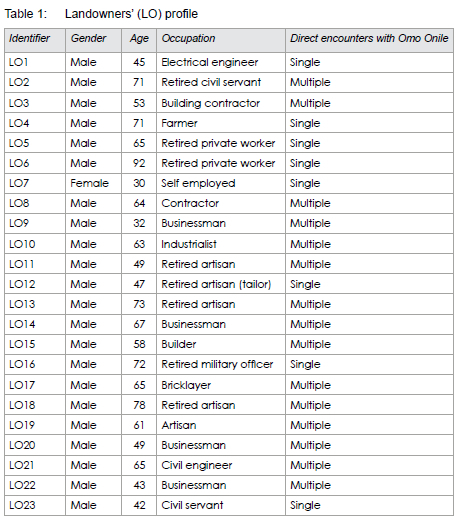
Table 1 presents the study interviewed 23 landowners (LO) with direct experience of Omo Onile practices during construction activities. The vast majority of the participants were male, with only one female (LO7), and ages ranged from 30 to 92 years. Most of the participants were aged 60 and above, reflecting the extensive experience of older landowners in land and construction matters in Lagos. Participants represented a mix of occupational backgrounds. A significant proportion were retired or engaged in skilled trades, including artisans, builders, and contractors, while others were retired civil servants, private sector workers, or military personnel. A smaller number were actively engaged in business, self-employment, or engineering-related professions. Overall, the group reflected a blend of formal and informal sector experience, skewed towards older males with semi-skilled or skilled occupational histories.
All participants had direct encounters with Omo Onile during construction projects. Eight participants reported single incidents, while fifteen experienced multiple encounters over several years, providing both historical and contemporary perspectives on the group's operations and impacts. This combination of demographic diversity, occupational experience, and extensive engagement with construction activities positioned the participants to provide rich and credible insights into Omo Onile practices, their characteristics, operational methods, and effects on land development in Lagos.
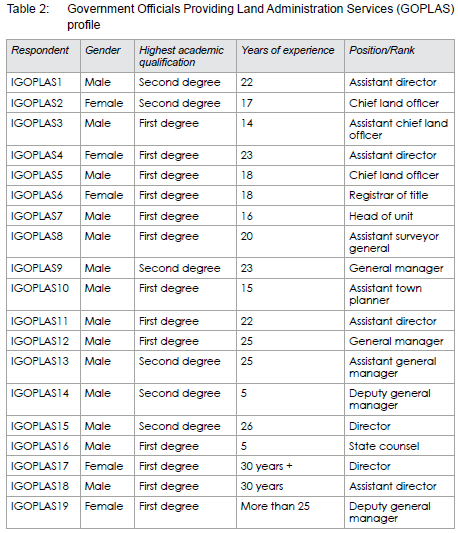
Table 2 shows that GOPLAS participants comprised 19 professionals with diverse but predominantly senior roles within the land administration sector. The group included 13 males and 6 females, reflecting a reasonably balanced gender representation in a traditionally male-dominated field. Most of the respondents hold at least a first-degree qualification, with several possessing second degrees, indicating a generally high level of academic attainment. Their years of experience ranged widely from 5 to over 30 years, with the majority having more than a decade of service.
This extensive experience is complemented by the seniority of their positions, which include directors, general managers, assistant directors, chief land officers, and other key leadership and specialist roles such as assistant surveyor general and state counsel. Collectively, this profile demonstrates that the participants have significant expertise and institutional knowledge in land administration. Given their qualifications, depth of experience, and leadership roles, these officials are well-equipped to provide informed and credible insights into the operations of construction mafias, including the challenges and dynamics involved in illegal construction and land-related corruption. Therefore, the GOPLAS respondents are valid and reliable sources for reporting on issues related to the Omo Onile within the land administration context.
4.2 Thematic analysis of results
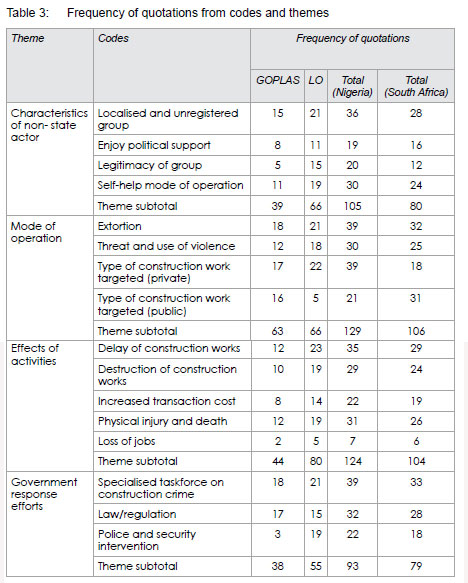
Four major themes emerged from the analysis of the semi-structured key informant interviews and secondary data. Table 3 presents the frequency of quotations associated with each theme and their underlying codes. Overall, a total of 105 and 80 quotations were extracted under the theme "Characteristics of non-state actors" for Nigeria and South Africa, respectively. For "Mode of operation", 129 quotations were recorded for Nigeria and 126 for South Africa. The "Effects of activities" theme yielded 124 quotations for Nigeria and 104 for South Africa. The theme "Government response efforts" included 93 quotations for Nigeria and 79 for South Africa. These frequencies reflect the prominence of each theme in the dataset and highlight the areas of greatest concern.
This thematic overview provides a structured understanding of the patterns emerging from both primary and secondary sources, offering insights into the similarities and differences in non-state actor activities across the two countries.
4.2.1 Characteristics of Nigerian Omo Onile and South African construction mafia
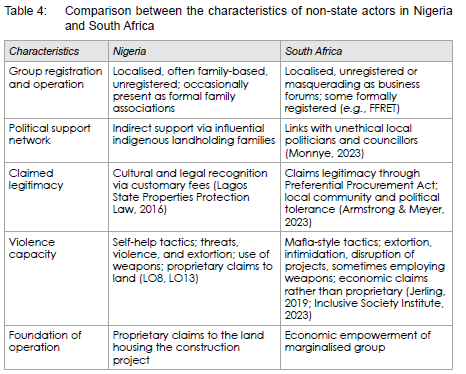
The results indicate that characteristics of non-state actors are widely reported in both Nigeria and South Africa (see Table 3), reflecting the complex and entrenched nature of informal construction practices. In Table 4, the key characteristics include group registration and operation, political support network, claimed legitimacy, violence capacity and foundation of operation.
The Omo Onile operates as localised, unregistered groups without formal legal status. As one government official noted: "The issue of land encroachment by Omo Onile is a serious problem which we battle on a continual basis" (IGOPLAS19). The construction mafia is a non-family-based group which can either be unregistered or registered under formal organisation structure in form of a business forum or non-profit organisation (Inclusive Society Institute, 2023).
Political support network: Both groups enjoy varying degrees of political support that provides them with protection and legitimacy. This support enables their continued operations, despite government efforts to curb their activities. In the case of the construction mafia, Monnye (2023) notes the following:
[...] the construction mafia appears to have links to and is being perpetuated by unethical ward councillors, members of mayoral committees, chief whips, and even executive mayors for the purpose of self-enrichment [...] (Monnye, 2023)
The Omo Onile group also enjoys some form of local political support, because of their relationship with the local aborigine landholding families that have an influence on the political power in their locality.
Both the Omo Onile and the construction mafia enjoy a degree of legitimacy in their respective contexts. In Nigeria, the Omo Onile benefit from both social and legal recognition. Culturally, within the Yoruba tradition, the payment of customary fees for land possession is considered acceptable and even expected (Olapade & Aluko, 2023). Legally, this practice is reinforced by Section 11 of the Lagos State Properties Protection Law of 2016, which states, inter alia, the following:
"A person shall not, whether for himself or acting as an agent demand for any fee or levy in respect of construction activities on ~ any property, disrupt or obstruct construction works provided that the provision of this Section shall not be interpreted to preclude land owning families under the authorization of the family head to demand for the customary fee for possession (in the name of foundation levy) from buyers, or ratification fee pursuant to judgment of a court of competent jurisdiction" (Lagos State Properties Protection Law, 2016).
Similarly, in South Africa, the construction mafia claims legitimacy through the framework established by the Preferential Procurement Policy Framework Act 5 of 2000 and its subsequent regulations. These regulations allow government agencies to mandate that a portion of large contracts -those exceeding 30 million Rand - be allocated to businesses owned by designated groups such as Black- or women-owned enterprises (Armstrong & Meyer, 2023; Nene-Matlou, 2024). Beyond this formal framework, the group also derives a degree of legitimacy from local communities, where they recruit members to disrupt construction activities. They are often supported or tolerated by local politicians and sometimes enjoy sympathy - or at least inaction - from law-enforcement agencies. As Armstrong and Meyer (2023: 192) succinctly state:
The perpetrators gain sympathy from police, policymakers and political role-players by hiding their criminal enterprise behind a job creation and radical transformation narrative
It is important to note that the social legitimacy, which these two groups enjoy, makes it difficult to categorise them outright as criminal gangs.
Both groups demonstrate willingness and capacity to use violence to achieve their objectives, including intimidation, vandalism, arson, and assault. Jerling (2019) draws a comparison between construction mafias and the Al Capone-era mafias, noting how both systems impose 'taxes' on businesses in exchange for protection, often enforced through intimidation or violence. Jerling (2019) describes their modus operandi as follows:
[...] they threaten the main contractor on a project with project closure and death or bodily harm to site management if work is not allocated to their members with a lucrative cut to the forum. This sounds a lot like Al Capone and his mafia buddies visiting the corner butchery every month for protection money. In extreme cases site agents are approached by these thugs, an AK47 bullet is placed on the desk.
The operation of the Omo Onile follows a similar method, where they employ a self-help approach often involving the use of dangerous weapons to enforce their nefarious activities. One of the respondents commented as follows:
The Omo Onile attacked our site with dangerous weapons and forced the workers on site to stop work until we make payment to them [...] (LO8).
It is important to note that the use of self-help methods and mafia-style operations is illegal and constitutes criminal activity in both countries.
The Omo Onile group typically bases their actions on proprietary claims to the land, which stem from family customary rights. For example, their claims arise from interests derived through ancestral ownership, although these claims can often be unfounded. Agboola et al. (2017) attribute such claims by the Omo Onile to dysfunctions within Nigeria's land policy framework, particularly the Land Use Act of 1978. In contrast, the construction mafia do not assert proprietary rights over land; rather, they base their activities on economic empowerment and exploitation of marginalised groups.
4.2.2 Operational methods
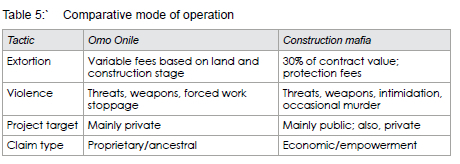
As highlighted in Table 5, both groups employ similar operational tactics.
Both groups demand payments from construction projects, typically ranging from specific amounts to percentages of project values. In South Africa, demands often reach 30% of contract values (Armstrong & Meyer, 2023).
[...] using the threat of violence, damage to property, assault or unrest unless the victim gives "something", usually money, property, contracts or employment ... to take from another some patrimonial or non-patrimonial advantage by intentionally and unlawfully subjecting that person to pressure which induces him or her to submit to the taking [...] (Armstrong & Meyer, 2023).
One of the participants in Nigeria commented on the extortion practices of the Omo Onile as follows:
When I started construction work on my site, the Omo Onile came to stop the workers on site and demand that I pay money for foundation when I have fully paid for the land and obtain building approval from the government [...] (LO13).
Similarly, the South African Police Services (SAPS), as reported by The Inclusive Society Institute (2023), describes the activities of the construction mafia as follows:
[...] threatening projects with violence and heavy weaponry, demanding a share without genuine interest in the job itself. Their criminal activities extend to terrorising, intimidating, assaulting, and in some cases, even killing employees or managers on site [...] (The Inclusive Society Institute, 2023).
Both groups use intimidation and actual violence to enforce their demands. As one landowner in Nigeria described:
The Omo Onile attacked our site with dangerous weapons and forced the workers on site to stop work until we make payment to them [...] (LO8).
Both groups target both private and public construction projects, though with different preferences and approaches. The construction mafia typically targets public sector projects, particularly infrastructure developments; however, as noted by Theessan (2023), they also extend their activities to private sector construction works for purposes of extortion. This may stem either from a lack of awareness that the Preferential Procurement Policy Framework Act applies solely to public projects or from a deliberate intention to exploit the broader society. Theessan (2023) further commented as follows:
One of the areas of misunderstanding which has been exploited by the construction mafias is a widespread misconception of the difference between government and private sector procurement (Theessan, 2023)
The Omo Onile primarily targets private sector projects, focusing mainly on building construction. However, they occasionally extend their activities to land owned by the government. Some of the informants from GOPLAS commented as follow:
The issue of land encroachment by Omo Onile is a serious problem which we battle on a continual basis [...] (IGOPLAS 5)
[...] More than 50 percent of our Site and Service schemes have been encroached by Omo Onile and they are disturbing the legal allottee [...] (IGOPLAS 1)
Both groups often demand that specific individuals affiliated with them be recruited to work on construction sites. For instance, The Inclusive Society Institute (2023) note that construction mafias usually demand employment and contract opportunities for their members, despite lacking the necessary qualifications.
4.2.3 Effects and impacts
The activities of both groups have similar negative impacts on the economic, social, and safety aspects in the construction sector.
Projects experience significant delays, due to work stoppages and disruptions. As highlighted by Lobola (2024), when construction sites are invaded, contractors are compelled to halt operations and construction work, leading to project delays. These interruptions contribute to cost overruns, due to factors such as contract penalties, rising labour costs, and inflation-driven increases in material prices. One interview respondent described the effect of such delays:
[...] just as we were about to begin the concrete work, our site was attacked by Omo Onile. The workers were chased away, and the concrete aggregate mixture was left to waste [...] (LO1).
Both groups engage in destruction of construction work and equipment to enforce their demands. The Inclusive Society Institute (2023) note that when construction mafias attack a construction site, they sometimes destroy ongoing construction work, construction equipment, and the project itself (The Inclusive Society Institute, 2023). For instance, Olapade (2023) reports the case of where Omo Onile and their accomplices destroyed over 400 properties including those under construction in Lagos, Nigeria.
Increased transaction costs and project expenses result from extortion payments and disruptions. These costs often arise from the need to implement heightened security measures to protect workers, materials, and equipment (Lobola, 2024; Armstrong & Meyer, 2023). In addition, developers may be compelled to make unofficial payments or meet extortion demands from these groups, either before commencing work or as the project progresses. Such disruptions and additional expenses contribute to inflated overall transaction costs, undermining project efficiency and sustainability. For instance, one of the respondents commented as follow:
[...] we have to pay some security personnel to dislodge the Omo Onile out of our site and secure the site in order to allow construction to continue [...] (LO7).
Physical violence: Both phenomena involve incidents of physical injury and death related to conflicts over construction projects. Pocock (2018) notes that:
[...] Gauteng are engulfed in wave after wave of illegal protest action, often marred by violence, physical harm and the destruction of property [...].
The interview sample also confirmed that activities of Omo Onile sometimes result in violence leading to injury and death.
[...] One person was gunned down when Omo Onile attacked us with dangerous weapons [...] (LO 3).
The activities of both groups negatively affect investor confidence and construction sector performance. Investors are often reluctant to commit funds to projects that may be exposed to extortion, violence, or operational disruptions. Lobola (2024) notes that the presence of the construction mafia has had a detrimental impact on investor sentiment in South Africa's real-estate sector. Similarly, Mfebe (2019) reports that ongoing intimidation and insecurity have driven hundreds of experts and skilled technical personnel to leave the South African construction industry, citing safety concerns and the lack of stable work opportunities. A comparable situation exists in Lagos, Nigeria, where investors are increasingly hesitant to invest in land within the informal sector, due to the persistent threats and interference posed by non-state actors.
5. DISCUSSION
The comparative analysis reveals significant parallels in the characteristics, operations, and impacts of Nigeria's Omo Onile groups and South Africa's construction mafias, despite their distinct historical and cultural contexts. Both sets of actors operate as non-state entities that claim legitimacy through community representation, albeit drawing upon different sources of authority. In Nigeria, legitimacy is rooted in customary land tenure and ancestral claims (Olapade, 2023), while in South Africa, it is framed around narratives of economic marginalisation and exclusion from postapartheid development opportunities (Armstrong & Meyer, 2023). These legitimacy claims highlight the dual nature of these groups: they exploit genuine community grievances, while simultaneously advancing criminal objectives. From a theoretical perspective, this aligns with institutional mimicry (DiMaggio & Powell, 1983), demonstrating how non-state actors emulate formal governance structures to navigate between legality and social acceptance. Practically, this indicates that policy interventions must address not only criminal behaviour, but also the underlying social and economic vulnerabilities that confer legitimacy.
From an organisation perspective, both groups exhibit structures that enable territorial control and operational adaptability. Omo Onile networks tend to be family-based and linked to traditional authority systems (Odunfa, Agboola & Oladokun, 2019), whereas construction mafias often form around business forums with elected leadership and semi-formal governance mechanisms (Inclusive Society Institute, 2023). These divergent organisational forms reflect the differing sociopolitical contexts from which they emerge, yet they share a common ability to mobilise collective power and negotiate influence within the construction sector. The findings support the criminal network theory (Varese, 2011), which explains how such groups sustain operational resilience and territorial dominance through strategic use of violence, intimidation, and community co-optation. Policy-wise, these insights suggest that strategies narrowly focused on policing and prosecution are insufficient; interventions must also strengthen institutional capacity and support legitimate avenues for community participation in development processes.
From an operation perspective, both groups employ similar methods centred on extortion, intimidation, coercion, and the deliberate disruption of construction projects. Their targeting of both public and private projects, particularly those of high financial value, demonstrates calculated strategic decision-making aimed at maximising returns, while minimising exposure to enforcement risks. The demand for percentage-based payments and protection fees indicates an advanced understanding of project financing and profit structures within the industry (Inclusive Society Institute, 2023). Moreover, both groups sustain their operations, by presenting themselves as defenders of community interests, maintaining a façade of legitimacy that secures a degree of local support, while concealing criminal motives.
The impacts of these groups on the construction sector are profound and multifaceted. Economically, they contribute to project cost escalation, delays, and increased transaction costs, which, in turn, erode investor confidence and dampen sectoral growth. In South Africa, the cumulative financial losses attributed to construction mafia activity amount to billions of dollars (Inclusive Society Institute, 2023), while in Nigeria, the pervasive influence of Omo Onile networks similarly inflates project costs and undermines productivity (Oyalowo, Nubi & Otegbulu, 2020). Socially, these activities exacerbate violence around construction sites, deepen community divisions, and weaken trust in both public institutions and legitimate development actors. These outcomes align with conflict theory (Collier & Hoeffier, 2004), which posits that competition over scarce economic resources drives the emergence of groups that extract rents and assert territorial dominance. From a policy perspective, addressing these impacts requires interventions that go beyond enforcement to include inclusive governance, economic empowerment, and community engagement.
The comparative evidence also suggests the potential for cross-country policy learning. Despite differing historical and sociopolitical contexts, the similarities in organisational forms, operational methods, and legitimacy claims indicate that successful interventions in one setting could be adapted to the other, provided contextual nuances are carefully considered. Ultimately, addressing the challenge posed by both Omo Onile and construction mafias demands a dual policy approach: recognising genuine community grievances, while decisively confronting criminal exploitation through legal reform, institutional strengthening, and socio-economic development with sustained community engagement.
6. CONCLUSION AND RECOMMENDATIONS
The disruption of construction works by non-state actors presents critical challenges to the construction sectors of Nigeria and South Africa. This study showed how Omo Onile groups and construction mafias, although distinct in historical origins, share striking similarities in their structures, operations, and socio-economic impacts. Both operate as hybrid entities that exploit governance weaknesses, while claiming community legitimacy. Their activities inflate project costs, deter investment, and undermine the developmental goals of the construction sector. While these similarities reveal shared structural drivers such as weak institutions, economic exclusion, and governance deficits, contextual differences necessitate tailored policy responses. Addressing these challenges requires a combination of immediate security measures and long-term structural reforms.
6.1 Recommendations for policymakers
Strengthening the legal and institutional framework is essential for addressing land-related issues effectively. In Nigeria, the Lagos State Property Protection Law (2016) and the Office of the Special Task Force on Land Grabbing have made notable progress, resolving over 4,283 cases and prosecuting 205 suspects (Lagos State, 2025). These initiatives should be institutionalised and adequately resourced to ensure long-term effectiveness. A similar approach in South Africa, with legislative reforms and specialised provincial task forces, could help close enforcement gaps and improve land protection. A comprehensive legal framework is needed to clearly define criminal behaviour and integrate community participation in land management. Strengthening land administration, oversight, and law enforcement is crucial to reduce exploitation and improve service delivery. In addition, coordinated efforts among law enforcement, economic development agencies, and community organisations are necessary to address both criminal activities and the socio-economic factors contributing to land disputes. Government institutions must be empowered to enforce existing laws impartially, especially concerning Omo Onile cases. The Lagos State Property Protection Law should be rigorously applied, with offenders facing appropriate legal consequences. The Office of the Special Task Force should be adequately resourced to operate effectively and safeguard property rights.
6.2 Recommendations for the construction industry
Construction firms should adopt proactive strategies that integrate rigorous risk assessment with structured community engagement. Early collaboration with local leaders, youth groups, and community-based organisations can build trust, secure a social licence to operate, and reduce vulnerability to criminal extortion. Where threats are acute, professional security arrangements may offer temporary protection if incorporated into project planning and budgets.
Comprehensive risk assessment frameworks should identify potential non-state actor threats before project commencement and guide appropriate mitigation measures. Engagement protocols must address legitimate community concerns such as employment and inclusion, while maintaining firm boundaries against unlawful demands. Industry-wide cooperation is also essential: sharing information and developing standard responses to extortion attempts can strengthen collective resilience and safety.
Legally, contractors facing disruption should pursue judicial remedies. In South Africa, this may include court injunctions or invoking force majeure clauses to obtain extensions, compensation, or contract termination. As Meijers (2004) notes, such actions require detailed documentation of incidents, proof of engagement efforts, and formal reporting to the South African Police Service. Contractors must also ensure that court orders are properly enforced to restore lawful operations.
In high-risk areas, employing private security services can provide short-term protection for personnel and assets. Although costly and often unsustainable without contractual provision, this measure may be necessary during sensitive project phases.
6.3 Recommendations for community leaders
Community leaders play a critical role in shaping how local communities engage with construction projects. They should ensure that community organisations effectively represent local interests in construction projects without resorting to criminal activities. Representation should be legitimate, accountable, and grounded in collective rather than individual interests.
Rejecting coercion, intimidation, and unlawful disruption as tools of negotiation is essential to building constructive relationships with contractors and public authorities. Transparent leadership can support trust, attract investment, and ensure that community participation contributes to development rather than conflict.
Promoting skills development and alternative livelihoods is equally important. By encouraging youth training programmes, local entrepreneurship, and partnerships with construction firms for apprenticeships or subcontracting, leaders can create pathways for lawful income generation. This reduces the appeal of extortion and other illicit activities often linked to economic marginalisation.
Finally, community-based conflict-resolution mechanisms should be established to manage project-related disputes early and fairly. These mechanisms - ideally comprising respected elders, civil society representatives, and local authorities - can provide platforms for dialogue before tensions escalate into violence or project disruption. By institutionalising peaceful problem-solving, communities can strengthen social cohesion and enhance their credibility as reliable development partners.
6.4 Recommendations for international development partners
International development partners can play a pivotal role in supporting local and national efforts to manage construction-related risks and community engagement challenges. They should prioritise initiatives that strengthen institutional capacity, enhance law enforcement effectiveness, and improve community development frameworks. By providing targeted technical assistance, development partners can help address the structural and systemic factors that contribute to project disruption and illicit activity.
Facilitating the exchange of best practices between countries facing similar challenges is another critical role. Comparative learning allows stakeholders to adapt successful intervention strategies to local contexts, while avoiding approaches that may be ineffective or culturally inappropriate.
Supporting rigorous, evidence-based research is equally important. Funding comparative and empirical studies can provide policymakers, practitioners, and communities with actionable insights, guide intervention design, and inform sustainable strategies and policies. By combining capacity-building, knowledge exchange, and research support, development partners can contribute to safer, more inclusive, and resilient construction project environments.
6.5 Recommendations for law enforcement
Law enforcement agencies should establish specialised units focused on construction-related organised crime, equipped with the resources and authority needed for effective intervention. Enhanced intelligence-sharing and inter-agency coordination are essential for tracking criminal networks across jurisdictions and project sites.
Building trust with industry stakeholders and local communities is equally important. Transparent policing and witness protection encourage reporting and cooperation. Early engagement between contractors and community representatives can secure a social licence to operate, reduce susceptibility to criminal manipulation, and minimise project disruption.
In high-risk areas, private security services may provide short-term protection for workers, equipment, and materials. While costly and not always sustainable without contractual provision, these measures can safeguard safety and project continuity during critical phases.
6.6 Addressing socio-economic drivers
Long-term sustainability in the construction sector depends on addressing the socio-economic conditions that fuel criminal mobilisation. High unemployment, economic inequality, and systemic poverty create fertile ground for such activity, particularly in urbanising areas. Inclusive economic policies, targeted job creation, and equitable access to opportunities are essential to reduce participation in illicit networks. In South Africa, addressing historical inequalities, workplace discrimination, and ensuring racially inclusive participation in the construction industry are central to mitigating the structural roots of violence and extortion.
Ultimately, mitigating non-state actor disruptions requires an integrated, multi-scalar strategy that combines legal reform, institutional capacity-building, and inclusive economic development. Coordinated, context-sensitive interventions are necessary to create secure, resilient, and enabling environments for sustainable construction and urban growth in Nigeria and South Africa.
7. STUDY LIMITATION AND FUTURE RESEARCH DIRECTIONS
While this study is the first to compare the phenomenon of non-state actors in Nigeria and South Africa, it acknowledges several important limitations. First, the asymmetric data-collection approach, using primary data from Nigeria and secondary data from South Africa, limits direct comparability of findings. Future research should validate these findings through primary data collection from South African stakeholders. Secondly, the geographical focus on Lagos State for Nigeria limits generalisability to other Nigerian contexts. Thirdly, the study's exploratory nature requires further validation through more comprehensive comparative research. Fourthly, safety constraints prevented direct engagement with construction mafia members, limiting understanding of their perspectives and motivations.
Future research should prioritise collecting primary data from South African construction industry stakeholders to validate and expand these preliminary findings. Longitudinal studies examining the evolution of both phenomena over time would provide valuable insights into their adaptation strategies and policy response effectiveness. Research examining successful intervention strategies and their transferability across contexts would inform more effective policy development. Studies investigating the economic quantification of impacts in both countries would support evidence-based policymaking.
REFERENCES
ACKNOWLEDGEMENT
The authors acknowledge funding from Tshwane University of Technology and thank the editorial team for their valuable input.
2. LITERATURE REVIEW
-
Adams, R.J., Smart, P. & Huff, A.S. 2017. Guidelines for working with the grey literature in systematic reviews for management and organizational studies. International Journal of Management Reviews, 19(4), pp. 432-454. https://doi.org/10.1111/ijmr.12102
» https://doi.org/10.1111/ijmr.12102 -
Adebowale, O.J. & Agumba, J.N. 2024. A systematic review of challenges undermining the efficacy of construction health and safety regulations in major African countries. Construction Economics and Building, 24(4/5), pp. 1-24. https://doi.org/10.5130/AJCEB.v24i4/5.9059
» https://doi.org/10.5130/AJCEB.v24i4/5.9059 -
Aderounmi, Z. 2024. Here are 10 highest contributing sectors to Nigeria's GDP in Q2. Business Day. https://businessday.ng [Accessed: 12 February 2025].
» https://businessday.ng - Agboola, A. 2015. Mixed-method research design: A qualitative research approach in social sciences. International Journal of Social Science Research, 3(2), pp. 67-82.
-
Agboola, A., Scofield, D. & Amidu, A. 2017. Understanding property market operations from a dual institutional perspective: The case of Lagos Nigeria. Land Use Policy, 68, pp. 89-96. https://doi.org/10.1016/j.landusepol.2017.07.047
» https://doi.org/10.1016/j.landusepol.2017.07.047 -
Akinyele, R.T. 2009. Contesting for space in an urban centre: The Omo Onile syndrome in Lagos. In: Locatelli, F. & Nugent, P. (Eds). African cities: Competing claims on urban spaces. Hotei Publishing, The Netherlands, pp. 81-108. https://doi.org/10.1163/ej.9789004162648.i-308.34
» https://doi.org/10.1163/ej.9789004162648.i-308.34 -
Armstrong, T. & Meyer, J. 2023. Illicit business forums in South Africa: A survey. Journal of Anti-Corruption Law, 6, pp. 192-236. https://doi.org/10.14426/jacl.v6i.1345
» https://doi.org/10.14426/jacl.v6i.1345 -
Blakeley, G. 2010. Governing ourselves: Citizen participation and governance in Barcelona and Manchester. International Journal of Urban and Regional Research, 34(1), pp. 130-145. https://doi.org/10.1111/j.1468-2427.2010.00953.x
» https://doi.org/10.1111/j.1468-2427.2010.00953.x -
Bowen, G.A. 2009. Document analysis as a qualitative research method. Qualitative Research Journal, 9(2), pp. 27-40. https://doi.org/10.3316/QRJ0902027
» https://doi.org/10.3316/QRJ0902027 - Braun, V. & Clarke, V. 2021. Thematic analysis: A practical guide. Londen, UK: Sage.
- Buchanan, R., Boddy, C.R. & McCalman, J. 2014. Engagement and interaction in strategic management research methodology. International Journal of Management and Decision Making, 13(3), pp. 287-308.
-
Collier, P. & Hoeffler, A. 2004. Greed and grievance in civil war. Oxford Economic Papers, 56(4), pp. 563-595. https://doi.org/10.1093/oep/gpf064
» https://doi.org/10.1093/oep/gpf064 - Corden, A. & Sainsbury, R. 2006. Using verbatim quotations in reporting qualitative social research: Researchers' views. University of York, Social Policy Research Unit.
- Creswell, J.W. 2013. Research design: Qualitative, quantitative, and mixed methods approaches. 4th edition. Thousand Oaks, CA: Sage Publications.
-
DiMaggio, P.J. & Powell, W.W. 1983. The iron cage revisited: Institutional isomorphism and collective rationality in organizational fields. American Sociological Review, 48(2), pp. 147-160. https://doi.org/10.2307/2095101
» https://doi.org/10.2307/2095101 -
Durand-Lasserve, A., Durand-Lasserve, M. & Selod, H. 2015. Land delivery systems in West African cities. The example of Bomako, Mali. Africa Development Forum series. Washington, DC: World Bank. https://doi.org/10.1596/978-1-44618-0433-5
» https://doi.org/10.1596/978-1-44618-0433-5 - Geldenhuys, K. 2024. Procurement mafias affecting all sectors. Servamus, 117(7), pp. 36-39.
-
Hofmann, C. & Schneckener, U. 2021. Non-state armed actors and the politics of legitimacy. International Relations, 35(3), pp. 409-431. https://doi.org/10.1177/0047117820962942
» https://doi.org/10.1177/0047117820962942 -
Inclusive Society Institute. 2023. Overview of the construction mafia crisis in South Africa. ISI Research Report. Inclusivesociety.org.za [Accessed: 2 February 2025].
» Inclusivesociety.org.za - Jerling, W. 2019. Construction - An ecosystem in crisis. Civil Engineering Magazine, 27(4), pp. 4-7.
-
Lagos State Ministry of Justice. 2025. Lagos State Government sets up task force to tackle land grabbers. Lagosstatemoj.org [Accessed: 19 February 2025].
» Lagosstatemoj.org -
Lingard, L. & Watling, C. 2021. Story, not study: 30 Brief lessons to inspire health researchers as writers. In: Effective use of quotes In qualitative research, 19, pp. 35-43. https://doi.org/10.1007/978-3-030-71363-8_6
» https://doi.org/10.1007/978-3-030-71363-8_6 - Lobola, L. 2024. The rise of the construction mafia in South Africa: Impact on developments and the real estate sector. Real Estate Law Alert. 13980/OCT, pp. 1-6.
- Meijers, K. 2020. Force majeure and the construction mafia. Institute of Municipal Engineering of Southern Africa, March, p. 48.
-
Mfebe, W. 2019. Construction industry up in flames: Urgent action required. cdn.ymaws.com [Accessed: 3 November 2024].
» cdn.ymaws.com -
Mlambo, V.H. 2023. Unravelling Africa's misgovernment: How state failures fuel the emergence of violent non-state actors: Selected case studies. Cogent Social Sciences, 9, article 2228127. https://doi.org/10.1080/23311886.2023.2228127
» https://doi.org/10.1080/23311886.2023.2228127 - Monnye, T. 2023. Suggestions for dealing with the construction mafia. Civil Engineering, 31(6), pp. 44-45.
-
Naderifar M., Goli, H. & Ghaljaie, F. 2017. Snowball sampling: A purposeful method of sampling in qualitative research. Strides in Development of Medical Education, 14(3), article 67670. https://doi.org/10.5812/sdme.67670
» https://doi.org/10.5812/sdme.67670 -
Nene-Matlou, T. 2024. Construction mafias in South Africa: Contain the terror before it spreads. Africaconstructionlaw.org [Accessed: 2 March 2024].
» Africaconstructionlaw.org - Odunfa, V.O., Agboola, A. & Oladokun, T.T. 2019. Factors influencing the activities of Omo Onile in Ibeju Lekki land market, Lagos, Nigeria. In: Babalole et al., (Eds). Drivers and dynamics of change in the built environment. Proceedings of EDMIC 2019 Conference, 20-22 May, Ile-Ife, Nigeria, pp. 267-277.
-
Olapade, D.T. 2023. Access to land and violent land conflict in West Africa: The case of Lagos. IPSS Policy Brief, 17(4/Oct), pp. 1-19. Ipss-addis.org [Accessed: 1 April 2024].
» Ipss-addis.org -
Olapade, D.T. & Aluko, B.T. 2023. Tenure insecurity in informal land delivery system of Lagos State, Nigeria: Causes and manifestations. Urban Forum, 34(1), pp. 31-52. https://doi.org/10.1007/s12132-022-09463-x
» https://doi.org/10.1007/s12132-022-09463-x -
Olapade, D.T. & Aluko, B.T. 2025. Nature and outcomes of collaborative governance in land delivery: The case of Lagos, Nigeria. African Journal on Land Policy and Geospatial Sciences, 8(2), pp. 385-402. https://doi.org/10.48346/IMIST.PRSM/ajlp-gs.v8i2.51665
» https://doi.org/10.48346/IMIST.PRSM/ajlp-gs.v8i2.51665 - Oyalowo, B., Nubi, T. & Otegbulu, C. 2020. The Omo-Onile issue is scary: Narratives of the struggles of co-operative societies in Land Assembly in Peri-Urban Lagos. Chapter 3. In: Akinyele, R. (Ed.). Land and development in Lagos. Lagos: University of Lagos Centre for Housing and Sustainable Development, pp. 65-93.
-
Oyalowo, B.A., Agboola, A.O. & Adeleye, O.A. 2021. Urban land conflicts and housing delivery in Lagos Nigeria. Cities, 108, 102974. https://doi.org/10.1016/j.cities.2020.102974
» https://doi.org/10.1016/j.cities.2020.102974 -
Palinkas, L.A., Horwitz, S.M., Green, C.A., Wisdom, J.P., Duan, N. & Hoagwood, K. 2015. Purposeful sampling for qualitative data collection and analysis in mixed method implementation research. Administration and Policy in Mental Health and Mental Health Services Research, 42(5), pp. 533-544. https://doi.org/10.1007/s10488-013-0528-y
» https://doi.org/10.1007/s10488-013-0528-y - Patton, M.Q. 2015. Qualitative research and evaluation methods. 4'h edition. London, UK: Sage Publications.
- Pocock, W. 2018. The construction mafia: How to deal with revolting protestors. Without Prejudice, 18(8), pp. 6-7.
-
Risse, T. 2011. Governance without a state?: Policies and politics in areas of limited statehood. New York: Columbia University Press. https://doi.org/10.1093/oxfordhb/9780199560530.013.0049
» https://doi.org/10.1093/oxfordhb/9780199560530.013.0049 - Shaw, M. 2022. SA: Origins of the mafia state-political transition, organized crime and the impact on democracy. In: Allum, F. & Gilmour, S. (Eds). Handbook of organized crime and politics. Cheltenham/Northampton: Edward Elgar Publishing, pp. 321-332.
-
Stats SA (South Africa Department of Statistics). 2024. Statistical release: Gross domestic product, Second Quarter. Statssa.gov.za [Accessed: 3 February 2025].
» Statssa.gov.za - Stewart, F. 2008. Horizontal inequalities and conflict: Understanding group violence in multi-ethnic societies. London: Palgrave Macmillan.
- Theessen, T. 2023. Dealing with SA's construction mafia - Remedies and prevention. Civil Engineering, 38(8), pp. 16-17.
- The Inclusive Society Institute, 2023. Overview of the construction mafia crisis in South Africa. Cape Town: Inclusive Society Institute.
-
Thorne, S. 2024. Construction mafia here to stay in South Africa - Be prepared. Businesstech.co.za [Accessed: 2 June 2024].
» Businesstech.co.za -
Tong, A., Sainsbury, P. & Craig, J. 2007. Consolidated criteria for reporting qualitative research (COREQ): A 32-item checklist for interviews and focus groups. International Journal for Quality in Health Care, 19(6), pp. 349-357. https://doi.org/10.1093/intqhc/mzm042
» https://doi.org/10.1093/intqhc/mzm042 - Umezulike, E.O. 2004. Land-tenure system and sustainable development in Nigeria. In: Proceedings of the FIG Working Week, 23-24 May, Athens, Greece, pp. 22-27
-
Varese, F. 2011. Mafias on the move: How organized crime conquers new territories. Oxford, UK: Princeton University Press. https://doi.org/10.23943/princeton/9780691128559.001.0001
» https://doi.org/10.23943/princeton/9780691128559.001.0001 -
Watermeyer, R. & Phillips, S. 2020. Public infrastructure delivery and construction sector dynamism in the South African economy. NPC's Economy Series. nationalplanningcommission.org.za [Accessed: 4 June 2024].
» nationalplanningcommission.org.za
Peer reviewed and revised: October 2025
Published: December 2025