Integrating multi-objective optimisation and life-cycle assessment in early-stage building design
Abstract
The built environment is responsible for roughly 40% of global carbon emissions, compelling the need for targeted strategies that address impacts across the building life cycle. Early-stage building design still lacks integrated optimisation frameworks that quantify how material choices and envelope configurations influence life-cycle emissions and thermal comfort. This gap is critical in tropical climates, where the interaction between thermal mass, envelope performance, and operational loads is complex. Each stage of a building's life cycle generates different carbon profiles. Designers often rely on single-metric assessments, leading to design decisions that appear sustainable but perform poorly across the full life cycle. This study develops a combined multi-objective optimisation (MOO) and life-cycle assessment (LCA) method to evaluate and balance these competing objectives across alternative design scenarios. A DesignBuilder (V6) MOO algorithm was applied to an existing tropical case building constructed with sandcrete blocks. Two optimised substitutes were developed: one combining burnt brick external walls with a clay slate roof, and another with burnt brick external walls with a green roof. Preliminary simulations show that, although material substitution reduced embodied carbon, it increased operational carbon and worsened thermal discomfort. The optimisation processes generated 626 iterations and yielded 57 non-dominated solutions, with Pareto front analyses revealing a complex interplay between design variables and performance outcomes. Subsequent LCA of the buildings using OneClick LCA revealed that horizontal structural elements accounted for up to 89% of embodied carbon in the A1-A3 (materials) stages. While embodied carbon represented 19% of total life-cycle emissions in the case building, operational carbon dominated overall impacts, reaching 87% in the second optimised building. The study concludes that Pareto-based multi-objective optimisation presents a robust framework for navigating conflicting design goals. However, it must be integrated with life-cycle evaluation to identify design interventions that can deliver the greatest environmental and thermal performance gains.
building performance simulation; life cycle carbon assessment; multi-objective optimisation; sustainable building design
Abstract
Die bou-omgewing is verantwoordelik vir ongeveer 40% van globale koolstofvrystellings, daarom die behoefte aan geteikende strategieë wat die impakte oor die gebou se lewensiklus aanspreek. Vroeëstadium-gebouontwerp het steeds nie geïntegreerde optimeringsraamwerke wat kwantifiseer hoe materiaalkeuses en omhulselkonfigurasies lewensiklusvrystellings en termiese gemak beïnvloed nie. Hierdie gaping is krities in tropiese klimate, waar die interaksie tussen termiese massa, omhulselprestasie en operasionele laste kompleks is. Elke stadium van 'n gebou se lewensiklus genereer verskillende koolstofprofiele. Ontwerpers maak dikwels staat op enkelmetriese assesserings, wat lei tot ontwerpbesluite wat volhoubaar lyk, maar swak presteer oor die volle lewensiklus. Hierdie studie ontwikkel 'n gekombineerde multi-doelwit optimering (MOO) en lewensiklusassessering (LCA) metode om hierdie mededingende doelwitte oor alternatiewe ontwerpscenario's te evalueer en te balanseer. 'n DesignBuilder (V6) MOO-algoritme is toegepas op 'n bestaande tropiese gevalgebou wat met sandbetonblokke gebou is. Twee geoptimaliseerde plaasvervangers is ontwikkel: een wat gebrande baksteen-buitemure met 'n klei-leiklipdak kombineer, en 'n ander met gebrande baksteen-buitemure met 'n groen dak. Voorlopige simulasies toon dat, hoewel materiaalvervanging beliggaamde koolstof verminder het, dit operasionele koolstof verhoog het en termiese ongemak vererger het. Die optimeringsprosesse het 626 iterasies gegenereer en 57 nie-gedomineerde oplossings opgelewer, met Pareto-frontontledings wat 'n komplekse wisselwerking tussen ontwerpveranderlikes en prestasie-uitkomste onthul het. Daaropvolgende LCA van die geboue met behulp van OneClick LCA het aan die lig gebring dat horisontale strukturele elemente tot 89% van die beliggaamde koolstof in die A1-A3 (materiaal) stadiums verantwoordelik was. Terwyl beliggaamde koolstof 19% van die totale lewensiklusvrystellings in die gevallestudiegebou verteenwoordig het, het operasionele koolstof die algehele impak oorheers en 87% in die tweede geoptimaliseerde gebou bereik. Die studie kom tot die gevolgtrekking dat Pareto-gebaseerde multi-doelwit optimalisering 'n robuuste raamwerk bied vir die navigasie van botsende ontwerpdoelwitte. Dit moet egter met lewensiklus-evaluering geïntegreer word om ontwerpintervensies te identifiseer wat die grootste omgewingsen termiese prestasiewinste kan lewer.
1. INTRODUCTION
The construction industry accounts for roughly one-third of energy-related carbon emissions worldwide (IEA, 2019; Liang et al., 2023; UNEP, 2023). These emissions are widely driven by operational energy use and the embodied carbon embedded in the materials and construction processes (Ibn-Mohammed et al., 2013; IPCC, 2023). Efforts aimed at decarbonising the industry in line with climate action are advancing. However, despite the role of embodied carbon in greenhouse gas emissions, decarbonisation strategies are widely concentrated on reducing operational carbon in buildings (Hu, 2023; Khan et al., 2022; Röck et al., 2020). As global climate goals tighten to conform with the Paris Agreement, scholarly and industry-wide measures for achieving carbon neutrality across the construction industry are evolving (Al-Obaidy, Courard & Attia, 2022; Too et al., 2022; ECF, 2020). For instance, optimisation techniques have emerged as an integral approach for evaluating complex design trade-offs for carbon reduction in buildings. According to Schwartz, Raslan and Mumovic (2016: 9) and Yu et al. (2015: 8), the multi-objective optimisation (MOO) technique, in particular, permits simultaneous integration of diverse competing design goals, including carbon emission, energy efficiency, indoor comfort, and cost. Its application has shown considerable potential for reducing a building's environmental impact (Bonamente et al., 2018; Gan et al., 2020; Yigit & Ozorhon, 2018).
Material selection at the early stage of a building plays a crucial role towards life-cycle carbon reduction and shapes the building's carbon profile during its operational and deconstruction phases. In tropical climates, where high ambient temperatures increase cooling demand, the choice of low-embodied carbon materials, along with the building's HVAC system, offers clear potential for improving energy efficiency and reducing emissions throughout its life cycle (Ahmed et al., 2021: 8; Huang et al., 2024: 20; Keyhani et al., 2024: 11,12). However, studies exploring life-cycle carbon reduction through early-stage design interventions remain fragmented (Dossche, Boel & De Corte, 2017; Fenner et al., 2018: 9). Currently, early-stage building design practice lacks integrated optimisation frameworks capable of simultaneously addressing thermal comfort and life-cycle carbon emissions. This study develops a MOO-LCA approach to reconcile these competing priorities by integrating life-cycle assessment with Pareto-based MOO techniques to evaluate carbon-comfort trade-offs in a tropical building in Nigeria. The aim is to determine how early-stage material choices can reduce life-cycle environmental impacts without increasing thermal discomfort. Through this integrated framework, the study advances a design decision-support approach for building performance modelling, where conflicting objectives often influence optimisation outcomes.
2.1 Embodied and operational carbon in buildings
In 2021, buildings in the European Union (EU) alone were responsible for nearly 40% of energy use and roughly 35% of greenhouse gas emissions (EC, 2020; EEA, 2023). Compared to the EU, buildings in Africa consume more energy (57%) and contribute significantly to global emissions (32%-75%), marking them as a crucial focus area for advancing environmental sustainability (Melaine, 2023; IEA, 2020). As noted by Akbarnezhad and Xiao (2017: 2), emissions from buildings are divided into embodied carbon (EC) and operational carbon (OC). EC is associated with the extraction, manufacture, transport, and assembly of construction materials, while OC relates to the energy used during a building's life. Influenced by its potential for reducing the carbon footprints of buildings, OC has received far more attention than EC. The focus of OC reduction is through heating, ventilation, and air conditioning (HVAC) systems, insulation, and other energy efficient practices (Pomponi & Moncaster, 2016: 17; Röck et al., 2020: 10). However, evidence suggests that this emphasis alone is no longer adequate to drive carbon neutrality in the built environment. As energy efficiency in buildings becomes more feasible, the share of embodied carbon in total life-cycle emissions continues to intensify, with some regions reporting that EC accounts for more than half of building-sector emissions (Zhu et al., 2020: 13).
When left unaddressed, embodied carbon can negatively impact both the economic and environmental value of buildings. Javaid et al. (2022: 9, 15) assert that EC reduction presents untapped opportunities for cost savings, mainly when combined with efficient construction methods. Yet, balancing operational and embodied carbon often introduces complex design tradeoffs, where operational carbon savings may not be justified by an embodied carbon offset in certain design strategies (Wild, 2022). In regions such as Spain, whole-life carbon assessments of buildings have revealed that, while embodied carbon in a residential apartment accounts for roughly one-third of total emissions, using recycled materials and insulating exterior walls led to reduced life-cycle emissions (Izaola, Akizu-Gardoki & Oregi, 2023: 8).
2.2 Building materials and embodied carbon
Globally, the shift towards low-carbon construction has intensified the incorporation of low-embodied carbon materials into building design (Palomar-Torres et al., 2025: 14). The main contributors to embodied carbon in buildings are the production of carbon-intensive materials such as concrete, cement, steel, bricks, and insulation. According to life-cycle impact studies, the material stage alone accounts for up to 90% of the embodied carbon in buildings (Li et al., 2017). In addition, structural systems such as concrete and steel are found to be the highest emitters, accounting for approximately 36% and 24% of total emissions, respectively (George & Jacob, 2018: 3). From a circularity perspective, the use of low-carbon, reclaimed or recycled material has shown to reduce a building's embodied carbon (Arenas & Shafique, 2024: 1; Carpio & Carrasco, 2021: 11). For instance, substituting concrete with low-carbon alternatives such as fly ash, GGBS-based concrete, and timber composites can significantly cut back embodied carbon (Craft et al., 2024). In a study by Gan et al. (2017: 11), replacing steel with recycled scrap or electric arc furnace steel led to embodied carbon reduction of up to 60%. A study by Paiva et al. (2022) in Brazil shows that bio-based earth mortars mixed with bamboo particles reduced carbon emissions when compared to conventional cement-based mortars.
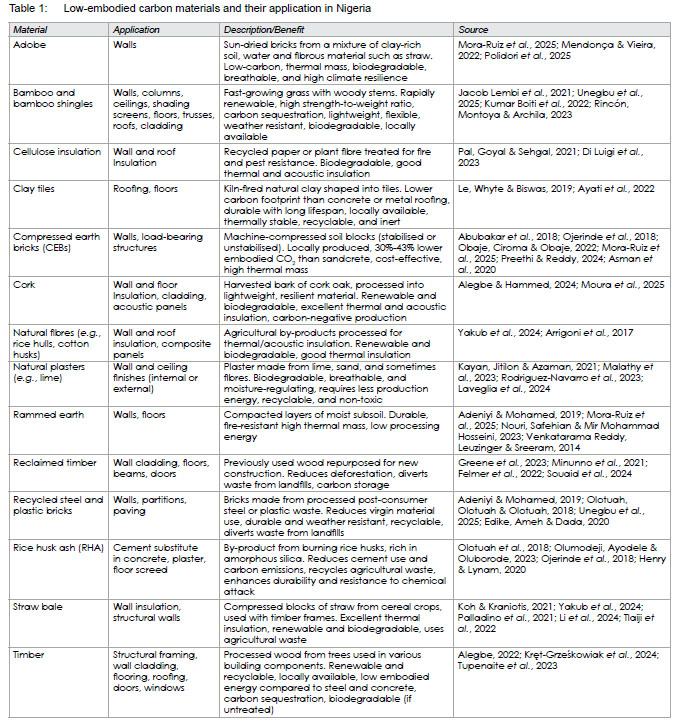
In pilot projects across sub-Saharan Africa, natural materials such as rammed earth and lime-plastered walls have been useful in construction to reduce environmental impact. Table 1 presents a selection of locally sourced materials and their application in the Nigerian context. These materials are recommended for design strategies that combine carbon-saving goals and climate resilience in tropical contexts (Wiik, Fufa & Andresen, 2018). For multi-floor buildings, the use of prefabricated lightweight timber-based and upcycled materials was found to significantly reduce embodied carbon without compromising thermal performance (Mulya et al., 2024). Other strategies adopted in the industry to decarbonise buildings include prioritising adaptive reuse of existing buildings over new construction (Kumari et al., 2020), sourcing materials locally with consideration to the carbon intensity of manufacturing processes (Cheng et al., 2013), and developing national regulatory frameworks and material databases (Gillespie & McIlwaine, 2021: 8). Nonetheless, it is crucial to note that material selection cannot always be driven by carbon concerns alone, as some low-impact materials may possess high 'embodied water' footprints, thus introducing trade-offs that complicate sustainable decision-making (Dixit & Pradeep Kumar, 2022).
2.3 Building form and its role in carbon emissions
Building form and other features such as size, orientation, and window properties play a fundamental role in determining the operational energy efficiency of buildings (Chobanov, 2016; Feng et al., 2024). These parameters occasionally exert conflicting influences on the overall performance of buildings. For instance, studies indicate that the window-to-wall ratio significantly impacts carbon emissions, by regulating heat gain in buildings (Hamida et al., 2022: 19; Troup et al., 2019; Wang et al., 2023), while operational energy, needed to maintain indoor comfort, accounts for the most significant share of life-cycle carbon emissions (Iddon & Firth, 2013: 16; Liang et al., 2023). These challenges occur due to multiple and sometimes conflicting design goals, which can be resolved through optimisation techniques. Optimising buildings from competing objectives to achieve competing design requirements involves understanding the relationships between building elements and their distinct roles in emission reduction. Schwartz et al. (2016: 9) and Seyedzadeh et al. (2018: 2) recommend that early-stage building energy evaluation pertaining to form, material choice, and orientation should be prioritised, as each has the potential to influence emissions independently. The practice of evaluating the carbon influence of a building's physical components, widely regarded as the 'fabric-first approach', has proven to be a valuable strategy for reducing embodied carbon emissions (DesigningBuildings, 2021). An integrated approach by Nazari et al. (2024: 12) further emphasises that both form and fabric of a building must be considered collectively to properly evaluate emission trade-offs.
2.4 Multi-objective optimisation in building performance evaluation
Since 2010, optimisation techniques have been influential in addressing building energy performance challenges, by conveying critical insights into measures for reducing the environmental impact of both new and retrofit buildings (Costa-Carrapiço, Raslan & González, 2020; Dede et al., 2019). Among these methods, the MOO framework stands out as a unique and compelling method because of its capability to evaluate multiple design goals within an optimisation setup (Yu et al., 2015). As noted by Chen, Janssen and Schlueter (2018: 7, 8), the application of MOO techniques is particularly effective in achieving defined optimisation targets in energy-efficient and low-carbon building design. In a study by Tavakolan et al. (2022), the effectiveness of MOO using simulation-based algorithms was demonstrated in finding optimal design configurations that minimise both energy use intensity and carbon emissions. Likewise, Yigit and Ozorhon (2018: 2) used genetic algorithms within an optimisation framework to identify effective design solutions in building performance evaluation. However, emerging research recognises that MOO techniques can be very complex and often rely on the inherent relationship between design parameters in the simulation environment. Despite advancements in computational methods for building optimisation, many designers struggle to identify an approach that balances building systems and design objectives (Alghamdi et al., 2022: 24; Halhoul Merabet et al., 2021: 32; Lu et al., 2024: 16). This gap stems from limited understanding, computational limits, and insufficient training in optimisation modelling. To achieve the most effective parametric optimisation outcomes, Evins (2013: 10-13) suggests that the process must be iterative rather than linear, for accurate and reliable performance outcomes.
2.5 Pareto front optimisation in multi-objective decision making
The application of Pareto-based optimisation methods has gained significant traction in building performance evaluation to address the complexity in MOO and decision-making. Pareto-based MOO is one of the most feasible approaches that enables designers to navigate numerous design objectives with greater clarity and accuracy (Bre, Roman & Fachinotti, 2020; Chen, Tsay & Ni, 2022). As mentioned by Kesireddy and Medrano (2024), the Pareto front represents a set of optimal design solutions where a design objective cannot be improved without compromising another. By implication, every point on the Pareto front is an outcome derived through the compromise of one design objective for another. Moreover, optimal solutions are uniquely represented on the Pareto graph to inform designers of design outcomes; an approach integral in architectural and engineering design processes, where decisions are not governed by a single criterion.
Bre et al. (2020: 6-8) used a metamodel-based optimisation framework, combined with artificial neural networks and NSGA-II algorithm to assess energy performance trade-offs to enable designers visualise Pareto optimal solutions that balance heating and cooling demands. Complemented by a Backpropagation Neural Network, Chen et al. (2022: 388) advanced the framework, by integrating carbon emissions, indoor discomfort hours, and cost to support the identification of design solutions and reducing emissions by over 50% without compromising comfort. Okumura et al. (2023: 8) demonstrate the use of supervised algorithms in resource-constrained environments to refine Pareto fronts for building facility control, emphasising that, with limited data sets, the optimisation process can yield meaningful outcomes. In the context of renovation strategies, Decorte et al. (2020) also used Pareto analysis to compare life-cycle cost, life-cycle assessment, and monetised environmental parameters, revealing a misalignment between financial and environmental goals that are key aspects in growing climate-change pressures. A notable advancement in Pareto-based optimisation is the direct integration of decision-making frameworks into the optimisation process, as illustrated by Kesireddy and Medrano (2024), where non-dominated solutions are ranked according to user-defined objectives.
The reviewed literature highlights the need for an approach that integrates low energy materials, optimised building parameters, and whole-life carbon assessment, in a multi-objective framework to reduce emissions in buildings. Global standards such as PAS2050 and ISO/TS 14067 have pushed the debate on life-cycle carbon assessment forward but the lack of a unified approach to applying these standards across a building's life cycle is limited (Fenner et al., 2018). Navigating the interplay of building materials, form, occupancy, and energy use to evaluate performance-based designs is both time- and resource-intensive. With the urgent imperative to reduce emissions in the global built environment, mainly in expanding regions such as Nigeria, integrating life-cycle carbon analysis with MOO at the design stage is essential for informed decision-making towards decarbonisation, aligning with the UN's Sustainable Development Goal 13 (Climate Action). As emphasised by Al-Obaidy et al. (2022), the built environment must undergo a profound transformation to meet the ambitious 2050 carbon-neutrality targets.
3. MATERIALS AND METHODS
3.1 Research design
This study adopts a quantitative, simulation-based approach to optimise building design parameters and demonstrate how early-stage material choices interact with building systems to influence both embodied carbon and thermal comfort decisions in tropical buildings in Nigeria. It combines numerical simulations with multi-objective optimisation techniques, aligning with previous research such as Machairas, Tsangrassoulis and Axarli (2014) and Croitoru et al. (2016), demonstrating its effectiveness. Nigeria's National Building Energy Efficiency Code (BEEC), developed by the Federal Ministry of Power, Works and Housing, establishes minimum energy efficiency requirements for new buildings and recommends the use of internationally recognised simulation tools endorsed by the American Society of Housing, Refrigerating and Air-Conditioning Engineers (ASHRAE) and the Institute of Electrical and Electronics Engineers (IECC) for energy modelling (New Climate Institute, 2017). In the absence of a country-specific life-cycle carbon assessment framework, this study adopts internationally recognised simulation and LCA methodologies as the basis for early-stage energy modelling and embodied carbon assessment, consistent with prevailing practice among Nigerian building designers who rely on global standards for life-cycle building optimisation. A virtual model was developed using an existing building's as-built material properties, occupancy schedules, and environmental boundary conditions to facilitate a baseline simulation. Using the EnergyPlus engine integrated within DesignBuilder (DB), an initial simulation of the case building was conducted to analyse its thermal comfort and carbon performance. Through Pareto front visualisations in DB, two optimised models of the case building, First Optimisation and Second Optimisation, were created with the goal of enhancing performance through fabric substitution. The models were exported from the DB interface to OneClick LCA tool, where a full life-cycle carbon assessment was conducted to evaluate the impacts of the design alternatives. While DB provides insights into design-performance trade-offs, the OneClick LCA platform offers a granular assessment of embodied and operational carbon distribution across the buildings' lifecycles (Marios, 2024) to guide early-stage design decisions that minimise life-cycle carbon while improving thermal comfort in Nigerian buildings.
3.2 Virtual models and specifications
3.2.1 Case building (base model)
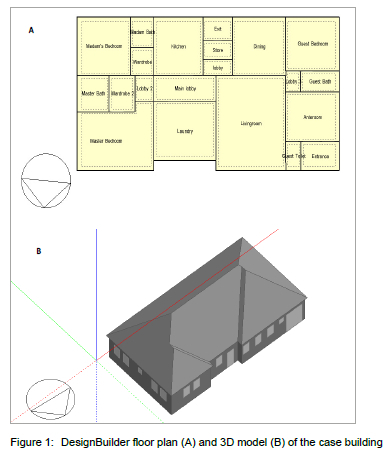
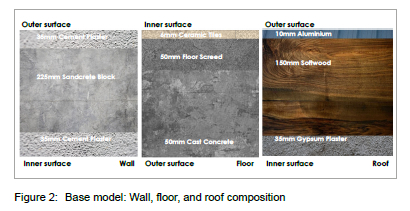
This study used an existing one-floor residential apartment building as the base model for embodied carbon assessment and optimisation. The building is located in Edo State, within Nigeria's South-South geopolitical zone, and consists of a three-bedroom block (Figure 1). It is constructed mainly with 225 mm thick hollow sandcrete block walls and finished externally with cement-sand plaster (Figure 2). A representative digital twin of the building was developed using the original architectural features, including internal layout, floor area, fenestration details, and wall thickness. These were drafted in AutoCAD and subsequently imported into DesignBuilder (DB). DB is a dynamic simulation tool powered by the EnergyPlus engine and supports file sharing and importation to facilitate building energy modelling (DesignBuilder, 2024a). Its graphical interface allows for accurate zoning and parameter definition, supporting performance simulation under varying design conditions.
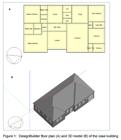
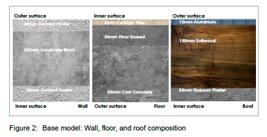
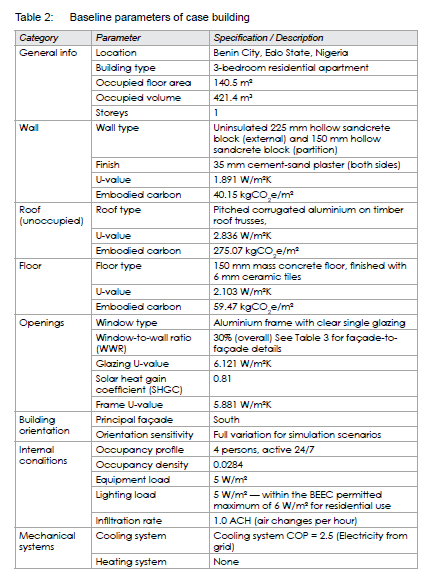
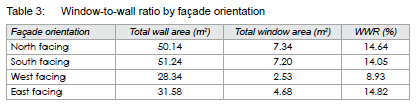
The virtual model was configured using the building's as-built properties to facilitate a baseline simulation. Details including wall and roof construction, orientation, HVAC type, lighting loads, and internal gains were systematically defined, as represented in Table 2, while window-to-wall ratio by façade orientation is presented in Table 3.
The overall 30% WWR stated in Table 2 represents the default value applied during the baseline simulation, with an adjustment range of 10%-80% in search of optimal solutions. The façade-by-façade values in Table 3 reflect the as-built configuration of the case building. For parametric modelling, these baseline characteristics served as the foundation for redefining design variables, i.e., parameters whose values were deliberately varied during the optimisation process to investigate carbon emissions. They include changes in both external and internal wall, variation in roof insulation thickness, modifications to the window-to-wall ratio, and the adjustment of building orientation. This flexibility within the simulation platform supported the identification of configurations that reduced both embodied and operational carbon while maintaining occupant thermal comfort.
3.2.2 Case building optimisation (optimised models)
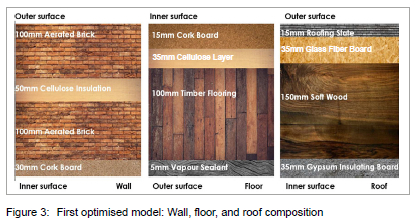
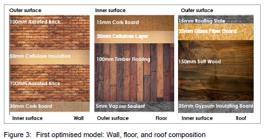
Two optimised models of the case building (first optimisation) and (second optimisation) were developed with the goal of enhancing performance through fabric improvements. An appraisal of the latest Inventory of Carbon and Energy (ICE) database (Circular Ecology, 2025) guided the selection of low-embodied carbon materials to replace those of the case building. In the first optimised model, the exterior fabric was redesigned, using a layered composition of 100 mm aerated brick, 50 mm cellulose insulation cavity, and a 30 mm cork board interior finish (Figure 3). This new wall configuration has a total thickness of 280 mm, and a U-value of 0.353 W/m2K. Internal partitions were replaced with 100 mm softwood frames finished on both sides with 35 mm cork board, resulting in an entirely wood-based partition system with a U-value of 0.372 W/rrPK. In addition, the roof structure in the first optimised model was modified to include four distinct layers including a 15 mm slate outer layer, a 35 mm fibre board insulation layer, timber trusses, and a 35 mm gypsum plaster finish. The resulting U-value of the optimised roof assembly was 0.389 W/m2k. For the floor, timber planks were layered with a vapour sealant, a 35 mm cellulose insulation layer, and a 15 mm cork board finish, achieving a combined U-value of 0.419 W/ m2k. The case building windows were substituted with triple-glazed, low-emissivity glass with wooden frames to limit solar gains through windows.
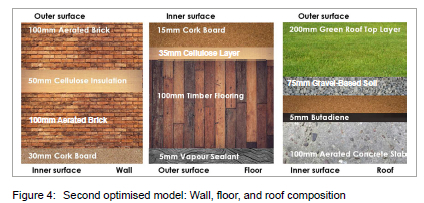
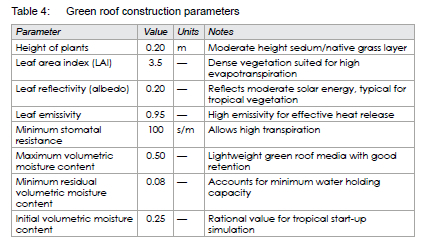
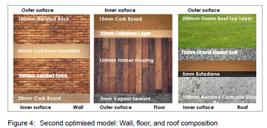
The second optimised model was developed from the first optimised alternative, by incorporating a green roof system and window shading features. The optimised roof includes a 200 mm plant outer layer, a 50 mm gravel-based soil layer, a 50 mm cork board insulation layer, a butadiene rubber damp-proof membrane, and a 100 mm aerated concrete slab (Figure 4). This configuration yields a slightly lower U-value of 0.336 W/m2K compared to the slate-based pitched roof in the first optimised model. The parameters of the vegetation layer are summarised in Table 4. Key thermal properties ofthegreen roof construction include a thermal conductivity of 0.225 W/mK, specific heat capacity of 1200 J/kgK, density of 1100 Kg/m3, thermal absorptance of 0.95, and solar absorptance of 0.8. In addition, the windows in the second optimised model were equipped with high reflectivity interior blinds, positioned 15 mm from the inner glazing to further reduce solar heat gain.
The overarching aim of the optimised models was to investigate the extent to which fabric material substitution can [influence carbon emissions and indoor comfort.
3.3 Building simulations and life-cycle assessment
3.3.1 Multi-objective optimisation simulations
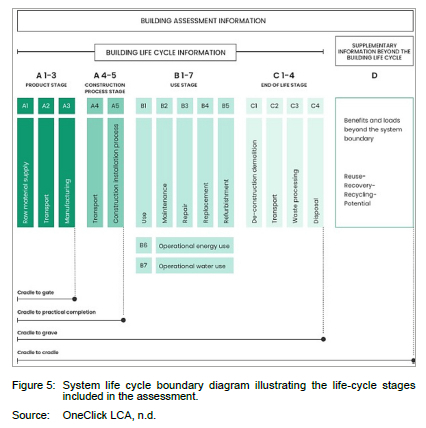
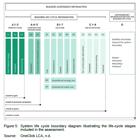
An initial simulation of the case building was conducted to analyse its thermal comfort and embodied carbon performance. This step ensured all geometric, material, and operational inputs such as occupancy schedules, climate data, construction layers, and HVAC settings were accurately defined and capable of producing the expected simulation outputs. The preliminary simulation was used not only to validate the accuracy and realism of the base model's inputs, but also to establish a reliable performance baseline. This baseline, therefore, served as a reference for the optimised scenarios. The outputs from this simulation helped identify the most influential parameters for MOO. The simulation employed a standard EnergyPlus Weather (EPW) file generated using the Meteonorm weather file generator, representing typical meteorological conditions for the building's location. The building, situated in a very hot humid climate zone (ASHRAE Climate Zone 1A), is characterised by consistently elevated temperatures and humidity throughout the year (Stackhouse & Westberg, 2015). The life-cycle assessment followed the EN 15978 system boundary framework (British Standards Institution, 2011), capturing potential impacts for a 60-year period for the full A-to-C stages: materials production (A-A3), construction processes (A4-A5), use-stage embodied processes (B1-B5), operational energy (B6), and end-of-life impacts (C1-C4), as depicted in Figure 5.
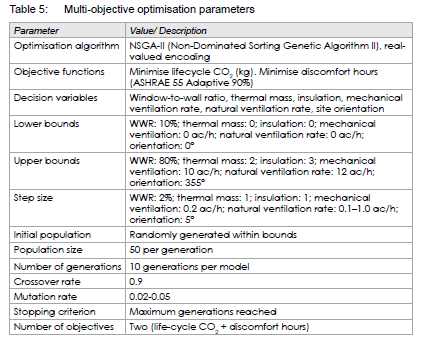
A parametric optimisation set-up was configured and managed in DB to facilitate multi-objective decision-making. This process offers a unique opportunity to configure up to ten design variables such as building height, window-to-wall ratio, and glazing type, which can be evaluated in combination with a maximum of two intuitive design objectives such as "minimise carbon emissions" and "minimise energy consumption". This decision approach helps identify design options that best meet performance expectations in the simulation environment (DesignBuilder, 2024b). In DB, two design objectives were stipulated: "minimise LCA carbon" and "minimise thermal discomfort" (Table 5). Thermal discomfort was evaluated based on ASHRAE 55 adaptive comfort model with 90% acceptability (ASHRAE, 2020). The design variables considered were thermal mass, insulation, mechanical ventilation, site orientation, natural ventilation rate, and window-to-wall percentage. The MOO employed the Java Evolutionary Algorithm (JEA), which implements the Non-dominated Sorting Genetic Algorithm II (NSGA-II) with real-valued encoding. This algorithm is fully GUI-based, requires no scripting, has a fast setup time, includes built-in-Pareto front visualisation, and integrates seamlessly with the DesignBuilder simulation Core.
3.3.2 Life-cycle carbon assessment - OneClick LCA
One of the limitations of the embodied carbon assessment in DesignBuilder is its inability to account for carbon emissions across all life-cycle stages of the building. Life-cycle assessment (LCA) tools such as OneClick LCA allow for a comprehensive analysis, capturing emissions from raw material extraction through disposal, that is, stages A1 to C4 (Marios, 2024). The models were exported from DB to OneClick LCA tool, where a full life-cycle embodied carbon assessment was conducted, divulging aspects of the building structure, and life-cycle stages that escalate environmental impacts. The embodied energy and emissions data used in the assessment relied on the integrated Environmental Product Declaration (EPD) database within the LCA tool. This database provides standardised material impact factors aligned with EN 15804 and ISO 14040 (British Standards Institution, 2021, 2020), ensuring consistency and compatibility across all material categories evaluated in the study.
4. RESULTS AND DISCUSSION
4.1 Embodied carbon and energy use
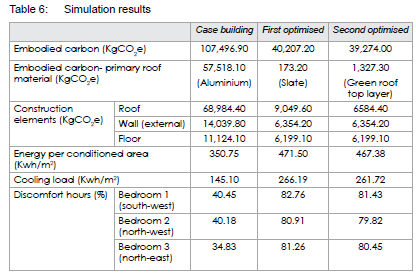
The results of the simulation of the case building indicate a total embodied carbon of 107,496.90 KgCO2e (Table 6). Sensitivity analysis revealed that roughly 54% of the embodied carbon was attributed to the aluminium roofing material, suggesting a key area for substitution with low embodied carbon alternatives. Among the construction entities, the roof, walls, and floors account for 64%, 13%, and 10% of the total embodied carbon, respectively. Further investigation shows that wood-based products such as plywood exhibited the lowest embodied carbon values. Metals such as aluminium have long been identified as major contributors to embodied carbon emissions, due to their energy-intensive production processes (Saevarsdottir, Kvande & Welch, 2020; Farjana, Huda & Mahmud, 2019), thus, minimising their use can significantly lower the overall carbon footprint of buildings (Raabe et al., 2022; Teeuwen et al., 2024). These findings align with established building energy studies such as Cheng, Zhou and Zhou (2023) and Arceo, Saxe and MacLean (2023), which identify the material production stage as the main contributor to embodied carbon in buildings. Furthermore, structural elements, including roof systems and floor slabs, are widely reported to account for the majority of a building's upfront embodied carbon (Eleftheriadis, Duffour & Mumovic, 2018).
When compared to the case building, the first optimised alternative demonstrates a significantly lower embodied carbon footprint, with a total embodied carbon of 40,207.20 KgCO2e, approximately 63% lower than the case building. This reduction was essentially achieved by replacing the aluminium roofing sheets with slate tiles. The second optimised model, which features a green roof and external window shading, achieved a further reduction, roughly 64% and 2% lower than the case building and first optimised model, respectively. These reductions are consistent with a broader body of evidence, demonstrating that targeted material interventions can deliver substantial embodied carbon savings (Khan et al., 2025; D'Amico, Pomponi & Hart, 2021). The green roof outcome is further supported by previous studies that used green roof construction to reduce the building's environmental impacts, and delivering measurable reductions in net embodied carbon through biogenic carbon sequestration in vegetative layers (Mousavi et al., 2023; Pragati et al., 2023; Nasr et al., 2024).
Operational energy results were evaluated, using site energy outputs from DB, with site-based emission factors applied to convert annual energy consumption into operational carbon. Source energy and upstream generation losses were not included in this study. The energy consumption of the buildings varied across each material optimisation. For instance, the total energy use per conditioned area increased by 34%, from 350.75 Kwh/ir^ in the case building to 471.5 Kwh/imP in the first optimised model. A marginal decrease, compared to the first optimised, was noted in the second optimised design, which recorded 467.38 Kwh/m2. These changes are influenced by the inherent thermal properties of the substituted materials. Precisely, materials such as concrete tend to reduce internal heat gains, due to their thermal mass properties (Kuczynski & Staszczuk, 2020; Salehpour et al., 2023; Hu, Liu & Niu, 2020), while lightweight alternatives, preferred in terms of embodied carbon emissions, often result in reduced thermal inertia, leading to higher operational energy demands (Roque et al., 2020; Rabenseifer et al., 2025). This trade-off between low-carbon material selection and increased operational cooling demand is well documented in building energy research. A study by Peng, Deng and Hong (2019) demonstrates that materials with lower thermal mass are associated with increased indoor thermal discomfort and higher operational energy requirements in residential buildings. While thermal mass plays a crucial role in enhancing indoor comfort, the simulation results suggest that neither of the optimised buildings improves indoor comfort, particularly in the bedrooms. This suggests the need for additional adaptive and material interventions beyond those already applied, as the materials used in the optimised models increased the cooling load of the buildings. Relative to the case building, cooling load increased by 46% in the first optimised model and 45% in the second alternative. The slight reduction in the cooling demand of the second model is attributed to the green roof integration. This location-based result is consistent with previous findings on the cooling potential of vegetated roofs in hot and humid climates (García et al., 2022; Robbiati et al., 2022).
4.2 Pareto-based multi-objective optimisation
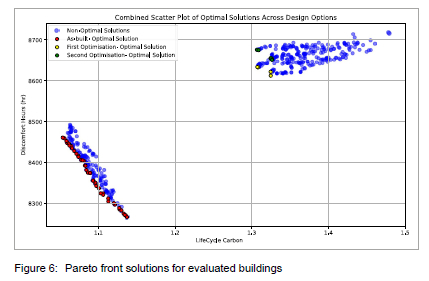
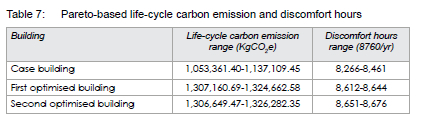
The building models were further evaluated using a MOO technique in DB to identify optimal design solutions that balances the goals of reducing life-cycle carbon and discomfort hours. These solutions represent varying compromises between competing design objectives, where the improvement of one objective may supersede the importance or need for the other. The design variables considered include window-to-wall percentage, cooling set-point temperatures, set-back temperatures, site orientation, as well as natural and mechanical ventilation rates. The case building simulation involved 217 iterations, resulting in 43 non-dominated solutions along the Pareto front. The first optimised building passed through 202 iterations, resulting in four optimal solutions, while the second optimised design required 207 continuous iterations to arrive at 10 optimal design solutions, as depicted in Figure 6. These variations in the frequency of optimal solutions across models reflect the complexity introduced by changes in material composition. The Pareto-based simulation of the case building reveals LCA emissions ranging from 1,053,361.40 KgCO2e to 1,137,109.45 KgCO2e, with corresponding discomfort hours spanning from 8266 to 8461 hours annually (Table 7). A notable inverse relationship was observed among the Pareto solutions, where the design alternative with the lowest carbon emissions coincided with the highest discomfort hours, while the alternative with the highest carbon emissions produced the lowest discomfort hours. This observation underscores the intrinsic nature of Pareto-based optimisation, where achieving gains in one performance metric inevitably compromises another. In such instances, the designer is tasked with evaluating the relative importance of each outcome and selecting a solution that aligns best with the building's performance goals as deeply rooted in current optimisation literature (Bejarano, Espitia & Montenegro, 2022; Kesireddy & Medrano, 2024; Petchrompo et al., 2022).
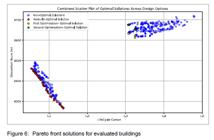
As outlined in Table 7, both life-cycle carbon emissions and discomfort hours increased in the optimised buildings. Note that embodied carbon assessment for the optimised alternatives was shown in section 4.1 to reduce, compared to the case building. Conversely, operational energy increased in the optimised model compared to the case building. The core of DesignBuilder simulation focuses on operational energy use (DesignBuilder, n.d.), while pareto-based evaluations account for both embodied and operational emissions across the building's life cycle. The contrast between the first optimised model and the case building reflects a wider trend in performance-based design, where what qualifies as an ideal solution changes as parameters are refined through iterative processes. This evolution aligns with literature such as Brown and Mueller (2018: 6-11), Natanian, Aleksandrowicz and Auer (2019: 5-8) and Sayın and Çelebi (2020: 6-11), advocating for evolutionary, performance-driven design processes to shape the trajectory of optimisation. The challenge of balancing embodied carbon savings against operational carbon and comfort penalties is not unique to this study. A review of residential building LCA studies in humid subtropical and tropical climates found that life-cycle GHG emissions are widely dominated by operational energy, highlighting that material improvements alone are insufficient to achieve whole-life carbon neutrality (Satola et al., 2021). The second optimised design, characterised by a green roof construction, yielded optimal solutions favouring north-facing orientations, higher natural ventilation rates, and comparatively high window-to-wall ratios. Despite having similar designs with the first optimised model, it shows a slightly higher range of life-cycle carbon emissions and discomfort hours, slightly deviating from the comparatively favourable outcome. This result exposes the significance of a multi-objective and life-cycle perspective for building simulation to uncover the challenges to which low-carbon buildings in the tropics can be exposed, and the need for early-stage design optimisation. Green roof systems are acknowledged as technically elaborate and potentially cost-prohibitive in residential buildings, especially in developing economies (Fachinello Krebs & Johansson, 2021). Their inclusion in this study served to explore the full performance envelope alternatives and to test whether the environmental performance gains they offer can justify their complexity. A comparative assessment across all three models suggests that optimal solutions cluster around higher natural ventilation rates and north-to-northwest facing orientations, indicating that passive design strategies could counterbalance the operational and comfort penalties introduced by material substitutions. These findings, while not universally prescriptive due to the complexity of MOO, highlight recurring patterns that can serve as strategic points for design interventions. Again, no single design solution can be universally declared optimal, but these varied patterns point to valuable directions for future explorations into energy-conscious and carbon-efficient building design.
4.3 OneClick life-cycle impact analysis of design alternatives
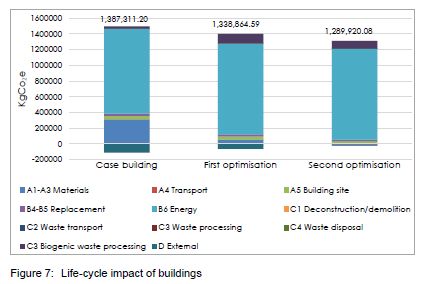
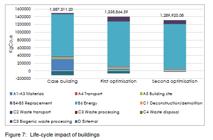
Reducing life-cycle carbon emissions in buildings requires a comprehensive understanding of the contributions made by different life-cycle stages. A fragmented approach that excludes this integrated perspective risks producing superficial or misdirected carbon-reduction strategies. As highlighted from preliminary simulations, the optimised models have lower embodied carbon through material substitutions, but their overall life-cycle carbon emissions increased (see Figure 6 and Table 7), which is indicative of emissions mainly from operational energy. An integrated LCA (Figure 7) traces emissions across all stages of the buildings from material extraction to end-of-life, providing a more integrated perspective of life-cycle emissions, enabling informed decisions in building optimisation.
4.3.1 Material-related carbon emissions
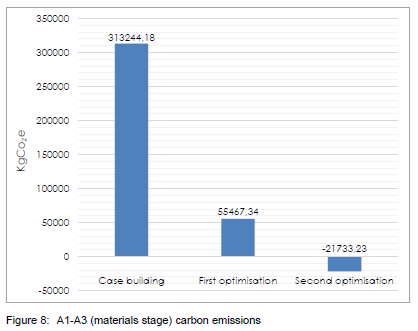
The case building, as expected, recorded the highest embodied carbon emissions, due to its use of carbon-intensive materials. Specifically, its A1-A3 emissions were approximately 82% and 93% higher than those of the first and second optimised models, respectively. This stresses the vital role of material selection in reducing embodied carbon, consistent with past studies, including Chen et al. (2023), Hawkins et al. (2020) and Lützkendorf and Balouktsi (2022). A particularly noteworthy result emerged from the second optimised model, which showed a negative A1-A3 carbon value of -23,733.23 KgCO2e (Figure 8). This outcome is attributed to its green roof feature, whose layered vegetative components such as organic growing media and plant biomass provide measurable biogenic carbon sequestration. While this sequestration benefit can significantly reduce net embodied carbon, it is crucial to recognise that such biogenic storage is not permanent, as carbon may gradually be released through decomposition or maintenance processes over the building's operational life (Van Den Oever et al., 2024: 21, 36; Vilčeková et al., 2024:
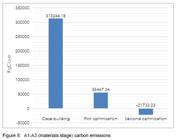
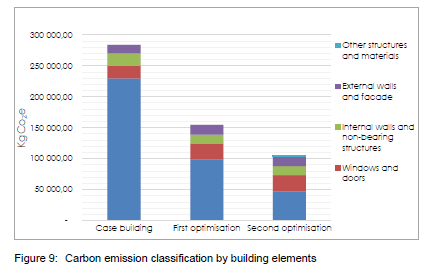
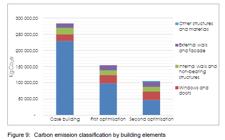
In contrast, the first optimised building, which features a slate roof, showed higher A1-A3 emissions. Slate, although durable, has a high embodied carbon, due to its energy-intensive quarrying and processing phases. It is critical to emphasise that the material emissions captured at the A1-A3 stage emissions account for walls, façades, internal partitions, floors, beams, doors, and windows. A further disaggregation of the embodied carbon by structural classification shows a consistent pattern in emission hotspots across the three designs, with substantial variance in emission contributions (Figure 9). In the case building, for instance, roughly 89% of the embodied carbon is ascribed to horizontal structures, including beams, floor slabs, and roof systems. Vertical structures and façades accounted for 7%, while 3% was attributed to other structural and non-structural components. This heavily lopsided distribution emphasises the carbon intensity of conventional floor and roof construction, mostly dependent on reinforced concrete, which has been regularly acknowledged as a major contributor to global embodied carbon emissions (Limphitakphong, 2020; Hart, D'Amico & Pomponi, 2021). This targeted life-cycle evaluation presents an indispensable strategic insight for reducing embodied carbon, by addressing the most carbon-intensive components within the building envelope, which are not elucidated in the prior simulations. In fact, several studies confirm that early interventions through a fabric-first approach, by substituting high-embodied materials with low-carbon alternatives, can yield substantial reductions in total carbon emissions (Eyre et al., 2023). In the case of the buildings assessed in this study, optimising or replacing the concrete floor composition could unlock additional carbon savings without compromising structural performance requirements or architectural intent.
4.3.2 Operational carbon emissions
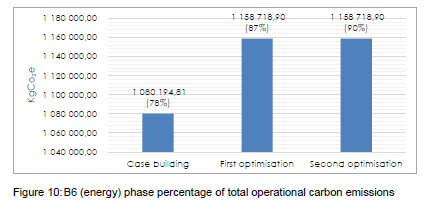
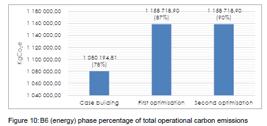
As widely established in existing literature, operational carbon emissions often represent the most sizeable portion of a building's whole life carbon (WLC) footprint. Numerous studies have shown that operational energy can account for over 50% and, in many cases, over 70% of total life-cycle emissions (Liang et al., 2023: 16; Venkatraj et al., 2020; Dilsiz et al., 2019: 6), especially in buildings located in hot regions. The dominance of operational carbon emissions in the tropics is most pronounced in energy-intensive residential buildings (Fachinello Krebs & Johansson, 2021). The findings from this study align with such assertions, reaffirming the dominant influence of operational carbon on WLC emissions. As described earlier in Section 4.3 (Figure 7), operational energy (B6) massively influences life-cycle carbon outcomes. In the case building, material-stage embodied carbon accounts for 19% of total emissions, while operational carbon accounts for a significant 67%. This embodied carbon share is consistent with reported emissions of up to 52% for conventional residential buildings by Dilsiz et al. (2019). The disparity between embodied and operational carbons widens in the optimised models with operational carbon of 79% and 87%, in carbons widens in the optimised models with operational carbon of 79% and 87%, in the first and second optimised models, respectively. For operational energy alone, the case building, first optimised, and second optimised models account for 78%, 87% and 90% of total emissions (Figure 10).
While the pareto front optimisation and visualisation is instrumental in identifying optimal design solutions, it does not offer a detailed evaluation of life-cycle impacts, as shown using OneClick life-cycle assessment tool. Pareto-based optimisation prioritised life-cycle performance based on design objectives such as reducing discomfort hours and energy consumption, yet its interpretation of life-cycle carbon was skewed, due to its focus on operational energy. This led to an apparent but misleading portrayal where the optimised designs appeared to produce higher lifecycle carbon than the case model. However, when assessed holistically through OneClick LCA's full-spectrum life-cycle analysis (Figure 7), the picture clearly changes. In fact, both optimised models outperformed the case building in total WLC terms. The case building recorded a life-cycle carbon emission of 1,387,311.20 KgCO2e. By contrast, the first optimised model demonstrated a 3.5% reduction (1,338,864.59 KgCO2e), while the second achieved a 7% reduction (1,289,920.08 KgCO2e). These results validate findings from related studies that early-stage building optimisation and material enhancement, even when they increase life-cycle operational energy, can result in significant long-term carbon savings (Ayoobi & Inceoğlu, 2024; Elbeltagi, Wefki & Khallaf, 2023).
5. CONCLUSIONS AND RECOMMENDATIONS
The outcome of this study reiterates the need for an integrated approach to operational and embodied carbon reductions in building performance evaluation. Prioritising energy performance or thermal comfort requirements, without accounting for life-cycle impacts, risks achieving only biased optimisation and missing opportunities for genuine life-cycle carbon reduction. Relying on an aspect of life-cycle carbon is insufficient to achieve carbon neutrality in the construction industry. High embodied materials such as concrete and steel are some of the largest contributors to embodied carbon. Pareto-based MOO was applied to buildings with different materials to identify best-performing design solutions that balance the objectives of reducing carbon emissions and energy consumption. The case building, sited in Edo State, Nigeria, was simulated with its baseline configuration of sandcrete block walls and aluminium roofing. Two optimised alternatives with aerated bricks and timber-based materials were explored to assess life-cycle carbon emission and comfort, as a method for early-stage design decision-making. Results from preliminary simulation showed that the original building has an embodied carbon of 107,496.90 KgCO2e emissions, with 54.8% of this attributed to the aluminium roof. Material substitution reduced embodied carbon by 63% in the first optimised model, while the second model with a green roof system achieved a 64% reduction relative to the case building. However, these substitutions increased cooling demand by approximately 46%, due to the weak thermal resistance of the low carbon materials. The Pareto front analysis revealed that, while material substitutions lowered embodied carbon, they resulted in higher life-cycle carbon emissions, highlighting the need for adaptive strategies and life-cycle impact evaluation. OneClick life-cycle assessment tools were used for comprehensive life-cycle evaluation. Results showed that the first optimised model reduced life-cycle carbon by 3.5%, and the second by 7%, demonstrating the potential for whole-life carbon improvements when both embodied and operational impacts are considered together.
The study concludes that, for early-design decision-making, a multifaceted approach that combines low-embodied materials, adaptive building strategies, and life-cycle impact analysis is vital to reduce the long-term environmental impact of buildings. Although operational energy remains the dominant contributor to life-cycle carbon emissions, attention must be paid to embodied carbon reduction in buildings, if genuine progress towards carbon neutrality is to be attained. Relying solely on an aspect of building performance optimisation such as operational energy, embodied carbon, passive design or indoor environmental quality risks overlooking the benefits of whole life-cycle impacts.
A key limitation of this study is that the optimisation models focused primarily on material substitution rather than its combination with a range of passive design strategies, even though passive measures are widely recognised for their influence on indoor comfort and operational performance. The discomfort hours recorded in the optimised buildings are an acknowledged consequence of the study's deliberate methodological scope, designed as a phase of ongoing optimisation investigations, focusing specifically on fabric and material performance in a building's life cycle.
Subsequent phases of the wider research will extend the optimisation to include passive design strategies, which are expected to reduce discomfort hours substantially. Consequently, future studies and industry practice should integrate adaptive comfort strategies within a full life-cycle assessment framework. Embedding life-cycle carbon evaluation at the early design stages is essential to support balanced, low-carbon design choices that address both immediate comfort needs and long-term environmental sustainability goals.
REFERENCES
ACKNOWLEDGEMENTS
The authors acknowledge the support of GreenTech Design and Research Lab for granting access to its research facilities to conduct this study.
2. LITERATURE REVIEW
- Abubakar, A., Mohammed, A., Abubakar, U.D. & Ikara, I.A. 2018. Embodied energy and carbon IV oxide emission analyses of sandcrete blocks and compressed earth bricks houses. Proceedings of the International Conference on Global and Emerging Trends, 2-4 May, Abuja, Nigeria, pp. 43-47.
-
Adeniyi, S.M. & Mohamed, S.F. 2019. Investigating potential green materials to improve cost effectiveness for low-cost building construction in Nigeria. International Journal of Recent Technology and Engineering, 8(15), pp. 270-274. https://doi.org/10.35940/ijrte.A1041.0581S19
» https://doi.org/10.35940/ijrte.A1041.0581S19 -
Ahmed, N., Abdel-Hamid, M., Abd El-Razik, M.M. & El-Dash, K.M. 2021. Impact of sustainable design in the construction sector on climate change. Ain Shams Engineering Journal, 12(2), pp. 1375-1383. https://doi.org/10.1016/j.asej.2020.11.002
» https://doi.org/10.1016/j.asej.2020.11.002 -
Akbarnezhad, A. & Xiao, J. 2017. Estimation and minimization of embodied carbon of buildings: A review. Buildings, 7(1), article 5. https://doi.org/10.3390/buildings7010005
» https://doi.org/10.3390/buildings7010005 -
Alegbe, M. 2022. Comparative analysis of wall materials toward improved thermal comfort, reduced emission, and construction cost in tropical buildings. 77th Masters Conference: People and Buildings, 16 September, University of Westminster, London, pp. 67-72. https://doi.org/10.5258/SOTON/P1094
» https://doi.org/10.5258/SOTON/P1094 -
Alegbe, M. & Hammed, N. 2024. Sustainability beyond the surface: Evaluating the long-term environmental and energy performance of selected cladding materials for housing retrofits. Journal of Sustainable Construction Materials and Technologies, 9(3), pp. 221-238. https://doi.org/10.47481/jscmt.1536060
» https://doi.org/10.47481/jscmt.1536060 -
Alghamdi, S., Tang, W., Kanjanabootra, S. & Alterman, D. 2022. Effect of architectural building design parameters on thermal comfort and energy consumption in higher education buildings. Buildings, 12(3), article 329. https://doi.org/10.3390/buildings12030329
» https://doi.org/10.3390/buildings12030329 -
Al-Obaidy, M., Courard, L. & Attia, S. 2022. A parametric approach to optimizing building construction systems and carbon footprint: A case study inspired by circularity principles. Sustainability, 14(6), article 3370. https://doi.org/10.3390/su14063370
» https://doi.org/10.3390/su14063370 -
Arceo, A., Saxe, S. & MacLean, H.L. 2023. Product stage embodied greenhouse gas reductions in single-family dwellings: Drivers of greenhouse gas emissions and variability between Toronto, Perth, and Luzon. Building and Environment, 242, article 110599. https://doi.org/10.1016/j.buildenv.2023.110599
» https://doi.org/10.1016/j.buildenv.2023.110599 -
Arenas, N.F. & Shafique, M. 2024. Reducing embodied carbon emissions of buildings - A key consideration to meet the net zero target. Sustainable Futures, 7, article 100166. https://doi.org/10.1016/j.sftr.2024.100166
» https://doi.org/10.1016/j.sftr.2024.100166 -
Arrigoni, A., Pelosato, R., Melià, P., Ruggieri, G. et al. 2017. Life cycle assessment of natural building materials: The role of carbonation, mixture components and transport in the environmental impacts of hempcrete blocks. Journal of Cleaner Production, 149, pp. 1051-1061. https://doi.org/10.1016/j.jclepro.2017.02.161
» https://doi.org/10.1016/j.jclepro.2017.02.161 -
ASHRAE (American Society of Heating, Refrigerating and Air-Conditioning Engineers). 2020. Standard 55- Thermal environmental conditions for human occupancy. https://www.ashrae.org [Accessed 8 February 2026].
» https://www.ashrae.org -
Asman, N.S.A., Bolong, N., Mirasa, A.K., Asrah, H. et al. 2020. Interlocking compressed earth bricks as low carbon footprint building material. IOP Conference Series: Earth and Environmental Science, 476(1), article 012086. https://doi.org/10.1088/1755-1315/476/1/012086
» https://doi.org/10.1088/1755-1315/476/1/012086 -
Ayati, B., Newport, D., Wong, H. & Cheeseman, C. 2022. Low-carbon cements: Potential for low-grade calcined clays to form supplementary cementitious materials. Cleaner Materials, 5, article 100099. https://doi.org/10.1016/j.clema.2022.100099
» https://doi.org/10.1016/j.clema.2022.100099 -
Ayoobi, A.W. & Inceoğlu, M. 2024. Developing an optimized energy-efficient sustainable building design model in an arid and semi-arid region: A genetic algorithm approach. Energies, 17(23), article 6095. https://doi.org/10.3390/en17236095
» https://doi.org/10.3390/en17236095 -
Bejarano, L.A., Espitia, H.E. & Montenegro, C.E. 2022. Clustering analysis for the pareto optimal front in multi-objective optimization. Computation, 10(3), pp. 1-21. https://doi.org/10.3390/computation10030037
» https://doi.org/10.3390/computation10030037 -
Bonamente, E., Brunelli, C., Castellani, F., Garinei, A. et al. 2018. A life-cycle approach for multi-objective optimisation in building design: Methodology and application to a case study. Civil Engineering and Environmental Systems, 35(1-4), pp. 158-179. https://doi.org/10.1080/10286608.2019.1576646
» https://doi.org/10.1080/10286608.2019.1576646 -
Bre, F., Roman, N. & Fachinotti, V.D. 2020. An efficient metamodel-based method to carry out multi-objective building performance optimizations. Energy and Buildings, 206, article 109576. https://doi.org/10.1016/j.enbuild.2019.109576
» https://doi.org/10.1016/j.enbuild.2019.109576 -
British Standards Institution. 2011. Sustainability of construction works. Assessment of environmental performance of buildings. Calculation method. BSI Standard Publication, EN 15978:2011. https://doi.org/10.3403/30192730
» https://doi.org/10.3403/30192730 -
British Standards Institution. 2020. BS EN ISO 74040:2006+A7:2020: Environmental management. Life cycle assessment. Principles and framework. https:bsol.bsigroup.com.
» https:bsol.bsigroup.com -
British Standards Institution. 2021. BS EN 75804:2072+A2:2079: Sustainability of construction works. Environmental product declarations. Core rules for the product category of construction products. https:bsol.bsigroup.com
» https:bsol.bsigroup.com -
Brown, N.C. & Mueller, C.T. 2018. Design variable analysis and generation for performance-based parametric modeling in architecture. International Journal of Architectural Computing, 17(1), pp. 36-52. https://doi.org/10.1177/1478077118799491
» https://doi.org/10.1177/1478077118799491 -
Carpio, M. & Carrasco, D. 2021. Impact of shape factor on energy demand, CO2 emissions and energy cost of residential buildings in cold oceanic climates: Case study of South Chile. Sustainability, 13(17), article 9491. https://doi.org/10.3390/su13179491
» https://doi.org/10.3390/su13179491 -
Chen, K.W., Janssen, P. & Schlueter, A. 2018. Multi-objective optimisation of building form, envelope and cooling system for improved building energy performance. Automation in Construction, 94, pp. 449-457. https://doi.org/10.1016/j.autcon.2018.07.002
» https://doi.org/10.1016/j.autcon.2018.07.002 -
Chen, R., Tsay, Y.-S. & Ni, S. 2022. An integrated framework for multi-objective optimization of building performance: Carbon emissions, thermal comfort, and global cost. Journal of Cleaner Production, 359, article 131978. https://doi.org/10.1016/j.jclepro.2022.131978
» https://doi.org/10.1016/j.jclepro.2022.131978 -
Chen, S., Teng, Y., Zhang, Y., Leung, C.K.Y. et al. 2023. Reducing embodied carbon in concrete materials: A state-of-the-art review. Resources, Conservation and Recycling, 188, article 106653. https://doi.org/10.1016/j.resconrec.2022.106653
» https://doi.org/10.1016/j.resconrec.2022.106653 - Cheng, J.C.P., Lo, I., Gan, J., Jing, R. et al. 2013. Development of a local embodied carbon database for construction materials. Sustainable Building 2073 Hong Kong Regional Conference: Urban Density & Sustainability, 12-13 September, Hong Kong, pp. 1-8.
-
Cheng, S., Zhou, X. & Zhou, H. 2023. Study on carbon emission measurement in building materialization stage. Sustainability, 15(7), article 5717. https://doi.org/10.3390/su15075717
» https://doi.org/10.3390/su15075717 - Chobanov, P.L. 2016. Form factor limits depending on the building shapes. World Science, 2(6), pp. 29-35.
-
Circular Ecology. 2025. Inventory of Carbon & Energy (ICE) Database v4.1. https://circularecology.com/news/ice-database-v4-1-released. [Accessed 18 February 2026].
» https://circularecology.com/news/ice-database-v4-1-released -
Costa-Carrapiço, I., Raslan, R. & González, J.N. 2020. A systematic review of genetic algorithm-based multi-objective optimisation for building retrofitting strategies towards energy efficiency. Energy and Buildings, 210, article 109690. https://doi.org/10.1016/j.enbuild.2019.109690
» https://doi.org/10.1016/j.enbuild.2019.109690 -
Craft, W., Oldfield, P., Reinmuth, G., Hadley, D. et al. 2024. Towards net-zero embodied carbon: Investigating the potential for ambitious embodied carbon reductions in Australian office buildings. Sustainable Cities and Society, 113, article 105702. https://doi.org/10.1016/j.scs.2024.105702
» https://doi.org/10.1016/j.scs.2024.105702 -
Croitoru, C., Nastase, I., Sandu, M. & Lungu, C. 2016. Multi-criteria design and impact on energy consumption of a residential house - A parametric study. Energy Procedia, 85, pp. 141-148. https://doi.org/10.1016/j.egypro.2015.12.284
» https://doi.org/10.1016/j.egypro.2015.12.284 -
D'Amico, B., Pomponi, F. & Hart, J. 2021. Global potential for material substitution in building construction: The case of cross laminated timber. Journal of Cleaner Production, 279, article 123487. https://doi.org/10.1016/j.jclepro.2020.123487
» https://doi.org/10.1016/j.jclepro.2020.123487 -
Decorte, Y., Steeman, M., Van Den Bossche, N. & Calle, K. 2020. Environmental evaluation of pareto optimal renovation strategies: A multidimensional life-cycle analysis. E3S Web Conf., 172, article 18003. https://doi.org/10.1051/e3sconf/202017218003
» https://doi.org/10.1051/e3sconf/202017218003 -
Dede, T., Kripka, M., Toğan, V. & Yepes, V. 2019. Usage of optimization techniques in civil engineering during the last two decades. Current Trends in Civil & Structural Engineering, 2(1). https://doi.org/10.33552/CTCSE.2019.02.000529
» https://doi.org/10.33552/CTCSE.2019.02.000529 -
DesignBuilder. 2024a. Importing 2D CAD Data. https:support.designbuilder.co.uk [Accessed 18 February 2026].
» https:support.designbuilder.co.uk -
DesignBuilder. 2024b. Optimisation. DesignBuilder. https:support.designbuilder.co.uk [Accessed 16 December 2025].
» https:support.designbuilder.co.uk -
DesignBuilder. n.d. Simulation. DesignBuilder Software Ltd. https:support.designbuilder.co.uk [Accessed 6 May 2026].
» https:support.designbuilder.co.uk -
DesigningBuildings. 2021. Fabric first. https://www.designingbuildings.co.uk [Accessed 22 May 2025].
» https://www.designingbuildings.co.uk -
Di Luigi, M., Petit, D., Sarkar, A., Guo, Z. et al. 2023. Tailoring biogenic straw insulation from additive manufacturing. Applied Materials Today, 32, article 101851. https://doi.org/10.1016/j.apmt.2023.101851
» https://doi.org/10.1016/j.apmt.2023.101851 -
Dilsiz, A.D., Felkner, J., Habert, G. & Nagy, Z. 2019. Embodied versus operational energy in residential and commercial buildings: Where should we focus? Journal of Physics: Conference Series, 1343(1), article 012178. https://doi.org/10.1088/1742-6596/1343/1/012178
» https://doi.org/10.1088/1742-6596/1343/1/012178 -
Dixit, M.K. & Pradeep Kumar, P. 2022. Analyzing embodied energy and embodied water of construction materials for an environmentally sustainable built environment. IOP Conference Series: Earth and Environmental Science, 1122(1), article 012045. https://doi.org/10.1088/1755-1315/1122/1/012045
» https://doi.org/10.1088/1755-1315/1122/1/012045 -
Dossche, C., Boel, V. & De Corte, W. 2017. Use of life cycle assessments in the construction sector: Critical review. Procedia Engineering, 171, pp. 302-311. https://doi.org/10.1016/j.proeng.2017.01.338
» https://doi.org/10.1016/j.proeng.2017.01.338 -
Edike, U.E., Ameh, O.J. & Dada, M.O. 2020. Production and optimization of eco-bricks. Journal of Cleaner Production, 266, article 121640. https://doi.org/10.1016/j.jclepro.2020.121640
» https://doi.org/10.1016/j.jclepro.2020.121640 -
Elbeltagi, E., Wefki, H. & Khallaf, R. 2023. Sustainable building optimization model for early-stage design. Buildings, 13(1), article 74. https://doi.org/10.3390/buildings13010074
» https://doi.org/10.3390/buildings13010074 -
Eleftheriadis, S., Duffour, P. & Mumovic, D. 2018. BIM-embedded life cycle carbon assessment of RC buildings using optimised structural design alternatives. Energy and Buildings, 173, pp. 587-600. https://doi.org/10.1016/j.enbuild.2018.05.042
» https://doi.org/10.1016/j.enbuild.2018.05.042 -
European Climate Foundation (ECF). 2020. Zero carbon buildings 2050: Summary Report. https://www.europeanclimate.org [Accessed 16 May 2025].
» https://www.europeanclimate.org -
European Commission (EC). 2020. In focus: Energy efficiency in buildings. European Commission. https://commission.europa.eu [Accessed 22 May 2025].
» https://commission.europa.eu -
European Environment Agency (EEA). 2023. Greenhouse gas emissions from energy use in buildings in Europe. https://www.eea.europa.eu [Accessed 22 May 2025].
» https://www.eea.europa.eu -
Evins, R. 2013. A review of computational optimisation methods applied to sustainable building design. Renewable and Sustainable Energy Reviews, 22, pp. 230-245. https://doi.org/10.1016/j.rser.2013.02.004
» https://doi.org/10.1016/j.rser.2013.02.004 -
Eyre, N., Fawcett, T., Topouzi, M., Killip, G. et al. 2023. Fabric first: Is it still the right approach? Buildings and Cities, 4(1), pp. 965-972. https://doi.org/10.5334/bc.388.
» https://doi.org/10.5334/bc.388 -
Fachinello Krebs, L. & Johansson, E. 2021. Influence of microclimate on the effect of green roofs in Southern Brazil - A study coupling outdoor and indoor thermal simulations. Energy and Buildings, 241, article 110963. https://doi.org/10.1016/j.enbuild.2021.110963
» https://doi.org/10.1016/j.enbuild.2021.110963 -
Farjana, S.H., Huda, N. & Mahmud, M.A.P. 2019. Impacts of aluminum production: A cradle to gate investigation using life-cycle assessment. Science of The Total Environment, 663, pp. 958-970. https://doi.org/10.1016/j.scitotenv.2019.01.400
» https://doi.org/10.1016/j.scitotenv.2019.01.400 -
Felmer, G., Morales-Vera, R., Astroza, R. ,González, I. et al. 2022. A lifecycle assessment of a low-energy mass-timber building and mainstream concrete alternative in Central Chile. Sustainability, 14(3), article 1249. https://doi.org/10.3390/su14031249
» https://doi.org/10.3390/su14031249 -
Feng, W., Chen, J., Yang, Y., Gao, W. et al. 2024. The impact of building morphology on energy use intensity of high-rise residential clusters: A case study of Hangzhou, China. Buildings, 14(7), article 2245. https://doi.org/10.3390/buildings14072245
» https://doi.org/10.3390/buildings14072245 -
Fenner, A.E., Kibert, C.J., Woo, J., Morque, S. et al. 2018. The carbon footprint of buildings: A review of methodologies and applications. Renewable and Sustainable Energy Reviews, 94, pp. 1142-1152. https://doi.org/10.1016/j.rser.2018.07.012
» https://doi.org/10.1016/j.rser.2018.07.012 -
Gan, V.J.L., Cheng, J.C.P., Lo, I. & Chan, C.M. 2017. Developing a CO2-e accounting method for quantification and analysis of embodied carbon in high-rise buildings. Journal of Cleaner Production, 141, pp. 825-836. https://doi.org/10.1016/j.jclepro.2016.09.126
» https://doi.org/10.1016/j.jclepro.2016.09.126 -
Gan, V.J.L., Lo, I.M.C., Ma, J., Tse, K.T. et al. 2020. Simulation optimisation towards energy efficient green buildings: Current status and future trends. Journal of Cleaner Production, 254, article 120012. https://doi.org/10.1016/j.jclepro.2020.120012
» https://doi.org/10.1016/j.jclepro.2020.120012 -
García, M., Vera, S., Rouault, F., Gironás, J. et al. 2022. Cooling potential of greenery systems for a stand-alone retail building under semi-arid and humid subtropical climates. Energy and Buildings, 259, article 111897. https://doi.org/10.1016/j.enbuild.2022.111897
» https://doi.org/10.1016/j.enbuild.2022.111897 - George, J. & Jacob, J. 2018. Assessment and reduction of embodied carbon in buildings. International Journal of Engineering & Technology, 5(4), pp. 4777-4786.
- Gillespie, D.P. & McIlwaine, S. 2021. Reducing embodied carbon in the construction sector. Proceedings of the 37th Annual ARCOM Conference, 7 September, United Kingdom, pp. 744-753.
-
Greene, J., Hosanna, H., Willson, B. & Quinn, J. 2023. Whole life embodied emissions and net-zero emissions potential for a mid-rise office building constructed with mass timber. Sustainable Materials and Technologies, 35, article 00528. https://doi.org/10.1016/j.susmat.2022.e00528
» https://doi.org/10.1016/j.susmat.2022.e00528 -
Halhoul Merabet, G., Essaaidi, M., Ben Haddou, M., Qolomany, B. et al. 2021. Intelligent building control systems for thermal comfort and energy-efficiency: A systematic review of artificial intelligence-assisted techniques. Renewable and Sustainable Energy Reviews, 144, article 110969. https://doi.org/10.1016/j.rser.2021.110969
» https://doi.org/10.1016/j.rser.2021.110969 -
Hamida, A., Alsudairi, A., Alshaibani, K. & Alshamrani, O. 2022. Parametric study of the impact of building envelope systems on embodied and operational carbon of residential buildings. International Journal of Building Pathology and Adaptation, 40(5), pp. 753-774. https://doi.org/10.1108/IJBPA-08-2020-0064
» https://doi.org/10.1108/IJBPA-08-2020-0064 -
Hart, J., D'Amico, B. & Pomponi, F. 2021. Whole-life embodied carbon in multistory buildings: Steel, concrete and timber structures. Journal of Industrial Ecology, 25(2), pp. 403-418. https://doi.org/10.1111/jiec.13139
» https://doi.org/10.1111/jiec.13139 -
Hawkins, W., Orr, J., Ibell, T. & Shepherd, P. 2020. A design methodology to reduce the embodied carbon of concrete buildings using thin-shell floors. Engineering Structures, 207, article 110195. https://doi.org/10.1016/j.engstruct.2020.110195
» https://doi.org/10.1016/j.engstruct.2020.110195 -
Henry, C.S. & Lynam, J.G. 2020. Embodied energy of rice husk ash for sustainable cement production. Case Studies in Chemical and Environmental Engineering, 2, article 100004. https://doi.org/10.1016/j.cscee.2020.100004
» https://doi.org/10.1016/j.cscee.2020.100004 -
Hu, M. 2023. Strategies and techniques of life cycle-embodied carbon reduction from the building and construction sector: A review. Journal of Architectural Engineering, 29(3), article 04023017. https://doi.org/10.1061/JAEIED.AEENG-1591
» https://doi.org/10.1061/JAEIED.AEENG-1591 -
Hu, R., Liu, G. & Niu, J. 2020. The impacts of a building's thermal mass on the cooling load of a radiant system under various typical climates. Energies, 13(6), article 1356. https://doi.org/10.3390/en13061356
» https://doi.org/10.3390/en13061356 -
Huang, Z., Zhou, H., Miao, Z., Tang, H. et al. 2024. Life-cycle carbon emissions (LCCE) of buildings: Implications, calculations, and reductions. Engineering, 35(4), pp. 115-139. https://doi.org/10.1016/j.eng.2023.08.019
» https://doi.org/10.1016/j.eng.2023.08.019 -
Ibn-Mohammed, T., Greenough, R., Taylor, S., Ozawa-Meida, L. et al. 2013. Operational vs. embodied emissions in buildings - A review of current trends. Energy and Buildings, 66, pp. 232-245. https://doi.org/10.1016/j.enbuild.2013.07.026
» https://doi.org/10.1016/j.enbuild.2013.07.026 -
Iddon, C.R. & Firth, S.K. 2013. Embodied and operational energy for new-build housing: A case study of construction methods in the UK. Energy and Buildings, 67, pp. 479-488. https://doi.org/10.1016/j.enbuild.2013.08.041
» https://doi.org/10.1016/j.enbuild.2013.08.041 -
Intergovernmental Panel on Climate Change (IPCC). 2023. Mitigation of climate change: Chapter 9: Cross-cutting issues. https://www.iea.org [Accessed 16 May 2025]. https://doi.org/10.1017/9781009157926
» https://www.iea.org -
International Energy Agency (IEA). 2019. Global status report for buildings and construction. https://www.iea.org [Accessed 16 May 2025].
» https://www.iea.org -
International Energy Agency (IEA). 2020. GlobalABC regional roadmap for buildings and construction in Africa 2020-2050. https://www.iea.org [Accessed 9 June 2025].
» https://www.iea.org -
Izaola, B., Akizu-Gardoki, O. & Oregi, X. 2023. Setting baselines of the embodied, operational and whole life carbon emissions of the average Spanish residential building. Sustainable Production and Consumption, 40, pp. 252-264. https://doi.org/10.1016/j.spc.2023.07.001
» https://doi.org/10.1016/j.spc.2023.07.001 -
Jacob Lembi, J., Kehinde Akande, O., Ahmed, S. & Chioma Emechebe, L. 2021. The drivers for low energy materials application for sustainable public housing delivery in Nigeria. Landscape Architecture and Regional Planning, 6(2), pp. 19-24. https://doi.org/10.11648/j.larp.20210602.11
» https://doi.org/10.11648/j.larp.20210602.11 -
Javaid, M., Dar, I.Y., Rouf, Z., Dar, M.Y. & Jehangir, A. 2022. Embodied carbon in construction and its ecological implications. In: Malik, J.A. & Marathe, S. (eds). Ecological and health effects of building materials, pp. 275-295. Springer International Publishing. https://doi.org/10.1007/978-3-030-76073-1_15
» https://doi.org/10.1007/978-3-030-76073-1_15 -
Kayan, B.A., Jitilon, D.S.K. & Azaman, M.N.M. 2021. Low carbon of lime plaster repair: Life cycle assessment approach in achieving sustainable maintenance management for heritage buildings. Journal of Cultural Heritage Management and Sustainable Development, 11(4), pp. 596-613. https://doi.org/10.1108/JCHMSD-05-2020-0068
» https://doi.org/10.1108/JCHMSD-05-2020-0068 -
Kesireddy, A. & Medrano, F.A. 2024. Elite multi-criteria decision-making - Pareto front optimization in multi-objective optimization. Algorithms, 17(5), article 206. https://doi.org/10.3390/a17050206
» https://doi.org/10.3390/a17050206 -
Keyhani, M., Bahadori-Jahromi, A., Fu, C., Godfrey, P. et al. 2024. Whole-life embodied carbon reduction strategies in UK buildings: A comprehensive analysis. Energy Science & Engineering, 12(12), pp. 5370-5384. https://doi.org/10.1002/ese3.1958
» https://doi.org/10.1002/ese3.1958 -
Khan, F.A., Ullah, Z., Aashan, M., Ahmad, F. et al. 2025. Life cycle assessment and energy efficiency of building façade materials: A case study of an educational building in Pakistan. The Journal of Engineering, 2025(1), article 70047. https://doi.org/10.1049/tje2.70047
» https://doi.org/10.1049/tje2.70047 -
Khan, S.A., Alam, T., Khan, M.S., Blecich, P. et al. 2022. Life cycle assessment of embodied carbon in buildings: Background, approaches and advancements. Buildings, 12(11), article 1944. https://doi.org/10.3390/buildings12111944
» https://doi.org/10.3390/buildings12111944 -
Koh, C.H. & Kraniotis, D. 2021. Hygrothermal performance, energy use and embodied emissions in straw bale buildings. Energy and Buildings, 245, article 111091. https://doi.org/10.1016/j.enbuild.2021.111091
» https://doi.org/10.1016/j.enbuild.2021.111091 -
Krst-Grzeskowiak, A., Bruhn, S., Jensen, A.A.V. & Birkved, M. 2024. Quantifying the environmental impact of structural timber across multiple future lifecycles. Discover Applied Sciences, 6(4), article 197. https://doi.org/10.1007/s42452-024-05860-y
» https://doi.org/10.1007/s42452-024-05860-y -
Kuczynski, T. & Staszczuk, A. 2020. Experimental study of the influence of thermal mass on thermal comfort and cooling energy demand in residential buildings. Energy, 195, article 116984. https://doi.org/10.1016/j.energy.2020.116984
» https://doi.org/10.1016/j.energy.2020.116984 -
Kumar Boity, A., Bhandari, H. & Shukla, S. 2022. Bamboo as a sustainable building construction material. Materials Today: Proceedings, 71, pp. 306-311. https://doi.org/10.1016/j.matpr.2022.09.218
» https://doi.org/10.1016/j.matpr.2022.09.218 -
Kumari, L.M.T., Kulatunga, U., Madusanka, N. & Jayasena, N. 2020. Embodied carbon reduction strategies for buildings. Lecture Notes in Civil Engineering, 44, pp. 295-308. https://doi.org/10.1007/978-981-15-0637-6_24
» https://doi.org/10.1007/978-981-15-0637-6_24 -
Laveglia, A., Ukrainczyk, N., De Belie, N. & Koenders, E. 2024. Cradle-to-grave environmental and economic sustainability of lime-based plasters manufactured with upcycled materials. Journal of Cleaner Production, 452, article 142088. https://doi.org/10.1016/j.jclepro.2024.142088
» https://doi.org/10.1016/j.jclepro.2024.142088 -
Le, A.B.D., Whyte, A. & Biswas, W.K. 2019. Carbon footprint and embodied energy assessment of roof-covering materials. Clean Technologies and Environmental Policy, 21(10), pp. 1913-1923. https://doi.org/10.1007/s10098-018-1629-9
» https://doi.org/10.1007/s10098-018-1629-9 -
Li, A., Guo, C., Gu, J., Hu, Y., Luo, Z. & Yin, X. 2024. Promoting circular economy of the building industry by the use of straw bales: A review. Buildings, 14(5), article 1337. https://doi.org/10.3390/buildings14051337
» https://doi.org/10.3390/buildings14051337 -
Li, S., Yan, H., Chen, J. & Shen, L. 2017. A life cycle analysis approach for embodied carbon for a residential building. Lecture Notes in Electrical Engineering, 398, pp. 1185-1196. https://doi.org/10.1007/978-981-10-0855-9_104
» https://doi.org/10.1007/978-981-10-0855-9_104 -
Liang, Y., Li, C., Liu, Z., Wang, X. et al. 2023. Decarbonization potentials of the embodied energy use and operational process in buildings: A review from the life-cycle perspective. Heliyon, 9(10), article 20190. https://doi.org/10.1016/j.heliyon.2023.e20190
» https://doi.org/10.1016/j.heliyon.2023.e20190 -
Limphitakphong, N. 2020. Embodied carbon emissions of construction materials: A case study of buildings in Thailand. International Journal of Geomate, 18(68), pp. 187-193. https://doi.org/10.21660/2020.68.9418
» https://doi.org/10.21660/2020.68.9418 -
Lu, S., Luo, Y., Gao, W. & Lin, B. 2024. Supporting early-stage design decisions with building performance optimisation: Findings from a design experiment. Journal of Building Engineering, 82, article 108298. https://doi.org/10.1016/j.jobe.2023.108298
» https://doi.org/10.1016/j.jobe.2023.108298 -
Lutzkendorf, T. & Balouktsi, M. 2022. Embodied carbon emissions in buildings: Explanations, interpretations, recommendations. Buildings and Cities, 3(1), pp. 964-973. https://doi.org/10.5334/bc.257
» https://doi.org/10.5334/bc.257 -
Machairas, V., Tsangrassoulis, A. & Axarli, K. 2014. Algorithms for optimization of building design: A review. Renewable and Sustainable Energy Reviews, 31, pp. 101-112. https://doi.org/10.1016/j.rser.2013.11.036
» https://doi.org/10.1016/j.rser.2013.11.036 -
Malathy, R., Shanmugam, R., Dhamotharan, D., Kamaraj, D. et al. 2023. Lime-based concrete and mortar enhanced with pozzolanic materials - State of art. Construction and Building Materials, 390, article 131415. https://doi.org/10.1016/j.conbuildmat.2023.131415
» https://doi.org/10.1016/j.conbuildmat.2023.131415 -
Marios, T. 2024. DesignBuilder LCA Integration. OneClick LCA. https://oneclicklca.com [Accessed 28 April 2026].
» https://oneclicklca.com -
Melaine, A.-W.S. 2023. Diagonistic note. Sustainable habitat and climate change in Africa. https://www.climate-chance.org [Accessed 9 June 2025].
» https://www.climate-chance.org -
Mendonça, P. & Vieira, C. 2022. Embodied carbon and economic cost analysis of a contemporary house design using local and reused materials. Sustainable Futures, 4, article 100100. https://doi.org/10.1016/j.sftr.2022.100100
» https://doi.org/10.1016/j.sftr.2022.100100 -
Minunno, R., O'Grady, T., Morrison, G. & Gruner, R. 2021. Investigating the embodied energy and carbon of buildings: A systematic literature review and meta-analysis of life cycle assessments. Renewable and Sustainable Energy Reviews, 143, article 110935. https://doi.org/10.1016/J.RSER.2021.110935
» https://doi.org/10.1016/J.RSER.2021.110935 -
Mora-Ruiz, V., Soto-Paz, J., Attia, S. & Mejía-Parada, C. 2025. Sustainable earthen construction: A meta-analytical review of environmental, mechanical, and thermal performance. Buildings, 15(6), article 918. https://doi.org/10.3390/buildings15060918
» https://doi.org/10.3390/buildings15060918 -
Moura, B., Ramos da Silva, T., Soares, N. & Monteiro, H. 2025. Eco-efficiency of concrete sandwich panels with different insulation core materials. Sustainability, 17(4), article 1687. https://doi.org/10.3390/su17041687
» https://doi.org/10.3390/su17041687 -
Mousavi, S., Gheibi, M., Wactawek, S. & Behzadian, K. 2023. A novel smart framework for optimal design of green roofs in buildings conforming with energy conservation and thermal comfort. Energy and Buildings, 291, article 113111. https://doi.org/10.1016/j.enbuild.2023.113111
» https://doi.org/10.1016/j.enbuild.2023.113111 -
Mulya, K.S., Ng, W.L., Biró, K., Ho, W.S. et al. 2024. Decarbonizing the high-rise office building: A life cycle carbon assessment to green building rating systems in a tropical country. Building and Environment, 255, article 111437. https://doi.org/10.1016/j.buildenv.2024.111437
» https://doi.org/10.1016/j.buildenv.2024.111437 -
Nasr, Y., El Zakhem, H., Hamami, A.E., El Bachawati, M. et al. 2024. Comprehensive assessment of the impact of green roofs and walls on building energy performance: A scientific review. Energies, 17(20), article 5160. https://doi.org/10.3390/en17205160
» https://doi.org/10.3390/en17205160 -
Natanian, J., Aleksandrowicz, O. & Auer, T. 2019. A parametric approach to optimizing urban form, energy balance and environmental quality: The case of Mediterranean districts. Applied Energy, 254, article113637. https://doi.org/10.1016/j.apenergy.2019.113637
» https://doi.org/10.1016/j.apenergy.2019.113637 -
Nazari, F., Dixit, M., Yan, W. & Aryal, A. 2024. Building shape optimization based on interconnected embodied and operational energy and carbon impacts. Energy and Buildings, 325, article 114933. https://doi.org/10.1016/j.enbuild.2024.114933
» https://doi.org/10.1016/j.enbuild.2024.114933 -
New Climate Institute. 2017. National building energy efficiency code, Nigeria. https://climatepolicydatabase.org [Accessed 12 May 2026].
» https://climatepolicydatabase.org -
Nouri, H., Safehian, M. & Mir Mohammad Hosseini, S.M. 2023. Life cycle assessment of earthen materials for low-cost housing. A comparison between rammed earth and fired clay bricks. International Journal of Building Pathology and Adaptation, 41(2), pp. 364-377. https://doi.org/10.1108/IJBPA-02-2021-0021
» https://doi.org/10.1108/IJBPA-02-2021-0021 -
Obaje, J., Ciroma, F. & Obaje, S. 2022. Suitability analysis of compressed earth bricks (CEB) for sustainable housing delivery in Guinea Savannah Zone of Northern Nigeria. Environmental Technology and Science Journal, 13(1), pp. 73-84. https://doi.org/10.4314/etsj.v13i1.6
» https://doi.org/10.4314/etsj.v13i1.6 - Ojerinde, A.M., Ajao, A.M., Ogunbayo, B.F., Stevenson, V. et al. 2018. The partial replacement of ordinary portland cement with rice husk ash to stabilize compressed earth blocks for affordable building materials. PLEA 2018: Smart and Healthy Within the Two-Degree Limit, 10-12 December, Hong Kong, China.
-
Okumura, N., Takagi, T., Ohta, Y. & Sato, H. 2023. Pareto front upconvert on multi-objective building facility control optimization. Proceedings of the Companion Conference on Genetic and Evolutionary Computation, 15-19 July, Lisbon, Portugal, pp. 1963-1971. https://doi.org/10.1145/3583133.3596339
» https://doi.org/10.1145/3583133.3596339 -
Olotuah, A.A., Olotuah, A.M. & Olotuah, A.O. 2018. Use of innovative low carbon materials for sustainable energy-efficient housing in Nigeria. WEENTECH Proceedings in Energy, 4(1), pp. 11-15. https://doi.org/10.32438/wpe.10718
» https://doi.org/10.32438/wpe.10718 -
Olumodeji, A.O., Ayodele, F. & Oluborode, K.D. 2023. Evaluation of compressive strength and abrasive properties of rice husk ash-cement compressed stabilized earth bricks. Nigerian Journal of Technology, 42(2), pp. 191-198. https://doi.org/10.4314/njt.v42i2.5
» https://doi.org/10.4314/njt.v42i2.5 -
OneClick LCA. n.d. Life cycle stages. https://help.oneclicklca.com [Accessed 12 May 2026].
» https://help.oneclicklca.com -
Paiva, R.d.L.M., Caldas, L.R., Souza, P.B., Oliveira, G.F. et al. 2022. Evaluation of bio-based earth engineered mortars for low energy and carbon buildings in tropical and subtropical climates. Construction Technologies and Architecture, 1, pp. 203-210. https://doi.org/10.4028/www.scientific.net/CTA.1.203
» https://doi.org/10.4028/www.scientific.net/CTA.1.203 -
Pal, R.K., Goyal, P. & Sehgal, S. 2021. Effect of cellulose fibre-based insulation on thermal performance of buildings. Materials Today: Proceedings, 45, pp. 5778-5781. https://doi.org/10.1016/j.matpr.2021.02.749
» https://doi.org/10.1016/j.matpr.2021.02.749 -
Palladino, D., Scrucca, F., Calabrese, N., Barberio, G. et al. 2021. Durum-wheat straw bales for thermal insulation of buildings. Energies, 14(17), article 5508. https://doi.org/10.3390/en14175508
» https://doi.org/10.3390/en14175508 -
Palomar-Torres, A., Rey-Hernández, J.M., Rey-Hernández, A. & Rey-Martínez, F.J. 2025. Decarbonizing near-zero-energy buildings to zero-emission buildings. Applied Sciences, 15(5), article 2670. https://doi.org/10.3390/app15052670
» https://doi.org/10.3390/app15052670 -
Peng, Z., Deng, W. & Hong, Y. 2019. Materials consumption, indoor thermal comfort and associated energy flows of urban residential buildings: Case studies from the cold climate zone of China. International Journal of Building Pathology and Adaptation, 37(5), pp. 579-596. https://doi.org/10.1108/IJBPA-01-2019-0007
» https://doi.org/10.1108/IJBPA-01-2019-0007 -
Petchrompo, S., Coit, D.W., Brintrup, A., Wannakrairot, A. & Parlikad, A.K. 2022. A review of Pareto pruning methods for multi-objective optimization. Computers & Industrial Engineering, 167, article 108022. https://doi.org/10.1016/j.cie.2022.108022
» https://doi.org/10.1016/j.cie.2022.108022 -
Polidori, G., Aras-Gaudry, A., Beaumont, F., Bogard, F. et al. 2025. Recyclability of vernacular adobes with high chalk content in the context of sustainable construction. Case Studies in Construction Materials, 22, article 4145. https://doi.org/10.1016/j.cscm.2024.e04145
» https://doi.org/10.1016/j.cscm.2024.e04145 -
Pomponi, F. & Moncaster, A. 2016. Embodied carbon mitigation and reduction in the built environment - What does the evidence say? Journal of Environmental Management, 181, pp. 687-700. https://doi.org/10.1016/j.jenvman.2016.08.036
» https://doi.org/10.1016/j.jenvman.2016.08.036 -
Pragati, S., Shanthi Priya, R., Pradeepa, C. & Senthil, R. 2023. Simulation of the energy performance of a building with green roofs and green walls in a tropical climate. Sustainability, 15(3), article 2006. https://doi.org/10.3390/su15032006
» https://doi.org/10.3390/su15032006 -
Preethi, R. & Reddy, B.V. 2024. Characteristics of geopolymer stabilised compressed earth bricks. Structures, 61, article 106007. https://doi.org/10.1016/j.istruc.2024.106007
» https://doi.org/10.1016/j.istruc.2024.106007 -
Raabe, D., Ponge, D., Uggowitzer, P.J., Roscher, M., Paolantonio, M. et al. 2022. Making sustainable aluminum by recycling scrap: The science of "dirty" alloys. Progress in Materials Science, 128, article 100947. https://doi.org/10.1016/j.pmatsci.2022.100947
» https://doi.org/10.1016/j.pmatsci.2022.100947 -
Rabenseifer, R., Kalivodová, M., Kononets, Y., Mahas, N. et al. 2025. How much is needed? Discussion on benchmarks for primary energy input and global warming potential caused by building construction. Energies, 18(5), article 1166. https://doi.org/10.3390/en18051166
» https://doi.org/10.3390/en18051166 -
Rincón, C.E., Montoya, J.A. & Archila, H.F. 2023. Bamboo construction inspired by vernacular techniques for reducing carbon footprint: A life cycle assessment (LCA). Sustainability, 15(24), article 16893. https://doi.org/10.3390/su152416893
» https://doi.org/10.3390/su152416893 -
Robbiati, F.O., Cáceres, N., Hick, E.C., Suarez, M. et al. 2022. Vegetative and thermal performance of an extensive vegetated roof located in the urban heat island of a semi-arid region. Building and Environment, 212, article 108791. https://doi.org/10.1016/j.buildenv.2022.108791
» https://doi.org/10.1016/j.buildenv.2022.108791 -
Röck, M., Saade, M.R.M., Balouktsi, M., Rasmussen, F.N. et al. 2020. Embodied GHG emissions of buildings - The hidden challenge for effective climate change mitigation. Applied Energy, 258, article 114107. https://doi.org/10.1016/j.apenergy.2019.114107
» https://doi.org/10.1016/j.apenergy.2019.114107 -
Rodriguez-Navarro, C., Ilic, T., Ruiz-Agudo, E. & Elert, K. 2023. Carbonation mechanisms and kinetics of lime-based binders: An overview. Cement and Concrete Research, 173, article 107301. https://doi.org/10.1016/j.cemconres.2023.107301
» https://doi.org/10.1016/j.cemconres.2023.107301 -
Roque, E., Oliveira, R., Almeida, R.M.S.F., Vicente, R.d.S. et al. 2020. Lightweight and prefabricated construction as a path to energy efficient buildings: Thermal design and execution challenges. International Journal of Environment and Sustainable Development, 19(1), pp. 1-32. https://doi.org/10.1504/ijesd.2020.10027166
» https://doi.org/10.1504/ijesd.2020.10027166 -
Saevarsdottir, G., Kvande, H. & Welch, B.J. 2020. Aluminum production in the times of climate change: The global challenge to reduce the carbon footprint and prevent carbon leakage. The Journal of The Minerals, Metals & Materials Society (TMS), 72(1), pp. 296-308. https://doi.org/10.1007/s11837-019-03918-6
» https://doi.org/10.1007/s11837-019-03918-6 -
Salehpour, B., Ghobadi, M., Ge, H. & Moore, T. 2023. Effects of thermal mass on transient thermal performance of concrete-based walls and energy consumption of an office building. Journal of Building Physics, 47(1), pp. 92-120. https://doi.org/10.1177/17442591231167609
» https://doi.org/10.1177/17442591231167609 -
Satola, D., Röck, M., Houlihan-Wiberg, A. & Gustavsen, A. 2021. Life cycle GHG emissions of residential buildings in humid subtropical and tropical climates: Systematic review and analysis. Buildings, 11(1), article 6. https://doi.org/10.3390/buildings11010006
» https://doi.org/10.3390/buildings11010006 -
Sayın, S. & Çelebi, G. 2020. A practical approach to performance-based building design in architectural project. Building Research & Information, 48(4), pp. 446-468. https://doi.org/10.1080/09613218.2019.1669008
» https://doi.org/10.1080/09613218.2019.1669008 -
Schwartz, Y., Raslan, R. & Mumovic, D. 2016. Implementing multi-objective genetic algorithm for life cycle carbon footprint and life cycle cost minimisation: A building refurbishment case study. Energy, 97, pp. 58-68. https://doi.org/10.1016/j.energy.2015.11.056
» https://doi.org/10.1016/j.energy.2015.11.056 -
Seyedzadeh, S., Rahimian, F.P., Glesk, I. & Roper, M. 2018. Machine learning for estimation of building energy consumption and performance: A review. Visualization in Engineering, 6(1), article 5. https://doi.org/10.1186/s40327-018-0064-7
» https://doi.org/10.1186/s40327-018-0064-7 -
Souaid, C., Caat, N., Meijer, A. & Visscher, H. 2024. Downsizing and the use of timber as embodied carbon reduction strategies for new-build housing: A partial life cycle assessment. Building and Environment, 253, article 111285. https://doi.org/10.1016/j.buildenv.2024.111285
» https://doi.org/10.1016/j.buildenv.2024.111285 -
Stackhouse, P. & Westberg, D. 2015. An assessment of actual and potential building climate zone change and variability from the last 30 years through 2100 using NASA's MERRA and CMIP5 simulations. World Energy & Meteorology Council. https://www.wemcouncil.org [Accessed 12 May 2026]
» https://www.wemcouncil.org -
Tavakolan, M., Mostafazadeh, F., Jalilzadeh Eirdmousa, S., Safari, A. et al. 2022. A parallel computing simulation-based multi-objective optimization framework for economic analysis of building energy retrofit: A case study in Iran. Journal of Building Engineering, 45, article 103485. https://doi.org/10.1016/j.jobe.2021.103485
» https://doi.org/10.1016/j.jobe.2021.103485 -
Teeuwen, R., Schipper, R., Cupac, J., Jansen, H. et al. 2024. Circularity of existing aluminium unitised curtain wall façades. International Conference on the Architectural and Structural Application of Glass. Challenging Glass Conference 9, 16 June, Delft, The Netherlands. https://doi.org/10.47982/cgc9.652
» https://doi.org/10.47982/cgc9.652 -
Tlaiji, G., Biwole, P., Ouldboukhitine, S. & Pennec, F. 2022. A mini-review on straw bale construction. Energies, 15(21), article 7859. https://doi.org/10.3390/en15217859
» https://doi.org/10.3390/en15217859 -
Too, J., Ejohwomu, O.A., Hui, F.K.P., Duffield, C. et al. 2022. Framework for standardising carbon neutrality in building projects. Journal of Cleaner Production, 373, article 133858. https://doi.org/10.1016/j.jclepro.2022.133858
» https://doi.org/10.1016/j.jclepro.2022.133858 -
Troup, L., Phillips, R., Eckelman, M.J. & Fannon, D. 2019. Effect of window-to-wall ratio on measured energy consumption in US office buildings. Energy and Buildings, 203, article 109434. https://doi.org/10.1016/j.enbuild.2019.109434
» https://doi.org/10.1016/j.enbuild.2019.109434 -
Tupenaite, L., Kanapeckiene, L., Naimaviciene, J., Kaklauskas, A. et al. 2023. Timber construction as a solution to climate change: A systematic literature review. Buildings, 13(4), article 976. https://doi.org/10.3390/buildings13040976
» https://doi.org/10.3390/buildings13040976 -
Unegbu, H.C.O., Yawas, D.S., Dan-asabe, B. & Alabi, A.A. 2025. Life cycle assessment of sustainable building materials in the Nigerian construction industry. Journal of Sustainable Construction, 4(2), pp. 25-41. https://doi.org/10.26593/josc.v4i2.8869
» https://doi.org/10.26593/josc.v4i2.8869 -
UN Environment Programme (UNEP). 2023. Building materials and the climate: Constructing a new future. https://www.unep.org [Accessed 16 November 2025].
» https://www.unep.org - Van Den Oever, M., Gursel, V., Weterings, H., De Munck, E., Van Der Burgh, F. et al. 2024. Bio-based building products in the Dutch Environmental Database (NMD). Part 1, Proposal for crediting biogenic carbon storage. Wageningen University and Research.
-
Venkatarama Reddy, B.V., Leuzinger, G. & Sreeram, V.S. 2014. Low embodied energy cement stabilised rammed earth building - A case study. Energy and Buildings, 68, pp. 541-546. https://doi.org/10.1016/j.enbuild.2013.09.051
» https://doi.org/10.1016/j.enbuild.2013.09.051 -
Venkatraj, V., Dixit, M.K., Yan, W. & Lavy, S. 2020. Evaluating the impact of operating energy reduction measures on embodied energy. Energy and Buildings, 226, article110340. https://doi.org/10.1016/j.enbuild.2020.110340
» https://doi.org/10.1016/j.enbuild.2020.110340 -
Vilceková, S., Budajová, J., HarCárová, K., Masaros, P. et al. 2024. The impact of green roofs' composition on its overall life cycle. Journal of Environmental Management, 369, article 122363. https://doi.org/10.1016/j.jenvman.2024.122363
» https://doi.org/10.1016/j.jenvman.2024.122363 -
Wang, R., Wang, J., Shao, T. & Wang, C. 2023. Sensitivity analysis of the impact of window-wall area ratio on building energy consumption based on climate and envelope differences. 7th International Conference on Energy and Environmental Science, Cham. pp. 305-321. https://doi.org/10.1007/978-3-031-32068-2_23
» https://doi.org/10.1007/978-3-031-32068-2_23 -
Wiik, M.K., Fufa, S.M. & Andresen, I. 2018. Design strategies for low embodied carbon in building materials. In: Pomponi, F. et al. (Eds). Embodied carbon in buildings: Measurement, management, and mitigation, pp. 323-339. Springer International Publishing. https://doi.org/10.1007/978-3-319-72796-7_15
» https://doi.org/10.1007/978-3-319-72796-7_15 -
Wild, W.G. 2022. Balancing embodied and operational carbon in building envelope design. The Structural Engineer, 100(3), pp. 16-20. https://doi.org/10.56330/AUBJ4078
» https://doi.org/10.56330/AUBJ4078 -
Yakub, A.A., Ahmad, A., Salawu, A.O., Gimba, S.D. et al. 2024. Green building strategies and material selection for hot-dry climatic conditions of North-Western Nigeria: A delphi approach. HAFED POLY Journal of Science, Management and Technology, 5(2), pp. 192-199. https://doi.org/10.4314/hpjsmt.v5i2.15
» https://doi.org/10.4314/hpjsmt.v5i2.15 -
Yigit, S. & Ozorhon, B. 2018. A simulation-based optimization method for designing energy efficient buildings. Energy and Buildings, 178, pp. 216-227. https://doi.org/10.1016/j.enbuild.2018.08.045
» https://doi.org/10.1016/j.enbuild.2018.08.045 -
Yu, W., Li, B., Jia, H., Zhang, M. et al. 2015. Application of multi-objective genetic algorithm to optimize energy efficiency and thermal comfort in building design. Energy and Buildings, 88, pp. 135-143. https://doi.org/10.1016/j.enbuild.2014.11.063
» https://doi.org/10.1016/j.enbuild.2014.11.063 -
Zhu, W., Feng, W., Li, X. & Zhang, Z. 2020. Analysis of the embodied carbon dioxide in the building sector: A case of China. Journal of Cleaner Production, 269, article 122438. https://doi.org/10.1016/j.jclepro.2020.122438
» https://doi.org/10.1016/j.jclepro.2020.122438
Peer reviewed and revised: May 2026
Published: June 2026