From Local Legacy to Global Impact: The SAIEE Africa Research Journal's Journey Through International Indices
The SAIEE Africa Research Journal, incorporating the Transactions of the South African Institute of Electrical Engineers (SAIEE), has evolved from a local cornerstone of South African engineering research into a globally recognized publication platform. Since its establishment in 1909, the journal has consistently fostered innovation and academic excellence in electrical engineering and related disciplines. This article summarizes the journal's transformative journey, highlighting its integration into prominent global databases/indices such as IEEE Xplore, Scopus, SciELO SA, DOAJ and WoS. These achievements have amplified its international visibility and impact, as reflected in steadily increasing SCImago Journal Rank (SJR) metrics and the attainment of its first Impact Factor in 2024. The journal's commitment to ethical publishing practices and alignment with global best practices in peer-review have further bolstered its credibility. Key milestones, such as the integration of over a century of archives into IEEE Xplore and the adoption of Open Access Creative Commons licensing, highlight the journal's mission to make African engineering research globally accessible. Additionally, its diverse editorial board and international collaboration highlight its role as a bridge between researchers worldwide. OPEN LICENSE: CC BY-NC-ND
SAIEE Africa Research Journal; IEEE Xplore; Electrical Engineering; Open Access; SCImago Journal Rank (SJR); International Collaboration; SciELO SA; Impact Factor; Peer Review Practices; African Research Visibility
From Local Legacy to Global Impact: The SAIEE Africa Research Journal's Journey Through International Indices
S. SinhaI; B. LacquetII; B.T.J. MaharajIII; N. Maddali
IFIEEE, F SAIEE; Professor and Executive Dean: Faculty of Engineering, University of Canterbury, New Zealand (e-mail:
IIFSAIEE; Professor of Electrical Engineering & Acting Director: Wits Centre for Part-time Studies, University of the Witwatersrand, Johannesburg, South Africa (e-mail:
IIISMIEEE, FSAIEE; Former President of the SAIEE, Professor in Dept. of Electrical, Electronic and Computer Engineering and Vice-Principal (Research and Postgraduate Education), University of Pretoria, South Africa (e-mail:
The SAIEE Africa Research Journal, incorporating the Transactions of the South African Institute of Electrical Engineers (SAIEE), has evolved from a local cornerstone of South African engineering research into a globally recognized publication platform. Since its establishment in 1909, the journal has consistently fostered innovation and academic excellence in electrical engineering and related disciplines.
This article summarizes the journal's transformative journey, highlighting its integration into prominent global databases/indices such as IEEE Xplore, Scopus, SciELO SA, DOAJ and WoS. These achievements have amplified its international visibility and impact, as reflected in steadily increasing SCImago Journal Rank (SJR) metrics and the attainment of its first Impact Factor in 2024. The journal's commitment to ethical publishing practices and alignment with global best practices in peer-review have further bolstered its credibility.
Key milestones, such as the integration of over a century of archives into IEEE Xplore and the adoption of Open Access Creative Commons licensing, highlight the journal's mission to make African engineering research globally accessible. Additionally, its diverse editorial board and international collaboration highlight its role as a bridge between researchers worldwide.
OPEN LICENSE: CC BY-NC-ND
Index Terms: SAIEE Africa Research Journal, IEEE Xplore, Electrical Engineering, Open Access, SCImago Journal Rank (SJR), International Collaboration, SciELO SA, Impact Factor, Peer Review Practices, African Research Visibility
I. Integration with IEEE Xplore and Historical Significance
In 2021, the journal reached a significant milestone by integrating its archives into the IEEE Xplore Digital Library [1], encompassing publications dating back to its inception. This accomplishment positioned it as the third oldest journal on IEEE Xplore, a globally respected platform and one of the largest digital libraries in electrical engineering and computer science. IEEE Xplore serves as a vital resource for researchers and practitioners worldwide, offering high-quality publications, conference proceedings, and standards.
The integration process was both complex and rigorous, requiring extensive validation of the journal's academic and technical quality to align with international best practices in peer review. The SAIEE played a crucial role by providing a substantial portion of the scanned archives and managing the in-house layout and design, ensuring consistency and quality. With the support of the IEEE Global Products and Marketing team, these efforts were significantly enhanced through optical character recognition (OCR) technology, improving searchability and accessibility, including translation capabilities.
The IEEE Foundation provided financial assistance to facilitate this multifaceted process, underscoring a commitment to preserving and amplifying the impact of South African engineering research on a global scale.
II. Global Editorial Board and Alignment with IEEE Publishing Practices
The journal's editorial board, comprising experts from around the world, plays a pivotal role in maintaining its quality and relevance. This global composition brings diverse perspectives across various electrical engineering disciplines, enhancing the journal's scholarly contributions and reinforcing its reputation as a platform for advancing original research.
The publication categories are aligned with those of IEEE Societies and Councils, reflecting the broad spectrum of electrical engineering and associated disciplines. By adopting approaches consistent with IEEE's high-quality publishing practices, the journal supports research that advances the scholarly body of work and contributes meaningfully to the global community of engineers and researchers.
III. Adherence to ASSAf Guidelines and Generative AI Policy
As part of its indexing in SciELO SA, the journal adheres to the policies outlined by the Academy of Science of South Africa (ASSAf). This includes clear guidelines regarding the use of generative AI in the publication process [2]. For instance:
- Generative AI can be used for proofreading to enhance language clarity and structure.
- Generative AI is strictly prohibited for content generation, ensuring the originality and integrity of the research.
The journal's position on generative AI is transparently expressed on its website, reflecting its commitment to ethical publishing practices.
IV. Open Access and Copyright Policies
The journal's copyright approach aligns with the standards of the Directory of Open Access Journals (DOAJ). Each published article is licensed under an Open Access Creative Commons License, enabling free distribution and reuse of content while maintaining proper attribution to the authors. This approach reinforces the journal's mission to make high-quality research accessible to a global audience.
V. Recognition and Accreditation by the Department of Higher Education and Training (DHET) in South Africa
The journal is recognized by the Department of Higher Education and Training (DHET) in South Africa, meeting multiple international indexing criteria. DHET's vision in accrediting journals is to elevate South African research to global visibility and ensure international acknowledgment. This strategy fosters greater global collaboration, enabling South African academics to engage meaningfully with peers worldwide and contribute to addressing global challenges.
The journal's recognition is based on its inclusion in prominent indices that highlight credibility and academic quality:
Scopus: A leading abstract and citation database, Scopus ensures global discoverability of the journal's articles, significantly enhancing their impact and relevance.
SciELO SA: As an initiative of the Academy of Science of South Africa (ASSAf), SciELO SA sets stringent open-access publishing standards, focusing on transparency, peer review, and accessibility. The journal aligns with SciELO SA's updated criteria, which include ORCID author validation and enriched metadata for broader visibility.
DOAJ: This listing underscores the journal's commitment to open-access principles while ensuring high standards of quality and searchability.
WoS: The SAIEE Africa Research Journal achieved its first Impact Factor (IF) of 1.0 in the 2024 release of the Journal citation Reports (JcR) by clarivate.
This milestone reflects the journal's growing influence within the academic community. The journal's inclusion in the Emerging Sources Citation Index (ESCI) of the Web of Science (WoS) Core Collection has enhanced its visibility, contributing to an increase in citations. Additionally, the journal's availability on platforms like IEEE Xplore and its indexing in the Directory of Open Access Journals (DOAJ) have further broadened its reach. These developments have collectively played a role in the journal obtaining its inaugural Impact Factor in 2024.
A. Digital Object Identifiers (DOI) and Data Interoperability
Each article published in the SAIEE Africa Research Journal is assigned a Digital Object Identifier (DOI), ensuring precise citation and discoverability. Authors are encouraged to link datasets to IEEE DataPort, providing a mechanism for replicating results and validating research. The interoperability between IEEE DataPort and IEEE Xplore further enhances research integrity and usability, allowing researchers to build upon existing studies effectively.
B. DHET Subsidy and Benefit to Researchers
Journals recognised by DHET qualify for government subsidies. These subsidies incentivize researchers at public higher education institutions in South Africa to produce high-quality work while providing financial support to their institutions. Subsidies encourage the dissemination of impactful research, fostering collaboration and enabling South African researchers to engage in globally significant projects.
VI. Partnerships
A. Special Issues and Conference Partnerships
The journal considers special issues from conferences, offering a valuable platform for focused, cutting-edge research. Recognizing that conference papers often represent preliminary findings, the journal requires submissions to undergo substantive enhancements to deliver significant contributions to the body of knowledge. This ensures integrity and originality while avoiding overlap in recognition for conference and journal outputs.
B. A Broader African Platform
The renaming of the journal (as of 2005) to the SAIEE Africa Research Journal reflects a deliberate strategy to broaden its reach across Africa. With the support of the IEEE Africa Council, researchers from multiple African countries now contribute to the journal. This expanded scope has enriched its content and reinforced its role as a valuable platform for showcasing Africa's contributions to engineering and technology.
VII. SCImago Metrics and Analysis for the SAIEE Africa Research Journal
The SCImago Journal Rank (SJR) offers valuable insights into the global academic standing of the SAIEE Africa Research Journal. These metrics provide a quantitative and qualitative measure of the journal's visibility, impact, and influence within the research community, particularly in electrical and electronic engineering.
A. SJR Score
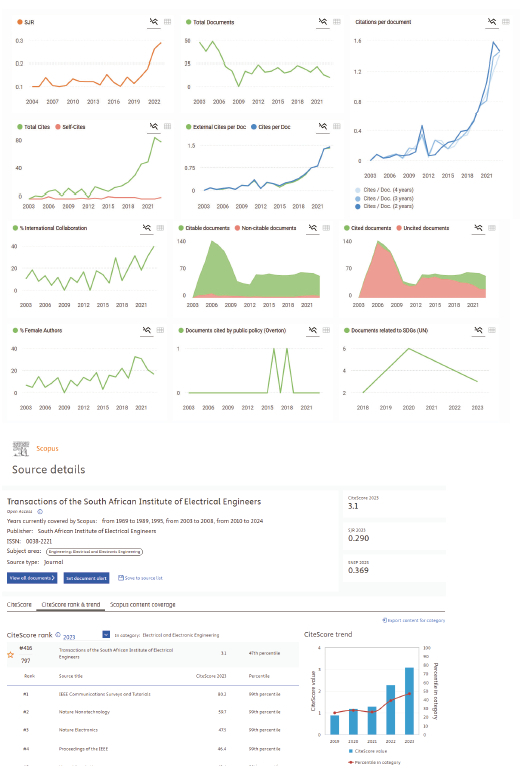
The SJR score has steadily increased over recent years, reflecting the journal's growing prestige and impact. The SJR, Scopus and related metrics are provided in the Annexure.
SJR Score Trends (2019-2023):
2019: 0.150
2020: 0.178
2021: 0.210
2022: 0.263
2023: 0.290
This growth signifies consistent improvement in the journal's academic influence and aligns with its commitment to publishing high-quality research.
B. Quartile Rankings
The journal advanced from Q4 in 2019 to Q3 by 2022 in the Electrical and Electronic Engineering category. This shift demonstrates the journal's enhanced reputation among peer-reviewed publications in this field.

Citations per Document
The journal's average number of citations per document has shown steady growth, highlighting the increasing relevance and impact of its published research.
Citations per Document Trends (2019-2023)
2019: 1.2 citations
2020: 1.4 citations
2021: 1.6 citations
2022: 2.1 citations
2023: 2.5 citations
This upward trend underscores the journal's role as a critical source of knowledge in electrical engineering and related disciplines.
International Collaboration
SCImago metrics also highlight the journal's increasing international reach:
Diverse Authorship: The journal has expanded its global authorship, featuring contributions from researchers across Africa and other continents.
Collaborative Impact: International collaborations have enriched the journal's content and broadened its relevance beyond South Africa, establishing it as a platform for global academic exchange.
Strategic Implications of SCImago Metrics
1. Improved Visibility : The consistent growth in SJR scores and citations per document enhances the journal's discoverability and appeal to researchers globally.
2. Validation of Quality: Inclusion in SCImago's database affirms the journal's adherence to international best practices in peer review and publication.
Below are some graphs representing the trends in SJR Scores and Citations (2019-2023):
These visuals illustrate the journal's upward trajectory, emphasizing its growing impact and academic standing.
VIII. Conclusion
The SAIEE Africa Research Journal exemplifies the importance of strategic partnerships, adherence to international publication standards, and a steadfast commitment to open access. Its inclusion in platforms like IEEE Xplore, Scopus, SciELO SA, and DOAJ, alongside continued recognition by DHET, establishes it as a trusted and impactful publication. The continued support of the IEEE Foundation and the growing participation of researchers across the globe highlight the journal's evolving role as a platform of scholarly excellence.