Narrative review: Continuous professional development training programmes in Africa and their limitations
Abstract
Continuous professional development (CPD) represents a cornerstone in the advancement of professional skills and knowledge across various sectors. It is globally recognised as a transformative process that unlocks potential, increases capacity, and fosters personal growth. This narrative review article aimed to understand how the CPD training programmes for laboratory professionals are implemented and sustained in Africa. A narrative review was conducted where a comprehensive search was conducted across PubMed, Embase, and web searches for white and/or grey literature, facilitated by a custom Python script. A combination of keywords, truncations, and subject headings targeted four key themes: Continuing professional development (and related terms), laboratory professionals, African countries, and aspects of implementation and scoring. The search was restricted to articles in English published from 2009 to 2024. While the actual training needs and gaps for CPD programmes are widely known, the actual implementation of CPD has remained a challenge. In the past, CPD training programmes have been implemented to address the lack of skills and the insufficient and skewed distribution of these health workers. This approach is not sustainable and has led to some challenges with coordination, quality assurance, and regulation. Each country has its unique context and training needs; therefore, CPD needs to be more coordinated and tailored so that professionals are given the right training for their needs. WHAT THIS STUDY ADDS: Addressing training gaps for laboratory professionals in Africa will require a well-structured, coordinated and tailored approach that will deliver a continent-wide CPD programme
Continuing professional development; laboratory professionals; training; African countries; health professional boards
Introduction
Medical laboratory professionals play a key role in the detection, diagnosis, and monitoring of diseases in today's healthcare environment.1,23,41,53,6,7,8,9
With the growing need for a competent work force, health professional boards around the globe are increasingly demanding that practitioners demonstrate their participation and commitment to continuous professional development (CPD). It will, therefore, be important that opportunities for CPD be made available and relevant to the cadre of healthcare professionals.10,11,1213
It is common practice, in many countries, that laboratory professionals need to be registered and licensed to practise - although implementation has varied across the African continent. Registration and licensure should be structured in a manner that includes new knowledge acquisition, skills and competence improvement given the ever-changing landscape of medical practice and technology. To promote and encourage the culture of learning, developed countries have adopted new strategies where remuneration increases and career growth for medical laboratory professionals are linked to participation in CPD programmes.14
Understanding the role of continuous professional development programmes
Continuous professional development represents a cornerstone in the advancement of professional skills and knowledge across various sectors, and is globally recognised as a transformative process that unlocks potential, increases capacity and fosters personal growth.15,16,1718,19,2021,22,2310,24,25,2627,28,2930ad hoc peer-to-peer trainings organised by employers.1031
One of the success factors for the implementation of CPD is that it should be driven by laboratory professionals themselves, employers, and training institutions, and should be well organised by national professional institutions, who are able to deliver well-structured CPD activities.24,3119,321930
Studies have highlighted the qualitative benefits of CPD, emphasising its role in improving service delivery and patient outcomes, particularly in the fields of HIV and tuberculosis, which are of high priority in sub-Saharan Africa.30,3324,33
As countries in Africa set up their own CPD programmes, harmonisation of these programmes across countries will be desirable and necessary to facilitate movement of laboratory professionals within the region as has been done in the European Union.341
Continuous professional development practice in Africa
Continuous professional development implementation for laboratory professionals in Africa presents a complex and varied picture. For instance, for the majority of African nations, the CPD activities predominantly fall under the umbrella of professional organisations. This includes a diverse array of entities such as medical associations, academies, professional bodies, government organisations, academic and training institutions, which are responsible for initiating, conducting, and promoting CPD programmes.353630
Research questions
This article aims at understanding how CPD training programmes for laboratory professionals are implemented and sustained in Africa. Specifically, it describes which African countries have mandatory CPD programmes and how they are implemented. We further explore the requirements that are essential for the effective deployment of CPD programmes in Africa. Lastly, we review what facilitates and hinders the implementation of CPD in Africa.
Methods
This study employed a narrative review where a comprehensive search was conducted across PubMed, Embase, and web-based grey literature repositories, utilising a custom Python script to automate query execution across multiple databases.37,38
The inclusion criteria involved all peer-reviewed or grey literature published from 2009 to 2024. Studies evaluating CPD models, implementation, impact, or challenges within African healthcare systems were included. These were both quantitative and qualitative evaluations of CPD programmes. The following were excluded: commentary articles, non-evaluative literature, and articles not in English. The process involved title/abstract screening, followed by full-text review. Data extracted included study characteristics, CPD intervention types, training duration, effectiveness outcomes, and barriers identified.
Experiences of continuous professional development programmes in Africa
Mandatory continuous professional development programmes and their implementation in Africa
Countries in Africa are at different levels of development for institutional support of promoting and encouraging human resource development through a CPD programme. While the actual training needs and gaps for CPD programmes are widely known - based on a few country surveys, the actual implementation of CPD has remained a challenge. For example, the full implementation of the policy for CPD in Nigeria that was established in 2012 is not yet well known. In Nigeria, it is noted that its implementation has been affected by lack of awareness by institutions and individual laboratory professionals themselves.26102710
To address this training need on quality management systems, a continent-wide CPD training programme called Stepwise Laboratory Quality Improvement Process Towards Accreditation (SLIPTA) was launched by the World Health Organization's Regional Office for Africa and other partners in 2011.23940
Another programme that was launched at the same time by World Health Organization's Regional Office for Africa and partners to address quality issues was the Strengthening Laboratory Management Toward Accreditation (SLMTA) programme. The SLMTA is a laboratory training programme with practical activities designed to equip laboratory professionals with skills and competencies for establishing and building quality management systems in laboratories that are working towards general quality improvement and/or international accreditation. The difference between the two programmes is that SLIPTA is a tool for auditing laboratories while SLMTA is a training and mentorship toolkit.39,41,.42,43,44,45,46
Despite the implementation of the SLIPTA and SLMTA programmes, challenges with achieving accreditation have persisted. A study in 2015 in Ethiopia and another study in Rwanda done in 2018 showed that inadequate skilled laboratory personnel in Ethiopia and lack of funding in Rwanda were found to be challenges in attaining accreditation and sustaining laboratory quality management systems.47,484948
Experiences in Malawi, Tanzania and South Africa noted that non-governmental organisations and other partners continue to coordinate, provide, track and monitor CPD activities.303030
Many African countries continue to struggle with the implementation of CPD training programmes. According to the 2015-2020 Health Sector Transformation plan in Ethiopia, the Federal Ministry of Health reported challenges in the implementation and actual realisation of the CPD programme in the country.5050501,1927
Essential requirements for effective deployment of continuous professional development programmes in Africa
According to several studies, limitations on utilisation of CPD range from time constraints, travel distance and perception of its importance.10,27,281010
The advent of online resources and learning opportunities have resulted in many professionals being able to conduct training in the comfort of their homes or in their offices. Over the last decade, the pace at which technology is changing in terms of patient management and diagnosis has led to professionals leaning towards online resources to be able to stay abreast. The online CPD programmes are considered to be cost effective as compared to being physically present at seminars or workshops.515129
Laboratory professionals are most likely to benefit from CPD programmes that allow them to return to their workplace and practise what they have learnt.303030
Factors that hinder implementation of continuous professional development programmes
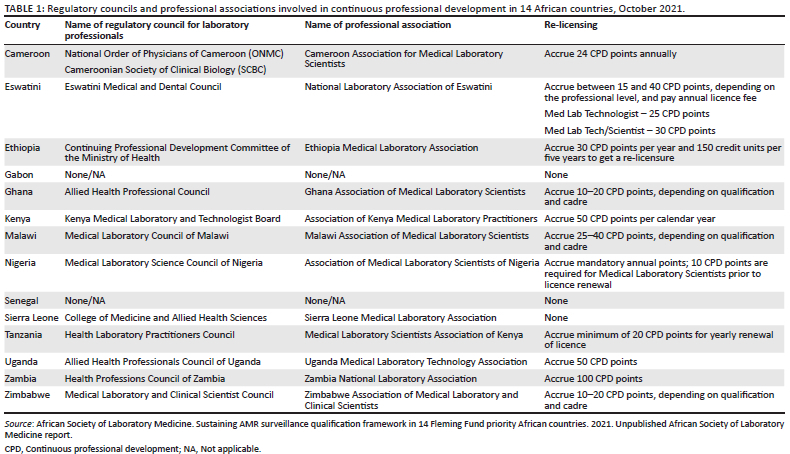
Many professional regulatory institutions in developing countries are now pushing for proper regulation and enforcement of CPD requirements for re-licensing.10101052Table 1). It is important to note that although 12 of the countries have documented guidelines on CPD requirements for laboratory professionals, the implementation of these requirements is still a work in progress, as most countries are still developing platforms to deliver accredited CPD programmes. Without funding and technical support, the countries will not be able to implement these CPD programmes.
This CPD project on the qualification framework aimed to equip the AMR surveillance workforce (microbiologists and epidemiologists) with the knowledge and skills to be able to implement key functions of the National AMR surveillance system and activities under the 'One Health' approach across 14 priority African countries and three Asian countries.52525252
Professional qualification and experience play a role in CPD attendance. In many developing countries, experiences show that differences in basic qualifications will also present unequal availability and opportunities to CPD programmes for laboratory professionals.3130303030
Health workers who are normally posted in rural and often neglected places face challenges related to travel distance, as well as a lack of communication and updates on upcoming CPD training opportunities.192424,3324
The current training packages designed and offered to increase the knowledge and skills of the recipients continue to face challenges with uptake. Instead of learning and skills development being owned and driven by the professionals themselves, learning is currently happening through a prescribed type of approach to training (top-down approach) and this has limited effects.185319
To scale up training on the continent and create a critical pool of well-trained laboratory professionals with the aim of improving laboratory quality, several critical factors need to be addressed in any CPD approach. Addressing these factors will require recognition that individuals prefer an environment of continuous education that has a flexible format, relevant content and is delivered at a convenient time, as participants have many other commitments. They prefer to drive their own learning, especially that which is applicable to their life and work environment. Lastly, CPD programmes will work well when the credit system is familiar and understood by the professionals. This is because participants can calculate the CPD points they can earn and, as a result, are able to chart their learning journey to achieving the requirements on credit units.5455
There are few studies that have defined and documented specific CPD training needs in Africa. Study results in Botswana and Ethiopia indicate that the preferred training areas for attention include technical, laboratory management, and leadership skills.10,28282728
Another important aspect has been whether CPD can improve the professional's working environment. Studies have observed that job satisfaction and retention are increased when well-designed CPD programmes are made available to professionals.565657
As already noted, one of the persistent barriers for many CPD programmes on the continent is funding. The scale, quality, effectiveness and reach of these CPD programmes will hinge on the availability of resources. On one hand, you have individual laboratory professionals without funding and resources to attend CPD opportunities. On the other hand, institutions are struggling to support, sponsor and meet some of these CPD training goals.3017171730192630
A new CPD programme launched under the ASLM Academy is envisioned to play a pivotal role in restructuring CPD in Africa by addressing the implementation challenges.58
Conclusion
In summary, implementation of CPD programmes in Africa remains a challenge. Linking CPD training to licensure and implementing mandatory CPD programmes will be critical in developing a well-skilled and up-to-date laboratory workforce.
Competing interests
The primary author, N.N., is the Chief Executive Officer of the African Society for Laboratory Medicine, and this manuscript will contribute to a PhD study. R.T.E. declares that he is an editor for the African Journal of Laboratory Medicine. The peer review process for this submission was handled independently, and the authors had no involvement in the editorial decision-making process for this manuscript. The authors have no other competing interests to declare.
Authors' contributions
N.N. was the principal investigator and was responsible for the conceptualisation, methodology development, data collection and review of articles, and writing the original manuscript. R.T.E. contributed to the conceptualisation and methodology approach and was also involved in the critical review and approved the final version to be published. A.E.Z. also contributed to the conceptualisation and methodology approach, and was involved in the critical review and approved the final version to be published.
Ethical considerations
This article followed all ethical standards for research without direct contact with human or animal subjects.
Sources of support
This research received no specific grant from any funding agency in the public, commercial, or not-for-profit sectors.
Data availability
The authors confirm that the data supporting the findings of this study are available within the article.
Disclaimer
The views and opinions expressed in this article are those of the authors and are the product of professional research. The article does not necessarily reflect the official policy or position of any affiliated institution, funder, agency, or that of the publisher. The authors are responsible for this article's results, findings, and content.
Acknowledgements
This article will partially contribute to the author's thesis entitled 'Strategies for Laboratory Continuous Professional Development in Africa Region' towards a PhD in the Department of Pathology, Division of Chemical Pathology, with supervisors Annalise E. Zemlin and Rajiv T. Erasmus.
References
-
1. Gebregzabher E, Tesfaye F, Cheneke W, Negesso AE, Kedida G. Continuing professional development (CPD) training needs assessment for medical laboratory professionals in Ethiopia. Hum Resour Health. 2023;21:47. https://doi.org/10.1186/s12960-023-00837-1
» https://doi.org/10.1186/s12960-023-00837-1 -
2. Nkengasong J. Strengthening laboratory services and systems in resource-poor. Am J Clin Pathol. 2009;131(6):774. https://doi.org/10.1309/AJCP8GYX8KTKDATZ
» https://doi.org/10.1309/AJCP8GYX8KTKDATZ - 3. Schneidman M, Dacombe J, Carter J. Laboratory proessionals in Africa: The backbone of quality diagnostics. Washington, DC: World Bank; 2014.
-
4. Peter T, Rotz P, Blair D, et al. Impact of laboratory accreditation on patient and health systems. Am J Clin Pathol. 2010;134(4):550-555. https://doi.org/10.1309/AJCPH1SKQ1HNWGHF
» https://doi.org/10.1309/AJCPH1SKQ1HNWGHF -
5. Taylor J, Thompson P, Genzen J, Hickner J, Marques M. Opportunities to enhance laboratory professionals' role on the diagnostic team. Lab Med. 2017;48(1):97-103. https://doi.org/10.1093/labmed/lmw048
» https://doi.org/10.1093/labmed/lmw048 -
6. Kiwanuka S, Namuhani N, Akulume M, Kalyesubula S, Bazeyo W, Kisakye A. Uganda's laboratory human resource in the era of global health initiatives: Experiences, constraints and opportunities - An assessment of 100 facilities. Hum Resour Health. 2020;18(1):13. https://doi.org/10.1186/s12960-020-0454-5
» https://doi.org/10.1186/s12960-020-0454-5 -
7. Nayupe S, Mbulaje P, Munharo S, Patel P, Lucero-Prisno D. Medical laboratory practice in Malawi - Current status. Afr J Lab Med. 2023;12(1):1921, 2023. https://doi.org/10.4102/ajlm.v12i1.1921
» https://doi.org/10.4102/ajlm.v12i1.1921 -
8. Elbireer A, Opio A, Brough R, Jackson J, Manabe Y. Strengthening public laboratory service in sub-Saharan Africa: Uganda case study. Lab Med. 2011;42(7):19-25. https://doi.org/10.1309/LM2OBNYY9D0UXZJO
» https://doi.org/10.1309/LM2OBNYY9D0UXZJO -
9. Nkengasong J, Nsubuga P, Nwanyanwu O, et al. Laboratory systems and services are critical in global health: Time to end the neglect? Am J Clin Pathol. 2010;134(3):368-373. https://doi.org/10.1309/AJCPMPSINQ9BRMU6
» https://doi.org/10.1309/AJCPMPSINQ9BRMU6 -
10. Kasvosve I, Ledikwe J, Phumaphi O, et al. Continuing professional development training needs of medical laboratory personnel in Botswana. Hum Resour Health. 2014;12:46. https://doi.org/10.1186/1478-4491-12-46
» https://doi.org/10.1186/1478-4491-12-46 -
11. Naidoo K. Continuing professional development opinions and challenges experienced by radiographers in KwaZulu-Natal Province, South Africa. Afr J Health Prof Educ. 2018;10(4):210-214. https://doi.org/10.7196/AJHPE.2018.v10i4.1001
» https://doi.org/10.7196/AJHPE.2018.v10i4.1001 -
12. Ross K, Barr J, Stevens J. Mandatory continuing professional development requirements: What does this mean for Australian nurses. BMC Nurs. 2013;12:9. https://doi.org/10.1186/1472-6955-12-9
» https://doi.org/10.1186/1472-6955-12-9 -
13. Yam C, Griffiths S, Yeoh E. What helps and hinders doctors in engaging in continuous professional development? An explanatory sequential design. PLoS One. 2020;15(8):e0237632. https://doi.org/10.1371/journal.pone.0237632
» https://doi.org/10.1371/journal.pone.0237632 - 14. Lennon PA, Deleon E, Reynolds A, et al. A model for rewarding professional growth in the diagnostic molecular oncology laboratory. J Assoc Genet Technol. 2011;37(2):80-83.
-
15. CIPD. CIPD [homepage on the Internet]. 2024 [cited 2024 May]. Available from: https://www.cipd.org/en/learning/cpd/cycle/
» https://www.cipd.org/en/learning/cpd/cycle/ -
16. Peck C, McCall M, McLaren B, Rotem T. Continuing medical education and continuing professional development: International comparisons. BMJ. 2000;320(7232):432-435. https://doi.org/10.1136/bmj.320.7232.432
» https://doi.org/10.1136/bmj.320.7232.432 -
17. Mulvey R. How to be a good professional: existentialist continuing professional development (CPD). Br J Guid Counsel. 2013;41(3):267-276. https://doi.org/10.1080/03069885.2013.773961
» https://doi.org/10.1080/03069885.2013.773961 -
18. Filipe HP, Silva ED, Stulting A, Golnik KC. Continuing professional development: Best practices. Middle East Afr J Ophthalmol. 2014;21(2):134-141. https://doi.org/10.4103/0974-9233.129760
» https://doi.org/10.4103/0974-9233.129760 -
19. Negussie A, Sisay A, Shibabaw A, et al. Perceptions, attitudes, and challenges regarding continuing professional development among Ethiopian Medical Laboratory professionals: A mixed-method study. medRxiv. 2024. https://doi.org/10.1101/2024.02.04.24302318
» https://doi.org/10.1101/2024.02.04.24302318 -
20. Iliffe J. Developing a national continuing professional development framework. Afr J Midwif Women's Health. 2011;5(4):123-128. https://doi.org/10.12968/ajmw.2011.5.4.189
» https://doi.org/10.12968/ajmw.2011.5.4.189 -
21. Ndlovu N, Mataka A, Lombard C, Erasmus T, Zemlin E. Survey and situation analysis of personal, employer-related, and environmental factors affecting participation in continuous professional development (CPD) programs of laboratory professionals in Africa. Am J Clin Pathol. 2024;161(4):360-368. https://doi.org/10.1093/ajcp/aqad154
» https://doi.org/10.1093/ajcp/aqad154 - 22. Goulet F, Hudon E, Gagnon R, Gauvin E, Lemire F, Arsenaul I. Effects of continuing professional development on clinical performance. Can Fam Physician. 2013;59:518-525.
-
23. IBMS. Institute of biomedical science: What is CPD? [homepage on the Internet] IBMS; 2024 [cited 2024 May]. Available from: https://www.ibms.org/cpd/what-is-cpd/
» https://www.ibms.org/cpd/what-is-cpd/ -
24. Marinucci F. Framework for distance training of laboratory professionals in sub-Saharan Africa. Letters to the Editor [homepage on the Internet]. Education for Health; 2020 [cited 2024 May]. Available from: http://www.educationforhealth.net
» http://www.educationforhealth.net -
25. Brand CA. A continuous professional development framework for medical laboratory technologist/technicians in South Africa [homepage on the Internet]. 2006 [cited 2024 May]. Available from: https://ir.cut.ac.za/handle/11462/57
» https://ir.cut.ac.za/handle/11462/57 -
26. Ifeoma E, Rebecca E, Ezekiel O, et al. A cross-sectional study of the knowledge and attitude of medical laboratory personnel regarding continuing professional development. Niger Med J. 2015;56(6):425-428. https://doi.org/10.4103/0300-1652.171617
» https://doi.org/10.4103/0300-1652.171617 -
27. Essuman M, Addy N, Essien-Baidoo S, et al. Self-reported continuing professional development needs of medical laboratory professionals in Ghana. Hum Resour Health. 2023;21(1):74. https://doi.org/10.1186/s12960-023-00859-9
» https://doi.org/10.1186/s12960-023-00859-9 -
28. Yadeta T, Mohammed A, Alemu A, Behir K, Balis, B, Letta S. Utilization of continuous professional development among health professionals in East Ethiopia: A multi-health facility-based cross-sectional study. BMC Med Educ. 2024;24(1):61. https://doi.org/10.1186/s12909-024-05036-7
» https://doi.org/10.1186/s12909-024-05036-7 -
29. Feldacker C, Jacob S, Chung M, Nartker A, Kim H. Experiences and perceptions of online continuing professional development among clinicians in sub-Saharan Africa. Hum Resour Health. 2017;15:1-8. https://doi.org/10.1186/s12960-017-0266-4
» https://doi.org/10.1186/s12960-017-0266-4 -
30. Feldacker C, Pintye J, Jacob S, et al. Continuing professional development for medical, nursing, and midwifery cadres in Malawi, Tanzania and South Africa: A qualitative evaluation. PLoS One. 2017;12(10):e0186074. https://doi.org/10.1371/journal.pone.0186074
» https://doi.org/10.1371/journal.pone.0186074 -
31. Topic E, Beletic A, Zima T. Continuing professional development crediting system for specialists in laboratory medicine within 28 EFLM national societies. Biochem Med (Zagreb). 2016;23(3):332-341. https://doi.org/10.11613/BM.2013.041
» https://doi.org/10.11613/BM.2013.041 -
32. EPHI, MoH, ICF. Ethiopian Public Health Institute (EPHI) [Ethiopia], Ministry of Health (MoH) [Ethiopia], and ICF. Ethiopia Service Provision Assessment 2021-22 Final Report. Addis Ababa: International Institute For Primanry Health Care - Ethiopia; 2023. http://repository.iphce.org/handle/123456789/258833.
» http://repository.iphce.org/handle/123456789/258833 -
33. Khan A. Continuing professional development (CPD); what should we do? Bangladesh J Med Educ. 2010;1(1):37-44. https://doi.org/10.3329/bjme.v1i1.12857
» https://doi.org/10.3329/bjme.v1i1.12857 -
34. Jan M, Buttigieg D, Silhavik J, et al. Enhance it - Enhancing hospital laboratory standards for continuing professional development: Transnational evaluation of a novel CPD activity for biomedical scientists. Am J Educ Res. 2014;2(11):1110-1114. https://doi.org/10.12691/education-2-11-18
» https://doi.org/10.12691/education-2-11-18 - 35. Anshu, Singh T. Continuing professional development of doctors. Natl Med J India. 2017;30(2):89-92.
-
36. KMPDC. Integrated CPD management system [homepage on the Internet]. Kenya Medical Practitioners and Dentist Council; 2024 [cited 2024 May]. Available from: https://www.medicalcpd.africa/; https://cpd.icpdkenya.org/
» https://www.medicalcpd.africa/ -
37. Sukhera J. Narrative reviews: Flexible, rigorous, and practical - Special article. J Grad Med Educ. 2022;14(4):414-417. https://doi.org/10.4300/JGME-D-22-00480.1
» https://doi.org/10.4300/JGME-D-22-00480.1 -
38. Embase [homepage on the]. [cited 2024]. Available from: https://www.embase.com/landing?status=grey.
» https://www.embase.com/landing?status=grey -
39. Ndihokubwayo J, Maruta T, Ndlovu N, et al. Implementation of the World Health Organization Regional Office for Africa Stepwise Laboratory Quality Improvement process towards accreditation. Afr J Lab Med. 2016;1(5):280. https://doi.org/10.4102/ajlm.v5i1.280
» https://doi.org/10.4102/ajlm.v5i1.280 -
40. WHO AFRO SLIPTA program implementation updates [homepage on the Internet]. [cited 2024 Feb 17]. Available from: https://aslm.org/resource/slipta-map/
» https://aslm.org/resource/slipta-map/ -
41. Datema T, Oskam L, Van Beers S, Klatser P. Critical review of the Stepwise Laboratory Improvement Process Towards Accreditation (SLIPTA): Suggestions for harmonization, implementation and improvement. Trop Med Int Health. 2012;17(3):361-367. https://doi.org/10.1111/j.1365-3156.2011.02917.x
» https://doi.org/10.1111/j.1365-3156.2011.02917.x -
42. Maruta T, Motebang D, Mathabo L, Rotz P, Wanyoike J, Peter T. Impact of mentorship on WHO-AFRO Strengthening Laboratory Quality Improvement Process Towards Accreditation (SLIPTA). Afr J Lab Med. 2012;1(1):6. https://doi.org/10.4102/ajlm.v1i1.6
» https://doi.org/10.4102/ajlm.v1i1.6 -
43. Mothabeng D, Maruta T, Lebina M, Lewis K, Wanyoike J, Mengstu Y. Strengthening laboratory management towards accreditation: The Lesotho experience. Afr J Lab Med. 2012;1(1):9,. https://doi.org/10.4102/ajlm.v1i1.9
» https://doi.org/10.4102/ajlm.v1i1.9 -
44. Yao K, Maruta T, Luman E, Nkengasong J. The SLMTA program: Transforming the laboratory landscape in developing countries. Afr J Lab Med. 2014;3(3):194. https://doi.org/10.4102/ajlm.v3i2.194
» https://doi.org/10.4102/ajlm.v3i2.194 -
45. Guevara G, Gordon F, Irving Y, et al. The impact of SLMTA in improving laboratory quality systems in the Caribbean Region. Afr J Lab Med. 20143(2):199. https://doi.org/10.4102/ajlm.v3i2.199
» https://doi.org/10.4102/ajlm.v3i2.199 -
46. Maruta T, Yao K, Ndlovu N, Moyo S. Training-of-trainers: A strategy to build country capacity for SLMTA expansion and sustainability. Afr J Lab Med. 2014; 3(2):196. https://doi.org/10.4102/ajlm.v3i2.196
» https://doi.org/10.4102/ajlm.v3i2.196 -
47. Desalegn D, Taddese B, Yemanebrhane N, et al. Medical laboratory accreditation in a resource-limited district health centre laboratory, Addis Ababa, Ethiopia. Afr J Lab Med. 2019;8(1):793. https://doi.org/10.4102/ajlm.v8i1.793
» https://doi.org/10.4102/ajlm.v8i1.793 -
48. Rusanganwa V, Gahutu J, Evander M, Hurtig A. Clinical referral laboratory personnel's perception of challenges and strategies for sustaining the laboratory quality management system. Am J Clin Pathol. 152(6):725-734. https://doi.org/10.1093/ajcp/aqz092
» https://doi.org/10.1093/ajcp/aqz092 -
49. Moyo H. Incorporating SLMTA in pre-service training pre-service training [homepage on the Internet]. 2016 [cited 2024 Nov 25]. Available from: https://www.slmta.org/uploads/category_file/39/1.12%20-%20Integrating%20SLMTA%20into%20Pre-service%20the%20Malawi%20experience.pdf
» https://www.slmta.org/uploads/category_file/39/1.12%20-%20Integrating%20SLMTA%20into%20Pre-service%20the%20Malawi%20experience.pdf - 50. MoH Ethiopia. Health Sector Transformation Plan 2015/16-2019/20. Addis Ababa, Ethiopia: Ministry of Health; 2015.
- 51. Byungura J, Nyiringango G, Fors U. Online learning for continuous professional development of healthcare workers: An exploratory study on perceptions of healthcare managers in Rwanda. BMC Med Educ. 2022; 22.
- 52. African Society of Laboratory Medicine. Sustaining AMR surveillance qualification framework in 14 Fleming Fund priority African countries. 2021. Unpublished African Society of Laboratory Medicine report.
- 53. Campos-Zamora M, Gilbert H, Esparza-Perez R, et al. Continuing professional development challenges in a rural setting: A mixed-methods study. Perspect Med Educ.2022;11(5):273-280.
-
54. The CPD certification Service [homepage on the Internet]. [cited 2023 May 20]. Available from: https://cpduk.co.uk/news/cpd-points-units-credit
» https://cpduk.co.uk/news/cpd-points-units-credit -
55. Schostak J, Davis M, Hanson J, et al. Effectiveness of continuing professional development project: A summary of findings. Med Teach. 2010;32(7):586-592. https://doi.org/10.3109/0142159X.2010.489129
» https://doi.org/10.3109/0142159X.2010.489129 -
56. Marinucci F, Majigo M, Wattleworth M, et al. Factors affecting job satisfaction and retention of medical laboratory professionals in seven countries of sub-Saharan Africa. Hum Resour Health. 2013;11:38. https://doi.org/10.1186/1478-4491-11-38
» https://doi.org/10.1186/1478-4491-11-38 - 57. Giri K, Frankel N, Tulenko K, Puckett A, Bailey R, Ross H. Keeping up to date: Continuing professional development for health workers in developing countries. Technical brief 6. CapacityPlus. Washington DC: IntraHealth International, Inc., 2012.
-
58. ASLM. African Society for Laboratory Medicine Academy [homepage on the Internet]. ASLM; 2024 [cited 2024 May]. Available from: https://aslm.org/aslm-academy/
» https://aslm.org/aslm-academy/

Accepted: 18 Feb. 2025
Published: 16 May 2025