Performance of Xpert® MTB/RIF among tuberculosis outpatients in Lilongwe, Malawi
Abstract
BACKGROUND: Xpert® MTB/RIF is a molecular test for the detection of Mycobacterium tuberculosis and rifampicin resistance. It is considered to be a great advance over smear microscopy and culture. However, there is very little information regarding the performance characteristics of Xpert MTB/RIF in Malawi. OBJECTIVE: We aimed to evaluate the performance of Xpert MTB/RIF in a Malawian setting. METHODS: Stored sputum pellets were processed on Xpert MTB/RIF between June 2012 and May 2014. Results were compared to mycobacteria growth indicator tube and Löwenstein-Jensen cultures, LED fluorescent microscopy and GenoType® MTBDRplus assay. Rifampicin resistance was confirmed by DNA sequencing. RESULTS: Of the 348 specimens with valid Xpert MTB/RIF results, 129/348 (37%) were smear-positive and 198/348 (57%) were culture-positive. Xpert MTB/RIF demonstrated a sensitivity of 93.8% (95% CI 89.4% - 96.8%) and specificity of 97.4% (95% CI 93.5% - 99.3%), with a positive predictive value of 97.8% (95% CI 94.6% - 99.4%) and a negative predictive value of 92.6% (95% CI 87.4% - 96.1%). Xpert MTB/RIF correctly identified 185/186 (99.5%) rifampicin-sensitive and 2/2 (100%) rifampicin-resistant M. tuberculosis strains. Mutations were not detected by sequencing in one isolate which was rifampicin resistant on Xpert MTB/RIF but sensitive on MTBDRplus. Four non-tuberculous mycobacteria grew from four smear-negative specimens, namely, M. avium (n = 1) and M. intracellulare (n = 3). No cross-reactivity was observed with any of the non-tuberculous mycobacteria when using Xpert MTB/RIF. CONCLUSION: When fully implemented, Xpert MTB/RIF may have an impact on patient care in Malawi. The increased diagnostic yield of Xpert MTB/RIF over smear microscopy can increase laboratory-confirmed tuberculosis detection and ensure that treatment is given to appropriate individuals or groups.
Introduction
Tuberculosis remains a major health challenge that has worsened with the emergence of multi-drug resistant (MDR) tuberculosis strains that are resistant to rifampicin and isoniazid. Globally, the impact of tuberculosis is significant, with an annual estimate of 9.6 million tuberculosis cases and over 1.5 million deaths due to tuberculosis in 2014.121
Malawi has a high HIV burden, with an estimated one million HIV-positive people. The major cause of morbidity and mortality of people living with HIV is tuberculosis. It is estimated that of all tuberculosis cases, 41% are smear-negative and 64% are HIV co-infected.33,4® MTB/RIF (Cepheid, Sunnyvale, California, United States), could benefit smear-negative patients in countries like Malawi, where culture is limited to the National Tuberculosis Reference Laboratory. Currently, the Malawi National Tuberculosis Programme (NTP) is using Xpert MTB/RIF to increase tuberculosis case detection and to detect rifampicin resistance as a proxy for MDR tuberculosis followed by culture (liquid and solid) and drug-susceptibility testing (DST) as confirmatory tests.2
DST is not routinely performed in Malawi, with the exception of retreatment cases and individuals at risk for MDR tuberculosis.351
The Xpert MTB/RIF can both detect tuberculosis and identify rifampicin resistance in a single, rapid assay,6,7Mycobacterium tuberculosis and rifampicin resistance.6,86,91,7710
The Malawi NTP recommended rolling out Xpert MTB/RIF in 2012 to increase detection of tuberculosis, especially in sputum smear-negative and HIV-positive individuals. While Xpert MTB/RIF has been approved for clinical use, its optimal use in the clinical algorithm for Malawi has not been established. There are currently over 50 GeneXpert® instruments distributed across 40 of the 315 public and private diagnostic centres (laboratories) with acid-fast bacilli testing capacity in the country.2
In this study, we evaluated the performance of Xpert MTB/RIF in detecting M. tuberculosis complex and determining resistance to rifampicin among both HIV-positive and HIV-negative outpatients at Bwaila Hospital in Lilongwe, Malawi.
Methods
Ethical considerations
Approvals for this study were granted by the University of the Witwatersrand Human Research Ethics Committee (M120256), National Health Sciences Research Committee (NHSRC) in Malawi (NHSRC # 999) and the University of North Carolina (Chapel Hill) Institutional Review Board (CID 1211).
Laboratory methodologies
We used frozen stored sputum pellets (n = 351) obtained from an observational cohort study which collected 702 samples between April 2011 and July 2012 at Bwaila in Lilongwe, Malawi. The study was looking at the prevalence of drug-resistant tuberculosis among adult outpatients (≥ 18 years) with laboratory-confirmed or clinically-diagnosed tuberculosis registering for tuberculosis treatment at this HIV/tuberculosis clinic.11M. tuberculosis on either of the media and negative if both media were negative. Drug susceptibility was investigated using the GenoType® MTBDRplus assay (version 2) (Hain Lifesciences GmbH, Nehren, Germany). Data collected from the above processes were included with data in this evaluation.
Xpert MTB/RIF
Samples for Xpert MTB/RIF testing were prepared as per manufacturer's instructions. Sample reagent was added to 500 µL of the re-suspended pellet in the ratio of 3:1 (sample reagent:specimen) as described previously.12
DNA extraction
Genomic bacterial DNA was extracted using a GenoLyse® kit (Hain Lifescience GmbH, Nehren, Germany) from mycobacteria growth indicator tube liquid media by transferring 1.0 mL to a Sarstedt micro-centrifuge tube. The tube was centrifuged for 15 minutes at 14 000 rpm. The supernatant was carefully removed and the pellet was re-suspended in 100 µL lysis buffer, vortexed thoroughly and incubated for five minutes at 95°C in a heating block. At the end of the five-minute incubation, tubes were briefly centrifuged to remove condensation. Neutralization buffer (100 µL) was added to each tube, vortexed for five seconds and then centrifuged for five minutes at 14 000 rpm. Supernatant was transferred to a new tube and the pellet discarded. Samples were stored at -80°C for use as DNA template.
Line probe assays
The GenoType® MTBDRplus (version 2) (Hain Lifesciences GmbH, Nehren, Germany) was performed on positive culture isolates according to manufacturer's instructions to identify M. tuberculosis complex and to determine drug susceptibility to rifampicin and isoniazid as described previously.13® CM (Hain Lifesciences GmbH, Nehren, Germany) was used to identify other common Mycobacterium species in samples which tested negative for M. tuberculosis complex on GenoType MTBDRplus.
PCR and DNA sequencing for the rifampicin resistance determining region
Determination of eligibility for DNA sequencing was based on detection of resistance to rifampicin by Xpert MTB/RIF. All eligible M. tuberculosis strains were shipped to the HIV Genotyping Laboratory (University of the Witwatersrand) and were processed as described below.
DNA amplification
Amplification of the 450 bp rpoB gene fragment which included the rifampicin resistance determining region was carried out by using forward primer rpoBF2 (5'-GAG GGT CAG ACC ACG ATG AC-3') and reverse primer rpoBR2 (5'-GAG CCG ATC AGA CCG ATG T-3') in a GeneAmp PCR system 9700 thermocycler (Applied Biosystems, Foster City, California, United States). The total volume of the reaction mix was 50 µL, which contained 5 µL of 10X high fidelity buffer, 1 µL of 10 mM dNTP mix, 2 µL of 50 mM MgSO4, 1 µL of each primer, 0.2 µL of Taq HiFi (Invitrogen, Carlsbad, California, United States), 36.8 µL of molecular grade water and 3 µL of genomic DNA. Amplification conditions were set as follows: 94°C for 2 minutes (initial denaturation); followed by 35 cycles of 94°C for 30 seconds, 55°C for 30 seconds, 68°C for 40 seconds; followed by a 10-minute final elongation at 68°C. Amplified products were visualised on a 1% agarose gel after staining with ethidium bromide.
Sequencing
PCR products, after purification by GeneJet PCR purification kit (Thermo Scientific, Waltham, Massachusetts, United States), were subjected to DNA sequencing by automated DNA sequencer (ABI 3700, Applied Biosystems, Foster City, California, United States). PCR sequencing was carried out with a BigDye terminator V3.1 sequencing kit according to manufacturer's instructions, using forward primer rpoBS (5'-GCA GAC GTT GAT CAA CAT CC-3') and reverse primer rpoBR2 (5'-GAG CCG ATC AGA CCG ATG T-3'). The resulting sequences were analysed using Sequencher software V4.8 (Genecodes Corporation, Ann Arbor, Michigan, United States).
Statistical analysis
All data were double entered into a Microsoft Excel spreadsheet (Microsoft, Redmond, Washington, United States). Discrepancies were checked against source records for completeness and consistency. Data analyses were done in Stata Version 12 (StataCorp, College Station, Texas, United States). The following statistics were calculated: sensitivity, specificity, positive predictive value (PPV), negative predictive value (NPV) and 95% confidence intervals (CI). Mycobacterium culture was considered the reference standard.
Results
A total of 351 sputum pellets were processed both on culture and Xpert MTB/RIF. However, only 348 sputum pellets had valid Xpert MTB/RIF results. The remaining three samples were not included in the final analysis due to an error (n = 1) and an invalid result (n = 2) on Xpert MTB/RIF. Of the 348 sputum pellets, 200 (57%) were from HIV-positive individuals, and 148 (43%) were HIV-negative. Among all samples, 219/348 (63%) were smear-negative and 129/348 (37%) were smear-positive. As shown in Table 1, 70/219 (32%) of smear-negative and 128/129 (99.2%) of smear-positive samples were culture positive.
Xpert MTB/RIF detected M. tuberculosis in 58/219 (27%) of smear-negative and 127/129 (98.5%) smear-positive cases. Xpert MTB/RIF correctly detected M. tuberculosis in 181/198 (91.4%) of the culture-positive samples. Of the remaining 17 samples, 1/198 (0.5%) was positive while 16/198 (8.1%) were negative for acid-fast bacilli on smear microscopy. A total of 150 samples were culture-negative regardless of their smear status. Among the 150 culture-negative samples, M. tuberculosis was detected by Xpert MTB/RIF in four (2.7%) samples which were smear-negative on microscopy. Xpert MTB/RIF did not detect M. tuberculosis in 12/70 (17%) of smear-negative, culture-positive samples. We further observed that 145/219 smear-negatives were culture negative and Xpert MTB/RIF negative. Out of these, 93/145 (64%) were from HIV-positive individuals. Four non-tuberculous mycobacteria grew from a total of four smear-negative specimens: M. avium (n = 1) and M. intracellulare (n = 3). No cross reactivity was observed with any of the non-tuberculous mycobacteria when using Xpert MTB/RIF (Table 1).
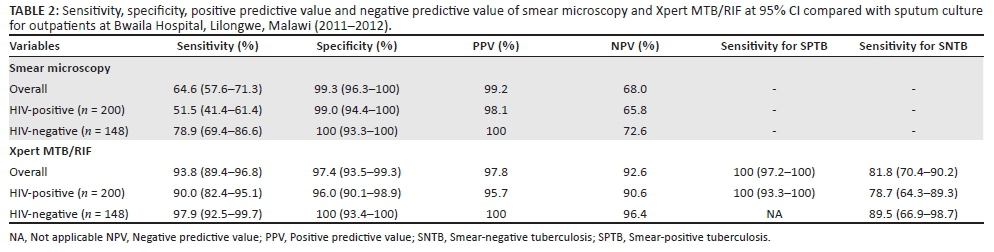
When compared to culture, the overall sensitivity for Xpert MTB/RIF was 93.8% (95% CI 89.4% - 96.8%) and specificity was 97.4% (95% CI 93.5% - 99.3%), with PPV of 97.8% (95% CI 94.6% - 99.4%) and NPV of 92.6% (95% CI 87.4% - 96.1%). Among smear-negative individuals, the overall sensitivity of Xpert MTB/RIF was 81.8% (95% CI 70.4% - 90.2%) and specificity was 97.4% (95% CI 93.4% - 99.3%), with PPV of 93.1% (95% CI 83.3% - 98.1%) and NPV of 92.5% (95% CI 87.3% - 96.1%) (Table 2).
Stratified by HIV status, sensitivity for smear microscopy was 78.9% (95% CI 69.4% - 86.6%) among HIV-negative individuals, with a specificity of 100% (95% CI 93.3% - 100%). Among HIV-positive individuals, sensitivity was 51.5% (95% CI 41.4% - 61.4%) and specificity was 99.0% (95% CI 94.4% - 100%). The sensitivity (90%; 95% CI 82.4% - 95.1%) and specificity (96%; 95% CI 90.1% - 98.9%) of Xpert MTB/RIF were lower in HIV-positive individuals, with PPV of 95.7% (95% CI 89.5% - 98.8%) and NPV of 90.6% (95% CI 83.3% - 95.4%). This was compared to HIV-negative participants, which showed a sensitivity of 97.9% (95% CI 92.5% - 99.7%) and specificity of 100% (95% CI 93.4% - 100%), with PPV of 100% (95% CI 96.1% - 100%) and NPV of 96.4% (95% CI 87.7% - 99.6%). Among smear-negative, HIV-positive individuals, the sensitivity of Xpert MTB/RIF was 78.7% (95% CI 64.3% - 89.3%) with a specificity of 96% (95% CI 90% - 98.9%) (Table 2).
DST using GenoType MTBDRplus was performed on 188/348 tuberculosis strains. When compared to Genotype MTBDRplus, Xpert MTB/RIF correctly identified 185 of 186 (99.5%) rifampicin-sensitive M. tuberculosis and 2/2 (100%) rifampicin-resistant M. tuberculosis. A single point mutation was detected in each of the two rifampicin-resistant strains (S531L and D516V). It was observed that for both strains, the corresponding Xpert MTB/RIF probes gave cycle threshold (Ct) value = 0 and were also detected as resistant to rifampicin by GenoType MTBDRplus line probe assay. One (0.5%) smear-negative, culture-positive tuberculosis strain was resistant on Xpert MTB/RIF but sensitive on GenoType MTBDRplus (Table 3). A delayed amplification on probe B was observed in this strain, with a Ct value of 24.4. Further testing on the isolate using DNA sequencing revealed no rpoB gene mutation.
Discussion
In the present study, the Xpert MTB/RIF assay detected 58 more tuberculosis cases than smear microscopy. The paucibacillary nature of samples cultured from tuberculosis/HIV co-infected individuals revealed a more serious inability to detect tuberculosis using smear microscopy than was the case for Xpert MTB/RIF. Among HIV-positive individuals registering for tuberculosis treatment, a relatively larger percentage of those who were smear-negative, were also Xpert MTB/RIF and culture negative, and thus had no laboratory confirmation of disease. Overall analysis revealed expected results using the Xpert MTB/RIF assay, proving more sensitive and specific than fluorescent microscopy in detecting M. tuberculosis when using culture as the reference standard and there was no overlap of the confidence intervals. The sensitivity of Xpert MTB/RIF was lower in HIV-positive than in HIV-negative individuals. The Xpert MTB/RIF correctly distinguished M. tuberculosis from non-tuberculous mycobacteria. Among the non-tuberculous mycobacteria, three were isolated from HIV-positive individuals, and one was from an HIV-negative individual.
Findings from our study are in agreement with studies by Rahman et al.1415plus for the detection of rifampicin susceptibility. Other studies have shown results in which rifampicin resistance was detected with a specificity of 100% and sensitivity of 99.1%.16,1718
The sensitivity of Xpert MTB/RIF (93.8%) observed in this study is in contrast to Dorman et al. and Geleta et al., who reported 62.6 % in South Africa and 65.5% in Ethiopia when compared with culture.19,20
Prior studies have shown greater accuracy of Xpert MTB/RIF as compared to smear microscopy621,2223M. tuberculosis was not detected by Xpert MTB/RIF, were from HIV-positive individuals. This may be interpreted as significant incorrect diagnosis of tuberculosis with a likelihood of treating people for tuberculosis who do not have the disease. It is therefore of paramount importance that steps should be taken to improve tuberculosis diagnosis to avoid exposing non-tuberculosis patients to the adverse effects of the tuberculosis medication. Misdiagnosis of tuberculosis can be a contributing factor to the high death rate observed in HIV-positive individuals globally.1
Our results are comparable to other studies which have shown that Xpert MTB/RIF increased tuberculosis case detection by almost 31%, despite its low sensitivity with smear-negative samples.2023
Results in this study show that Xpert MTB/RIF detected primary rifampicin resistance in 3/188 (1.6%) specimens. DNA sequencing of the rifampicin resistance determining region of the rpoB gene confirmed two mutations (S531L and D516V) and further helped to resolve the discordant result, since no mutation was detected. Mixed infection with multiple M. tuberculosis strains was excluded in this strain, given the wild-type rpoB gene sequence and no observed underlying peaks on the DNA sequence chromatogram. Prior studies demonstrated that DNA sequencing resolves discrepancies in favour of Xpert MTB/RIF,62
False resistance to rifampicin on Xpert MTB/RIF has been reported previously, although in some of the studies hetero-resistance could not be excluded, because neither cartridge amplicons nor unprocessed sputum were sequenced,17,2522267
The low rifampicin resistance detected in this study is similar to results obtained by Glynn et al., which identified 3/373 samples as resistant to rifampicin in Karonga, in the northern region of Malawi.271127,28
The Malawi NTP has phased in plans within the context of national strategic plan for tuberculosis to expand and maintain Xpert MTB/RIF as a primary test for active case finding at high-volume antiretroviral therapy services and among high risk and vulnerable populations. This will consequently lead to improved tuberculosis diagnosis and initiation of appropriate treatment to patients, thereby reducing the spread of tuberculosis and/or transmission of resistant strains in the country. Additionally, Xpert MTB/RIF offers to help in reducing the time lost in the diagnostic pathway and potential loss of patients at each step of the pathway.22
Limitations
With our limited sample size from a single outpatient location, the observed results may not apply across the country due to differences in the prevalence of HIV in rural districts. The relatively small number of patients with drug-resistant tuberculosis limits the ability to evaluate comparative performance of Xpert MTB/RIF. We recommend that future studies extend to other sites with an overall sample size and/or focus on evaluating Xpert MTB/RIF on raw sputum, since is it known that testing frozen stored specimens may influence results.29
In the current algorithm for Malawi, a residual specimen from the second sample of presumptive tuberculosis patients is tested on Xpert MTB/RIF if both samples are smear-negative. Xpert MTB/RIF is also performed on samples from all patients suspected of having MDR tuberculosis and retreatment cases, but not on new smear-positive cases.3
Conclusion
Our results demonstrate that Xpert MTB/RIF has the potential to increase the number of patients initiated early on appropriate treatment, given that additional tuberculosis cases were identified among smear-negative/culture-confirmed cases, one of which was resistant to rifampicin. It is expected that the use of Xpert MTB/RIF will offer a greater opportunity in increasing tuberculosis case detection among high-risk and vulnerable groups in Malawi where sputum smear microscopy is still widely used. We believe that results obtained by Xpert MTB/RIF may facilitate a proactive approach to tuberculosis by enhancing decisions towards treatment and ensuring that the tuberculosis programme is not treating people who do not have tuberculosis but are obviously sick. When this is achieved, it is anticipated that there will be a reduction in the burden of tuberculosis among people living with HIV.
Competing interests
The authors declare that they have no financial or personal relationship(s) that may have inappropriately influenced them in writing this article.
Source of support
This project was funded by the National Commission for Science and Technology (Malawi) through the Health Research Capacity Strengthening Initiative (HRCSI). Additional funds were made available by the UNC Project (Malawi), UNC Fogarty AITRP (D43 TW001039), UNC Centre for AIDS Research (P30 AI50410) and Malawi HIV Implementation Research Scientist Program (D43 TW010060).
Authors' contributions
T.C. conceptualised the study. B.B. and R.H.G. oversaw patient enrolment in the primary study. T.C., N.N. and I.T. performed the laboratory experiments. M.H., L.S., W.S., R.K., J.M. and I.F.H. oversaw the operational aspects of the study. T.C., N.E.R. and C.S. conducted the data analysis, and T.C. drafted the manuscript. All authors revised the manuscript and approved the final draft.
Acknowledgements
The authors thank the laboratory staff at UNC Project and the HIV genotyping laboratory at the University of the Witwatersrand for assisting with the study.
References
- 1. World Health Organization. Global tuberculosis report 2015. Geneva, Switzerland: WHO; c2015 [cited 2016 Jan 27].
- Available form: http://apps.who.int/iris/bitstream/10665/191102/1/9789241565059_eng.pdf
- 3. Malawi National Tuberculosis Programme. National tuberculosis control programme manual. 7th ed. Lilongwe, Malawi: Ministry of Health; 2012.
-
4. Rachow A, Zumla A, Heinrich N, et al. Rapid and accurate detection of Mycobacterium tuberculosis in sputum samples by Cepheid Xpert MTB/RIF assay-a clinical validation Study. PLoS One. 2011;6(6):e20458. https://doi.org/10.1371/journal.pone.0020458
» https://doi.org/10.1371/journal.pone.0020458 -
5. Van Rie A, Page-Shipp L, Scott L, et al. Xpert® MTB/RIF for point-of-care diagnosis of TB in high-HIV burden, resource-limited countries: hype or hope? Expert Rev Mol Diagn. 2010;10(7):937-946. https://doi.org/10.1586/erm.10.67
» https://doi.org/10.1586/erm.10.67 -
6. Boehme C, Nabeta P, Hillemann D, et al. Rapid molecular detection of tuberculsis and rifampin resistance. N Engl J Med. 2010;363(11):1005-1015. https://doi.org/10.1056/NEJMoa0907847
» https://doi.org/10.1056/NEJMoa0907847 -
7. Chang K, Lu W, Wang J, et al. Rapid and effective diagnosis of tuberculosis and rifampicin resistance with Xpert MTB/RIF assay: a meta-analysis. J Infect. 2012;64(6):580-588. https://doi.org/10.1016/j.jinf.2012.02.012
» https://doi.org/10.1016/j.jinf.2012.02.012 - 8. World Health Organization. Automated real-time nucleic acid amplification technology for rapid and simultaneous detection of tuberculosis and rifampicin resistance: Xpert MTB/RIF system: policy statement. Geneva, Switzerland: WHO; c2011 [cited 2011 Nov 07].
-
Available from: http://apps.who.int/iris/bitstream/10665/44586/1/9789241501545_eng.pdf
» https://doi.org/10.1093/trstmh/trv092 - 9. World Health Organization. Rapid implementation of the Xpert MTB/RIF diagnostic test: technical and operational 'how-to' practical considerations. WHO/HTM/TB/2011.2. Geneva, Switzerland: WHO; c 2011 [cited 2011 Nov 07].
-
Available from: http://apps.who.int/iris/bitstream/10665/44593/1/9789241501569_eng
» https://doi.org/10.1128/JCM.00521-07 -
10. Hanrahan CF, Clouse K, Bassett J, et al. The patient impact of point-of-care vs. laboratory placement of Xpert® MTB/RIF. Int J Tuberc Lung Dis. 2015 Jul;19(7):811-816. https://doi.org/10.5588/ijtld.15.0013
» https://doi.org/10.5588/ijtld.15.0013 -
12. Nicol MP, Workman L, Isaacs W, et al. Accuracy of the Xpert MTB/RIF test for the diagnosis of pulmonary tuberculosis in children admitted to hospital in Cape Town, South Africa: a descriptive study. Lancet Infect Dis. 2011;11(11):819-824. https://doi.org/10.1016/S1473-3099(11)70167-0
» https://doi.org/10.1016/S1473-3099(11)70167-0 -
14. Rahman A, Sahrin M, Afrin S, et al. Comparison of Xpert MTB/RIF assay and GenoType MTBDRplus DNA probes for detection of mutations associated with rifampicin resistance in Mycobacterium tuberculosis. PLoS One. 2016;11(4):e0152694. https://doi.org/10.1371/journal.pone.0152694
» https://doi.org/10.1371/journal.pone.0152694 -
15. Barnard M, Gey van Pittius NC, van Helden PD, et al. The diagnostic performance of the GenoType MTBDRplus version 2 line probe assay is equivalent to that of the Xpert MTB/RIF assay. J Clin Microbiol. 2012;50(11):3712-3716. https://doi.org/10.1128/JCM.01958-12
» https://doi.org/10.1128/JCM.01958-12 -
16. Kwak N, Choi SM, Lee J, et al. Diagnostic accuracy and turnaround time of the Xpert MTB/RIF assay in routine clinical practice. PLoS One. 2013;8(10):e77456. https://doi.org/10.1371/journal.pone.0077456
» https://doi.org/10.1371/journal.pone.0077456 -
17. Boehme CC, Nicol MP, Nabeta P, et al. Feasibility, diagnostic accuracy, and effectiveness of decentralised use of the Xpert MTB/RIF test for diagnosis of tuberculosis and multidrug resistance: a multicentre implementation study. Lancet. 2011;377(9776):1495-1505. https://doi.org/10.1016/S0140-6736(11)60438-8
» https://doi.org/10.1016/S0140-6736(11)60438-8 -
18. Steingart K, Schiller I, Horne DJ, et al. Xpert® MTB / RIF assay for pulmonary tuberculosis and rifampicin resistance in adults. Cochrane Database Syst Rev. 2014;1:CD009593. https://doi.org/10.1002/14651858.CD009593.pub3
» https://doi.org/10.1002/14651858.CD009593.pub3 -
19. Dorman SE, Chihota VN, Lewis JJ, et al. Performance characteristics of the Cepheid Xpert MTB/RIF test in a tuberculosis prevalence survey. PLoS One. 2012;7(8):e43307. https://doi.org/10.1371/journal.pone.0043307
» https://doi.org/10.1371/journal.pone.0043307 -
20. Geleta DA, Megerssa YC, Gudeta AN, et al. Xpert MTB/RIF assay for diagnosis of pulmonary tuberculosis in sputum specimens in remote health care facility. BMC Microbiol. 2015;15:220. https://doi.org/10.1186/s12866-015-0566-6
» https://doi.org/10.1186/s12866-015-0566-6 -
21. Scott LE, McCarthy K, Gous N, et al. Comparison of Xpert MTB/RIF with other nucleic acid technologies for diagnosing pulmonary tuberculosis in a high HIV prevalence setting: a prospective study. PLoS Med. 2011;8(7):1-11. https://doi.org/10.1371/journal.pmed.1001061
» https://doi.org/10.1371/journal.pmed.1001061 -
22. Theron G, Peter J, van Zyl-Smit R, et al. Evaluation of the Xpert MTB/RIF assay for the diagnosis of pulmonary tuberculosis in a high HIV prevalence setting. Am J Respir Crit Care Med. 2011;184(1):132-140. https://doi.org/10.1164/rccm.201101-0056OC
» https://doi.org/10.1164/rccm.201101-0056OC - 23. Hargreaves NJ, Kadzakumanja O, Whitty CJM, et al. 'Smear-negative' pulmonary tuberculosis in a DOTS programme: poor outcomes in an area of high HIV seroprevalence. Int J Tuberc Lung Dis. 2001;5(9):847-854.
-
24. van Kampen SC, Tursynbayeva A, Koptleuova A, et al. Effect of introducing Xpert MTB/RIF to test and treat individuals at risk of multidrug-resistant tuberculosis in Kazakhstan: a prospective cohort study. PLoS One. 2015;10(7):e0132514. https://doi.org/10.1371/journal.pone.0132514
» https://doi.org/10.1371/journal.pone.0132514 -
25. Van Rie A, Mellet K, John M, et al. False-positive rifampicin resistance on Xpert® MTB/RIF: case report and clinical implications. Int J Tuberc Lung Dis. 2013;16(2):206-208. https://doi.org/10.5588/ijtld.11.0395
» https://doi.org/10.5588/ijtld.11.0395 -
26. Marlowe EM, Novak-Weekley SM, Cumpio J, et al. Evaluation of the Cepheid Xpert MTB/RIF assay for direct detection of Mycobacterium tuberculosis complex from respiratory specimens. J Clin Microbiol. 2011;49(4):1621-1623. https://doi.org/10.1128/JCM.02214-10
» https://doi.org/10.1128/JCM.02214-10 - 27. Glynn JR, Jenkins PA, Fine PEM, et al. Patterns of initial and acquired antituberculosis drug resistance in Karonga District, Malawi. Lancet. 1995;345(8954):907-910.
- 28. Mitchison DA. Drug resistance in Mycobacteria. Br Med Bull. 1984;40:84-90.
-
29. Carriquiry G, Otero L, González-Lagos E, et al. A diagnostic accuracy study of Xpert® MTB/RIF in HIV-positive patients with high clinical suspicion of pulmonary tuberculosis in Lima, Peru. PLoS One. 2012;7(9):e44626. https://doi.org/10.1371/journal.pone.0044626
» https://doi.org/10.1371/journal.pone.0044626

Accepted: 13 Oct. 2016
Published: 31 Mar. 2017