Effects of pre-storage leukoreduction on erythrocyte concentrates and performance of newer generation leuko-filters at a tertiary care oncology hospital in Western India
Abstract
BACKGROUND: Leukoreduction is a post-processing technique that reduces residual leukocytes in cellular blood components. Previous studies have evaluated these parameters mainly among older generation leuko-filters OBJECTIVE: This study evaluated the immediate effects of pre-storage leukoreduction on red cell indices and the performance efficacy of two newer generation leuko-filters METHODS: This retrospective analysis collected quality control data before and after leukoreduction for erythrocyte concentrates (ECs) from laboratory registers from the Blood Transfusion Laboratory at the Advanced Centre for Treatment, Research and Education in Cancer in Mumbai, India, for the period January 2015 to December 2019. Data related to red cell indices and performance characteristics for Fresenius and Macopharma filters were included RESULTS: A total of 500 records was included in the study. All EC units demonstrated a 99.99% leukocyte log reduction, with both filters showing equal efficacy. Post-leukoreduction haemoglobin concentrations were lower than the pre-leukoreduction for all units (p < 0.001). Of those prepared from 350 mL units, 11.6% (28/240) had haemoglobin levels under 40 g/bag as compared to 1.1% (3/260) among those prepared from 450 mL units. All indices exhibited statistically significant changes after leukoreduction (p < 0.001) except for mean corpuscular haemoglobin (p = 0.215). The Fresenius filter required less time for leukoreduction compared to the Macopharma filter (p < 0.001 CONCLUSION: Red cell indices show several changes following leukoreduction. Further studies are needed to assess the microscopic and functional impact of leukoreduction. Leuko-filters vary in their performance characteristics, which may influence vendor selection What this study adds: This study found changes among several red cell indices after leukoreduction of ECs, which have not been extensively studied in previous literature. Further, we found that the newer generation leuko-filters differ in specific performance characteristics, which may influence vendor selection.
leukoreduction; red cell indices; quality control; whole blood; leuko-filter; red cell concentrate
Introduction
The field of transfusion medicine has experienced several challenging periods, which have culminated in the introduction of newer technological advancements to improve the safety of allogenic blood. Leukoreduction was one such paradigm shift in transfusion practices which gained momentum in the 1990s in response to the Variant Creutzfeldt-Jakob disease outbreak.12
Residual viable donor leukocytes are present in cellular blood components and have been implicated in several complications such as febrile, non-haemolytic transfusion reactions; human leukocyte antigen alloimmunisation and subsequent platelet transfusion refractoriness; transfusion related immuno-modulation; and transmission of infectious leukotropic agents such as cytomegalovirus and human T-lymphotropic virus I/II, and transfusion-associated graft-versus-host disease.345
Presently, leukoreduction is achieved via leuko-filters, comprising an external plastic housing which fits tightly around the filtration medium.267,85,9,10
Blood transfusion services in India are decentralised, with varying practices across the country. Leukoreduction is not a mandatory requirement in India. However, it may be implemented by the blood centre based on selective patient profiles. At our tertiary care oncology setup at the Department of Transfusion Medicine at the Advanced Centre for Treatment, Research and Education in Cancer in Mumbai, India, we cater to all types of oncology patients, and leukoreduced blood components are specifically indicated for haemato-oncology patients, since they are at risk of human leukocyte antigen alloimmunisation and future risk of poor transplant outcomes. In our current study, we assessed the immediate effects of pre-storage leukoreduction on red cell indices of ECs, and the performance efficacy of two newer-generation leuko-filters available at our centre.
Methods
Ethical considerations
This study was approved by the Institutional Ethics Committee-III at the Advanced Centre for Treatment, Research and Education in Cancer, Mumbai, India (Project number 900713 and Institutional Ethics Committee approval number 566/2020 dated 19 October 2020). Waiver of consent was approved for this study, since it involved technical anonymised data (not involving human or animal research) delinked from original blood donor records, not available in the public domain. These quality control (QC) records were maintained as hard copies, which were recorded in laboratory registers, and the complete blood count (CBC) printouts from the haematology analyser, which were filed and stored in locked cabinet sections in the component laboratory. Furthermore, access to these documents was restricted to the respective section staff, technical supervisors, and transfusion laboratory in-charge personnel.
Study design and setting
This retrospective analysis of leukoreduction QC records for ECs recorded from 01 January 2015 to 31 December 2019 was conducted at the Department of Transfusion Medicine (Blood Transfusion Laboratory) at the Advanced Centre for Treatment, Research and Education in Cancer, Mumbai, India. This hospital serves as a tertiary care oncology hospital catering to all types of cancer patients, including haemato-oncology. All EC units subjected to leukoreduction are prepared from whole blood which has been collected from voluntary blood donors in accordance with the national blood donor selection guidelines approved by the Directorate General of Health Services, India, which is the regulatory authority for blood safety in India. Quality control is mandated by the Indian regulatory authorities for 1% of all leukoreduced ECs prepared from 350 mL or 450 mL whole blood. Quality control is performed as a routine measure in the laboratory, to ensure the quality of blood components and that leukoreduction was performed by trained and competent staff as per standard operating procedures in the department of transfusion medicine, and documented in the respective QC registers.
Inclusion/exclusion criteria
Erythrocyte concentrates undergoing leukoreduction between 01 January 2015 and 31 December 2019 were included in the study, whereas ECs not subjected to leukoreduction, QC records with missing data, and units that were leukoreduced outside designated 5-year study period were excluded from the study.
Sample and data collection
Representative samples were collected from the tubing of the EC unit. The CBC samples were collected in ethylenediaminetetraacetic acid vacutainers (BD Sciences, Mumbai, Maharashtra, India) and were analysed using the Siemens ADVIA® 2120i (Siemens AG, Erlangen, Germany), a 5-part differential haematology analyser. These ethylenediaminetetraacetic acid samples were tested immediately and subsequently discarded as per national biomedical waste management guidelines. Quality control data, including filter performance data for leukoreduced ECs, were recorded manually in physical laboratory registers maintained in Department of Transfusion Medicine. Red cell indices were recorded from the CBC report printouts from the Siemens ADVIA® analyser.
Laboratory analyses
The data obtained from the QC records were CBC parameters of pre-leukoreduction and post-leukoreduction samples from red cell concentrates, namely WBC, red blood cell count (RBC), haemoglobin, haematocrit, mean corpuscular volume (MCV), mean corpuscular haemoglobin (MCH), mean corpuscular haemoglobin concentration, cellular haemoglobin, and platelet count. Post-leukoreduction WBC count was measured using Nageotte's haemocytometer (Paul Marienfeld GmbH & Co. KG, Lauda-Königshofen, Germany) as per validated departmental standard operating procedures, by trained technical staff. Demographic data related to donors were not captured in the QC laboratory registers; only the date of collection and donor unit numbers were recorded, along with other QC data, while the actual donor records were stored separately. The two newer generation leuko-filters (Macopharma Leucolab LCG2b: Macopharma, Tourcoing, France; Fresenius BioR: Fresenius Kabi AG, Homburg, Germany) used at our centre were also assessed for their performance efficacy using the following parameters: WBC log reduction, hold-up volume of the filter, and time taken for filtration. These leuko-filter performance characteristics were also recorded in the QC laboratory registers.
Data analysis
Data were captured from the laboratory registers in a case record form, checked by the investigators during entry and cleaned using Microsoft Excel (Redmond, Washington, United States). Data were analysed using IBM SPSS Statistics for Windows, Version 24.0 (IBM Corp., Armonk, New York, United States). Data were descriptively summarised using median and interquartile range (IQR) for continuous data, while categorical data were reported as frequency and percentage. Normality assumptions were tested using Shapiro-Wilk's test. The pre- and post- outcomes in the study were compared using the paired Wilcoxon signed rank test for pre-leukoreduction and post-leukoreduction comparisons of red cell indices, and the Mann U Whitney test for inter-filter comparisons, depending on the normality of the data. The level of significance for all statistical analysis was established at p < 0.05.
Results
A total of 500 leukoreduction QC records for ECs were reviewed during the study period, with 34 QC records with missing CBC data excluded from the final analysis. Of these, 52% (260/500) were derived from 450 mL whole blood donations (R450), while the rest were prepared from 350 mL whole blood donations (R350). The majority, 69.2% (346/500), of ECs were filtered using Macopharma Leucolab LCG2b, with the remaining 30.8% (154/500) filtered using the Fresenius BioR leuko-filter. Among the ECs filtered with the Macopharma filter, 53.8% (186/346) were R450 units, while the rest were R350. The Fresenius BioR filter was used for almost an equal number of ECs units prepared from 350 mL (74/154; 48.1%) and 450 mL (80/154; 51.9%) whole blood donations.
Comparison of pre-leukocyte reduction and post-leukocyte reduction red cell indices
There were no instances of leukoreduction failure, even with a wide range of pre-leukoreduction WBC loads (12.4 × 1033
In terms of haemoglobin concentration, a statistically significant reduction was seen in the post-leukoreduction units (p < 0.001). The difference in pre-leukoreduction haemoglobin content of the R350 units compared to the R450 units was statistically significant (R350 [median = 54.9 g/bag, IQR = 50.3-63.7] vs R450 [median = 62.5 g/bag, IQR = 58-70], p < 0.001). Post-leukoreduction haemoglobin concentrations were statistically significant and lower than the pre-leukoreduction haemoglobin levels for all EC units (p < 0.001). Post-leukoreduction haemoglobin concentrations were also noted to be lower and statistically significant in the R350 units compared to the R450 units (R350 [median = 47.5 g/bag, IQR = 42.8-56.8] vs R450 [median = 55.3 g/bag, IQR = 51.1-61.1], p < 0.001).
Despite all units meeting the QC criteria for leukoreduced red cell concentrates in India, we found that 11.6% of R350 units (28/240) had haemoglobin levels under 40 g/bag (as per European and United Kingdom guidelines).11
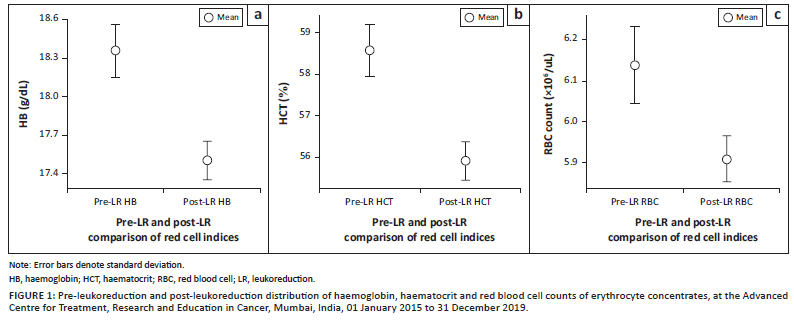
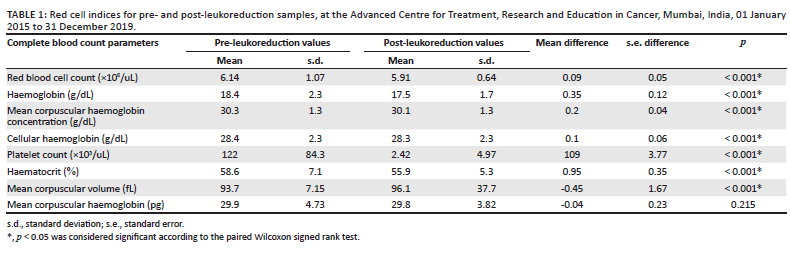
All red cell indices exhibited statistically significant changes after leukoreduction (p < 0.001), except for MCH (p = 0.215) (Table 1).
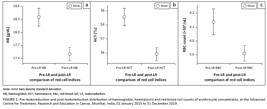
Among the remaining parameters, all indices showed a statistically significant decrease (p < 0.001), except for MCV, which showed a statistically significant increase (p < 0.001). However, the absolute magnitude of difference between the pre-leukoreduction and post-leukoreduction for all red cell indices was found to be small. The most affected haematological parameters were haemoglobin, RBC, and haematocrit, with haematocrit showing a considerable narrowing of its range after leukoreduction (Figure 1).
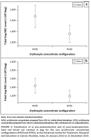
Total red blood cell content in erythrocyte concentrate units (red blood cell count × volume of erythrocyte concentrate)
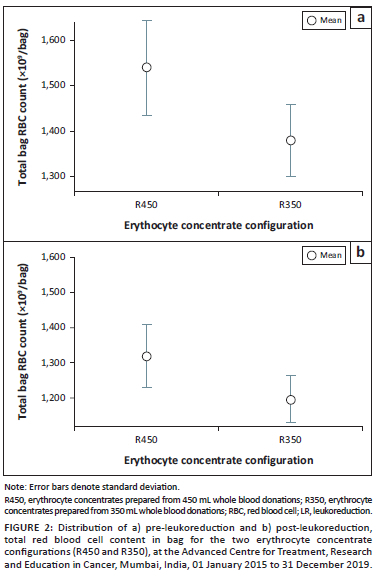
The total RBC content was higher in all pre-leukoreduction units (R350 and R450) than the post-leukoreduction units (Figure 2). Another notable finding was the narrower range of red cell count in the post-leukoreduction ECs. Furthermore, as expected, mean total RBC counts in R450 units were higher than those in R350 units, both before and after leukoreduction.
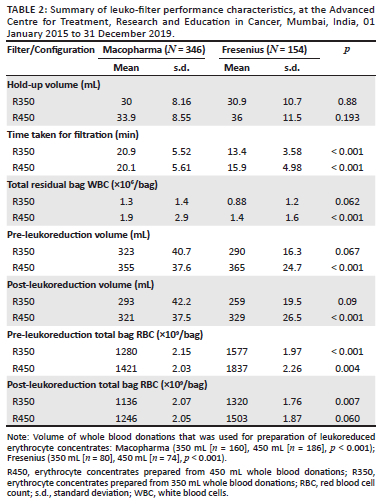
Both filters demonstrated an equal efficacy in obtaining a 3-4 log WBC reduction post-filtration, with all units in the study meeting the leukoreduction criteria of < 5 × 1066
Leuko-filter data
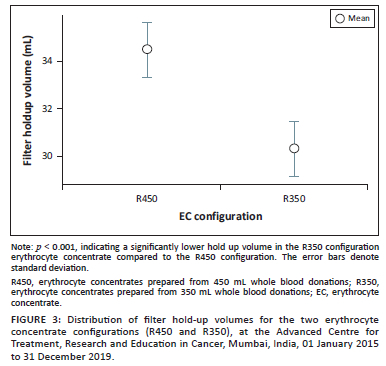
The lower red cell recovery observed in the post-filtration units is attributable to the hold-up volume retained in the filter housing medium.
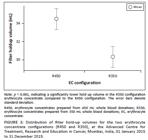
Although no statistically significant difference was noted between the two manufacturers (p = 0.88 for R350 units and p = 0.193 for R450 units), there was a statistically significant lower hold-up volume in the R350 units compared to the R450 units, p < 0.001 (Table 2, Figure 3).
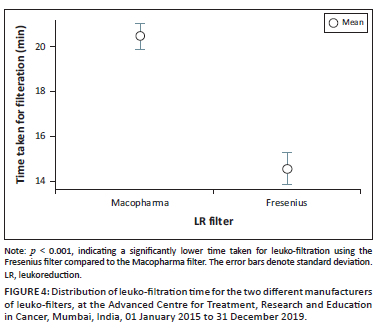
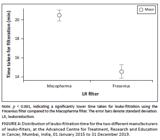
The difference in time taken for filtration of R350 and R450 units was not found to be statistically significant (p = 0.343). In contrast, inter-filter comparisons revealed that ECs undergoing leukoreduction with the Fresenius filter required statistically significantly less time compared to those processed with the Macopharma filter, p < 0.001 (Figure 4).
Discussion
Our study showed that both leuko-filter brands were equally efficacious in achieving leukoreduction to a residual leukocyte count of less than 5 × 10611
Our leukoreduction efficacy aligns with previous studies from India published in 2021121314,15
Among other red cell indices assessed, all indices showed a statistically significant change after leukoreduction, except for MCH. However, the pre-leukoreduction and post-leukoreduction differences for all red cell indices were noted to be small in absolute magnitude. These findings are in accordance with two previous studies - an Indian study by Sonker, Dubey and Chaudhary in 2014,15716101718
However, Ghezelbash et al.9516
Furthermore, our study was comparable to the French study in 1988 by Andreu et al. which showed a similar 1-log platelet reduction in leukoreduced ECs, which might contribute to the beneficial effects of leukoreduction.81920
The two manufacturers evaluated in our study demonstrated equal efficacy, consistently achieving high levels of leukoreduction, as evidenced by the Indian study by Sonker et al. in 2014 and the American study by Heaton et al. in 1994.15,1911666
An inherent drawback of the leuko-filtration process is the hold-up volume retained in the filter housing medium. Our study found that the hold-up volume was statistically significantly higher in ECs filtered by Macopharma filters (10.3% ± 3.5%) compared to Fresenius filters (9.56% ± 2.72%). While most filtered units exhibited post-filtration losses of less than 15%, approximately 4.4% of the units had hold-up volumes exceeding 15% within the leuko-filters. Despite this, all units complied with national QC guidelines, which require 75% of tested units to meet the QC standards. Similar red cell losses in leuko-filters have been reported in previous studies by Andreu et al. in 1988, and AuBuchon et al. from the United States in 1997.7,8
Lastly, the inter-filter comparisons also showed a difference in the time taken for leukoreduction, with the Fresenius filters demonstrating higher efficiency with faster filtration rates compared to the Macopharma filter. Leuko-filtration rates documented in published literature exhibit considerable variability, influenced by factors such as filter composition, ambient processing temperature, and the initial specifications of red cells prior to filtration, as shown in the study from The Netherlands by Pietersz, Steneker and Reesink in 1993.21
Our study is the first Indian study to evaluate two newer-generation filters for their performance efficacy and to compare the pre-leukoreduction and post-leukoreduction changes in red cell indices. Our findings support previously published data and also present new data, especially with regard to changes in red cell indices where prior comparative research has been lacking.
Limitations
The retrospective design of the research study precluded the evaluation of storage duration-related changes in red cell indices. Further, we were only able to include those units which had been subject to a QC check. Donor characteristics such as age, sex and other medical information which are known to influence EC characteristics were not evaluated as part of this study. Additionally, parameters such as supernatant potassium levels, haemoglobin levels, and haemolysis percentage were not investigated. Lastly, patient outcomes following the administration of leukoreduced red cells were not monitored as part of this study.
Conclusion
Red cell indices show several changes following leukoreduction, but further studies are needed to assess the microscopic and functional impact of leukoreduction.
The newer-generation filters show a good performance efficacy for leukoreduction. Erythrocyte concentrates prepared from 450 mL whole blood units should be preferred for preparation of leukoreduced units subject to local operational constraints, because of the higher red cell recovery. Leuko-filters vary in their performance characteristics such as filtration time and hold-up volume, which may influence vendor selection for hospital purchase.
Competing interests
The authors declare that they have no financial or personal relationships that may have inappropriately influenced them in writing this article.
Authors' contributions
D.M. and S.O. conceptualised the study, sought ethics committee approval, and supervised the conduct of the study. A.N. and K.C. performed sampling, lab analysis, and data compilation along with D.M. D.M., A.N. and K.C. compiled the article draft and the article was scrutinised by S.O. This final version of the article has been approved by D.M., S.O., A.N. and K.C.
Sources of support
This research received no specific grant from any funding agency in the public, commercial, or not-for-profit sectors.
Data availability
The data that support the findings of this study are available from the corresponding author, D.M., upon reasonable request.
Disclaimer
The views and opinions expressed in this article are those of the authors and are the product of professional research. The article does not necessarily reflect the official policy or position of any affiliated institution, funder, agency, or that of the publisher. The authors are responsible for this article's results, findings, and content.
Acknowledgements
We would like to thank all the staff in the Department of Transfusion Medicine, Advanced Centre for Treatment, Research and Education in Cancer, who supported us in this research. This article is partially based on the author's thesis entitled 'Retrospective assessment of leukoreduced red cell concentrates and leukocyte filter performance characteristics at a tertiary care haemato-oncology hospital' towards the degree of MD Immuno-Haematology and Blood Transfusion, in the Department of Transfusion Medicine at the Homi Bhabha National Institute, Mumbai, India in 2021, with supervisor Dr Shashank Ojha.
References
-
1. Bassuni WY, Blajchman MA, Al-Moshary MA. Why implement universal leukoreduction? Hematol Oncol Stem Cell Ther. 2008;1(2):106-123. https://doi.org/10.1016/S1658-3876(08)50042-2
» https://doi.org/10.1016/S1658-3876(08)50042-2 - 2. Harris SB, Hillyer CD, editors. Blood manufacturing: Component preparation, storage and transportation. In: Blood banking and transfusion medicine. Edinburgh: Churchill Livingstone (Elsevier), 2008; p. 183-202.
-
3. Bordin JO, Heddle NM, Blajchman MA. Biologic effects of leukocytes present in transfused cellular blood products. Blood. 1994;84(6):1703-1721. https://doi.org/10.1182/blood.V84.6.1703.1703
» https://doi.org/10.1182/blood.V84.6.1703.1703 -
4. Khan AI, Patidar GK, Lakshmy R, Makhija N, Talwar S, Hazarika A. Effect of leukoreduction on transfusion-related immunomodulation in patients undergoing cardiac surgery. Transfus Med. 2020;30(6):497-504. https://doi.org/10.1111/tme.12714
» https://doi.org/10.1111/tme.12714 -
5. Antonelou MH, Tzounakas VL, Velentzas AD, Stamoulis KE, Kriebardis AG, Papassideri IS. Effects of pre-storage leukoreduction on stored red blood cells signaling: A time-course evaluation from shape to proteome. J Proteomics. 2012;76:220-238. https://doi.org/10.1016/j.jprot.2012.06.032
» https://doi.org/10.1016/j.jprot.2012.06.032 -
6. Sharma RR, Marwaha N. Leukoreduced blood components: Advantages and strategies for its implementation in developing countries. Asian J Transfus Sci. 2010;4(1):3-8. https://doi.org/10.4103/0973-6247.59384
» https://doi.org/10.4103/0973-6247.59384 -
7. AuBuchon JP, Elfath MD, Popovsky MA, et al. Evaluation of a new prestorage leukoreduction filter for red blood cell units. Vox Sang. 1997;72(2):101-106. https://doi.org/10.1046/j.1423-0410.1997.7220101.x
» https://doi.org/10.1046/j.1423-0410.1997.7220101.x -
8. Andreu G, Dewailly J, Leberre C, et al. Prevention of HLA immunization with leukocyte-poor packed red cells and platelet concentrates obtained by filtration. Blood. 1988;72(3):964-969. https://doi.org/10.1182/blood.V72.3.964.bloodjournal723964
» https://doi.org/10.1182/blood.V72.3.964.bloodjournal723964 - 9. Ghezelbash B, Azarkeivan A, Pourfathollah AA, Deyhim M, Hajati E, Goodarzi A. Comparative evaluation of biochemical and hematological parameters of pre-storage leukoreduction during RBC storage. Int J Hematol Oncol Stem Cell Res. 2018;12(1):35-42.
-
10. Mahmoud RH, Hassan DA. Impact of leukofiltration on microparticles generation and phosphatedylserine exposure in stored red blood units. Clin Med Diagn. 2016;6(4):85-95. https://doi.org/10.5923/j.cmd.20160604.01
» https://doi.org/10.5923/j.cmd.20160604.01 - 11. Council of Europe. Recommendation No.R (95) 15 Guide to the preparation, use and quality assurance of blood components. 20th ed. Strasbourg: Council of Europe; 2020.
-
12. Sheikh MA, Biswas AK, Baranwal AK, Kushwaha N, Karade S, Philip J. Comparative study of quality of leukoreduced packed red blood cell units as assessed by nageotte hemocytometry and flow cytometry. Asian J Transfus Sci. 2023;17(1):63-68. https://doi.org/10.4103/ajts.AJTS_101_21
» https://doi.org/10.4103/ajts.AJTS_101_21 -
13. Mittal S, Chacko MP, Varughese S, et al. Laboratory and clinical comparison of the efficacy of prestorage leukoreduction of red cells at cold versus room temperature. Transfusion. 2021;61(9):2556-2565. https://doi.org/10.1111/trf.16570
» https://doi.org/10.1111/trf.16570 -
14. Chand S, Rudrappan RB, Gupta D. Leukoreduced red cell concentrates: Are they meeting the quality standards? Asian J Transfus Sci. 2023;17(2):151-156. https://doi.org/10.4103/ajts.ajts_126_21
» https://doi.org/10.4103/ajts.ajts_126_21 -
15. Sonker A, Dubey A, Chaudhary R. Evaluation of a red cell leukofilter performance and effect of buffy coat removal on filtration efficiency and post filtration storage. Indian J Hematol Blood Transfus. 2014;30(4):321-327. https://doi.org/10.1007/s12288-013-0257-0
» https://doi.org/10.1007/s12288-013-0257-0 -
16. Ran Q, Hao P, Xiao Y, Zhao J, Ye X, Li Z. Effect of irradiation and/or leucocyte filtration on RBC storage lesions. PLoS One. 2011;6(3):e18328. https://doi.org/10.1371/journal.pone.0018328
» https://doi.org/10.1371/journal.pone.0018328 -
17. Pertinhez TA, Casali E, Baroni F, Berni P, Baricchi R, Spisni A. A comparative study of the effect of leukoreduction and pre-storage leukodepletion on red blood cells during storage. Front Mol Biosci. 2016;3:13. https://doi.org/10.3389/fmolb.2016.00013
» https://doi.org/10.3389/fmolb.2016.00013 -
18. Gyongyossy-Issa MI, Weiss SL, Sowemimo-Coker SO, Garcez RB, Devine DV. Prestorage leukoreduction and low-temperature filtration reduce hemolysis of stored red cell concentrates. Transfusion. 2005;45(1):90-96. https://doi.org/10.1111/j.1537-2995.2005.04061.x
» https://doi.org/10.1111/j.1537-2995.2005.04061.x -
19. Heaton WA, Holme S, Smith K, et al. Effects of 3-5 log10 pre-storage leucocyte depletion on red cell storage and metabolism. Br J Haematol. 1994;87(2):363-368. https://doi.org/10.1111/j.1365-2141.1994.tb04923.x
» https://doi.org/10.1111/j.1365-2141.1994.tb04923.x -
20. Steneker I, Prins HK, Florie M, Loos JA, Biewenga J. Mechanisms of white cell reduction in red cell concentrates by filtration: The effect of the cellular composition of the red cell concentrates. Transfusion. 1993;33(1):42-50. https://doi.org/10.1046/j.1537-2995.1993.33193142309.x
» https://doi.org/10.1046/j.1537-2995.1993.33193142309.x -
21. Pietersz RN, Steneker I, Reesink HW. Prestorage leukocyte depletion of blood products in a closed system. Transfus Med Rev. 1993;7(1):17-24. https://doi.org/10.1016/S0887-7963(93)70029-2
» https://doi.org/10.1016/S0887-7963(93)70029-2

Accepted: 28 Mar. 2025
Published: 25 June 2025