A comprehensive district-level laboratory intervention after the Ebola epidemic in Sierra Leone
Abstract
BACKGROUND: The 2014-2016 Ebola outbreak exposed the poor laboratory systems in Sierra Leone. Immense needs were recognised across all areas, from facilities, diagnostic capacity, supplies, trained personnel to quality assurance mechanisms. OBJECTIVE: We aimed to describe the first year of a comprehensive intervention, which started in 2015, in a public hospital's general laboratory serving a population of over 500 000 in a rural district METHODS: The intervention focused on (1) supporting local authorities and healthcare workers in policy implementation and developing procedures to enhance access to services, (2) addressing gaps by investing in infrastructure, supplies, and equipment, (3) development of quality assurance mechanisms via mentorship, bench-side training, and the introduction of quality control and information systems. All work was performed alongside counterparts from the Ministry of Health and Sanitation. RESULTS: We observed a strong increase in patient visits and inpatient and outpatient testing volumes. Novel techniques and procedures were taken up well by staff, leading to improved and expanded service and safety, laying foundations for further improvements. CONCLUSION: This comprehensive approach was successful and the results suggest an increase in trust from patients and healthcare workers.
Sierra Leone; intervention; district hospital; diagnostics; service expansion; mentorship
Introduction
Laboratories are an often neglected yet crucial part of a functioning health system. Laboratory services are required for clinical diagnosis, patient care, treatment and monitoring and have an important public health role in surveillance of disease and antimicrobial resistance. However, many low-income countries lack adequate laboratory services at the community, district and even national levels, hence laboratories have been referred to as the 'Achilles heel' in efforts to combat disease.1
The World Health Organization (WHO) has included laboratory services in the 'basic minimum package' for health interventions in low-resource settings,2345,65,64,7,8,9,10
In Sierra Leone most people live below the poverty line, life expectancy and adult literacy in 2016 were as low as 51.3 years and 48.1% respectively while the maternal mortality rate of 1360 per 100 000 live births - was among the highest in the world.1112,1314,15,16
In June-July 2015, after the peak of EVD transmission, the Sierra Leone Ministry of Health and Sanitation (MOHS) conducted a comprehensive evaluation of the national laboratory system, using an adapted WHO laboratory assessment tool,17,18
Three hundred and fifteen (315) laboratories, ranging from community health centre laboratories to all district and regional hospital level laboratories, were assessed. The study identified gaps in systems, supplies, infrastructure and quality, including insufficient numbers of adequately trained personnel to respond to outbreaks. Of 20 public hospitals, 11 (55%) had no reliable water supply, 16 (80%) lacked 24-h electricity, and five (25%) had no freezer space. Regarding testing resources, 16 (80%) offered no blood biochemistry tests, and only three (15%) had electrolytes and liver function tests. Standard operating procedures for available tests were absent at 16 (80%) sites. The majority (83%) of the facilities had no guidelines for specimen referral. Additionally, while acknowledging the needs, the report stressed limited government resources available to invest in laboratory services.18
At the invitation of the Sierra Leonean government, the non-profit organisation Partners In Health (PIH) started working in Sierra Leone during the Ebola outbreak in 2014. By 2015, PIH shifted its focus from emergency response and committed to providing long-term comprehensive support at the Koidu Government Hospital (KGH), the district hospital in Kono. The intervention in the district laboratory was initiated in October 2015, a few months after the MOHS laboratory assessment. Here, we describe the first year of this programme and summarise initial outcomes, as a replicable model for laboratory strengthening in low-resource settings.
Intervention
Ethical considerations
No identifiable patient data were collected for this study.
Baseline setting
Kono is a district in eastern Sierra Leone (506 867 population). Rich in diamond mines, Kono was the epicentre of the civil war. There were 301 confirmed EVD infections in the district.19
The KGH laboratory was staffed by a total of 15 technicians and technician assistants, of whom several were not paid or had no laboratory training. This baseline capacity was reflected in the 2015 MOHS national laboratory assessment, in which the overall score for the laboratory, based on availability of supplies, equipment, and quality assurance was 30%, ranking KGH among the five lowest scoring districts.18
During the Ebola outbreak, patients with suspected EVD were quarantined in a holding unit on the hospital grounds. After receiving a positive or negative test result, they were referred to an Ebola treatment centre or the KGH wards. Koidu Government Hospital laboratory staff collected blood samples from patients in the holding unit, and received oral swabs from deceased individuals in the district. Referral of all specimens to a Public Health England-supported laboratory in the region was well organised and strictly regulated. In contrast, referral systems for other samples (i.e. for testing or surveillance of other diseases) was poor. External quality assurance mechanisms, such as reading tuberculosis microscopy slides at the national level, were hampered by the outbreak, and for biosafety reasons referral of sputum samples for culture or drug sensitivity testing at the supranational laboratory was on hold.
Program objective and strategy
Partners In Health worked alongside local MOHS counterparts to support their laboratory strategy and accompany them in the improvement process. Partners In Health's health system strengthening model - also referred to as 'stuff, staff, space, and systems' - incorporates investments in materials, human resources, facilities, and systems.2015,18
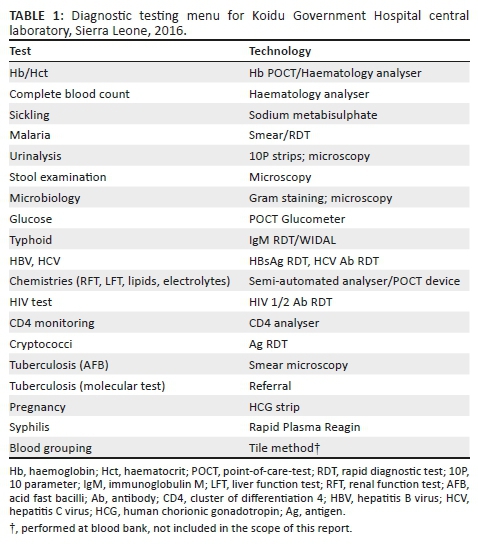
The laboratory diagnostic menu was revised to align with Sierra Leone's national guidelines for district level services and WHO policies (Table 1). New systems and tests were introduced gradually throughout the year to ensure proper time for training and adjustment to novel modalities for both laboratory staff and clinicians.
To improve access to services for patients, a flat laboratory fee (5000.00 SLL [Sierra Leonean Leone] or $0.70 [United States dollars]) for outpatients was introduced. Inpatient laboratory services were free of charge.
In collaboration with the hospital's HIV and tuberculosis clinics, referral systems were revised to (1) ensure proper and rapid transport of specimens from community clinics to the laboratory for diagnostic testing and treatment monitoring and (2) refer patients with positive test results from the laboratory to the HIV or tuberculosis clinic for further testing and counselling. As the hospital laboratory relied on smear microscopy for tuberculosis diagnosis, a referral system with a nearby PIH-supported outpatient clinic was set up for molecular testing for tuberculosis for patients suspected to have multidrug-resistant or extrapulmonary tuberculosis.
Community Health Workers were given a central role in HIV and tuberculosis referral processes. All Community Health Workers at KGH were trained in HIV and tuberculosis care and equipped to guide patients through the hospital system, accompanying them to and from the laboratory. Additionally, Community Health Workers coordinated collection and transport of sputum samples for tuberculosis testing from patients in the community to the laboratory.
To improve inpatient care, routine blood draws were introduced in all wards in the mornings, and the results were disseminated in the afternoon.
Addressing gaps in the system
•Infrastructure: Utility improvements were made at the hospital, including the laboratory, ensuring water and electricity were available 24 hours per day seven days per week. Minor infrastructure and repair work was completed at the laboratory building. The laboratory areas were reorganised, and a separate space for phlebotomy and sample collection was built to improve both patient and sample flow, as well as safety and privacy. Air conditioning was installed to protect equipment, as well as fans (to increase air circulation) and UV lights, two recommended interventions to reduce the risk of tuberculosis transmission.
•Procurement and supplies: A procurement and cold-chain supply system was established to fill gaps and support transport of MOHS supplies. Procurement was organised in biannual international orders and quarterly regional and local orders to ensure uninterrupted availability of consumables and reagents and to reduce stock-outs and expiration. Refrigerators and freezers were bought and installed to expand cold storage capacity in the laboratory, hospital and district warehouses. Replenishment of supplies to the laboratory from a central warehouse took place on a weekly basis.
•Equipment: To improve quality and expand diagnostic services, novel equipment was introduced. Technicians from respective companies installed and provided training on larger equipment. Smaller equipment was introduced by the laboratory manager:
■Electronic light-emitting diode (LED) microscopes for tuberculosis and malaria diagnosis, as well as urine and stool microbiological diagnostics
■Electrical centrifuges for separation of plasma and serum and sedimentation of urine to replace hand centrifuges
■Haematology analyser (20 parameter) for complete blood counts
■Biochemistry analyser, semi-automated
■Point-of-care testing equipment for electrolytes, haemoglobin and blood glucose.
•Management and education. Partners In Health recruited a laboratory manager, who worked with the MOHS laboratory superintendent on supervision and management. Provision of ongoing mentorship and training to improve test performance were essential parts of the programme. In addition to didactic training for the entire team, individual technicians received bench-side training to use novel equipment during multiple weeks of mentorship.
•Quality control and assurance:
■For every new test and procedure, a standard operating procedure was developed to standardise the quality of testing and biosafety.
■Daily, weekly and monthly controls, maintenance and calibration were implemented for all novel equipment according to manufacturers' guidelines; contracts and service agreements were obtained for all relevant equipment to cover regional or international technical support services and warranty.
■Daily temperature monitoring was introduced for all cold storage space in the laboratory and warehouses.
•Data management and information systems:
■To improve documentation and registration, forms when needed were updated, and standardised registration for all requests and results was introduced in the laboratory.
■The laboratory received monitoring and evaluation support to develop data collection tools and continuously monitor operations, including inventory and consumption rates.
■By ensuring provision of test and consumption data to national programmes, including the National AIDS Secretariat and National AIDS Control Programme, National Tuberculosis Control Programme, and the Malaria Control Programme, sufficient HIV, tuberculosis and malaria testing materials were supplied from national stores for these Global Fund-supported programmes. Partners In Health filled any remaining supply gaps.
Outcomes
Increased patient and testing volumes
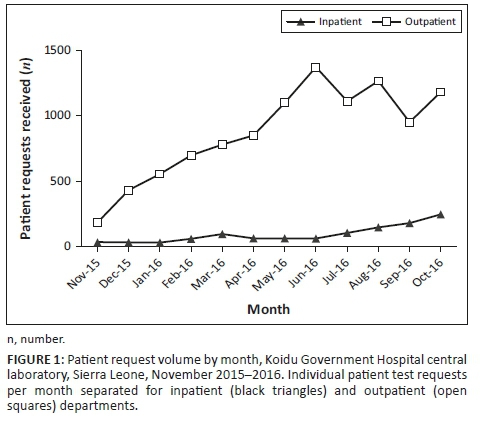
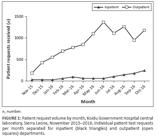
Between November 2015 and October 2016, the volume of individual outpatient test requests increased 5.8 times over baseline, from 246 to 1428 per month (Figure 1). During this timeframe, PIH's health system programming primarily supported inpatient and outpatient HIV and tuberculosis care, but was not involved in general outpatient services. Therefore, this increase in outpatient visits (including from surrounding districts) suggests increased trust in the health system and KGH among national staff and local community members, as evidenced by increasing test requests and larger patient volumes, and potentially reflects expanded service delivery.
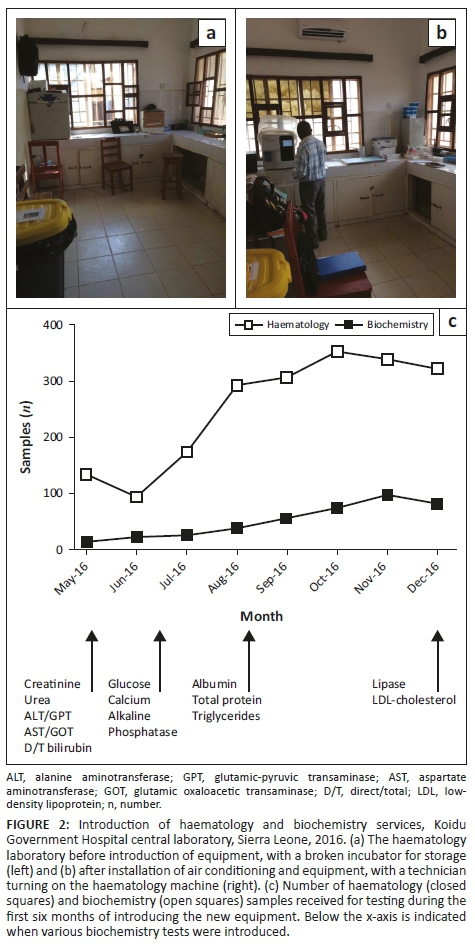
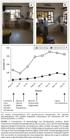
After improving infrastructure and preparing the laboratory and technicians for new equipment, semi-automated haematology and biochemistry analysers were installed in May 2016. During the first six months after introduction, this new equipment enabled the laboratory to perform a total of 224 liver and renal function tests for HIV and tuberculosis patient monitoring and inpatient care, as well as 1352 complete blood counts for inpatient and outpatient care (Figure 2). Overall, the programme and, specifically, the introduction of new machines boosted staff morale. Introducing new procedures and tests required a moderate amount of initial cost and training, but was absorbed relatively easily by the national MOHS laboratory team.
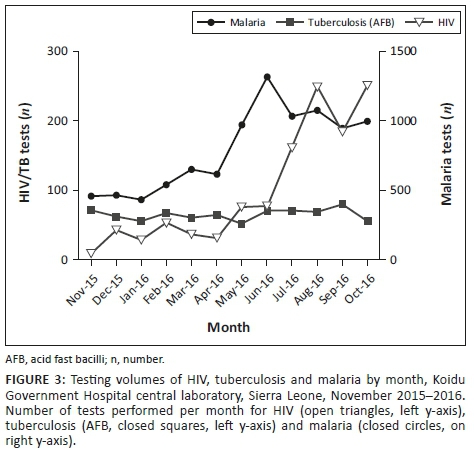
To illustrate the effect of our intervention on diagnostics of HIV, tuberculosis and malaria - which are all national and WHO priorities - testing volumes are presented in Figure 3.These numbers reflect volumes within the laboratory and exclude point-of-care HIV and malaria tests performed by clinicians and support staff in the wards and HIV clinic.
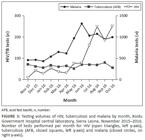
•HIV: Prior to the intervention, almost all HIV tests for outpatients were performed at the HIV clinic on the hospital grounds and on the wards for inpatients. The laboratory performed only eight HIV tests in November 2015; this number increased to 251 in October a year later. This result was achieved by training technicians in testing procedures, patient confidentiality, and improving communication with clinicians, HIV clinic staff, and Community Health Workers. This change gave the HIV clinic staff more time to focus on other tasks, and increased access to testing services for outpatients, without a required visit to the HIV clinic.
•Tuberculosis: Repair and ongoing maintenance of a Mycobacterium tuberculosis molecular testing platform and supply of cartridges located at our partner outpatient health clinic enabled the testing of 66 specimens (for patients suspected of having multidrug-resistant tuberculosis or extrapulmonary tuberculosis) during the first six months of this system.
•Malaria: Throughout the year, the laboratory tested 9501 patients for malaria, with a peak in volume (and positivity rate, data not shown) in the rainy season from May to September. To support the increase in volume, PIH supplied rapid diagnostic tests in addition to slide tests to reduce the burden on staff.
Discussion
As a result of this programme, the diagnostic capacity at KGH was expanded and improved and an increase in patient visits was recorded. This suggests that an improvement in environment, organisation and access to diagnostics allowed for more trust and satisfaction with the system by patients and clinicians, as has been shown by others.8,9
This programme had several limitations. All operational and clinical support was part of a hospital-wide health-strengthening programme. These combined efforts had the immeasurable effect of improving service delivery and trust among patients, community and hospital staff, likely contributing to the increase in laboratory utilisation as well. Therefore, we cannot observe our outcomes in isolation from other interventions. Secondly, our data demonstrate improved access to laboratory services, as more patients visited the laboratory, but do not quantify improved quality or how access to these services changed clinical practice and outcomes. A laboratory satisfaction survey would provide better information about perceived laboratory services.
In a MOHS 2016 progress report (personal communication), the laboratory score increased from 65% to 87% for availability of tests, supplies, and standard operating procedures. This indicates that improvement of laboratory services was recognised by the government. Unfortunately, this report was not published nationally and the structure differed from the 2015 comprehensive assessment and hence cannot be compared with other districts or the 30% score in the previous report. Lastly, this score is not synonymous with quality services; for example, the KGH laboratory lost credits in 2016 after replacing the haemoglobin colour scale with an automated analyser, because only the colour scale was provided by MOHS and included in the assessment.
It is the mission of PIH to strengthen public health systems to ensure the access of health services to people living in resource-limited settings. Investing in public sector laboratory services though a comprehensive approach has proven effective in other countries.212011
To remove these barriers and rebuild health systems, advocacy and collaboration with national programmes are needed. These efforts are also required regarding testing policies. There are discrepancies between national guidelines, WHO recommendations, and accepted standards for tests used in high-income countries. For many low-income countries, cheap testing methods for diseases such as HIV and tuberculosis are considered acceptable22423242526
The intervention described here is still ongoing as PIH continues to support the MOHS staff in the laboratory and other clinical service delivery. To improve the quality of diagnostic services, PIH has recruited a quality officer to support the laboratory manager. The next steps of the programme include, but are not limited to, enrolment of tests into (national) external quality assurance systems, strengthening the referral system, introduction of microbiological culture assays and equipment for automated tuberculosis and HIV viral load detection, eventually leading to improved quality services, emergency preparedness, and first steps towards accreditation.15

Competing interests
The authors declare that they have no financial or personal relationships that may have inappropriately influenced them in writing this paper.
Authors' contributions
A.W.M. conceived of and wrote the manuscript, analysed the data and implemented the project; M.B. and S.M.K. were involved in project implementation, analysis and interpretation of data; J.S.G. performed data collection and analysis; K.L.D. and M.M.S. provided programmatic direction and support; J.D.O. provided technical laboratory support; R.H.M. supervised the intervention and provided support. All authors critically reviewed the manuscript and approved the final version.
Sources of Support
The intervention was funded by Partners In Health. A.W.M. is funded by the Harvard Medical School Department of Global Health and Social Medicine.
Data availability statement
Data sharing is not applicable to this article as no new data were created or analysed in this study.
Disclaimer
The views and opinions expressed in this article are those of the authors and do not necessarily reflect the official policy or position of any affiliated agency of the authors.
Acknowledgements
The authors acknowledge all laboratory and blood bank staff in the Kono district and are grateful to the staff of Partners In Health for their dedication to health equity in Sierra Leone.
References
-
1.Berkelman RG, Cassell S, Specter M. The "Achilles Heel" of global efforts to combat infectious diseases. Clin Infect Dis. 2006;42(10):1503. https://doi.org/10.1086/504494
» https://doi.org/10.1086/504494 - 2.Tarimo E. Essential Health Service Packages - Current concerns. Division of Analysis, Research And Assessment. World Health Organization. Geneva 1997.
-
3.Parsons LM, Somoskovi A, Lee E, et al. Global health: Integrating national laboratory health systems and services in resource-limited settings. Afr J Lab Med. 2012;1(1), Art. #11:1-5. https://doi.org/10.4102/ajlm.v1i1.11
» https://doi.org/10.4102/ajlm.v1i1.11 -
4.Engel N, Wachter K, Pai M, et al. Addressing the challenges of diagnostics demand and supply: Insights from an online global health discussion platform. BMJ Glob Health. 2016;1:e000132. https://doi.org/10.1136/bmjgh-2016-000132
» https://doi.org/10.1136/bmjgh-2016-000132 -
5.Perry L, Malkin R. Effectiveness of medical equipment donations to improve health systems: How much medical equipment is broken in the developing world? Med Biol Eng Comput. 2011;49:719-722. https://doi.org/10.1007/s11517-011-0786-3
» https://doi.org/10.1007/s11517-011-0786-3 -
6.Bauserman M, Hailey C, Gado J, et al. Determining the utility and durability of medical equipment donated to a rural clinic in a low-income country. Int Health. 2015;7:262-265. https://doi.org/10.1093/inthealth/ihu091
» https://doi.org/10.1093/inthealth/ihu091 -
7.Nkengasong JN, Birx D. Quality matters in strengthening global laboratory medicine. Afr J Lab Med. 2014;3(2), Art. #239:1-4. https://doi.org/10.4102/ajlm.v3i2.239
» https://doi.org/10.4102/ajlm.v3i2.239 -
8.Mfinanga SG, Kahwa A, Kimaro G, et al. Dissatisfaction with the laboratory services in conducting HIV related testing among public and private medical personnel in Tanzania. BMC Health Serv Res. 2008;8:4-9. https://doi.org/10.1186/1472-6963-8-171
» https://doi.org/10.1186/1472-6963-8-171 -
9.Mfinanga SG, Kahwa A, Kimaro G, et al. Patient's dissatisfaction with the public and private laboratory services in conducting HIV related testing in Tanzania. BMC Health Serv Res. 2008;8:1-5. https://doi.org/10.1186/1472-6963-8-167
» https://doi.org/10.1186/1472-6963-8-167 -
10.Chaw PS, Schlinkmann KM, Raupach-Rosin H, et al. Knowledge, attitude and practice of Gambian health practitioners towards antibiotic prescribing and microbiological testing: A crosssectional survey. Trans Roy Soc Trop Med Hyg. 2017;111:117-124. https://doi.org/10.1093/trstmh/trx027
» https://doi.org/10.1093/trstmh/trx027 - 11.United Nations Development Programme. Human development report 2016. United Nations Development Programme. Canada; 2016. eISBN: 978-92-1-060036-1.
-
12.Evans DK, Goldstein M, Popova A. Health-care worker mortality and the legacy of the Ebola epidemic. Lancet Glob Health. 2015;3:e439-e440. https://doi.org/10.1016/S2214-109X(15)00065-0
» https://doi.org/10.1016/S2214-109X(15)00065-0 -
13.Bausch DG. The year that ebola virus took over West Africa: Missed opportunities for prevention. Am J Trop Med Hyg. 2015;92:229-232. https://doi.org/10.4269/ajtmh.14-0818
» https://doi.org/10.4269/ajtmh.14-0818 -
14.Kennedy SB, Dogba JB, Wasunna CL, et al. Pre-Ebola virus disease laboratory system and related challenges in Liberia. Afr J Lab Med. 2016;5(3), a508:1-5. https://doi.org/10.4102/ajlm.v5i3.508
» https://doi.org/10.4102/ajlm.v5i3.508 -
15.Wurie I. Sierra Leone laboratory systems - Now and future. Afr J Lab Med. 2016;5(3), a549:1-4. https://doi.org/10.4102/ajlm.v5i3.549
» https://doi.org/10.4102/ajlm.v5i3.549 -
16.Chua AC, Cunningham J, Moussy F, Perkins MD, Formenty P. The case for improved diagnostic tools to control ebola virus disease in West Africa and how to get there. PLoS Negl Trop Dis. 2015;9:4-9. https://doi.org/10.1371/journal.pntd.0003734
» https://doi.org/10.1371/journal.pntd.0003734 - 17.World Health Organization. Laboratory assessment tool. Ref: WHO/HSE/GCR/LYO/2012.2. World Health Organization. Geneva. 2012.
-
18.Ministry of Health and Sanitation. Sierra Leone national rapid ssessment of laboratory capacity and systems (July 2015). 2016. https://mohs2017.files.wordpress.com/2017/05/mohs_2016_national-lab-assessment-main-report_approved.pdf.
» https://mohs2017.files.wordpress.com/2017/05/mohs_2016_national-lab-assessment-main-report_approved.pdf -
19.Richardson ET, Kelly JD, Barrie MB, et al. Minimally Symptomatic Infection in an Ebola 'Hotspot': A cross-sectional serosurvey. PLoS Negl Trop Dis. 2016; 10(11): 1-10. https://doi.org/10.1371/journal.pntd.0005087
» https://doi.org/10.1371/journal.pntd.0005087 -
20.Orozco JD, Greenberg LA, Desai IK, et al. Building laboratory capacity to strengthen health systems: The partners in health experience. Clin Lab Med. 2018;38:101-117. https://doi.org/10.1016/j.cll.2017.10.008
» https://doi.org/10.1016/j.cll.2017.10.008 - 21.Farmer, P., Kleinman, A., Kim, J. & Basilico, M. Reimagining Global Health: An Introduction. (2013).
- 22.Cox H, Nicol MP. Tuberculosis eradication: Renewed commitment and global investment required. Lancet Infect Dis. 2017;3099:10-11.
-
23.McNerney R. Diagnostics for developing countries. Diagnostics (Basel). 2015;5:200-209. https://doi.org/10.3390/diagnostics5020200
» https://doi.org/10.3390/diagnostics5020200 -
24.Schroeder LF, Guarner J, Elbireer A, Castle PE, Amukele TK. Time for a model list of essential diagnostics. N Engl J Med. 2016;374:2511-2514. https://doi.org/10.1056/NEJMp1602825
» https://doi.org/10.1056/NEJMp1602825 - 25.World Health Organization. Model list of essential In vitro diagnostics. World Health Organization. Geneva. 2018.
-
26.Albetkova A, et al. Critical gaps in laboratory leadership to meet global health security goals. Bull. World Health Organ. 2017;95:0-1. https://doi.org/10.2471/BLT.17.195883
» https://doi.org/10.2471/BLT.17.195883
Accepted: 18 Mar. 2019
Published: 22 Oct. 2019