Stronger tuberculosis laboratory networks and services in Africa essential to ending tuberculosis
Introduction
The recent transition from the Millennium Development Goals to the Sustainable Development Goals highlights a major paradigm shift in the global fight against tuberculosis.1234
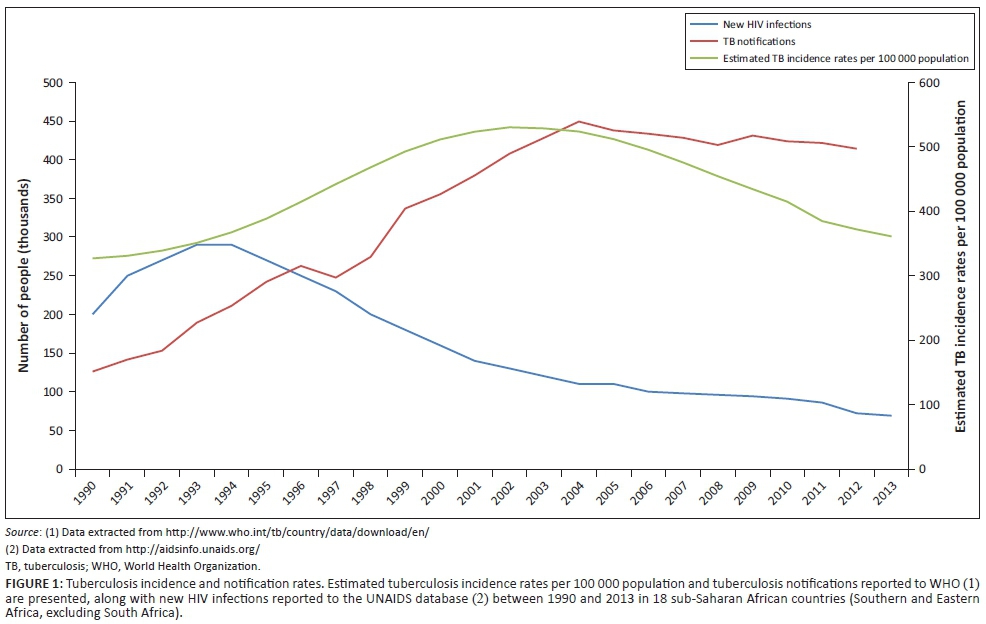
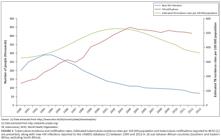
Africa is home to more than a quarter of the estimated incidence of all tuberculosis cases (2.7 million; 26%) and has twice the global estimated incidence rates (239/100 000 people) of new tuberculosis cases.33Figure 1). Improving equitable access to tuberculosis diagnosis and treatment remains the most pressing need for Africa where laboratory services play a pivotal role.
Tuberculosis laboratory services in Africa
Public health laboratory organisational structures and services for the diagnosis of infectious diseases, including tuberculosis, are heterogeneous and suffer from several challenges in Africa.5,6Table 1).
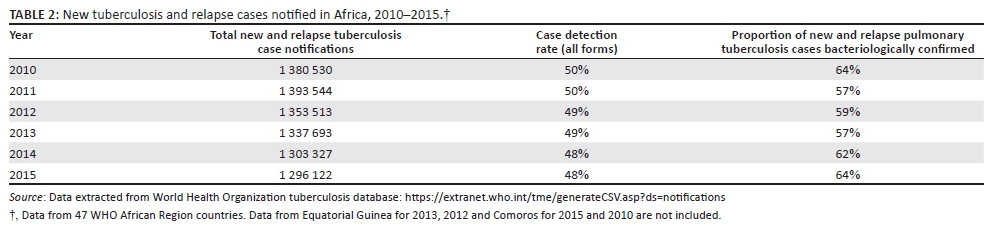
Efforts to diagnose tuberculosis in Africa are lagging behind estimated incidence of the disease, as reflected in the stable case detection rates for the last five years (Table 2). In 2015, 48% of estimated incident tuberculosis cases (all forms) were detected and national tuberculosis control programmes were notified, which is significantly lower than the 61% global average.3
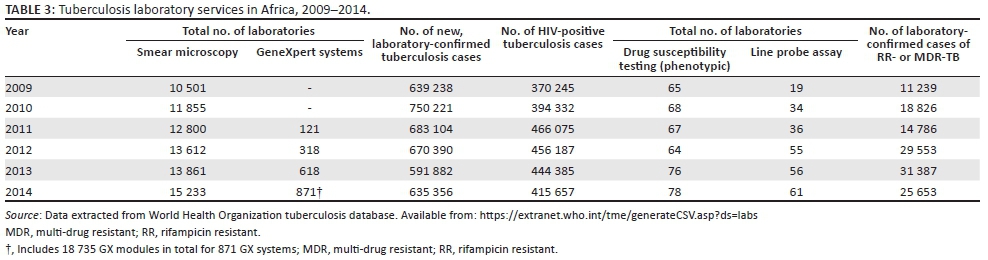
New strategies and policies to guide diagnostic interventions have been introduced in Africa, in line with the global tuberculosis control policies of the WHO. Increasing investments are being made by national governments and donor agencies to accelerate efforts for preventing, diagnosing, and treating tuberculosis, although large gaps remain in meeting need.3® systems and modules across Africa.7Table 3). However, the overall number of new laboratory-confirmed tuberculosis cases has not increased. As a more sensitive and accurate molecular diagnostic tool, the potential of the GeneXpert technology to improve diagnosis of tuberculosis/HIV cases has yet to be fully realised with regard to the overall increase in the number of HIV-positive tuberculosis cases detected.
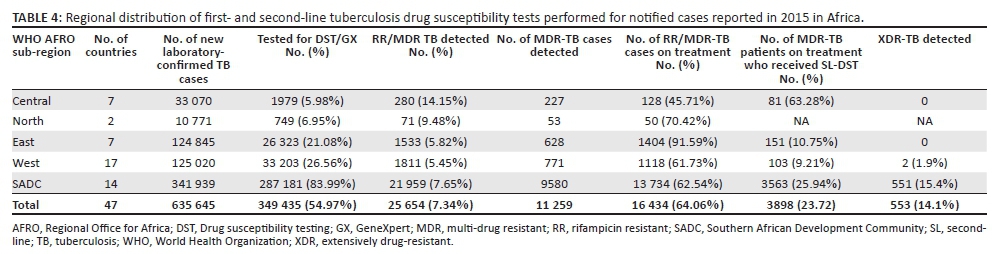
Eight African countries, including Angola, the Democratic Republic of Congo, Ethiopia, Kenya, Mozambique, Nigeria, South Africa and Zimbabwe, are included on the WHO's list of 30 multi-drug resistant (MDR), high tuberculosis-burden countries.3Table 4). During the same period, the total number of laboratories providing DST also increased by 20%, and the number of laboratories offering line-probe assays increased by 221%. Providing universal access to tuberculosis DST remains a newly-defined target of the End TB Strategy. Universal access to DST is currently defined as DST for at least rifampicin among all patients with bacteriologically-confirmed tuberculosis, and further DST for at least fluoroquinolones and second-line injectable agents among all tuberculosis patients with rifampicin resistance.
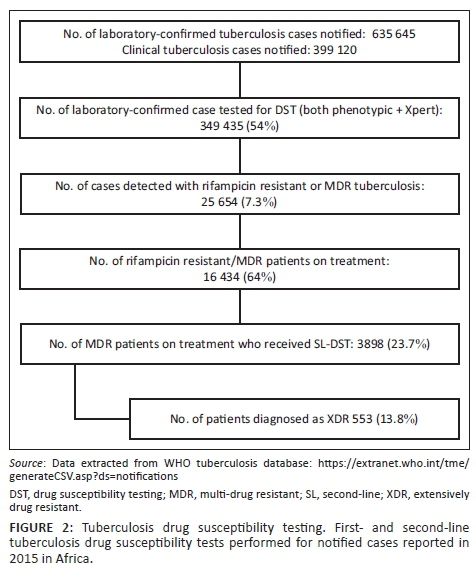
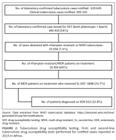
Preliminary assessment of existing gaps for achieving universal access to DST (Figure 2), based on 2015 case notifications in Africa, indicated that only 349 435 (54%) laboratory-confirmed tuberculosis patients had access to a first-line DST. In 2015, of the 16 434 patients who were diagnosed and treated for MDR tuberculosis, only 3898 (23.7%) could get a second-line DST test. Thus, the challenge that lies ahead for achieving universal access to first- and second-line DST suggests a need to close the 46% gap in access to first-line DST, and the 76.3% gap for second-line DST among tuberculosis and MDR-tuberculosis patients on treatment.
Regional disparities exist in the gaps in access to universal DST, with the southern Africa development community sub-region having better access than the rest of Africa, mainly because of progress made in South Africa proportionate to the number of tuberculosis patients (Table 4). However, these gaps are expected to be bridged through the recent endorsement of rapid molecular line probe assay for second-line drugs and the introduction of shorter-term regimens for programmatic management of drug-resistant tuberculosis.8
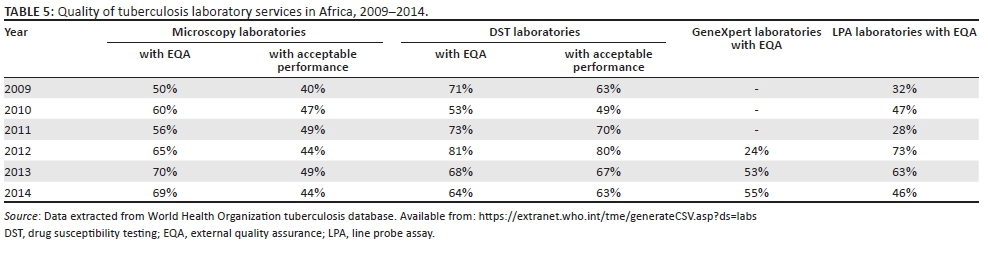
The pace of establishing tuberculosis diagnostic services needs to be viewed in the context of quality assessment measures and proficiencies for testing. Quality management systems were introduced in laboratory networks in Africa as an integrated effort starting in 2008, and commendable efforts were made through support from the African Society for Laboratory Medicine for Strengthening Laboratory Management Towards Accreditation to the ISO 15189 standard. Tuberculosis-specific quality management roadmaps for accreditation of quality standards were advocated by the Stop TB Partnership's Global Laboratory Initiative. Most peripheral laboratories in Africa have at least one component of an external quality assessment programme for smear microscopy (usually panel testing). WHO data indicate that less than half of the smear microscopy laboratories performed adequately on external quality assessments (Table 5). Nearly two-thirds of DST laboratories reported meeting WHO-specified quality standards and about half of the laboratories providing Xpert® MTB/RIF test or line probe assay were routinely monitored for quality under programmatic conditions.
All of this taken together strongly suggests that available tuberculosis laboratory services need to be optimally utilised in Africa as new technologies are introduced during the next few years. There is an urgent need to redefine the purpose, structure and use of diagnostic networks to diagnose tuberculosis and drug-resistant tuberculosis in an epidemiological context and within the operational capacities of the existing, resource-limited settings of Africa without compromising quality standards.
Priorities for strengthening tuberculosis services in Africa
Make use of new ambitious global strategies and goals, and diagnostic testing advances
To accelerate global tuberculosis efforts, the World Health Assembly approved the End TB Strategy9210
Compared to a few years ago, laboratory services in Africa now have better access to advanced tuberculosis diagnostics, including the rapid molecular assays that can accurately diagnose tuberculosis and drug-resistant tuberculosis in less than a day, improved sensitivity for microscopy through fluorescent light-emitting diode technology and faster automated liquid tuberculosis culture systems. Recent advancements in diagnostic tests to detect HIV, including advanced point-of-care rapid diagnostic tests, early infant diagnostic tests and viral load tests, are all critically important in Africa as part of the continuum of care for people co-infected with tuberculosis and HIV.
Laboratory quality management and accreditation systems are now available, including the Strengthening Laboratory Management Towards Accreditation and Stepwise Laboratory Improvement Process Towards Accreditation tools developed especially for Africa.11
Strengthen strategic policy, planning and health system components to improve tuberculosis diagnostic networks
The data above suggest that increasing the number of laboratories may improve access to tuberculosis diagnostic services to an extent. However, it may not necessarily increase overall tuberculosis case notifications under programmatic conditions. Enabling interventions such as appropriate changes in national diagnostic policies and algorithms, adequately resourced ambitious strategic plans, increased training for human resources, efficient sputum transport systems to avoid unnecessary diagnostic- and patient-delayed testing, and increased participation of community level organisations are all needed. The need for early access to point-of-care diagnostic services and treatment monitoring is greatest at the primary healthcare level and at the community level, whereas more sophisticated extensive diagnostic capacity is needed at regional- or central-level facilities.12
Integrate public health laboratory and diagnostic networks
To address the deficiencies in laboratories' diagnostic capacity, the integration of public health laboratory networks and surveillance systems1314151617
Strengthening collaborative tuberculosis/HIV activities (i.e., an integrated approach for prevention, diagnosis, and treatment among co-infected patients) will remain critical in addressing the tuberculosis/HIV epidemic in sub-Saharan Africa. Integrated laboratory services under one roof have the potential to reduce repeated visits of patients to health facilities by comprehensively screening for multiple infectious diseases, thus improving early case detection and management, in addition to optimising the use of laboratory resources. The fast-growing transition toward more non-communicable conditions in most settings can be tackled through integrated service provision. By default, several laboratory facilities at the district level in Africa provide 'integrated services', in one form or other, due to resource constraints and sharing of facilities and personnel. The challenges are mainly related to inadequate infrastructure, equipment, skilled laboratory personnel and their mentoring and supervision, resulting in inadequate integration. The integrated approach demands systematic training and recruitment of high-quality and skilled laboratory scientists, technologists and other laboratory personnel. To achieve universal health coverage, as set out in the End TB Strategy, interdependent, fully-integrated laboratory networks at the country and regional levels are needed, with a minimum set of diagnostic technologies for key infectious diseases prevalent at district and subdistrict levels.
Establish more regional collaboration
A persuasive way to enhance diagnostic capacity is through the establishment of regional laboratory networks. The capacity of national reference laboratories for culture and drug resistance testing in many African countries has been developed through several multi-country collaborative efforts, such as the EXPANDx-TB project and the East African Laboratory Network, established by the World Bank and aimed at setting up cross-cutting laboratory services with a clear surveillance focus. These networks have been playing an increasingly critical supportive role in the diagnosis and management of drug-resistant tuberculosis.
The strengthening of laboratory systems should be further facilitated through new African regional collaborative initiatives across intergovernmental health bodies and communities. Regional health networks have an important role in facilitating adoption and adaptation of global policies and allowing better care and surveillance through increased domestic funding commitments within the region. The East Central Southern African Health Community regional tuberculosis laboratory networking supported by the Global Fund is one example of the right direction in this regard.
Prioritise research to inform African-specific solutions
Key components of the End TB Strategy are the early and rapid diagnosis of tuberculosis, universal DST, and systematic screening of contacts and people who practise high-risk activities.16
Garner commitment and leadership from within African governments
While concerted action from all stakeholders is needed, national governments must demonstrate stronger political will and provide stewardship. Efforts must be enhanced to ensure that diagnosis and treatment systems for tuberculosis and drug-resistant tuberculosis are available and well aligned across the different levels of their public health systems. Lower-level laboratories must be linked to higher-level laboratories for access to follow-up testing for efficient patient management, ensure optimal use of different technologies at different levels of the tiered network, and maintain staff competence in these techniques.12
Conclusions
Tuberculosis laboratory services and networks suffer multiple deficiencies in Africa. Implementation of rapid molecular diagnostic laboratory tools for tuberculosis in the past five years, has resulted in an increased number of people diagnosed with and treated for drug-resistant tuberculosis in Africa, although drug-sensitive tuberculosis cases and tuberculosis/HIV cases have not seen increased case notifications, primarily due to restricted diagnostic algorithms, and capacity and access limitations. There is an urgent need to redefine the purpose, structure and optimal use of diagnostic networks to diagnose tuberculosis within the resource-constrained setting of Africa and tuberculosis epidemiology. Well-planned and -resourced national strategies are needed to achieve the laboratory targets set forth by the Global Plan to strengthen services toward ending tuberculosis. Appreciable efforts made in the introduction of new laboratory technologies in the last five years in several countries need to be multiplied at all service delivery levels to maximise technology utilisation to close the diagnostic gap in providing universal access to tuberculosis DST by 2020 in Africa. Integration of laboratory services within public health institutions and public-private collaborations would improve tuberculosis case detection. Tuberculosis is preventable, treatable and curable, and governments need to swiftly demonstrate strong leadership in ending tuberculosis as a leading infectious disease in Africa.
Competing interests
The authors declare that they have no financial or personal relationship(s) which may have inappropriately influenced them in writing this article.
Sources of support
None.
Authors' contributions
P.C.O., A.P. and A.K.T. contributed to qualitative and quantitative analysis of the information. All three contributed to the conceptualisation, design, development of this Opinion article.
Acknowledgements
The data used for generating the tables was extracted from the WHO global tuberculosis database. The authors wish to acknowledge the field experiences shared by the national tuberculosis control programmes and tuberculosis laboratories across Africa.
References
-
1. United Nations (2016). Sustainable development knowledge platform: health and population [page on the Internet]. c2016 [cited 2016 Oct 28]. Available from: https://sustainabledevelopment.un.org/topics/healthandpopulation
» https://sustainabledevelopment.un.org/topics/healthandpopulation -
2. World Health Organization. WHO End TB Strategy: global strategy and targets for tuberculosis prevention, care and control after 2015 [page on the Internet]. c2016 [cited 2016 Oct 28]. Available from: http://www.who.int/tb/post2015_strategy/en/
» http://www.who.int/tb/post2015_strategy/en/ -
3. World Health Organization. Global tuberculosis report 2016 [page on the Internet]. c2016 [cited 2016 Oct 28]. Available from: http://www.who.int/tb/publications/global_report/en/
» http://www.who.int/tb/publications/global_report/en/ -
4. United Nations Development Programme. MDG report 2015. Lessons learned in implementing the MDGs. [document on the Internet]. c2016 [cited 2017 Jan 15]. Available from: https://www.afdb.org/fileadmin/uploads/afdb/Documents/Publications/MDG_Report_2015.pdf
» https://www.afdb.org/fileadmin/uploads/afdb/Documents/Publications/MDG_Report_2015.pdf -
5. Onyebujoh PC, Thirumala AK, Ndihokubwayo J-B. Integrating laboratory networks, surveillance systems and public health institutes in Africa. Afr J Lab Med. 2016;5(3):a431. https://doi.org/10.4102/ajlm.v5i3.431
» https://doi.org/10.4102/ajlm.v5i3.431 - 6. World Health Organization Regional Office for Africa, Inter-country support team for East/Southern. Reports of: Joint external NTP review missions; Regional GLC missions; and TB Laboratory assessments country missions (2013-16). Unpublished
-
7. World Health Organization, WHO monitoring of Xpert MTB/RIF roll-out: Procurements of GeneXperts and Xpert MTB/RIF cartridges [page on the Internet]. c2016 [cited 2016 Oct 28]. Available from: http://www.who.int/tb/laboratory/xpertmap
» http://www.who.int/tb/laboratory/xpertmap -
8. World Health Organization. Rapid diagnostic test and shorter, cheaper treatment signal new hope for multidrug-resistant tuberculosis patients [page on the Internet]. c2016 [cited 2016 Oct 28]. Available from: http://www.who.int/mediacentre/news/releases/2016/multidrug-resistant-tuberculosis/en/
» http://www.who.int/mediacentre/news/releases/2016/multidrug-resistant-tuberculosis/en/ -
9. World Health Organization. The End TB strategy: global strategy and targets for tuberculosis prevention, care and control after 2015 [document on the Internet]. c2015 [cited 2017 Jan 16]. Available from: http://www.who.int/tb/post2015_TBstrategy.pdf?ua=1
» http://www.who.int/tb/post2015_TBstrategy.pdf?ua=1 -
10. Stop TB Partnership. The paradigm shift 2016-2020: global plan to End TB [page on the Internet]. c2016 [cited 2016 Oct 28]. Available from: http://www.stoptb.org/assets/documents/global/plan/GlobalPlanToEndTB_TheParadigmShift_2016-2020_StopTBPartnership.pdf
» http://www.stoptb.org/assets/documents/global/plan/GlobalPlanToEndTB_TheParadigmShift_2016-2020_StopTBPartnership.pdf -
11. World Health Organization, Regional Offices for Africa. World Health Organization guide for stepwise laboratory improvement process towards accreditation in African region (with check list) [document on the Internet]. c2008 [cited 2016 Oct 28]. Available from: http://www.who.int/tb/laboratory/afro-slipta-checklist-guidance.pdf
» http://www.who.int/tb/laboratory/afro-slipta-checklist-guidance.pdf -
12. Stop TB Partnership, Global Laboratory Initiative. Guide for providing technical support to TB laboratories in low- and middle-income countries [document on the Internet]. c2015 [cited 2017 Jan 16]. Available from: http://www.stoptb.org/wg/gli/assets/documents/guideforprovidingtechnicalsupport_gb_web.pdf
» http://www.stoptb.org/wg/gli/assets/documents/guideforprovidingtechnicalsupport_gb_web.pdf - 13. Goodfellow I, Reusken C, Koopmans M. Laboratory support during and after the Ebola virus endgame: towards a sustained laboratory infrastructure. Euro Surveill. 2015;20(12):pii:21074.
-
14. United Nations Development Group-Central and West Africa. Socio-economic impact of Ebola virus in West African countries [document on the Internet]. c2015 [cited 2016 Oct 28]. Available from: http://www.africa.undp.org/content/dam/rba/docs/Reports/ebola-west-africa.pdf
» http://www.africa.undp.org/content/dam/rba/docs/Reports/ebola-west-africa.pdf -
15. ACAPS. Ebola in West Africa: impact on health systems [document on the Internet]. c2015 [cited 2016 Oct 28]. Available from: http://reliefweb.int/sites/reliefweb.int/files/resources/20150226_ebola_health_system.pdf
» http://reliefweb.int/sites/reliefweb.int/files/resources/20150226_ebola_health_system.pdf -
16. World Health Organization. International Health regulations (2005). 2nd ed [document on the Internet]. c2005 [cited 2016 Oct 28]. Available from: http://www.who.int/ihr/publications/9789241596664/en/
» http://www.who.int/ihr/publications/9789241596664/en/ -
17. US Centres for Disease Control and Prevention. Global Health Security Agenda: action packages [page on the Internet]. c2016 [cited 2016 Oct 28]. Available from: http://www.cdc.gov/globalhealth/security/actionpackages/
» http://www.cdc.gov/globalhealth/security/actionpackages/ -
18. World Health Organization. The END TB Strategy [document on the Internet]. c2015 [cited 2016 Oct 28]. Available from: www.who.int/tb/End_TB_brochure.pdf
» www.who.int/tb/End_TB_brochure.pdf

Accepted: 15 Nov. 2016
Published: 31 Mar. 2017