Neonatal presentation of a patient with Liddle syndrome, South Africa
Abstract
INTRODUCTION: Liddle syndrome is an autosomal dominantly inherited disorder usually arising from single mutations of the genes that encode for the alpha, beta and gamma epithelial sodium channel (ENaC) subunits. This leads to refractory hypertension, hypokalaemia, metabolic alkalosis, hyporeninaemia and hypoaldosteronism, through over-activation of the ENaC. CASE PRESENTATION: We describe a 5-day old neonate who presented with severe hypernatraemic dehydration requiring admission to Steve Biko Academic Hospital in South Africa in 2012. Further evaluation revealed features in keeping with Liddle syndrome. Two compound heterozygous mutations located at different subunits encoding the ENaC were detected following genetic sequencing done in 2020. The severe clinical phenotype observed here could be attributed to the synergistic effect of these known pathological mutations, but may also indicate that one of the other variants detected has hitherto undocumented pathological effects. MANAGEMENT AND OUTCOME: This child's treatment course was complicated by poor adherence to therapy, requiring numerous admissions over the years. Adequate blood pressure control was achieved only after the addition of amiloride at the end of 2018, which raised the suspicion of an ENaC abnormality. CONCLUSION: To our knowledge, this is the first Liddle syndrome case where a combined effect from mutations resulted in severe disease. This highlights the importance of early recognition and management of this highly treatable genetic disease to prevent the grave sequelae associated with long-standing hypertension. Whole exome sequencing may assist in the detection of known mutations, but may also unveil new potentially pathological variants. WHAT THIS STUDY ADDS: This study highlights the importance of developing a high index of suspicion of tubulopathy such as Liddle syndrome for any child presenting with persistent hypertension associated with hypokalaemic metabolic alkalosis.
Liddle syndrome; epithelial sodium channels; genetic sequencing; hypertension; hyporeninaemia; hypoaldosteronism
Introduction
Liddle syndrome, the most common monogenic cause of hypertension,123
Sodium reabsorption in the epithelial cells of the distal renal tubule is regulated by the epithelial sodium channel (ENaC).4SCNN1A, SCNN1B and SCNN1G genes,52,3
Ethical considerations
Written consent was obtained from the child's parents and ethics approval obtained from the Research and Ethics Committee at the University of Pretoria (No. 536/2020). Confidentiality was ensured in the preparation of this case study.
Case presentation
A male patient of Ethiopian descent, born in November 2012, presented on day five of life with severe hypernatraemic dehydration and acute renal failure requiring admission. On examination, he appeared severely wasted and dehydrated with absent femoral pulses. Abdominal ultrasound revealed a thrombus in the aorta, attributed to the hyperviscosity associated with the severe dehydration. The thrombus resolved following heparin therapy and the child was discharged upon resolution of his renal failure with rehydration in December 2012.
He was reviewed a week after discharge and found to have hypertension. During subsequent admissions over the years of follow-up, no clotting abnormalities were found and renal ultrasonography revealed no new thrombus nor renal abnormalities. No cardiac abnormalities were detected on sonography. There was no history of consanguinity.
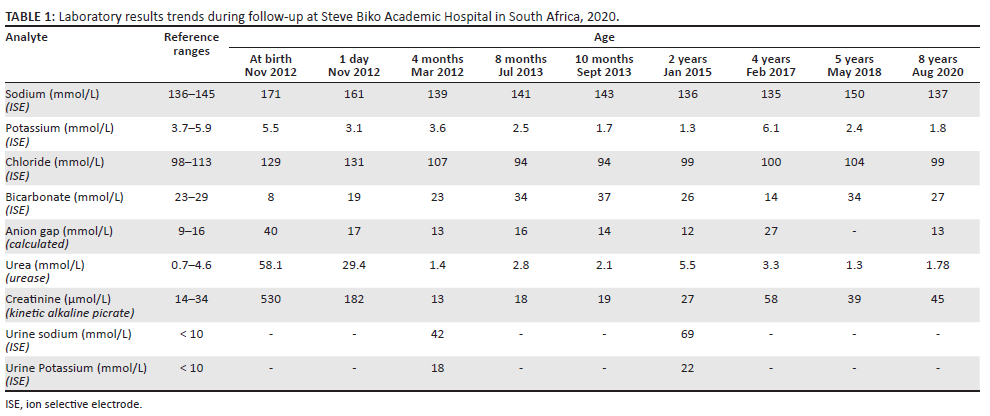
Laboratory results (analysed on an Abbott Architect ci8200 (Abbott Laboratories, Chicago, Illinois, United States) up to 8 years of age revealed potassium values ranging from 2.0 mmol/L to 3.0 mmol/L (reference interval [RI]: 3.7 mmol/L - 5.9 mmol/L) and sodium levels 159 mmol/L - 171 mmol/L (RI: 136 mmol/L - 145 mmol/L) (Table 1). Metabolic alkalosis was also present (HCO3− = 29 mmol/L to 34 mmol/L [RI: 23 mmol/L - 29 mmol/L]). Random urine potassium was elevated (12.0 mmol/L - 22.0 mmol/L [RI: < 10 mmol/L]) despite the low serum potassium on presentation.
Initial investigations in 2019, for the specific R563Q mutation and mutations on exon 13 of the beta subunit of the ENaC (most common causes of Liddle syndrome in South Africa), were negative. Further investigation was undertaken, with the aid of external funding, of all exons and exon-intron boundaries of the alpha (SCNN1A [GenBank NM_001038.5]), beta (SCNN1B [GenBank NM_000336.2]) and gamma (SCNN1G [GenBank NM_001039.3]) subunits encoding for the ENaC; these were amplified by polymerase chain reaction and sequenced using the Nimagen, BrilliantDye™ Terminator Cycle Sequencing Kit V3.1, BRD3-100/1000 (NimaGen, Nijmegen, the Netherlands), according to manufacturer's instructions, in 2020.
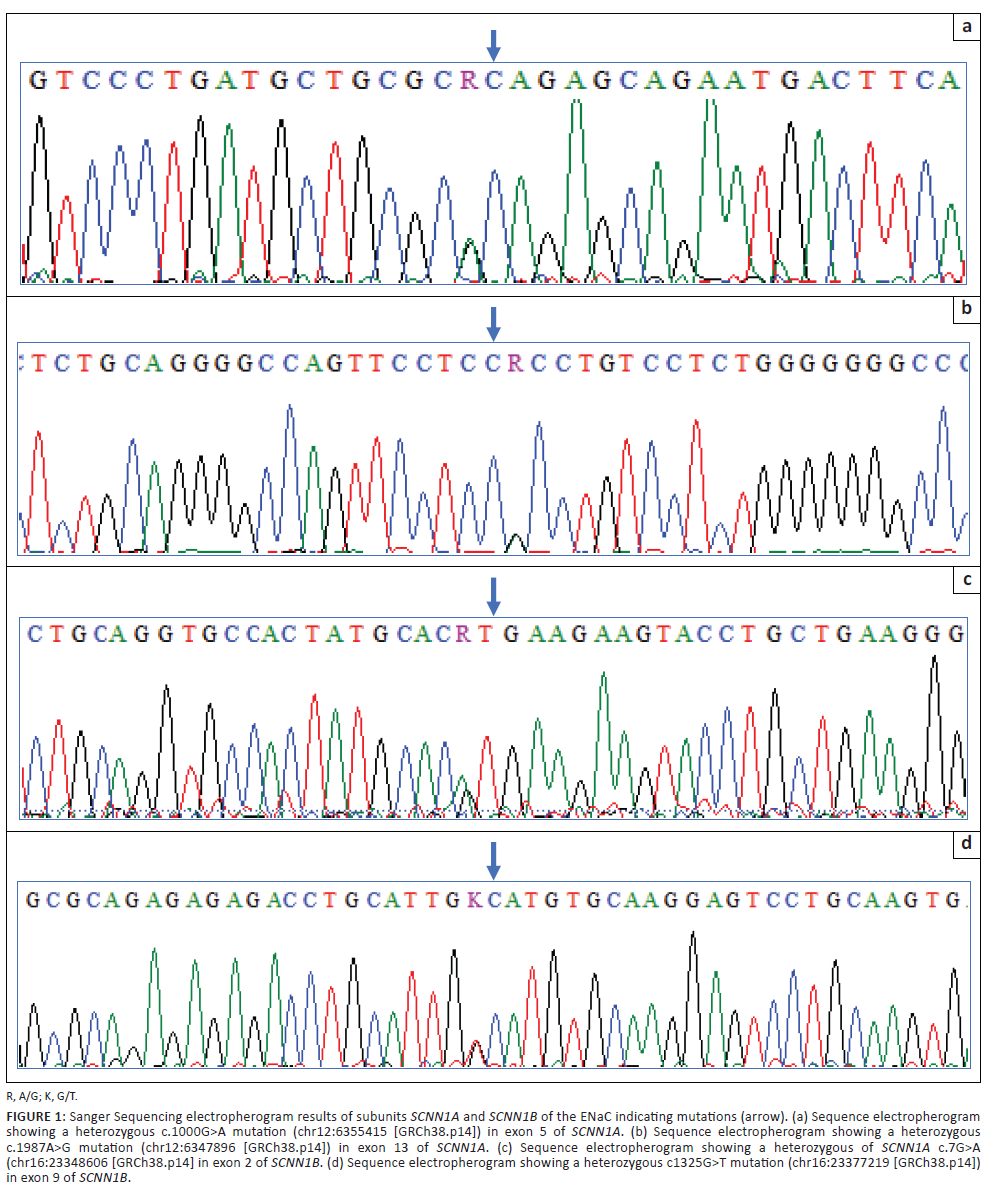
Two sets of compound heterozygous transition mutations were found in the coding regions of the SCNN1A and SCNN1B genes (Figure 1). In SCNN1A, c.1000G>A in exon 5 resulted in Ala334Thr substitution and c.1987A>G in exon 13 led to Thr663Ala amino acid change. In the SCNN1B gene, there was a c.7G>A mutation in exon 2 leading to a Val3Met substitution, and a c.1325G>T mutation in exon 9 leading to a Gly442Val substitution. No mutations were detected in the coding region of the SCNN1G gene.
Management and outcomes
The patient was initially managed on multiple antihypertensive drugs and potassium supplementation, but the treatment course was complicated by poor adherence to therapy and follow-up, resulting in numerous re-admissions over the years to achieve blood pressure control. Effective blood pressure control was only achieved on commencement of amiloride in 2018, years after the initial presentation. This prompted the investigations for an ENaC abnormality.
Discussion
In a neonate presenting with hypernatraemia and hypokalaemic metabolic alkalosis, the use of diuretics, persistent vomiting, nasogastric free drainage losses or a tubular disorder such as Gitelman or Bartter syndrome should be considered. If hypertension is also present, secondary causes such as congenital adrenal hyperplasia, primary hyperaldosteronism, syndrome of apparent mineralocorticoid excess, glucocorticoid-remediable aldosteronism, renal artery stenosis and a deoxycorticosterone-producing tumour should be included in the differential diagnosis.6
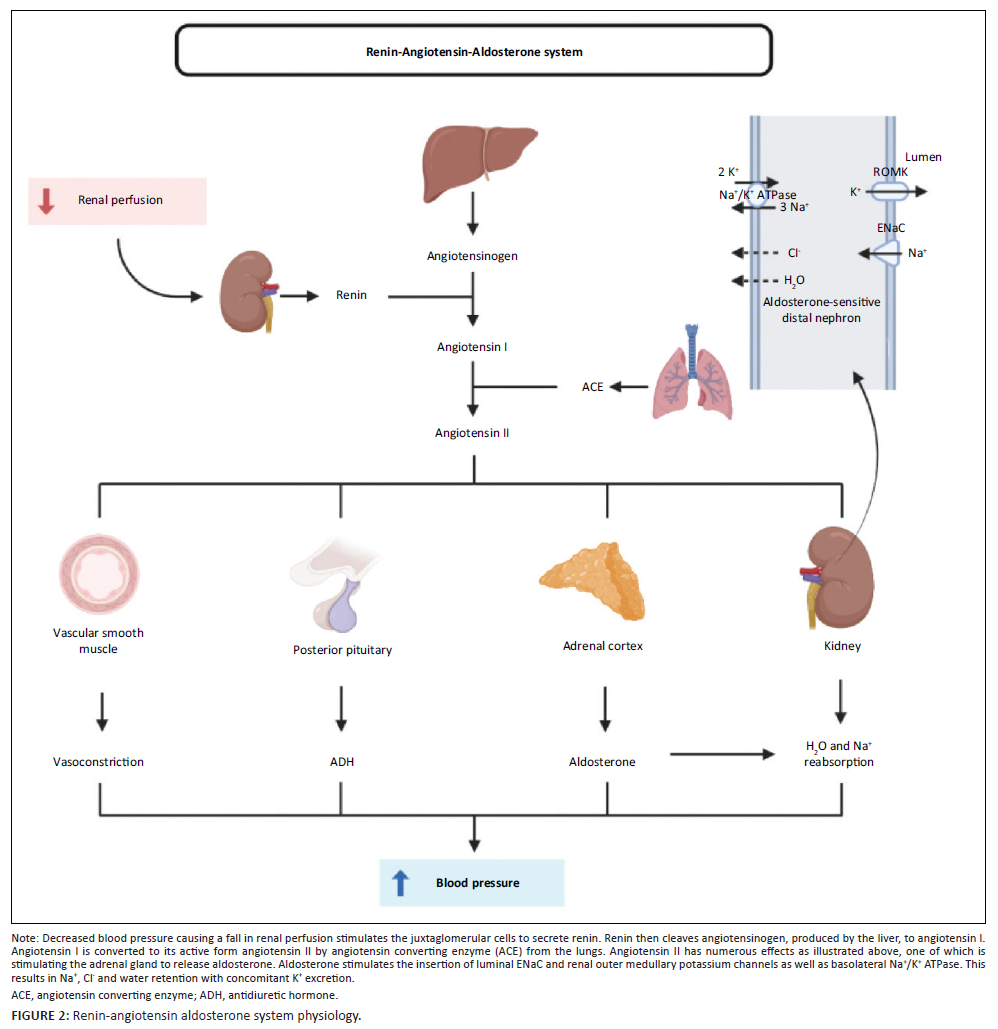
The presence of persistent hypertension with hypokalaemic metabolic alkalosis should raise the suspicion of unregulated ENaC activation.46Figure 2). It is important to determine if the hypertension is associated with low renin levels. In this instance, both serum aldosterone (< 27.0 pmol/L [RI: 49-643 pmol/L, supine], measured by Diagnostic Products Corporation Aldosterone Coat-a-count Kit, Diagnostic Products Corporation, Los Angeles, California, United States) and plasma renin concentration (0.5 mIU/L [RI: 6.5-36.2 mIU/L, supine], measured by CIS BIO Active Renin assay, Cisbio Bioassays, Codolet, France) levels were suppressed.
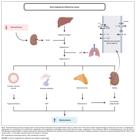
When the ENaC is activated independently of aldosterone stimulation, treatment with aldosterone antagonists has no effect. However, the use of amiloride or triamterene can lead to complete resolution of symptoms, as they are direct antagonists of the renal tubular ENaC and cause natriuresis while being both potassium and magnesium sparing.33
The very rare missense single nucleotide variant (for which our patient is heterozygous), that causes the substitution of glycine to valine (p.Gly442Val), has been linked to hypertension with increased ENaC activity.7,87791010
Analogous to disorders caused by mineralocorticoid excess, Liddle syndrome classically presents with hypertension, hypokalaemia and metabolic alkalosis. These findings are not always present, which may lead to under-diagnosis of the syndrome.113
Rare variants may, autonomously or cumulatively, cause hereditary disorders. Liu and colleagues observed substantial differences in serum potassium levels and symptom onset in rare and non-rare SCNN1B and SCNN1G variant carriers, suggesting potential pathogenicity of some variants.123,10,13
Interpretation of results from next-generation sequencing technologies are challenging as they have increased not only the diagnostic sensitivity, but also the number of variants with uncertain clinical significance. It is feasible that additional mutations that increase ENaC activity and result in phenotypical Liddle syndrome will be discovered. In a study including patients with the Liddle syndrome phenotype from Kenya, Nigeria and South Africa, most patients had variants of a number of diverse genes that affect the ENaC channel.1313
In the assessment of patients with hyporeninaemic hypertension, investigation for a mutation in the ENaC subunits is recommended since early diagnosis and correct management of these patients may improve outcomes. Delayed treatment is associated with failure to thrive and hypertension-related morbidity and mortality from cardiovascular disease, cerebrovascular disease, nephrosclerosis and progressive renal failure. Furthermore, mutation studies permit clinicians to advocate for family screening based on the proband to identify carriers.14
This is the first case where a combined effect from mutations resulted in severe disease. Genetic testing (including whole exome sequencing) should be performed, when possible, to identify mutations in patients with suspected secondary hypertension and unusual presentation.14
Conclusion
Liddle syndrome is a poorly understood, but treatable genetic disease. Mis- or late diagnosis may lead to unfavourable clinical sequelae. Thus, any infant presenting with hypertension and metabolic alkalosis, with or without hypokalaemia, should raise suspicion for Liddle syndrome, even in patients without a family history of hypertension. More functional studies are needed to characterise the numerous variants associated with the syndrome and their potential pathogenicity.
Competing interests
The authors declare that they have no financial or personal relationships that may have inappropriately influenced them in writing this article.
Authors' contributions
N.S. drafted the original manuscript; B.C.-M. conceptualised and edited the manuscript; A.B.A. performed genetic studies and interpretation; G.v.B. undertook patient examination and investigation; and T.S.P. supervised the study.
Sources of support
This research received no specific grant from any funding agency in the public, commercial or not-for-profit sectors.
Data availability
Data supporting the findings of this study are available within the article.
Disclaimer
The views and opinions expressed in this article are those of the authors and do not necessarily reflect the official policy or position of any affiliated institutions or organisations of the authors.
Acknowledgements
Christiaan Labuschagne and Erika Viljoen of Inqaba Biotechnical Industries for technical assistance with sequencing studies.
References
-
1.Buyukkaragoz B, Yilmaz AC, Karcaaltincaba D, Ozdemir O, Ludwig M. Liddle syndrome in a Turkish family with heterogeneous phenotypes. Pediatr Int. 2016;58(8):801-804. https://doi.org/10.1111/ped.12985
» https://doi.org/10.1111/ped.12985 -
2.Bogdanovic R, Kuburovic V, Stajic N, et al. Liddle syndrome in a Serbian family and literature review of underlying mutations. Eur J Pediatr. 2012;171(3):471-478. https://doi.org/10.1007/s00431-011-1581-8
» https://doi.org/10.1007/s00431-011-1581-8 -
3.Assadi FK, Kimura RE, Subramanian U, Patel S. Liddle syndrome in a newborn infant. Pediatr Nephrol. 2002;17(8):609-611. https://doi.org/10.1007/s00467-002-0897-z
» https://doi.org/10.1007/s00467-002-0897-z -
4.Enslow BT, Stockand JD, Berman JM. Liddle's syndrome mechanisms, diagnosis and management. Integr Blood Pressure Control. 2019;12:13-22. https://doi.org/10.2147/IBPC.S188869
» https://doi.org/10.2147/IBPC.S188869 -
5.Hanukoglu I, Hanukoglu A. Epithelial sodium channel (ENaC) family: Phylogeny, structure-function, tissue distribution, and associated inherited diseases. Gene. 2016;579(2):95-132. https://doi.org/10.1016/j.gene.2015.12.061
» https://doi.org/10.1016/j.gene.2015.12.061 - 6.Rifai N. Tietz textbook of clinical chemistry and molecular diagnostics. e-book. Elsevier Health Sciences: St Louis, MO; 2017.
-
7.Dong YB, Zhu HD, Baker EH, et al. T594M and G442V polymorphisms of the sodium channel beta subunit and hypertension in a black population. J Hum Hypertens. 2001;15(6):425-430. https://doi.org/10.1038/sj.jhh.1001182
» https://doi.org/10.1038/sj.jhh.1001182 -
8.Baker EH, Dong YB, Sagnella GA, et al. Association of hypertension with T594M mutation in β subunit of epithelial sodium channels in Black people resident in London. Lancet. 1998;351(9113):1388-1392. https://doi.org/10.1016/S0140-6736(97)07306-6
» https://doi.org/10.1016/S0140-6736(97)07306-6 -
9.Ambrosius WT, Bloem LJ, Zhou L, et al. Genetic variants in the epithelial sodium channel in relation to aldosterone and potassium excretion and risk for hypertension. Hypertension. 1999;34(4):631-637. https://doi.org/10.1161/01.HYP.34.4.631
» https://doi.org/10.1161/01.HYP.34.4.631 -
10.Tetti M, Monticone S, Burrello J, et al. Liddle syndrome: Review of the literature and description of a new case. Int J Mol Sci. 2018;19(3):812. https://doi.org/10.3390/ijms19030812
» https://doi.org/10.3390/ijms19030812 -
11.Rossi E, Farnetti E, Nicoli D, et al. A clinical phenotype mimicking essential hypertension in a newly discovered family with Liddle's syndrome. Am J Hypertens. 2011;24(8):930-935. https://doi.org/10.1038/ajh.2011.76
» https://doi.org/10.1038/ajh.2011.76 -
12.Liu K, Qin F, Sun X, et al. Analysis of the genes involved in Mendelian forms of low-renin hypertension in Chinese early-onset hypertensive patients. J Hypertens. 2018;36(3):502-509. https://doi.org/10.1097/HJH.0000000000001556
» https://doi.org/10.1097/HJH.0000000000001556 -
13.Jones ES, Rayner BL, Spence JD, et al. High frequency of variants of candidate genes in Black Africans with low renin-resistant hypertension. Am J Hypertens. 2017;30(5):478-483. https://doi.org/10.1093/ajh/hpw167
» https://doi.org/10.1093/ajh/hpw167 -
14.Polfus LM, Boerwinkle E, Gibbs RA, et al. Whole-exome sequencing reveals an inherited R566X mutation of the epithelial sodium channel beta-subunit in a case of early-onset phenotype of Liddle syndrome. Cold Spring Harb Mol Case Stud. 2016;2(6):a001255. https://doi.org/10.1101/mcs.a001255
» https://doi.org/10.1101/mcs.a001255

Accepted: 03 Feb. 2023
Published: 14 Apr. 2023