Review of the Stepwise Laboratory Quality Improvement Process Towards Accreditation (SLIPTA) version 2:2015
Abstract
BACKGROUND: In 2011 the Stepwise Laboratory Quality Improvement Process Towards Accreditation (SLIPTA) was launched, aimed at strengthening the quality and competence of African clinical, public health and reference laboratories. We reviewed the first version of the SLIPTA checklist in 2011. The continued development and publication of a new version of the International Organization for Standardization (ISO) 15189 standard demands a renewed review OBJECTIVE: This study aimed to determine the suitability of SLIPTA in guiding laboratories towards ISO 15189:2012 compliance and accreditation and provide recommendations for further SLIPTA improvement METHODS: The study was conducted between September 2018 and April 2019. Coverage of ISO 15189:2012 by SLIPTA checklist version 2:2015 was determined and the point distribution of the scoring system over the different sections of the SLIPTA checklist was re-investigated. These findings were compared with the review of the first version of the SLIPTA checklist (based on ISO 15189:2007) and with findings published on SLIPTA implementation and roll-out RESULTS: The coverage of ISO 15189 by the SLIPTA checklist has increased, even though ISO 15189:012 is more extensive than ISO 15189:2007. The point distribution is still skewed towards sections related to quality planning rather than quality control and improvement. Although to date 314 laboratories have been assessed, barriers for laboratories to participate in SLIPTA are high. Sustainability of SLIPTA results is insufficiently studied CONCLUSION: SLIPTA checklist version 2:2015 has improved compared to earlier versions. We recommend increasing accessibility for laboratories to participate and increasing guidance for ISO-based quality management system implementation
accreditation; ISO 15189; laboratory; SLIPTA; SLMTA; quality assurance; total quality management
Introduction
In 2011 the Stepwise Laboratory Quality Improvement Process Towards Accreditation (SLIPTA) was launched, aimed at strengthening quality and competence of clinical, public health and reference laboratories in the African region.1,2,3,45,67,89,10,11,124,10,13
In 2012, WHO-AFRO designated the African Society for Laboratory Medicine (ASLM) as the SLIPTA secretariat.4,12,144,14
•WHO-AFRO SLIPTA Focal Point, responsible for mobilisation of resources, providing guidance on content and implementation, and reviewing and updating SLIPTA.
•Ministry of Health SLIPTA Focal Point, responsible for -in-country promotion of laboratory improvement through SLIPTA. The ministry of health develops an implementation plan and prioritises SLIPTA applicant laboratories and allocates financial and human resources for SLIPTA implementation.
•ASLM-certified SLIPTA auditors, responsible for conducting audits and providing advice to auditees.
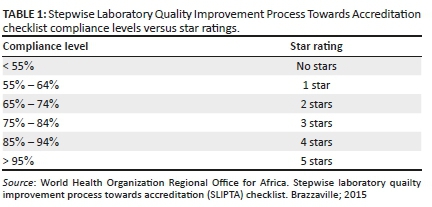
•SLIPTA independent advisory group, enrolling laboratories into the SLIPTA programme, organising audits and making a final decision on laboratory recognition through awarding a star rating based on audit reports (varying from zero to five stars) (Table 1). Star ratings are valid for a two-year period.12,14
The ASLM aims to enrol 2500 laboratories in SLIPTA and have 250 public laboratories accredited to international standards by 2020.12
Not all laboratories can voluntarily participate in SLIPTA because ministries of health are encouraged to select laboratories in phases, considering tiered laboratory networks and giving precedence to laboratories that have already completed laboratory quality improvement training. Eligibility criteria include a SLIPTA self-audit score of 55% or higher, participation in proficiency testing schemes or alternative methods in the past 6 months and having conducted internal audits and a management review in the past 12 months. The laboratory should also have documented its QMS.14
Upon enrolment a laboratory is audited to determine its initial star rating. Laboratories are expected to work towards the next star. Laboratories that achieve a five-star rating are encouraged to apply for ISO 15189 accreditation.14
Key in the SLIPTA programme is the SLIPTA checklist, which is primarily based on ISO 15189 and, to a lesser extent, Clinical and Laboratory Standards Institute (CLSI) guideline QMS01-A4.3,1516111,123,12
This article informs potential users about SLIPTA's suitability to guide laboratories towards ISO 15189:2012 compliance and accreditation and provides recommendations for further improvement of SLIPTA.
Methods
Ethical considerations
Ethical clearance was not required for this study.
Study design
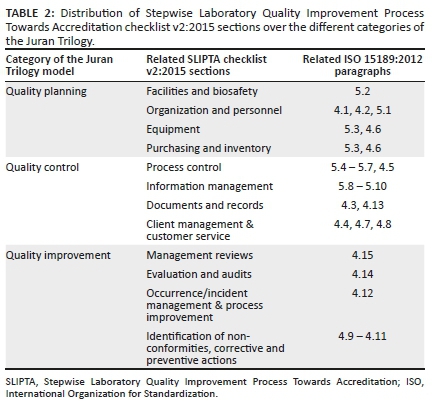
The study was conducted between September 2018 and April 2019. The methodology used in this study was adapted from Datema et al. 2011.11Table 2).171
A PubMed search was conducted on 06 March 2019 to gather literature on outcomes of SLIPTA implementation and roll-out. The search terms were 'SLIPTA' OR 'Stepwise Laboratory Improvement Process Towards Accreditation' and the search yielded 29 hits. After primary and secondary selection based on title and abstract, and identification of additional reports through snowballing, a total of 23 articles were identified. Upon further scrutiny 12 papers were excluded because they did not report findings on SLIPTA implementation, roll-out, effectiveness or sustainability per se. Finally, 11 papers were included.
Results
Changes to Stepwise Laboratory Quality Improvement Process Towards Accreditation checklist v2:2015 compared with the alpha version
Structurally, SLIPTA checklist v2:2015 is very similar to the alpha version. The checklist is still divided over 12 sections based on the Quality System Essential structure developed by the CLSI.15 A notable change is the addition of one very detailed question on the presence and content of 36 specific standard operating procedures (SOPs).
ISO 15189:2012 coverage
The SLIPTA checklist v2:2015 addresses 82% of ISO 15189:2012 clauses, of which 35% are fully addressed, 47% addressed partially and 18% are not addressed at all. This is an improvement compared to the alpha version, which wholly or partially covered 52% of ISO 15189:2007 clauses. In some areas SLIPTA checklist v2:2015 is more detailed and prescriptive compared to ISO 15189 requirements, whereas in other areas ISO 15189 requirements are more extensive than the SLIPTA checklist.
Point distribution and relative weight (importance) of quality management system elements
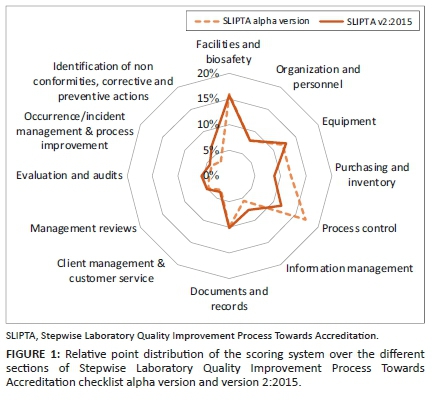
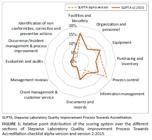
The total number of points in the SLIPTA checklist v2:2015 has increased from 250 to 275. In most sections a higher number of points can be scored compared to the alpha version. However, the relative weight of each section has remained similar due to the increase in the total number of points (see Figure 1).
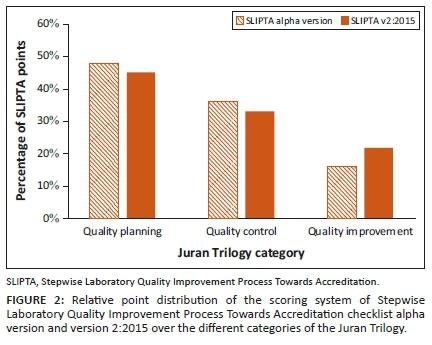
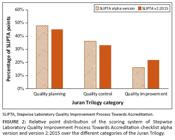
When the point distribution of the SLIPTA checklist v2:2015 scoring system was analysed using the Juran Trilogy model, points were still heavily skewed towards quality planning (45% of the weight) and quality control (33%). Quality improvement received the lowest number of points (22%) (Figure 2).
Outcomes of Stepwise Laboratory Quality Improvement Process Towards Accreditation roll-out
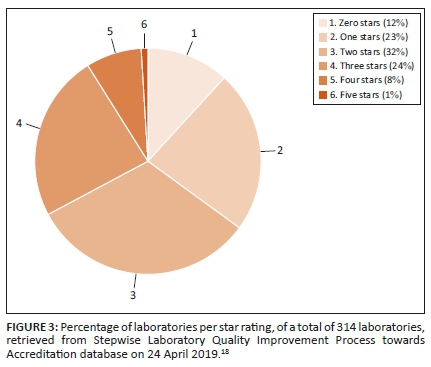
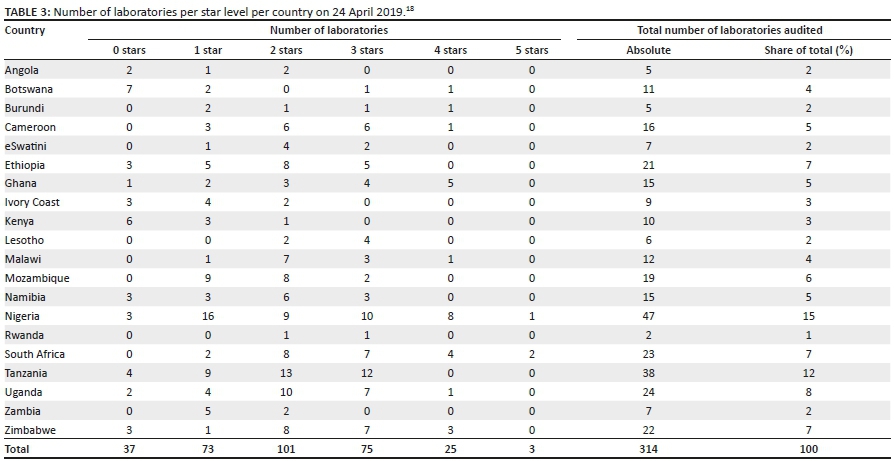
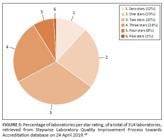
Up to 24 April 2019, 314 laboratories had been audited in 20 countries, which is still far below the ambition to enrol 2500 laboratories by 2020 (Table 3).18Figure 3. The distribution is still in line with data published by Ndihokubwayo et al. in 2016, and Andiric et al. in 2018.12,19
Although many papers have been published on the SLMTA training and mentoring programme, in which the SLIPTA checklist was used to measure progress, papers evaluating the SLIPTA initiative per se are scarce. The paper by Ndihokubwayo et al. (2016) is the only paper summarising SLIPTA implementation and lessons learned.1220,2120,21
Ndihokubwayo et al. found that SLIPTA laboratories performed most poorly on the internal audit and corrective action sections.1222,23,24,25,26,27,2812
Discussion
SLIPTA checklist v2:2015 has improved compared to the alpha version. Even though ISO 15189:2012 is more extensive than ISO 15189:2007, ISO 15189 coverage has increased, decreasing the gap that still needs to be bridged by 5-star laboratories aiming for ISO 15189 accreditation. However, the gap is still considerable: only 35% of ISO 15189 clauses are fully covered, leaving 47% partially covered and 18% not covered at all. Compliance with some of these requirements may be reached as part of the continuous improvement process which 5-star laboratories may have already partially implemented.
The main point for SLIPTA improvement remains the absence of prioritisation of QMS implementation activities. There are no conditions for the different star ratings (other than the star rating thresholds) that encourage laboratories to implement the QMS in a specific, rational manner, indicating that QMS implementation guidance remains limited. Most SLIPTA checklist v2:2015 questions are supplemented with short notes including examples, but neither a stepwise plan nor a detailed explanation of implementation of requirements is provided, showing that SLIPTA remains primarily an assessment checklist. SLIPTA auditors may provide advice on implementation during assessments4,1214
Currently, most points can be scored in SLIPTA checklist sections related to quality planning, followed by quality control. The least number of points can be scored on quality improvement. This creates an imbalance. Implementing a QMS is a 'systems approach': all QMS elements work together to create a sustainable system that can deliver quality-assured laboratory services and continuously improve itself. When one QMS element is not (correctly) functioning, quality assurance of overall laboratory services and continuous quality improvement may be compromised. Therefore, one could argue that SLIPTA should award an equal number of points for each section. On the other hand, the skewed point distribution may point laboratories in the right direction by encouraging them to address sections related to quality planning first because of the high number of points that can be scored in this category, as was also argued by Datema et al. in 2011 (although no evidence was found in literature supporting this hypothesis).1
Another improvement opportunity for the SLIPTA checklist is the imbalance in the effort required to earn points per question. For example, for question 1.5 one needs to develop 36 SOPs to earn five points, whereas by developing a list of documents used in the laboratory (question 1.4), making sure that SOPs are accessible to staff (question 1.6), and indicating date of authorisation, location and date of discontinuation on each SOP (question 1.8) one can score a total of six points. Writing 36 SOPs obviously requires considerably more effort.
Stepwise Laboratory Quality Improvement Process Towards Accreditation implementation and roll-out
A strong point is that SLIPTA requires the ministry of health to play an active role; government commitment has been shown to be key to success in both SLIPTA2111,12,20,24,25,27,29,30,31,32,33,34,35 Also, SLIPTA can be well combined with other guidance methods for laboratory accreditation as is evident from many studies on SLMTA implementation.20,22,27,29,30,33,34,35,36
A major downside is the indirect accessibility of the SLIPTA programme: laboratories are selected by the ministry of health for participation. Only 27 of the 47 WHO-AFRO member states have established a SLIPTA focal point within their ministry of health. Moreover, the programme has a language bias towards Anglophone countries.12,18,2818,3712
Recommendations for improvement
The level of guidance provided by SLIPTA for QMS implementation could be increased by making better use of the star rating system. Currently, stars are simply awarded based on the number of points scored, regardless of the section these points are scored in. Setting certain benchmarks and conditions for the different star ratings may improve guidance. An example could be the definition of key questions that have to be implemented for each star rating. This may help laboratories in using a rational approach towards QMS implementation. It may also assist laboratories in lower tiers of laboratory networks, for which ISO 15189:2012 is not (yet) feasible, to implement a basic yet functional QMS. The phased approach incorporated in the WHO Laboratory Quality Stepwise Implementation (LQSI) tool as well as the tiered approach of the Laboratory Quality Management System Stepwise Improvement Process (LQMS-SIP) used in the Caribbean region could serve as models in assigning key questions to the different star ratings, which would also contribute to harmonisation of SLIPTA with these laboratory strengthening tools and initiatives.38,39,40
Sustainability is a challenge for laboratory strengthening efforts. Literature on SLIPTA implementation does not provide sufficient clarity on sustainability. SLIPTA assessments, like accreditation assessments in general, are snapshot measurements of laboratory compliance, creating the risk that the efforts may weaken after an assessment, as was also witnessed in SLMTA evaluations.11,24,32assurance and may be an extra driver for the laboratory to ensure continued compliance. In the case of SLIPTA, both measures could be adopted without requiring major revisions as it would primarily require amendment of the audit scoring section of the SLIPTA checklist. It should be noted that SLIPTA checklist v2:2015 already indicates that audit scores should be based on laboratory performance during the 12 months preceding the SLIPTA audit, which is an encouragement for laboratories to maintain compliance.3
The last recommendations relate to implementation and roll-out of SLIPTA: increasing the accessibility of SLIPTA by increasing the capacity, among others through ensuring the presence of SLIPTA focal points at each ministry of health and training of more SLIPTA auditors. This should include training of more SLIPTA auditors fluent in Portuguese and French to increase accessibility for laboratories in Lusophone and Francophone countries.
Limitations
The analysis using the Juran Trilogy model was limited to categorisation of overall SLIPTA sections. Although the authors are aware that the same analysis can be conducted at the individual question level, the decision was made to categorise based on the overall intention of each SLIPTA section and, therefore, categorise each SLIPTA checklist section as a whole as described in the methods section. This was also required to enable comparison with the review of the alpha version of the checklist. This study is a desk-based review. Ideally, the findings of this study should be triangulated through an observational study monitoring SLIPTA implementation with a sufficiently large sample size. This would enable substantiation of the findings and may reveal additional opportunities for improvement of the SLIPTA checklist and programme.
Conclusion
SLIPTA checklist v2:2015 has improved compared to the alpha version. Suggestions for improvement are mainly related to the point scoring system, including the designation of key questions to specific star ratings to improve the level of guidance for implementation of a QMS. The LQSI tool and LQMS-SIP could serve as examples, leading to harmonisation of SLIPTA with these tools. Recommendations for enhanced SLIPTA roll-out include increasing accessibility by translation into French and Portuguese, training more auditors, and increasing capacity for participation.
Competing interests
The authors have declared that no competing interests exist.
Authors' contributions
T.A.M.D. designed and performed the review and wrote the manuscript. L.O., J.E.W.B. and P.R.K. critically reviewed the analysis and the manuscript. All authors approved the present version of the manuscript.
Sources of support
This research received no specific grant from any funding agency in the public, commercial, or not-for-profit sectors.
Data availability statement
Data are available upon request.
Disclaimer
The views and opinions expressed in this article are those of the authors and do not necessarily reflect the official policy or position of any affiliated agency of the authors.
Acknowledgements
References
-
1.Datema TAM, Oskam L, van Beers SM, Klatser PR. Critical review of the Stepwise Laboratory Improvement Process Towards Accreditation (SLIPTA): Suggestions for harmonization, implementation and improvement. Trop Med Int Health. 2012;17(3):361-367. https://doi.org/10.1111/j.1365-3156.2011.02917.x
» https://doi.org/10.1111/j.1365-3156.2011.02917.x - 2.World Health Organization Regional Office for Africa. Laboratory accreditation checklist. Brazzaville: WHO-AFRO; 2009.
-
3.World Health Organization Regional Office for Africa. Stepwise laboratory quailty improvement process towards accreditation (SLIPTA) checklist. Brazzaville: WHO-AFRO; 2015. [cited 2019 March 06]. Available from: https://apps.who.int/iris/bitstream/handle/10665/204423/slipta-checkist0711.pdf?sequence=1&isAllowed=y
» https://apps.who.int/iris/bitstream/handle/10665/204423/slipta-checkist0711.pdf?sequence=1& isAllowed=y -
4.World Health Organization Regional Office for Africa. WHO guide for the stepwise laboratory improvement process towards accreditation in the African Region (SLIPTA). Brazzaville: WHO-AFRO; 2015 [cited 2019 March 06]. Available from: http://www.afro.who.int/en/who-guide-for-the-stepwise-laboratory-improvement-process-towards-accreditation-in-the-african-region-with-checklist.html
» http://www.afro.who.int/en/who-guide-for-the-stepwise-laboratory-improvement-process-towards-accreditation-in-the-african-region-with-checklist.html -
5.World Health Organisation. Joint WHO - CDC conference on health laboratory quality systems. Lyon: WHO; 2008. Available from: https://www.who.int/csr/ihr/lyon/report20080409.pdf?ua=1
» https://www.who.int/csr/ihr/lyon/report20080409.pdf?ua=1 -
6.World Health Organization. Joint WHO-CDC conference on laboratory quality systems, Lyon, April 2008 - Joint statement and recommendations. Wkly Epidemiol Rec. 2008;83(32):285-292. [cited 2019 March 06]. Available from: http://www.who.int/wer/2008/wer8332/en/
» http://www.who.int/wer/2008/wer8332/en/ -
7.World Health Organization Regional Office for Africa. The Maputo declaration on strengthening of laboratory systems. Maputo: WHO-AFRO; 2008. Available from: http://www.who.int/diagnostics_laboratory/Maputo-Declaration_2008.pdf
» http://www.who.int/diagnostics_laboratory/Maputo-Declaration_2008.pdf -
8.Regional Committee for Africa. Strengthening public health laboratories in the WHO African Region: A critical need for disease control (resolution AFR/RC58/6). Maputo: WHO-AFRO; 2008. [cited 2019 March 06]. Available from: https://www.afro.who.int/sites/default/files/2017-06/AFR-RC58-6.pdf
» https://www.afro.who.int/sites/default/files/2017-06/AFR-RC58-6.pdf -
9.World Health Organization. Press release: Kigali host the launch of a program to accelerate national laboratory service capcity building towards accreditation in the African Region. Kigali: WHO; 2009 [cited 2019 March 06]. Available from: https://www.who.int/hiv/amds/diagnostics/amds_kigali_pr_lab.pdf
» https://www.who.int/hiv/amds/diagnostics/amds_kigali_pr_lab.pdf -
10.Nordling L. African disease labs to get health check. Nature. 2009. https://doi.org/10.1038/news.2009.735
» https://doi.org/10.1038/news.2009.735 -
11.Andiric LR, Massambu CG. Laboratory quality improvement in Tanzania. Am J Clin Pathol. 2015;143(4):566-572. https://doi.org/10.1309/AJCPAB4A6WWPYIEN
» https://doi.org/10.1309/AJCPAB4A6WWPYIEN -
12.Ndihokubwayo JB, Maruta T, Ndlovu N, et al. Implementation of the World Health Organization regional office for Africa stepwise laboratory quality improvement process towards accreditation. Afr J Lab Med. 2016;5(1):a280. https://doi.org/10.4102/ajlm.v5i1.280
» https://doi.org/10.4102/ajlm.v5i1.280 -
13.Gershy-Damet G-M, Rotz P, Cross D, et al. The World Health Organization African Region laboratory accreditation process. Am J Clin Pathol. 2010;134(3):393-400. https://doi.org/10.1309/AJCPTUUC2V1WJQBM
» https://doi.org/10.1309/AJCPTUUC2V1WJQBM - 14.World Health Organization Regional Office for Africa. WHO/AFRO guide for the stepwise laboratory quality improvement process towards accreditation (SLIPTA) in the African Region - Revision 2 (draft). Brazzaville: WHO-AFRO; 2019.
- 15.Clinical and Laboratory Standards Institute. Quality management system : A model for laboratory services; Approved guideline - 4th ed. Wayne, PA: CLSI; 2011.
-
16.Yao K, McKinney B, Murphy A, et al. Improving quality management systems of laboratories in developing countries: An innovative training approach to accelerate laboratory accreditation. Am J Clin Pathol. 2010;134(3):401-409. https://doi.org/10.1309/AJCPNBBL53FWUIQJ
» https://doi.org/10.1309/AJCPNBBL53FWUIQJ - 17.Juran JM. Juran on leadership for quality - An executive handbook. New York, NY: Collier Macmillan; 1989.
-
18.ASLM Laboratory Accreditation/SLIPTA - ASLM [homepage on the Internet]. [cited 2019 Apr 24]. Available from: http://www.aslm.org/slipta-map/
» http://www.aslm.org/slipta-map/ -
19.Andiric LR, Chavez LA, Johnson M, Landgraf K, Milner Jr DA. Strengthening laboratory management toward accreditation, a model program for pathology laboratory improvement. Clin Lab Med. 2018;38(1):131-140. https://doi.org/10.1016/j.cll.2017.10.010
» https://doi.org/10.1016/j.cll.2017.10.010 -
20.Viegas SO, Azam K, Madeira C, et al. Mozambique's journey toward accreditation of the National Tuberculosis Reference Laboratory. Afr J Lab Med. 2017;6(2):a491. https://doi.org/10.4102/ajlm.v6i2.491
» https://doi.org/10.4102/ajlm.v6i2.491 -
21.Maruta T, Motebang D, Mathabo L, Rotz PJ, Wanyoike J, Peter T. Impact of mentorship on WHO-AFRO strengthening laboratory quality improvement process towards accreditation (SLIPTA). Afr J Lab Med. 2012;1(1):6. https://doi.org/10.4102/ajlm.v1i1.6
» https://doi.org/10.4102/ajlm.v1i1.6 -
22.Taremwa IM, Ampaire L, Iramiot J, et al. Assessment of three medical and research laboratories using WHO AFRO_SLIPTA quality standards in Southwestern Uganda: Long way to go. Pan Afr Med J. 2017;28(1):129. https://doi.org/10.11604/pamj.2017.28.129.10995
» https://doi.org/10.11604/pamj.2017.28.129.10995 -
23.Mokobela KO, Moatshe MT, Modukanele M. Accelerating the spread of laboratory quality improvement efforts in Botswana. Afr J Lab Med. 2014;3(2):207. https://doi.org/10.4102/ajlm.v3i2.207
» https://doi.org/10.4102/ajlm.v3i2.207 -
24.Mbah H, Ojo E, Ameh J, et al. Piloting laboratory quality system management in six health facilities in Nigeria. PLoS One. 2014;9(12):e116185. https://doi.org/10.1371/journal.pone.0116185
» https://doi.org/10.1371/journal.pone.0116185 -
25.Guevara G, Gordon F, Irving Y, et al. The impact of SLMTA in improving laboratory quality systems in the Caribbean Region. Afr J Lab Med. 2014;3(2):199. https://doi.org/10.4102/ajlm.v3i2.199
» https://doi.org/10.4102/ajlm.v3i2.199 -
26.Maina RN, Mengo DM, Mohamud AD, et al. Progressing beyond SLMTA: Are internal audits and corrective action the key drivers of quality improvement? Afr J Lab Med. 2014;3(2):222. https://doi.org/10.4102/ajlm.v3i2.222
» https://doi.org/10.4102/ajlm.v3i2.222 -
27.Mothabeng D, Maruta T, Lebina M, Lewis K, Wanyoike J, Mengstu Y. Strengthening laboratory management towards accreditation: The lesotho experience. Afr J Lab Med. 2012;1(1):9. https://doi.org/10.4102/ajlm.v1i1.9
» https://doi.org/10.4102/ajlm.v1i1.9 -
28.World Health Organization Regional Office for Africa. WHO/AFRO SLIPTA update [homepage on the Internet]. SLIPTA/SLMTA Symposium 2016; 2016 [cited 2019 Jul 17]. Available from: https://slmta.org/uploads/category_file/29/1.4-SLIPTAUpdates.pdf
» https://slmta.org/uploads/category_file/29/1.4-SLIPTAUpdates.pdf -
29.Nzabahimana I, Sebasirimu S, Gatabazi JB, et al. Innovative strategies for a successful SLMTA country programme: The Rwanda story. Afr J Lab Med. 2014;3(2):a217. https://doi.org/10.4102/ajlm.v3i2.217
» https://doi.org/10.4102/ajlm.v3i2.217 -
30.Skaggs B, Pinto I, Masamha J, Turgeon D, Gudo ES. Implementing laboratory quality management systems in Mozambique: The becton dickinson-US President's emergency plan for AIDS relief public-private partnership initiative. J Infect Dis. 2016;213(Suppl 2):S47-S52. https://doi.org/10.1093/infdis/jiv544
» https://doi.org/10.1093/infdis/jiv544 -
31.Yao K, Maruta T, Luman ET, Nkengasong JN. The SLMTA programme: Transforming the laboratory landscape in developing countries. Afr J Lab Med. 2014;3(3):a194. https://doi.org/10.4102/ajlm.v3i2.194
» https://doi.org/10.4102/ajlm.v3i2.194 -
32.Andiric LR, Massambu CG. One laboratory's progress toward accreditation in Tanzania. Afr J Lab Med. 2014;3(2):202. https://doi.org/10.4102/ajlm.v3i2.202
» https://doi.org/10.4102/ajlm.v3i2.202 -
33.Nkrumah B, Van der Puije B, Bekoe V, et al. Building local human resources to implement SLMTA with limited donor funding: The Ghana experience. Afr J Lab Med. 2014;3(2):a214. https://doi.org/10.4102/ajlm.v3i2.214
» https://doi.org/10.4102/ajlm.v3i2.214 -
34.Nkwawir SC, Batumani NN, Maruta T, Awasom CN. From grass to grace: How SLMTA revolutionised the Bamenda Regional hospital laboratory in Cameroon. Afr J Lab Med. 2014;3(2):a203. https://doi.org/10.4102/ajlm.v3i2.203
» https://doi.org/10.4102/ajlm.v3i2.203 -
35.Ntshambiwa K, Ntabe-Jagwer W, Kefilwe C, Samuel F, Moyo S. Translating a National Laboratory Strategic Plan into action through SLMTA in a district hospital laboratory in Botswana. Afr J Lab Med. 2014;3(2):a209. https://doi.org/10.4102/ajlm.v3i2.209
» https://doi.org/10.4102/ajlm.v3i2.209 -
36.Masamha J, Skaggs B, Pinto I, et al. Working toward a sustainable laboratory quality improvement programme through country ownership: Mozambique's SLMTA story. Afr J Lab Med. 2014;3(2):a253. https://doi.org/10.4102/ajlm.v3i2.253
» https://doi.org/10.4102/ajlm.v3i2.253 -
37.Elbireer AM, Jackson JB, Sendagire H, Opio A, Bagenda D, Amukele TK. The good, the bad, and the unknown: Quality of clinical laboratories in Kampala, Uganda. PLoS One. 2013;8(5):e64661. https://doi.org/10.1371/journal.pone.0064661
» https://doi.org/10.1371/journal.pone.0064661 -
38.Caricom Regional Organization for Standards and Quality [homepage on the Internet]. LQMS-SIP. [cited 2019 Jul 17]. Available from: https://www.crosq.org/index.php/projects/lqms-sip
» https://www.crosq.org/index.php/projects/lqms-sip -
39.Alemnji G, Edghill L, Guevara G, et al. Development and implementation of the Caribbean Laboratory Quality Management Systems Stepwise improvement process (LQMS-SIP) towards accreditation. Afr J Lab Med. 2017;6(1):a496. https://doi.org/10.4102/ajlm.v6i1.496
» https://doi.org/10.4102/ajlm.v6i1.496 -
40.World Health Organization. Laboratory quality stepwise implementation tool [homepage on the Internet]. 2014. [cited 2019 Jul 17]. Available from: https://extranet.who.int/lqsi
» https://extranet.who.int/lqsi

Accepted: 19 Aug. 2020
Published: 28 Oct. 2020