Genetic copy number variation of TLR7, T-bet, IL12B, and FcγRIIIB in Egyptian ankylosing spondylitis patients
Abstract
BACKGROUND: Ankylosing spondylitis (AS) is a polygenic disorder. Copy number variations (CNVs) alter the expression of TLR7, T-bet, IL-12B, and FcγRIIIB genes, contributing to AS development via their immune system roles OBJECTIVE: The current study aimed to assess the correlation between AS susceptibility and CNVs of TLR7, T-bet, IL12B, and FcγRIIIB, as well as their influence on disease activity METHODS: The study involved 42 healthy controls and 72 patients with AS, recruited from the Rheumatology and Rehabilitation clinic of Zagazig University Hospitals, Zagazig, Egypt, from 01 November 2023 to 30 October 2024. Sociodemographic, clinical data and blood samples were collected from all participants. Copy number estimations for TLR7, T-bet, IL12B, and FcγRIIIB genes were performed using SYBR Green real-time polymerase chain reaction RESULTS: Of 72 cases aged 19 to 52 years, 47 (65.2%) were men and 25 (34.8%) were women. Controls included 42 participants aged 27 to 55 years, 22 (52.4%) men and 20 (47.6%) women. Higher IL12b and FcγRIIIB gene copy numbers were significantly associated with a higher risk of AS (p = 0.001, odds ratio [OR]: 3.8, 95% confidence interval [CI]: 1.7-8.07, and p < 0.001, OR: 5.5, 95% CI: 2.31-13.08, respectively). While T-bet and TLR7 gene CNVs showed no significant association with AS risk. No significant association was observed between the studied CNVs and AS activity CONCLUSION: High copy numbers of IL12B and FcγRIIIB genes may be associated with increased AS risk. However, no significant correlation was found between AS risk and TLR7 or T-bet CNVs WHAT THIS STUDY ADDS: The findings of this study revealed that genetic copy number variations may contribute to the risk of AS
ankylosing spondylitis; copy number variations; TLR7; T-bet; IL12B; FcγRIIIB
Introduction
Ankylosing spondylitis (AS) is a common seronegative autoimmune arthropathy, primarily characterised by axial skeleton and sacroiliac joint inflammation. In severe cases, inflammation may progress to fibrosis and calcification, reducing spinal flexibility and resulting in fusion and restricted mobility.12
The aetiology of AS is multifactorial, involving numerous factors, such as genetic factors, environmental influences, prior infections, and socio-economic status.3HLA-B27, a key genetic factor accounting for 16% - 50% of disease genetic susceptibility.4,54,6
Recent findings have highlighted the substantial role of copy number variations (CNVs) in the progression of AS.3789
Research increasingly emphasises the significance of CNVs in various complex immune and nonimmune disorders.10,11FcγRIIIB), T-box expressed in T-cells (T-bet), Interleukin-12B (IL12B), and Toll-like receptor 7 (TLR7) have been identified as risk factors for the onset of several autoimmune disorders, such as rheumatoid arthritis, AS, and systemic lupus erythematosus.12,13,14,15
Lower CNs of FcγRIIIB genes have been linked to an increased risk of developing AS.16T-bet gene has been associated with increased susceptibility to AS, along with acute anterior uveitis, indicating the potential impact of the T-bet gene CNV on the clinical course of the disease.15T-bet and IL-12B,17IL-12B expression, which has been demonstrated to exacerbate the severity of AS.18TLR7 gene are linked to AS, with a reduced CN posing a risk for men and a protective effect for women.19
Furthermore, a number of studies have connected several gene polymorphisms to the progression of AS and the activity of the disease. The Ankylosing Spondylitis Disease Activity Score based on C-reactive protein is the standard method for evaluating AS disease activity. This validated composite index combines C-reactive protein levels with patient-reported measures (back pain, morning stiffness length, and global disease activity), and categorises disease activity as inactive (< 1.3), low (1.3-2.1), high (2.1-3.5), or extremely high (≥ 3.5), based on the 2018 criteria.20
The link between CNVs and AS risk has been the subject of several studies in developed countries, but far less is known in North African countries with limited resources, especially Egypt. Moreover, to our knowledge, the influence of these CNVs on disease activity has not been previously examined. Thus, the purpose of this study was to examine the relationship between the risk of developing AS in Egyptian patients and CNVs in the FcγRIIIB, T-bet, IL12B, and TLR7 genes. We also aimed to assess the influence of these CNVs on AS activity.
Methods
Ethical considerations
This study was approved by the Zagazig University Institutional Review Board (approval number: 11207) on 25 October 2023. All participants provided written informed consent prior to participating. Procedures were followed in accordance with the Helsinki Declaration. The patient's information had been concealed from the lab staff as the data records and sample tubes were coded.
Subjects
This study was a case-control study conducted at Zagazig University Hospital, Zagazig, Egypt, from 01 November 2023 to 30 October 2024. It comprised 72 consecutive patients with AS, recruited from the Rheumatology and Rehabilitation clinic of the Zagazig University Hospitals, Zagazig, Egypt. The control group comprised 42 healthy volunteers of the same ethnicity, matched for age and gender, devoid of any autoimmune or malignant disorders. Sample size of this study was calculated using Epi Info version 3.01 (Centers for Disease Control and Prevention [CDC], Atlanta, Georgia, United States), at 95% confidence interval (CI), based on the previously published data.12,15,19
Eligibility criteria of participating patients included fulfilling the Modified New York Criteria for AS diagnosis.21HLA-B27 status, C-reactive protein, and erythrocyte sedimentation rate levels. Disease activity was assessed using ASDAS.20
Extraction of genomic DNA
Venous blood samples were collected in tubes containing ethylenediaminetetraacetic acid. Total DNA was extracted according to the manufacturer's instructions using DNA isolation kits (QIAamp DNA Minikit; QIAGEN GmbH, Hilden, Germany) and stored at −20 °C. Agarose gel electrophoresis was used to roughly assess the extracted DNA concentration before storage.22
Copy number estimation
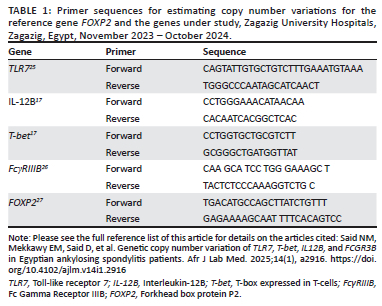
Real-time quantitative polymerase chain reaction (PCR) (RTqPCR, SYBR Green; Enzynomics, Life Technologies, Delhi, India) was utilised to assess the CNVs of FcγRIIIB, T-bet, IL12B, and TLR7, following the previously described procedure.2324FOXP2) gene (a non-CNV gene) served as the reference for normalisation. Table 1 lists the primer sequences used to estimate CNVs for the genes under study and the reference gene FOXP2.
Copy numbers (CNs) were calculated using the comparative cycle threshold (2-^^Ct) method.23FcγRIIIB, T-bet, IL12B, and TLR7 were categorised as low CN (< 2), normal CN (= 2), and high CN (> 2).
Data analysis
Data were tabulated and analysed using SPSS-22 (IBM Corporation, Armonk, New York, United States). Student's t-test and one-way analysis of variation with least significant difference post-hoc test were used to compare means, and the Kruskal-Wallis test was used to compare medians. Chi-square and Fisher's exact tests were used to compare frequencies. The level of statistical significance was set at a p-value of < 0.05.
Results
Demographic and clinical characteristics
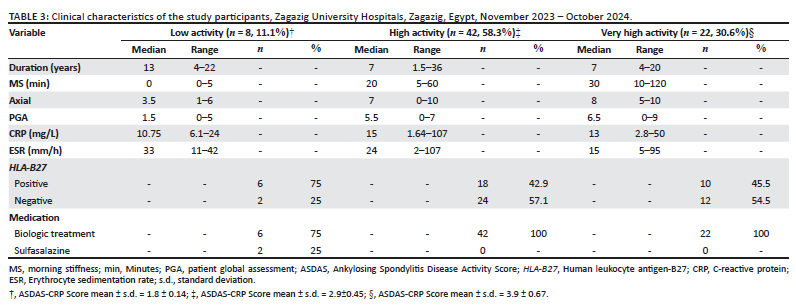
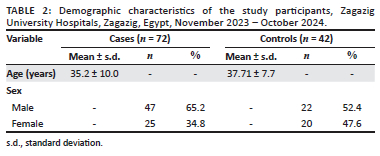
The study included 114 participants: 72 AS patients and 42 healthy controls. Among the 72 AS patients, aged 19 to 52 years, 47 (65.2%) were men and 25 (34.8%) were women. The control group consisted of 42 individuals aged 27 to 55 years, with 22 (52.4%) men and 20 (47.6%) women. Among patients with AS, 11.1% exhibited low disease activity, 58.3% demonstrated high activity, and 30.6% presented with very high activity. Table 2 and Table 3 summarise the demographics and clinical characteristics of the study participants.
Frequency distribution of FcγRIIIB, T-bet, IL12B, and TLR7 genes copy number variations
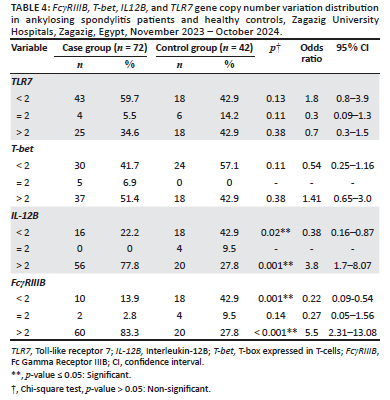
Patients and healthy controls were compared regarding the frequency of CNV in the genes under investigation (Table 4).
Elevated CNs of the IL12b and FcγRIIIB genes (> 2) were associated with an increased risk of AS (> 2) (IL12b: p = 0.001, odds ratio [OR]: 3.8, 95% CI: 1.7-8.07; FcγRIIIB: p < 0.001, OR: 5.5, 95% CI: 2.31-13.08). While low CNs of IL12b and FcγRIIIB genes (< 2) were found to be associated with reduced risk of AS (IL12b: p = 0.02, OR: 0.38, 95% CI: 0.16-0.87; FcγRIIIB: p = 0.001, OR: 0.22, 95% CI: 0.09-0.54). However, neither T-bet nor TLR7 gene CNVs were significantly associated with the risk of AS.
Association between ankylosing spondylitis activity and copy number variations in FcγRIIIB, T-bet, IL12B, and TLR7 genes
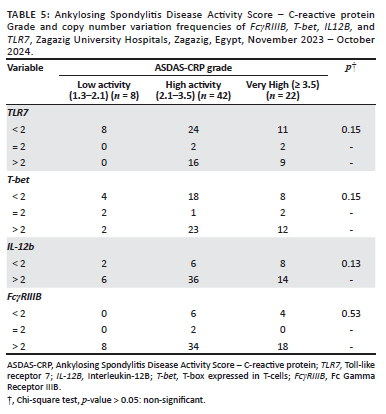
To determine the association between CNVs of the examined genes and AS activity, we analysed the differences in cases concerning CNVs and the erythrocyte sedimentation rate, C-reactive protein, HLA-B27, and Ankylosing Spondylitis Disease Activity Score - C-reactive protein Grade (Table 5). However, we could not identify any correlation between the clinical manifestations of AS and FcγRIIIB, T-bet, IL12B, and TLR7 CNVs.
Discussion
The study examined the association between the risk of AS and CNVs in the FcγRIIIB, T-bet, IL12B, and TLR7 genes among Egyptian patients, as well as their impact on disease activity.
The results of the current investigation showed a strong correlation between elevated FcγRIIIB and IL12B copy numbers (> 2 copies) and a higher risk of AS, with 3.8-fold and 5.5-fold increases in risk associated with each. As for the T-bet gene CNV, there was no significant distinction between AS patients and healthy controls, even though AS patients had a higher frequency (51.4%) of increased CNs (> 2 copies). Furthermore, AS patients had a higher frequency of low TLR7 CN (59.7%). Nevertheless, no significant link between AS risk and TLR7 CNVs was found. Meanwhile, we found no association between AS activity and CNVs of TLR7, IL12B, T-bet, or FcγRIIIB.
In contrast to our findings, the analysis of FcγRIIIB CNV frequency distribution in a study of Algerian AS patients in 2019 showed no statistically significant difference between patients and controls.28FcγRIIIB gene may be a risk factor for AS.12
To the best of our knowledge, this is the first study to investigate the association of IL12B CNV and the risk of AS. Previous research, however, including a Chinese study in 2024 and a Bulgarian study in 2019, found a strong correlation between IL12B SNPs and an increased genetic risk for AS.29,30IL12B has been identified as a possible therapeutic target for AS in two recent Chinese studies conducted in 2024.30,31
In contrast to our findings, a study conducted in China in 2016 identified a higher prevalence of a high T-bet CN in AS patients, which was significantly correlated with disease risk.15
A Chinese study in 2018 identified a significant correlation between low TLR7 CN and the risk of AS. Nevertheless, the CNs found in this investigation were restricted to one or two copies, in contrast to our analysis, which found that more than two copies of the gene were found in 51.4% of AS patients and 42.9% of healthy controls.19TLR7 CNVs.19FcγRIIIB, T-bet, and IL12B CNVs.
Limitations
It is important to take into account the limitations of this study when evaluating the results. First, the study was conducted at a single centre and had a relatively small sample size. Therefore, subsequent multicentre studies with larger cohorts may be necessary to corroborate the results, as they might be lacking sufficient power. Second, despite the established impact of genetic CNVs on the level of gene expression, which may influence the outcomes of therapy, the study did not address the effect of the genes under investigation on the response to therapy.
Conclusion
The study's findings indicate that possessing more than two copies of both IL12B and FcγRIIIB may increase the risk of developing AS. However, AS risk was not significantly correlated with TLR7 or T-bet CNVs.
Competing interests
The authors declare that they have no financial or personal relationships that may have inappropriately influenced them in writing this article.
Authors' contributions
N.M.S. and A.A.A. helped to conceptualise the study. N.M.S., E.M.M., D.S., and D.G.A. all made contributions to the study's investigation. Contributions to data curation came from E.M.M., D.S., D.G.A. and A.A.A. D.G.A., A.A.A., A.A.E.S., E.A.A., and F.Z.K. all made contributions to the methodology. The project administration and original draft preparation were handled by N.M.S. The article was reviewed and edited with assistance from E.M.M., D.S., F.Z.K., E.A.A., A.A.E.S. and A.A.A. F.Z.K., E.A.A., and A.A.E.S. assisted with the study supervision. All of the authors read and approved the article.
Sources of support
This research received no specific grant from any funding agency in the public, commercial, or not-for-profit sectors.
Data availability
The data sets generated and analysed during the current study are available from the corresponding author, N.M.S., on reasonable request.
Disclaimer
The views and opinions expressed in this article are those of the authors and are the product of professional research. The article does not necessarily reflect the official policy or position of any affiliated institution, funder, agency, or that of the publisher. The authors are responsible for this article's results, findings, and content.
Acknowledgements
We express our gratitude to all of the willing participants in this study, as well as to the staff at Zagazig University Hospitals, particularly the Medical Laboratory Department and the Rheumatology and Rehabilitation clinic in Zagazig, Egypt, for their technical assistance throughout this study.
References
-
1. Thomas GP, Willner D, Robinson PC, et al. Genetic diagnostic profiling in axial spondyloarthritis: A real world study. Clin Exp Rheumatol [serial online]. 2017 [cited 2025 Jun 19]; 35(2):229-233. Available from: https://hdl.handle.net/1887/114610
» https://hdl.handle.net/1887/114610 -
2. Zhu W, He X, Cheng K, et al. Ankylosing spondylitis: Etiology, pathogenesis, and treatments. Bone Res. 2019;7(1):22. https://doi.org/10.1038/s41413-019-0057-8
» https://doi.org/10.1038/s41413-019-0057-8 -
3. Biały S, Iwaszko M, Świerkot J, et al. Genetic variability of three common NK and γδ T cell receptor genes (FCγ3R, NCR3, and DNAM-1) and their role in Polish patients with rheumatoid arthritis and ankylosing spondylitis. Immunol Res. 2024;72(4):614-625. https://doi.org/10.1007/S12026-024-09488-3
» https://doi.org/10.1007/S12026-024-09488-3 -
4. Nam B, Jo S, Bang SY, et al. Clinical and genetic factors associated with radiographic damage in patients with ankylosing spondylitis. Ann Rheum Dis. 2023;82(4):527-532. https://doi.org/10.1136/annrheumdis-2022-222796
» https://doi.org/10.1136/annrheumdis-2022-222796 -
5. Brown MA, Kennedy LG, Macgregor AJ, et al. Susceptibility to ankylosing spondylitis in twins the role of genes, HLA, and the environment. Arthritis Rheum. 1997;40(10):1823-1828. https://doi.org/10.1002/ART.1780401015
» https://doi.org/10.1002/ART.1780401015 -
6. Díaz-Peña R, López-Vázquez A, López-Larrea C. Old and new HLA associations with ankylosing spondylitis. Tissue Antigens. 2012;80(3):205-213. https://doi.org/10.1111/j.1399-0039.2012.01944.x
» https://doi.org/10.1111/j.1399-0039.2012.01944.x -
7. Stankiewicz P, Lupski JR. Structural variation in the human genome and its role in disease. Ann Rev Med. 2010;61(1):437-455. https://doi.org/10.1146/ANNUREV-MED-100708-204735
» https://doi.org/10.1146/ANNUREV-MED-100708-204735 -
8. Gamazon ER, Stranger BE. The impact of human copy number variation on gene expression. Brief Funct Genom. 2015;14(5):352-357. https://doi.org/10.1093/bfgp/elv017
» https://doi.org/10.1093/bfgp/elv017 -
9. Usher CL, McCarroll SA. Complex and multi-allelic copy number variation in human disease. Brief Funct Genom. 2015;14(5):329-338. https://doi.org/10.1093/bfgp/elv028
» https://doi.org/10.1093/bfgp/elv028 -
10. Bigagli E, De Filippo C, Castagnini C, et al. DNA copy number alterations, gene expression changes and disease-free survival in patients with colorectal cancer: A 10 year follow-up. Cell Oncol. 2016;39(6):545-558. https://doi.org/10.1007/S13402-016-0299-Z
» https://doi.org/10.1007/S13402-016-0299-Z -
11. Aghaei H, Farhadi E, Akhtari M, et al. Copy number variation of IL17RA gene and its association with the ankylosing spondylitis risk in Iranian patients: A case-control study. BMC Med Genet. 2020;21(1):147. https://doi.org/10.1186/S12881-020-01078-Y
» https://doi.org/10.1186/S12881-020-01078-Y -
12. Wang L, Yang X, Cai G, et al. Association study of copy number variants in FCGR3A and FCGR3B gene with risk of ankylosing spondylitis in a Chinese population. Rheumatol Int. 2016;36(3):437-442. https://doi.org/10.1007/S00296-015-3384-0
» https://doi.org/10.1007/S00296-015-3384-0 -
13. Aslam MM, John P, Fan KH, et al. Association of Fc Gamma Receptor 3B gene copy number variation with rheumatoid arthritis susceptibility. Genes. 2022;13(12): 2238. https://doi.org/10.3390/genes13122238
» https://doi.org/10.3390/genes13122238 -
14. García-Ortiz H, Velázquez-Cruz R, Espinosa-Rosales F, Jiménez-Morales S, Baca V, Orozco L. Association of TLR7 copy number variation with susceptibility to childhood-onset systemic lupus erythematosus in Mexican population. Ann Rheum Dis. 2010;69(10):1861-1865. https://doi.org/10.1136/ard.2009.124313
» https://doi.org/10.1136/ard.2009.124313 -
15. Bai L, Liu Y, Hou S, Liao D, Kijlstra A, Yang P. Association of T-Bet, GATA-3, RORC, and FOXP3 copy number variations with acute anterior uveitis with or without ankylosing spondylitis in Chinese Han. Invest Ophthalmol Vis Sci. 2016;57(4):1847-1852. https://doi.org/10.1167/iovs.15-17960
» https://doi.org/10.1167/iovs.15-17960 -
16. Qi Y, Zhou X, Bu D, Hou P, Lv J, Zhang H. Low copy numbers of FCGR3A and FCGR3B associated with Chinese patients with SLE and AASV. Lupus. 2017;26(13):1383-1389. https://doi.org/10.1177/0961203317700485
» https://doi.org/10.1177/0961203317700485 -
17. Yu B, Shao Y, Yue X, et al. Copy number variations of Interleukin-12B and T-bet are associated with systemic lupus erythematosus. Rheumatology. 2011;50(7):1201-1205. https://doi.org/10.1093/rheumatology/keq439
» https://doi.org/10.1093/rheumatology/keq439 -
18. Meng S, Fan S, Li Y, et al. Aberrant methylation of miR-34b and IL-12B mRNA promoters contributes to the reduced severity of ankylosing spondylitis. Biochem Genet. 2021;59(3):714-730. https://doi.org/10.1007/S10528-020-10023-W
» https://doi.org/10.1007/S10528-020-10023-W -
19. Wang M, Xu S, Zhang X, et al. Association of TLR7 gene copy number variations with ankylosing spondylitis in a Chinese population: A case control study. Clin Exp Rheumatol. 2018;36(5):814-819. https://hdl.handle.net/102.100.100/560014
» https://hdl.handle.net/102.100.100/560014 -
20. Machado PM, Landewé R, Van der Heijde D. Ankylosing Spondylitis Disease Activity Score (ASDAS): 2018 update of the nomenclature for disease activity states. Ann Rheum Dis. 2018;77(10):1539-1540. https://doi.org/10.1136/annrheumdis-2018-213184
» https://doi.org/10.1136/annrheumdis-2018-213184 -
21. Moll JM. New criteria for the diagnosis of ankylosing spondylitis. Scand J Rheumatol. 1987;16(sup65):12-24. https://doi.org/10.3109/03009748709102173
» https://doi.org/10.3109/03009748709102173 -
22. Parks VR, Torres DA. Yield gel via quantitative gel electrophoresis. In: C. Cupples Connon (ed.)., Forensic DNA analysis: Methods and protocols. New York, NY: Springer US, 2023; p. 129-147. https://doi.org/10.1007/978-1-0716-3295-6_9
» https://doi.org/10.1007/978-1-0716-3295-6_9 -
23. Ma L, Chung WK. Quantitative analysis of copy number variants based on real-time LightCycler PCR. Curr Protoc Hum Genet. 2014;80(1):7-21. https://doi.org/10.1002/0471142905.HG0721S80
» https://doi.org/10.1002/0471142905.HG0721S80 -
24. Haendiges J, Timme R, Ramachandran P, Balkey M. DNA Quantification using the Qubit Fluorometer v1. 2020 [homepage on the Internet] [cited 2025 Sep 19]. Available from: https://www.protocols.io/view/dna-quantification-using-the-qubit-fluorometer-bi8dkhs6dx.doi.org/10.17504/protocols.io.bi8dkhs6
» https://www.protocols.io/view/dna-quantification-using-the-qubit-fluorometer-bi8dkhs6dx.doi.org/10.17504/protocols.io.bi8dkhs6 -
25. Kelley J, Johnson MR, Alarcón GS, Kimberly RP, Edberg JC. Variation in the relative copy number of the TLR7 gene in patients with systemic lupus erythematosus and healthy control subjects. Arthritis Rheum. 2007;56(10):3375-3378. https://doi.org/10.1002/ART.22916
» https://doi.org/10.1002/ART.22916 -
26. Marques RB, Thabet MM, White SJ, et al. Genetic variation of the Fc gamma receptor 3B gene and association with rheumatoid arthritis. PLoS One. 2010;5(10):e13173. https://doi.org/10.1371/JOURNAL.PONE.0013173
» https://doi.org/10.1371/JOURNAL.PONE.0013173 -
27. Boon-Peng H, Mat Jusoh JA, Marshall CR, et al. Rare copy number variants identified suggest the regulating pathways in hypertension-related left ventricular hypertrophy. PLoS One. 2016;11(3):e0148755. https://doi.org/10.1371/JOURNAL.PONE.0148755
» https://doi.org/10.1371/JOURNAL.PONE.0148755 -
28. Dahmani CA, Benzaoui A, Amroun H, Zemani-Fodil F, Petit-Teixeira E, Boudjema A. Association study of copy number variants in CCL3L1, FCGR3A and FCGR3B genes with risk of ankylosing spondylitis in a West Algerian population. Int J Immunogenet. 2019;46(6):437-443. https://doi.org/10.1111/IJI.12454
» https://doi.org/10.1111/IJI.12454 -
29. Ivanova M, Manolova I, Miteva L, Gancheva R, Stoilov R, Stanilova S. Genetic variations in the IL-12B gene in association with IL-23 and IL-12p40 serum levels in ankylosing spondylitis. Rheumatol Int. 2019;39(1):111-119. https://doi.org/10.1007/S00296-018-4204-0
» https://doi.org/10.1007/S00296-018-4204-0 -
30. Jin Q, Ren F, Song P. Innovate therapeutic targets for autoimmune diseases: Insights from proteome-wide mendelian randomization and Bayesian colocalization. Autoimmunity. 2024;57(1):2330392. https://doi.org/10.1080/08916934.2024.233039
» https://doi.org/10.1080/08916934.2024.233039 -
31. Dai L, Xia L, Su G, Gao Y, Jiang Q, Yang P. Identifying prioritization of therapeutic targets for ankylosing spondylitis: A multi-omics Mendelian randomization study. J Transl Med. 2024;22(1): 1115. https://doi.org/10.1186/S12967-024-05925-X
» https://doi.org/10.1186/S12967-024-05925-X

Accepted: 11 Oct. 2025
Published: 29 Nov. 2025