African laboratory medicine in the time of COVID-19
Iruka N. Okeke
Department of Pharmaceutical Microbiology, Faculty of Pharmacy, University of Ibadan, Ibadan, Nigeria
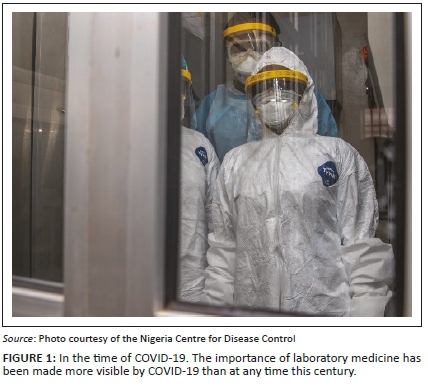
2020 has been a turbulent year but one that fixed the importance of laboratory medicine in the eye of the global public. Public health experts' worst fears surrounding a hypothetical 'Agent X' that spurred thousands of calls for 'pandemic preparedness' in the last half-decade have become eerily true and the importance of 'testing' is now broadly acknowledged. By the end of the first quarter of 2020, following its emergence in Wuhan, China, Agent X was named severe acute respiratory syndrome coronavirus 2 (SARS-CoV-2); it had caused infections in almost every country, and one of the worst pandemics of all time was underway (Figure 1). Instituting SARS-CoV-2 testing rapidly and reliably was one of the pivotal distinguishers between countries that got a handle on their coronavirus disease 2019 (COVID-19) epidemics and those that did not.
No country in the world was ready by the time COVID-19 overwhelmed each national surveillance and health system. Across Africa, pandemic response planning began early and, as SARS-CoV-2 entered our continent relatively late, most African countries were able to deploy testing before the virus arrived.1,2
National epidemic responses depend on very local activities. Published this year in the African Journal of Laboratory Medicine (AJLM) is an exemplary local response to a COVID-19 crisis in an African SARS-CoV-2 testing laboratory. The crisis was a laboratory outbreak that not only endangered the medical laboratory scientists, but also disabled the testing service when the need was greatest.34
At the patient level, a significant proportion of COVID-19 survivors live for months with disabling sequelae in 'long-COVID'; the ultimate prognosis for this new disease remains unclear.567,8
SARS-CoV-2 is not the only epidemic pathogen that circulated in Africa in 2020. The Democratic Republic of Congo declared a 21-month Ebola outbreak that ended on 14 May 2020, but on 01 June 2020, a new outbreak began. Nigeria has worked to contain Lassa fever virus epidemics for most of the duration of the COVID-19 pandemic. While these three feared viruses ravage, measles, cholera and other epidemics are also in play.83,9,10,11,12,13,14,15,16,17,181019,20
As clinical and laboratory health workers and the scientific community engaged in discoveries to combat the pandemic, another equally frenetic behind-the-scenes response took place in editorial offices as we, gratefully helped by volunteer reviewers, struggled under the mound of COVID-19 submissions to bring to the fore discoveries that are most worthy of priority and long-term attention. In mid-May, relatively early in the pandemic, a Science commentary reported that COVID-19 researchers and policymakers were becoming overwhelmed by the literature in this brand new field with a 20-day doubling time on the number of articles indexed by major databases.2121
As a regional journal addressing laboratory medicine on a continent that has seen multiple epidemics this year, we at AJLM quickly found that our standard workflows would not manage submissions fast and rigorously enough for a helpful pandemic response. At the same time, it was important for us to continue to process manuscripts across the journal's scope. We did manage to ensure that the journal could contribute in valuable ways towards addressing the pandemic while at the same time ensuring that important articles not focused on the pressing problem of COVID-19 were published. Indeed, by responding to COVID-19 but not succumbing to 'COVIDdisation',22Future of Diagnostics special issue article by Preiser and Van Zyl2324,25
To meet the double demands of maintaining peer review and production of regular articles, the submission rate of which continues to rise, and processing pandemic submissions, the pandemic pushed us to alter our operations. AJLM's new normal allows for a regular submission track, and a new fast track for articles containing knowledge that could be applied to the ongoing COVID-19, Lassa fever and Ebola haemorrhagic fever outbreaks. This year, these ran in addition to the call to our special issue (Volume 9, Issue 2) on the future of diagnostics, which was guest edited by Timothy Amukele, Noah Fongwen and Rosanna Peeling.26
Altogether, AJLM received 47 submissions through its viral epidemic fast track between April 2020 when we opened the track and October of the same year. Only two of these epidemic articles addressed Lassa fever, and none addressed Ebola haemorrhagic fever, pointing to the disproportionately low scientific activity on local African epidemics. So far, just 10 of the COVID-19 fast-tracked articles have been accepted. This acceptance rate compares with that for regular submissions but is unexpectedly low, because we expected predominantly pressing issues worthy of publication to come via the fast track. Similar high submission, low acceptance rates have been reported by editors of other journals.27
Do the low acceptance rates make all the extra hard work done on pandemic submissions by the editorial offices worth it? This question is important to us, because all three epidemics are still in play, our journal's overall submission rate has continued to rise and our fast track is still open. The answer is undoubtedly yes. Firstly, by overseeing the peer review of the manuscripts we received, we did help to shield frontline health workers and policymakers from the even larger deluge of COVID-19 preprints that they would otherwise have had to navigate. This is an important function of peer review in general. Secondly and more pointedly, we are proud to be publishing key articles that influence the course of the pandemic, particularly on the African continent, where the dynamics are different, the response, while variable, is largely commendable and resources are severely limited. Given the sacrifices made in so many areas towards containing this pandemic, this is the least we could do.
Competing interests
The author has declared that no competing interests exist.
Author's contributions
I conceived and wrote the editorial.
Disclaimer
The views and opinions expressed in this article are those of the author and do not necessarily reflect the official policy or position of any affiliated agency of the author.
Acknowledgements
I thank the authors, reviewers, editorial office and publishers' staff that made African Journal of Laboratory Medicine's necessary capacity surge in this pandemic possible. I am also grateful to frontline medical laboratory science and other health professionals for their selfless service through this pandemic.
References
-
1.Kapata N, Ihekweazu C, Ntoumi F, et al. Is Africa prepared for tackling the COVID-19 (SARS-CoV-2) epidemic. Lessons from past outbreaks, ongoing pan-African public health efforts, and implications for the future. Int J Infect Dis. 2020;93:233-236. https://doi.org/10.1016/j.ijid.2020.02.049
» https://doi.org/10.1016/j.ijid.2020.02.049 -
2.Senghore M, Savi MK, Gnangnon B, Hanage WP, Okeke IN. Leveraging Africa's preparedness towards the next phase of the COVID-19 pandemic. Lancet Glob Health. 2020;8(7):e884-e885. https://doi.org/10.1016/S2214-109X(20)30234-5
» https://doi.org/10.1016/S2214-109X(20)30234-5 -
3.Opperman CJ, Marais GJK, Naidoo M, Hsiao M, Samodien N. Response to a cluster of Severe Acute Respiratory Syndrome Coronavirus 2 cases at a diagnostic laboratory. Afr J Lab Med. 2020;9(1):a1307. https://doi.org/10.4102/ajlm.v9i1.1307
» https://doi.org/10.4102/ajlm.v9i1.1307 -
4.Skosana L, Ismail F, Mbelle N, Said M. Brucellosis - Laboratory workers' nightmare come true: A case study. Afr J Lab Med. 2020;9(1):a1114. https://doi.org/10.4102/ajlm.v9i1.1114
» https://doi.org/10.4102/ajlm.v9i1.1114 -
5.Honigsbaum M, Krishnan L. Taking pandemic sequelae seriously: From the Russian influenza to COVID-19 long-haulers. Lancet. 2020;396(10260):1389-1391. https://doi.org/10.1016/S0140-6736(20)32134-6
» https://doi.org/10.1016/S0140-6736(20)32134-6 -
6.Umaru FA. Scaling up testing for COVID-19 in Africa: Responding to the pandemic in ways that strengthen health systems. Afr J Lab Med. 2020;9(1):a1244. https://doi.org/10.4102/ajlm.v9i1.1244
» https://doi.org/10.4102/ajlm.v9i1.1244 -
7.Nkengasong JN, Mankoula W. Looming threat of COVID-19 infection in Africa: act collectively, and fast. Lancet. 2020;395(10227):841-842. https://doi.org/10.1016/S0140-6736(20)30464-5
» https://doi.org/10.1016/S0140-6736(20)30464-5 -
8.Nkengasong JN, Tessema SK. Africa needs a new public health order to tackle infectious disease threats. Cell. 2020;183(2):296-300. https://doi.org/10.1016/j.cell.2020.09.041
» https://doi.org/10.1016/j.cell.2020.09.041 -
9.Egyir B, Obeng-Nkrumah N, Kyei GB. COVID-19 pandemic and antimicrobial resistance: Another call to strengthen laboratory diagnostic capacity in Africa. Afr J Lab Med. 2020;9(1):a1302. https://doi.org/10.4102/ajlm.v9i1.1302
» https://doi.org/10.4102/ajlm.v9i1.1302 -
10.Olalekan A, Iwalokun B, Akinloye OM, Popoola O, Samuel TA, Akinloye O. COVID-19 rapid diagnostic test could contain transmission in low- and middle-income countries. Afr J Lab Med. 2020;9(1):a1255. https://doi.org/10.4102/ajlm.v9i1.1255
» https://doi.org/10.4102/ajlm.v9i1.1255 -
11.Mitton B, Rule R, Mbelle N, Van Hougenhouck-Tulleken W, Said M. Post-procedural Bacillus cereus septic arthritis in a patient with systemic lupus erythematosus. Afr J Lab Med. 2020;9(1):a1119. https://doi.org/10.4102/ajlm.v9i1.1119
» https://doi.org/10.4102/ajlm.v9i1.1119 -
12.Govender S, Mbambo L, Nyirenda M, Sebitloane M, Abbai N. Herpes simplex virus-2 infections in pregnant women from South Africa: Evaluation of the ImmunoFLOW rapid test. Afr J Lab Med. 2020;9(1):a854. https://doi.org/10.4102/ajlm.v9i1.854
» https://doi.org/10.4102/ajlm.v9i1.854 -
13.Haumba SM, Toda M, Jeffries R, et al. Prevalence of cryptococcal antigen (CrAg) among HIV-positive patients in Eswatini, 2014-2015. Afr J Lab Med. 2020;9(1):a933. https://doi.org/10.4102/ajlm.v9i1.933
» https://doi.org/10.4102/ajlm.v9i1.933 -
14.Madeira CM, Azam KI, Sato DN, Khosa C, Bhatt N, Viegas SO. Evaluation of the Ogawa-Kudoh method for tuberculosis isolation in two health units in Mozambique. Afr J Lab Med. 2020;9(1):a929. https://doi.org/10.4102/ajlm.v9i1.929
» https://doi.org/10.4102/ajlm.v9i1.929 -
15.Pasipamire M, Broughton E, Mkhontfo M, Maphalala G, Simelane-Vilane B, Haumba S. Detecting tuberculosis in pregnant and postpartum women in Eswatini. Afr J Lab Med. 2020;9(1):a837. https://doi.org/10.4102/ajlm.v9i1.837
» https://doi.org/10.4102/ajlm.v9i1.837 -
16.Sayed S, Mutasa R, Kaaya E, et al. Establishing the College of Pathologists of East, Central and Southern Africa - The Regional East Central and Southern Africa College of Pathology. Afr J Lab Med. 2020;9(1):a979. https://doi.org/10.4102/ajlm.v9i1.979
» https://doi.org/10.4102/ajlm.v9i1.979 -
17.Mudenda V, Malyangu E, Sayed S, Fleming K. Addressing the shortage of pathologists in Africa: Creation of a MMed programme in pathology in Zambia. Afr J Lab Med. 2020;9(1):a974. https://doi.org/10.4102/ajlm.v9i1.974
» https://doi.org/10.4102/ajlm.v9i1.974 -
18.Demba RN, Aradi SM, Mwau M, Mwanda WO. Kaposi's sarcoma-associated herpesvirus protein ORF75 among HIV-1 patients in Kenya. Afr J Lab Med. 2020;9(1), a939. https://doi.org/10.4102/ajlm.v9i1.939
» https://doi.org/10.4102/ajlm.v9i1.939 -
19.Attoh SA, Hobenu F, Edusei L, et al. Postmortem diagnosis of COVID-19: Antemortem challenges of three cases at the 37 Military Hospital, Accra, Ghana. Afr J Lab Med. 2020;9(1):a1290. https://doi.org/10.4102/ajlm.v9i1.1290
» https://doi.org/10.4102/ajlm.v9i1.1290 -
20.Admou B, Hachimi A, Samkaoui MA. How can clinical immunology laboratories contribute to the management of severe COVID-19 cases in limited resource contexts? Afr J Lab Med. 2020;9(1), a1282. https://doi.org/10.4102/ajlm.v9i1.1282
» https://doi.org/10.4102/ajlm.v9i1.1282 -
21.Brainard J. Scientists are drowning in COVID-19 papers. Can new tools keep them afloat. Science. 2020 (13 May). https://doi.org/10.1126/science.abc7839
» https://doi.org/10.1126/science.abc7839 -
22.Pai M. Covidization of research: What are the risks? Nat Med. 2020;26(8):1159. https://doi.org/10.1038/s41591-020-1015-0
» https://doi.org/10.1038/s41591-020-1015-0 -
23.Preiser W, Van Zyl GU. Pooled testing: A tool to increase efficiency of infant HIV diagnosis and virological monitoring. Afr J Lab Med. 2020;9(2):a1035. https://doi.org/10.4102/ajlm.v9i2.1035
» https://doi.org/10.4102/ajlm.v9i2.1035 -
24.Emperador DM, Mazzola LT, Kelly-Cirino C. An open-source molecular diagnostic platform approach for outbreak and epidemic preparedness. Afr J Lab Med. 2020;9(2):a1017. https://doi.org/10.4102/ajlm.v9i2.1017
» https://doi.org/10.4102/ajlm.v9i2.1017 -
25.Naidoo D, Ihekweazu C. Nigeria's efforts to strengthen laboratory diagnostics - Why access to reliable and affordable diagnostics is key to building resilient laboratory systems. Afr J Lab Med. 2020;9(2):a1019. https://doi.org/10.4102/ajlm.v9i2.1019
» https://doi.org/10.4102/ajlm.v9i2.1019 - 26.Fongwen N, Boeras D, Peeling RW, Amukele T. Connected Diagnostics Systems: The Future of Disease Control in Africa. Afr J Lab Med. 2020;9(2):a1365. In press.
-
27.The Lancet Global Health. Publishing in the time of COVID-19. Lancet Glob Health. 2020;8(7):e860. https://doi.org/10.1016/S2214-109X(20)30260-6
» https://doi.org/10.1016/S2214-109X(20)30260-6