Africa Centres for Disease Control and Prevention's framework for antimicrobial resistance control in Africa
Jay K. VarmaI; John Oppong-OtooII; Pascale OndoaIII; Olga PerovicIV, V; Benjamin J. ParkVI; Ramanan LaxminarayanVII, VIII; Rosanna W. PeelingIX; Constance SchultszX; Han LiXI, XII; Chikwe IhekweazuXIII; Amadou A. SallXIV; Baboucarr JawII; John N. NkengasongI
IAfrica Centres for Disease Control and Prevention, Addis Ababa, Ethiopia
IIAfrican Union, Inter-African Bureau for Animal Resources, Nairobi, Kenya
IIIAfrican Society for Laboratory Medicine, Addis Ababa, Ethiopia
IVNational Institute for Communicable Diseases, Johannesburg, South Africa
VUniversity of Witwatersrand, Johannesburg, South Africa
VIUnited States Centers for Disease Control and Prevention, Atlanta, Georgia, United States
VIICenter for Disease Dynamics, Economics and Policy, Washington, D.C., United States
VIIIPrinceton University, Princeton, New Jersey, United States
IXLondon School of Tropical Medicine and Hygiene, London, England, United Kingdom
XAmsterdam Institute for Global Health and Development, Amsterdam, the Netherlands
XIChina Center for Disease Control and Prevention, Beijing, China
XIIChina PLA Institute for Disease Control and Prevention, Beijing, China
XIIINigeria Center for Disease Control, Abuja, Nigeria
XIVInstitut Pasteur, Dakar, Senegal
Antimicrobial resistant (AMR) organisms are increasing globally, threatening to render existing treatments ineffective against many infectious diseases.1,23,456,7
Many factors contribute to the emergence, persistence, and transmission of AMR. Although AMR strains arise naturally due to genetic changes in replicating microorganisms, their emergence is accelerated by inappropriate use of antimicrobial agents in humans, animals, and the environment.891011
Recognising the urgent need for action, the World Health Assembly adopted the Global Action Plan on Antimicrobial Resistance in May 2015, and the World Health Organization established the Global Antimicrobial Resistance Surveillance System.1213,141516
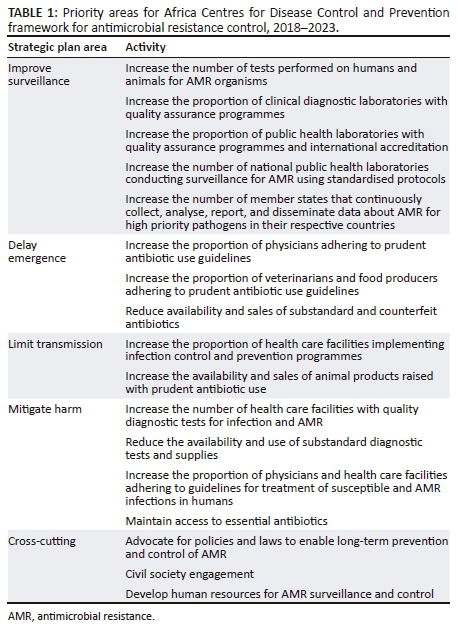
Africa CDC developed its framework with four principles in mind. Firstly, the strategy should help advance the Global Action Plan. Secondly, while more information is needed about incidence, prevalence, and interventions, Africa CDC should follow the 'precautionary principle' and take action against resistance now. Thirdly, policy and practice are as important as diagnostic or treatment technologies in mitigating AMR. Finally, Africa CDC has an opportunity to leverage its unique position in the AU to raise awareness, secure commitments, and influence policy at the head of state level. After consultation with subject matter experts in Africa and globally, Africa CDC developed a framework that has four objectives: (1) improve surveillance of AMR organisms among humans and animals, (2) delay emergence of AMR, (3) limit transmission of AMR and (4) mitigate harm among patients infected with AMR organisms. Table 1 lists the high priority activities Africa CDC will pursue for each of these areas.
Improve surveillance
Understanding the full extent of AMR and its impact in Africa is challenged by a lack of continent-wide AMR surveillance data, especially for pathogens that require complex testing methods.3Mycobacterium tuberculosis, and Plasmodium spp., several challenges remain, including inadequate demand by clinicians for diagnostic testing, laboratory infrastructure, resources to continuously collect, transport, and test specimens for AMR surveillance, use of standardised protocols, quality assurance, systematic surveillance of AMR in animals and their products in Africa, and collaboration between the human and animal health sectors.17,18
Delay emergence
Reducing the need for and inappropriate use of antimicrobials can help delay emergence of AMR. In human health, extensive studies have been conducted in the United States, Europe, and other high-income settings on approaches to promote prudent antimicrobial prescribing - an approach known as antimicrobial stewardship.1920,21,2223924
In animals, antimicrobials are used for prophylaxis, treatment, and growth promotion, and it is reasonably assumed that most antimicrobial consumption occurs during food production, not through prescriptions to treat illness. Prudent use in these settings is a critical risk management approach to delaying emergence, but is challenging, because food producers have a strong economic incentive to use antimicrobials and weak incentive to use them prudently.25,26
Limit transmission
Transmission of AMR occurs frequently in health care facilities.2728
In animal health, implementation of risk-based food safety systems - such as hazard analysis of critical control points, good handling practices, and good agricultural practices - can reduce the flow of AMR pathogens in food to humans, especially when combined with proper nutrition to reduce the need for antimicrobials.29
Mitigate harm
Strong antimicrobial stewardship programmes promote adherence to clinical treatment guidelines, helping delay emergence of AMR and improve outcomes among patients already infected with AMR organisms. Diagnostic stewardship will also be essential to guide such treatment.3031
Enablers of Africa Centres for Disease Control and Prevention's framework
Laws and policies play a critical role in framing, enabling, and protecting public health. Africa CDC will leverage its stature and authority as a specialised agency of the AU to advocate for laws and policies to monitor, prevent, and mitigate AMR. Such policy initiatives, however, can only succeed with robust involvement of civil society. To date, engagement of civil society for AMR has been challenging, because the science can be complex to explain, the threat often characterised as distant, patients' stories of illness and death often not told because of under-diagnosis and because they occur in marginalised groups, interventions not readily distilled into high-impact slogans, and public health agencies investing too little in civil society engagement.
To effectively control AMR, each country will need leadership and staff that have the education and skills to implement AMR control programmes in both human and animal health sectors. The most pronounced human resources gaps are likely in laboratory services - from bench microbiologists to managers - and in health care infection prevention and control. Africa CDC and partners are working together on a public health workforce strategy for the continent and mobilising resources to support hiring, training, and retaining of staff. By highlighting the urgency and severity of the AMR threat, Africa CDC will advocate for both donors and government ministries to allocate more funding to laboratory services and infection prevention and control personnel.
Implementation of Africa Centres for Disease Control and Prevention's framework
From 4-5 April 2018, Africa CDC convened AMR focal points from African countries and partners to review the Africa CDC AMR framework and prioritise activities for the next year. One major conclusion of the meeting was that Africa CDC should establish a formal structure to coordinate AMR activities within the AU, particularly with the AU's animal health agency (the Inter-African Bureau for Animal Resources), across member states, and with multilateral and non-governmental partners in Africa. Participants proposed that this entity's first task should be to transform the Africa CDC AMR framework into an AU-wide framework and ensure that it more fully addresses AMR issues in animal and environmental health. In addition to governance and coordination, participants proposed that Africa CDC focus activities in the next year on developing and harmonising tools to map and assess human and animal diagnostic laboratory capacity for AMR, developing guidelines for prudent antimicrobial use in humans and in animals that reflect what is currently known about AMR in Africa, and developing minimum standards for infection prevention and control in health care facilities to limit AMR transmission.
Conclusion
Africa CDC's framework for AMR is broad and aspirational, reflecting the urgency and complexity of this public health problem and the potential for Africa CDC as an institution to help galvanise action and provide guidance to member states. Progress in implementing this framework will require close coordination across and high-level commitment from member states and partners in Africa.
Competing interests
The authors declare that they have no financial or personal relationships which may have inappropriately influenced them in writing this article.
Sources of support
None.
Authors' contributions
J.K.V. drafted the manuscript. All authors contributed to the design and analysis of this project and all authors reviewed, approved and substantively revised the manuscript.
Acknowledgements
The conclusions, findings and opinions do not necessarily reflect the official position of the United States Centers for Disease Control and Prevention or the authors' affiliated institutions.
References
- 1. World Bank. Drug-resistant infections: A threat to our economic future [homepage on the Internet].
-
Washington, DC; 2016. Available from: http://pubdocs.worldbank.org/en/689381474641399486/1701381-AMR-Lab-Report-Web.pdf
» https://doi.org/10.1016/S1473-3099(13)70318-9 - 3. Ndihokubwayo JB, Yahaya AA, Desta AT, et al. Antimicrobial resistance in the African region: Issues, challenges and actions proposed. Key determinants for health in the African region. African Health Monitor. 2013;16.
- 4. World Health Organization. Drug resistant tuberculosis is now at record levels [homepage on the Internet].
-
Geneva; 2010. Available from: http://www.who.int/mediacentre/news/releases/2010/drug_resistant_tb_20100318/en/
» https://doi.org/10.1016/S1473-3099(17)30394-8 -
5. Essack SY, Desta AT, Abotsi RE, Agoba EE. Antimicrobial resistance in the WHO African region: Current status and roadmap for action. J Pub Health. 2016;39:8-13. https://doi.org/10.1093/pubmed/fdw015
» https://doi.org/10.1093/pubmed/fdw015 -
6. Le Doare K, Bielicki J, Heath PT, Sharland M. Systematic review of antibiotic resistance rates among gram-negative bacteria in children with sepsis in resource-limited countries. J Pediatric Infect Dis Soc. 2015;4:11-20. https://doi.org/10.1093/jpids/piu014
» https://doi.org/10.1093/jpids/piu014 -
8. Levy SB, Marshall B. Antibacterial resistance worldwide: Causes, challenges and responses. Nat Med. 2004;10:S122-S129. https://doi.org/10.1038/nm1145
» https://doi.org/10.1038/nm1145 -
9. Newton PN, Green MD, Fernández FM, Day NP, White NJ. Counterfeit anti-infective drugs. Lancet Infect Dis. 2006;6:602-613. https://doi.org/10.1016/S1473-3099(06)70581-3
» https://doi.org/10.1016/S1473-3099(06)70581-3 -
10. Okeke IN, Lamikanra A, Edelman R. Socioeconomic and behavioral factors leading to acquired bacterial resistance to antibiotics in developing countries. Emerg Infect Dis. 1999;5(1):18-27. https://doi.org/10.3201/eid0501.990103
» https://doi.org/10.3201/eid0501.990103 - 11. O'Neill J. Tackling drug-resistant infections globally: final report and recommendations [homepage on the Internet].
- Wellcome Trust and HM Government c2018 [cited 2018 Nov 8]. Available from: https://amr-review.org/sites/default/files/160525_Final%20paper_with%20cover.pdf
- 12. World Health Organization. Global action plan on antimicrobial resistance [homepage on the Internet].
- 2015. Available from: http://apps.who.int/iris/bitstream/10665/193736/1/9789241509763_eng.pdf
- 13. United Nations. Political declaration of the high-level meeting of the General Assembly on antimicrobial resistance (A/RES/71/3) [homepage on the Internet].
-
Available from: https://digitallibrary.un.org/record/845917/files/A_RES_71_3-EN.pdf
» https://doi.org/10.1177/2042098614554919 - 14. African Union. Declaration on accelerating implementation of International Health Regulations in Africa [homepage on the Internet].
-
Doc. EX.CL/1026(XXXI). Available from: http://africacdc.org/resources/continental-commitments/continental-commitments/ihr-english/download
» https://doi.org/10.1002/14651858.CD003543.pub4 -
Available from: http://www.africacdc.org/resources/strategic-framework
» https://doi.org/10.1016/S1473-3099(11)70054-8 -
16. Nkengasong JN, Maiyegun O, Moeti M. Establishing the Africa Centres for Disease Control and Prevention: Responding to Africa's health threats. Lancet Glob Health. 2017;5:e246-e247. https://doi.org/10.1016/S2214-109X(17)30025-6
» https://doi.org/10.1016/S2214-109X(17)30025-6 -
Washington, DC; 2016. Available from: https://www.cddep.org/sites/default/files/wb_report_32.pdf
» https://doi.org/10.1177/003335491212700103 -
18. Nkengasong JN, Yao K, Onyebujoh P. Laboratory medicine in low-income and middle-income countries: Progress and challenges. Lancet. 2018;391(10133):1873-1875. https://doi.org/10.1016/S0140-6736(18)30308-8
» https://doi.org/10.1016/S0140-6736(18)30308-8 -
20. Arnold SR, Straus SE. Interventions to improve antibiotic prescribing practices in ambulatory care. Cochrane Database Syst Rev. 2005;(4):CD003539. https://doi.org/10.1002/14651858.CD003539.pub2
» https://doi.org/10.1002/14651858.CD003539.pub2 -
22. Hulscher ME, Grol RP, Van der Meer JW. Antibiotic prescribing in hospitals: A social and behavioural scientific approach. Lancet Infect Dis. 2010;10:167-175. https://doi.org/10.1016/S1473-3099(10)70027-X
» https://doi.org/10.1016/S1473-3099(10)70027-X -
24. Cox JA, Vlieghe E, Mendelson M, et al. Antibiotic stewardship in low-and middle-income countries: 'Same, but different'? Clin Microbiol Infect. 2017;23(11):812-818. https://doi.org/10.1016/S1198-743X(17)30365-8
» https://doi.org/10.1016/S1198-743X(17)30365-8 - 25. World Animal Health Organization (OIE). Terrestrial animal health code - Chapter 6.7. In: Harmonization of national antimicrobial resistance surveillance and monitoring programmes [homepage on the Internet].
- 2017. Available from: http://www.oie.int/fileadmin/Home/eng/Health_standards/tahc/current/chapitre_antibio_harmonisation.pdf
-
27. Weinstein RA. Controlling antimicrobial resistance in hospitals: Infection control and use of antibiotics. Emerg Infect Dis. 2001;7:188-192. https://doi.org/10.3201/eid0702.010206
» https://doi.org/10.3201/eid0702.010206 - 28. World Health Organization. Guidelines on core components of infection prevention and control [homepage on the Internet].
- 2016. Available from: http://www.who.int/gpsc/ipc-components/en/
- 29. Food Animal Organization. Impact of animal nutrition on animal welfare [homepage on the Internet].
- 2011. Available from: www.fao.org/3/a-i3148e.pdf
-
30. Morgan DJ, Malani P, Diekema DJ. Diagnostic stewardship - Leveraging the laboratory to improve antimicrobial use. J Am Med Assoc. 2017;318:607-608. https://doi.org/10.1001/jama.2017.8531
» https://doi.org/10.1001/jama.2017.8531 - 31. Das P, Horton R. Antibiotics: Achieving the balance between access and excess. Lancet. 2016;387(10014):102-104. https://doi.org/10.1016/S0140-6736(15)00729-1

Accepted: 26 July 2018
Published: 06 Dec. 2018