The Togo national proficiency test pilot programme for basic clinical chemistry tests
Abstract
BACKGROUND: A national proficiency test (PT) programme is not currently implemented in most low-income countries. However, participation in such PT programmes assists improves test performance and result accuracy OBJECTIVE: This study assessed how well 11 government hospital laboratories performed 18 basic clinical chemistry tests and identified areas needing improvement METHODS: A cross-sectional study was carried out by the Division of Laboratories of the Ministry of Health of Togo from 01 July 2016 to 31 December 2016. The test performance was evaluated using panels provided by One World Accuracy, Canada (Vancouver). The Clinical Laboratory Improvement Amendments criteria were used in evaluating the laboratories, and their success rates were compared with the World Health Organization Regional Office for Africa's target of 80% RESULTS: The overall rate of acceptable results at the laboratories was over 80% for glucose, alanine aminotransferase, aspartate aminotransferase, gamma-glutamyltransferase, alkaline phosphatase and triglycerides tests. The laboratories using fully automated spectrophotometers had an acceptable results rate of 89% (p = 0.001). The overall performance of the laboratories by cycles varied from 71% to 82% CONCLUSION: This national PT programme identified the tests, which laboratories must improve their performance (urea, creatinine, uric acid, bilirubin, cholesterol, total protein, calcium, magnesium, phosphorus). It demonstrated the need for the use of routine appropriate internal quality control in all laboratories. The proficiency test programme should be extended to all clinical laboratories and target all biology disciplines
quality control; biochemistry; laboratory; performance; Togo
Introduction
Clinical laboratory test results are for screening, diagnosis, prognosis, therapeutic monitoring of chronic pathologies and epidemiology surveillance.123,4
Clinical biochemistry tests remain predominant in the management of pathologies, whether resulting from transmissible or non-transmissible diseases.5,67in vitro diagnostic medical devices; implementing appropriate quality assurance processes, including IQC, and participating in a national or private EQA (PT) programme; and getting the ISO 15189 accreditation (particularly for the national reference laboratories). Since 2012, only three clinical laboratories in Togo have been ISO 15189:2012 accredited, two within the public health institute by the West African Accreditation System and one private laboratory by the French accreditation committee.8,91011
Methods
Ethical considerations
This study did not involve human subjects or animal research. This PT programme is part of regular assessment activities of the Ministry of Health of Togo and does not require any particular ethical consideration. A unique PT biological material was obtained from the Canadian company One World Accuracy and sent to all participating laboratories. The PT programme is part of the Ministry of Health's regular assessment activities and does not require a particular ethical consideration. More so, the PT activity did not violate the current ethical considerations of the Declaration of Helsinki.
Study design
A cross-sectional assessment was carried out from 01 July 2016 to 31 December 2016. The programme comprised four cycles at the rate of one cycle per month from August to November 2016. The study was conducted in three steps: (1) identification and training of participating laboratories (PLs); (2) selection of tests, reception of samples at the central level, and dispatch of samples to PLs; (3) collection of PT results and data evaluation.
Participating laboratories and personnel training
Eleven government hospital laboratories (representing 32% of 34 laboratories that routinely perform the 18 basic clinical chemistry tests), were enrolled in the PT programme. These 34 government hospital laboratories represent 19% of all the government hospital laboratories spread across the six health regions in Togo. The PLs were purposefully selected to ensure that all three levels of the health system were represented: three University Hospital Laboratories for the central level; six Regional Hospital Laboratories for the intermediate level; and two District Hospital Laboratories for the peripheral level. These PLs were randomly anonymised by numbering them 1-11. None of these PLs had ISO/International Electrotechnical Commission (IEC) 15189 accreditation. A unique PT panel was obtained from Oneworld Accuracy® (OWA) located in Vancouver, British Columbia, Canada, and shipped by Fedex® Expedition Services. Following arrival and customs clearance, the package was immediately sent to the Institut National d'Hygiène, the national public health reference laboratory in Togo, which is ISO 15189 accredited. At Institut National d'Hygiène, sample integrity and adherence to temperature requirements (2 °C - 8 °C) were confirmed using a calibrated thermometer. These samples were stored for up to 24 h at 2 °C - 8 °C at the Institut National d'Hygiène and then sent to the PLs for immediate testing upon reception. Samples were transported refrigerated in individual insulated containers to each PL. The maximum transit time was 12 hours for the furthest PL.
Two laboratory technicians from each PL were trained by two members of the coordinating team of the national PT programme of the Division of Laboratories, Ministry of Health of Togo. The training was provided by members with experience in the areas of quality management, statistical analysis, and biochemical analysis. The PL technicians were trained on PT principles under ISO/IEC 17043, IQC and the inter-laboratory comparison requirements in ISO/IEC 15189, and OWA® PT PL guidelines for demonstration.2,7,12
Laboratory tests and samples
The 18 basic clinical chemistry tests and serum analytes selected by the Ministry of Health Division of Laboratories for this PT programme were: urea, blood glucose, creatinine, uric acid, alanine aminotransferase (Enzyme Commission [EC] number: 2.6.1.2 [International Union of Biochemistry and Molecular Biology, https://iubmb.qmul.ac.uk]), aspartate aminotransferase (EC 2.6.1.1), gamma-glutamyl transferase (EC 2.3.2.2), alkaline phosphatase (EC 3.1.3.1), total bilirubin, direct bilirubin, total cholesterol, high-density lipoprotein cholesterol, low-density lipoprotein cholesterol, triglycerides, total protein, calcium, magnesium, and phosphorus. These tests were performed by the technicians of the 11 PLs using commercially purchased reagents and IQC was used where available. Analytical methods used for each test were recorded.
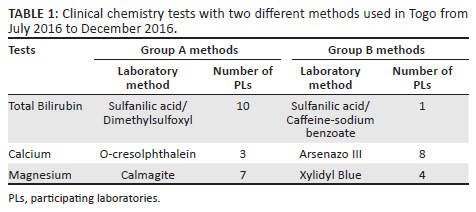
The 11 PLs used the same methods but not the same vendor kits for the following tests: urea (urease), blood glucose (glucose oxidase-hydrogen peroxide), creatinine (alkaline picrate), uric acid (uricase-hydrogen peroxide), alanine aminotransferase (International Federation of Clinical Chemistry and Laboratory Medicine method without pyridoxal-5-phosphate cofactor), aspartate aminotransferase (International Federation of Clinical Chemistry and Laboratory Medicine method without pyridoxal-5-phosphate cofactor), gamma-glutamyl transferase (carboxy-gamma-glutamyl-p-nitroanilide), alkaline phosphatase (p-nitrophenyl phosphate-diethanolamine), cholesterol (cholesterol oxidase-hydrogen peroxide), high-density lipoprotein cholesterol (phosphotungstic acid), low-density lipoprotein cholesterol (calculated by Friedewald's formula), triglycerides (glycerol phosphate oxidase-hydrogen peroxide), total protein (Biuret), phosphorus (phosphomolybdic by ultraviolet spectrophotometry) and direct bilirubin (diazosulfanilic acid). For the three remaining tests (total bilirubin, calcium and magnesium), two different methods (A and B) were used by the PLs (Table 1).
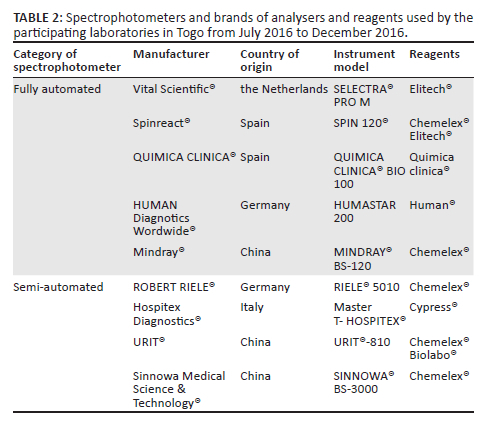
Calibration traceability information was stated in the package inserts and all assays were traceable to an appropriate international reference standard or method. Tests were performed by a fully automated or semi-automated spectrophotometer, depending on the analyser available in each PL (Table 2).
The sample analysed by each PL consisted of a lyophilised multiparametric serum supplied by OWA. In the four cycles of this pilot programme, the PLs received PT samples of different ranges in each cycle. Five millilitre vials of PHILCO WATER 5® brand distilled water (Philco Pharma Carsten, Grosshansdorf, Germany) was provided for the reconstitution of samples using a volumetric micropipette.
Proficiency test data collection
Participating laboratories were instructed to test each sample in the same manner as patient samples. Results were documented and sent to OWA for analysis, with the final PT reports typically being received from OWA within 15 days of sample receipt in Togo. A WhatsApp group (WhatsApp LLC, Menlo Park, California, United States) including all 11 PLs and staff from the coordinating team was created to monitor the timely submission of results and PT reports. This WhatsApp group was also used to discuss the implementation of corrective actions when a result was unacceptable or when a PL had issues with continuing the programme. The corrective actions were tracked using a 'non-conformity management sheet'.
Data evaluation and performances criteria
The PLs were divided into two main groups to determine and compare their PT performance: one group of PLs used fully automated spectrophotometers and the second group used semi-automated spectrophotometers and volumetric micropipettes. In addition, the performance of labs that used IQC was compared with that of labs that did not, evaluating the impact of IQC. The performance measurements included the overall performance of PLs by cycle, the performance of the PLs in each test across the four cycles, the performance of labs using automated or semi-automated spectrophotometers, and the adherence to the IQC process as identified through the WhatsApp group discussions.
The evaluation criteria were based on the Clinical Laboratory Improvement Amendments (CLIA) acceptable limits. This acceptable limit corresponded to the OWA peer group mean ± (allowable total error) defined by CLIA.132,14
Statistical data analysis
Results of all PLs were sent both to PLs and directly to the Ministry of Health Division of Laboratories by OWA in a Microsoft Excel file (Microsoft, Redmond, Washington, United States), with the quantitative results of the PLs identified as compliant or non-compliant. The PT results of each PL, with the assigned values of each test, were also checked by the PT coordinating team as recommended in the ISO 13528 guideline.15
The data were collated and analysed using Epi-Info software version 3.5.3 (2011, Centers for Disease Control and Prevention, Atlanta, Georgia, United States). The calculation of the number of compliant results for a test or an identified group was used to determine the compliance rates in percentage (%). The performance rates of identified groups were compared using the uncorrected Chi-square test or Fisher's exact test where appropriate. The same statistical method was used in comparing the number and percentage of acceptable results between two successive cycles.
The target score of acceptable results was 80% as recommended by the World Health Organization Regional Office for Africa.16p-value significance level was < 0.05.
Results
Laboratory participation rate
Each PL submitted results after performing all 18 tests. A cycle participation rate of 100% was obtained by nine PLs (82%). The participation rate for the two remaining PLs was 50% for PL4 and 25% for PL9.
Overall analytical performance of participating laboratories in performing tests
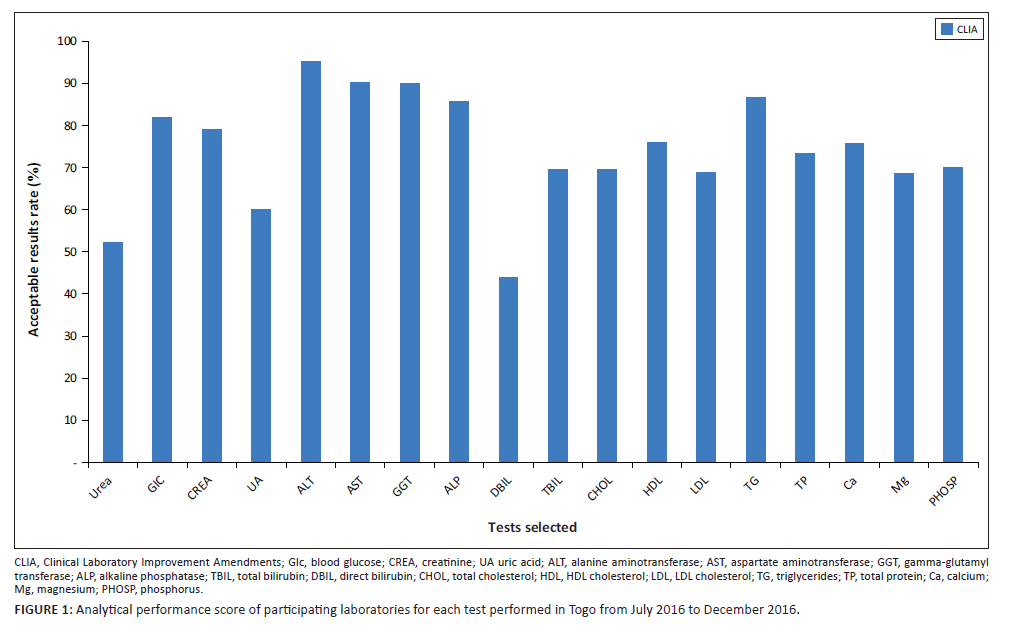
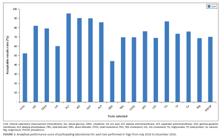
Seventy-six per cent of 775 results were acceptable. The performance scores for urea and direct bilirubin tests were less than 60%. The PLs had a performance score above 80% for blood glucose, alanine aminotransferase, aspartate aminotransferase, gamma-glutamyl transferase, alkaline phosphatase and triglycerides (Figure 1).
Comparing the overall analytical performance between cycles
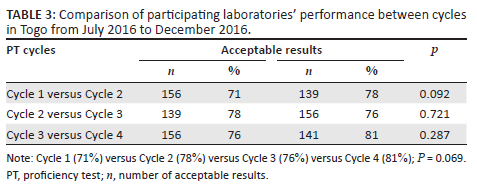
Assessing the overall performance level by cycle provides a measurement for the rate of improvement. The performance score increased from 71% to 81% (Table 3). Eight corrective actions were implemented at least once during the four cycles: providing a refrigerator thermometer to monitor the cold chain for better preservation of reagents and samples; planning a daily temperature measurement and performing root cause analysis for any observed deviations relating to out-of-range temperatures; purchasing new refrigerators suitable for laboratory use; calibrating micropipettes; performing periodic preventive maintenance on instruments and corrective maintenance when required; running IQC after each maintenance and re-calibrating instruments when necessary; implementing the use of IQC periodically; and analysing the results of the IQC using a Levey-Jennings chart.
Comparing participating laboratories' performance based on the use of internal quality control
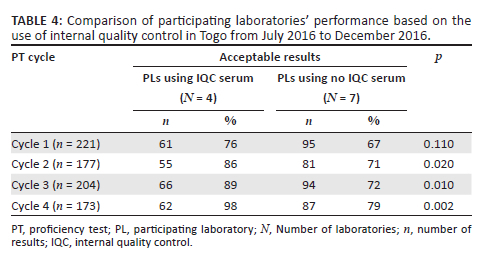
Out of the 11 PLs, four (36%) used control sera before performing each test, but none of the sites calculated uncertainty. During cycles 2, 3 and 4, the acceptable results rate of PLs using IQC serum was significantly higher than for those not using IQC (Table 4).
Rate of acceptable results based on the spectrophotometer category
Five out of 11 PLs used a fully automated spectrophotometer. Three hundred and thirteen (89%) out of 352 results produced were acceptable, against 292 (69%) acceptable results (p = 0.001) in the six PLs that used semi-automated spectrophotometers.
Discussion
This study assessed how well 11 government hospital laboratories performed 18 basic clinical chemistry tests and identified areas needing improvement may be required. This assessment focused on the most common clinical chemistry laboratory tests and therefore a logical starting point for national PT activities.17185
The low participation rate of PL9 in this study was caused by the breakdown of their spectrophotometer. Three months was insufficient for PL9 to perform the appropriate corrective action and to participate in subsequent cycles. In addition, PL4 suffered reagentstock-outs for six tests, resulting in low participation. The scenario demonstrates the challenge of PLs in low-income countries to implement corrective actions in a timely fashion, even when root causes are identified.17,19719,2016,1977,202122
The lower performance in urea testing was also documented in a similar study in Ethiopia that used the same OWA PT panel as used in this study. The performance rate for urea testing in 12 Ethiopian laboratories over six cycles was 21% lower than those obtained in the present study.23222,24
The low-performance scores for both total and direct bilirubin can be attributed to multiple factors, such as failure to maintain consistent assay temperature to which the diazo reaction is sensitive, failure to maintain reagent cold chain, and failure to protect calibrators and specimens from exposure to light, as bilirubin is light sensitive.25
Limitations
The major limitations of this study are the use of multiple instruments and reagent kits by PLs. Other limitations of the study include the few numbers of PLs because of limited funds, and the insufficiently spaced PT cycles that did not allow for corrective actions to be implemented before the subsequent PT cycle. In a future study, the impact of the implementing ISO/IEC 15189 requirements on PLs' performance will be evaluated with the possibility of benchmarking between the central, intermediate and peripheral health levels.
Conclusion
This study identified areas for improvement for a national PT programme and also demonstrated the value of such work in Togo. It also identified some tests (urea, creatinine, uric acid, bilirubins, cholesterols, otal protein, calcium, magnesium, phosphorus) for which laboratories must improve their performance. It showed that the use of fully automated spectrophotometers is more likely to lead to reliable test results and demonstrated the need for the use of routine appropriate IQC in all laboratories. It emphasised the necessity to plan cycles with sufficient delay for implementing sustainable corrective actions. The national PT programme should be extended to all clinical laboratories in Togo with three cycles per year and should also target all clinical laboratory disciplines.
Competing interests
The authors declare that they have no financial or personal relationship that may have inappropriately influenced them in writing this article.
Authors' contributions
K.C.K. and A.M.D. conceived of the presented idea; K.C.K. developed methods and followed up the field activities; K.G. and M.T. verified the analytical methods and helped participating laboratories with results submission; Y-G.A. wrote the manuscript with support from A.M.D. and K.C.K.; A.K. helped supervise the project under A.M.D.'s supervision. All authors discussed the results and contributed to the final manuscript.
Sources of support
This work was supported by Fondation Mérieux and partners, who funded RESAOLAB Project (Phase 2).
Data availability
The authors confirm that the data supporting the findings of this study are available within the article.
Disclaimer
The views and opinions expressed in this article are those of the authors and do not necessarily reflect the official policy or position of any affiliated agency of the authors.
Acknowledgements
The authors would like to thank Fondation Mérieux and their partners for funding the RESAOLAB Project, Togo's Ministry of Health, Dr Katawa Gnatoulma, and the members of participating laboratories.
References
-
1.Wians FH. Clinical laboratory tests: Which, why, and what do the results mean? Lab Med. 2009;40(2):105-113. https://doi.org/10.1309/LM4O4L0HHUTWWUDD
» https://doi.org/10.1309/LM4O4L0HHUTWWUDD - 2.International Standardization Organization. ISO 17043:2010 - Conformity assessment - General requirements for proficiency testing. Genève: ISO/IEC; 2010.
-
3.Schroeder LF, Amukele T. Medical laboratories in sub-Saharan Africa that meet international quality standards. Am J Clin Pathol. 2014;141:791-795. https://doi.org/10.1309/AJCPQ5KTKAGSSCFN
» https://doi.org/10.1309/AJCPQ5KTKAGSSCFN -
4.World Bank Country and Lending Groups [homepage on the Internet]. [cited 2021 Jun 29]. Available from: https://datahelpdesk.worldbank.org/knowledgebase/articles/906519
» https://datahelpdesk.worldbank.org/knowledgebase/articles/906519 -
5.Fleming KA, Naidoo M, Wilson M, et al. Essential pathology package for low- and middle-income countries. Am J Clin Pathol. 2017;147(1):15-32. https://doi.org/10.1093/ajcp/aqw143
» https://doi.org/10.1093/ajcp/aqw143 - 6.Murray RK, Kennelly PJ, Bender DA, Rodwell VW, Botham KM, Weil PA. Biochimie et medecine. 4th ed. Bruxelles: De boeck: Biochimie de Harper; 2011
- 7.International Standardization Organization. ISO 15189:2012 - Medical laboratories - Requirements for quality and competence. Genève: ISO/IEC; 2012.
-
8.COFRAC. Compétence le magazine de l'accréditation N°71 de 2017 [homepage on the Internet]. [cited 2020 Jul 13]. Available from: https://www.cofrac.fr/fileadmin/user_upload/competences_71_0117.pdf
» https://www.cofrac.fr/fileadmin/user_upload/competences_71_0117.pdf -
9.WAAS. Accredited conformity assessment bodies [homepage on the Internet]. [cited 2020 Jul 29]. Available from: https://www.soacwaas.org/internal-documents.html
» https://www.soacwaas.org/internal-documents.html -
10.Kouassi K, Fétéké L, Assignon S, Dorkenoo A, Napo-Koura G. External quality assessment in clinical biochemistry laboratories: Pilot study in 11 laboratories of Lomé. Ann Biol Clin. 2015;73(2):165-175. https://doi.org/10.1684/abc.2015.1026
» https://doi.org/10.1684/abc.2015.1026 -
11.Fondation Mérieux. Report of 4th steering commitee of RESAOLAB at Dakar [homepage on the Internet]. 2017. [cited 2020 Feb 04]. Available from: https://www.resaolab.org/wp-content/uploads/2018/05/4e-resaolab-comite-de-pilotage-senegal-2017-compte-rendu.pdf
» https://www.resaolab.org/wp-content/uploads/2018/05/4e-resaolab-comite-de-pilotage-senegal-2017-compte-rendu.pdf -
12.One WorldAccuracy. One World Accuracy® PT participating laboratory guidelines for demonstration [homepage on the Internet]. [cited 2018 Oct 24]. Available from: https://demo.oneworldaccuracy.com/HealthMetrx/secure/home.do;jsessionid=CADB099 5A1E394EC622CDC7D4186FE8A.node7?method=prepare
» https://demo.oneworldaccuracy.com/HealthMetrx/secure/home.do;jsessionid=CADB099 5A1E394EC622CDC7D4186FE8A.node7?method=prepare -
13.Westgard J. CLIA requirements for analytical quality [homepage on the Internet]. Westgard. [cited 2018 Oct 25]. Available from: https://www.westgard.com/clia.htm
» https://www.westgard.com/clia.htm -
14.Westgard JOWS. New CLIA proposed rules for acceptance limits for proficiency testing. [cited 2020 Mar 02]. Available from: https://www.westgard.com/2019-clia-changes.htm
» https://www.westgard.com/2019-clia-changes.htm - 15.International Standardization Organization. ISO 13528:2015 - Statistical methods for use in proficiency testing by inter-laboratory comparison. Geneva; 2015.
-
16.World Health Organization Regional Office for Africa. WHO guide for the stepwise laboratory improvement process towards accreditation in the African Region (SLIPTA) [homepage on the Internet]. Brazzaville: WHO-AFRO; 2015 [cited 2020 Mar 02]. Available from: https://www.afro.who.int/sites/default/files/2017-06/slipta-checkist0711.pdf
» https://www.afro.who.int/sites/default/files/2017-06/slipta-checkist0711.pdf -
17.Krleza JL, Celap I, Tanaskovic JV. External quality assessment in laboratory medicine: External quality assessment in Croatia: Problems, challenges, and specific circumstances. Biochem Med. 2017;27(1):86-92. https://doi.org/10.11613/BM.2017.011
» https://doi.org/10.11613/BM.2017.011 -
18.Carter JY. External quality assessment in laboratory medicine: External quality assessment in resource-limited countries. Biochem Med. 2017;27(1):97-109. https://doi.org/10.11613/BM.2017.013
» https://doi.org/10.11613/BM.2017.013 -
19.John NN, Katy Y, Philip O. Laboratory medicine in low-income and middle-income countries: Progress and challenges. Lancet. 2018 391(10133):1873-1875. https://doi.org/10.1016/S0140-6736(18)30308-8
» https://doi.org/10.1016/S0140-6736(18)30308-8 -
20.Kaseha WM, Manyilizu WB. Variations on external quality assessment performance of public medical laboratories: The effect of strengthening laboratory management towards. Acta Sci Med Sci. 2019;33:1-10. https://doi.org/10.31080/ASMS.2019.03.0419
» https://doi.org/10.31080/ASMS.2019.03.0419 -
21.Lothar S, Robert IW, Craig MJ, Linda T, Stephane M. Outline of the calibration and measurement hierarchy in laboratory medecine - Quality policy and definitions WG2-P-00 [homepage on the Internet]. [cited 2020 Feb 13]. Available from: https://www.bipm.org/en/committees/jc/jctlm-wg2/wg2_quality-manual.html
» https://www.bipm.org/en/committees/jc/jctlm-wg2/wg2_quality-manual.html - 22.Bertrand S. Biochimie clinique. Instruments et techniques de laboratoire. Diagnostics Médico-chirugicaux. 2nd ed. Paris: Maloine; 1985.
-
23.Ashebir G, Abay S. Proficiency test feedback utilization at government hospitals laboratory, Addis Ababa, Ethiopia. J Med Diagn Methods. 2017;6:1-8. https://doi.org/10.4172/2168-9784.1000258
» https://doi.org/10.4172/2168-9784.1000258 -
24.Kristensen GBB, Meijer P. External quality assessment in laboratory medicine: Interpretation of EQA results and EQA-based trouble shooting. Biochem Med. 2017;27(1):49-62. https://doi.org/10.11613/BM.2017.007
» https://doi.org/10.11613/BM.2017.007 -
25.Westwood A. The analysis of bilirubin in serum. Ann Clin Biochem. 1991;28(2):119-130. https://doi.org/10.1177/000456329102800202
» https://doi.org/10.1177/000456329102800202

Accepted: 09 Mar. 2022
Published: 24 June 2022