Surveillance of antimicrobial resistance in human health in Tanzania: 2016-2021
Abstract
BACKGROUND: Antimicrobial resistance (AMR) surveillance plays an important role in early detection of resistant strains of pathogens and informs treatments decisions at local, regional and national levels. In 2017, Tanzania developed a One Health AMR Surveillance Framework to guide establishment of AMR surveillance systems in the human and animal sectors. AIM: We reviewed AMR surveillance studies in Tanzania to document progress towards establishing an AMR surveillance system and determine effective strengthening strategies. METHODS: We conducted a literature review on AMR studies conducted in Tanzania by searching Google Scholar, PubMed, and the websites of the Tanzania Ministry of Health and the World Health Organization for articles written in English and published from January 2012 to March 2021 using relevant search terms. Additionally, we reviewed applicable guidelines, plans, and reports from the Tanzanian Ministry of Health. RESULTS: We reviewed 10 articles on AMR in Tanzania, where studies were conducted at hospitals in seven of Tanzania's 26 regions between 2012 and 2019. Nine AMR sentinel sites had been established, and there was suitable and clear coordination under 'One Health'. However, sharing of surveillance data between sectors had yet to be strengthened. Most studies documented high resistance rates of Gram-negative bacteria to third-generation cephalosporins. There were few laboratory staff who were well trained on AMR. CONCLUSION: Important progress has been made in establishing a useful, reliable AMR surveillance system. Challenges include a need to develop, implement and build investment case studies for the sustainability of AMR surveillance in Tanzania and ensure proper use of third-generation cephalosporins. WHAT THIS STUDY ADDS: This article adds to the knowledge base of AMR trends in Tanzania and progress made in the implementation of AMR surveillance in human health sector as a contribution to the global AMR initiatives to reduce AMR burden worldwide. It has highlighted key gaps that need policy and implementation level attention.
surveillance; antimicrobial resistance; COVID-19; One Health; Tanzania; Africa
Introduction
Antimicrobial resistance (AMR) is a global public health threat with extensive social, health and economic impacts.1,23333
In 2015, the World Health Assembly, through its 68th session, adopted the Global Action Plan on AMR to ensure the treatment and prevention of infectious diseases with quality-assured, safe, and effective medicines available.4455
In 2016, Tanzania developed the National Action Plan for AMR (2017-2022) following the WHO and Global Health Security Agenda Joint External Evaluation recommendation. Subsequently, a holistic One Health AMR Surveillance Framework was developed to guide the establishment of AMR surveillance systems in the human, animal and environmental health sectors. The country is bordered by more than eight countries, which poses a high risk of pathogen importation into the country. In addition, several socioeconomic, demographic and environmental factors also facilitate the emergence and spread of microorganisms; thus, robust health systems are paramount for detecting, responding, and mitigating the effects of the resistant microbes.
In this current global coronavirus disease 2019 (COVID-19) pandemic situation, where scientists are struggling to find an effective treatment for COVID-19, antibiotics have been widely used to manage COVID-19, either to treat COVID-19 itself or co-infections.67
This paper reviewed AMR surveillance studies and documents the progress made in establishing the AMR surveillance system in the human health sector in Tanzania and provides recommendations for strengthening it. The literature review was essential to contextualise the AMR situation in the past decade and the need to strengthen AMR surveillance.
Methods
Data collection
We searched Google Scholar, PubMed, and websites of the Tanzania Ministry of Health and WHO written in English and published from January 2012 to March 2021. We used the search terms: 'antimicrobial resistance', 'bacterial resistance', 'antibiotic resistance'; 'AMR surveillance', or 'surveillance' or 'cross-section' or 'review'; and 'Tanzania'. All words were searched together, and, in some instances, two of the three words were used. We reviewed guidelines, plans, and reports from the Ministry of Health to describe the Tanzania AMR surveillance system's objective, surveillance sites, data collection, reporting, analysis, interpretation, and dissemination, coordination of AMR surveillance activities, and funding of AMR surveillance.
Setting and structure of healthcare system in Tanzania
The United Republic of Tanzania comprises Tanzania's Mainland and the semiautonomous Islands of Zanzibar, and it lies on the East African coast. The Tanzania 2012 population census was 44 928 923.8
Health services in Tanzania are decentralised into three categories: district (primary level), regional (secondary level), and zonal and national hospital (tertiary level). The district level provides primary health care services through dispensaries at the village level, health centres at the ward level, and Level 1 Hospital at the council level.9910,11
Results
Antimicrobial resistance trends of priority pathogens in Tanzania
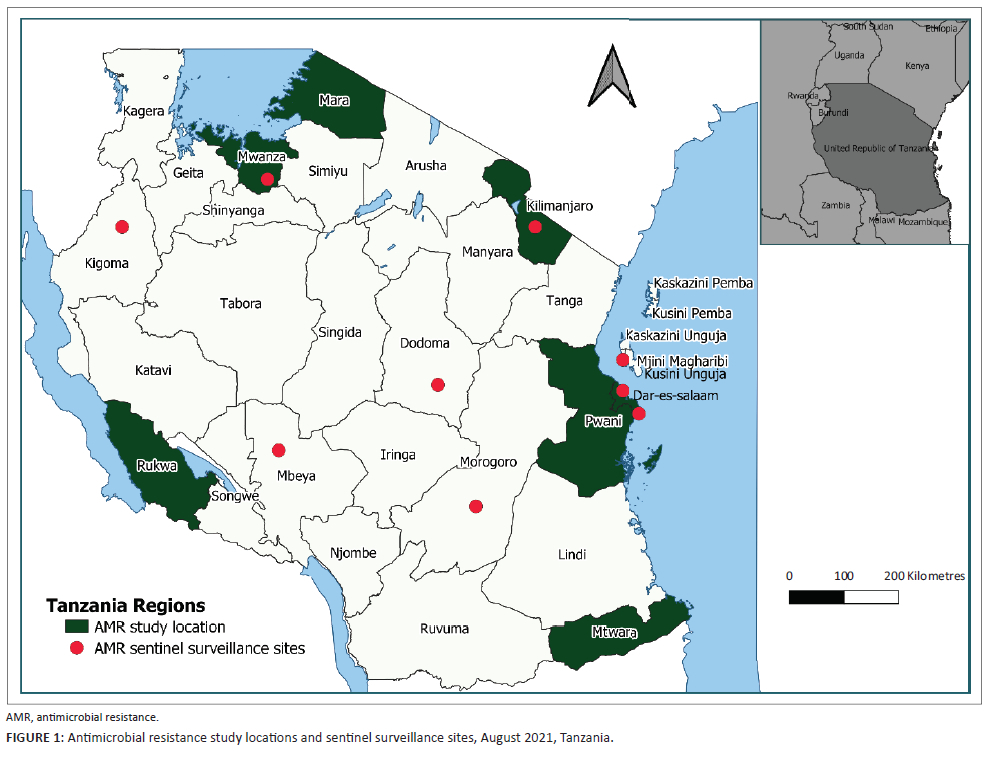
A total of 10 articles on AMR in Tanzania were retrieved and reviewed. These studies were conducted at either the zonal or regional referral hospitals between 2012 and 2019. Four of the 10 studies were conducted at Kilimanjaro Christian Medical Centre in the Kilimanjaro region, three at Bugando Medical Centre in Mwanza region, two at Muhimbili National Hospital in Dar es Salaam region, and one study each at Maweni Regional Referral Hospital in Kigoma region, Musoma Regional Referral Hospital in Mara region, Sumbawanga Regional Referral Hospital in Rukwa region, St. Benedict Ndanda Hospital in Mtwara region, Bagamoyo District Hospital in Pwani region, Sekou Toure Regional Referral Hospital, Nyamagana District Hospital, and Sengerema District Designated Hospital in Mwanza region (Figure 1). Blood, pus and wound swabs, and urine were the most common laboratory samples analysed (Table 1). All of the studies performed antimicrobial susceptibility testing (AST) using the disk-diffusion method per the Clinical Laboratory Standards Institute guidelines.12Staphylococcus aureus, Klebsiella pneumoniae and Escherichia coli; and from pus, Pseudomonas aeruginosa (Table 1). S. aureus resistance to clindamycin ranged between 33.3% to 68.4% and erythromycin between 35.6% to 76.3%, while resistance to cotrimoxazole was 82.6% and ampicillin was 100%.13,14,15,1614,17,18S. aureus decreased from 41.2% in 2013 to 9.5% in 2015, but rose to 66.7% in 2018.14,15K. pneumoniae was resistant to ampicillin (100%), cotrimoxazole (96.3%), ceftriaxone (95.7%), amoxicillin/clavulanate (94.6%), ceftazidime (90.9%), gentamycin (86.4%) and cefepime (75.6%).13,16,19E. coli was more resistant to ampicillin, amoxicillin-clavulanic acid, gentamycin, tetracycline, ciprofloxacin, amikacin, third-generation cephalosporins (ceftazidime and ceftriaxone) and cefepime.,13,15,16,19,20 Notably, P. aeruginosa was resistant to cefepime (93.8%).1317,21,22
Progress in implementation of antimicrobial resistance surveillance
Coordination
In 2018, Tanzania took the first step of developing a One Health National AMR surveillance framework to guide the establishment of AMR surveillance programmes in the country. The framework provides a holistic approach to monitor trends of infections and resistance that will inform standard treatment guidelines that support best practices for patient care, and links AMR information from the human, animal and environmental health sectors.23
Antimicrobial resistance surveillance system
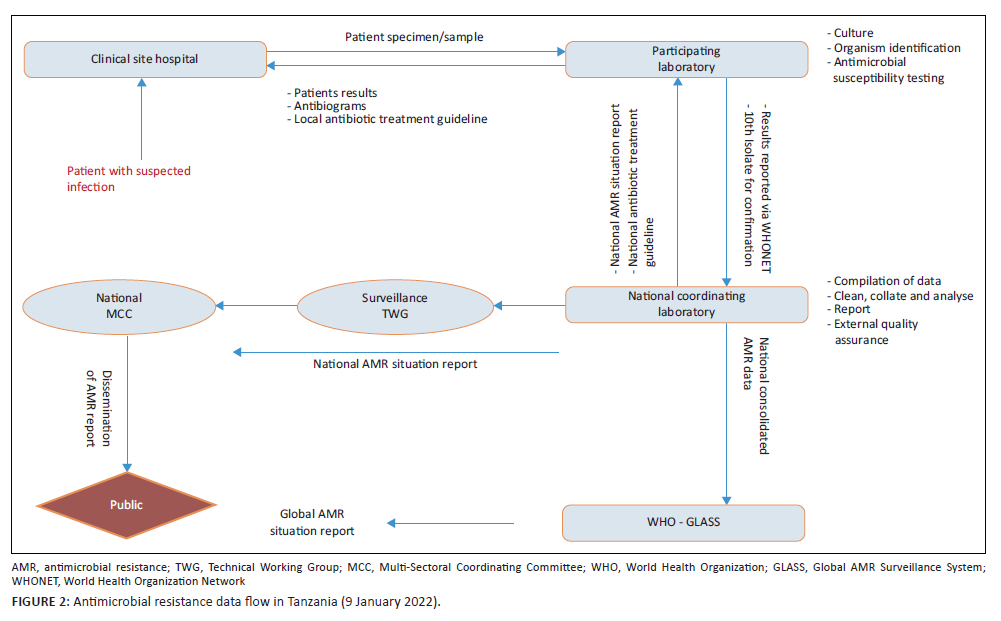
Tanzania started with laboratory-based AMR surveillance in healthcare settings, as laboratory-based surveillance is the most efficient AMR burden determination method.24,25Figure 1). The National Health Laboratory (NHL) is the national coordinating laboratory, and its primary roles include: developing AMR national standard operating procedures; training, mentoring and supervising sentinel laboratories; conducting external quality assurance and monitoring internal quality assurances done by sentinel laboratories; and compiling, aggregating, analysing, visualising and disseminating national AMR surveillance data to the national MCC and the GLASS. On the other hand, sentinel laboratories isolate and identify organisms; perform susceptibility tests; store isolates as per national standardised operating procedures; produce and share timely antibiograms with clinicians; and conduct internal quality assurances. Antimicrobial resistance surveillance involves the routine collection of blood and urine specimens from in and out-patients with clinical signs and symptoms attending the hospitals. Clinicians decide whether to take samples for microbiological culture based on the patient's clinical assessment. Presently, the participating laboratories employ phenotypic methods for pathogen identification and disk diffusion for AST. The AST is a laboratory procedure to identify effective antimicrobial agents that kill or prevent the growth of isolated pathogens recovered from samples of individual patients.26262623
Clinical data and AST positive culture results are recorded in the reporting forms and entered into the laboratory information system and the World Health Organization Network (WHONET), a freely available system for capturing, analysing and sharing AMR data in a standardised format. Data import into WHONET can be semi-automated using the add-on Baclink software (WHO Collaborating Centre for Surveillance of Antimicrobial Resistance, Boston, Massachusetts, United States), which allows for import from other data sources, for example, text files exported from a laboratory information management system (LIMS) or directly from a laboratory instrument.2727E. coli, K. pneumoniae, Acinetobacter baumannii, S. aureus, Neisseria meningitidis, Streptococcus pneumoniae, Salmonella spp., Shigella spp., Pseudomonas spp. and Neisseria gonorrhoeae.
Data analysis, interpretation and dissemination
The participating laboratories must clean, collate, analyse, and create site-specific bacterial antibiograms every month. In addition, annual AMR surveillance reports are shared with the relevant clinical departments and hospital committees to increase hospital and community AMR awareness, inform treatment policies at the health facility, and encourage continued participation in the surveillance system.
Antimicrobial resistance data from surveillance sites are centrally stored and managed at the NHL. The NHL conducts data quality checks, analysis, and visualisation, generates official AMR reports, and provides long-term data storage. Antimicrobial resistance surveillance reports, including trends and resistant pathogen prevalences, are generated at least twice a year and disseminated to stakeholders after approval by the AMR Surveillance Technical Working Group and the national MCC. At the same time, the clean AMR data set is transmitted to the GLASS (Figure 2). The AMR surveillance data guides strategies and policies for combating AMR. It also provides opportunities for in-depth scientific research that generates additional knowledge on AMR. However, sharing of surveillance data among sectors is yet to be strengthened, that is, environment, health and animal. Tanzania started reporting AMR data to GLASS in June 2021.
Quality assurance and standards
All nine sentinel sites participate in the external quality assurance which is being supported by NHL and African Society for Laboratory Medicine under the project called External Quality Assessment for Africa. External quality assurance is done twice a year for all sites and involves most of the GLASS priority pathogens, including E. coli, K. pneumoniae, A. baumannii, S. aureus, N. meningitidis, S. pneumoniae and Salmonella spp. As per the AMR surveillance framework, all isolates are to be stored at −70 °C for future studies. Isolates with unusual, unexpected, or indeterminate resistance patterns are sent to the NHL for confirmatory testing and AST. Also, every 10th isolate from each site is sent to NHL for quality assessment.
Funding
Funds to run the nine AMR surveillance sentinel laboratories are contributed by the Government of the United Republic of Tanzania, the Fleming Fund, and the United States Agency for International Development fund under the Infectious Disease Diagnostic and Surveillance project. Therefore, there is a need to establish a sustainable funding mechanism for AMR activities in Tanzania.
Discussion
This review has shown that the most frequently isolated microorganisms from blood were S. aureus, K. pneumoniae and E. coli; from urine, E. coli; and from pus, P. aeruginosa. Most studies documented high resistance rates of Gram-negative bacteria to third-generation cephalosporins. Importantly, significant progress has been made in establishing AMR surveillance; nine sentinel sites across Tanzania have been established and are generating data and there are suitable and clear coordination structures and platforms for multisectoral engagement and collaboration under One Health. However, sharing of surveillance data between sectors is yet to be strengthened. There are also few laboratory staff well trained on AMR practices.
Studies in Tanzania reveal increasing bacterial resistance to third-generation cephalosporins. In Tanzania, ceftriaxone is reportedly prescribed excessively and inappropriately in hospital settings,2829,30
Progress made in establishing the AMR surveillance system in the country is commendable. A total of nine sentinel sites have been established. There are suitable coordination structures and platforms for multisectoral engagement and collaboration under the 'One Health'.312727
There are few well-trained laboratory staff at the sentinel sites for data analysis and the production of antibiograms, which can be shared with the clinicians and AMR teams to inform on the appropriate treatment and measures to tackle AMR at the hospital or community. At the surveillance sites, frequent stock out of AST reagents and analysis, inadequate resources, and poor laboratory infrastructure for phenotypic and genotypic analysis is commonplace. Although AMR surveillance receives much support from the government as per human resources and infrastructure, there are also funds from donors. A sustainability plan is essential to prevent over-dependence on donors over time. These challenges are unique in Tanzania and have also been reported elsewhere in Africa.32,33
Sharing of surveillance data between sectors is yet to be strengthened. Antimicrobial resistance is a broad and complex issue affecting the animal, human and environmental sectors; thus, a multisectoral and multidisciplinary combat approach is needed. Antimicrobials are also widely used in animals for treatment and growth promoters. In addition, evidence suggests that antimicrobial use in animals contributes significantly to the development of AMR in humans,34
This study has some limitations. The review was based on reports only. We did not seek additional inputs and insights from AMR stakeholders through a standardised questionnaire or interview. As such some comprehensive views and perspectives may have been missed out. The AMR trends in Tanzania presented here should be interpreted with caution as the review was only based on 10 surveillance articles.
Conclusion
Tanzania is currently implementing AMR surveillance in nine hospitals, and reporting of AMR data to GLASS has commenced. There are well-established AMR coordination mechanisms at health facilities and national levels to effectively implement and utilise the AMR information. Although there are challenges affecting implementation, the current AMR surveillance system in place is useful, reliable and capable of better performance. There is a need to develop, implement and build an investment case study for the sustainability of AMR surveillance in Tanzania. We recommend that the government creates a fit-to-purpose laboratory information system with functionality able to link with other systems; develops a mechanism for sustainable financing for laboratory infrastructure development and continuous supply of reagents, commodities, and laboratory materials; and invests hugely in building human capacities for bacterial identification and AST and data analysis, interpretation and utilisation.
Competing interests
The authors declare that they have no financial or personal relationships that may have inappropriately influenced them in writing this article.
Authors' contributions
N.C., E.S., P.O. and B.E. were involved in the conceptualization of the project. N.C. and B.E, were involved in the writing of an initial draft, reviewing and editing the manuscript. N.C., N.M., J.M, E.E., E.S., P.O., B.E. reviewed and edited the manuscript. All authors read and approved the final version of the manuscript.
Ethical considerations
This paper has no ethical concerns as it does not have human or animal subjects or data, and as such ethical approval from an ethics review board was not required.
Sources of support
This work was part of the activities of a Fellowship (Surveillance in Human Health) workplan, which was supported by the Fleming Fund through the Fellowship Scheme in Tanzania.
Data availability
The authors confirm that the data supporting the findings of this study are available within the article.
Disclaimer
The views and opinions expressed in this article are those of the authors and do not necessarily reflect the official policy or position of any affiliated agency of the authors.
Acknowledgements
The authors would like to acknowledge the Government of Tanzania and partners for the efforts to implement AMR surveillance activities. Also, we appreciate authors of the surveillance articles and contributors of the AMR reports, minutes, guidelines, and frameworks which informed this writing.
References
- 1.World Health Organization, editor. Antimicrobial resistance: Global report on surveillance. World Health Organization; Geneva, 2014.
- 2.Howell L, World Economic Forum, risk response network. Global Risks 2013. World Economic Forum; Geneva, 2013.
-
3.O'Neill J. Tackling drug-resistant infections globally: Final report and recommendations: The review on antimicrobial resistance. World Bank; 2016 (cited 2020 April 10). Available from: https://amr-review.org/sites/default/files/160525_Final%20paper_with%20cover.pdf
» https://amr-review.org/sites/default/files/160525_Final%20paper_with%20cover.pdf -
4.World Health Organization. 2015. Global action plan on antimicrobial resistance [homepage on the Internet]. World Health Organization. c2015 (cited 2020 September 13). Available from: https://apps.who.int/iris/handle/10665/193736
» https://apps.who.int/iris/handle/10665/193736 - 5.World Health Organization. Global Antimicrobial Resistance Surveillance System (GLASS) report: Early implementation 2016-2017. World Health Organization; Geneva, 2017.
-
6.Iwu CJ, Jordan P, Jaja IF, Iwu CD, Wiysonge CS. Treatment of COVID-19: implications for antimicrobial resistance in Africa. Pan Afr Med J. 2020;35(Suppl 2):119. https://doi.org/10.11604/pamj.supp.2020.35.2.23713
» https://doi.org/10.11604/pamj.supp.2020.35.2.23713 -
7.Rawson TM, Moore LSP, Zhu N, et al. Bacterial and fungal co-infection in individuals with coronavirus: A rapid review to support COVID-19 antimicrobial prescribing. Clin Infect Dis. 2020;71(9):2459-2468. https://doi.org/10.1093/cid/ciaa530
» https://doi.org/10.1093/cid/ciaa530 - 8.United Republic of Tanzania. Population and housing census 2012: Population distribution by administrative areas. Dar es Salaam: National Bureau of Statistics; 2013.
- 9.Hokororo J, Eliakimu E, Ngowi R, et al. Report of Trend for Compliance of Infection Prevention and Control Standards in Tanzania from 2010 to 2017 in Tanzania Mainland. Microbiol Infect Dis. 2021; 5(3):1-10.
-
10.Minzi OM, Manyilizu VS. Application of basic pharmacology and dispensing practice of antibiotics in accredited drug-dispensing outlets in Tanzania. Drug Healthc Patient Saf. 2013;5:5-11. https://doi.org/10.2147/DHPS.S36409
» https://doi.org/10.2147/DHPS.S36409 -
11.Poyongo BP, Sangeda RZ. Pharmacists' knowledge, attitude and practice regarding the dispensing of antibiotics without prescription in Tanzania: An explorative cross-sectional study. Pharmacy. 2020;8(4):238. https://doi.org/10.3390/pharmacy8040238
» https://doi.org/10.3390/pharmacy8040238 - 12.Clinical and Laboratory Standards Institute (CLSI). Performance Standards for Antimicrobial Susceptibility Testing. 27th ed. CLSI supplement M100. Pennsylvania: Clinical and Laboratory Standards Institute; 2017.
-
13.Mikomangwa WP, Bwire GM, Kilonzi M, et al. The existence of high bacterial resistance to some reserved antibiotics in tertiary hospitals in Tanzania: A call to revisit their use. Infect Drug Resist. 2020;13:1831-1838. https://doi.org/10.2147/IDR.S250158
» https://doi.org/10.2147/IDR.S250158 -
14.Kazimoto T, Abdulla S, Bategereza L, et al. Causative agents and antimicrobial resistance patterns of human skin and soft tissue infections in Bagamoyo, Tanzania. Acta Trop. 2018;186:102-106. https://doi.org/10.1016/j.actatropica.2018.07.007
» https://doi.org/10.1016/j.actatropica.2018.07.007 -
15.Mnyambwa NP, Mahende C, Wilfred A, et al. Antibiotic susceptibility patterns of bacterial isolates from routine clinical specimens from referral hospitals in Tanzania: A prospective hospital-based observational study. Infect Drug Resist. 2021;14:869-878. https://doi.org/10.2147/IDR.S294575
» https://doi.org/10.2147/IDR.S294575 -
16.Seni J, Mwakyoma AA, Mashuda F, et al. Deciphering risk factors for blood stream infections, bacteria species and antimicrobial resistance profiles among children under five years of age in North-Western Tanzania: A multicentre study in a cascade of referral health care system. BMC Pediatr. 2019;19(1):32. https://doi.org/10.1186/s12887-019-1411-0
» https://doi.org/10.1186/s12887-019-1411-0 -
17.Kumburu HH, Sonda T, Mmbaga BT, et al. Patterns of infections, aetiological agents and antimicrobial resistance at a tertiary care hospital in northern Tanzania. Trop Med Int Health. 2017;22(4):454-464. https://doi.org/10.1111/tmi.12836
» https://doi.org/10.1111/tmi.12836 -
18.Mauki II, William JD, Mlay HL, et al. Etiologies of bloodstream infection and antimicrobial resistance: A cross sectional study among patients in a tertiary hospital, Northern Tanzania. East Afr Sci. 2021;3(1):104-111. https://doi.org/10.24248/EASci-D-20-00012
» https://doi.org/10.24248/EASci-D-20-00012 -
19.Kiponza R, Balandya B, Majigo MV, Matee M. Laboratory confirmed puerperal sepsis in a national referral hospital in Tanzania: Etiological agents and their susceptibility to commonly prescribed antibiotics. BMC Infect Dis. 2019;19(1):690. https://doi.org/10.1186/s12879-019-4324-5
» https://doi.org/10.1186/s12879-019-4324-5 -
20.Pratap FN. Prevalence and antimicrobial resistance patterns of extended spectrum beta-lactamase producing E. Coli in human isolates at Kilimanjaro Medical Centre, Moshi, Tanzania [homepage on the Internet]. Thesis. 2019 [cited 2021 Jun 15]. Available from: http://repository.costech.or.tz//handle/123456789/15023
» http://repository.costech.or.tz//handle/123456789/15023 -
21.Moremi N, Claus H, Mshana SE. Antimicrobial resistance pattern: A report of microbiological cultures at a tertiary hospital in Tanzania. BMC Infect Dis. 2016;16(1):756. https://doi.org/10.1186/s12879-016-2082-1
» https://doi.org/10.1186/s12879-016-2082-1 -
22.Shabhay AA, Horumpende P, Mujuni M, et al. Antibiotic resistance in aerobic bacterial isolates from infected diabetic foot ulcers in North Eastern Tanzania: An urgent call to establish a hospital antimicrobial stewardship committee. Preprint 2021 Jun 8 [cited 2021 Jun 15]. https://doi.org/10.21203/rs.3.rs-569062/v1
» https://doi.org/10.21203/rs.3.rs-569062/v1 - 23.United Republic of Tanzania. National Antimicrobial Resistance Framework. Dar es Salaam: United Republic of Tanzania; 2018.
-
24.Mendelson M, Matsoso MP. The World Health Organization Global Action Plan for antimicrobial resistance. S Afr Med J. 2015;105(5):325-325. https://doi.org/10.7196/SAMJ.9644
» https://doi.org/10.7196/SAMJ.9644 -
25.Perovic O, Schultsz C. Stepwise approach for implementation of antimicrobial resistance surveillance in Africa. Afr J Lab Med. 2016;5(3):7. https://doi.org/10.4102/ajlm.v5i3.482
» https://doi.org/10.4102/ajlm.v5i3.482 -
26.Bayot ML, Bragg BN. Antimicrobial susceptibility testing [homepage on the Internet]. StatPearls Publishing; 2021 [cited 2021 Mar 07]. Available from: http://www.ncbi.nlm.nih.gov/books/NBK539714/
» http://www.ncbi.nlm.nih.gov/books/NBK539714/ -
27.Turner P, Rupali P, Opintan JA, et al. Laboratory informatics capacity for effective antimicrobial resistance surveillance in resource-limited settings. Lancet Infect Dis. 2021;21(6):e170-e174. https://doi.org/10.1016/S1473-3099(20)30835-5
» https://doi.org/10.1016/S1473-3099(20)30835-5 -
28.Sonda TB, Horumpende PG, Kumburu HH, et al. Ceftriaxone use in a tertiary care hospital in Kilimanjaro, Tanzania: A need for a hospital antibiotic stewardship programme. PLoS One. 2019;14(8):e0220261. https://doi.org/10.1371/journal.pone.0220261
» https://doi.org/10.1371/journal.pone.0220261 -
29.Mushi MF, Mshana SE, Imirzalioglu C, Bwanga F. Carbapenemase genes among multidrug resistant gram-negative clinical isolates from a tertiary hospital in Mwanza, Tanzania. BioMed Res Int. 2014;2014:e303104. https://doi.org/10.1155/2014/303104
» https://doi.org/10.1155/2014/303104 -
30.Ssekatawa K, Byarugaba DK, Wampande E, Ejobi F. A systematic review: The current status of carbapenem resistance in East Africa. BMC Res Notes. 2018;11(1):629. https://doi.org/10.1186/s13104-018-3738-2
» https://doi.org/10.1186/s13104-018-3738-2 -
31.Frumence G, Mboera LEG, Sindato C, et al. The governance and implementation of the national action plan on antimicrobial resistance in Tanzania: A qualitative study. Antibiotics. 2021;10(3):273. https://doi.org/10.3390/antibiotics10030273
» https://doi.org/10.3390/antibiotics10030273 -
32.Kariuki S, Keddy KH, Antonio M, Okeke IN. Antimicrobial resistance surveillance in Africa: Successes, gaps and a roadmap for the future. Afr J Lab Med. 2018;7(2):924. https://doi.org/10.4102/ajlm.v7i2.924
» https://doi.org/10.4102/ajlm.v7i2.924 - 33.Ndihokubwayo JB, Yahaya AA, Desta AT, et al. Antimicrobial resistance in the African Region: Issues, challenges and actions proposed. African Health Monitor. 2023;(16):4.
-
34.Carrique-Mas JJ, Choisy M, Van Cuong N, Thwaites G, Baker S. An estimation of total antimicrobial usage in humans and animals in Vietnam. Antimicrob Resist Infect Control. 2020;9(1):16. https://doi.org/10.1186/s13756-019-0671-7
» https://doi.org/10.1186/s13756-019-0671-7

Accepted: 09 Mar. 2023
Published: 22 May 2023