Knowledge, competence, experience of healthcare practitioners using glucometers for patient care in Nigeria
Abstract
BACKGROUND: Despite the widespread acceptability of glucometers as a blood glucose self-monitoring and point-of-care device, their usage is confronted with operational, technical, regulatory, and quality control concerns OBJECTIVE: This study assessed knowledge, estimated competence, and measured experience of healthcare practitioners using glucometers for patient care in two states of Northern Nigeria METHODS: This cross-sectional, descriptive study used a total population sampling strategy and self-completed questionnaires. A total of 768 questionnaires were distributed to hospitals in Jigawa and Kogi States, Nigeria, from December 2019 to April 2022. The questionnaire had three sections: collecting details about type of healthcare facility, sociodemographic characteristics and educational qualifications of participants, and assessment of knowledge, competence and practice. Data were analysed and results expressed as frequencies and percentages RESULTS: Overall, 570 questionnaires were filled and retrieved, giving a response rate of 74.2%. Most of the participants were male (312; 54.7%); female participants totalled 258 (45.3%). Most participants were aged < 50 years (25-40 years, 215 [37.7%]; 41-50 years, 246 [43.2%]). The majority of participants were Medical Laboratory Scientists (124, 21.8%]), Technicians (151, 26.5%), or Nurses (132, 23.2%). Most participants (284, 49.8%) reported having no formal training prior to first use of glucometers in patient care. Many participants (379, 66.5%) knew about glucometer calibrators; 235 (41.2%) did not know what specific purpose calibrators served CONCLUSION: This study found a lack of knowledge, competence and experience among healthcare practitioners, especially for hands-on use of glucometer calibrators and standard operating procedures for blood glucose testing using glucometers WHAT THIS STUDY ADDS: The study brings to fore the need for training and retraining of healthcare practitioners on the theoretical and practical skills required for operating glucometers. Periodic calibration of glucometers and provision of quality control materials should be incorporated into standard operating procedures at point-of-care testing workstations in health facilities
knowledge; competence; experience; glucometers; healthcare practitioners; Nigeria
Introduction
The practice of using glucometers for self-monitoring of blood glucose (SMBG) is an essential component for care and management of diabetes,1,23,45,6788,910,119,12,13
Outpatient glucometers differ from those found in hospital settings, resulting in heterogeneity of operators and multi-directional studies. Because of the diversity of glucometer operators, some studies14,15,16,17,18,1920,21,22,23,24,25
Researchers' efforts to develop an operator's assessment checklist2627282930,31,32,33
Studies conducted in Northern Nigeria have shown poor quality control practices for glucometers, and inadequate or lack of training for HCPs, to be major challenges facing the use of glucometers as a point-of-care device in the region. Although studies have accessed either knowledge, competence or experience among HCPs, limited studies have investigated the trio in Jigawa and Kogi States of Nigeria, where the study was conducted. The objectives of the study were to assess knowledge, estimate competence and measure experience of HCPs using glucometers for patient care in two states of Northern Nigeria.
Methods
Ethical considerations
An application for full ethical approval was made to the Jigawa State Health Research Ethics Committee and Kogi State Health Research Ethics Committee. Ethical approval reference number MOH/SEC/3/784/1/12 received on 23 November 2019 and reference number MOH/PRS/465/V.1/011 received on 17 May 2021, were granted before the study commenced in Kogi and Jigawa States. We obtained written informed consent from all participants. Information which revealed the identity of participants was masked for confidentiality purposes. Study materials were stored in locked steel cabinets accessible only to the research team.
Study design and setting
We performed a cross-sectional descriptive assessment conducted using a self-completed questionnaire (Online Supplementary Questionnaire). The questionnaire was designed to cover important aspects of knowledge, competence and experience required by health professionals to appropriately use glucometers for patient care.
The study was performed in 36 health facilities of Kogi and Jigawa States of Nigeria. Healthcare practitioners comprising physicians, medical laboratory scientists, pharmacists, physiotherapists, nutritionists and/or dietitians, medical laboratory technicians, community health workers, and nurses, spanning 48 Local Government Areas, participated in the study between 02 December 2019 and 16 October 2020 in Jigawa State, and from 18 May 2021 to 29 April 2022 in Kogi State.
Sampling size and strategy
Using the total population sampling approach, all eligible HCPs working in the study hospitals and involved in patient care, who served as the target population, were invited to take part in the study. An equal number of questionnaires was distributed to the respective departments in the study hospitals.
Healthcare practitioners who were on intern service or the mandatory national youth service corps were excluded. Health professionals in administrative positions were also excluded, because they were not actively involved in direct patient care.
Data collection
A questionnaire for self-completion was developed by the investigators through an iterative process involving several stages of drafting and revision of the questionnaire items. The drafting and redrafting process involved experts in different fields with expertise in survey research, laboratory quality management systems, and POCT to ensure the questionnaire's content and face validity.
The questionnaire was pre-tested with a small group of health professionals (n = 30) from 25 November 2019 to 29 November 2019 at the accident and emergency ward of Rasheed Shekoni Federal University Teaching Hospital, Jigawa State, and the instrument was refined using the outcome of aggregate score for sections, as well as clarity and interpretation of the questions. Participants of the pilot study were asked to make inputs to improve the questionnaire, and minimal adjustments which did not show need for significant changes were suggested. As a result, the questionnaire was adopted for the study.
The questionnaire was designed to evaluate the knowledge, competence, and experience of HCPs on the use of glucometers in patient-care settings. Questions were numbered serially, did not follow a particular design, and were attached to options and sub-questions. The final questionnaire was structured into three sections; section 'A' comprised facility details, section 'B' contained personnel details (sociodemographic characteristics of respondents), and section 'C' comprised assessment questions for knowledge, competence and experience. Questions in section 'C' included general knowledge about glucometers and calibrators, technical competence, and experiences of HCPs actively operating glucometers in patient care.
A total of 768 copies of the final paper-based questionnaires were distributed to participants at their various workstations. Reminder/follow-up was done via phone calls at weekly intervals for three consecutive weeks, after which manual collection of paper-based completed questionnaires was performed.
Data analysis
Information from completed questionnaires was entered into a Microsoft® Excel database, (Microsoft Corporation, Redmond, Washington, United States). Data entry was performed by two research assistants. Entry by the first research assistant was cross-checked and validated by the second. Missing data were not encountered during data entry by the research assistants and review by the research team. Data entered were cleaned then exported to Statistical Package for the Social Sciences v25.0 (IBM Corp., Armonk, New York, United States) for subsequent management and analysis. Gender, age range and educational qualifications were represented by a specific code prior to data entry for categorisation purposes. Respondents' characteristics are expressed in percentages and frequencies analysed using simple descriptive statistical tools.
Each knowledge question was scored as 0 for incorrect responses and 1 for correct responses. Composite knowledge was calculated as an aggregate of the six knowledge questions, with a minimum of 0 and a maximum of 6 achievable by each respondent. Respondents who achieved scores between 0 and 4 (< 70%) were considered to have low knowledge, while those who scored 5 and 6 (≥ 70%) were considered to have high knowledge. Similarly, competence was operationalised by a mix of 6 questions which were scored and analysed in the same way as described for the knowledge domain.
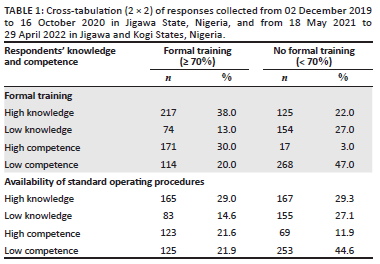
Categorical variables were analysed using a 2 × 2 cross-tabulation analysis (Table 1) to determine the level of knowledge and competence of respondents, hypothesised as a function effect of formal training and availability of standard operating procedures (SOPs) for glucometers. Experience was measured by the number of positive responses related to skills and work experience pertaining to glucometer usage.
Results
Participant characteristics
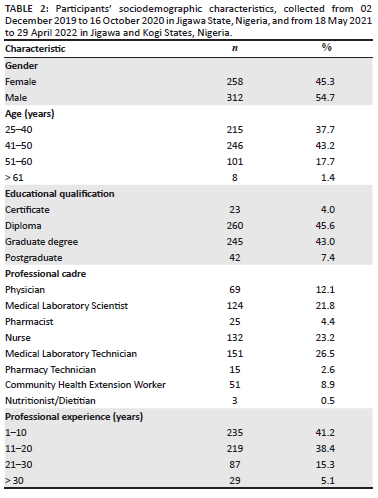
Of the 768 questionnaires distributed, 570 were filled and retrieved, with a response rate of 74.2% recorded. The majority of the respondents were Medical Laboratory Technicians (n = 151, 26.5%), Nurses (n = 132, 23.2%), or Medical Laboratory Scientists (n = 124, 21.8%) (Table 2). The highest educational qualification of respondents was almost evenly split between the diploma level (n = 260, 45.6%) and graduate degree level (n = 245, 43.0%).
Knowledge and competence of respondents
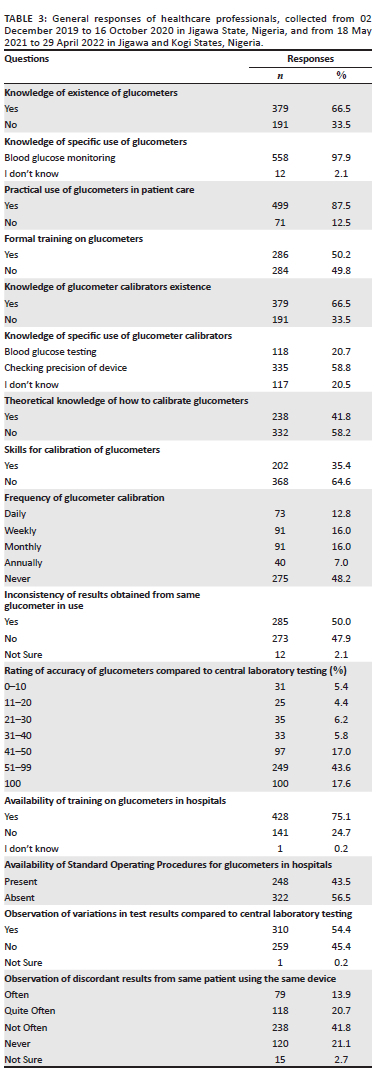
Most respondents (379/570, 66.5%) were familiar with glucometers as a point-of-care device (Table 3). Despite availability of training for HCPs in some hospitals (248/570, 43.5%), most HCPs have no theoretical (332/570, 58.2%) and practical skills (368/570, 64.6%) on glucometer calibrators.
Many (368/570, 64.6%) had never calibrated a glucometer used for patient care. Standard operating procedures for blood glucose testing using glucometers were unavailable in most clinical settings (322/570, 56.5%).
Discussion
Our study found a paucity of theory and skills for glucometer calibrators and calibration in about half of the participants, which in turn impacts the frequency of calibration of the device by HCPs, reliability and reproducibility of test results obtained, and the quality of life of the patients. Unavailability of SOPs for blood glucose testing using glucometers was reported by many respondents, despite the accessibility of training in some healthcare facilities.
About two-thirds of participants knew glucometers existed as a point-of-care device utilised for patient care. This is because over the years, glucometers have gained wide acceptability as an SMBG tool and point-of-care device. A study2322
We observed that work experience, or years of service, for most respondents ranged between 1 and 10 years (41.2%) and 11 and 20 years (38.4%), showing that years of HCPs' service or work experience in patient care was not directly linked with knowledge about existence of the device and its use. This implies that HCPs may not have to practise for many years before becoming acquainted with glucometers. Similarly, an assessment of nurses' competencies in diabetes care,20
Nearly half of the respondents (49.2%) reported not securing formal training or certification prior to first use of glucometers in patient care. This is because most health facilities in the private or public sector in Nigeria rely solely on device manual inserts provided by manufacturers to guide HCPs as a substitute for formal training or certification. Similarly, a multi-centre study by Nnakenyi et al.,3022,2320
Some studies have suggested in-service training on POCTs for doctors, nurses and midwives20,21,22,2331
Although more than half of respondents (66.5%) were aware of the existence of glucometer calibrators, many (41.2%) didn't know what purpose calibrators specifically served in SMBG. This may be attributed to the fact that most new glucometers do not come with calibrators in their packs, and those with calibrators lacked an operation manual.1311,23
The essence of calibration is for early detection of device non-conformances and ensuring results obtained are accurate and reproducible. Studies in Douala, Southwest Cameroon,89,1332913
Certain brands of glucometers have exhibited superiority in terms of precision and accuracy, even without necessarily meeting certain international standards for POCTs.8,10,1123
About half of respondents (43.6%) rated the accuracy of glucometers as 51.0% to 99.0%, and 17.6% reported its accuracy as 100.0% when compared to central laboratory testing for blood glucose. In recent times, increased accuracy and precision for some glucometers have been reported,2,108,9
Standard operating procedures are sets of step-wise instructions containing elements of quality assurance and quality control which conform with regulatory guidelines for end users. Robust training, supervision and intensive quality assurance mechanisms are necessary to optimise blood glucose testing using glucometers.3423
Most studies in sub-Saharan Africa22,23,3030222332
In Nigeria, operating glucometers in hospital settings is not restricted to a specific cadre of HCPs.2232
Currently, there is no regulatory agency or national guideline in Nigeria dedicated to POCTs or glucometers, and there are no POCT committees in hospitals. Organising centralised local, state or national POCT training or certification in Nigeria may encourage stakeholders in government, health, science, and technology, as well as the private sector, towards engagement of HCPs in developing policies, creating hospital committees on POCTs, and implementation of policies at the grassroots.
Recommendations
We recommend compulsory formal training, on-the-job competency assessment, and certification on glucometers and other POCTs for HCPs. Updating and assessing HCPs' knowledge, competency and skills is a professional gap that needs to be addressed by the relevant stakeholders. Formation of hospital-based, state and national POCT committees, provision of standard protocols, and quality control materials and engagement of central laboratories in establishing standard POCT guidelines and implementation of its content should also be considered.
Limitations
Our study limitations include the restriction of participation to HCPs employed only by the study hospitals which are directly under the state ministries of health, thereby excluding HCPs employed in the private sector although actively involved in patient care. Although the response rate was quite high, we observed in some hospitals that the available HCPs were busy with official duties when the questionnaires were distributed and didn't have the time to fill the questionnaires at follow-up and until completion of the study. The questionnaire was not designed to get feedback from HCPs on how POCT committees will be formed at hospitals, the likely members of the proposed committees, and the number of POCTs to be included in local and national guidelines. The information would have provided insights into the opinions of HCPs on POCTs, and provided suggestions on how the state and federal ministries of health can establish a formidable POCT programme.
Our findings are solely applicable to the study hospitals and may not be generalised for all health facilities in Nigeria, especially in resource-constrained settings where testing of blood glucose is completely absent or only performed in central laboratories, as seen in some hospitals.
Conclusion
The study found that although most participants possessed theoretical knowledge, the skills required for calibration of glucometers were absent. Standard operating procedures, calibrators, formal training, and skills acquisition forums for glucometers should be made available in health facilities in order to improve test quality and minimise avoidable errors in blood glucose testing using glucometers in Nigeria. Our study is the first in Nigeria conducted among a diverse cadre of HCPs, numerous inter-state health facilities, and different tiers of health centres: cottage, primary, secondary, and tertiary hospitals.
Competing interests
The authors declare that they have no financial or personal relationships that may have inappropriately influenced them in writing this article.
Authors' contributions
All authors, S.B.M., H.B., A.M.B., J.N.O., F.S., A.O.A., Z.I.N., R.J.B., E-y.S.A. and S.A.A., were responsible for development of study protocol until submission to the respective state Ethics Committees and writing the first draft of the manuscript. S.B.M., H.B., A.M.B., J.N.O. and F.S. distributed and retrieved the questionnaires, and collected the data for entry onto the Microsoft Excel spreadsheet for data analysis. A.O.A., Z.I.N., E.-y.S.A., R.J.B. and S.A.A. critically revised the manuscript in preparation for submission. All authors, S.B.M., H.B., A.M.B., J.N.O., F.S., A.O.A., Z.I.N., R.J.B., E.-y.S.A. and S.A.A., approved the final version of the article prior to publication.
Sources of support
This research received no specific grant from any funding agency in the public, commercial, or not-for-profit sectors.
Data availability
The data that support the findings of this study are available on request from the corresponding author, H.B. The data are not publicly available because they contain information that could compromise the privacy of the research participants.
Disclaimer
The views and opinions expressed in this article are those of the authors and are the product of professional research. The article does not necessarily reflect the official policy or position of any affiliated institution, funder, agency, or that of the publisher. The authors are responsible for this article's results, findings, and content.
Acknowledgements
The authors sincerely appreciate the support of the Jigawa and Kogi State Ministries of Health.
References
-
1. Muhali SS, Muhali FS, Mfinanga SG, et al. Impact of self-monitoring blood glucose on glycaemic control among insulin-treated patients with diabetes mellitus in Northeastern Tanzania: A randomised controlled trial. J Diabetes Res. 2024;16(4):173-176. https://doi.org/10.1155/2024/6789672
» https://doi.org/10.1155/2024/6789672 -
2. Irace C, Acmet E, Cutruzzolà A, et al. Digital technology and healthcare delivery in insulin-treated adults with diabetes: A proposal for analysis of self-monitoring blood glucose patterns using a dedicated platform. Endocrine. 2024;84:441-449. https://doi.org/10.1007/s12020-023-03605-2
» https://doi.org/10.1007/s12020-023-03605-2 - 3. International Diabetes Federation. IDF diabetes atlas. Brussels: IDF; 2021.
-
4. American Diabetes Association Professional Practice. 9. Pharmacologic approaches to glycemic treatment: Standards of medical care in diabetes-2022. Diabetes Care. 2022;45(Suppl. 1):S125-S143. https://doi.org/10.2337/dc22-S009
» https://doi.org/10.2337/dc22-S009 -
5. Farhan SA, Shaikh AT, Zia M, et al. Prevalence and predictors of home use of glucometers in diabetic patients. Cureus. 2017;9(6):e1330. https://doi.org/10.7759/cureus.1330
» https://doi.org/10.7759/cureus.1330 -
6. Cameron D, Harris F, Evans JMM. Self-monitoring of blood glucose in insulin treated diabetes: A multicase study. BMJ Open Diab Res Care. 2018;6(1):e000538. https://doi.org/10.1136/bmjdrc-2018-000538
» https://doi.org/10.1136/bmjdrc-2018-000538 -
7. Pleus S, Freckmann G, Schauer S, et al. Self-monitoring of blood glucose as an integral part in the management of people with type 2 diabetes mellitus. Diabetes Ther. 2022;13:829-846. https://doi.org/10.1007/s13300-022-01254-8
» https://doi.org/10.1007/s13300-022-01254-8 -
8. Choukem S-P, Sih C, Nebongo D, Keunmoe P, Kengne A-P. Accuracy and precision of four main glucometers used in a sub-Saharan African country: A cross-sectional study. PAMJ. 2019;32:118. https://doi.org/10.11604/pamj.2019.32.118.15553
» https://doi.org/10.11604/pamj.2019.32.118.15553 -
9. Inaku KO, Eyam ES, Emin EJ, Onuche OL. Self-monitoring of blood glucose can be misleading without periodic re-calibration of glucose meters: A pilot study. Niger J Med. 2021;30(3):259-263. https://doi.org/10.4103/NJM.NJM_224_20
» https://doi.org/10.4103/NJM.NJM_224_20 -
10. Dahman LSB, Daakeek AM, Alghazali HS, Kaity AM, Obbed MS. Evaluation of the three glucometer devices performance in comparison with the cobas Integra 400 Plus autoanalyzer in measuring blood glucose levels: A comparative cross-sectional study. Int J Diabetes Mellit. 2021;11(4):132-142. https://doi.org/10.4236/jdm.2021.114010
» https://doi.org/10.4236/jdm.2021.114010 -
11. Immanuel J, Kongbrailatpam T, Rajagopal R, Simmons D. Evaluation of the analytical and clinical accuracy of four blood glucose meters in pregnant women with hyperglycaemia. Diabetes Obes Metab. 2025;27(4):2131-2137. https://doi.org/10.1111/dom.16209
» https://doi.org/10.1111/dom.16209 -
12. Kesavadev J, Shankar A, Chandran GB, Sreelakshmi R, Basanth A. Comparative evaluation of the precision and accuracy of five available glucometers in India. Int J Diabetes Technol. 2024;3(4):143-150. https://doi.org/10.4103/ijdt.ijdt_44_24
» https://doi.org/10.4103/ijdt.ijdt_44_24 -
13. Nnakenyi I, Arum E, Young E, Anyim O, Nnakenyi E, Okoro N. Functionality of glucose meters of patients with diabetes for self-monitoring of blood glucose using quality control solutions. J Diabetes Sci Technol. 2022;16(5):1340-1341. https://doi.org/10.1177/19322968221104467
» https://doi.org/10.1177/19322968221104467 -
14. Mohamed S, Mukhtar M, Aseed K, et al. Knowledge and practice of glucose self-monitoring devices among patients with diabetes. Sudan J Med Sci. 2023;18(2):127-138. https://doi.org/10.18502/sjms.v18i2.13598
» https://doi.org/10.18502/sjms.v18i2.13598 -
15. Pinelli M, Lettieri E, Boaretto A, et al. Glucometer usability for 65+ type 2 diabetes patients: Insights on physical and cognitive issues. Sensors. 2022;22(16): 6202. https://doi.org/10.3390/s22166202
» https://doi.org/10.3390/s22166202 -
16. Adgoy ET, Ghebretinsae A, Solomon M, Girmay K, Fissehaye D, Andemariam Z. Cross-sectional study on knowledge, attitude and practice about diabetes mellitus among diabetic patients with type II; Asmara, Eritrea. MOJ Public Health. 2021;10(1):1-7. https://doi.org/10.15406/mojph.2021.10.00351
» https://doi.org/10.15406/mojph.2021.10.00351 -
17. Parsons S, Luzio S, Bain S, et al. Self-monitoring of blood glucose in non-insulin treated type 2 diabetes (the SMBG Study): Study protocol for a randomised controlled trial. BMC Endocr Disord. 2017;17(1):4. https://doi.org/10.1186/s12902-017-0154-x
» https://doi.org/10.1186/s12902-017-0154-x -
18. Edah JO, Odoh G, Kumtap CY, et al. Self-monitoring of blood glucose in Jos, Nigeria. J Med Trop. 2016;18(1):28-32. https://doi.org/10.4103/2276-7096.172106
» https://doi.org/10.4103/2276-7096.172106 -
19. Shabnum S, Sarwar H. Knowledge, attitude and practice of blood glucose monitoring in rural area among diabetic patients. Int J Soc Sci Manage. 2018;5(3):225-230. https://doi.org/10.3126/ijssm.v5i3.20615
» https://doi.org/10.3126/ijssm.v5i3.20615 -
20. Ilodibe EE, Nwankwo CU. Nurses' competencies and resource availability in the care of diabetes mellitus patient attending primary health care centres in Anambra State. GSCARR. 2023;14(02):007-021. https://doi.org/10.30574/gscarr.2023.14.2.0038
» https://doi.org/10.30574/gscarr.2023.14.2.0038 - 21. Esther YO, Lucia YO. Primary health care nurses' competencies and resources availability for diabetes mellitus care at local government areas of Ibadan. Int J Caring Sci. 2020;13(1):368-380.
-
22. Onovughakpo-Sakpa EO, Osemwenkha SO, Adewolu OF, Okhimamhe AF. Point of care testing: Knowledge and utilization amongst Doctors in Government hospitals in Edo State, Nigeria. Niger J Clin Pract. 2015;18(6):780-785. https://doi.org/10.4103/1119-3077.163279
» https://doi.org/10.4103/1119-3077.163279 -
23. Jalavu TP, Rensburg M, Erasmus R. Clinical staff knowledge and awareness of point-of-care-testing best practices at Tygerberg Hospital. South Africa. Afr J Lab Med. 2020;9(1):a853. https://doi.org/10.4102/ajlm.v9i1.853
» https://doi.org/10.4102/ajlm.v9i1.853 -
24. Chinnasamy A, Moodie M. Diabetes related knowledge, attitudes and practice - A survey among oral health professionals in Victoria, Australia. Clin Cosmet Investig Dent. 2020;12:111-121. https://doi.org/10.2147/CCIDE.S240212
» https://doi.org/10.2147/CCIDE.S240212 -
25. Greenwood DA, Grady M. Healthcare professional perceptions of blood glucose meter features that support achievement of self-management goals recommended by clinical practice guidelines. J Diabetes Sci Technol. 2020;15(5):1142-1152. https://doi.org/10.1177/1932296820946112
» https://doi.org/10.1177/1932296820946112 -
26. Friesner CT, Meyer J, Nippak P. Glucose point-of-care meter operators competency: An assessment checklist. Pract Lab Med. 2020;20:e00157. https://doi.org/10.1016/j.plabm.2020.e00157
» https://doi.org/10.1016/j.plabm.2020.e00157 -
27. Johari SM, Razalli NH, Chua KH, Shahar S. The efficacy of self-monitoring of blood glucose (SMBG) intervention package through a subscription model among type-2 diabetes mellitus in Malaysia: A preliminary trial. Diabetol Metab Syndr. 2024;16:135. https://doi.org/10.1186/s13098-024-01379-9
» https://doi.org/10.1186/s13098-024-01379-9 -
28. Nijor S, Rallis G, Lad N, Gokcen E. Patient safety issues from information overload in electronic medical records. J Patient Saf. 2022;18(6):e999-e1003. https://doi.org/10.1097/PTS.0000000000001002
» https://doi.org/10.1097/PTS.0000000000001002 -
29. Fung AWS. Utilizing connectivity and data management system for effective quality management and regulatory compliance in point of care testing. Pract Lab Med. 2020;22:e00187. https://doi.org/10.1016/j.plabm.2020.e00187
» https://doi.org/10.1016/j.plabm.2020.e00187 -
30. Nnakenyi ID, Onyenekwu C, Imoh L, Ntuen N, Mohammed I, Nlemadim C. A multicenter evaluation of the quality management practices for point-of-care testing in Nigeria: Point of care. J Near Patient Test Technol. 2017;16(4):173-176. https://doi.org/10.1097/POC.0000000000000152
» https://doi.org/10.1097/POC.0000000000000152 -
31. Okorie-Kanu CO, Okorie-Kanu OJ, Akwuobu CA, Tizhe EV, Antia RE. Knowledge of validation status of point-of-care glucometers among veterinarians and veterinary technologists in Nigeria. Niger Vet J. 2020;41(3):214-222. https://doi.org/10.4314/nvj.v41i3.2
» https://doi.org/10.4314/nvj.v41i3.2 -
32. Inaku KO, Ene AB, Isong IK, Ita OI, Inyama MA. Survey of the use of point of care testing devices in a tertiary hospital in Nigeria. Saudi J Pathol Microbiol. 2019;4(10):712-718. https://doi.org/10.36348/SJPM.2019.v04i10.003
» https://doi.org/10.36348/SJPM.2019.v04i10.003 -
33. De Block C, Cheng AYY, Christensen TB, Patted URH, Ginovker A. Healthcare professionals' knowledge of and attitudes towards the use of time in range in diabetes management: Online survey across seven countries. Diabetes Ther. 2023;14:1399-1413. https://doi.org/10.1007/s13300-023-01429-x
» https://doi.org/10.1007/s13300-023-01429-x -
34. Higioka AS, Rudolf-Oliveira RCM, Martinello F, Bazzo ML. Analytical performance of glucometers in a tertiary care hospital. Accred Qual Assur. 2016;21:143-149. https://doi.org/10.1007/s00769-015-1188-2
» https://doi.org/10.1007/s00769-015-1188-2

Accepted: 24 June 2025
Published: 07 Oct. 2025