Potential role of Lu/BCAM in HIV-related atherosclerosis
Abstract
Atheromatous lesions are formed by macrophages and low-density lipoprotein cholesterol invading the vascular intima. Here we show that increasing cholesterol levels are associated with peripheral monocyte depletion and this imbalance is aggravated by carriage of Lu/BCAM leukocyte adhesion molecules. This is true only in HIV infection and probably explains the risk of atherosclerosis observed in HIV-positive patients.
cholesterol; Non-high-density lipoprotein cholesterol; Lu, BCAM; Atherosclerosis
Introduction
The pathology of atherosclerosis is tightly linked to three main factors; leukocytes, plasma lipids and vascular injury or chronic inflammation.1,233445,6
In HIV-positive individuals, the viral Tat protein accumulates in the extracellular matrix of blood vessels and facilitates integrin-mediated adhesion789102101112131415
In our previous study, the Lutheran blood group, Lub, was associated with a three-fold risk for HIV infection,16b antigen as an adhesion molecule on circulating monocytes and neutrophils, as well as how these parameters related to cholesterol measurements. The results indicate that HIV does affect the relationship between monocytes and cholesterol, and that this relationship is accentuated by expression of the Lub antigen.
Methods
Ethical considerations
Ethical clearance for the study was obtained from the University of Botswana's Office of Research and Development (Permit No. URB/IRB/1365), Botswana's Ministry of Health and Wellness Health Research Development Committee (Permit No. HPDME 13/18/1) and the Cape Peninsula University of Technology, Faculty of Health and Wellness Research Ethics Committee (Permit No. CPUT/HW-REC 2015/H11). Informed consent was not necessary, since de-identified, residual samples were used,17
Study design
The study was conducted at the Julia Molefe Clinic, Gaborone, Botswana, from December 2016 to February 2017. One hundred blood samples comprising 58 female patients and 42 male patients were enrolled in the study. The patients had all tested positive for HIV and were being prepared for enrolment into the antiretroviral therapy programme. Patients were enrolled sequentially upon receipt of an adequate residual sample to perform requisite tests. A full blood count was done using the Sysmex® XT1800i haematology analyser (Sysmex Corporation, Kobe, Japan). The samples were phenotyped for the Lutheran antigens (Lua and Lub) using specific antisera (Fortress Diagnostics, Antrim, United Kingdom) according to the manufacturer's instructions. The reactivity of the antisera was confirmed by use of antigen-positive and negative cells selected from an antibody identification panel (DiaPanel®, Lot 45241.88.1, Bio-Rad®, Cressier FR, Switzerland). Total and HDL cholesterol measurements were also made using the AU480 chemistry analyser (Beckman-Coulter, Brea, California, United States). Non-HDL cholesterol was calculated as the difference between the two measured values. We also revisited a previous dataset of 261 normal individuals as a control group to examine the same relationships in healthy, HIV-negative individuals18
Statistical analysis
The results were analysed using IBM SPSS version 24 (IBM Corporation, Armonk, New York, United States) statistical software. Statistical analyses included comparison of means according to carriage of the Lutheran antigens, as well as the correlation of data to explore relationships between variables. Results were considered significant only if p < 0.05.
Results
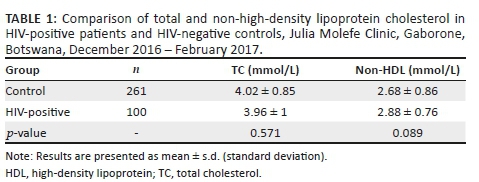
The mean total cholesterol did not differ between controls and HIV-positive patients (mean ± s.d. = 4.02 ± 0.85 vs 3.96 ± 1 mmol/L, p = 0.571) (Table 1). Likewise, the mean non-HDL values did not differ between the groups (2.68 ± 0.85 vs 2.88, ± 0.588 mmol/L, p = 0.089).
Among HIV-positive patients, total cholesterol correlated weakly and negatively with monocytes but not with neutrophils (r = −0.208, p = 0.038 vs r = −0.090, p = 0.372). However, with respect to the atherogenic non-HDL cholesterol, a stronger depletive effect was observed with monocytes (r = −0.401, p = 0.006), but not neutrophils (r = −0.226, p = 0.136). Among HIV-negative controls, there was no correlation between monocytes and total cholesterol or non-HDL cholesterol. However, a very weak positive relationship was observed between total cholesterol and neutrophils (r = 0.142, p = 0.023).
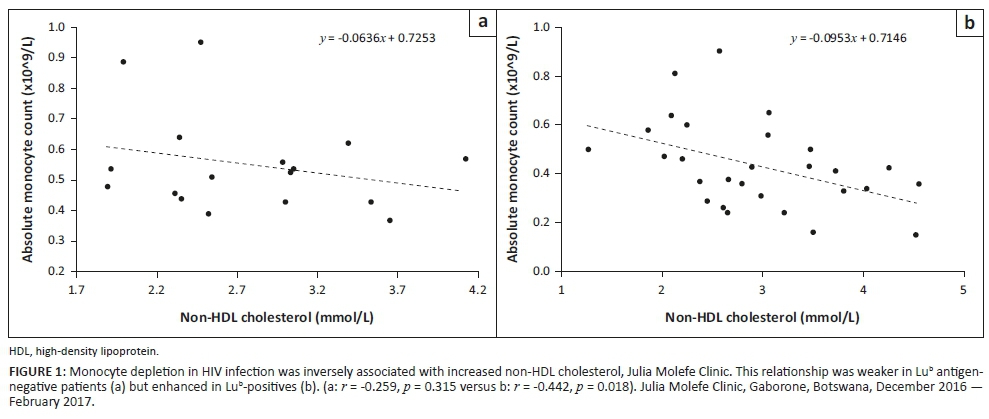
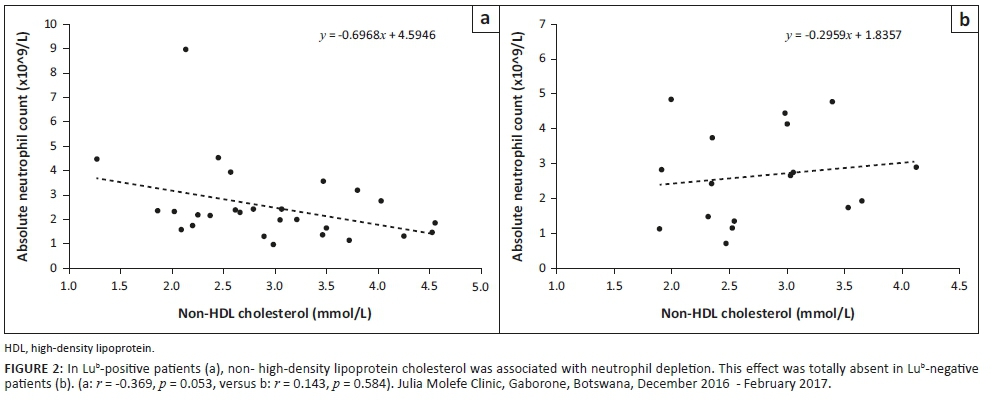
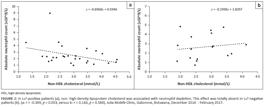
When patients were segregated according to their Lub phenotypes, the correlation between non-HDL cholesterol with phagocytes improved for both monocytes (r = −0.442, p = 0.018; Figure 1) and neutrophils (r = −0.369, p = 0.053; Figure 2). In contrast, this relationship was absent for both phagocytes in Lub-negative patients (r = −0.259, p = 0.315 for monocytes vs. r = 0.143, p = 0.584 for neutrophils). Overall, Lub expression was associated with lower absolute monocyte counts (0.45 ± 0.18 vs 0.54 ± 0.22 × 10⁹p = 0.023).
Discussion
We studied the relationship between cholesterol and phagocytes in HIV-positive and HIV-negative individuals in an attempt to determine the influence, if any, of the Lu/BCAM on phagocyte counts. We hypothesised that carriage of the Lub antigen, an adhesion molecule, would enhance margination of leukocytes leading to a peripheral deficiency of the affected leukocytes. Indeed, we observed a significantly lower absolute monocyte count in Lub-positive individuals compared to Lub-negative individuals.
We also observed a negative correlation between cholesterol and phagocytes (neutrophils and monocytes), which corroborates the findings by other investigators that membrane cholesterol, which is in equilibrium with plasma cholesterol,191,21,12b-positive individuals but totally absent in the Lub-negative individuals. While the difference in absolute monocyte counts may be considered to be small, the difference translates to 90 million cells per litre. The resulting statistical significance underlines a consistent finding of monocyte depletion in Lub-positive individuals, and may explain the insidious development characteristic of atherosclerosis.
We conclude that higher levels of cholesterol are associated with lower peripheral monocyte and neutrophil counts and that this depletion is accentuated in individuals expressing the Lub antigen. This depletion is an effect of HIV infection, since it was not observed in the HIV-negative population and probably involves the particular role of the HIV-Tat protein's enhancement of vascular adhesion and trans-endothelial migration of monocytes reported by other investigators.208b blood group contributes to the depletion of circulating phagocytes, possibly by enhancing their margination and extravasation.2
Working from the established fact that cholesterol, especially non-HDL cholesterol, promotes the adhesion of phagocytes,1,22,8
When cholesterol components were examined, non-HDL cholesterol negatively affected phagocyte counts consistently, especially the monocyte counts, which corroborates previous reports by others11
Limitations
A limitation of our study was that we did not directly measure phagocyte migration but rather inferred it from diminished peripheral cell counts. Future studies need to focus on direct migration measurements of phenotyped phagocytes. Moreover, the ages of the patients included in the study were not available, making it impossible to include the effect of age in the cholesterol analysis. This notwithstanding, the results provide critical information for HIV-associated atherosclerosis.
Conclusion
Our findings suggest that the risk of cardiovascular disease in HIV-1-positive patients may in part be due to an interplay between cholesterol, phagocytes and Lub-mediated adhesion, all of which tend to recruit phagocytes out of circulation. While a genetic predisposition for atherogenesis has always been alluded to, our results suggest that the Lub adhesion molecule may be a potentially important genetic link. The results also suggest a need to manage cholesterol in HIV-positive patients to achieve lower levels than the general public, especially for those who are Lub-positive. Moreover, the vulnerability occasioned by Lub-positive status may provide an opportunity for personalised care in Lub-positive, HIV-positive individuals.
Competing interests
The authors declare that they have no financial or personal relationships that may have inappropriately influenced them in writing this article.
Authors' contributions
M.S.M. conceived the idea, carried out the experiments, analysed results and drafted the article. O.O.O. and I.K. provided experimental guidance, participated in data analysis, critiqued the content and gave final approval of the version to be published.
Sources of support
This research project was supported by a research grant from the Office of Research and Development of the University of Botswana, (granted to M.S.M.), and from the Cape Peninsula University of Technology and National Research Foundation South Africa (CPUT/RJ23), granted to O.O.O. However, the funders did not contribute in any way to the design of the study, data collection, analysis, or interpretation of data nor in the writing of the manuscript.
Data availability statement
Data sharing regarding this article is available upon written request to the corresponding author.
Disclaimer
The views and opinions expressed in this article are those of the author(s) and do not necessarily reflect the official policy or position of any affiliated agency of the authors.
Acknowledgements
The authors wish to express gratitude to the staff and management of the Gaborone District Health Management team, especially those at the Julia Molefe Clinic, where samples were obtained and haematology and chemistry tests were performed.
References
-
1.Frostegard J, Nilsson J, Haegerstrand A, Hamsten A, Wigzell H, Gidlund M. Oxidized low density lipoprotein induces differentiation and adhesion of human monocytes and the monocytic cell line U937. Proc Nati Acad Sci USA. 1990;87:904-908. https://doi.org/10.1073/pnas.87.3.904
» https://doi.org/10.1073/pnas.87.3.904 -
2.Oh H, Mohler ER, Tian A, Baumgart T, Diamond SL. Membrane cholesterol is a biomechanical regulator of neutrophil adhesion. Arterioscler, Thromb Vasc Biol. 2009;29(9):1290-1297. https://doi.org/10.1161/ATVBAHA.109.189571
» https://doi.org/10.1161/ATVBAHA.109.189571 -
3.Pedraza C, Geberhiwot T, Ingerpuu S, et al. Monocytic cells synthesize, adhere to, and migrate on laminin-8 (α4β1γ1). J Immunol. 2000;165:5831-5838. https://doi.org/10.4049/jimmunol.165.10.5831
» https://doi.org/10.4049/jimmunol.165.10.5831 -
4.Chaar V, Picot J, Renaud O, Bartolucci P, et al. Aggregation of mononuclear and red blood cells through an {alpha}4{beta}1-Lu/basal cell adhesion molecule interaction in sickle cell disease. Haematologica. 2010;95(11):1841-1848. https://doi.org/10.3324/haematol.2010.026294
» https://doi.org/10.3324/haematol.2010.026294 -
5.Chang H-Y, Chang H-M, Wu T-J, et al. The role of Lutheran/basal cell adhesion molecule in human bladder carcinogenesis. J Biomed Sci. 2017;24(1):61. https://doi.org/10.1186/s12929-017-0360-x
» https://doi.org/10.1186/s12929-017-0360-x -
6.De Grandis M, Cambot M, Wautier M-P, et al. JAK2V617F activates Lu/BCAM-mediated red cell adhesion in polycythemia vera through an EpoR-independent Rap1/Akt pathway. Blood. 2013;121(4):658-665. https://doi.org/10.1182/blood-2012-07-440487
» https://doi.org/10.1182/blood-2012-07-440487 -
7.Chiodelli P, Urbinati C, Mitola S, Tanghetti E, Rusnati M. Sialic acid associated with α(v)β(3) integrin mediates HIV-1 tat protein interaction and endothelial cell proangiogenic activation. J Biol Chem. 2012;287(24):20456-20466. https://doi.org/10.1074/jbc.M111.337139
» https://doi.org/10.1074/jbc.M111.337139 -
8.Dhawan S, Vargo M, Meltzer M. Interactions between HIV-infected monocytes and the extracellular matrix: increased capacity of HIV-infected monocytes to adhere to and spread on extracellular matrix associated with changes in extent of virus replication and cytopathic effects in infected cells. J Leukoc Biol. 1992;52:62-69. https://doi.org/10.1002/jlb.52.1.62
» https://doi.org/10.1002/jlb.52.1.62 -
9.Appay V, Sauce D. Immune activation and inflammation in HIV-1 infection: causes and consequences. J Pathol. 2008;214(2):231-241. https://doi.org/10.1002/path.2276
» https://doi.org/10.1002/path.2276 -
10.Hartwig H, Roig CS, Daemen M, Lutgens E, Soehnlein O. Neutrophils in atherosclerosis. Hamostaseologie. 2015;35(02):121-127. https://doi.org/10.5482/HAMO-14-09-0040
» https://doi.org/10.5482/HAMO-14-09-0040 -
11.Badiou S, Thiebaut R, Aurillac-Lavignolle V, et al. Association of non-HDL cholesterol with subclinical atherosclerosis in HIV-positive patients. J Infect. 2008;57(1):47-54. https://doi.org/10.1016/j.jinf.2008.05.007
» https://doi.org/10.1016/j.jinf.2008.05.007 -
12.Østerud B, Bjørklid E. Role of Monocytes in atherogenesis. Physiol Rev 2003;83(4):1069-1112. https://doi.org/10.1152/physrev.00005.2003
» https://doi.org/10.1152/physrev.00005.2003 -
13.Von Hundelshausen P, Weber KS, Huo Y, et al. RANTES deposition by platelets triggers monocyte arrest on inflamed and atherosclerotic endothelium. Circulation. 2001;103(13):1772-1777. https://doi.org/10.1161/01.CIR.103.13.1772
» https://doi.org/10.1161/01.CIR.103.13.1772 -
14.Johnsen SH, Fosse E, Joakimsen O, et al. Monocyte count is a predictor of novel plaque formation A 7-year follow-up study of 2610 persons without carotid plaque at baseline the Tromsø Study. Stroke. 2005;36:715-719. https://doi.org/10.1161/01.STR.0000158909.07634.83
» https://doi.org/10.1161/01.STR.0000158909.07634.83 -
15.Ionita MG, Van den Borne P, Catanzariti LM, et al. High neutrophil numbers in human carotid atherosclerotic plaques are associated with characteristics of rupture-prone lesions. Arterioscler Thromb Vasc Biol. 2010;30(9):1842-1848. https://doi.org/10.1161/ATVBAHA.110.209296
» https://doi.org/10.1161/ATVBAHA.110.209296 -
16.Motswaledi MS, Kasvosve I, Oguntibeju OO. Blood Group Antigens C, Lub and P1 may have a role in HIV infection in Africans. PLoS One. 2016;11(2):e0149883. https://doi.org/10.1371/journal.pone.0149883
» https://doi.org/10.1371/journal.pone.0149883 - 17.International Organization for Standardisation. Annexure C: Ethics in laboratory medicine. ISO 15189: 2007:C9. Geneva: ISO; 2007.
-
18.Mine M, Moyo S, Stevens S, et al. Immunohaematological reference values for HIV-negative healthy adults in Botswana. Afr J Lab Med. 2011, 1(1). https://doi.org/10.4102/ajlm.v1i1.5
» https://doi.org/10.4102/ajlm.v1i1.5 -
19.Buchwald H, O'Dea TJ, Menchaca HJ, Michalek VN, Rohde TD. Effect of plasma cholesterol on red blood cell oxygen transport. Clin Exp Pharmacol Physiol. 2000;27(12):951-955. https://doi.org/10.1046/j.1440-1681.2000.03383.x
» https://doi.org/10.1046/j.1440-1681.2000.03383.x - 20.Lafrenie RM, Wahl LM, Epstein JS, Hewlett IK, Yamada KM, Dhawan S. HIV-1-Tat modulates the function of monocytes and alters their interactions with microvessel endothelial cells. A mechanism of HIV pathogenesis. J Immunol. 1996;156(4):1638-1645.

Accepted: 22 Feb. 2019
Published: 30 Sept. 2019