Prevalence and aetiology of moderate and severe thrombocytopenia in a tertiary and quaternary centre in KwaZulu-Natal
Abstract
BACKGROUND: Thrombocytopenia is a common haematological disorder, characterised by platelet counts below 150 × 109/L. The aetiology of thrombocytopenia is multifactorial; notably, in a misdiagnosis this condition may be due to pre-analytical laboratory artefacts. Knowledge about the common aetiology of thrombocytopenia will assist clinicians in decision-making and interpretation of laboratory tests and this may lead to prompt, adequate patient management and cost-saving measures. OBJECTIVE: This study determined the prevalence and aetiology of moderate and severe thrombocytopenia in a tertiary or quaternary laboratory in Durban, KwaZulu-Natal, South Africa. METHODS: We conducted a retrospective study at the Inkosi Albert Luthuli Central Hospital haematology laboratory between October 2015 and April 2016. A total of 2076 full blood count results with a platelet count of less than 100 × 109/L were retrieved from the Inkosi Albert Luthuli Academic Hospital database. Laboratory data were extracted and matched with clinical data and used to identify the potential aetiology of thrombocytopenia. RESULTS: The prevalence of thrombocytopenia was 14.9% within the selected study period. The haematology or oncology wards and clinic accounted for 55.2% of thrombocytopenia cases, whereas the adult and paediatric intensive care units accounted for 29.3%. Notably, 15.5% of thrombocytopenia cases were reported in non-haematology wards and clinics. The most common cause of thrombocytopenia was chemotherapy which accounted for 38.5% of all causes. CONCLUSION: In our tertiary and quaternary setting, thrombocytopenia in adults was most common in patients admitted to haematology and oncology wards. Moreover, chemotherapy-induced thrombocytopenia accounted for more than a third of all these cases.
thrombocytopenia; prevalence; aetiology; South Africa; haematology
Introduction
Thrombocytopenia is a common clinical condition that is associated with multiple systemic diseases. Thrombocytopenia is characterised by platelet counts below 150 × 109919923,41,513,631,74,8
For prompt and adequate management of patients with thrombocytopenia, a comprehensive review of the patients' medical records should be performed by the treating clinician, and appropriate physical examination and investigations need to be performed.14,9,10129,10,114
Methods
Ethical considerations
The study received ethical approval from the University of KwaZulu-Natal Biomedical Research and Ethics Committee (Approval number: BE 297/16).
Sample selection and data extraction
This retrospective study was conducted at the Department of Haematology at Inkosi Albert Luthuli Central Hospital (IALCH), Durban, KwaZulu-Natal, South Africa. The department offers diagnostic haematology services to the entire province of KwaZulu-Natal. The IALCH is an 846-bed referral hospital that provides tertiary level services to the entire KwaZulu-Natal province and parts of the Eastern Cape.
Data collection
Patients' diagnostic test results and clinical notes were retrieved from the IALCH TRAK laboratory data management system, version 6.10.56 (Intersystems Corporation, Cambridge, Massachusetts, United States). The extracted laboratory data items included the peripheral blood film report, diagnosis, platelet count, ward number and hospitalisation status. Clinical data items were retrieved from Meditech version 615 (Meditech, Westwood, Massachusetts, United States). The extracted patient information included age, sex, type of ward, hospitalisation status and the cause of thrombocytopenia in these patients.
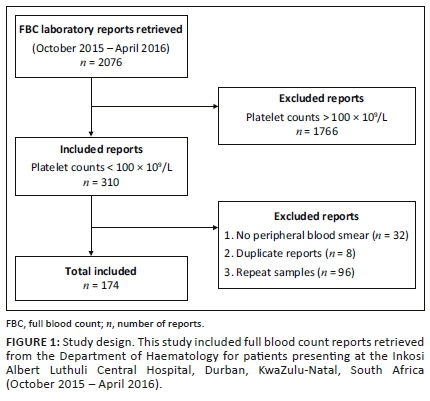
A total of 2076 full blood count results were extracted from the TRAK database. These results were from samples received at IALCH haematology laboratory on non-consecutive weekdays from October 2015 to April 2016. This was in an effort to minimise the inclusion of repeat samples in our analysis. All samples were analysed using the same Sysmex XE5000 analyser (Sysmex Corporation, Chuo-ku, Kobe, Japan). The study included patient reports that fulfilled the study inclusion criteria of a platelet count of < 100 × 109Figure 1).
Sample size determination
In order to determine the prevalence of thrombocytopenia, we computed a minimum required sample size (n) of 304 based on the thrombocytopenia prevalence of 20% and an appropriate precision (d) of 0.05 and a 95% confidence interval width of 15.5% - 24.5%.13 Furthermore, a sub-sample size of 170 was required to estimate the aetiology of thrombocytopenia with a 5% probability of error and assuming that 50% of cases are due to acquired factors.
Statistical analysis
The Kolmogorov-Smirnov and Lilliefors tests for normality were used to assess data distribution. Parametric data such as platelet count and cluster of differentiation 4 T-cell counts were reported as mean and standard deviations. Platelet counts were ordered into two categories (i.e. < 50 and 51-100). The Fisher's exact test was used for comparisons between ordinal data (age, platelet count, diagnosis and race). The prevalence of thrombocytopenia was reported as a proportion of patients with the disease. Furthermore, associations between patient characteristics (age, sex and hospital ward) and aetiology of thrombocytopenia were assessed. A p-value of < 0.05 was regarded as statistically significant. All data analyses were performed using the Stata version 13.1 statistical software (StataCorp LP, College Station, Texas, United States).
Results
A total of 2076 full blood count reports were retrieved from the IALCH database. Among these, 174 reports that met the inclusion criteria were included in the study (Figure 1). The extracted participant data included age, gender, peripheral blood film report, diagnosis, platelet count, ward number and hospitalisation status.
Patient characteristics
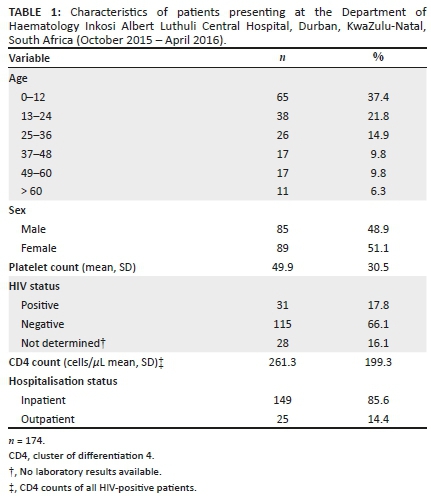
The study comprised 174 thrombocytopenia patients with a mean age of 24.4 ± 2.9 years. This consisted of patients receiving both inpatient and outpatient care (Table 1). The HIV status of the thrombocytopenia patients was reported in 146 (83.9%) of the included cases, while it was not determined in 28 (16.1%) (Table 1). Thirty-one (21.2%) of the thrombocytopenia patients were HIV-positive with a mean cluster of differentiation 4 T-cell count of 261.3 ± 199.3 cells/µL.
Prevalence and aetiology of moderate to severe thrombocytopenia
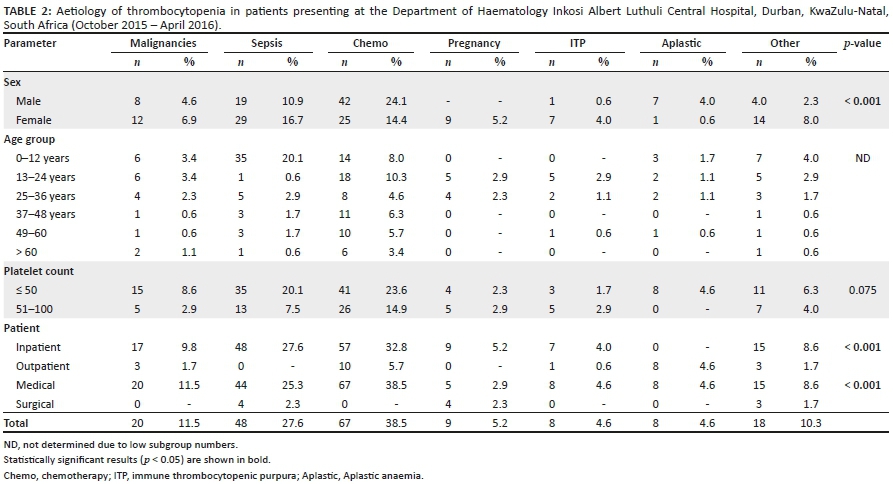
The overall prevalence of thrombocytopenia was 14.9%. The paediatric population (0-12 years) had the highest prevalence of thrombocytopenia (37.4%) compared with those aged 13-24 years (21.8%), 25-36 years (14.9%), 37-48 years (9.8%), 49-60 years (9.8%) and > 60 years (6.3%) (Table 1). In the overall cohort, the prevalence of thrombocytopenia was higher in female patients (51.1%) compared to male patients (48.9%), p < 0.001. Thrombocytopenia was most common in inpatients (85.6%) compared to outpatients (14.4%), p < 0.001. The adult and paediatric haematology and oncology wards and clinic had the highest prevalence of thrombocytopenia (55%), whereas the adult and paediatric intensive care units (29.3%) and the non-haematology wards and clinic (15.5%) had a lower prevalence, p < 0.001. Overall, severe thrombocytopenia (platelet count ≤ 50 × 109p = 0.004 (Table 2).
Chemotherapy-induced thrombocytopenia (38.5%) and sepsis (27.6%) accounted for the majority of thrombocytopenia cases (Table 2). Malignancies accounted for 11.5%, immune thrombocytopenic purpura 4.6% and aplastic anaemia 4.6%. Aetiologies with a prevalence less than 4% were grouped into one category and these comprised trauma as well as pre-eclampsia, storage disorders, autoimmune disorders, hereditary thrombocytopenia and human leukocyte antigen antibodies to platelets, which accounted for between 0.6 and 1.7%.
Discussion
In this study, we report a thrombocytopenia prevalence of 14.9%, which is higher than the 8.6% prevalence reported in a similar study conducted at an academic state hospital in Johannesburg, South Africa.41414,1544
More than a third of cases referred to the haematology department with thrombocytopenia were classified as chemotherapy-induced. The mechanism of thrombocytopenia in chemotherapy-induced thrombocytopenia involves reduced platelet production, an increased rate of platelet destruction and enhanced platelet clearance by immune mechanisms.71,74
Thrombocytopenia due to sepsis accounted for 27.6% of the cases, a majority of which were in the intensive care unit. The majority of cases presenting with sepsis had severe thrombocytopenia; these findings were similar to those previously described.165,6,171818,19
Contrary to literature, immune thrombocytopenic purpura was not common among the paediatric group (12.5%).192020
In our study, the prevalence of pregnancy-associated thrombocytopenia was 5.2%, which is lower in comparison to other studies.8,9,212223,24
Limitations
Care should be taken in generalising the findings of the study because of the small numbers included in the study. The patient characteristics of those included may also differ from those seen at other levels of the healthcare system. Other limitations encountered were a lack of family history and other medications patients were taking, as this would have allowed for the classification and consideration of familial and drug-induced thrombocytopenia.
Conclusion
In our study, thrombocytopenia was common in hospitalised patients compared to outpatients. Chemotherapy, sepsis and malignancies were the most common causes of thrombocytopenia. Focused investigations are warranted for prompt patient management. Knowledge of the prevalence and common aetiology of thrombocytopenia in a healthcare facility will assist clinicians in decision-making and interpretation of laboratory test results, leading to prompt and adequate patient management and potentially offsetting patient costs that may be incurred due to unwarranted laboratory investigations. Further research in this field is required at different levels of healthcare as differences in the reported prevalence of thrombocytopenia may be the result of differences in patient demographics and clinical presentation of patients, which may differ between these facilities.
Competing interests
The authors declare that there are no financial, personal or professional competing interests that may interfere with this work.
Authors' contributions
A.G.P.J. performed the experiments, designed the study and wrote the paper; B.B.N. contributed to the revision of the intellectual content. All authors gave their approval of the final version to be submitted for publication.
Sources of support
B.B.N. is a University of KwaZulu-Natal Developing Research Innovation, Localisation and Leadership in South Africa fellow. Developing Research Innovation, Localisation and Leadership in South Africa is a United States National Institutes of Health D43 grant (D43TW010131) awarded to the University of KwaZulu-Natal in 2015 to support a research training and induction programme for early-career academics.
Data availability statement
Data sharing is not applicable to this article as no new data were created or analysed in this study.
Disclaimer
The views and opinions expressed in this article are those of the authors and do not necessarily reflect the official policy or position of any affiliated agency of the authors.
Acknowledgements
The authors would like to thank the Department of Haematology, National Health Laboratory Service laboratory, Inkosi Albert Luthuli Central Hospital and Inkosi Albert Luthuli Central Hospital for granting access to the patient database.
References
-
1.Stasi R. How to approach thrombocytopenia. Hematology Am Soc Hematol Educ Program. 2012;2012(1):191-197. https://doi.org/10.1182/asheducation-2012.1.191
» https://doi.org/10.1182/asheducation-2012.1.191 -
2.Gernsheimer T, James AH, Stasi R. How I treat thrombocytopenia in pregnancy. Blood. 2013;121(1):38-47. https://doi.org/10.1182/blood-2012-08-448944
» https://doi.org/10.1182/blood-2012-08-448944 -
3.Zhang L, Xu J, Gao L, Pan S. Spurious thrombocytopenia in automated platelet count. Lab Med. 2018;49(2):130-133. https://doi.org/10.1093/labmed/lmx081
» https://doi.org/10.1093/labmed/lmx081 -
4.Vaughan JL, Fourie J, Naidoo S, Subramony N, Wiggill T, Alli N. Prevalence and causes of thrombocytopenia in an academic state sector laboratory in Soweto, Johannesburg, South Africa. S Afr Med J. 2015;105(3):215-219. https://doi.org/10.7196/samj.8791
» https://doi.org/10.7196/samj.8791 -
5.Provan D, Stasi R, Newland AC, et al. International consensus report on the investigation and management of primary immune thrombocytopenia. Blood. 2010;115(2):168-186. https://doi.org/10.1182/blood-2009-06-225565
» https://doi.org/10.1182/blood-2009-06-225565 -
6.Bain BJ. Diagnosis from the blood smear. N Engl J Med. 2005;353(5):498-507. https://doi.org/10.1056/NEJMra043442
» https://doi.org/10.1056/NEJMra043442 -
7.Zeuner A, Signore M, Martinetti D, Bartucci M, Peschle C, De Maria R. Chemotherapy-induced thrombocytopenia derives from the selective death of megakaryocyte progenitors and can be rescued by stem cell factor. Cancer Res. 2007;67(10):4767-4773. https://doi.org/10.1158/0008-5472.CAN-06-4303
» https://doi.org/10.1158/0008-5472.CAN-06-4303 -
8.Williamson DR, Albert M, Heels-Ansdell D, et al. Thrombocytopenia in critically ill patients receiving thromboprophylaxis: Frequency, risk factors, and outcomes. Chest. 2013;144(4):1207-1215. https://doi.org/10.1378/chest.13-0121
» https://doi.org/10.1378/chest.13-0121 - 9.Teo CP, Kueh YK. Incidence of thrombocytopenia in an acute care hospital. Ann Acad Med Singapore. 1989;18(4):379-381.
-
10.Fountain EM, Arepally GM. Etiology and complications of thrombocytopenia in hospitalized medical patients. J Thromb Thrombolysis. 2017;43(4):429-436. https://doi.org/10.1007/s11239-016-1467-8
» https://doi.org/10.1007/s11239-016-1467-8 -
11.Chaturvedi S, Kohli R, McCrae K. Over-testing for heparin induced thrombocytopenia in hospitalized patients. J Thromb Thrombolysis. 2015;40(1):12-16. https://doi.org/10.1007/s11239-014-1123-0
» https://doi.org/10.1007/s11239-014-1123-0 -
12.Soff GA, Shaw J, Kilpatrick K, Marongiu A, Park J. Burden of thrombocytopenia in adult cancer patients receiving chemotherapy. J Clin Oncol. 2019;37(15):1555-1555. https://ascopubs.org/doi/abs/10.1200/JCO.2019.37.15_suppl.1555
» https://ascopubs.org/doi/abs/10.1200/JCO.2019.37.15_suppl.1555 -
13.Louie KS, Micallef JM, Pimenta JM, Forssen UM. Prevalence of thrombocytopenia among patients with chronic hepatitis C: A systematic review. J Viral Hepat. 2011;18(1):1-7. https://doi.org/10.1111/j.1365-2893.2010.01366.x
» https://doi.org/10.1111/j.1365-2893.2010.01366.x -
14.Buckley MF, James JW, Brown DE, et al. A novel approach to the assessment of variations in the human platelet count. Thromb Haemost. 2000;83(03):480-484. https://doi.org/10.1055/s-0037-1613840
» https://doi.org/10.1055/s-0037-1613840 -
15.Liu B, Taioli E. Seasonal variations of complete blood count and inflammatory biomarkers in the US population-analysis of NHANES data. PLoS One. 2015;10(11):e0142382. https://doi.org/10.1371/journal.pone.0142382
» https://doi.org/10.1371/journal.pone.0142382 -
16.Venkata C, Kashyap R, Farmer JC, Afessa B. Thrombocytopenia in adult patients with sepsis: Incidence, risk factors, and its association with clinical outcome. J Intensive Care. 2013;1(1):9. https://doi.org/10.1186/2052-0492-1-9
» https://doi.org/10.1186/2052-0492-1-9 - 17.Boechat Tde O, Silveira MF, Faviere W, Macedo GL. Thrombocitopenia in sepsis: An important prognosis factor. Rev Bras Ter intensiva. 2012;24(1):35-42.
-
18.Thota S, Kistangari G, Daw H, Spiro T. Immune thrombocytopenia in adults: An update. Cleve Clin J Med. 2012;79(9):641-650. https://doi.org/10.3949/ccjm.79a.11027
» https://doi.org/10.3949/ccjm.79a.11027 -
19.Grimaldi-Bensouda L, Nordon C, Michel M, et al. Immune thrombocytopenia in adults: A prospective cohort study of clinical features and predictors of outcome. Haematologica. 2016;101(9):1039-1045. https://doi.org/10.3324/haematol.2016.146373
» https://doi.org/10.3324/haematol.2016.146373 -
20.Arora M, Goyal L, Khutan H. Prevalence of thrombocytopenia during pregnancy and its effect on pregnancy and neonatal outcome. Ann Int Med Dent Res. 2019;3(2):4. https://doi.org/10.4103/ijh.ijh_17_18
» https://doi.org/10.4103/ijh.ijh_17_18 -
21.Sebitloane HM. Thrombocytopenia during pregnancy in women with HIV infection receiving no treatment. S Afr Med J. 2016;106(2):210-213. https://doi.org/10.7196/SAMJ.2016.v106i2.9903
» https://doi.org/10.7196/SAMJ.2016.v106i2.9903 - 22.Dwivedi P, Puri M, Nigam A, Agarwal K. Fetomaternal outcome in pregnancy with severe thrombocytopenia. Eur Rev Med Pharmacol Sci. 2012;16(11):1563-1566.
-
23. McCrae KR. Thrombocytopenia in pregnancy: Differential diagnosis, pathogenesis, and management. Blood Rev. 2003;17(1):7-14. https://doi.org/10.1016/s0268-960x(02)00056-5
» https://doi.org/10.1016/s0268-960x(02)00056-5 - 24 . Ciobanu AM, Colibaba S, Cimpoca B, Peltecu G, Panaitescu AM. Thrombocytopenia in pregnancy. Maedica (Buchar). 2016;11(1):55.

Accepted: 02 June 2020
Published: 24 Aug. 2020