Erythrocyte glucose-6-phosphate dehydrogenase deficiency-induced anaemia in children in Jos, North-Central Nigeria
Abstract
BACKGROUND: Glucose-6-phosphate dehydrogenase deficiency (G6PDD), a common inherited enzyme defect, associated with severe neonatal anaemia and hyperbilirubinaemia, can result in permanent neurologic damage or death. Prevalence of G6PDD-induced anaemia in vulnerable groups, like children, is not known in our setting. OBJECTIVE: This study was aimed at determining the prevalence of erythrocyte G6PDD-induced anaemia among children aged 0-5 years old seen at Jos University Teaching Hospital, North-Central Nigeria. METHODS: This was a hospital-based cross-sectional study conducted from February to June 2023. Glucose-6-phosphate dehydrogenase and haemoglobin levels were analysed colourimetrically. Data were analysed; p < 0.05 was considered significant. RESULTS: Out of 100 children aged 0-5 years (54 male, 46 female), 40 (40%) were G6PD deficient. Nineteen (35.2%) of the G6PD-deficient children were male and 21 (45.7%) were female. Fifty-one (51%) children were anaemic, 23 (57.5%) were G6PDD-induced; 85 (85%) of the parents had no knowledge of G6PD and its deficiency. CONCLUSION: This study showed a high prevalence of G6PDD-induced anaemia among children in Jos. This suggests that there may be a need for early routine G6PD screening in children for early detection and proper intervention in those with the deficiency. WHAT THIS STUDY ADDS: This study has objectively established high prevalence of anaemia, G6PDD and G6PDD-induced anaemia in children aged 0-5 years in Jos, Nigeria, highlighting the importance of G6PD screening in children.
prevalence; glucose-6-phosphate dehydrogenase deficiency-induced-anaemia; children; awareness; Jos; Nigeria
Introduction
Anaemia and glucose-6-phosphate dehydrogenase (G6PD) deficiency are causes of childhood morbidity and death, especially in malaria-endemic areas such as Nigeria. Deficiency of G6PD, an oxidoreductase that catalyses the oxidation of glucose-6-phosphate to 6-phosphogluconate or the corresponding lactose, is the most common and important enzyme deficiency in red blood cells. Mediterranean, Asian, and African G6PD deficiency variants have been reported.12,3,4
Glucose-6-phosphate dehydrogenase is an antioxidant enzyme. It is present in all body cells, including the erythrocytes, where it helps protect the cells from damage and premature destruction by reactive species.14,5
Glucose-6-phosphate dehydrogenase deficiency is an X-linked disorder, where the enzyme deficiency occurs more in male than in female individuals, because the males only have one X chromosome when compared to the females, who have two X-chromosomes.617
The World Health Organization21
The prevalence of G6PD deficiency-induced anaemia among children seen in Jos University Teaching Hospital, Nigeria, has, to the best of our knowledge, not been established.89
Methods
Ethical considerations
Ethical approval was sought and obtained from the ethical review committee of Jos University Teaching Hospital and Jos University Teaching Hospital Research Ethics Committee before the commencement of the study, with reference number JUTH/DCS/IREC/127XXXI/437 and registration number NHREC/JUTH/05/10/22. Data were anonymised and stored on a hard drive.
Written informed consent was obtained from the parents or legal guardians of the participants. The consent forms contained information on the study's purpose, procedures, potential risks, benefits, confidentiality, and publishing of the study's results.
Study design and population
This was a hospital-based cross-sectional study. The study was carried out from 10 February to 28 June 2023 in the Paediatrics clinic, units, and wards of Jos University Teaching Hospital, located at Lamingo, Jos, in the North Local Government Area of Plateau State, North-Central Nigeria.
The minimum sample size to obtain data that is scientifically acceptable was calculated using the Thrustfield1010
Sample and data collection
Questionnaire administration
A structured questionnaire was administered to each child's legal parent or guardian by a trained member of the research team. The questionnaires were filled by the educated parents/guardians or individually interpreted for the uneducated ones. The questionnaire contained sections that requested information on aspects of socio-demography and G6PD deficiency awareness.
Blood sample collection and preparation
A 2 mL venous blood sample was aseptically collected from each child by an experienced paediatrician into ethylenediaminetetraacetic acid plastic sterile vacutainer containers (BD vacutainer®; Becton Dickinson, Ltd., Franklin Lakes, New Jersey, United States), mixed gently, and transported to the laboratory in a cold box for immediate laboratory analysis of G6PD and erythrocyte indices.
Laboratory analysis
The haemoglobin concentration (g/dL), erythrocyte values (x10121112
Glucose 6-phosphate dehydrogenase estimation was carried out quantitatively using the ICuBio Ichaem-535 chemistry automated analyser (Shenzhen iCubio Biomedical Technology Co., Ltd, Shenzhen, China), based on the principle as explained by Pferffer et al.613
Data analysis
Data were entered into Excel spreadsheet software and analysed using the International Business Machine Statistical Package for Social Science version 26 (IBM Corp., Armonk, New York, United States). Test for normality was done using Kolmogorov-Smironv test with Lilliefors correction. Chi-square was used to analyse for the categorical variables. The Z-test was used to test for significance in the mean values of the numerical variables. The means for participants' erythrocyte G6PD activity were compared using one-way analysis of variance, and p < 0.05 at a 95% confidence interval were considered a significant difference.
Results
Distribution of the study population
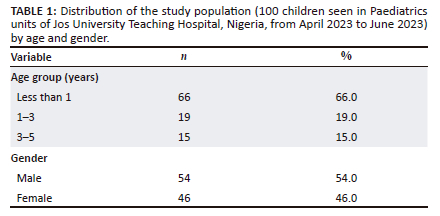
One hundred children participated in this study (Table 1). Two-thirds (66/100) were aged less than 1 year. There were slightly more boys (n = 54/100) than girls (n = 46/100).
Mean erythrocyte glucose-6-phosphate dehydrogenase activity of the children
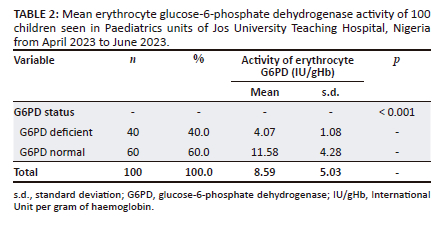
Forty patients (40%) were G6PD deficient, with a mean G6PD activity of 4.07 IU/gHb ± 1.08 IU/gHb, while 60 (60%) had normal G6PD activity, with a mean of 11.58 IU/gHb ± 4.28 IU/gHb (p < 0.001) (Table 2).
Erythrocyte glucose-6-phosphate dehydrogenase status distribution by gender of the children
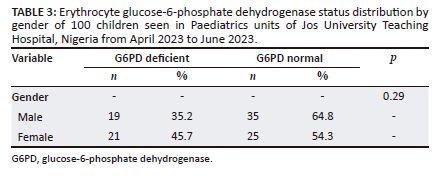
Fifty-four (54%) of the 100 children were male. Of the 40 G6PD-deficient children, 19 (n = 19/40) were male (p = 0.29) (Table 3).
Mean activity of erythrocyte glucose-6-phosphate dehydrogenase by age and gender of the children
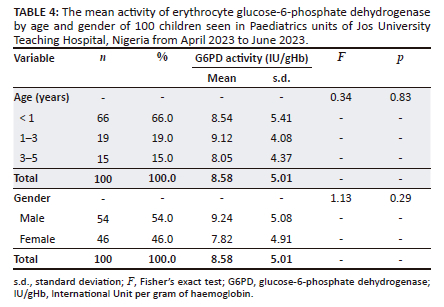
Mean G6PD activity was non-significantly (p = 0.83) higher among the children aged 1 to 3 years compared to the other age groups, and lower (p = 0.29) among the female patients (7.82 IU/gHb ± 4.91 IU/gHb) compared to the male patients (9.24 IU/gHb ± 5.08 IU/gHb). Glucose-6-phosphate dehydrogenase activity was non-significantly associated with both age and gender (F = 0.34, p = 0.83 [age]; F = 1.13, p = 0.29 [gender]) (Table 4).
Prevalence of glucose-6-phosphate dehydrogenase deficiency-induced anaemia in the children
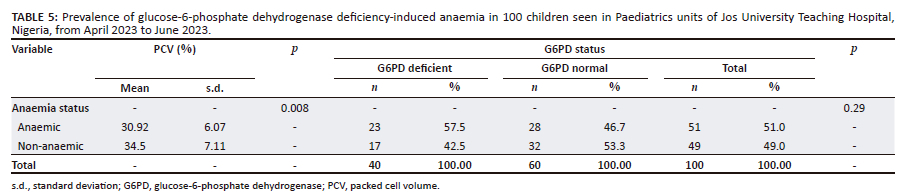
Mean packed cell volume was lower in anaemic children (30.92% ± 6.07%) compared to non-anaemic children (34.50% ± 7.11%), which was statistically significant (p = 0.008). Glucose-6-phosphate dehydrogenase deficiency-induced anaemia was found in 23 (57.5%) of the children, while 28 (46.7%) of the anaemic children were non-G6PD deficiency induced. Seventeen (42.5%) of G6PD-deficient children were not anaemic and 32 (53.3%) children with normal G6PD activity had normal packed cell volume values (p = 0.29) (Table 5).
Parental level of knowledge of glucose-6-phosphate dehydrogenase deficiency by glucose-6-phosphate dehydrogenase activity of children
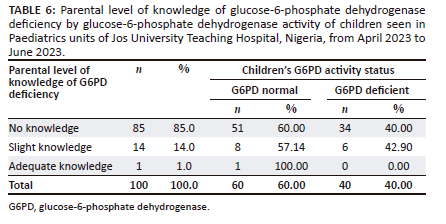
Thirty-four (40%) children of 85 parents who had no knowledge of G6PD and its deficiency were G6PD deficient. Six children of 14 parents who had slight knowledge of G6PD were G6PD deficient (Table 6).
Discussion
We report the prevalence of erythrocyte G6PD deficiency-induced anaemia in children in a tertiary hospital setting in North-Central Nigeria. From this study, there was a high (40%) prevalence of G6PD deficiency, with a mean G6PD activity score of 4.07 IU/gHb ± 1.08 IU/gHb for G6PD-deficient children. Glucose-6-phosphate dehydrogenase deficiency was not age- or gender-dependent (p = 0.83 [age]; p = 0.29 [gender]). Forty (40%) of the children were anaemic and 23 (57.5%) had G6PD deficiency-induced anaemia.
The high prevalence of G6PD deficiency observed in this study is similar to that (40.7%, and mean 3.79 IU/gHb ± 1.37 IU/gHb) reported by Jatau et al. in 2019,11141516Plasmodium spp.) is vulnerable to oxidative damage. The altered red blood cells in G6PD-deficient individuals create an inhospitable environment for the parasite, making it more difficult for the parasite to survive and reproduce. As a result, individuals with G6PD deficiency have a reduced risk of developing severe forms of malaria caused by P. falciparum. This selective advantage has contributed to a higher prevalence of G6PD deficiency in regions where malaria is endemic.1
In addition, G6PD deficiency was neither age nor gender-dependent in this study. Glucose-6-phosphate dehydrogenase deficiency is an X-linked disorder, where the enzyme deficiency occurs more in male than in female individuals, because the males only have one X-chromosome when compared to the females, who have two X-chromosomes.11181913
Also, in this study it was observed that there was a non-significant (p = 0.83) increase in serum G6PD activity from 8.54 IU/gHb ± 5.41 IU/gHb in children less than 1 year to 9.12 IU/gHb ± 4.08 IU/gHb as age increased between 1 and 3 years; however, there was a decrease in the activity (8.58 IU/gHb ± 5.01 IU/gHb) with further rise in age. Age was noted not to have a significant (F = 0.34, p = 0.83) effect on G6PD activity. This implies that G6PD deficiency does not depend on age, as was also noted by Iheanacho et al.1812
There was a high (57.5%) prevalence of G6PD-induced anaemia among children attending Jos University Teaching Hospital, Nigeria. Anaemia is one of the major causes of paediatric death and can affect a child's mental, physical, and social development. With the decrease in iron levels, it can lead to poor cognitive function, thus negatively affecting a child's academic performance and further complications in later life.920
This study also showed a poor level of awareness of G6PD and its deficiency among the people, as almost 99% of them had either 'no' or 'slight' knowledge of G6PD and its deficiency before enlightenment talks from the research team. This tallies with the report of Williams et al.,21
Limitation of the study
The limitations of this study include small sample size and recall bias, which is inherent in this type of study. Also, because of financial restrictions, we were not able to conduct a molecular analysis of G6PD. This could have helped to differentiate the G6PD genotypes.
Conclusion
There is a high prevalence of G6PD deficiency and G6PD deficiency-induced anaemia among the children in this study, and a very poor level of awareness of this defect among the parents and guardians. This could suggest the need to screen children, especially neonates, for G6PD deficiency, to allow for early detection of this abnormality.
Competing interests
The authors declare that they have no financial or personal relationships that may have inappropriately influenced them in writing this article.
Authors' contributions
J.D.N. was involved in data collection, sample collection, laboratory analysis, and write-up of the original draft. C.A.O. conceptualised the study, supervised it, validated the methods and results, was involved in statistical analysis and interpretation, and was involved in editing and reviewing the article.
Sources of support
This research received no specific grant from any funding agency in the public, commercial, or not-for-profit sectors.
Data availability
The data that support the findings of this study are available on request from the corresponding author, C.A.O.
Disclaimer
The views and opinions expressed in this article are those of the authors and are the product of professional research. The article does not necessarily reflect the official policy or position of any affiliated institution, funder, agency, or that of the publisher. The authors are responsible for this article's results, findings, and content.
Acknowledgements
We acknowledge the tremendous assistance received from the staff of the Paediatric clinic and units in the course of sample collection for this study. Our special thanks go to Mr Philip Lekshak, Mr Bitrus for helping in the sample collection, Mrs Gladys for helping to organise the patients, Mrs Hope Zanko for running the laboratory analysis, Mr Ishaya Zhakom and Mr Deffi Favour for being involved in statistical analysis and interpretation and Prof. James Adisa for reviewing and editing the work. This article is partially based on the author's undergraduate research project entitled 'Cross sectional study on the prevalence of erythrocyte glucose-6 phosphate dehydrogenase activity in children attending Jos University Teaching Hospital' towards the degree of Bachelor of Medical Laboratory Science in the Department of Medical Laboratory Science, University of Jos, Nigeria, on 13 August 2023, with supervisor Dr Caroline Amuche Okoli.
References
-
1. Muzaffar IH, Boundaqji KR, Khatib HA, et al. An overview of the most common enzyme defect, glucose-6-phosphate-dehydrogenase deficiency. EJHM. 2018;70(1):102-108. https://doi.org/10.12816/0042970
» https://doi.org/10.12816/0042970 - 2. World Health Organization. Screening for G6PD deficiency in children and neonates in malaria-endemic regions. Geneva: WHO; 2019.
-
3. Howes RE, Dewi M, Piel FB, et al. Spatial distribution of G6PD deficiency variants across malaria-endemic regions. Malar J. 2013;12(1):1-15. https://doi.org/10.1186/1475-2875-12-418
» https://doi.org/10.1186/1475-2875-12-418 -
4. Eyo-Ita EU, Ogunsanya B, Osazee EM, Eyo-Ita IA, Omoigberale A. Glucose-6-phosphate dehydrogenase deficiency in a Nigerian neonate with acute bilirubin encephalopathy triggered by ciprofloxacin. J Med Case Rep Case Series. 2023;4(13). https://doi.org/10.38207/JMCRCS/2023/AUG04130385
» https://doi.org/10.38207/JMCRCS/2023/AUG04130385 -
5. World Health Organization. Haemoglobin concentration for the diagnosis of anaemia and assessment of severity [homepage on the Internet]. Vitamin and mineral nutrition information system. WHO/NMH/NHD/MNM/11.1. Geneva: World Health Organization; 2011 [cited 2025 Jan 20]. Available from: https://www.who.int/publications/i/item/WHO-NMH-NHD-MNM-11.1
» https://www.who.int/publications/i/item/WHO-NMH-NHD-MNM-11.1 -
6. Pferffer M, Daniel A, Ley B, et al. Quantification of glucide-6 phosphste dehydrogensr ctivity by spectrophotometry: A systematic review and meta-analysis. PLoS Med. 2020;17(5):1003084. https://doi.org/10.1371/journal.pmed.1003084
» https://doi.org/10.1371/journal.pmed.1003084 -
7. Pengboon P, Thamwarokun A, Changsri K, Kaset C, Chomean S. Evaluation of quantitative biosensor for glucose-6-phosphate dehydrogenase activity detection. PLoS One. 2019;14(12):226-927. https://doi.org/10.1371/journal.pone.0226927
» https://doi.org/10.1371/journal.pone.0226927 -
8. Eziokwu AS, Angelini D. New diagnosis of G6PD deficiency presenting as severe International Journal of Healthcare Sciences ISSN 2348-5728 (Online) rhabdomyolysis. Cureus. 2018;10(3):1-4. https://doi.org/10.7759/cureus.2387
» https://doi.org/10.7759/cureus.2387 -
9. Mann DM, Swahn MH, McCool S. Undernutrition and malaria among under-five children: Findings from the 2018 Nigeria demographic and health survey. Pathog Glob Health. 2021;115:423-433. https://doi.org/10.1080/20477724.2021.1916729
» https://doi.org/10.1080/20477724.2021.1916729 - 10. Thrustfield M. Veterinary epidemiology. 2nd ed. Oxford: Blackwell Science Ltd.; 1995, p. 178-198.
-
11. Jatau E, Toma O, Egesie O, et al. Glucose-6-phosphate dehydrogenase activity in newborn in Jos: A necessary evaluation for icteric neonates. J Biomed Res Clin Pract. 2019;2(4):191-196. https://doi.org/10.46912/jbrcp.127
» https://doi.org/10.46912/jbrcp.127 -
12. Luzzatto L, Ally M, Notaro R. Glucose-6-phosphate dehydrogenase deficiency. Blood. 2020;136(11):1225-1240. https://doi.org/10.1182/blood.2019000944
» https://doi.org/10.1182/blood.2019000944 -
13. Cappellini MD, Fiorelli G. Glucose-6-phosphate dehydrogenase deficiency. Lancet. 2008;371(9606):64-74. https://doi.org/10.1016/S0140-6736(08)60073-2
» https://doi.org/10.1016/S0140-6736(08)60073-2 - 14. Uko EK, Agwunobi SN, Udoh JJ. Glucose-6-phosphate dehydrogenase levels in jaundiced neonates in Calabar. Niger J Med. 2003;2:98-102.
-
15. National Malaria Elimination Programme (NMEP), National Population Commission (NPopC), National Bureau of Statistics (NBS), and ICF International. Nigeria Malaria Indicator Survey 2015. Abuja, Nigeria, and Rockville, Maryland, USA: NMEP, NPopC, and ICF International. 2016. [cited 2025 Jun 02]. Available from: https://www.nigerianstat.gov.ng/pdfuploads/MIS20.pdf
» https://www.nigerianstat.gov.ng/pdfuploads/MIS20.pdf - 16. Jeremiah Z, Jeremiah T, Emelike F. Frequencies of some human genetic markers and their association with Plasmodium falciparum malaria in the Niger Delta, Nigeria. J Vector Borne Dis. 2010:47(1):11.
-
17. Taleb M, Brahim AT, Yebouk C, et al. Epidemiology of glucose-6-phosphate dehydrogenase deficiency in 10 malaria-endemic countries in sub-Saharan Africa: A systematic review. Pan Afr Med J. 2025;50:7. https://doi.org/10.11604/pamj.2025.50.7.45066
» https://doi.org/10.11604/pamj.2025.50.7.45066 - 18. Iheanacho C, Etuka C, Ugwu BK, Nnanna O. Glucose-6-phosphate dehydrogenase deficiency in children at Vwang Village, Vom, Jos South, Plateau State, Nigeria. IJHS. 2017;5(1):588-593.
-
19. Albagshi MH., Alomran S, Sloma S, Alsuweel A, Alkhalaf H. Prevalence of glucose-6-phosphate dehydrogenase deficiency among children in Eastern Saudi Arabia. Cureus. 2020;12(10):1-3. https://doi.org/10.7759/cureus.11235
» https://doi.org/10.7759/cureus.11235 - 20. Morsy N, Alhady S. Nutritional status and socio-economic conditions influencing prevalence of anaemia in pregnant women. IJSTR. 2014;3(7):54-60.
-
21. Williams O, Gbadero D, Eduwnorum G, Brearkey A, Shasher T, Clundu T. Glucose-6-phosphate dehydrogenase deficiency in Nigeria children. PLoS One. 2013;8(7):e68800. https://doi.org/10.1371/journal.pone.0068800
» https://doi.org/10.1371/journal.pone.0068800

Accepted: 24 June 2025
Published: 14 Oct. 2025