Association between coagulation indicators and menorrhagia among women in Kenya
Abstract
BACKGROUND: Despite the significant burden of menorrhagia (bleeding > 80 mL every menstrual cycle) among women in Western Kenya, it remains unknown whether coagulation disorders are an important underlying cause of this condition in the region OBJECTIVE: This study assessed differences in coagulation profiles, associations between menorrhagia and coagulation profiles and compared morphological features of platelets among women attending Bungoma County Referral Hospital in Kenya METHODS: A comparative cross-sectional study of women with and without menorrhagia, aged 18-45 years, was performed between December 2022 and September 2023. Sociodemographic factors, prothrombin time (PT), activated partial thromboplastin time, thrombin time, fibrinogen, international normalised ratio (INR), and platelet count were compared between groups, and associations with menorrhagia were assessed. Prothrombin time and INR levels above normal references were deemed increased RESULTS: A total of 428 (214 per group) women were included. Family history of bleeding disorders (p < 0.0001) was more frequent in menorrhagic than in non-menorrhagic women. Additionally, menorrhagic women had high PT (p < 0.0001) and high INR (p < 0.0001) levels. Menorrhagia was significantly associated with an increased PT (odds ratio = 2.129, 95% confidence interval = 1.658-2.734; p < 0.0001) and increased INR (odds ratio = 7.479, 95% confidence interval = 3.094-18.080; p < 0.0001 CONCLUSION: In this population in Western Kenya, menorrhagia was associated with a family history of bleeding disorders, increased PT, and increased INR. Routine assessment of the coagulation profile and family history of bleeding disorders is crucial for diagnosing and managing menorrhagia WHAT THIS STUDY ADDS: Our findings suggest that menorrhagic and non-menorrhagic women differ in terms of PT and INR, which may be predictive of menorrhagia.
menorrhagia; coagulation; profile; women; Kenya
Introduction
Menorrhagia is defined as heavy menstrual bleeding that exceeds 80 mL per cycle.123
Menorrhagia is a diagnosable ailment that needs to be treated to improve the quality of life of affected women,4567
An international expert panel in obstetrics, gynaecology, and haematology made recommendations on the best ways to manage menorrhagia in women without a known bleeding disorder.8910111213141516
Methods
Ethical considerations
The study was approved by the Maseno University Scientific and Ethical Review Committee (reference number MUSERC/01166/22), and the authority to carry out the research was granted by the National Commission for Science, Technology, and Innovation (reference number NACOSTI/P/22/22573). Bungoma County Referral Hospital (reference number BDH/TP/B/VOL2) provided permission to perform the study. Each participant provided written informed consent after a brief explanation of the study. Measures taken to secure data included a password on the computer used and protected physical space. Protocol numbers were assigned, and personal information was collected from the participants in a confidential manner and utilised solely for the purpose of the study.
Study area
The study was conducted at BCRH in Bungoma County, in Western Kenya, between December 2022 and September 2023. Bungoma County Referral Hospital is a level 5 hospital located within the headquarters of Bungoma County and is the main referral health facility for Bungoma County and its soundings, serving a population of 1 670 570 across an area of 2206.9 km217
Study design and population
This study used a comparative cross-sectional design. The sample size formula for a quantitative comparative survey18
Inclusion criteria
The study recruited adult women between the reproductive ages of 18 years and 45 years. The study included women who visited the clinic with complaints of menorrhagia. The comparison group consisted of healthy women picked at random. A qualified gynaecologist determined menorrhagia in each patient and established the clinical diagnosis based on the definition of menorrhagia as menstruation at regular cycle intervals but with excess flow (more than 80 mL of blood loss per cycle or requiring more frequent than 2 h changes of hygiene products) and/or duration (> 7 days).19
Exclusion criteria
Women who experienced menorrhagia due to known causes, such as uterine fibroids or intrauterine contraception, were excluded from the study. Women with other known disorders that may alter coagulation parameters were excluded. Women who were found to be using any anticoagulants, as determined by a thorough clinical history by qualified clinicians, were also ineligible. Patients who had taken sylate or tranexamic acid within the previous 3 months, as well as other drugs known to manage bleeding difficulties, were ineligible.
Sample and data collection
Using a screening procedure as used before,20
The phlebotomy order of drawing blood using evacuated tubes was blood collection in sodium citrate, followed by blood collection in ethylenediaminetetraacetic acid. For the coagulation profile, whole blood was collected from the participant's arm by a qualified phlebotomist and put in a vacuum tube containing 3.2% sodium citrate (Becton, Dickinson and Company Corporate, Franklin Lakes, New Jersey, US), to ensure a 9:1 dilution of blood to the anticoagulant for prothrombin time (PT), international normalised ratio (INR), activated partial thromboplastin time (aPTT), thrombin time (TT) and fibrinogen tests. Thereafter, the participant's distinctive identifying number tube was affixed to the tube. The sample(s) were delivered to the laboratory immediately after collection and spun for 5 min at 4000 rpm to ensure that the samples were platelet poor within 4 h. The separated samples were stored at 2°C - 8°C for 24 h if not tested immediately. The lyophilised coagulation test control materials (HUMAN Gesellschaft fur Biochemica and Diagnostica mbH, Wiesbaden, Germany) were reconstituted following the manufacturer's instructions. For platelets count and morphology, whole blood was collected in a vacuum tube with ethylenediaminetetraacetic acid (Becton, Dickinson and Company Corporate, Franklin Lakes, New Jersey, US), immediately inverted gently 8-9 times, and labeled with a unique study number. Thin blood films for performing reflex testing when the analyser results were flagged and determining the platelet cell morphology were immediately prepared and fixed using absolute ethanol (Sigma-Aldrich, St. Louis, Missouri, US). The lyophilised control materials (HUMAN Gesellschaft fur Biochemica and Diagnostica mbH, Wiesbaden, Germany) were brought to room temperature and mixed well according to the manufacturer's instructions before testing.
Laboratory analyses
Coagulation profile parameters, including PT, aPTT, TT, fibrinogen, and the INR, were tested using a Humaclot Junior semiautomated coagulation analyser (HUMAN Gesellschaft fur Biochemica and Diagnostica mbH, Wiesbaden, Germany) as used previously.212223
For interpretation purposes, the reference ranges for the coagulation profile of adult women were adopted from the BCRH Laboratory as follows: PT: 11.0-12.5 s; aPTT: 30-40 s; TT: 15-19 s; fibrinogen: 200-400 mg/dL; and INR: 1.1 or less. The samples were examined at the same time as both abnormal and normal control plasma.
A Celtac F, MEK-8222 K analyser (NIHON KOHDEN Corporation, Tokyo, Japan), as described previously,249
The morphology of the thrombocytes was evaluated using Leishman-stained blood films and OlympusTM optical light compound microscopy (Olympus Global, Tokyo, Japan), as described previously,25
Data analysis
Microsoft Excel sheets (Microsoft Corporation, Redmond, Washington, US) were used to store the data. The Statistical Package for Social Science (SPSS V.26) (IBM Corporation, Armonk, New York, US) was used for the analysis. The Shapiro-Wilk test was used to check for normality, and histograms and box plots were generated to verify the normality of the distribution of the data. The chi-square test was used to analyse categorical descriptive data that included residence, parity, occupation, family history of bleeding disorders, history of bleeding or gum bleeding, history of extended bleeding following tooth extraction, postoperative extended bleeding and history of prolonged bleeding following delivery or miscarriage. The Mann‒Whitney U test was used to compare coagulation profiles between menorrhagic and non-menorrhagic women, as the data were not normally distributed. Since the current study included a categorical dependent variable, binary logistic regression was used to predict the association between menorrhagia and coagulation parameters. The platelet morphological characteristics are presented as frequencies and percentages. The frequency, median, and dispersion of the descriptive statistics were shown. For all analyses, statistical significance was established at p ≤ 0.05.
Results
Demographic characteristics of the study population
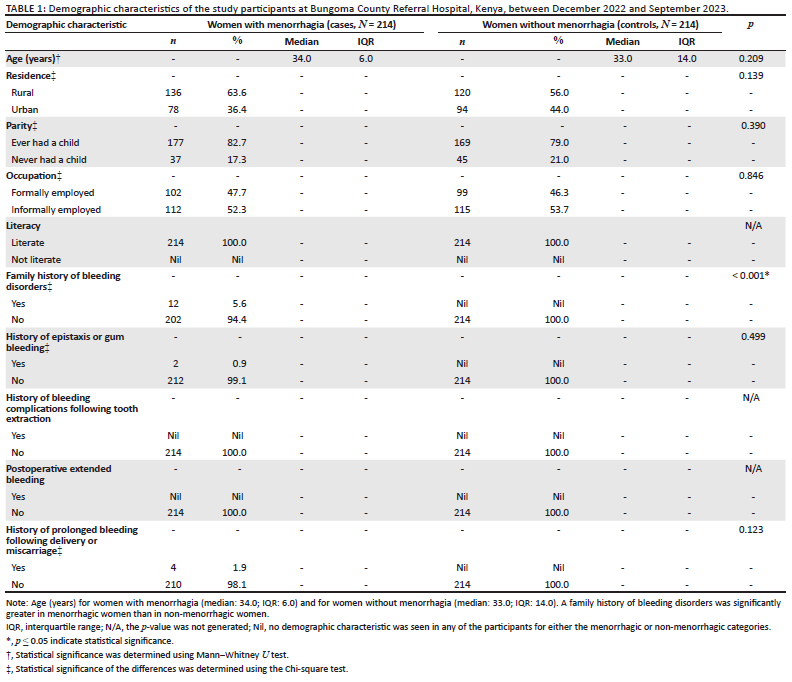
A total of 428 adult women between the ages of 18 years and 45 years (median [Interquartile range]: 33.5 [11.0] years) participated in the study (Table 1). There were 214 menorrhagic patients and an equal number of non-menorrhagic healthy women. Participants did not differ with respect to place of residence in urban or rural location (p = 0.139), parity (p = 0.390), occupation (p = 0.846), history of epistaxis or gum bleeding (p = 0.499), and history of prolonged bleeding following delivery or miscarriage (p = 0.123) (Table 1). Menorrhagic women (n = 12/214; 5.6%) were more likely than non-menorrhagic women (n = 0/214; 0%) to have a family history of bleeding disorders (p < 0.001) (Table 1).
Comparison of coagulation profiles between menorrhagic and non-menorrhagic women
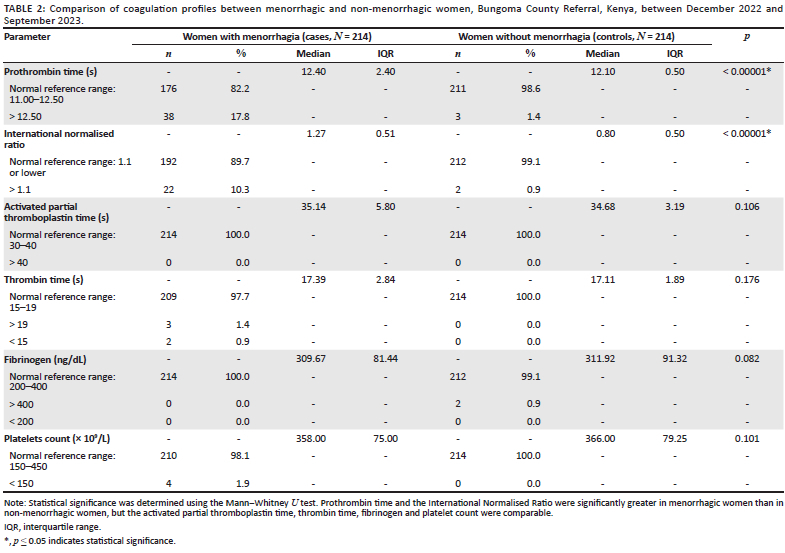
Menorrhagic women (n = 38/214; 17.8%) were more likely to have increased PT than non-menorrhagic women (n = 3/214; 1.4%) (p < 0.0001) (Table 2). Menorrhagic women (n = 22/214; 10.3%) were more likely to have increased INR than non-menorrhagic women (n = 2/214; 0.9%) (p < 0.0001) (Table 2). Both menorrhagic and non-menorrhagic women showed no difference in terms of aPTT (p = 0.106), TT (p = 0.176), fibrinogen (p = 0.082) and platelet count (p = 0.101) (Table 2).
Association between coagulation profile and menorrhagia
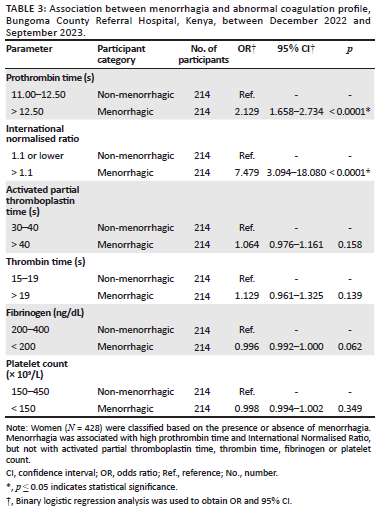
Menorrhagia was associated with increased PT (odds ratio [OR] = 2.129, 95% confidence interval [CI] = 1.658 - 2.734; p < 0.0001) and increased INR (OR = 7.479, 95% CI = 3.094-18.080; p < 0.0001) (Table 3). Menorrhagia was not associated with aPTT (OR = 1.064, 95% CI = 0.976-1.161; p = 0.158), TT (OR = 1.129, 95% CI = 0.961-1.325; p = 0.139), fibrinogen (OR = 0.996, 95% CI = 0.992-1.000; p = 0.062), or platelet count (OR = 0.998, 95% CI = 0.994-1.002; p = 0.349) (Table 3).
Comparison of morphological characteristics of platelets between menorrhagic and non-menorrhagic women
In both menorrhagic and non-menorrhagic women, there were no morphologic differences in the platelets.
Discussion
In this study, menorrhagic women were more likely to have a family history of bleeding disorders than non-menorrhagic women. Menorrhagic women had statistically significant increases in PTs and INRs compared with non-menorrhagic women, and menorrhagia had a statistically significant association with increased PT and INR. The demographic characteristics of the study participants were comparable between the two groups in terms of age, place of residence, parity, occupation, and literacy; however, menorrhagic women had no family history of bleeding disorders, while 5.6% of the menorrhagic women had a bleeding history of bleeding disorders. Due to the age range in this study, the median age of 34 years for menorrhagic women compared to 33 years of non-menorrhagic women was higher than those obtained in previous studies conducted in Sudan, India and Turkey.26,27,28
The residential areas of menopausal women (rural or urban) were not substantially different from those of non-menorrhagic women in the present study, which was similar to the findings of a study performed in Tanzania and published in 2023.2929
The present study found that whereas menorrhagic women were more likely to have a family history of bleeding disorders, almost three times as many menorrhagic women did not have a family history of bleeding disorders. None of the non-menorrhagic women had a family history of bleeding disorders. These findings are consistent with studies performed in Egypt, published in March 2014,30263128323334
The present study revealed that a history of epistaxis or gum bleeding in menorrhagic women was comparable to that in non-menorrhagic women; however, 0.9% of menorrhagic women had a history of epistaxis or gum bleeding. Additionally, the study showed that the history of prolonged bleeding following delivery or miscarriage in menorrhagic women and non-menorrhagic women was comparable; however, 1.9% of menorrhagic women had a history of prolonged bleeding following delivery or miscarriage. These findings agree with studies performed in South Sudan, published in December 2015,262828
In the current investigation, the PT and INR were considerably greater in menorrhagic women than in non-menorrhagic women and were associated with menorrhagia, but the aPTT was comparable between the two groups and was not associated with menorrhagia. This was consistent with the results of a research done in Sudan, published in December, 2015,2627143536373838
In the present study, TT, fibrinogen and platelet count were comparable in menorrhagic and non-menorrhagic women and were not associated with menorrhagia. Patients with dysfibrinogenaemia can also experience combined haemorrhagic and thrombotic tendencies.3940414142
Despite the current data indicating comparable platelet counts in menorrhagic and non- menorrhagic women, it is important to highlight that platelet count, size, and morphology are usually normal in individuals with Glanzmann thrombasthaenia, a hereditary qualitative condition that affects platelet function through failure of aggregation and others hereditary conditions.4344
Overall, the PT, INR, and family history of bleeding disorders, among other parameters, should be evaluated in menorrhagic women as soon as possible to better understand the coagulation profile and diagnose this life-threatening condition so that prompt treatment can be provided. A more accurate classification of menorrhagia would most likely result in the identification of a broader range of characteristics that could indicate haemostatic diseases or other aetiologies.
Recommendations
The study recommends that women who experience heavy menstrual bleeding have a coagulation profile, as well as a family history of bleeding and history of bleeding disorders other than menorrhagia assessed. This approach allows for a more accurate diagnosis of menorrhagia based on the identified coagulation hallmark indicators.
Limitations
The study was limited in that we did not assess von Willebrand factor, which is known to affect coagulation. Furthermore, the study did not perform platelet aggregometry as platelet function test to measure platelet response or aggregation to a panel of antagonists such as collagen, and did not measure vitamin K-dependent factors due to a lack of equipment at the laboratory and financial constraints. A longitudinal study with a larger sample size could help to close the knowledge gap in determining and interpreting such an association.
Conclusion
In this study, a family history of bleeding disorders was present in some menorrhagic but not in non-menorrhagic women. Prothrombin time and INR were both increased among menorrhagic compared with non-menorrhagic women, and were associated with menorrhagia. Thus, family history of bleeding disorders, PT and the INR, which are coagulation parameters, may contribute to the aetiology of menorrhagia.
Competing interests
The authors declare that they have no financial or personal relationships that may have inappropriately influenced them in writing this article.
Authors' contributions
P.M.M., S.K.M., P.M.K., and C.O. planned the study and participated in all areas. S.K.M., P.M.K., and C.O. oversaw the study. P.M.M. and F.M. conducted the data analysis and developed the manuscript. S.K.M., P.M.K., and C.O. reviewed the manuscript for philosophical insights. P.M.M., S.K.M., P.M.K., C.O. and F.M. reviewed the final manuscript and approved it for submission.
Sources of support
This research received no specific grant from any funding agency in the public, commercial or not-for-profit sectors.
Data availability
The data that support the findings of this study are not openly available due to ethical reviewing guidelines and are available from the corresponding author, P.M.M., upon reasonable request.
Disclaimer
The views and opinions expressed in this article are those of the authors and are the product of professional research. It does not necessarily reflect the official policy or position of any affiliated institution, funder, agency, or that of the publisher. The authors are responsible for this article's results, findings, and content.
Acknowledgements
Leonard Lusenaka contributed to the recruitment of the participants. Thomas Wekesa contributed by performing the sample collection exercise. Antony Sangolo and Emmanuel Khisa assisted in the operation of the samples and the data collection. The authors acknowledges the following preprint.45
References
-
1. Magnay JL, O'Brien S, Gerlinger C, Seitz C. A systematic review of methods to measure menstrual blood loss. BMC Womens Health. 2018;18(1):142. https://doi.org/10.1186/s12905-018-0627-8
» https://doi.org/10.1186/s12905-018-0627-8 -
2. Gokyildiz S, Aslan E, Beji NK, Mecdi M. The effects of menorrhagia on women's quality of life: A case-control study. ISRN Obstet Gynecol. 2013;2013:918179. https://doi.org/10.1155/2013/918179
» https://doi.org/10.1155/2013/918179 -
3. Cooper K, Breeman S, Scott NW, et al. Laparoscopic supracervical hysterectomy versus endometrial ablation for women with heavy menstrual bleeding (Health): A parallel-group, open-label, randomised controlled trial. Lancet. 2019;394(10207):1425-1436. https://doi.org/10.1016/S0140-6736(19)31790-8
» https://doi.org/10.1016/S0140-6736(19)31790-8 -
4. Yusuf L. Menorraghia's impact on quality of life: A case control study from a teaching Hospital in Lahore. Pak J Med Sci. 2018;34(6):1435-1438. https://doi.org/10.12669/pjms.346.15410
» https://doi.org/10.12669/pjms.346.15410 -
5. Chodankar R, Critchley HOD. Biomarkers in abnormal uterine bleeding. Biol Reprod. 2019;101(6):1155-1166. https://doi.org/10.1093/biolre/ioy231
» https://doi.org/10.1093/biolre/ioy231 -
6. LaPelusa A, Dave HD. Physiology, hemostasis [homepage on the Internet]. Treasure Island, FL: StatPearls Publishing; 2023 [cited 2023 Sept 28]. Available from: http://www.ncbi.nlm.nih.gov/books/NBK545263/
» http://www.ncbi.nlm.nih.gov/books/NBK545263/ -
7. Chaudhry R, Usama SM, Babiker HM. Physiology, coagulation pathways [homepage on the Internet]. Treasure Island, FL: StatPearls Publishing; 2022 [cited 2022 Apr 16]. Available from: http://www.ncbi.nlm.nih.gov/books/NBK482253/
» http://www.ncbi.nlm.nih.gov/books/NBK482253/ -
8. James AH, Kouides PA, Abdul-Kadir R, et al. Evaluation and management of acute menorrhagia in women with and without underlying bleeding disorders: Consensus from an international expert panel. Eur J Obstet Gynecol Reprod Biol. 2011;158(2):124-134. https://doi.org/10.1016/j.ejogrb.2011.04.025
» https://doi.org/10.1016/j.ejogrb.2011.04.025 -
9. Shaw J. Menorrhagia: Practice essentials, background, pathophysiology [homepage on the Internet]. 2023 [cited 2023 Sept 28]. Available from: https://emedicine.medscape.com/article/255540-overview
» https://emedicine.medscape.com/article/255540-overview -
10. Zia A, Jain S, Kouides P, et al. Bleeding disorders in adolescents with heavy menstrual bleeding in a multicenter prospective US cohort. Haematologica. 2020;105(7):1969-1976. https://doi.org/10.3324/haematol.2019.225656
» https://doi.org/10.3324/haematol.2019.225656 -
11. O'Brien S. Evaluation and management of heavy menstrual bleeding in adolescents: The role of the hematologist. Blood. 2018;132:blood-2018. https://doi.org/10.1182/blood-2018-05-848739
» https://doi.org/10.1182/blood-2018-05-848739 -
12. Livanou ME, Matsas A, Valsami S, Papadimitriou DT, Kontogiannis A, Christopoulos P. Clotting factor deficiencies as an underlying cause of abnormal uterine bleeding in women of reproductive age: A literature review. Life. 2023;13(6):1321. https://doi.org/10.3390/life13061321
» https://doi.org/10.3390/life13061321 -
13. Ping D, Bergamasco A, Moride Y, Truong Berthoz F, Özen G, Tzivelekis S. Von Willebrand disease epidemiology, burden of illness and management: A systematic review. J Blood Med. 2023;14:189-208. https://doi.org/10.2147/JBM.S389241
» https://doi.org/10.2147/JBM.S389241 -
14. Amesse LS, Pfaff-Amesse T, Gunning WT, Duffy N, French JA. Clinical and laboratory characteristics of adolescents with platelet function disorders and heavy menstrual bleeding. Exp Hematol Amp Oncol. 2013;2(1):3. https://doi.org/10.1186/2162-3619-2-3
» https://doi.org/10.1186/2162-3619-2-3 -
15. Mutakha GS, Mwaliko E, Kirwa P. Clinical bleeding patterns and management techniques of abnormal uterine bleeding at a teaching and referral hospital in Western Kenya. PLoS One. 2020;15(12):e0243166. https://doi.org/10.1371/journal.pone.0243166
» https://doi.org/10.1371/journal.pone.0243166 - 16. Bungoma County Referral Hospital. Bungoma County Referral Hospital gynaecology register [unpublished data]. 2020.
-
17. Kenya National Bureau Statistics. Population and housing census [homepage on the Internet]. 2019 [cited 2024 Jan 16]. Available from: https://www.knbs.or.ke/2019-kenya-population-and-housing-census-results
» https://www.knbs.or.ke/2019-kenya-population-and-housing-census-results -
18. Charan J, Biswas T. How to calculate sample size for different study designs in medical research? Indian J Psychol Med. 2013;35(2):121-126. https://doi.org/10.4103/0253-7176.116232
» https://doi.org/10.4103/0253-7176.116232 -
19. Walker MH, Coffey W, Borger J. Menorrhagia [homepage on the Internet]. Treasure Island, FL: StatPearls Publishing; 2022 [cited 2022 Apr 26]. Available from: http://www.ncbi.nlm.nih.gov/books/NBK536910/
» http://www.ncbi.nlm.nih.gov/books/NBK536910/ -
20. Philipp C, Faiz A, Byams V, et al. Screening tool for bleeding disorders in women with menorrhagia: Evaluation in a prospective US multi-site cohort. Blood. 2008;112(11):1237. https://doi.org/10.1182/blood.V112.11.1237.1237
» https://doi.org/10.1182/blood.V112.11.1237.1237 - 21. George L, Lambert M. Coagulation cascade and fibrinolysis pathway: Assessment in the laboratory. In: Abutalib SA, Ragni MV, editors. Nonmalignant hematology: Expert clinical review: Questions and answers. Philadelphia: Springer International Publishing, 2016; p. 221-233.
-
22. Mohammadi Aria M, Erten A, Yalcin O. Technology advancements in blood coagulation measurements for point-of-care diagnostic testing. Front Bioeng Biotechnol. 2019;7:395. https://doi.org/10.3389/fbioe.2019.00395
» https://doi.org/10.3389/fbioe.2019.00395 - 23. Ameri M, Schnaars HA, Sibley JR, Honor DJ. Determination of plasma fibrinogen concentrations in beagle dogs, cynomolgus monkeys, New Zealand white rabbits, and Sprague-Dawley rats by using clauss and prothrombin-time-derived assays. J Am Assoc Lab Anim Sci. 2011;50(6):864-867.
-
24. Kondo H, Akiyama T, Tatsumi N, Nagai Y. Performance evaluation of the complete blood count and white blood cell differential parameters obtained using a Celltac F automated hematology analyzer. Aboratory Hematol off Publ Int Soc Lab Hematol. 2004;10(1):3-13. https://doi.org/10.1532/LH96.03053
» https://doi.org/10.1532/LH96.03053 -
25. Latger-Cannard V, Fenneteau O, Salignac S, Lecompte TP, Schlegel N. Platelet morphology analysis. Methods Mol Biol Clifton NJ. 2013;992:207-225. https://doi.org/10.1007/978-1-62703-339-8_16
» https://doi.org/10.1007/978-1-62703-339-8_16 - 26. Mohamedahmed K, Shatha A, Sayedahmed, Alrayan Y, Alsaeed. Evaluation effects of menorrhagia in coagulation profile (PT, INR, PTT, and platelets count) in Sudanese females. Eur Acad Res. 2015;3:10317.
- 27. Prasad HLK, Manjunatha HK, Ramaswamy A, et al. Adolescent menorrhagia: Study of the coagulation profile in a tertiary centre in South India. J Clin Diagn Res. 2011;5:1589-1592.
-
28. Çakı Kılıç S, Sarper N, Zengin E, Aylan Gelen S. Screening bleeding disorders in adolescents and young women with menorrhagia. Turk J Hematol. 2013;30(2):168-176. https://doi.org/10.4274/Tjh.2011.0048
» https://doi.org/10.4274/Tjh.2011.0048 -
29. Ibrahim PM, Samwel EL. Prevalence of heavy menstrual bleeding and its associated factors among women attending Kilimanjaro Christian Medical Centre in Northern Eastern, Tanzania: A cross-sectional study. East Afr Health Res J. 2023;7(1):1. https://doi.org/10.24248/eahrj.v7i1.702
» https://doi.org/10.24248/eahrj.v7i1.702 -
30. Sherif N, Goubran H, Hassan A, Burnouf T, El-Ekiaby M. An approach to outreach patients with von Willebrand disease in Egypt by targeting women with heavy menstrual bleeding and/or bleeding symptoms. Haemoph Off J World Fed Hemoph. 2014;20(2):238-243. https://doi.org/10.1111/hae.12335
» https://doi.org/10.1111/hae.12335 -
31. Friberg B, Kristin Örnö A, Lindgren A, Lethagen S. Bleeding disorders among young women: A population-based prevalence study. Acta Obstet Gynecol Scand. 2006;85(2):200-206. https://doi.org/10.1080/00016340500342912
» https://doi.org/10.1080/00016340500342912 -
32. Doherty TM, Kelley A. Bleeding disorders [homepage on the Internet]. Treasure Island, FL: StatPearls Publishing; 2023 [cited 2024 Jan 16]. Available from: http://www.ncbi.nlm.nih.gov/books/NBK541050/
» http://www.ncbi.nlm.nih.gov/books/NBK541050/ -
33. Critchley HOD, Babayev E, Bulun SE, et al. Menstruation: Science and society. Am J Obstet Gynecol. 2020;223(5):624-664. https://doi.org/10.1016/j.ajog.2020.06.004
» https://doi.org/10.1016/j.ajog.2020.06.004 -
34. Park CH, Park MS, Lee KO, Kim SH, Park YS, Kim HJ. Congenital factor V deficiency from compound heterozygous mutations with a novel variant c.2426del (p.Pro809Hisfs*2) in the F5 gene. Medicine (Baltimore). 2020;99(5):e18947. https://doi.org/10.1097/MD.0000000000018947
» https://doi.org/10.1097/MD.0000000000018947 -
35. Goswami N, Brix B, Roessler A, Koestenberger M, Reibnegger G, Cvirn G. Menstrual phase affects coagulation and hematological parameters during central hypovolemia. J Clin Med. 2020;9(10):3118. https://doi.org/10.3390/jcm9103118
» https://doi.org/10.3390/jcm9103118 -
36. Lin Q, Li T, Ding S, Yu Q, Zhang X. Anemia-associated platelets and plasma prothrombin time increase in patients with adenomyosis. J Clin Med. 2022;11(15):4382. https://doi.org/10.3390/jcm11154382
» https://doi.org/10.3390/jcm11154382 -
37. Thachil J. Dispelling myths about coagulation abnormalities in internal medicine. Clin Med. 2014;14(3):239-244. https://doi.org/10.7861/clinmedicine.14-3-239
» https://doi.org/10.7861/clinmedicine.14-3-239 -
38. Yang R, Moosavi L. Prothrombin time [homepage on the Internet]. Treasure Island, FL: StatPearls Publishing; 2023 [cited 2024 Jan 16]. Available from: http://www.ncbi.nlm.nih.gov/books/NBK544269/
» http://www.ncbi.nlm.nih.gov/books/NBK544269/ -
39. Korte W, Poon MC, Iorio A, Makris M. Thrombosis in inherited fibrinogen disorders. Transfus Med Hemotherapy. 2017;44(2):70-76. https://doi.org/10.1159/000452864
» https://doi.org/10.1159/000452864 -
40. Cunningham MT, Brandt JT, Laposata M, Olson JD. Laboratory diagnosis of dysfibrinogenemia. Arch Pathol Lab Med. 2002;126(4):499-505. https://doi.org/10.5858/2002-126-0499-LDOD
» https://doi.org/10.5858/2002-126-0499-LDOD -
41. Wang Y, Zhao L, Feng X, et al. Two-pronged treatment of hemoperitoneum and abnormal uterine bleeding in an adolescent girl with congenital fibrinogen deficiency. Front Med. 2020;7:181. https://doi.org/10.3389/fmed.2020.00181
» https://doi.org/10.3389/fmed.2020.00181 -
42. Tziomalos K, Vakalopoulou S, Perifanis V, Garipidou V. Treatment of congenital fibrinogen deficiency: Overview and recent findings. Vasc Health Risk Manag. 2009;5:843-848. https://doi.org/10.2147/VHRM.S5305
» https://doi.org/10.2147/VHRM.S5305 -
43. Rajpurkar M, O'Brien SH, Haamid FW, Cooper DL, Gunawardena S, Chitlur M. Heavy menstrual bleeding as a common presenting symptom of rare platelet disorders: Illustrative case examples. J Pediatr Adolesc Gynecol. 2016;29(6):537-541. https://doi.org/10.1016/j.jpag.2016.02.002
» https://doi.org/10.1016/j.jpag.2016.02.002 -
44. Bhadra D, Chakraborty S. Bernard-Soulier syndrome (BSS) with uncontrollable menorrhagia. Asian J Transfus Sci. 2020;14(1):93-95. https://doi.org/10.4103/ajts.AJTS_61_18
» https://doi.org/10.4103/ajts.AJTS_61_18 -
45. Maruti PM, Stanslaus KM, Fred M, Paul K, Collins O. Coagulation hallmark indicators of menorrhagia in a comparative study between menorrhagic and healthy women attending Bungoma County Referral Hospital in Kenya. Research Square. 2024. https://doi.org/10.21203/rs.3.rs-3944100/v1
» https://doi.org/10.21203/rs.3.rs-3944100/v1

Accepted: 15 July 2024
Published: 17 Sept. 2024