Haematological reference intervals for healthy adults in Bamenda, Cameroon
Abstract
BACKGROUND: In the era of evidence-based medicine, haematological reference intervals are essential for the interpretation of data for clinical decision-making, monitoring of treatment and research. It is not uncommon that reference intervals used in most African countries have been obtained from published scientific literature, textbooks, reagent/instrument manuals. OBJECTIVE: The aim of this study was to determine haematological reference intervals of healthy adults in Bamenda, Cameroon. METHODS: This was a cross-sectional study conducted between June and November 2015. Participants were voluntary blood donors at the Blood Bank Service of the Regional Hospital Bamenda aged between 18 and 65 years. The mean, median and standard deviation of the mean were calculated for each haematological parameter. The 95th percentile reference intervals were determined using the 2.5th and 97.5th percentile. The differences between gender for all the parameters were evaluated using the Kruskal-Wallis test. Significance was determined at the 95% confidence level. RESULTS: Out of a total of 340 participants, 202 (59.4%) were men and 138 (40.6%) were women. The median red blood cell, haemoglobin, haematocrit and mean cell haemoglobin concentration were significantly higher in men than women (p < 0.001). The median white blood cell, absolute lymphocytes count, absolute granulocytes and platelet counts for men were significantly lower than those for women (p < 0.011). CONCLUSION: We propose that the present established haematological reference intervals in this study should be used for clinical management of patients and interpretation of laboratory data for research in Bamenda.
haematological reference intervals; African population; pathogenic infections; haematological abnormalities; Cameroon; Clinical and Laboratory Standard Institute; local reference values; Bamenda
Introduction
Haematological reference intervals are essential for the interpretation of data for diagnosis, clinical decision-making and research in this era of evidence-based medicine. It is not uncommon that reference intervals used in most African countries have been obtained from published scientific literature, textbooks,1,234,56,7,8,9,10,11,12,135,14,157,16,17,18,19,209,21,2221,23
Cameroon is one of the countries that has been burdened by the malaria and HIV epidemics and that has received multilevel interventions, including access to drugs, and capacity building to manage prevention, treatment and clinical trials. There is little published literature on haematological reference intervals established for the population of Yaoundé in Cameroon.62324,25,26,27
Methods
Ethical considerations
Ethical clearance to carry out this research was obtained from the Institutional Review Board of Regional Hospital Bamenda, Cameroon (Number: 029/APP/RDPH/RHB/IRB). Participants consented to participate in the study by signing the consent form. Participants could withdraw from the study even after signing the consent form.
Study area
The study was conducted at the Regional Hospital Bamenda situated in Bamenda, capital of the North-West region of Cameroon, which lies at an altitude between 1100 m and 1430 m above sea level.28,29303132
Regional Hospital Bamenda has standard clinical laboratory and Blood Bank services. The laboratory has been implementing laboratory quality management systems since 2010 and obtained ISO 15189 accreditation by the South African National Accreditation Services in 2017 for Biochemistry, Serology and Haematology services.33
Research design
This was a cross-sectional descriptive study conducted between April 2015 and September 2015. The participants were voluntary blood donors who presented during the Regional Hospital Bamenda's voluntary blood donation programme. Blood samples were collected from the Mankon, Nkwen and Bamendakwe settlements. A stratified and clustered sampling method was used. The population was divided into two groups (men and women) and at least 50 samples were collected from participants at each site and from each sex. The blood donors were subjected to several physical and medical screening protocols, as required by the national blood transfusion programme of the Ministry of Health, Cameroon,3421
The questionnaire was used to profile eligible donor. Criteria include: the donor should be free from any non-communicable disease, should not have donated blood or had any sexually-transmitted diseases in the previous three months, should not have been sick or been vaccinated during the previous four months and should not have been on any medication for at least a week before sample collection. Also, the donor should not have smoked on the day of donation or should not have drunk alcohol for at least 24 hours before donation. Female donors should not be pregnant, breastfeeding, or on or expecting their menses within one week of the donation. Furthermore, the donor should be between the ages of 18 and 60 years (women) and 18 and 65 years (men), with blood pressure of 100 mmHg - 140 mmHg/60 mmHg - 100 mmHg, weight greater than 50 kg, and temperature between 36.0 °C - 37.5 °C. Blood specimens were collected from donors who were physically fit and who consented to be part of the study. We anticipated enrolling at least 150 participants from each sex to meet the minimum target of at least 120 or more participants after exclusions, as recommended by the Clinical and Laboratory Standards Institute.21
Inclusion and exclusion criteria
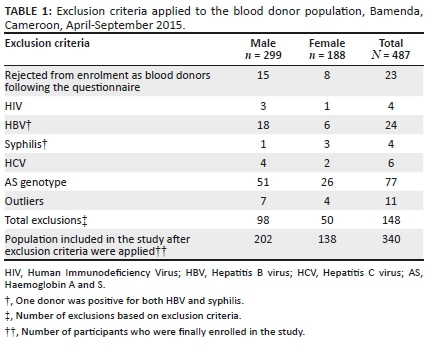
Participants that met the inclusion criteria for voluntary blood donation were excluded if they were positive for HIV, HBV, HCV or syphilis. Participants who were sickle cell disease carriers (had the AS genotype) or who had sickle cell disease (had the SS genotype) were also excluded. Participants who did not meet the inclusion criteria, who did not consent, or who withdrew their consent after consenting, were excluded.
Sample collection
Blood was collected by trained and competent personnel into two 5 mL vacutainer tubes containing dipotassium ethylene diamine tetraacetic acid (K2EDTA). Samples were stored and transported to the Blood Bank service of the Regional Hospital Bamenda in a cold chain between 2 °C and 8 °C within 2 h of collection. One tube was used for screening HIV, HBV, HCV, syphilis and haemoglobin electrophoresis, and the other for complete blood count analysis. The plasma was separated from the red blood cells in separate tubes within 1 h of the samples' arrival at the Blood Bank. Both tubes were stored at 4 °C - 8 °C for testing the following day.
HIV, hepatitis B virus, hepatitis C virus, syphilis and haemoglobin electrophoresis testing
Plasma samples were screened at the Blood Bank department of the Regional Hospital Bamenda. The national algorithm of a rapid test for HIV screening in Cameroon was used.35Treponema pallidum haemagglutination test for the serodiagnosis of syphilis - IMMUTREP® TPHA (Omega Diagnostics LTD, Alva, Scotland, United Kingdom). Hepatitis B virus was screened for using the HBsAg DiaSpot rapid diagnostic test (DIASpot Diagnostics, Jawa Barat, Indonesia) while Hepatitis C virus antigen was detected using the HCV Ag DiaSpot rapid diagnostic test (DIASpot Diagnostics, Jawa Barat, Indonesia). Haemoglobin electrophoresis was done using the Hospitex Diagnostics (Hospitex Diagnostics Srl, Sesto Fiorentino, Italy) electrophoresis machine.
The haematological analysis was done within 6 h of sample collection, using the Urit 3300 auto-analyser (Urit Medical Electronic [Group] Co., Ltd, Guilin, China). The instrument was calibrated using Eurocell Diagnostics internal controls (Eurocell Diagnostics, Rennes Cedex, France), following the protocol provided by the manufacturer. The analyser automatically counted and gave a print-out of results for: red blood cells (RBC); haemoglobin (g/dL); haematocrit (%); mean cell volume; mean cell haemoglobin; mean cell haemoglobin concentration); coefficient of variation for the standard deviation of red cell distribution (%); standard deviation of red cell distribution; white blood cells (WBC); proportion of lymphocytes (%), monocytes (%) and granulocytes (%); absolute count of lymphocytes (×10999
Quality control
The Urit 3300 auto-analyser used for the analysis of the specimens went through a vigorous formal verification process following the Clinical Laboratory Standards Institute guidelines21
Data collection
Data were collected by three trained personnel using a structured data collection format. Data for age, sex and haematological parameters for the participants who were negative for HIV, HBV, HCV and syphilis, with no haemoglobin abnormalities, were collected from the print-out of the Urit 3300 auto-analyser. Data were entered into Excel 2007 software (Microsoft Corp., Redmond, Washington, United States) and double-checked for data entry errors by a second person.
Statistical analysis
The analysis was done using Microsoft Excel 2007 spreadsheet (Microsoft Corporation, Redmond, Washington, United States) and SPSS version 16 software (IBM Corp., Chicago, Illinois, United States). Outliers were eliminated using the box plot function. The median, mean and standard deviation were calculated for each haematological parameter. The 95th percentile reference intervals were determined using the 2.5th and 97.5th percentile. The differences between sexes for all the parameters were evaluated using the Kruskal-Wallis test. Significance was determined at the 95% confidence level.
Results
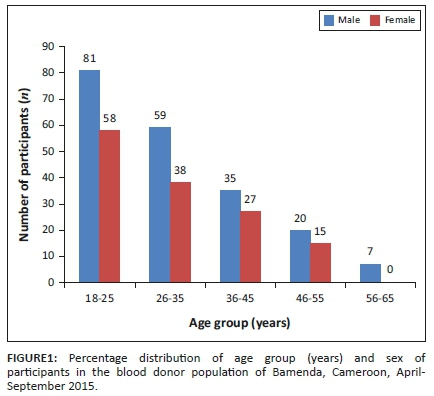
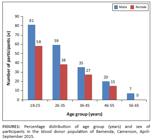
Of the 487 individuals who presented for the blood donation campaigns, 147 were excluded as per the exclusion criteria (Table 1). Of the 340 participants included in the study, 202 were male (59.4%) and 138 were female (40.6%) within the age range of 18-60 years (95% confidence interval: 31.5 ± 10.9; median age = 29 years). One hundred and thirty-nine participants (40.9%) were aged 18-25 years, 97 (28.5%) were aged 26-35 years, 62 (18.2%) were aged 36-45 years, 35 (10.3%) were aged 46-55 years, and 7 (2.1%) were aged 56-65 years (Figure 1).
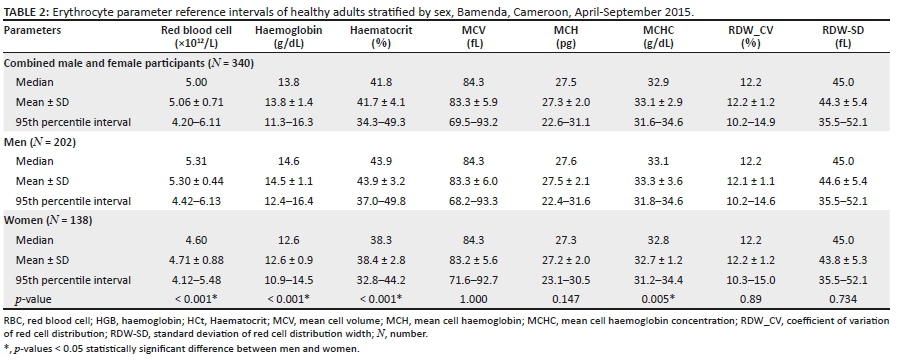
The median RBC, haemoglobin, haematocrit and mean cell haemoglobin concentration were significantly higher in men than in women (RBC: 5.31 × 101212p < 0.001; haemoglobin: 14.6 g/dL vs. 12.6 g/dL, p < 0.001; haematocrit: 43.9% vs. 38.3%, p < 0.001; and mean cell haemoglobin concentration: 33.1 g/dL vs. 32.8 g/dL, p = 0.005). Although the median mean cell volume and mean cell haemoglobin were higher in men than women (mean cell volume 27.6 fL vs. 27.3 fL, p = 1.000; and mean cell haemoglobin 27.6 pg vs. 27.3 pg, p = 0.147), the differences were not statistically significant (Table 2).
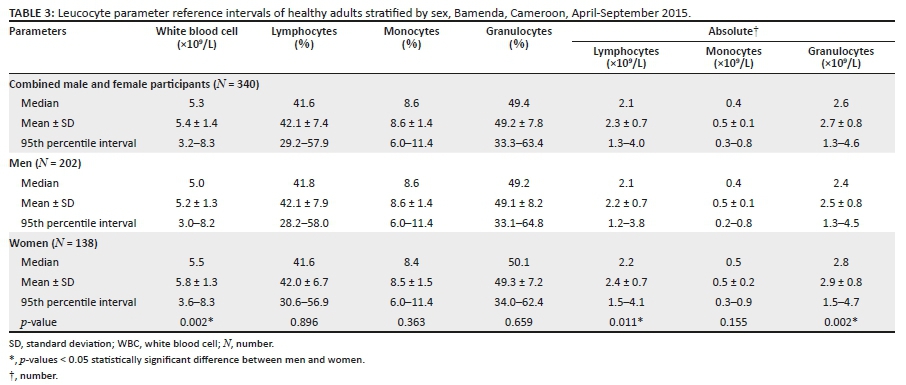
The median total WBC, absolute lymphocyte count and absolute granulocyte count were significantly lower in men than in women (WBC: 5.0 × 1099p = 0.002; absolute lymphocyte count: 2.1 × 1099p = 0.011; and absolute granulocyte count: 2.4 × 1099p = 0.002). Although the absolute median monocyte count for men was relatively higher than that of women, the difference was not statistically significant (Table 3).
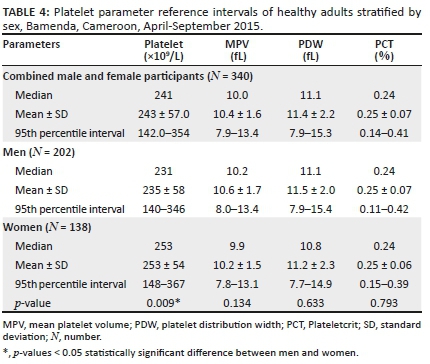
Also, the median platelet count was significantly lower in men (231 × 1099p = 0.009). There was no statistically significant difference between the median mean platelet volume, platelet distribution width and plateletcrit for men as compared to women (Table 4).
Discussion
The reference interval for haematological parameters, which may serve as a standard for decision-making on clinical laboratory results, treatments and research, were established from 340 participants from Bamenda City, Cameroon. The participants included 202 (59.4%) men and 138 (40.6%) women aged between 18 and 60 years.
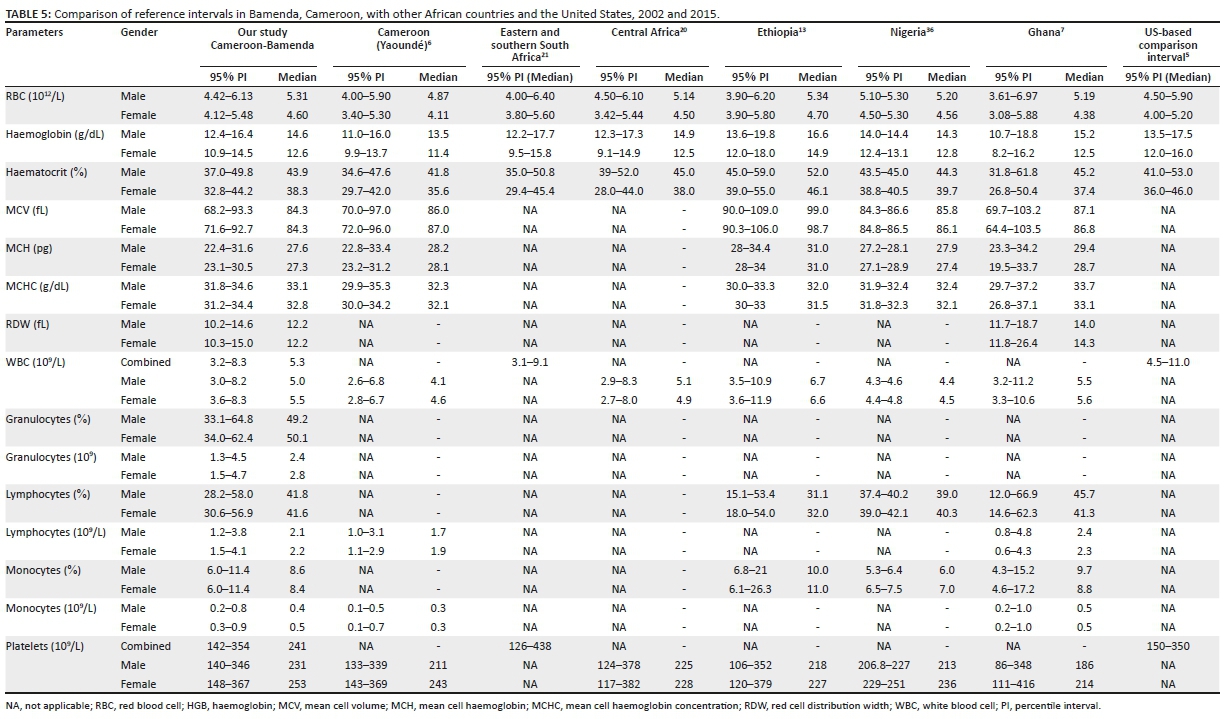
According to our findings, the median RBC, haemoglobin and haematocrit for men were significantly higher than for women. These variations may be attributed to the influence of the hormone androgen on erythropoiesis as well as menstrual blood loss in women.36638781312361092120563729,39,403241,427,10,12,17,3613,43Table 5).54412
The median total WBC for men was lower than that for women, and the difference was statistically significant. This may be attributed to the significant difference in the immune system of men and women, associated with the presence of sex hormone receptors on the immune cells. These make women generally more prone to autoimmunity, resulting in lower rates of infection and chronic inflammatory disease.45,46681447
The significantly higher median platelet count in women compared to men is suggestive of variations in hormone type and concentrations in the different genders as well as the effect of erythropoietin released in response to menstrual blood loss and cross-stimulation of megakaryopoiesis.10,367813361017Table 5).5Plasmodium spp. in malaria-endemic areas.48,49
Limitations
A limitation for this study was that we could not screen for malaria, helminthes or all types of abnormal haemoglobin (except for the AS and SS sickle cell genotypes), and our complete blood analyser could not differentiate the granulocytes into neutrophils, basophils and eosinophils. Also, subclinical conditions which could affect blood parameters were not discernable during sample collection. Furthermore, ethnic and cultural differences that may influence diet and nutritional practices could have affected the outcome of our haematological intervals. We could not control for potential selection bias for some people who visited Bamenda and donated blood.
Recommendations
We recommend that locally generated haematological values should be used as reference intervals in our locality and that each region in Cameroon should determine their haematological reference intervals as recommended by the Clinical Laboratory Standards Institute.21
Conclusion
The haematological reference intervals established in this study are comparable to those obtained in Yaoundé, Cameroon and other studies within and outside of Africa. Any differences in values may be due to differences in latitudes of the localities, race and diet. We propose that the present established haematological reference intervals in this study should be used for clinical management of patients and interpretation of laboratory data for research in Bamenda.
Competing interests
The authors have declared that no competing interests exist.
Authors' contributions
V.N.F. (study leader) was responsible for the conceptualisation of the study, study design, supervision (of the experiments, specimen collection, testing, data collection), statistical analysis and final writing. C.N.A. and R.M.F. were responsible for the conceptualisation of the study and statistical analysis. V.N.F., P.L.E. and W.A.N. were responsible for performing the experiments, specimen collection, specimen testing and data collection. B.R. was responsible for providing technical equipment maintenance services. T.M., R.M.F., C.N.A., R.E-T., P.N., B.R., J.S., E.P.E., A.E., R.L, A.L. and D.N. were responsible to help shape the research, adding literature search and critical review of the manuscript.
Sources of support
This research received no specific grant from any funding agency in the public, commercial, or not-for-profit sectors.
Data availability statement
Data sharing does not apply to this article as no new data were created or analysed in this study.
Disclaimer
The views and opinions expressed in this article are those of the authors and do not necessarily reflect the official policy or position of any affiliated agency of the authors.
Acknowledgements
We acknowledge all the participants of this study for voluntarily giving their blood for the establishment of haematological reference intervals for the Bamenda community. Thanks to the Centre for Disease Control and Prevention (CDC), Cameroon, and the Global Health System Solutions, Limbe, for their technical support, the management of the Department of Health Economics, Policy and Management, and the faculty of Health and Medical Science of the Catholic University of Cameroon-Bamenda for academic support during this study. Lastly, we appreciate the staff and management of the Bamenda Regional Hospital Laboratory and the Blood Bank for their wonderful support during the study.
References
- 1.Jameson JL, Weetman AP, Fausi A, et al. Harrison's principles of internal medicine. New York: McGraw-Hill Education, 2005.
- 2.Lewis SM, Bain BJ, Bates I, et al. Dacie and Lewis practical haematology. E-book. Elsevier Health Sciences; 2006.
-
3.Koram K, Addae M, Ocran J, et al. Population based reference intervals for common blood haematological and biochemical parameters in the Akuapem north district. Ghana Med J. 2007;41(4): 160-166. https://doi.org/10.4314/gmj.v41i4.55284
» https://doi.org/10.4314/gmj.v41i4.55284 -
4.Giorno R, Clifford JH, Beverly S, et al. Hematology reference values analysis by different statistical technics and variations with age and sex. Am J Clin Pathol. 1980;74(6):765-770. https://doi.org/10.1093/ajcp/74.6.765
» https://doi.org/10.1093/ajcp/74.6.765 -
5.Kratz A, Ferraro M, Sluss PM, et al. Normal reference laboratory values. N Engl J Med. 2004;351(15):1548-1563. https://doi.org/10.1056/NEJMcpc049016
» https://doi.org/10.1056/NEJMcpc049016 -
6.Oloume ME, Mouliom A, Melingui BF, et al. Haematological values in a healthy adult population in Yaoundé, Cameroon. Afr J Lab Med. 2019;8(1):a852. https://doi.org/10.4102/ajlm.v8i1.852
» https://doi.org/10.4102/ajlm.v8i1.852 -
7.Addai-Mensah O, Gyamfi D, Duneeh RV, et al. Determination of haematological reference ranges in healthy adults in three regions in Ghana. BioMed Res Int. 2019;2019:1-6. https://doi.org/10.1155/2019/7467512
» https://doi.org/10.1155/2019/7467512 -
8.Bakrim S, Motiaa Y, Benajiba M, et al. Establishment of the hematology reference intervals in a healthy population of adults in the Northwest of Morocco (Tangier-Tetouan region). Pan Afr Med J. 2018;29(1):1-18. https://doi.org/10.11604/pamj.2018.29.169.13042
» https://doi.org/10.11604/pamj.2018.29.169.13042 -
9.Kueviakoe IM, Segbena AY, Jouault H, et al. Hematological reference values for healthy adults in Togo. ISRN Hematol. 2010;2011:1-5. https://doi.org/10.5402/2011/736062
» https://doi.org/10.5402/2011/736062 -
10.Dosoo DK, Kayan K, Adu-Gyasi D, et al. Haematological and biochemical reference values for healthy adults in the middle belt of Ghana. PLoS One. 2012;7(4):1-9. https://doi.org/10.1371/journal.pone.0036308
» https://doi.org/10.1371/journal.pone.0036308 - 11.Ramezani A, Shams M, Zarinfar N, et al. Hematological reference values for healthy males in the central part of Iran. Iran J Pathol. 2014;9(1):50-55.
-
12.Yalew A, Terefe B, Alem M, et al. Hematological reference intervals determination in adults at Gondar university hospital, Northwest Ethiopia. BMC Res Notes. 2016;9(1):483. https://doi.org/10.1186/s13104-016-2288-8
» https://doi.org/10.1186/s13104-016-2288-8 - 13.Mulu W, Abera B, Mekonnen Z, et al. Haematological and CD4+ T cells reference ranges in healthy adult populations in Gojjam zones in Amhara region, Ethiopia. PLoS One. 2017;12(7):1-13.
- 14.Tekkeşin N, Bekoz H, Tukenmez F. The largest reference range study for hematological parameters from Turkey: A case control study. J Clin Exp Investig. 2014;5(4):548-552.
- 15.Troussard X, Vol S, Cornet E, et al. Étude des valeurs normales de l'hémogramme chez l'adulte: Un besoin pour une meilleure interprétation et pour l'accréditation du laboratoire. Ann Biol Clin. 2014;72(5):61-81.
-
16.Buchanan AM, Muro FJ, Gratz J, et al. Establishment of haematological and immunological reference values for healthy Tanzanian children in Kilimanjaro Region. Trop Med Int Health. 2010;15(9):1011-1021. https://doi.org/10.1111/j.1365-3156.2010.02585.x
» https://doi.org/10.1111/j.1365-3156.2010.02585.x - 17.Kibaya RS, Bautista CT, Sawe FK, et al. Reference ranges for the clinical laboratory derived from a rural population in Kericho, Kenya. PLoS One. 2008;3(10):1-7.
- 18.Lawrie D, Coetzee LM, Becker P, et al. Local reference ranges for full blood count and CD4 lymphocyte count testing. S Afr Med J. 2009;99(4): 243-248.
-
19.Otahbachi M, Simoni J, Simoni G, et al. Gender differences in platelet aggregation in healthy individuals. J Thromb Thrombolysis. 2010;30(2):184-191. https://doi.org/10.1007/s11239-009-0436-x
» https://doi.org/10.1007/s11239-009-0436-x - 20.Menard D, Mandeng MJ, Tothy MB, et al. Immunohematological reference ranges for adults from the Central African Republic. Clin Diagn Lab Immunol. 2003;10(3):443-445.
- 21.Karita E, Ketter N, Price MA, et al. CLSI-derived hematology and biochemistry reference intervals for healthy adults in eastern and southern Africa. PLoS One. 2009;4(2):1-14.
-
22.Segbena AY, Prehu C, Wajcman H, et al. Hemoglobins in Togolese newborns: Hb S, Hb C, Hb Bart's, and α-Globin gene status. Am J Hematol. 1998;59(3):208-213. https://doi.org/10.1002/(SICI)1096-8652(199811)59:3<208::AID-AJH5>3.0.CO;2-R
» https://doi.org/10.1002/(SICI)1096-8652(199811)59:3<208::AID-AJH5>3.0.CO;2-R - 23.Appold K. Determining laboratory reference intervals: CLSI guideline makes the task manageable. Lab Med. 2009;40(2):75-76.
- 24.Alemnji G, Mbuagbaw J, Folefac E, et al. Reference physiological ranges for serum biochemical parameters among healthy Cameroonians to support HIV vaccine and related clinical trials. Afr J Health Sci. 2010;17(3&4):75-82.
-
25.Ngo-Matip M-E, Pieme CA, Azabji-Kenfack M, et al. Impact of daily supplementation of Spirulina platensis on the immune system of naïve HIV-1 patients in Cameroon: A 12-months single blind, randomized, multicenter trial. Nutr J. 2015;14(1):70. https://doi.org/10.1186/s12937-015-0058-4
» https://doi.org/10.1186/s12937-015-0058-4 - 26.Sumbele IUN, Kimbi HK, Ndamukong-Nyanga JL, et al. Malarial anaemia and anaemia severity in apparently healthy primary school children in urban and rural settings in the Mount Cameroon area: Cross sectional survey. PLoS One. 2015;10(4):1-17.
- 27.Nkuo Akenji T, Ntonifor N, Ching J, et al. Evaluating a malaria intervention strategy using knowledge, practices and coverage surveys in rural Bolifamba, southwest Cameroon. Trans R Soc Trop Med Hyg. 2005;99(5):325-332.
-
28.Kometa SS, Akoh NR. The Hydro-geomorphological implications of urbanisation in Bamenda, Cameroon. J Sustain Dev. 2012;5(6):64-73. https://doi.org/10.5539/jsd.v5n6p64
» https://doi.org/10.5539/jsd.v5n6p64 -
29.Chi A. Human interference and environmental instability: Addresing the environmental consequences of rapid urban growth in Bamenda, Cameroon. Environ Urban. 1998;10(2):161-173. https://doi.org/10.1630/095624798101284527
» https://doi.org/10.1630/095624798101284527 -
30.Review WP. Cameroon population 2020. c2019 [cited 2020 Mar 13]. Available from: https://worldpopulationreview.com/countries/cameroon-population/
» https://worldpopulationreview.com/countries/cameroon-population/ -
31.Immanuel J. Lack of basic services in the tourism industry: A study of stakeholders' perspectives in Bamenda, Cameroons. c2019 [cited 2020 August 10]. Available from: https://www.diva-portal.org/smash/get/diva2:1337743/FULLTEXT01.pdf
» https://www.diva-portal.org/smash/get/diva2:1337743/FULLTEXT01.pdf - 32.Asongwe GA, Yerima BP, Tening AS. Vegetable production and the livelihood of farmers in Bamenda Municipality, Cameroon. Int J Curr Microbiol App Sci. 2014;3(12):682-700.
-
33.SANAS. 2017 [cited 2020 Mar 13]. Available from: https://www.sanas.co.za/Pages/index.aspx
» https://www.sanas.co.za/Pages/index.aspx -
34.Nchinda E, Tagny C, Mbanya D. Blood donor haemovigilance in Yaoundé, Cameroon. Transfus Med. 2012;22(4):257-261. https://doi.org/10.1111/j.1365-3148.2012.01161.x
» https://doi.org/10.1111/j.1365-3148.2012.01161.x -
35.NACC. National guildeline on the prevention and mangement of HIV in Cameroom [homepage on the Internet]. c2015 [cited 2020 Mar 13]. Available from: https://aidsfree.usaid.gov/sites/default/files/cameroon_art_2015.pdf
» https://aidsfree.usaid.gov/sites/default/files/cameroon_art_2015.pdf -
36.Miri-Dashe T, Osawe S, Tokdung M, et al. Comprehensive reference ranges for hematology and clinical chemistry laboratory parameters derived from normal Nigerian adults. PLoS One. 2014;9(5):1-10. https://doi.org/10.1371/journal.pone.0093919
» https://doi.org/10.1371/journal.pone.0093919 - 37.Bros B, Leblanc T, Barbier-Bouvet B, et al. Lecture critique de l'hémogramme: valeurs seuils à reconnaître comme probablement pathologiques et principales variations non pathologiques. National Agency of Accreditation and Evaluation of Health (ANAES). September 1997.
- 38.Awad KM, Bashir AA, Osman AA, et al. Reference values for hemoglobin and red blood cells indices in Sudanese in Khartoum State. International Journal of Health Sciences and Research. 2019;9(1):210-214.
- 39.Tchamba A, Nzeukou A, Tené R, et al. Building potentials of stabilized earth blocks in Yaounde and Douala (Cameroon). Int J Civil Eng Res. 2012;3(1):1-14.
-
40.Ngon GN, Yongue-Fouateu R, Bitom D, et al. A geological study of clayey laterite and clayey hydromorphic material of the region of Yaoundé (Cameroon): A prerequisite for local material promotion. J Afr Earth Sci. 2009;55(1-2):69-78. https://doi.org/10.1016/j.jafrearsci.2008.12.008
» https://doi.org/10.1016/j.jafrearsci.2008.12.008 - 41.Windsor JS, Rodway GW. Heights and haematology: The story of haemoglobin at altitude. Postgraduate Med J. 2007;83(977):148-151.
-
42.Whitacre CC. Sex differences in autoimmune disease. Nat Immunol. 2001;2(9):777-780. https://doi.org/10.1038/ni0901-777
» https://doi.org/10.1038/ni0901-777 - 43.Scheinfeldt LB, Soi S, Thompson S, Ranciaro A, et al. Genetic adaptation to high altitude in the Ethiopian highlands. Genome Biol. 2012;13(1):R1.
- 44.El-Hazmi MA, Warsy AS. Normal reference values for hematological parameters, red cell indices, HB A2 and HB F from early childhood through adolescence in Saudis. Ann Saudi Med. 2001;21(3-4):165-169.
-
45.Bupp MRG. Sex, the aging immune system, and chronic disease. Cell Immunol. 2015;294(2):102-110. https://doi.org/10.1016/j.cellimm.2015.02.002
» https://doi.org/10.1016/j.cellimm.2015.02.002 - 46.Bhatia A, Sekhon HK, Kaur G. Sex hormones and immune dimorphism. Sci World J. 2014;2014:1-9.
-
47.Mine M, Moyo S, Penny Stevens KM, et al. Immunohaematological reference values for HIV-negative healthy adults in Botswana. Afr J Lab Med. 2012;1(1):1-7. https://doi.org/10.4102/ajlm.v1i1.5
» https://doi.org/10.4102/ajlm.v1i1.5 -
48.Asare-Ntow K, Kuma G, Adjei R. Analysis of Malaria diagnosis and treatment data amongst pregnant women after the implementation of Test-Treat-Track policy, Brong Ahafo Region-2017. Int J Infect Dis. 2018;73:171-172. https://doi.org/10.1016/j.ijid.2018.04.3803
» https://doi.org/10.1016/j.ijid.2018.04.3803 - 49.Hoffbrand A, Moss P, Pettit J. Essential haematology, 2006. Volume 5. Malden MA: Blackwell Publishing, 2006; p. 249.

Accepted: 01 July 2020
Published: 21 Dec. 2020