Establishing a national laboratory quality system for HIV diagnosis and monitoring in resource-limited settings: Experience from Senegal
Mouhamed A.S. MbengueI; Moussa SarrI, II; Papa A. DiawI; Papa A.N. DiallIII; Maimouna D. ToureI; Ndeye F.F.N. FayeIV; Bousso GueyeI; Ndeye C.T. KaneI; Souleymane MboupI
ILaboratory of Bacteriology and Virology, Cheikh Anta Diop University, CHU Aristide Le Dantec, Dakar, Senegal
IIWestat, Rockville, Maryland, United States
IIINational Committee for the Control of AIDS, Dakar, Senegal
IVDivision for the Control of AIDS and STDs, Ministry of Health, Dakar, Senegal
HIV situation in Senegal
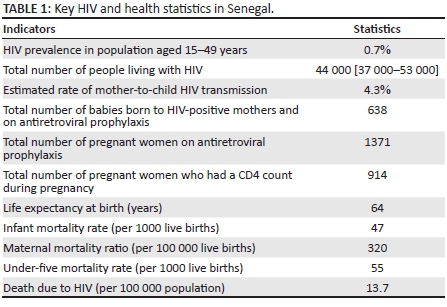
Senegal is a Western African Country, with a population of around 14 million people and 14 administrative regions. Based on the 2013 census, the total population of the country is estimated at 14 799 859 inhabitants, with a median population age of 18 years old.1Table 1). In 2013, the Crude Birth Rate was 37.2 per thousand, with a sex ratio at birth of around 105 men per 100 women. Additionally, approximately 43% of the population is under 15 years of age, with an infant mortality rate of 47 deaths per 1000 births, and an overall risk of dying between birth and five years estimated at 72 deaths per 1000. The life expectancy at birth was 64 years in 2013.1
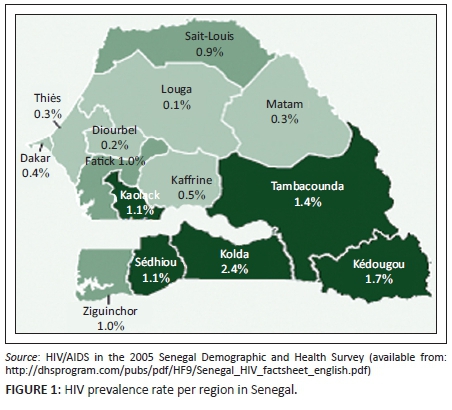
Senegal has a concentrated HIV epidemic with high prevalence rates in most-at-risk groups, including commercial sex workers, but low prevalence rates in the general population in most regions (Figure 1). Based on the 2010-2011 Senegal Demographic and Health Survey, the global prevalence of HIV amongst women and men aged 15-49 years is 0.7%.23,4556
Laboratory infrastructure in Senegal
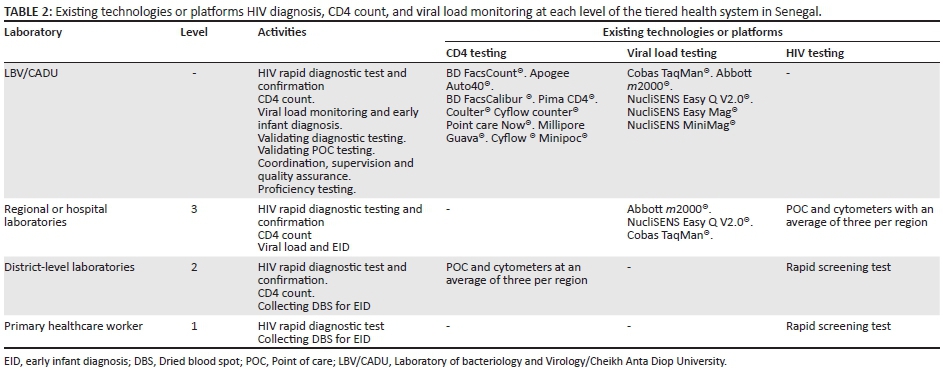
Diagnostic laboratories in Senegal operate within a three-tiered laboratory system: (1) district and peripheral health centre level laboratories; (2) regional level laboratories; and (3) central and hospital level laboratories (Table 2). The organisation of the laboratory system is part of the overall health system structure and is placed under the leadership of the Ministry of Health. There is a Bureau of Laboratories within the Ministry of Health that is responsible for the implementation of policies defined by the government concerning the functioning and organisation of clinical laboratories. This office also promotes good clinical laboratory practice, not only for public medical laboratories, but also for private laboratories within the country.
The Laboratory of Bacteriology and Virology (LBV) at Cheikh Anta Diop University (CADU), which is located at Le Dantec Hospital in the capital city, has been recognised by health authorities as the HIV National Reference laboratory since 1986. In partnership with the Ministry of Health and the National AIDS programme, LBV/CADU is responsible for evaluating and validating diagnostic testing technologies, and technologies for CD4 count, viral load and EID. Additionally, LBV/CADU ensures the supervision of other laboratories through a national external quality assessment (EQA) programme, through distribution of regular proficiency testing panels, collection of data for analysis, and follow-up and corrective actions in partnership with the Ministry of Health, the National Committee for the Control of AIDS and the Division for the Control of AIDS and Sexually Transmitted Diseases.
At the central and reference laboratory level, the HIV viral load, EID, CD4-count monitoring and HIV-diagnosis capabilities of LBV/CADU are described in Table 2. At the regional and hospital laboratories level, these infrastructures are capable of performing HIV rapid diagnostic test confirmation, CD4-count measures and, at some of them, viral load and EID testing. However, the vast majority of the laboratory activities are conducted at the district level and peripheral health centre level. The capabilities for the district/peripheral health centre-level laboratories include: HIV rapid testing, CD4 count and collection of dried-blood specimens for EID. There are also few private laboratories operating at different levels of the health system.
Quality assurance framework
Quality assurance is the backbone of quality laboratory performance7
The maintenance of a quality management system, including quality assurance, is crucial for having and providing good and reliable laboratory services.7,8,9
Additionally, AFRIQUALAB is also involved in an EQA programme focusing only on CD4 count technologies within Senegal, with the support of the National AIDS programme and the Public Health Agency of Canada, an international programme for quality assessment and standardisation for immunological measures relevant to HIV. AFRIQUALAB also offers other panels, such as haematology, biochemistry, hepatitis B and C and mycobacteria, to participating labs using a fee-based service structure. LBV/CADU has made major improvements to its own quality management system and has recently achieved International Organization for Standardization 15189 accreditation of its medical laboratories.
Additionally, within Senegal and at the national level, the Ministry of Health has recently released a national strategic plan that will guide the quality management system across the medical laboratory services and system in the country.
Lessons learned and challenges
Laboratories participating in the EQA programme for HIV rapid testing and CD4 (including POC) received feedback and, based on their results, have implemented corrective actions, as needed, to improve the quality of services, and were encouraged to participate in a laboratory network for continuous improvement. These outcomes are positive steps toward the implementation of quality management systems.
The feedback received from the EQA programme has been used as an opportunity for participating laboratories to be more vigilant in many aspects of their work; for example, with respect to the expiration date for reagents, implementation of corrective actions, and on-site training for staff. The quality assurance programme and the external quality control activities must be followed up by systems-strengthening activities, such as staff training at all levels. We found that there is a need for more communication between the National Reference Laboratories and the Bureau of Laboratories, located at the Ministry of Health, regarding the type of corrective actions and support to be provided from the central/national level to regional and peripheral laboratories. There is also a need to provide incentives such as certificates of participation or achievement to successfully performing labs.
Quality assurance for POC
Currently, all 24 sites in-country with POC diagnostic technologies, including POC for CD4, are participating in an EQA programme organised by LBV. Since 2004, LBV, with the support of the national AIDS programme, has provided voluntary, free-of-charge EQA of HIV rapid testing to assess the performance of laboratories conducting HIV diagnostics in Dakar and other regions. Currently, the EQA programme for HIV rapid testing uses dried-tube specimens. The proficiency testing panels consist of four specimens (two negatives, one HIV-1, one HIV-2) distributed at ambient temperature to participants. The results from the participants are sent to the national reference laboratory via email or cell-phone text messaging.
Costing and cost-effectiveness of HIV POC testing
With regard to the 90-90-90 goals, the affordability of viral load testing and CD4 count measures is a key factor in plans to expand HIV laboratory services and scaling antiretroviral therapy across Senegal. The country will need to put in place an affordable and sustainable strategy to reinforce the capacity of the public laboratories as well as to advocate for a strong political commitment from the Ministry of Health and sponsors. In partnership with the National AIDS programme, LBV/CADU is planning to estimate the costing and to undertake a cost-effectiveness study of implementing a nationwide HIV POC testing system, for CD4 count and viral load testing. The costing for, and cost-effectiveness of, a related quality assurance programme will be also taken into account. A model of costing for HIV POC testing, including quality assurance activities is currently under review with the International Diagnostics Centre of the London School of Hygiene and Tropical Medicine.
Competing interests
The authors declare that they have no financial or personal relationship(s) that may have inappropriately influenced them in writing this article.
Sources of support
None.
Acknowledgements
The authors are grateful to the staff of all sites participating in related EQA programmes.
References
- 1. Agence Nationale de la Statistique et de la Démographie. Recensement général de la population et de l'habitat, de l'agriculture et de l'elevage. Senegal: ANSD; 2014.
- 2. Agence National de la Statistique et de la Démographie. Enquête démographique et de santé et à indicateurs multiples 2010-2012. Senegal: ANSD; 2012.
- 3. Comité National de Lutte contre le Sida. Rapport national de la riposte VIH/SIDA 2014. Yaoundé, Cameroun: CNLS; 2015.
-
4. Leprêtre A, Ba I, Lacombe K, et al. Prevalence and behavioural risks for HIV and HCV infections in a population of drug users of Dakar, Senegal: the ANRS 12243 UDSEN study. J Int AIDS Soc. 2015;18:19888. http://dx.doi.org/10.7448/IAS.18.1.19888. eCollection 2015.
» http://dx.doi.org/10.7448/IAS.18.1.19888 - 5. Joint United Nations Programme on HIV/AIDS. Global AIDS response progress reporting 2015. Geneva, Switzerland: WHO Press; 2015.
-
6. Nguyen S, Ramos A, Chang J, et al. Monitoring the quality of HIV-1 viral load testing through a proficiency testing program using dried tube specimens in resource-limited settings. J Clin Microbiol. 2015;53(4):1129-1136. http://dx.doi.org/10.1128/JCM.02780-14. Epub 2015 Jan 21.
» http://dx.doi.org/10.1128/JCM.02780-14 -
7. Garcia A, Subbarao S, Zhang G, et al. Impact of proficiency testing program for laboratories conducting early diagnosis of HIV-1 infection in infants in low- to middle-income countries. J Clin Microbiol. 2014;52(3):773-780. http://dx.doi.org/10.1128/JCM.03097-13. Epub 2013 Dec 18.
» http://dx.doi.org/10.1128/JCM.03097-13 -
8. Pai NP, Vadnais C, Denkinger C, et al. Point-of-care testing for infectious diseases: diversity, complexity, and barriers in low- and middle-income countries. PLoS One. 2012;9(9):e1001306. http://dx.doi.org/10.1371/journal.pmed.1001306. Epub 2012 Sep 4.
» http://dx.doi.org/10.1371/journal.pmed.1001306 -
9. Miller WG, Jones GRD, Horowitz GL, et al. Proficiency testing/external quality assessment: current challenges and future directions. Clin Chem. 2011;57(12):1670-1680. http://dx.doi.org/10.1373/clinchem.2011.168641. Epub 2011 Sep 30.
» http://dx.doi.org/10.1373/clinchem.2011.168641

Accepted: 12 Aug. 2016
Published: 17 Oct. 2016