COVID-19 positive cases among asymptomatic individuals during the second wave in Ndola, Zambia
Abstract
BACKGROUND: Coronavirus disease 2019 (COVID-19) is a worldwide public health concern for healthcare workers. About 80% of cases appear to be asymptomatic, and about 3% may experience hospitalisation and later die. Less than 20% of studies have looked at the positivity rate of asymptomatic individuals. OBJECTIVE: This study investigated the COVID-19 positivity rates among asymptomatic individuals during the second COVID-19 wave at one of Zambia's largest testing centre. METHODS: This was a retrospective cross-sectional study conducted on routine surveillance and laboratory data at the Tropical Diseases Research Centre COVID-19 laboratory in Ndola, Zambia, from 01 December 2020 to 31 March 2021. The study population was made up of persons that had tested for severe acute respiratory syndrome coronavirus 2 (SARS-CoV-2) infection as a requirement for travel. Microsoft Excel was used to come up with an epidemiological curve of daily COVID-19 positive cases; proportions for gender were described using frequencies and percentages. RESULTS: A total of 11 144 asymptomatic individuals tested for SARS-CoV-2 were sampled for the study and 1781 (16.0%) returned positive results. The median age among those tested was 36 years (interquartile range: 29-46). Testing for COVID-19 peaked in the month of January 2021 (37.4%) and declined in March 2021 (21.0%). The epidemiological curve showed a combination of continuous and propagated point-source transmission. CONCLUSION: The positivity rate of 16.0% among asymptomatic individuals was high and could imply continued community transmission, especially during January 2021 and February 2021. We recommend heightened testing for SARS-CoV-2 among asymptomatic individuals. WHAT THIS STUDY ADDS: This study adds critical knowledge to the transmission of COVID-19 among asymptomatic travellers who are usually a key population in driving community infection. This knowledge is critical in instituting evidence-based interventions in the screening and management of travellers, and its control.
asymptomatic individuals; COVID-19 disease; positivity rate; SARS-CoV-2; Zambia
Introduction
Coronavirus disease 2019 (COVID-19), caused by the severe acute respiratory syndrome coronavirus 2 (SARS-CoV-2), is a worldwide public health concern for healthcare workers, including physicians, public health specialists and researchers.123456
Severe acute respiratory syndrome coronavirus causes a number of human respiratory disease conditions, ranging from mild cold to severe respiratory distress syndrome, and it largely spreads between persons by respiratory droplets and contact routes.784,9,1011
Despite public health preventive measures such as hand hygiene, social distancing, quarantine and travel restrictions which were instituted, transmission of COVID-19 seemed to be ongoing.121314
Zambia has experienced four waves of COVID-19.115,16
Methods
Ethical considerations
Ethical approval to carry out the study was obtained from the TDRC Research Ethics Committee (IRB registration number: 00002911). Permission to carry out the study and access to patient information was obtained from the Tropical Diseases Research Centre management. Informed consent was not obtained from any individual as there was no active participation in the study. Confidentiality of patient information was adhered to and data were de-identified prior to analysis.
Study design and site
This was a retrospective cross-sectional study conducted on surveillance and laboratory data collected at the Tropical Diseases Research Centre (TDRC) COVID-19 laboratory in Ndola, Zambia, from 01 December 2020 to 31 March 2021. The TDRC is a national health research institution specialising in both infectious and non-infectious diseases. The TDRC COVID-19 laboratory is accredited for certification of travellers by the African Society for Laboratory Medicine and conducts approximately 400 COVID-19 tests per day.
Study population and eligibility criteria
The study population was made up of persons who were tested for SARS-CoV-2 infection during the second wave of COVID-19. Complete enumeration of the data set comprising individuals tested for COVID-19 was obtained for analysis. Eligibility for testing was based on getting tested for COVID-19 as a mandatory requirement for international travel, regardless of age. Tests of individuals that were collected from outside the TDRC and those that were done outside the stipulated period of the second wave were not included in the analysis. Additionally, tests that were done after vaccination had begun were excluded.
Data collection
Data were collected from an already-prepared Microsoft Excel spreadsheet (Microsoft Corporation, Redmond, Washington, United States) and a case investigation form comprising the following information: date the test was done, age, gender, and results. An extraction data tool was used for data collection. Variables with no clear labels and missing data were removed from the data set.
Data analysis
Microsoft Excel was used to come up with an epidemiological curve of daily COVID-19-positive cases, whereas proportions for gender were described using frequencies and percentages. Age was described as a continuous variable and the mean, median, mode and range were used. To test for differences on the COVID-19 test result, the chi-square test was used once assumptions were met to analyse binary variables; otherwise Fisher's exact test was used. For continuous variables; the Mann-Whitney ranksum test was used for skewed data. After stratifying COVID-19 positivity by months, the one-way analysis of variance test was used to analyse for differences in age among groups. To predict factors associated with a positive test for COVID-19, logistic regression methods were used. STATA® software, version 14 SE (STATA Corp., College Station, Texas, United States) was used for analysis. A p-value less than 0.05 was considered statistically significant at a confidence interval of 95%.
Results
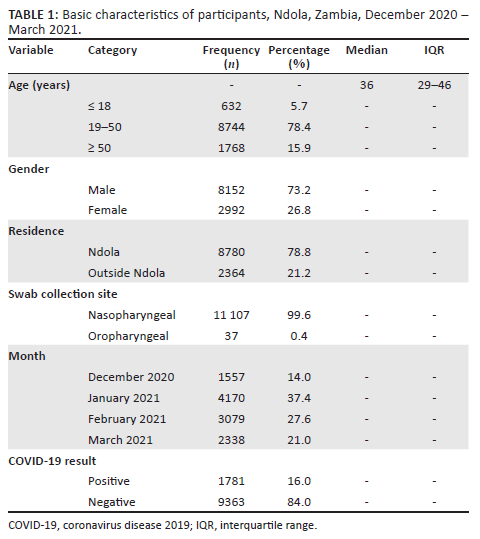
A total of 11 144 asymptomatic travellers tested for COVID-19 were sampled for the study and 1781 tested positive, resulting in a positivity rate of 16.0% (Table 1). The study participants had a median age of 36 years (interquartile range: 29 to 36 years). The test for COVID-19 was noted to be done mostly by travellers in the age group 19 to 50 years. The youngest participant was 1 year old while the oldest was 92 years old. A majority of those tested were male travellers (73.2%; 8152/11 144); female travellers accounted for the remaining 26.8% (2992/11 144). The highest number of tests were completed in January 2021 (4170/11 144).
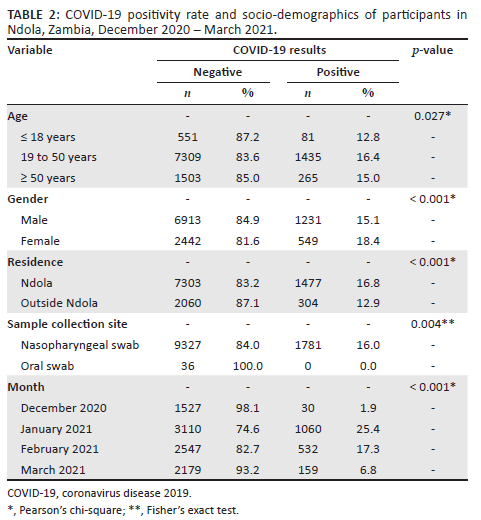
The proportion of female travellers that tested positive for COVID-19 (18.4%) was greater than the proportion of male travellers (15.1%) with a p-value of 0.027 (Table 2). Among individuals who tested for COVID-19 prior to travelling, about 7303 (83.2%) tested negative and were Ndola residents, whereas among individuals that tested positive, 304 (12.9%) were not Ndola residents. There were no positive results among individuals whose samples were collected orally. Of the monthly tests done, 30/1557 (1.9%) were positive in December 2020, 1060/4170 (25.4%) were positive in January 2021, 532/3079 (17.3%) positive in February 2021 and 159/2338 (6.8%) positive in March 2021.
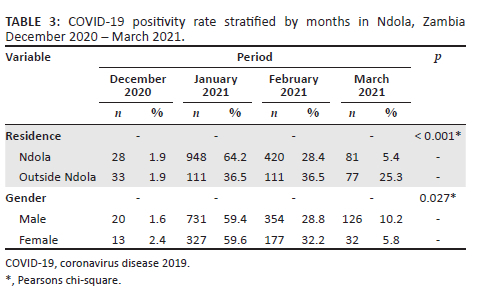
When stratified by month of visit to the testing centre, there were more Ndola residents seeking testing services at the TDRC laboratory in January 2021 (n = 948) than any other month included in the study (Table 3). An equal peak number of non-Ndola residents (n = 111) was seen in January 2021 and February 2021. The lowest number of travellers was seen in December 2020.
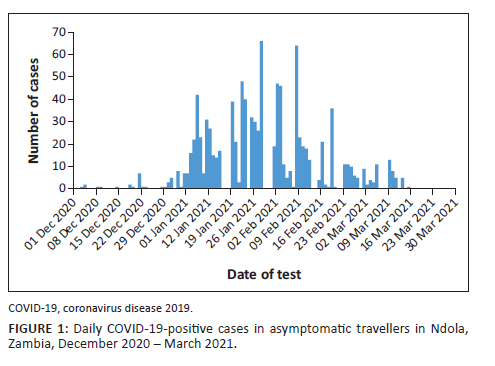
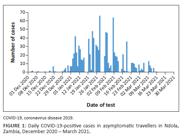
Coronavirus disease 2019 cases began to rise on 05 January 2021 and reached a peak on 26 January 2021 (Figure 1). The cases remained high until 23 February 2021, when there was a reduction of 150 in the number of positive cases reported.
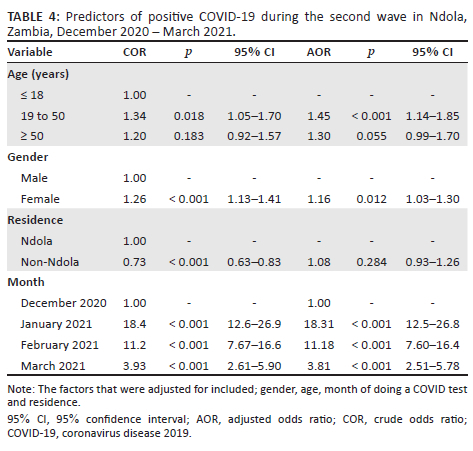
Female travellers had a 16.0% (adjusted odds ratio: 1.16; 95% confidence interval: 1.03 - 1.30; p = 0.012) increased chance of testing positive for SARS-CoV-2 compared to male travellers, after adjusting for age, residence, and month in which the test was done (Table 4).
Discussion
This study found a positivity rate of 16.0% (1781/11 144), with 69.1% (1231/1781) of male travellers being affected. The months of January 2021 and February 2021 recorded the highest rate of positivity. The epidemiological curve showed that the second wave of COVID-19 lasted from December 2020 to the end of March 2021. Further, the chances of testing positive for SARS-CoV-2 if an individual was female increased by about 16% (95% confidence interval: 1.03-1.30) compared to being male, after controlling for other variables.
The positivity rate found in this study was similar to the positivity rate at the national level in Zambia during the same period.611151617181719
Our study found that a rise in COVID-19 cases during the second wave of the pandemic was observed from December 2020 and ended in March 2021. The epidemiological curve for the daily cases of COVID-19 showed a peak on 26 January 2021. In Italy, different findings were reported in which the second wave began in August 2020 and continued to February 2021.20211922,23,24
This study found a statistically significant difference in positivity rate between female travellers compared with male travellers, with female travellers more likely to test positive. These findings are consistent with those in Nigeria, where more asymptomatic female individuals than male tested positive.1725,26252728,29303132
Limitations
This study had some limitations, one of which was that there was no control on the variables as this was a retrospective analysis of previously collected data. Findings in this study may not be generalisable, as the data were obtained from one testing site. However, the study had good power and the results are a true reflection of the country's positivity rate. A prospective study with more variables is recommended.
Conclusion
The positivity rate was found to be 16.0%, implying that there was continued community transmission despite the instituted public health guidelines. Age was not a predictor of a testing positive for COVID-19, whereas the month in which a test was done, the sex of the individual and their place of residence were good predictors. The positivity rate reported in this study suggests the need to heighten testing of SARS-CoV-2 among asymptomatic individuals.
Competing interests
The authors declare that they have no financial or personal relationships that may have inappropriately influenced them in writing this article.
Authors' contributions
J.G. conceptualised the study, conducted the formal analysis and wrote the first draft. V.D. conducted the formal analysis and review and editing of the manuscript. J.C., S.M., B.M. and R.L.M. performed data curation and reviewed the manuscript. M.M. performed the formal analysis and reviewed the manuscript. G.C. performed the editing, review of the manuscript and supervised the conduct of the study.
Sources of support
This research received no specific grant from any funding agency in the public, commercial, or not-for-profit sectors.
Data availability
The data supporting the findings of this study are available from the corresponding author, V.D., upon request.
Disclaimer
The views and opinions expressed in this article are solely of the authors and do not reflect the official policy or position of any affiliated organisation of the authors.
Acknowledgements
We would like to acknowledge the staff in the molecular laboratory at the Tropical Diseases Research Centre for availing the data that was used in this study.
References
-
1.Sokolovska L, Sultanova A, Cistjakovs M, Murovska M. COVID-19: The third wave of coronavirus infection outbreak. J Transl Sci. 2021;7(1):e1-e5. https://doi.org/10.15761/JTS.1000389
» https://doi.org/10.15761/JTS.1000389 -
2.Bwire GM, Paulo LS. Coronavirus disease-2019: Is fever an adequate screening for the returning travelers? Trop Med Health. 2020;48(1):1-3. https://doi.org/10.1186/s41182-020-00201-2
» https://doi.org/10.1186/s41182-020-00201-2 -
3.Yanez ND, Weiss NS, Romand JA, Treggiari MM. COVID-19 mortality risk for older men and women. BMC Public Health. 2020;20(1):e0248281. https://doi.org/10.1186/s12889-020-09826-8
» https://doi.org/10.1186/s12889-020-09826-8 -
4.Tessema SK, Nkengasong JN. Understanding COVID-19 in Africa. Nat Rev Immunol. 2021;21(8):469-470. https://doi.org/10.1038/s41577-021-00579-y
» https://doi.org/10.1038/s41577-021-00579-y -
5.Mulenga LB, Hines JZ, Fwoloshi S, Chirwa L, Siwingwa M, Yingst S. Prevalence of SARS-CoV-2 in six districts in Zambia in July, 2020: A cross-sectional cluster sample survey. Artic Lancet Glob Health. 2021;9(6):E773-E781. https://doi.org/10.1016/S2214-109X(21)00053-X
» https://doi.org/10.1016/S2214-109X(21)00053-X -
6.Worldometer. Zambia COVID - Coronavirus statistics - Worldometer [homepage on the Internet]. 2022 [cited 2022 Oct 06]. Available from: https://www.worldometers.info/coronavirus/country/zambia/
» https://www.worldometers.info/coronavirus/country/zambia/ -
7.Fwoloshi S, Hines JZ, Barradas DT, et al. Prevalence of severe acute respiratory syndrome coronavirus 2 among healthcare workers - Zambia, July 2020. Clin Infect Dis. 2021;73(6):e1321-e1328. https://doi.org/10.1093/cid/ciab273
» https://doi.org/10.1093/cid/ciab273 -
8.Johansson MA, Quandelacy TM, Kada S, et al. SARS-CoV-2 transmission from people without COVID-19 symptoms. JAMA Netw Open. 2021;4(1):e2035057-e2035057. https://doi.org/10.1001/jamanetworkopen.2020.35057
» https://doi.org/10.1001/jamanetworkopen.2020.35057 -
9.Tindale LC, Stockdale JE, Coombe M, et al. Evidence for transmission of COVID-19 prior to symptom onset. Elife. 2020;9:1-34. https://doi.org/10.7554/eLife.57149
» https://doi.org/10.7554/eLife.57149 -
10.Wei WE, Li Z, Chiew CJ, Yong SE, Toh MP, Lee VJ. Presymptomatic transmission of SARS-CoV-2 - Singapore, January 23 - March 16, 2020. MMWR Morb Mortal Wkly Rep. 2020;69(14):411-415. https://doi.org/10.15585/mmwr.mm6914e1
» https://doi.org/10.15585/mmwr.mm6914e1 -
11.Paleker M, Tembo YA, Davies M-A, et al. Asymptomatic COVID-19 in South Africa - Implications for the control of transmission. Public Health Action. 2021;11(2):58. https://doi.org/10.5588/pha.20.0069
» https://doi.org/10.5588/pha.20.0069 -
12.Güner R, Hasanoğlu İ, Aktaş F. COVID-19: Prevention and control measures in community. Turk J Med Sci. 2020;50(9):571-577. https://doi.org/10.3906/sag-2004-146
» https://doi.org/10.3906/sag-2004-146 -
13.Williams TC, Burgers WA. SARS-CoV-2 evolution and vaccines: Cause for concern? Lancet Respir Med. 2021;9(4):333-335. https://doi.org/10.1016/S2213-2600(21)00075-8
» https://doi.org/10.1016/S2213-2600(21)00075-8 -
14.Palmer BS. Covid-19 eradication: Stopping transmission between countries. BMJ. 2021;373.e1 https://doi.org/10.1136/bmj.n1425
» https://doi.org/10.1136/bmj.n1425 -
15.Mulenga LB, Hines JZ, Fwoloshi S, et al. Prevalence of SARS-CoV-2 in six districts in Zambia in July, 2020: A cross-sectional cluster sample survey. Lancet Glob Health. 2021;9(6):e773-e781. https://doi.org/10.1016/S2214-109X(21)00053-X
» https://doi.org/10.1016/S2214-109X(21)00053-X -
16.Soriano V, Ganado-Pinilla P, Sanchez-Santos M, et al. Main differences between the first and second waves of COVID-19 in Madrid, Spain. Int J Infect Dis. 2021;105:374-376. https://doi.org/10.1016/j.ijid.2021.02.115
» https://doi.org/10.1016/j.ijid.2021.02.115 -
17.Akande OW, Elimian KO, Igumbor E, et al. Epidemiological comparison of the first and second waves of the COVID-19 pandemic in Nigeria, February 2020-April 2021. BMJ Glob Health. 2021;6(11):e007076. https://doi.org/10.1136/bmjgh-2021-007076
» https://doi.org/10.1136/bmjgh-2021-007076 -
18.Avadhanula V, Nicholson EG, Ferlic-Stark L, et al. Viral load of SARS-CoV-2 in adults during the first and second wave of COVID-19 pandemic in Houston, TX: The potential of the super-spreader. J Infect Dis. 2021;223(9):1528-1537. https://doi.org/10.1093/infdis/jiab097
» https://doi.org/10.1093/infdis/jiab097 -
19.Ghosh DD, Sarkar A, Chouhan DP. COVID-19 second wave: District level study of concentration of confirmed cases and fatality in India. Environ Challenges. 2021;5:100221. https://doi.org/10.1016/j.envc.2021.100221
» https://doi.org/10.1016/j.envc.2021.100221 -
20.Coccia M. The impact of first and second wave of the COVID-19 pandemic in society: Comparative analysis to support control measures to cope with negative effects of future infectious diseases. Environ Res. 2021;197:111099. https://doi.org/10.1016/j.envres.2021.111099
» https://doi.org/10.1016/j.envres.2021.111099 -
21.Iftimie S, Lopez-Azcona AF, Vallverdu I, et al. First and second waves of coronavirus disease-19: A comparative study in hospitalized patients in Reus, Spain. PLoS One. 2021;16(3):e0248029. https://doi.org/10.1101/2020.12.10.20246959
» https://doi.org/10.1101/2020.12.10.20246959 -
22.Mudenda S. The second wave of COVID-19 and risk of the third wave: Factors affecting the continuous transmission, spread of, and increased mortality associated with coronavirus disease 2019 (COVID-19). Eur J Environ Public Health. 2021;5(2):em0081. https://doi.org/10.21601/ejeph/11056
» https://doi.org/10.21601/ejeph/11056 -
23.De Cos O, Castillo V, Cantarero D. Facing a second wave from a regional view: Spatial patterns of COVID-19 as a key determinant for public health and geoprevention plans. Int J Environ Res Public Health. 2020;17(22):8468. https://doi.org/10.3390/ijerph17228468
» https://doi.org/10.3390/ijerph17228468 -
24.Chen S, Prettner K, Kuhn M, et al. Climate and the spread of COVID-19. Sci Rep. 2021;11(1):9042. https://doi.org/10.1038/s41598-021-87692-z
» https://doi.org/10.1038/s41598-021-87692-z -
25.Stall NM, Wu W, Lapointe-Shaw L, et al. Sex- and age-specific differences in COVID-19 testing, cases, and outcomes: A population-wide study in Ontario, Canada. J Am Geriatr Soc. 2020;68:2188-2191. https://doi.org/10.1111/jgs.16761
» https://doi.org/10.1111/jgs.16761 -
26.Lapointe-Shaw L, Rader B, Astley CM, et al. Web and phone-based COVID-19 syndromic surveillance in Canada: A cross-sectional study. PLoS One. 2020;15(10):e0239886. https://doi.org/10.1371/journal.pone.0239886
» https://doi.org/10.1371/journal.pone.0239886 -
27.Ballering AV, Oertelt-Prigione S, Olde Hartman TC, et al. Sex and gender-related differences in COVID-19 diagnoses and SARS-CoV-2 testing practices during the first wave of the pandemic: The Dutch lifelines COVID-19 cohort study. J Womens Health. 2021;30(12):1686-1692. https://doi.org/10.1089/jwh.2021.0226
» https://doi.org/10.1089/jwh.2021.0226 -
28.Yu C, Zhou M, Liu Y, et al. Characteristics of asymptomatic COVID-19 infection and progression: A multicenter, retrospective study. Virulence. 2020;11(1):1006. https://doi.org/10.1080/21505594.2020.1802194
» https://doi.org/10.1080/21505594.2020.1802194 -
29.Almadhi MA, Abdulrahman A, Sharaf SA, et al. The high prevalence of asymptomatic SARS-CoV-2 infection reveals the silent spread of COVID-19. Int J Infect Dis. 2021;105:656-661. https://doi.org/10.1016/j.ijid.2021.02.100
» https://doi.org/10.1016/j.ijid.2021.02.100 -
30.Starke KR, Reissig D, Petereit-Haack G, Schmauder S, Nienhaus A, Seidler A. The isolated effect of age on the risk of COVID-19 severe outcomes: A systematic review with meta-analysis. BMJ Glob Health. 2021;6(12):e006434. https://doi.org/10.1136/bmjgh-2021-006434
» https://doi.org/10.1136/bmjgh-2021-006434 -
31.Rotevatn TA, Nygård K, Espenhain L, et al. When schools were open for in-person teaching during the COVID-19 pandemic - The Nordic experience on control measures and transmission in schools during the delta wave. BMC Public Health. 2023;23(1):1-12. https://doi.org/10.1186/s12889-022-14906-y
» https://doi.org/10.1186/s12889-022-14906-y -
32.Crimmins EM. Age-related vulnerability to coronavirus disease 2019 (COVID-19): Biological, contextual, and policy-related factors. Public Policy Aging Rep. 2020;30(4):142-146. https://doi.org/10.1093/ppar/praa023
» https://doi.org/10.1093/ppar/praa023

Accepted: 18 Apr. 2023
Published: 31 May 2023