Vitamin D deficiency and its associated factors among HIV patients at Mbarara City Health Centre IV, south-western Uganda
Abstract
BACKGROUND: HIV is a global health challenge. Despite increased life expectancy because of antiretroviral therapy, vitamin D deficiency (VDD) remains widespread among HIV-positive individuals. Factors such as poor nutrition, limited sunlight exposure, and certain medications, contribute to high VDD rates. Despite this, the magnitude of this problem is not well documented in our setting. OBJECTIVE: The purpose of this study was to determine the prevalence and factors associated with VDD among HIV patients in south-western Uganda. METHODS: This cross-sectional study at Mbarara City Health Centre IV involved 218 randomly selected HIV patients on antiretroviral therapy. Data were collected through structured questionnaires, medical records review, and blood samples for biochemical analysis. VDD was defined as serum levels < 25 ng/mL. Levels of ˃ 5 mg/L for C-Reactive Protein (CRP) were considered elevated. Body mass index (BMI) was categorised as < 25 kg/m2 normal, 25-29.9 kg/m2 overweight, and ≥ 30 kg/m2 for obese. Statistical analysis included descriptive statistics and logistic regression to assess factors associated with VDD. RESULTS: The median age of the participants was 38 years (interquartile range 30-45) with most being female (163, 74.8%). Of the 218 study participants, 66 had Vitamin D levels < 25 ng/mL, giving a prevalence of VDD of 30.3% (95% CI: 24.51% - 36.73%). Being overweight, obese, and having a CRP level of > 5 mg/L, were significantly associated with VDD. CONCLUSION: The study found a 30.3% prevalence of VDD among HIV-positive individuals at Mbarara City Health Centre IV. Key associated factors included higher BMI and elevated CRP levels. WHAT THIS STUDY ADDS: This study highlights the significant burden of VDD among HIV-positive individuals in a Ugandan setting, with a prevalence of 30.3%. It identifies obesity and elevated CRP levels as key risk factors, emphasising the need for integrated nutritional and inflammatory monitoring in HIV care.
vitamin D; human immunodeficiency virus; deficiency; inflammation; obesity; nutrition; Uganda; body mass index
Introduction
HIV infection is an intercontinental health challenge affecting millions of people. According to the World Health Organization, by the end of 2022, there were 39.0 million (33.1-45.7 million) HIV-positive individuals worldwide.1234
Vitamin D is an important component needed for many physiological processes, such as hormone regulation, bone health, and immunological function.564
However, VDD is a common issue worldwide, affecting different populations, including individuals living with HIV. A review article reported that the prevalence of vitamin D insufficiency is overly high within those living with HIV around the world, with approximately 70% to 85% of patients experiencing insufficient levels.789101112,13
In East Africa, a study at Aga Khan University Hospital, Nairobi indicated a high deficiency of vitamin D, with a prevalence of 39%, among people living with HIV.1415
Tuberculosis also remains one of the most common opportunistic infections among people living with HIV, and HIV/tuberculosis co-infection has been associated with VDD. A meta-analysis study conducted in 2024 found that the prevalence of VDD was higher in the HIV-tuberculosis group than in the HIV group, addressing this deficiency in co-infected populations.16175
In Uganda, south-western Uganda in particular, there is little information on the prevalence of VDD among HIV patients, yet information from other countries has indicated a high prevalence.7
Methods
Ethical considerations
Approval was sought from the Research Ethics Committee of Mbarara University of Science and Technology (reference number: MUST-2024-1609) before patients were involved. Clearance was obtained from the Mbarara City Town Clerk through the City Health Officer and the director of Mbarara City Health Centre IV to access the antiretroviral therapy clinic and the laboratory. Written informed consent was also obtained from the participants, and all data were kept private and anonymous by assigning each participant a unique identification code. Direct feedback was given to physicians in-charge of patients who were found with VDD, for immediate management.
Study design, site and population
This study used a cross-sectional observational study design. This study was conducted at Mbarara City Health Centre IV, a government health facility which is located in Kamukuzi Division, Mbarara City. It has a functional ART clinic, with approximately 5000 active ART patients. The study population was HIV patients who are currently receiving ART at Mbarara City Health Centre IV. We used simple random sampling to recruit participants from the ART clinic. A thorough explanation was given, and those patients who volunteered to take part and gave consent were recruited into the study.
Eligibility criteria
HIV-positive patients who were 18 years old and above, had been on ART for a minimum of 6 months, who gave both verbal and written consent, and who were willing to provide a blood sample for biochemical analysis, were included. Participants who were critically ill and those who were already on vitamin D supplementation were excluded.
Sample size calculation
The Kish and Leslie sample size formula of 1965 was used, using 17%, a prevalence that was obtained by a study that was carried out among HIV patients at the Infectious Disease Institute in Kampala.15
Study procedure
Participants were randomly selected, and those that fulfilled these research inclusion criteria were enrolled on each of the ART clinic days of the week. The data were collected from 13 August 2024 to 23 August 2024. The principal researcher and the research assistants approached patients at the ART clinic each day of data collection to explain the goal of the study. Prior to being interviewed by the research assistants using a structured questionnaire that recorded social demographic, behavioural, clinical, and HIV/ART-related factors, patients who consented to participate in the study were asked to sign an informed consent form. The participant was then requested to provide a blood sample to be used for laboratory vitamin D, C-Reactive Protein (CRP), and lipid profile measurement. The samples collected from the facility main laboratory were centrifuged to separate cells and serum, which was stored in the laboratory fridge at 2 °C - 8 °C before analysis, either in the evening of each day of blood sample collection or the following day. The sample was then stored long term in the freezer at -20 °C. This procedure was repeated until the required sample size was achieved.
Data management
Data collection
Data were obtained using a researcher-administered structured questionnaire to obtain information on sociodemographics, lifestyle factors, and participants' knowledge regarding VDD. The clinic records of the eligible individuals were consulted for information regarding HIV disease-related factors. The time of ART initiation, the recent viral load, the current ART regimen, and the length of time on that ART are among the data that were gathered.
A 5 mL venous blood sample was obtained from every study participant in a red-top vacutainer bottle, and it was used to analyse the serum vitamin D levels, CRP levels, triglycerides, high density lipoprotein (HDL), low density lipoprotein (LDL), and total cholesterol concentrations.
Blood specimen collection and analysis
Venous blood (5 mL) was extracted into a red top blood collection vacutainer from each participant according to World Health Organization standard operating procedures. Blood was centrifuged within an hour of collection at 3000 rpm for 10 min, and serum was collected into cryovials and stored at 2 °C - 8 °C before the biochemical analysis and long-term storage at -20 °C.
Laboratory assessment of the biochemical tests
The serum vitamin D (25-hydroxyvitamin D) was measured using the cobas e 411 analyser (Roche Diagnostics GmbH, Mannheim, Germany). Serum samples were transferred into tubes, placed in sample racks, and analysed using the cobas e 411 fully automated immunoassay analyser, with all procedures carried out in line with its instructions for use. The reagent used was Elecsys Vitamin D total III, and calibration was done using the calibrator, CalSet Vitamin D total III.
The serum CRP, triglycerides, HDL cholesterol levels, LDL cholesterol levels, and total cholesterol levels were measured using the cobas c 111 chemistry analyser (Roche Diagnostics GmbH, Mannheim, Germany). The serum samples were carefully transferred into sample tubes. The sample tubes with serum were loaded into sample racks; sample information was entered, and the fully automated testing was started. Biochemical analysis was done using the respective reagents, namely: CRP4, Tina-quant CRP IV for CRP, TRIGL, Triglycerides for triglycerides, CHOL2, Cholesterol Gen.2 for total cholesterol, HDLC4, HDL Cholesterol Gen.4 for HDL cholesterol, and LDLC3, Cholesterol Gen.3 for LDL cholesterol. Dyslipidaemia was defined based on standard cutoffs: total cholesterol ≥ 5.2 mmol/L, HDL cholesterol < 1 mmol/L for men or < 1.3 mmol/L for women, triglycerides ≥ 1.7 mmol/L, and LDL cholesterol ≥ 3.4 mmol/L.
The calibration and quality control of this chemistry analyser was performed using the respective calibrators (C.f.a.s Proteins for CRP, and C.f.a.s Lipids for the lipid parameters) before the biochemical analysis was done.
The manufacturer's instructions for the machines and the reagents were strictly followed. The analysis for 25-hydroxyvitamin D was performed since it is the most abundant form in blood and has a longer half-life, making it a more reliable indicator.18
Anthropometric measurements
All participants underwent anthropometric measurements following World Health Organization guidelines. Weight was measured without shoes using a calibrated Seca Scale (Seca GmbH & Co. KG, Hamburg, Germany), accurate to 0.5 kg. Height was recorded with a stadiometer (Seca GmbH & Co. KG, Hamburg, Germany) to the nearest 0.5 cm while participants stood upright. Body mass index (BMI) was then derived by diving weight in kilograms by height in square metres.
Data storage
Completed consent forms and questionnaires were kept under lock and key, in order to maintain confidentiality of the participants' information. Data were coded, entered into Microsoft Excel 2019 (Microsoft Corporation, Redmond, California, United States), and stored on flash disks and an external drive. These were also kept under lock and key.
Data analysis
Data were entered into Microsoft Excel 2019 and exported to STATA 17.0 (StataCorp LLC, College Station, Texas, United States) for cleaning and analysis. All the studied variables were compared by VDD of the participants at a univariate level to test for statistical difference between two groups, that is, HIV-infected persons with VDD, and those without VDD.
Continuous variables were tested for normality using the Shapiro-Wilk test. We used mean and standard deviation to summarise the continuous variables which are normally distributed, while those that are not normally distributed were summarised using median and interquartile range. Continuous variable distribution was then compared using Student's t-test for means and Wilcoxon rank sum test for medians. Frequencies and proportions were used to describe categorical variables. The significance of categorical variables' association with VDD was tested using the chi-square test and Fisher's exact test for those which had a frequency below 5.
The proportion of patients with VDD and its 95% confidence interval (95%CI) was determined by dividing the total number of participants with VDD by the total number of study participants; this was expressed as a percentage.
Logistic regression analysis was used to assess the factors associated with VDD, which was the dependent binary variable. All independent variables were compared with VDD at a bivariate level. The associations were measured using odds ratio and their 95% CI, and a p-value. The variables that were clinically or statistically significant with a p-value ≤ 0.2 at this level were assessed in the multivariate model to adjust for confounding. In the final multivariate model, a p-value ≤ 0.05 were considered significant.
Results
Characteristics of study participants
The study comprised 218 participants, with a median age of 38 years (interquartile range 30-45). The distribution across age groups was nearly uniform, with 80 (36.7%) participants in each of the 31-40 years and over 40 years age groups. The majority of participants were women (163, 74.8%), and educational attainment was predominantly at the primary level (107, 49.1%), with only 13 (6.0%) having completed tertiary education. Most participants were married or cohabiting (141, 64.7%) and employed (157, 72.0%), with a significant proportion earning less than UGX100000 (115, 52.8%).
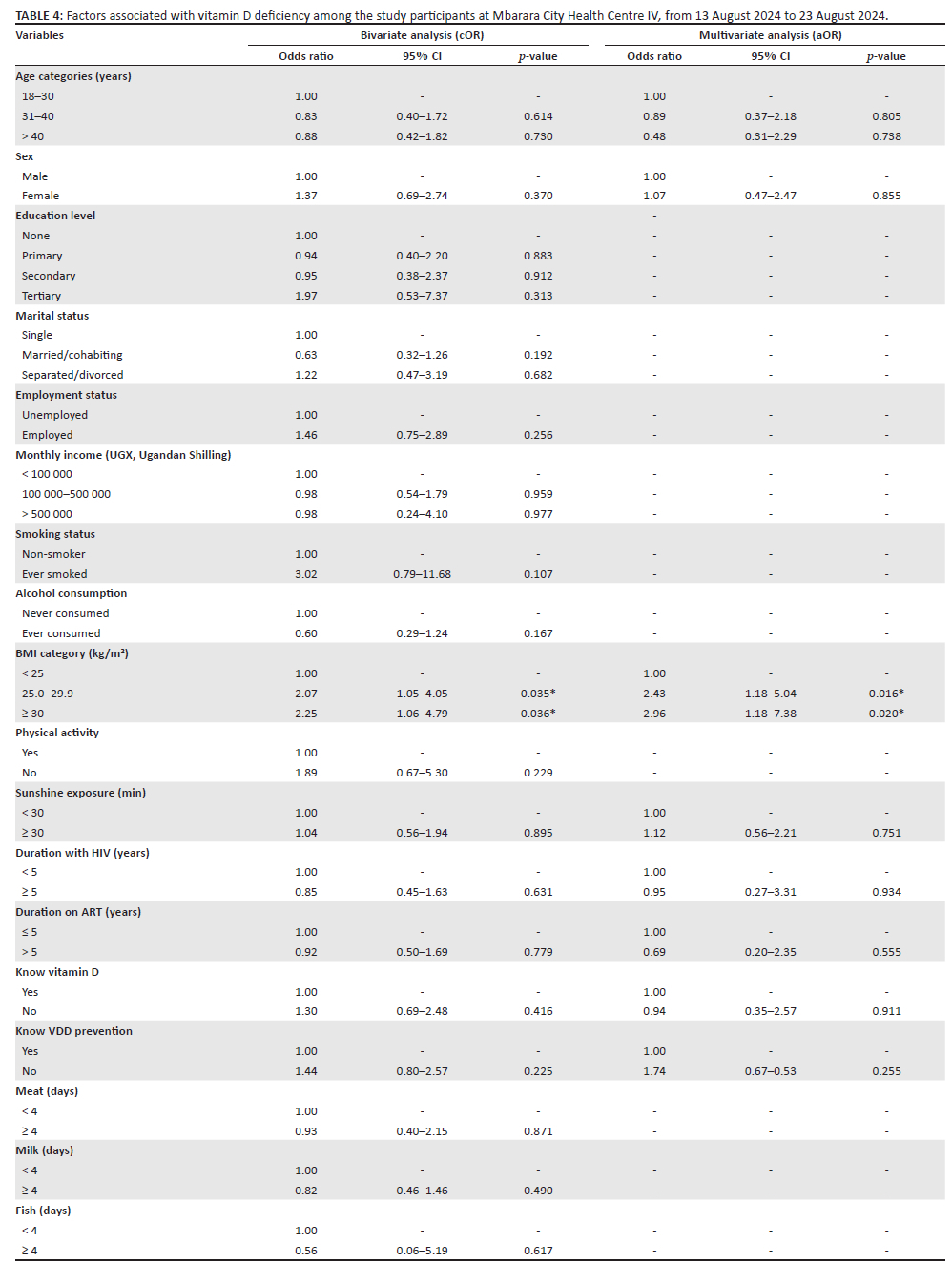
Participants' characteristics were grouped by the presence of VDD. A significant difference was observed with BMI, where a higher proportion of individuals with VDD had a BMI of 25 kg/m2p < 0.05). No significant differences were found in median age, sex, marital status, or employment status between those with and without VDD. Other factors, such as smoking, alcohol consumption, physical activity, and biochemical variables, such as total cholesterol, HDL cholesterol, and LDL cholesterol levels, also did not show significant differences between the two groups (p > 0.05) (Table 1, Table 2 and Table 3).
Prevalence of VDD among HIV patients at Mbarara City Health Centre IV
Out of the 218 study participants, 66 had Vitamin D levels < 25 ng/mL, giving an overall prevalence of VDD of 30.3%, with a 95%CI of 24.51% - 36.73%, as indicated in Figure 1.
Factors associated with VDD among HIV patients at Mbarara City Health Centre IV
After adjustment for confounding effects at multivariate logistic regression analysis, having a BMI of 25-29.9 kg/m2p-value: 0.016), having a BMI of > 30 kg/m2p-value: 0.020), and having a CRP level of > 5 mg/L (aOR: 2.29 (95%CI: 1.04-5.03; p-value: 0.039), were significantly associated with VDD (Table 4).
Discussion
Prevalence of VDD among HIV patients at Mbarara City Health Centre IV
The prevalence of VDD in this study was found to be 30.3% among HIV-positive persons. This prevalence is relatively lower than what has been reported in various studies globally, but still highlights a significant public health concern, as VDD is recognised as a global health issue, with widespread prevalence both in developed and developing countries.719
In comparison to global data, our study's prevalence of 30.3% is markedly lower than that from a review study that was found to range from 70.3% to 83.7% after grading it by country.7
Our prevalence is also lower than the 60% - 77% VDD prevalence reported in HIV-positive patients in the United States whose study population was only HIV-positive men,201321222324
The prevalence we observed aligns more closely with the data from East Africa, where a Kenyan study reported 6.3% of patients as vitamin D deficient, with 29.7% experiencing insufficiency.25262728
A study that was conducted by the Infectious Disease Institute in Uganda found a baseline prevalence of 17% among HIV-infected adults, which was significantly lower than our findings.154,5,6
Factors associated with VDD among HIV patients at Mbarara City Health Centre IV
Our study found that higher BMI categories were significantly associated with VDD among HIV-positive individuals. Specifically, individuals with a BMI of 25-29.9 kg/m22
These findings align with previous research, indicating that both being overweight and obesity are linked to an increased risk of VDD in the context of HIV infection.29,30,313233
Our study also identified a significant association between VDD and elevated CRP levels (> 5 mg/L aOR: 2.29) in HIV-positive individuals, indicating that VDD is linked to increased inflammation. This finding is consistent with existing research, which has shown that VDD in HIV patients is associated with greater inflammation and immune dysfunction.7,337
Our results align closely with those of Manion et al.,9343536
Study limitations
This was a cross-sectional study, therefore the cause-effect relationship between the exposure variables; overweight, obesity, and elevated CRP with the outcome variable VDD remain unclear.
Recommendations
We recommend routine screening for VDD among HIV-infected persons with elevated CRP and BMI. Nutritional support, including vitamin D supplementation and dietary counselling, could be integrated into HIV care programmes to address VDD. A prospective study should be conducted to further investigate the risk of developing VDD among HIV patients that are overweight, obese, and those with elevated CRP levels.
Conclusion
The study found a 30.3% prevalence of VDD among HIV-positive individuals at Mbarara City Health Centre IV. Key associated factors included higher BMI and elevated inflammation (CRP levels). Our study underscores the importance of addressing both obesity and inflammation in the management of HIV-infected persons.
This article is based on research originally conducted as part of Jazira Tumusiime's master's thesis titled 'Vitamin D deficiency and its associated factors among HIV patients at Mbarara City Health Centre IV, South Western Uganda' submitted to the Faculty of Medicine, Mbarara University of Science and Technology, in 2025. The thesis is currently unpublished and not publicly available. The thesis was supervised by Frank Ssedyabane, Winnie R. Muyindike, Ritah Kiconco, and Simon P. Rugera. The manuscript has been revised and adapted for journal publication. The author confirms that the content has not been previously published or disseminated and complies with ethical standards for original publication.
Competing interests
The authors declare that they have no financial or personal relationships that may have inappropriately influenced them in writing this article.
Authors' contributions
J.T., C.N.B., D.N., E.S., B.R., F.S., W.R.M., R.K., and S.P.R. contributed equally to the conceptualisation, writing, and editing of the article, and share first authorship. All authors contributed to the article, discussed the results, and approved the final version for submission and publication.
Sources of support
This research received no specific grant from and funding agency in the public, commercial or not-for-profit-sectors.
Data availability
The data that support the findings of this study are not openly available due to reasons of sensitivity and are available from the corresponding author, J.T., upon reasonable request.
Disclaimer
The views and opinions expressed in this article are those of the authors and are the product of professional research. The article does not necessarily reflect the official policy or position of any affiliated institution, funder, agency, or that of the publisher. The authors are responsible for this article's results, findings, and content.
Acknowledgements
The authors would like to thank the Director, the In-charge ART clinic, the laboratory staff and the ART clinic staff at Mbarara City Health Centre IV for their technical support throughout the period of data collection.
References
-
1.World Health Organization. HIV and AIDS 2023 [homepage on the Internet]. 2023 [cited 2023 Jul 13]. Available from: https://www.who.int/news-room/fact-sheets/detail/hiv-aids?gclid=CjwKCAjw7oeqBhBwEiwALyHLMzPDXypj2invtQn7G-_XTYhZnmTyjvLo9OtH9lwaOxo6ijsg_6t6FBoC0YwQAvD_BwE
» https://www.who.int/news-room/fact-sheets/detail/hiv-aids?gclid=CjwKCAjw7oeqBhBwEiwALyHLMzPDXypj2invtQn7G-_XTYhZnmTyjvLo9OtH9lwaOxo6ijsg_6t6FBoC0YwQAvD_BwE -
2.Forsythe SS, McGreevey W, Whiteside A, et al. Twenty years of antiretroviral therapy for people living with HIV: Global costs, health achievements, economic benefits. Health Affs. 2019;38(7):1163-1172. https://doi.org/10.1377/hlthaff.2018.05391
» https://doi.org/10.1377/hlthaff.2018.05391 -
3.Lu D-Y, Wu H-Y, Yarla NS, Xu B, Ding J, Lu T-R. HAART in HIV/AIDS treatments: Future trends. Infect Disord Drug Targets. 2018;18(1):15-22. https://doi.org/10.2174/1871526517666170505122800
» https://doi.org/10.2174/1871526517666170505122800 -
4.Jiménez-Sousa MÁ, Martínez I, Medrano LM, Fernández-Rodríguez A, Resino S. Vitamin D in human immunodeficiency virus infection: Influence on immunity and disease. Front Immunol. 2018;9:458. https://doi.org/10.3389/fimmu.2018.00458
» https://doi.org/10.3389/fimmu.2018.00458 -
5.Chokuda E, Reynolds C, Das S. Association of low vitamin D with complications of HIV and AIDS: A literature review. Infect Disord Drug Targets. 2020;20(2):122-142. https://doi.org/10.2174/1871526519666181221122731
» https://doi.org/10.2174/1871526519666181221122731 -
6.Sun M, Wu X, Yu Y, et al. Disorders of calcium and phosphorus metabolism and the proteomics/metabolomics-based research. Front Cell Dev Biol. 2020;8:576110. https://doi.org/10.3389/fcell.2020.576110
» https://doi.org/10.3389/fcell.2020.576110 -
7.Mansueto P, Seidita A, Vitale G, Gangemi S, Iaria C, Cascio A. Vitamin D deficiency in HIV infection: Not only a bone disorder. BioMed Res Int. 2015;2015:735615. https://doi.org/10.1155/2015/735615
» https://doi.org/10.1155/2015/735615 -
8.Visuthranukul J, Phansuea P, Buranakityanon P, Lerdrungroj P, Yamasmith E. Prevalence and risk factors of vitamin D deficiency among living with HIV adults receiving antiretroviral treatment in tropical area: Cross-sectional study. Heliyon. 2023;9(9):e19537. https://doi.org/10.1016/j.heliyon.2023.e19537
» https://doi.org/10.1016/j.heliyon.2023.e19537 -
9.Manion M, Hullsiek KH, Wilson EM, et al. Vitamin D deficiency is associated with IL-6 levels and monocyte activation in HIV-infected persons. PLoS One. 2017;12(5):e0175517. https://doi.org/10.1371/journal.pone.0175517
» https://doi.org/10.1371/journal.pone.0175517 -
10.Escota GV, Cross S, Powderly WG. Vitamin D and calcium abnormalities in the HIV-infected population. Endocrinol Metab Clin North Am. 2014;43(3):743-767. https://doi.org/10.1016/j.ecl.2014.05.005
» https://doi.org/10.1016/j.ecl.2014.05.005 -
11.Lambert AA, Drummond MB, Mehta SH, et al. Risk factors for vitamin D deficiency among HIV-infected and uninfected injection drug users. PLoS One. 2014;9(4):e95802. https://doi.org/10.1371/journal.pone.0095802
» https://doi.org/10.1371/journal.pone.0095802 -
12.Sudjaritruk T, Bunupuradah T, Aurpibul L, et al. Impact of tenofovir disoproxil fumarate on bone metabolism and bone mass among perinatally HIV-infected Asian adolescents. Antivir Ther. 2017;22(6):471-479. https://doi.org/10.3851/IMP3103
» https://doi.org/10.3851/IMP3103 -
13.Allavena C, Delpierre C, Cuzin L, et al. High frequency of vitamin D deficiency in HIV-infected patients: Effects of HIV-related factors and antiretroviral drugs. J Antimicrob Chemother. 2012;67(9):2222-2230. https://doi.org/10.1093/jac/dks176
» https://doi.org/10.1093/jac/dks176 -
14.Gichuhi CW. Serum vitamin D levels in human immunodeficiency virus infected patients attending Aga Khan University Hospital. Nairobi: Jesuit Historical Institute in Africa (JHIA); 2015. Available from: http://thesisbank.jhia.ac.ke/id/eprint/964
» http://thesisbank.jhia.ac.ke/id/eprint/964 -
15.Ezeamama AE, Guwatudde D, Wang M, et al. Vitamin-D deficiency impairs CD4+ T-cell count recovery rate in HIV-positive adults on highly active antiretroviral therapy: A longitudinal study. J Clin Nutr. 2016;35(5):1110-1117. https://doi.org/10.1016/j.clnu.2015.08.007
» https://doi.org/10.1016/j.clnu.2015.08.007 -
16.Xie K, Zhang Y, Zhang M, et al. Association of vitamin D with HIV infected individuals, TB infected individuals, and HIV-TB co-infected individuals: A systematic review and meta-analysis. Front Public Health. 2024;12:1344024. https://doi.org/10.3389/fpubh.2024.1344024
» https://doi.org/10.3389/fpubh.2024.1344024 -
17.Ali Ewune H, Daka K, Bekele B, Meskele M. Challenges to nutrition management among patients using antiretroviral therapy in primary health 'centres' in Addis Ababa, Ethiopia: A phenomenological study. PLos One. 2021;16(6):e0250919. https://doi.org/10.1371/journal.pone.0250919
» https://doi.org/10.1371/journal.pone.0250919 -
18.Conesa-Botella A, Goovaerts O, Massinga-Loembé M, et al. Low prevalence of vitamin D deficiency in Ugandan HIV-infected patients with and without tuberculosis. Int J Tuberc Lung Dis. 2012;16(11):1517-1521. https://doi.org/10.5588/ijtld.11.0146
» https://doi.org/10.5588/ijtld.11.0146 - 19.Pinzone M, Di Rosa M, Malaguarnera M, et al. Vitamin D deficiency in HIV infection: An underestimated and undertreated epidemic. Eur Rev Med Pharmacol Sci. 2013;17(9):1218-1232.
-
20.Wasserman P, Rubin DS. Highly prevalent vitamin D deficiency and insufficiency in an urban cohort of HIV-infected men under care. AIDS Patient Care STDs. 2010;24(4):223-227. https://doi.org/10.1089/apc.2009.0241
» https://doi.org/10.1089/apc.2009.0241 -
21.Ames BN, Grant WB, Willett WC. Does the high prevalence of vitamin D deficiency in African Americans contribute to health disparities? Nutrients. 2021;13(2):499. https://doi.org/10.3390/nu13020499
» https://doi.org/10.3390/nu13020499 - 22.Aftab S, Butt NI, Ashfaq F, Malik T, Arshad R, Anser A. Prevalence of vitamin D deficiency in HIV/AIDS patients. RMJ. 2020;45(3):545-548.
-
23.Theodorou M, Sersté T, Van Gossum M, Dewit S. Factors associated with vitamin D deficiency in a population of 2044 HIV-infected patients. J Clin Nutr. 2014;33(2):274-279. https://doi.org/10.1016/j.clnu.2013.04.018
» https://doi.org/10.1016/j.clnu.2013.04.018 -
24.Viard J-P, Souberbielle J-C, Kirk O, et al. Vitamin D and clinical disease progression in HIV infection: results from the EuroSIDA study. AIDS. 2011;25(10):1305-1315. https://doi.org/10.1097/QAD.0b013e328347f6f7
» https://doi.org/10.1097/QAD.0b013e328347f6f7 - 25.Wambui A, Odhiambo A, Achieng L, Otieno CF, Bhatt SM. Prevalence of vitamin D deficiency in adult human immunodeficiency virus infected persons at District Hospital in Nairobi, Kenya. IOSR J Dent Med Sci. 2018;17(3):70-75.
- 26.Jones G, Prosser DE, Kaufmann M. The activating enzymes of vitamin D metabolism (25-and 1α-hydroxylases). In: Feldman D, editor. Vitamin D. 4th ed. Kingston: Elsevier, Academic Press; 2018, p. 57-79.
-
27.Piloya TW, Bakeera-Kitaka S, Kisitu GP, Idro R, Cusick SE. Vitamin D status and associated factors among HIV-infected children and adolescents on antiretroviral therapy in Kampala, Uganda. PLos One. 2021;16(6):e0253689. https://doi.org/10.1371/journal.pone.0253689
» https://doi.org/10.1371/journal.pone.0253689 -
28.Antonucci R, Locci C, Clemente MG, Chicconi E, Antonucci L. Vitamin D deficiency in childhood: Old lessons and current challenges. J Pediatr Endocrinol Metab. 2018;31(3):247-260. https://doi.org/10.1515/jpem-2017-0391
» https://doi.org/10.1515/jpem-2017-0391 -
29.Canuto JMP, Canuto VMP, Lima MHAd, et al. Risk factors associated with hypovitaminosis D in HIV/aids-infected adults. Arch Endocrinol Metab. 2015;59:34-41. https://doi.org/10.1590/2359-3997000000007
» https://doi.org/10.1590/2359-3997000000007 -
30.Crutchley RD, Gathe Jr J, Mayberry C, Trieu A, Abughosh S, Garey KW. Risk factors for vitamin D deficiency in HIV-infected patients in the south central United States. AIDS Res. 2012;28(5):454-459. https://doi.org/10.1089/aid.2011.0025
» https://doi.org/10.1089/aid.2011.0025 -
31.Mueller NJ, Fux CA, Ledergerber B, et al. High prevalence of severe vitamin D deficiency in combined antiretroviral therapy-naive and successfully treated Swiss HIV patients. AIDS. 2010;24(8):1127-1134. https://doi.org/10.1097/QAD.0b013e328337b161
» https://doi.org/10.1097/QAD.0b013e328337b161 -
32.Jawad IH, Baiee HA. Prevalence of vitamin D deficiency and its correlate with overweight and obesity in community-dwelling old adults. Med J Babylon. 2020;17(1):36-40. https://doi.org/10.4103/MJBL.MJBL_98_19
» https://doi.org/10.4103/MJBL.MJBL_98_19 -
33.Wang Y, Huang X, Wu Y, et al. Increased risk of vitamin D deficiency among HIV-infected individuals: A systematic review and meta-analysis. Front Nutr. 2021;8:722032. https://doi.org/10.3389/fnut.2021.722032
» https://doi.org/10.3389/fnut.2021.722032 -
34.Ansemant T, Mahy S, Piroth C, et al. Severe hypovitaminosis D correlates with increased inflammatory markers in HIV infected patients. BMC Infect Dis. 2013;13:1-7. https://doi.org/10.1186/1471-2334-13-7
» https://doi.org/10.1186/1471-2334-13-7 -
35.Shepherd L, Souberbielle J-C, Bastard J-P, et al. Prognostic value of vitamin D level for all-cause mortality, and association with inflammatory markers, in HIV-infected persons. J Infect Dis. 2014;210(2):234-243. https://doi.org/10.1093/infdis/jiu074
» https://doi.org/10.1093/infdis/jiu074 -
36.Hoffman RM, Lake JE, Wilhalme HM, Tseng C-H, Currier JS. Vitamin D levels and markers of inflammation and metabolism in HIV-infected individuals on suppressive antiretroviral therapy. AIDS Res. 2016;32(3):247-254. https://doi.org/10.1089/aid.2015.0200
» https://doi.org/10.1089/aid.2015.0200

Accepted: 30 Sept. 2025
Published: 10 Dec. 2025