Appropriate use of plasma glucose tests for diagnosis of diabetes mellitus in Ibadan, Nigeria
Abstract
BACKGROUND: Diabetes mellitus is a growing epidemic in Africa. Its diagnosis relies exclusively on laboratory evidence, which differs based on clinical circumstances. OBJECTIVE: The study described the appropriateness of plasma glucose test requests per the American Diabetes Association criteria. METHODS: We reviewed the plasma glucose test requests received by the chemical pathology laboratory of the University College Hospital, Ibadan, Nigeria between June 2018 and November 2018. The American Diabetes Association diabetes diagnostic criteria were used to define the appropriateness of test requests and determine the potential for ill-informed clinical decisions. RESULTS: Four hundred and twenty-three requisition forms were included, with the majority from the medical wards/clinics (72.3%); the most frequent reason for a plasma glucose test was systemic hypertension (28.6%). Fasting plasma glucose was most requested (254; 60.0%). One hundred and sixteen (27.4%) requests were potentially inappropriate, with the 2-h postprandial plasma glucose (2hPPG) test requests (83; 71.6%) being the most inappropriate. The difference in the proportion of inappropriate requests was not statistically significantly between medical or surgical wards/clinics (Odds ratio 1.131, 95% confidence interval 0.709-1.803, p = 0.605). Inappropriate requests in six cases may have triggered inappropriate action. CONCLUSION: A third of the glucose tests requested for querying diabetes mellitus may have been inappropriate. Results of such testing may trigger inappropriate clinical action. To improve the quality of care and for economic reasons, laboratories should have programmes to improve the appropriate use of their services.
diabetes mellitus; glucose; utilisation management; laboratory; guidelines; fasting; postprandial; random
Introduction
The socio-economic burden of a diabetes mellitus (DM) diagnosis is substantial for persons in low and middle-income countries relative to persons in higher-income countries.123,4,56
One of the fundamental requirements for appropriate public health response to this epidemic is accurate diagnosis of DM. The diagnosis of DM relies exclusively on biochemical evidence of a specific degree of glucose intolerance. The current accepted diagnostic criteria for DM in the non-pregnant adult were initially published by the American Diabetes Association in 1998 and were adopted by the World Health Organization in 1999.7,8910
The study aimed to determine the appropriateness of the glucose test requests per the American Diabetes Association DM diagnosis criteria.11
Methods
Ethical considerations
Ethical approval was obtained from the University of Ibadan/University College Hospital Ethics Committee with a National Health Research Ethics Committee NHREC/05/01/2008a. The ethical committee assigned number for the study was UI/EC/19/0630. This was an analysis of secondary data and did not retrieve any patient-identifiable information or involve contact with any human participants. Patient consent was therefore not required. All glucose results were anonymised from patient details and study numbers accessible only to the researchers were used during analysis.
Study setting
The University College Hospital, Ibadan is a public tertiary hospital located in an urban setting in the South Western region of Nigeria. The hospital is served by a Chemical Pathology laboratory that receives about 33 000 samples annually, including blood, urine, and cerebrospinal, ascitic and pleural fluids. Tests provided include those assessing for renal, liver, metabolic, endocrine, and neoplastic diseases. For a non-pregnant adult, the laboratory offers two stand-alone glucose tests - FPG and RPG - as well as two glucose profiles - FPG/2hPPG and FPG/2hPLG.
Study design
This cross-sectional study reviewed all request forms from the wards/clinics of the hospital from June and November 2018 for plasma glucose tests. To be included in this study, the section for clinical information was required to contain information about the patient such as presenting symptoms, signs, working diagnosis, or treatment. Any form with no clinical information or with clear information that the patient was previously diagnosed as having DM was excluded.
-
Definition of test request inappropriateness
The appropriateness of the tests was defined using the American Diabetes Association DM diagnostic criteria (Box 1).12
All 2hPPGtest requests.
All RPG test requests in which the clinical details on the requisition form included none of the classic symptoms of DM (polyuria, polydipsia, and weight loss).

The potential for inappropriate clinical action was deemed to be present if:
The result of an inappropriately requested RPG exceeded 11.1 mmol/L, and/or
The FPG was < 7.1 mmol/L and the 2hPPG was > 11.1 mmol/L.
Data analysis
Statistical analysis was performed using IBM® Statistical Package for Social Sciences (SPSS®) version 25 (2017, IBM Corp, Armonk, New York, United States). Proportions are presented as numbers (percent) and were compared using the chi-square test. Results were considered significant if p was 0.05 or less, with a 95% confidence interval.
Results
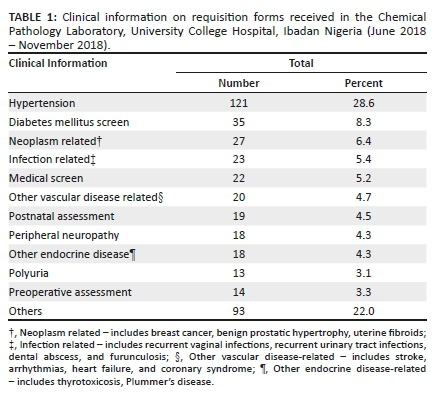
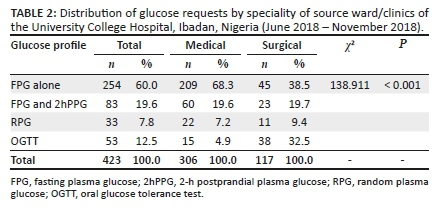
Four hundred and twenty-three request forms satisfied the inclusion criteria. Medical outpatient clinics and wards accounted for 306 (72.3%) of these requests. Overall, the most common reason for a glucose test request was to evaluate systemic hypertension (Table 1). The surgical clinics and wards most commonly requested a glucose test for evaluating neoplastic disease (benign or malignant). A one-off FPG was the most requested glucose test in both specialities, accounting for 254 (60.0%) of all requests (Table 2). The usage pattern for the different tests/profiles was significantly different between both specialities (X2p < 0.001]); the surgical specialities requested more OGTT, mostly for postnatal assessment of persons with previous gestational DM.
The FPG level was normal (< 5.5 mmol/L) in 77.7% (303) of cases, impaired (5.5 mmol/L - 6.9 mmol/L) in 15.1% (n = 59), and diabetic (≥ 7.0 mmol/L) in 7.2% (n = 28). The glucose level was < 11.1 mmol/L for 88% (n = 73) 2hPPG, 88.7% (n = 47) 2-h OGTT and 100% (n = 33) RPG requests.
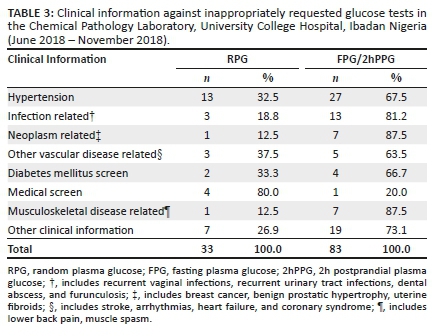
One hundred and sixteen (27.4%) of the test requests were potentially inappropriate, comprising 83 (71.6%) requests for FPG/2hPPG and 33 (28.4%) requests for RPG (Table 3). All of the OGTT requests were appropriate. Inappropriate test requests from the medical wards and clinics (n = 82; 70.7%) were higher than those from the surgical wards and clinics (48 tests; p = -0.629) (Table 2). Of the 83 inappropriately requested FPG/2hPPG, the FPG was < 7 mmol/L while the 2hPPG was > 11.1 mmol/L in 6 (7.2%) cases. The FPG and accompanying 2hPPG were < 7 mmol/L and < 11.1 mmol/L in 71 (85.5%) cases. Fasting plasma glucose > 7 mmol/L/2hPPG < 11.1 mmol/L was seen in one case and FPG > 7 mmol/L/2hPPG > 11.1 mmol/L was seen in another five cases.
Discussion
Despite the annual publication of the American Diabetes Association standards for the laboratory diagnosis of DM for over 20 years, this study provides evidence that there exists a need to increase the uptake of its recommendations in routine practice in our setting. Nearly one out of every three requests for glucose tests, in our setting, was found to be potentially inappropriate. Inappropriate requests were mostly due to requests for 2hPPG as a DM screening test. Reports from both Nigeria and Cameroon indicate that primary care physicians, who represent the bulk of physicians providing DM screening and care, have poor knowledge of the diabetes clinical guideline criteria.13,1413,14
The primary consequence of an inappropriate glucose test is the waste of the patient's money for an unnecessary test. The wastage is particularly costly in a region where most patients are uninsured and thus pay out of pocket.1516, 17
A further consequence of inappropriate testing is a false negative test result. As observed in this study, the majority of the requests for RPG returned values below a 'diagnostic' threshold. There is no guarantee that the screened patients were all glucose tolerant. Reports suggest that the sensitivity of an RPG value greater than or equal to 7 mmol/L for identifying asymptomatic persons with DM may be less than 70%.18,19
We examined whether the requests from surgical wards and clinics were more likely to be inappropriate compared to those from medical wards and clinics. Reports suggest that certain practices by surgeons may increase the likelihood of inappropriate test requests. Charani et al.2021,22
We also note that, although a 2hPPG > 11.1 mmol/L may be suggestive of the presence of DM, it may not be used as conclusive evidence of the disease, as current criteria for DM diagnosis do not include it. Glycaemia > 11.1 mmol/L may be observed as part of a physiologic stress response.23
The present study has demonstrated that a significant percentage of requests for plasma glucose, a routine and frequently test, may be inappropriate. Similarly, estimates from a teaching hospital in Austria suggest that as many as 60% - 70% of high throughput tests such as potassium and lactate dehydrogenase may have been ordered inappropriately or in clinical situations where they had only minor relevance.242526
Predictably, a system to manage physician test utilisation has value for patients, the physicians, and the health care system, with significant positive yields in quality of care and economic savings.27,282930,31 These approaches include the use of utilisation audits, as in the current study, analytical algorithms, test guidelines, formularies and, where applicable, clinical decision support systems and changes to computerised provider order entry. Implementing utilisation management initiatives requires the collaboration of key stakeholders, including pathologists, laboratorians and other professionals who contribute to the health care process.2828,32,33
Limitations
The study was limited by its reliance on the information included in the submitted requisition forms. This information may not have correctly reflected the entire clinical status of the patient being evaluated.
Conclusion
In conclusion, we have demonstrated the suboptimal usage of glucose tests in DM screening, with the speciality of the requesting physician as a potential factor. This provides evidence that laboratories should engage in programmes, such as standard diagnosis awareness campaigns, directed at improving the appropriate use of their services.
Competing interests
The authors declare that they have no financial or personal relationships that may have inappropriately influenced them in writing this article.
Authors' contributions
M.A.K. conceived the article and analysed the data; O.T.B. and C.T.U. conceived the article and collected the data; all authors were involved in writing and approval of the manuscript.
Sources of support
This research received no specific grant from any funding agency in the public, commercial or not-for-profit sectors.
Data availability
Due to the nature of this research, participants of this study did not agree for their data to be shared publicly, so supporting data is not available.
Disclaimer
The views and opinions expressed in this article are those of the authors and do not necessarily reflect the official policy or position of any affiliated agency of the authors.
Acknowledgements
References
-
1. Seuring T, Archangelidi O, Suhrcke M. The economic costs of type 2 diabetes: A global systematic review. Pharmacoeconomics. 2015;33(8):811-831. https://doi.org/10.1007/s40273-015-0268-9
» https://doi.org/10.1007/s40273-015-0268-9 -
2. Bermudez-Tamayo C, Besançon S, Johri M, Assa S, Brown JB, Ramaiya K. Direct and indirect costs of diabetes mellitus in Mali: A case-control study. PLoS One. 2017;12(5):e0176128. https://doi.org/10.1371/journal.pone.0176128
» https://doi.org/10.1371/journal.pone.0176128 -
3. Peer N, Steyn K, Lombard C, Lambert EV, Vythilingum B, Levitt NS. Rising diabetes prevalence among urban-dwelling Black South Africans. PLoS One. 2012;7(9):e43336. https://doi.org/10.1371/journal.pone.0043336
» https://doi.org/10.1371/journal.pone.0043336 -
4. Ploubidis GB, Mathenge W, De Stavola B, Grundy E, Foster A, Kuper H. Socioeconomic position and later life prevalence of hypertension, diabetes and visual impairment in Nakuru, Kenya. Int J Public Health. 2013;58(1):133-141. https://doi.org/10.1007/s00038-012-0389-2
» https://doi.org/10.1007/s00038-012-0389-2 -
5. Echouffo-Tcheugui JB, Dzudie A, Epacka ME, et al. Prevalence and determinants of undiagnosed diabetes in an urban sub-Saharan African population. Prim Care Diabetes. 2012;6(3):229-234. https://doi.org/10.1016/j.pcd.2012.05.002
» https://doi.org/10.1016/j.pcd.2012.05.002 -
6. Atun R, Davies JI, Gale EAM, et al. Diabetes in sub-Saharan Africa: From clinical care to health policy. Lancet Diabetes Endocrinol. 2017;5(8):622-667. https://doi.org/10.1016/S2213-8587(17)30181-X
» https://doi.org/10.1016/S2213-8587(17)30181-X -
7. Gavin JR, Alberti KGMM, Davidson MB, et al. Report of the expert committee on the diagnosis and classification of diabetes mellitus. Diabetes Care. 1998;21(Suppl 1):S5-S19. https://doi.org/10.2337/diacare.21.1.S5
» https://doi.org/10.2337/diacare.21.1.S5 -
8. Alberti KGMM, Zimmet PZ, Consultation WHO. Definition, diagnosis and classification of diabetes mellitus and its complications. Part 1: Diagnosis and classification of diabetes mellitus. Provisional report of a WHO Consultation. Diabet Med. 1998;15(7):539-553. https://doi.org/10.1002/(SICI)1096-9136(199807)15:7%3C539::AID-DIA668%3E3.0.CO;2-S
» https://doi.org/10.1002/(SICI)1096-9136(199807)15:7%3C539::AID-DIA668%3E3.0.CO;2-S -
9. American Diabetes Association. Diagnosis and classification of diabetes mellitus. Diabetes Care. 2010;33(Suppl 1):S62-S69. https://doi.org/10.2337/dc10-S062
» https://doi.org/10.2337/dc10-S062 -
10. Abougalambou SSI, Ahmed NO, Abougalambou AS. A study evaluating the postprandial plasma glucose control among type 2 diabetes patients attending a teaching hospital in Malaysia. Diabetes Metab Syndr Clin Res Rev. 2017;11:S445-S449. https://doi.org/10.1016/j.dsx.2017.03.033
» https://doi.org/10.1016/j.dsx.2017.03.033 -
11. American Diabetes Association. Classification and diagnosis of diabetes: Standards of medical care in Diabetes 2018. Diabetes Care. 2018;41(Suppl 1):S13-S27. https://doi.org/10.2337/dc18-S002
» https://doi.org/10.2337/dc18-S002 -
12. American Diabetes Association. Standards of medical care in diabetes - 2013. Diabetes Care. 2013;36(Suppl 1):S11-S66. https://doi.org/10.2337/dc13-S011
» https://doi.org/10.2337/dc13-S011 -
13. Jingi AM, Nansseu JRN, Noubiap JJN. Primary care physicians' practice regarding diabetes mellitus diagnosis, evaluation and management in the West region of Cameroon. BMC Endocr Disord. 2015;15(1):18. https://doi.org/10.1186/s12902-015-0016-3
» https://doi.org/10.1186/s12902-015-0016-3 -
14. Ugwu E, Young E, Nkpozi M. Diabetes care knowledge and practice among primary care physicians in Southeast Nigeria: A cross-sectional study. BMC Fam Pract. 2020;21(1):128. https://doi.org/10.1186/s12875-020-01202-0
» https://doi.org/10.1186/s12875-020-01202-0 -
15. Okebukola PO, Brieger WR. Providing universal health insurance coverage in Nigeria. Int Q Commun Health Educ. 2016;36(4):241-246. https://doi.org/10.1177/0272684X16657451
» https://doi.org/10.1177/0272684X16657451 -
16. Horton S, Fleming KA, Kuti M, et al. The top 25 laboratory tests by volume and revenue in five different countries. Am J Clin Pathol. 2019;151(5):446-451. https://doi.org/10.1093/ajcp/aqy165
» https://doi.org/10.1093/ajcp/aqy165 -
17. Moloney TW, Rogers DE. Medical technology - A different view of the contentious debate over costs. N Engl J Med. 1979;301(26):1413-1419. https://doi.org/10.1056/NEJM197912273012603
» https://doi.org/10.1056/NEJM197912273012603 -
18. Qiao Q, Keinänen-Kiukaanniemi S, Rajala U, Uusimäki A, Kivelä SL. Random capillary whole blood glucose test as a screening test for diabetes mellitus in a middle-aged population. Scand J Clin Lab Invest. 1995;55(1):3-8. https://doi.org/10.3109/00365519509075372
» https://doi.org/10.3109/00365519509075372 -
19. Simmons D, Williams DR. Random blood glucose as a screening test for diabetes in a bi-ethnic population. Diabet Med. 1994;11(9):830-835. https://doi.org/10.1111/j.1464-5491.1994.tb00364.x
» https://doi.org/10.1111/j.1464-5491.1994.tb00364.x -
20. Charani E, Ahmad R, Rawson TM, Castro-Sanchèz E, Tarrant C, Holmes AH. The differences in antibiotic decision-making between acute surgical and acute medical teams: An ethnographic study of culture and team dynamics. Clin Infect Dis. 2019;69(1):12-20. https://doi.org/10.1093/cid/ciy844
» https://doi.org/10.1093/cid/ciy844 -
21. Mughal Z, Narayanan A, Gupta V, Reay-Jones N. Clinical need-directed blood tests: A step in saving the NHS? Ann Clin Biochem. 2016;53(5):568-574. https://doi.org/10.1177/0004563215617782
» https://doi.org/10.1177/0004563215617782 -
22. Chu KH, Wagholikar AS, Greenslade JH, O'Dwyer JA, Brown AF. Sustained reductions in emergency department laboratory test orders: Impact of a simple intervention. Postgrad Med J. 2013;89(1056):566-571. https://doi.org/10.1136/postgradmedj-2012-130833
» https://doi.org/10.1136/postgradmedj-2012-130833 -
23. Dungan KM, Braithwaite SS, Preiser JC. Stress hyperglycaemia. Lancet. 2009;373(9677):1798-1807. https://doi.org/10.1016/S0140-6736(09)60553-5
» https://doi.org/10.1016/S0140-6736(09)60553-5 -
24. Cadamuro J, Gaksch M, Wiedemann H, et al. Are laboratory tests always needed? Frequency and causes of laboratory overuse in a hospital setting. Clin Biochem. 2018;54:85-91. https://doi.org/10.1016/j.clinbiochem.2018.01.024
» https://doi.org/10.1016/j.clinbiochem.2018.01.024 -
25. Van Walraven C, David Naylor C. Do we know what inappropriate laboratory utilization is? A systematic review of laboratory clinical audits. J Am Med Assoc. 1998;280(6):550-558. https://doi.org/10.1001/jama.280.6.550
» https://doi.org/10.1001/jama.280.6.550 -
26. Gandhi TK, Kachalia A, Thomas EJ, et al. Missed and delayed diagnoses in the ambulatory setting: A study of closed malpractice claims. Ann Intern Med. 2006;145(7):488-496. https://doi.org/10.7326/0003-4819-145-7-200610030-00006
» https://doi.org/10.7326/0003-4819-145-7-200610030-00006 -
27. Plebani M, Zaninotto M, Faggian D. Utilization management: A European perspective. Clin Chim Acta. 2014;427:137-141. https://doi.org/10.1016/j.cca.2013.03.002
» https://doi.org/10.1016/j.cca.2013.03.002 -
28. Reichard KK, Wood AJ. Laboratory test utilization management. General principles and applications in hematopathology. Surg Pathol Clin. 2016;9(1):1-10. https://doi.org/10.1016/j.path.2015.10.002
» https://doi.org/10.1016/j.path.2015.10.002 -
29. Whiting P, Toerien M, De Salis I, et al. A review identifies and classifies reasons for ordering diagnostic tests. J Clin Epidemiol. 2007;60(10):981-989. https://doi.org/10.1016/j.jclinepi.2007.01.012
» https://doi.org/10.1016/j.jclinepi.2007.01.012 -
30. Wilson ML. Decreasing inappropriate laboratory test utilization controlling costs and improving quality of care. Am J Clin Pathol. 2015;143(5):614-616. https://doi.org/10.1309/AJCPHQODM9XYWLZ9
» https://doi.org/10.1309/AJCPHQODM9XYWLZ9 -
31. Baird G. The laboratory test utilization management toolbox. Biochem Medica. 2014;24(2):223-234. https://doi.org/10.11613/BM.2014.025
» https://doi.org/10.11613/BM.2014.025 -
32. Zhao X, Bo L, Zhao H, Li L, Zhou Y, Wang H. Descriptive study of the relationship between the subclinical carotid disease and biomarkers, carotid femoral pulse wave velocity in patients with hypertension. Clin Exp Hypertens. 2018;40(3):274-280. https://doi.org/10.1080/10641963.2017.1368537
» https://doi.org/10.1080/10641963.2017.1368537 -
33. Ducatman BS, Ducatman AM, Crawford JM, Laposata M, Sanfilippo F. The value proposition for pathologists: A population health approach. Acad Pathol. 2020;7. https://doi.org/10.1177/2374289519898857
» https://doi.org/10.1177/2374289519898857
Accepted: 07 Feb. 2022
Published: 29 Apr. 2022