Will long-read sequencing technologies replace short-read sequencing technologies in the next 10 years?
Boluwatife A. AdewaleI, II, III
IMedicine and Surgery, Faculty of Clinical Sciences, College of Medicine, University of Ibadan, Ibadan, Nigeria
IICollege Research and Innovation Hub (CRIH), University of Ibadan, Ibadan, Nigeria
IIIUniversity College Hospital, Ibadan, Nigeria
The year 1977 is quite remarkable in the history of genomics. It was the first time that the complete genome of an organism (phage φX174) would be sequenced - the advent of the first generation of sequencing technologies. Of the two sequencing methods published that year, Fred Sanger's 'chain-termination' method would become the mainstay of sequencing technology for the next three decades. Because of its better usability compared to the Maxam-Gilbert method, it was widely preferred and became commercialised123
Next-generation sequencing
The launch of pyrosequencing by 454 Life Sciences in 2005 marked the beginning of the second generation of sequencing. Massively parallel or next-generation sequencing (NGS) technologies eliminated the need for multiple personnel working on a genome by automating DNA cleavage, amplification and parallel short-read sequencing on a single instrument, thereby lowering costs and increasing throughput.1,4
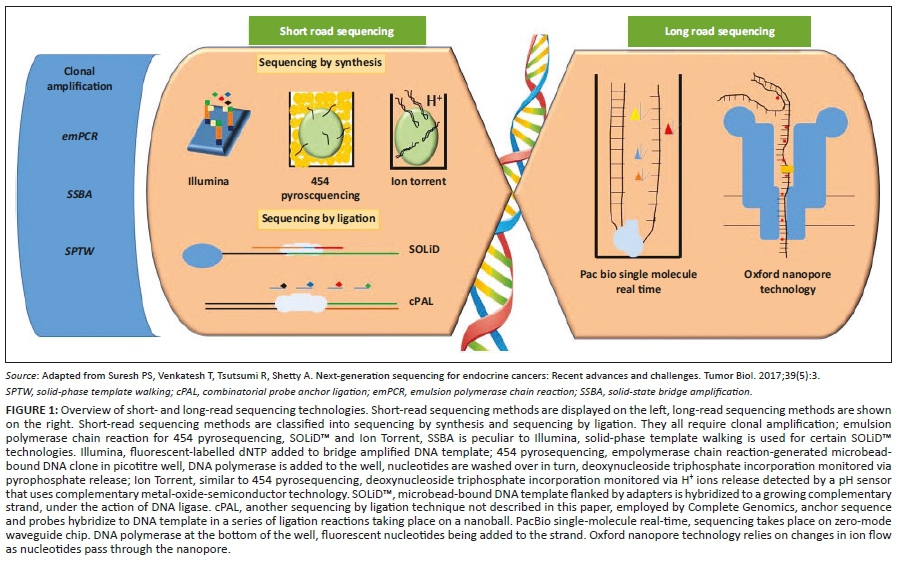
Pyrosequencing relies on the release of pyrophosphates when nucleotides are washed over fixed DNA clones in a DNA polymerase-mediated reaction (Figure 1). Pyrophosphate takes part in a cascade of reactions that eventually give off light which is detected and interpreted by a computer program. Ion Torrent employs a similar technique except that it uses pH instead of luminescence to detect nucleotide addition, whereas the Applied Biosystems Inc. SOLiD™ system is a sequencing--by-ligation technique which detects fluorescence that results from the action of DNA ligase on oligonucleotides (Figure 1).5,6
SOLiD™ and Ion Torrent have been in the NGS market since 2007 and 2010, whereas Roche announced the phaseout of 454 Pyrosequencing in 2013 after facing stiff competition in the market. The reversible terminator sequencing currently sold by Illumina is the predominant NGS platform: a sequencing-by-synthesis approach that uses bridge amplification and fluorescent signals from the addition of deoxynucleoside triphosphate (dNTP) to a growing complementary strand (Figure 1). The signal is detected in real time by a coupled charge device camera and interpreted by computer software.1
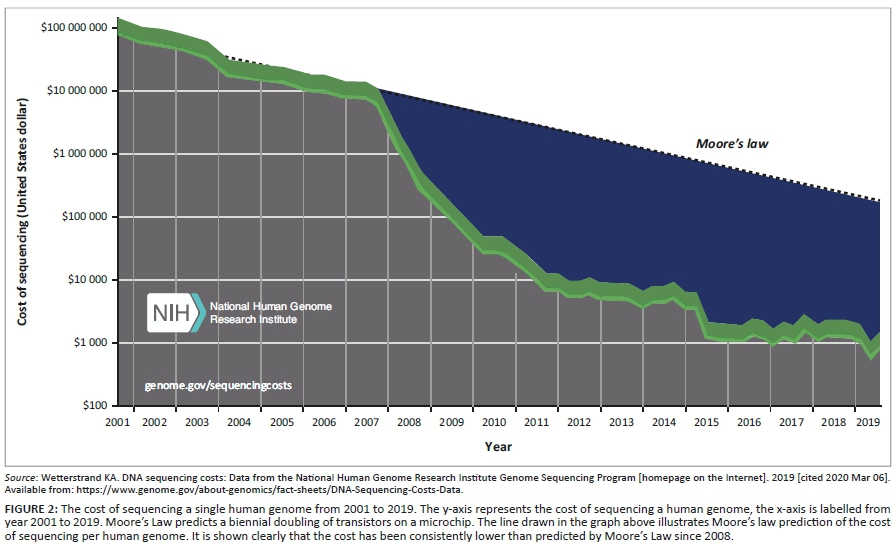
Next-generation sequencing technologies have made sequencing much easier, faster and cheaper than Sanger sequencing. The August 2019 report from the National Human Genome Research Institute put the cost of sequencing a complete human genome at $942.00 United States dollars (USD). Thanks to NGS, the reduction in cost of genome sequencing has beaten Moore's Law prediction (Figure 2), more evidently since 2008, about the same time that NGS became popular in sequencing centres.7
Illumina, introduced in 2006, is the most robust of all NGS technologies. It quickly gained traction among scientists, because of its high throughput and affordability compared to 454 Pyrosequencing, SOLiD™ and Ion Torrent. In fact, Illumina was the first company to fulfil the '$1000 genome' promise with its HiSeq X Ten sequencer in 2014. Sequencing a genome now costs below $1000.00 USD with ongoing efforts to reach the $100.00 USD target.3
Where short reads come short
All second-generation sequencing technologies have a common limitation - the inability to sequence long stretches of DNA. To sequence a large genome like human DNA using NGS, the DNA has to be fragmented and amplified in clones of between 75 base pairs and 400 base pairs, hence the term 'short-read sequencing' (SRS). Computer programs are then used to assemble the random clones into a contiguous sequence.2de novo sequencing of a highly complex and repetitive genome like the human genome.28
Long-read sequencing
Third-generation sequencing technologies which are otherwise called long-read sequencing (LRS) technologies address the shortcomings of NGS. Whereas the Sanger and SRS approaches cannot exceed read lengths of 1 kilobase pair, third-generation sequencing technologies read lengths are between 5 kilobase pairs and 30 kilobase pairs. The longest read length ever generated by a third-generation sequencing technology is 2 gigabase pairs.91
There are two prominent LRS technologies namely, nanopore sequencing and the single-molecule real-time (SMRT) sequencing.101
Nanopore sequencing, released by Oxford Nanopore Technologies in 2014, works by a different principle: threading the DNA molecule through a 1.5 nm wide bioengineered channel embedded in a biological membrane. Electrical current across the channel depends on which nucleotide is traversing the channel at the time. This variation is used to determine the base sequence of the nucleic acid.1
Single-molecule real-time and nanopore sequencing check all of the boxes in terms of suitability for de novo sequencing, resolution of repeat sequences (e.g. human leukocyte antigen gene, centromere), detection of structural variations, epigenetics and transcriptome sequencing, among others. However, the accuracy per read and the throughput of LRS is poor compared to SRS.1,1010
The high error rates of nanopore sequencing are attributed to the poor sensitivity of the nanopore and the inability to control the speed of DNA translocation through the pore. Whereas the errors in nanopore sequencing are systematic, SMRT base-calling errors are random and can be reduced using circular consensus sequencing (CCS), a method that allows the DNA to have multiple passes through the zero-mode waveguides. Increasing the accuracy of SMRT via CCS comes at a higher cost than using NGS.3
'Nano-promises, giga-prospects'
MinION, a small-sized nanopore sequencing device similar to a universal serial bus flash drive, was used to sequence the Ebola virus during the 2014-2016 outbreak in West Africa in 60 min.39
The Sequel II 8M SMRT cell, which was launched in 2019 by PacBio, has a CCS read accuracy of 99% and above. PromethION, also released in 2019 by Oxford Nanopore Technologies, generates ultra-long reads, although with less accuracy than SMRT. In their efforts to beef up quality, both companies update their products regularly. The latest -double-sensored nanopore cell R10 and linear consensus sequencing (a similar method to SMRT CCS) are expected to improve the accuracy of Oxford Nanopore Technologies products. Interestingly, LRS technologies are approaching SRS in terms of cost and accuracy. Using the Sequel II 8M SMRT cell that was released, CCS reads can now be obtained for about $1500.00 - an eight-fold reduction in costs.33,55103,5
Situation report
Notwithstanding SRS market dominance, LRS has broadened its range of applications in recent years as a result of significant improvements in accuracy and throughput. For instance, there has been an increase in the use of MinION in metagenomics studies. LRS technologies are increasingly being used in epigenetics and transcriptomics as well.10
The technical difficulties associated with de novo assembly of short reads for large complex genomes will likely persist for the foreseeable future. The question then becomes whether LRS technologies will improve on their own shortcomings to take over the market.
A paradigm shift in the prevailing technology is likely to occur if there is a major scientific breakthrough, such as the discovery of a DNA polymerase with a longer lifespan for higher throughput and accuracy in SMRT base calling, or a drastic improvement in the sensitivity and DNA translocation speed in nanopore sequencing that matches the accuracy of SRS technologies. However, such improvements are more likely to take place gradually rather than suddenly; I do not see that occurring in the next 10 years.
Lessons from the past
History suggests a difficult transition from short-read to long-read technologies. When 454 pyrosequencing was introduced in 2005, it had a clear advantage over Sanger sequencing in terms of throughput and cost. However, funding agencies and scientists were not immediately receptive to the new technology. Many of the researchers had got used to Sanger sequencing, whereas investors were mindful of their stakes. Thus, it took 3 years before NGS gained wide acceptance in the scientific community.4,7
As of 2014, Illumina controlled about 70% of the market for DNA sequencers and accounted for 90% of global DNA data.311
The Illumina-PacBio merger
The potential of LRS, particularly SMRT, is not unnoticed by market giant Illumina, who entered talks in 2018 on a $1.2 billion USD merger with PacBio. Both parties, however, terminated the deal owing to concerns from the United Kingdom Competition and Markets Authority and the United States Federal Trade Commission about an emerging monopoly.12
One is left to imagine why Illumina wanted a merger. Sheer desire for monopoly or the prospect of a robust hybrid technology? Anyway, the synergy of both generations of sequencing technology is worth considering. Hybrid sequencing combines the throughput and accuracy of SRS with the long read length of LRS. It is highly effective for genome polishing103
Outlook
While it may be difficult to predict with certainty major breakthroughs capable of altering the narrative in genomic sequencing, it is apparent that LRS holds the key to many unanswered questions in genomics. Long-read sequencing technologies, although constantly improving and gradually closing the gap on NGS in terms of accuracy and costs,3,5 have yet to attain their full potential. In this decade, I expect that LRS technologies will gain more recognition and acceptance as they are adapted for sequencing a variety of organisms. In the absence of an innovation in LRS technology that can significantly increase accuracy and throughput and reduce costs far beyond what SRS technologies offer, I would argue that it is unlikely that LRS technologies completely replace SRS technologies in the next 10 years. Meanwhile, in the middle of these improvements in SRS and LRS technologies, I expect to see increased efforts towards making hybrid sequencing more scalable.
Competing interests
The author declares that no competing interests exist.
Author's contributions
The author B.A.A. wrote and edited the manuscript.
Ethical considerations
I confirm that ethical clearance was not needed for this paper.
Sources of support
The author received no financial support for the research, authorship or publication of this article.
Data availability statement
Data sharing is not applicable to this article as no new data were created or analysed in this study.
Disclaimer
The views and opinions expressed in this article are those of the author and do not necessarily reflect the official policy or position of any affiliated agency of the author.
Acknowledgements
I am immensely grateful to my mentors and teachers Dr J.O. Olugbami and Dr O.O. Bello for their invaluable guidance and support. This article was adapted from the winning essay for the Sanger Institute Prize 2020 organised by the Wellcome Sanger Institute, Hinxton, Cambridge, United Kingdom.
References
-
1.Heather JM, Chain B. The sequence of sequencers: The history of sequencing DNA. Genomics. 2016;107(1):1-8. https://doi.org/10.1016/j.ygeno.2015.11.003
» https://doi.org/10.1016/j.ygeno.2015.11.003 -
2.Mardis ER. DNA sequencing technologies: 2006-2016. Nat Protoc. 2017;12(2):213-218. https://doi.org/10.1038/nprot.2016.182
» https://doi.org/10.1038/nprot.2016.182 -
3.Giani AM, Gallo GR, Gianfranceschi L, Formenti G. Long walk to genomics: History and current approaches to genome sequencing and assembly. Comput Struct Biotechnol J. 2020;18:9-19. https://doi.org/10.1016/j.csbj.2019.11.002
» https://doi.org/10.1016/j.csbj.2019.11.002 -
4.Schuster SC. Next-generation sequencing transforms today's biology. Nat Methods. 2008;5(1):16-18. https://doi.org/10.1038/nmeth1156
» https://doi.org/10.1038/nmeth1156 -
5.Kchouk M, Gibrat J, Elloumi M. Generations of sequencing technologies: From first to next generation. Biol Med. 2017;9(3):1-8. https://doi.org/10.4172/0974-8369.1000395
» https://doi.org/10.4172/0974-8369.1000395 - 6.Suresh PS, Venkatesh T, Tsutsumi R, Shetty A. Next-generation sequencing for endocrine cancers: Recent advances and challenges. Tumor Biol. 2017;39(5):1-11.
-
7.Wetterstrand KA. DNA sequencing costs: Data from the NHGRI Genome Sequencing Program (GSP) [homepage on the Internet]. 2019 [cited 2020 Mar 06]. Available from: https://www.genome.gov/about-genomics/fact-sheets/DNA-Sequencing-Costs-Data
» https://www.genome.gov/about-genomics/fact-sheets/DNA-Sequencing-Costs-Data -
8.Ho SS, Urban AE, Mills RE. Structural variation in the sequencing era. Nature Research. 2020;21:171-89. Available from: https://www.nature.com/articles/s41576-019-0180-9
» https://www.nature.com/articles/s41576-019-0180-9 -
9.Kraft F, Kurth I. Long-read sequencing in human genetics. Medizinische Genet. 2019;31:198-204. https://doi.org/10.1007/s11825-019-0249-z
» https://doi.org/10.1007/s11825-019-0249-z -
10.Amarasinghe SL, Su S, Dong X, Zappia L, Ritchie ME, Gouil Q. Opportunities and challenges in long-read sequencing data analysis. Genome Biol. 2020;21(30):1-16. https://doi.org/10.1186/s13059-020-1935-5
» https://doi.org/10.1186/s13059-020-1935-5 -
11.Berman K. Genome sequencing stocks on the rise [homepage on the Internet]. Forbes; 2019 [cited 2020 Mar 06]. Available from: https://www.forbes.com/sites/kenberman/2019/02/21/genome-sequencing-stocks-on-the-rise/#76a851951f51
» https://www.forbes.com/sites/kenberman/2019/02/21/genome-sequencing-stocks-on-the-rise/#76a851951f51 -
12.Illumina, PacBio Scrap $1.2B Merger, Citing 'Continued Uncertainty' [homepage on the Internet]. Genetic Engineering and Biotechnology News; 2020 [cited 2020 Mar 06]. Available from: https://www.genengnews.com/news/illumina-pacbio-scrap-1-2b-merger-citing-continued-uncertainty/
» https://www.genengnews.com/news/illumina-pacbio-scrap-1-2b-merger-citing-continued-uncertainty/

Accepted: 07 Sept. 2020
Published: 26 Nov. 2020