Impact of viral load on sample pooling for reverse-transcription polymerase chain reaction detection-based diagnosis of coronavirus disease 2019 in Nigeria
Abstract
BACKGROUND: The coronavirus disease 2019 (COVID-19) pandemic strained diagnostic testing capacities globally, particularly in low- and middle-income countries like Nigeria. Reverse-transcription polymerase chain reaction (RT-PCR) remains the gold standard for COVID-19 detection, but limited testing resources caused bottlenecks in Nigeria's response during the pandemic. Sample pooling offers a cost-effective strategy to enhance testing capacity during future outbreaks. OBJECTIVE: This study determined the maximum number of COVID-19 samples that can be pooled for RT-PCR testing in Nigeria without compromising the detection sensitivity of a single positive sample. METHODS: A total of 1222 nasopharyngeal samples from symptomatic COVID-19 patients in Nasarawa State, Nigeria, collected between March 2021 and August 2022, were retrieved from the laboratory biorepository and analysed from November 2022 to February 2023. These included five positive samples with cycle threshold (Ct) values ranging from ≤ 20 to 40, and 1217 negative samples. Positive samples were pooled with negative ones at increasing dilution ratios (1:4-1:64), to assess detection sensitivity on the GeneXpert platform RESULTS: A positive sample with a Ct value ≤ 25 could be pooled with up to 64 negative samples while maintaining a detectable positive result. However, samples with Ct values of 36-40 could only be pooled with a maximum of eight negative samples. Higher Ct values reduced pooling effectiveness. CONCLUSION: Sample pooling is a feasible method for scaling up COVID-19 RT-PCR testing in resource-limited settings like Nigeria. The Ct value is critical in determining optimal pool sizes for accurate detection. WHAT THIS STUDY ADDS: The findings provide critical guidelines for determining the optimal pool sizes based on Ct values, aiding in effective COVID-19 testing strategies. By optimising sample pooling based on viral load, health authorities can improve their response to future COVID-19 outbreaks and similar public health emergencies.
coronavirus disease 2019; pandemic; real-time polymerase chain reaction testing; cycle threshold; sample pooling; Nigeria
Introduction
The coronavirus disease 2019 (COVID-19) pandemic, caused by severe acute respiratory syndrome coronavirus 2, created a global health crisis and drastically increased the demand for diagnostic testing.1,23,4 This was followed by rising daily cases and deaths across several states and the Federal Capital Territory, including Nasarawa State, which indicated widespread community transmission and unmet testing needs.5,6
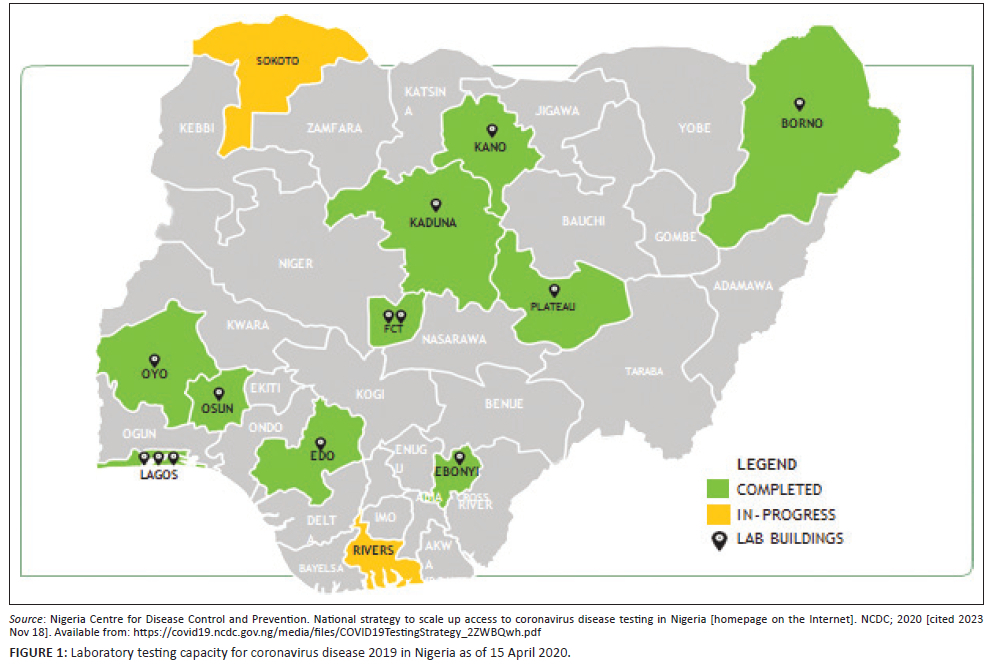
As with many low- and middle-income countries, Nigeria faced significant challenges in diagnostic testing during the pandemic because of limited resources. Reverse-transcription polymerase chain reaction (RT-PCR), the gold standard for COVID-19 diagnosis, was constrained by shortages of kits, reagents, and trained personnel.3Figure 1),33,7 These limitations caused testing delays, hindered contact tracing, and underreported cases, weakening Nigeria's pandemic response.8
Sample pooling, a cost-effective diagnostic technique in which multiple samples were combined and tested together, emerged as a potential solution to these challenges.8,9,10,11,12,13,14,15,16,17,18,1914,15,1617,188,10,118,10,1119
Despite the global decline in COVID-19 cases, as well as in Nigeria, the threat of future pandemics and outbreaks due to COVID-19 remains, especially with the emergence of different COVID-19 variants, highlighting the importance of strengthening diagnostic systems.7
Methods
Ethical considerations
Ethical approval for this study was obtained from the Federal Capital Territory Health Research Ethics Committee (reference no: FHREC/2024/01/48/04-03-24). A waiver for informed patient consent was granted, as stored laboratory samples were retrieved solely for analysis, with no additional clinical procedures involving patients. All personal information and patient identifiers were removed from the samples and study-specific numbers (identifiers) were assigned to each. These identifiers and outcome of the laboratory analysis were entered into an anonymised, password-protected Excel spreadsheet (Office 2016, Microsoft, Redmond, Washington, United States), accessible only to the study investigators for data analysis.
Study area
Nigeria, the most populous country in Africa, with over 250 million people,2020,21212220,23
Study specimens and laboratory analysis
The samples for this study were aliquots stored in cryovials, retrieved from the Zankli Research Centre Molecular Laboratory biorepository at Bingham University, Nasarawa State, Nigeria. These included nasopharyngeal swab specimens in viral transport medium (MANTACC Viral Transport Media disposable sampling kit; Huo-Yan Laboratory, Shenzhen, China), collected from symptomatic patients suspected of COVID-19 infection across communities in Nasarawa State, Nigeria, between March 2021 and August 2022. Initially tested for COVID-19 following Nigeria Centre for Disease Control and Prevention guidelines and procedures,24
The retrieved samples were analysed between November 2022 and February 2023. A repeat RT-PCR test was conducted to re-confirm the Ct values for each sample before performing the pooled test procedure. These positive samples were tested individually by RT-PCR on Cepheid's GeneXpert® systems with the Xpert® Xpress SARS-CoV-2 (Cepheid, Sunnyvale, California, United States), and their Ct values were grouped in the following ranges: ≤ 20, 21 ‒25, 26 ‒ 30, 31 ‒ 35, and 36 ‒ 40, to represent a decreasing viral load, with '≤ 20' representing the highest and '36‒40' representing the lowest. Similarly, 1217 samples confirmed to be negative through RT-PCR were pooled to create different pools of varying dilution factors.
All procedures were conducted in a NuAire Class II 12469:2000 biological safety cabinet within the containment laboratory room by trained personnel. Samples and pools were tested using Cepheid's GeneXpert® systems following the manufacturer's instructions. Each selected positive sample was pooled with negative samples at increasing dilution factors of 1:4 until the Ct value of the pool with the highest dilution factor exceeded 40 while remaining positive. The Ct values of each pool for each positive sample were recorded.
For the first pool (1:4), 70 µL of the positive sample and 70 µL of each of the four (4) negative samples were transferred to a cryovial to obtain the 1:4 dilution factors. The contents were vortexed, transferred to a GeneXpert cartridge and loaded onto the GeneXpert platform according to the manufacturer's instructions. The same procedure was used to constitute pools of 1:8, up through 1:64 for each of the five (5) positive samples.
Data management and analysis
The Ct values of the test outcomes from the RT-PCR analysis of pooled samples were entered into an anonymised, password-protected Excel spreadsheet (Office 2016, Microsoft, Redmond, Washington, United States), and the data were analysed descriptively using charts and tables. Samples with Ct values ≤ 43 were considered positive for COVID-19 infection, while samples with Ct values > 43 were considered negative for COVID-19 infection.
Results
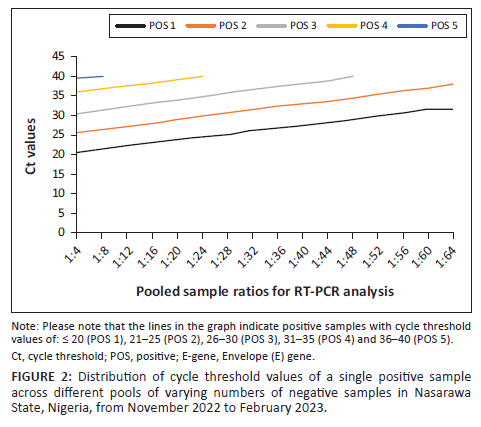
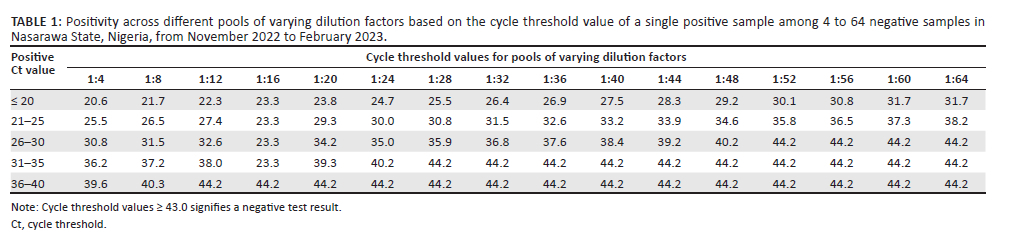
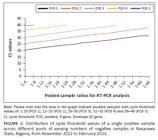
As shown in Table 1 and Figure 2, our investigation revealed that a single positive COVID-19 sample with Ct values ≤ 20 and 21-25 could be pooled with as many as 63 other samples to obtain a positive pool, which signifies that such a single positive sample is detectable in a pool of up to 1:64 negative samples. However, pooling COVID-19 samples with a single positive COVID-19 sample with Ct values 26-30 can only be detected in a pool of 1:48 negative samples using RT-PCR, 31-35 as 1:24, and 36-40 as 1:8 (Table 1 and Figure 2).
Discussion
This investigation showed that the Ct value was a determining factor in choosing the maximum number of samples to be pooled for effective RT-PCR detection of COVID-19. However, determining the maximum number of samples that can be pooled while still maintaining reliable and accurate test results is a critical challenge to consider.
In our study, we discovered that a single positive sample with a presumed Ct value of ≤ 25 could be pooled with up to 64 samples to obtain a positive pool, while a single presumed positive sample with a Ct value > 40 could only be pooled with a maximum of 8 presumed negative samples to obtain a positive pool. A similar study carried out in Israel in 2020 reported that using a pooled testing approach for standard RT-PCR for COVID-19 detection with a single positive sample could detect a pool of up to 32 samples, with an estimated false-negative rate of 10%.20
A study from Malaysia, evaluating the effectiveness of pooled sample testing for COVID-19 RT-PCR, conducted in 2020 by Lim et al.,11
Similarly, Wacharapluesadee et al.,2525
The Ct value is a measure of the amount of RT-PCR amplification required to detect a signal from the target nucleic acid in a sample.262626
Notably, the maximum number of samples that can be pooled while still maintaining accurate and reliable results may vary depending on the prevalence of COVID-19 in the population being tested, the assay used, and the quality of the samples.15,27,28,29,30,31 If the prevalence of COVID-19 in the population is low, it may be necessary to reduce the number of samples in the pool to maintain accurate and reliable results; likewise, if the quality of the samples is poor, it may be necessary to reduce the number of samples in the pool to ensure accurate results.15,27,28,29
Most importantly, determining the optimal pool size for RT-PCR testing for COVID-19 detection requires consideration of several factors, including the presumed viral load of positive samples, the Ct value, the sensitivity of the RT-PCR test, the prevalence of COVID-19 in the population, and the cost and time efficiency of the testing process.7,15,27,28,29 While different studies have recommended different pool sizes, there is no one-size-fits-all approach, and the optimal pool size may vary depending on the context and resources available. Therefore, a process of trial and error was necessary to determine the optimal pool size for RT-PCR testing in specific settings.15Table 1.
Additionally, Yani et al.,3232
Limitations
A limitation of this study is that we did not collect information on clinical data or symptoms; we believe that all patients may have been symptomatic with COVID-19-related symptoms, as stated in the study protocol, as this was strictly monitored to eliminate protocol deviations.
Additionally, RT-PCR, like most other testing systems, could have misclassified some negative samples as positive and vice versa during the evaluation cycle. These errors might result from improper sample handling, deficient sample loading, or RNA degradation during processing. However, to minimise such errors, we ensured strict adherence to all standard operating procedures for laboratory practices under the supervision of highly experienced senior laboratory scientists throughout the study implementation
Conclusion
Sample pooling for RT-PCR of COVID-19 samples is a promising strategy that could increase testing capacity and overcome the limitations of current testing methods during a COVID‒19 pandemic, especially in Nigeria, which has a limited capacity for RT-PCR. However, sample pooling requires careful planning, coordination, and optimisation to ensure that it is both cost-effective and reliable. This research revealed that the presumed Ct value is a determining factor in choosing the maximum number of samples to be pooled for effective RT-PCR detection of COVID-19, and provides a guide for COVID-19 sample pooling in Nigeria for current and future outbreak responses.
Competing interests
The authors declare that they have no financial or personal relationships that may have inappropriately influenced them in writing this article.
Authors' contributions
T.T.E., E.E.I., C.U., J.S.B., B.E., and P.I. conceptualised the study and developed the methodology. The investigation was conducted by T.T.E., B.E., A.E.I., and P.I. Data curation and formal analysis were performed by T.T.E. and J.K. The initial draft was prepared by T.T.E. and E.E.I., with study validation by C.U., and supervision by J.S.B. Additionally, T.T.E., E.E.I., C.U., J.S.B., B.E., and P.I. reviewed and revised the article. T.T.E., E.E.I., J.S.B., B.E., C.U., J.K., P.I. and A.E.I. have read and approved the final version of the article.
Sources of support
This research received no specific grant from any funding agency in the public, commercial, or not-for-profit sectors.
Data availability
Data sets analysed in this study are available from the corresponding author, E.E.I., upon reasonable request.
Disclaimer
The views and opinions expressed in this article are those of the authors and are the product of professional research. The article does not necessarily reflect the official policy or position of any affiliated institution, funder, agency, or that of the publisher. The authors are responsible for this article's results, findings, and content.
Acknowledgements
The authors sincerely appreciate the management of the Zankli Research Centre Molecular Laboratory, Bingham University, Nasarawa State, Nigeria, for their immense support toward conducting the study, as well as the staff members of the Zankli Research Centre Molecular Laboratory, Bingham University, Nasarawa State, who were involved in sample processing during the study.
References
-
1.Lim KL, Johari NA, Wong ST, et al. A novel strategy for community screening of SARS-CoV-2 (COVID-19): Sample pooling method. PLoS One. 2020;15(8):e0238417. https://doi.org/10.1371/journal.pone.0238417
» https://doi.org/10.1371/journal.pone.0238417 -
2.Libin PJK, Willem L, Verstraeten T, Torneri A, Vanderlocht J, Hens N. Assessing the feasibility and effectiveness of household pooled universal testing to control COVID-19 epidemics. PLoS Comput Biol. 2021;17(3):e1008688. https://doi.org/10.1371/journal.pcbi.1008688
» https://doi.org/10.1371/journal.pcbi.1008688 -
3.Nigeria Centre for Disease Control and Prevention. National strategy to scale up access to coronavirus disease testing in Nigeria [homepage on the Internet]. NCDC; 2020 [cited 2023 Nov 18]. Available from: https://covid19.ncdc.gov.ng/media/files/COVID19TestingStrategy_2ZWBQwh.pdf
» https://covid19.ncdc.gov.ng/media/files/COVID19TestingStrategy_2ZWBQwh.pdf -
4.Bolu O, Mustapha B, Ihekweazu C, et al. Effect of Nigeria Presidential Task Force on COVID-19 pandemic, Nigeria. Emerg Infect Dis Suppl. 2022;28(13):S168-S178. https://doi.org/10.3201/eid2813.220254
» https://doi.org/10.3201/eid2813.220254 -
5.Isere EE, Adejugbagbe AM, Fagbemi AT, et al. Outcome of epidemiological investigation of COVID-19 outbreak in a Southwest State of Nigeria, March to August 2020. Open J Epidemiol. 2021;11(2):163-177. https://doi.org/10.4236/ojepi.2021.112015
» https://doi.org/10.4236/ojepi.2021.112015 -
6.Isere EE, Oluwole M, Adejugbagbe M, et al. SARS-CoV-2 Rapid Antigen Test in comparison with RT‒PCR for laboratory diagnosis of COVID-19 in a Southwest State of Nigeria. Open J Epidemiol. 2022;12(4):387-400. https://doi.org/10.4236/ojepi.2022.124032
» https://doi.org/10.4236/ojepi.2022.124032 -
7.Bosonkie M, Egbende L, Namale A, et al. Improving testing capacity for COVID-19: Experiences and lessons from Senegal, Uganda, Nigeria, and the Democratic Republic of Congo. Front Public Health. 2023;11:1202966. https://doi.org/10.3389/fpubh.2023.1202966
» https://doi.org/10.3389/fpubh.2023.1202966 -
8.World Health Organization. Pooling samples boosts Ghana's COVID-19 testing [homepage on the Internet]. 2020 [cited 2023 Dec 18]. Available from: https://www.who.int/news-room/feature-stories/detail/pooling-samples-boosts-ghana-s-covid-19-testing
» https://www.who.int/news-room/feature-stories/detail/pooling-samples-boosts-ghana-s-covid-19-testing -
9.Chen HB, Guo JY, Shu YC, Lee YH, Chang FH. Improvement of sensitivity of pooling strategies for COVID-19. Comput Math Methods Med. 2021;2021:6636396. https://doi.org/10.1155/2021/6636396
» https://doi.org/10.1155/2021/6636396 -
10.Lagopati N, Tsioli P, Mourkioti I, et al. Sample pooling strategies for SARS-CoV-2 detection. J Virol Methods. 2021;289:114044. https://doi.org/10.1016/j.jviromet.2020.114044
» https://doi.org/10.1016/j.jviromet.2020.114044 -
11.Nyazika TK, Kaela R, Mugoni M, et al. Implementation of antibody rapid diagnostic testing versus real-time reverse transcription-PCR sample pooling in the screening of COVID-19: A case of different testing strategies in Africa. mSphere. 2020;5(4):e00524-20. https://doi.org/10.1128/mSphere.00524-20
» https://doi.org/10.1128/mSphere.00524-20 - 12.Aldridge M, Ellis D. Pooled testing and its applications in the COVID-19 pandemic. In: Boado-Penas MdC, Eisenberg J, Şahin Ş, editors. Pandemics: Insurance and social protection. Springer Actuarial, Cham: Springer, 2022; pp. 217-246.
-
13.Hogan CA, Sahoo MK, Pinsky BA. Sample pooling as a strategy to detect community transmission of SARS-CoV-2. JAMA. 2020;323(19):1967-1969. https://doi.org/10.1001/jama.2020.5445
» https://doi.org/10.1001/jama.2020.5445 -
14.Sunjaya AF, Sunjaya AP. Pooled testing for expanding COVID-19 mass surveillance. Disaster Med Public Health Prep. 2020;14(3):e42-e43. https://doi.org/10.1017/dmp.2020.246
» https://doi.org/10.1017/dmp.2020.246 -
15.De Wolff T, Pflüger D, Rehme M, Heuer J, Bittner MI. Evaluation of pool-based testing approaches to enable population-wide screening for COVID-19. PLoS One. 2020;15(12):e0243692. https://doi.org/10.1371/journal.pone.0243692
» https://doi.org/10.1371/journal.pone.0243692 -
16.Lohse S, Pfuhl T, Berkó-Göttel B, et al. Pooling of samples for testing for SARS-CoV-2 in asymptomatic people. Lancet Infect Dis. 2020;20(11):1231-1232. https://doi.org/10.1016/S1473-3099(20)30362-5
» https://doi.org/10.1016/S1473-3099(20)30362-5 -
17.Shani-Narkiss H, Gilday OD, Yayon N, Landau ID. Efficient and practical sample pooling for high throughput PCR diagnosis of COVID-19. medRxiv. 2020. https://doi.org/10.1101/2020.04.06.20052159
» https://doi.org/10.1101/2020.04.06.20052159 -
18.Mahmoud SA, Ibrahim E, Thakre B, et al. Evaluation of pooling of samples for testing SARS-CoV-2 for mass screening of COVID-19. BMC Infect Dis. 2021;21(1):360. https://doi.org/10.1186/s12879-021-06061-3
» https://doi.org/10.1186/s12879-021-06061-3 -
19.Yelin I, Aharony N, Tamar ES, et al. Evaluation of COVID-19 RT‒qPCR test in multi sample pools. Clin Infect Dis. 2020;71(16):2073-2078. https://doi.org/10.1093/cid/ciaa531
» https://doi.org/10.1093/cid/ciaa531 -
20.National Bureau of Statistics. Nigeria multidimensional poverty index survey results [homepage on the Internet]. 2022 [cited 2023 Dec 18]. Available from: https://nigerianstat.gov.ng/elibrary/read/1241254
» https://nigerianstat.gov.ng/elibrary/read/1241254 - 21.Igbalajobi O, Fatuase AI, Ajibefun I. Determinants of poverty incidence among rural farmers in Ondo State, Nigeria. Am J Rural Dev. 2013;1(5):131-137.
- 22.Bello S, Hassan I, Ogunkunle T, Ibrahim O, Lawal A, Issah Y. Factors affecting the vaccination status of under five children in Nasarawa State, Nigeria. Afr J Med Health Sci. 2021;20(8):98-104.
- 23.Tandon A, Cashin C. Assessing public expenditure on health from a fiscal space perspective. Washington, DC: World Bank; 2010.
-
24.De Campos-Stairiker K, Pidathala AS, Gill RK, et al. Validation of microchip RT‒PCR COVID-19 detection system. J Biosci Med. 2021;9(9):8-24. https://doi.org/10.4236/jbm.2021.99002
» https://doi.org/10.4236/jbm.2021.99002 -
25.Wacharapluesadee S, Kaewpom T, Ampoot W, et al. Evaluating the efficiency of specimen pooling for PCR-based detection of COVID-19. J Med Virol. 2020;92(10):2193-2199. https://doi.org/10.1002/jmv.26005
» https://doi.org/10.1002/jmv.26005 -
26.Xu T, Chen C, Zhu Z, Cui M, Chen C, Dai H. Clinical features and dynamics of viral load in imported and nonimported patients with COVID-19. Int J Infect Dis. 2020;94:68-71. https://doi.org/10.1016/j.ijid.2020.03.022
» https://doi.org/10.1016/j.ijid.2020.03.022 -
27.Cabrera-Alvargonzalez JJ, Larrañaga A, Martinez J, et al. Assessment of the effective sensitivity of SARS-CoV-2 sample pooling based on a large-scale screening experience: Retrospective analysis. JMIR Public Health Surveill. 2024;10:e54503. https://doi.org/10.2196/54503
» https://doi.org/10.2196/54503 -
28.Fagg J, Beale R, Futschik ME, et al. Swab pooling enables rapid expansion of high-throughput capacity for SARS-CoV-2 community testing. J Clin Virol. 2023;167:105574. https://doi.org/10.1016/j.jcv.2023.105574
» https://doi.org/10.1016/j.jcv.2023.105574 -
29.Filiatreau LM, Zivich PN, Edwards JK, Mulholland GE, Max R, Westreich D. Optimizing SARS-CoV-2 pooled testing strategies through differentiated pooling for distinct groups. Am J Epidemiol. 2023;192(2):246-256. https://doi.org/10.1093/aje/kwac178
» https://doi.org/10.1093/aje/kwac178 -
30.Paikrao VM, Hassani US, Nagdeo NV. Comparative analysis of pooling methods for SARS-CoV-2 real-time polymerase chain reaction testing. Biomed Biotechnol Res J. 2024;8(2):147-153. https://doi.org/10.4103/bbrj.bbrj_99_24
» https://doi.org/10.4103/bbrj.bbrj_99_24 -
31.Nazaryan I, Pepanyan N, Keshishyan A, Petrosyan S, Margaryan N, Mnatsakanyan S. SARS-CoV-2 pooled testing methodology for PCR testing applied in private laboratory in Armenia. Adv Infect Dis. 2024;14(1):67-73. https://doi.org/10.4236/aid.2024.141006
» https://doi.org/10.4236/aid.2024.141006 -
32.Yani H, Yuan TD, Lubis AD, Iswara LK, Lubis IND. Comparison of RT-PCR cycle threshold values between individual and pooled SARS-CoV-2 infected nasopharyngeal swab specimens. Narra J. 2024;4(2):e765. http://doi.org/10.52225/narra.v4i2.765
» http://doi.org/10.52225/narra.v4i2.765

Accepted: 12 Nov. 2024
Published: 10 Feb. 2025