Role of ACE2 and TMPRSS2 polymorphisms in clinical severity and outcomes of COVID-19 in Egypt
Abstract
BACKGROUND: The clinical presentations of coronavirus disease 2019 (COVID-19) exhibit significant variation, ranging from asymptomatic cases to mortality resulting from severe pneumonia. Host genetics can partially explain this variation OBJECTIVE: This study evaluated possible associations between severity and outcome of COVID-19 and single nucleotide polymorphism (SNP) rs2285666 in the ACE2 gene and SNP rs2070788 in the TMPRSS2 gene METHODS: The study included a sample of 100 consecutive adult patients admitted to the COVID-19 Isolation and Intensive Care Units of the Zagazig University Hospitals, Zagazig, Egypt from July 2021 to November 2021. For rs2285666, polymerase chain reaction-restriction fragment length polymorphism was carried out. For rs2070788, real-time polymerase chain reaction was performed RESULTS: For rs2285666, the GA genotype was the most frequent among female patients (39% [16/41]) and the A genotype was more prevalent among male patients (54.2% [32/59]). For rs2070788, the AA genotype was the most frequent among all patients (46% [46/100]). No rs2285666 or rs2070788 genotypes or allele frequencies had significant associations with either severity or outcomes of patients CONCLUSION: This study found no significant associations of COVID-19 severity or outcomes of patients with genotypes or allele frequencies of the rs2285666 SNP in the ACE2 gene or the rs2070788 SNP of the TMPRSS2 gene. The search for other genetic associations with COVID-19 infection is still required WHAT THIS STUDY ADDS: The study reveals that host genetics explain the variation observed in the disease. Specific genetic variants can confer either increased susceptibility or resistance to the disease.
ACE2 gene; single nucleotide polymorphisms; COVID-19; severity; outcome
Introduction
Coronavirus disease 2019 (COVID-19), which is caused by the severe acute respiratory syndrome coronavirus 2 (SARS-CoV-2), has resulted in more than 6 million fatalities and 603 million confirmed cases since its identification in 2019 until 07 September 2022.12
Similar to all viruses, SARS-CoV-2 undergoes genetic mutations over time, which can potentially affect various aspects of the virus, including its ability to spread and infect, the severity of symptoms and disease, the efficacy of vaccines, diagnostic methods, and other public health interventions. Since the outbreak of the pandemic, SARS-CoV-2 has been undergoing continuous evolution. Omicron, the most divergent variant of concern, is still evolving, both genetically and antigenically. There is a possibility that it may be able to evade the existing population immunity compared with the pre-Omicron strains. Also, Omicron prefers to involve the upper rather than the lower respiratory tract; therefore, ongoing research on the SARS-CoV-2 virus is still required.3
The SARS-CoV-2 virus binds to host cell surface receptors by utilising spike (S) protein to mediate the fusion of the viral envelope with the cell membrane. The S protein is composed of S1 and S2 subunits. The subunit S1 contains the receptor-binding domain, that interacts with the peptidase domain of the angiotensin-converting enzyme 2 (ACE2) protein. This step is critical for the viral entry into the cell. The ACE2 protein is a well-characterised negative regulator of the renin-angiotensin system, which catalyses the conversion of angiotensin II to the heptapeptide angiotensin (1-7), which produces the opposite effect to that of angiotensin II.4
The ACE2 protein plays two opposing roles in COVID-19 infection. Firstly, it acts as a potent receptor for the virus to enter the cell. Secondly, it has a protective function in maintaining the balance of angiotensin II, a hormone involved in regulating blood pressure. However, when there is an excessive buildup of angiotensin II, it can lead to the release of large amounts of cytokines, causing a cytokine storm and subsequent tissue damage.5ACE2 gene polymorphisms and their functional impacts. This is important not only because the ACE2 protein receptor is involved in the development of infections, but also because it is suggested to be a potential target for therapy.6ACE2 gene is located on chromosome Xp22; a functional single nucleotide polymorphism (SNP) in the ACE2 gene 'G8790A (rs2285666)' in intron 3 could alter mRNA splicing and so affect ACE2 gene expression.78
Receptor binding is facilitated by the human enzyme transmembrane protease serine 2 (TMPRSS2),910ACE2 and TMPRSS2 nucleotide sequences may change the interaction of receptor-binding domain and peptidase domains, altering the host's susceptibility to the virus and influencing the disease's severity and outcome. The TMPRSS2 gene is located on chromosome 21q22. Rs2070788 is a G to A transition SNP located in intron 11-12 of the TMPRSS2 gene and was found to be associated with reduced TMPRSS2 gene expression.11
Based on that, it was proposed that the aforementioned SNPs can influence the course of COVID-19 infection. This work was performed to evaluate the possible association between the ACE2 (rs2285666) and TMPRSS2 (rs2070788) SNPs and clinical severity and outcomes among COVID-19 patients.
Methods
Ethical considerations
The Institutional Review Board of the Faculty of Medicine, Zagazig University, approved this work (ZU-IRB#6775). Participants voluntarily signed a written informed consent. Procedures were carried out in agreement with the Declaration of Helsinki. Patients' data files and sample tubes were coded, so laboratory workers were blinded to patients' information.
Study design and patient criteria
This prospective cohort study was performed in the Biochemistry and Clinical Pathology departments in collaboration with the Scientific and Medical Research Center, Faculty of Medicine, Zagazig University, Zagazig, Egypt, from 01 July 2021 to 30 November 2021. The study included 100 consecutive patients, ≥ 18 years old, from both genders and the same ethnicity, admitted to the COVID-19 clinic, isolation and intensive care units of the Zagazig University Hospitals, Zagazig, Egypt. Patients who refused to participate were excluded from the study.
Diagnosis and routine investigations
Patients were selected based on the COVID-19 case definition provided by the World Health Organization.12131415
Routine laboratory workup data including full blood counts, liver, kidney function tests, C reactive protein (CRP), lactate dehydrogenase, plasma ferritin, troponin t, and D dimer were collected from patients' files. Additionally, all patients underwent routine chest computed tomography scans; results were collected from patients' files after obtaining the required permissions. The Egyptian Ministry of Health and Population management roles were applied to stratify confirmed patients based on severity. Mild cases include all symptomatic patients with no radiological signs of pneumonia. Moderate cases are those with pneumonia manifestation with positive radiological signs and do not meet the criteria of severe cases. Severe cases are those with a respiratory rate > 30, oxygen saturation at room air < 92, and chest imaging showing > 50% lesions or progressive lesions within 1 day or 2 days, while critically ill patients are severe patients who still have oxygen saturation at room air < 92 or respiratory rate > 30, despite receiving oxygen therapy.14
Asymptomatic, mild, and moderate cases without risk were referred to home isolation with close follow-up. Conversely, moderate cases were hospitalized in COVID-19 areas, severe cases were hospitalized in intermediate care units, while critically ill patients were hospitalized in intensive care units. Therapy was carried out according to the aforementioned guidelines. Routine laboratory workup was performed in the clinical pathology department laboratories.
Based on the severity, patients were classified as mild, moderate, or severe cases, and based on the outcome patients were classified as survived and died. Demographic criteria, history of vaccination, comorbidities, occurrence of complications, viral load, and laboratory results were compared in between each two groups.
According to the guidelines of the Egyptian Ministry of Health, parenteral prophylactic anticoagulants were prescribed for hospitalised patients to guard against cardiovascular complications. In case of suspected pulmonary embolism, as most of these patients are haemodynamically unstable, and because of the risk of medical staff exposure to infection, diagnosis was based on echocardiography and D-dimer level rather than CT-angiography.16
Genotyping
According to manufacturers' guidelines, a volume of 2 mL of ethylenediaminetetraacetic acid anti-coagulated blood was obtained for DNA extraction using the QIAamp Blood Kit (Qiagen GmbH, Hilden, Germany). For the ACE2 SNP, rs2285666, PCR and restriction fragment length polymorphism were used with the primers: forward 5′-CAT GTG GTC AAA AGG ATA TCT-3′ and reverse 5′-AAA GTA AGG TTG GCA GAC AT-3′. Polymerase chain reaction mixture included 12.5 µL of DreamTaq Green PCR Master Mix (Thermo Scientific™, Vilnius, Lithuania), 10 pmol of forward and reverse primers, 100 ng of extracted genomic DNA, and nucleases-free water up to 25 µL. The thermal cycling conditions commenced with an initial denaturation at 95 °C for 5 min, then 25 cycles (95 °C for 30 s, 60 °C for 40 s, and 72 °C for 30 s), ended by a final extension for 3 min at 72°C. The PCR products were digested using AluI (Thermo Fisher Scientific Inc., Toronto, Ontario, Canada) at 37 °C for 3 h.1718
For the TMPRSS2 SNP, rs2070788, a real-time polymerase chain reaction assay was performed, SNP genotyping assay that contains the specific primer-probe mixture and TaqMan Universal PCR Master Mix were purchased from Thermo Fisher Scientific Inc. (Vilnius, Lithuania), amplification and detection were carried out on QuantStdioTM5 real-time polymerase chain reaction system (Applied Biosystems, Siemens Healthcare Diagnostics Inc, Singapore); all procedures were carried out according to manufacturers' guidelines. The reaction mixture was as follows: 10 µL of (2X) TaqMan Universal PCR Master Mix, 20 units (0.5 µL) of the primer-probe assay, 1 µL of the extracted genomic DNA, and 8.5 µL nuclease-free water making the final volume of the mixture 20 µL. The real-time polymerase chain reaction cycling conditions were 60 °C for 2 min, initial denaturation at 95 °C for 10 min then 40 cycles of denaturation at 95 °C for 15 s, and annealing -extension at 60 °C for 1 min.19
Data analysis
The SPSS® statistical software version 22 (IBM Corp., Armonk, New York, United States) was used for data analysis. Numeric values are presented as mean ± standard deviation if it was normally distributed (age, haemoglobin concentration, and platelet counts), while for not-normally distributed data (total and differential leukocyte counts, prothrombin time, kidney function tests, liver enzymes, lactate dehydrogenase, ferritin, CRP, and cycle threshold value) the median (range) was used. Student's t-test and one-way analysis of variance with least significant differences post hoc test were used to compare means; Mann-Whitney U test and Krusskal-Wallis with Bonferroni post hoc tests were used for medians comparison. Frequencies were expressed as numbers (percentages). Chi-square test and the two-tailed Fisher's exact test for results ≤ 5 were used to compare frequencies. p-values < 0.05 were considered statistically significant differences. After comparing all variables either qualitatively or quantitatively between different groups, all variables that have p < 0.1 were tested by the multivariate logistic regression, and significant results are presented as p-value, odds ratio and 95% confidence interval. Because ACE2 is an X-linked gene, ACE2 G8790A genotypes were analysed separately in female and male patients.
Results
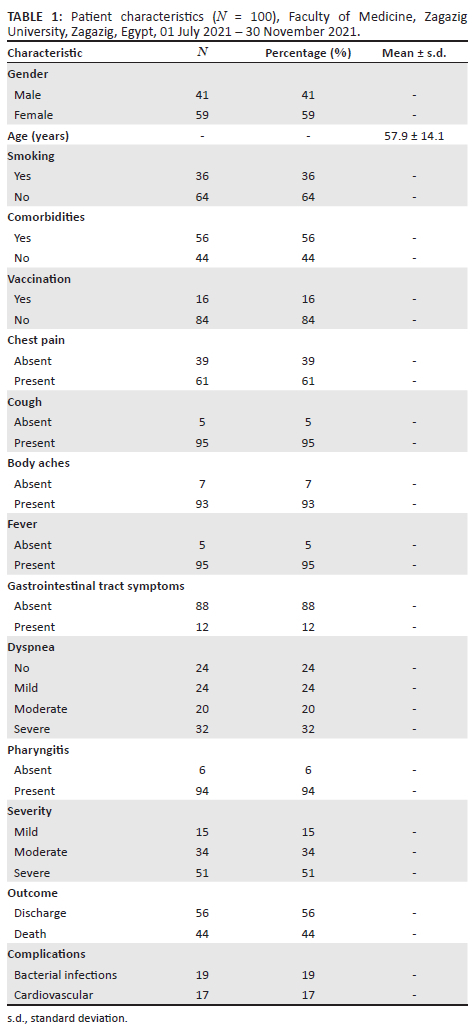
This study included 100 patients with COVID-19 admitted to Zagazig University Hospitals; their ages ranged from 35 years to 80 years, 59% (59/100) of them were male patients, and 41% (41/100) were female patients. Apart from smoking (36%), no other substance abuse, including alcohol, has been reported; 56% of patients had history of other medical diseases including hypertension (31%), diabetes mellitus (19%), cardiovascular diseases (14%), chronic obstructive lung diseases (8%) and malignancies (6%) (Table 1). Prior to the globalisation of the vaccination programme in Egypt, only 14% of patients had been administered the Sinopharm vaccine, while 2% had received the Oxford AstraZeneca vaccine. Among the patients, fever was observed in 95% of cases, pharyngitis in 94% of cases, and chest pain in 61% of cases; 4% were diagnosed by PCR before the appearance of symptoms. Concerning severity, 51%, 34% and 15% were severe, moderate and mild cases, while 44% died by the end of the study. Nineteen patients (19%) were complicated with secondary bacterial pneumonia; 12 (12%) were infected with methicillin-resistant Staphylococcus aureus, 5% with Klebsiella pneumoniae, and 2% with Acinetobacter spp. Seventeen (17%) patients had cardiovascular complications in the form of lower limb ischaemia (2%), deep vein thrombosis (7%), pulmonary embolism (5%), and cerebrovascular stroke (3%). Ten (19.6%) of the severe patients group and 7 (14.2%) of the mild or moderate group had cardiovascular complications, 10 (58.8%) of whom had comorbidities in the form of hypertension (6/10; 60%), diabetes mellitus (4/10; 40%), cardiovascular diseases (3/10; 30%) and malignancy (1/10; 10%), and 7 of whom (41.2%) did not survive.
There were statistically significant associations between age and severity (p = 0.03) (Online Supplementary Table 1). Complications occurred more frequently among severe patients (p < 0.001). Statistically significant increases among severe cases were observed for both kidney function markers (p = 0.03) and CRP (p < 0.001). There were no significant associations between either demographic features or laboratory data and patient outcome (Online Supplementary Table 2). A statistically significant increase in mortality rate was observed in association with severity (p < 0.001) and the occurrence of complications (p = 0.02).
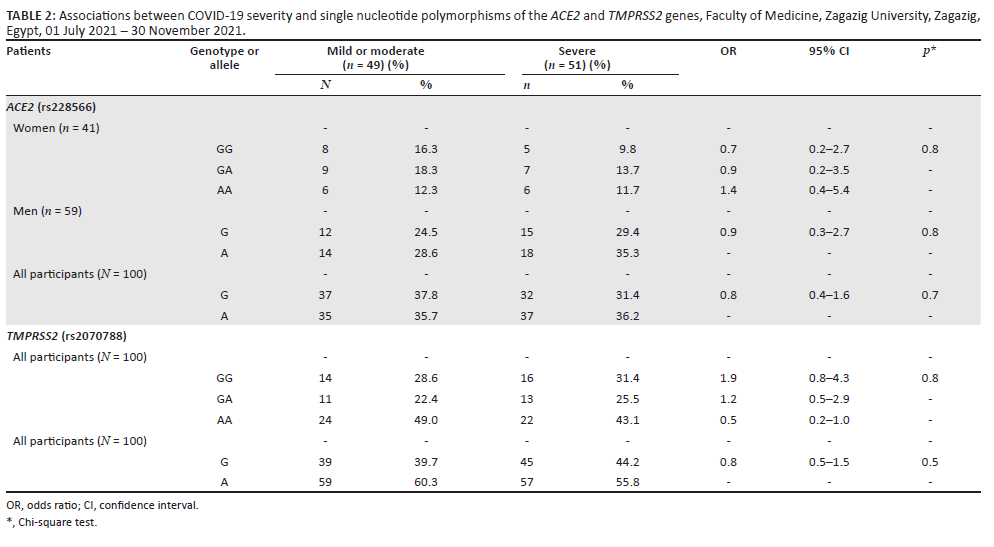
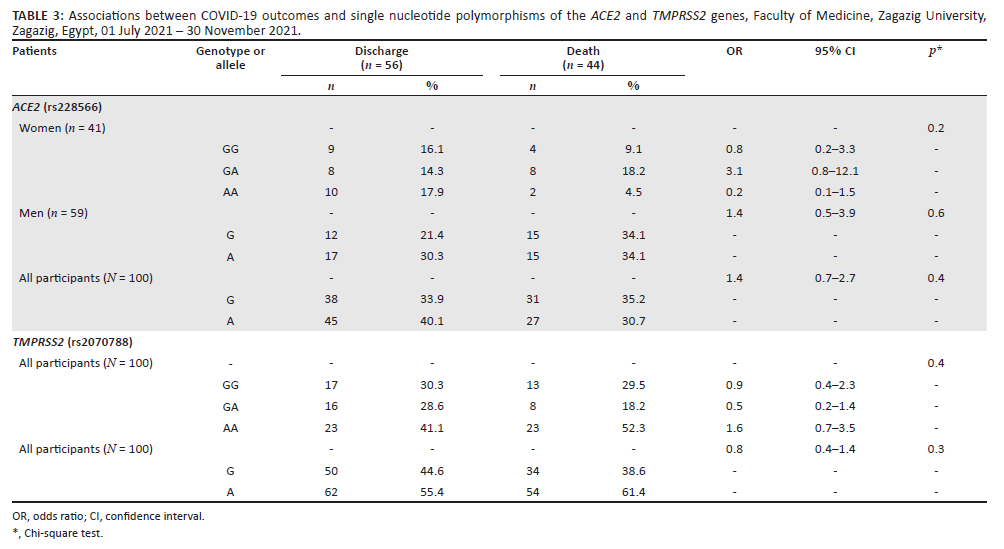
For the ACE2 SNP rs2285666, the GA genotype was the most frequent among female patients (39%), while among male patients the A genotype was more prevalent (54.2%). For the TMPRSS2 SNP rs2070788, the AA genotype was the most frequent among all patients (46%). ACE2 rs2285666 and TMPRSS2 rs2070788 genotypes and allele frequencies had no significant associations with either disease severity or patient outcomes, as shown in Table 2 and Table 3. Multivariate logistic regression revealed that CRP level was the only independent predictor of COVID-19 severity in this cohort: p = 0.001, odds ratio (95% confidence interval) were 1.1 (1.0-1.2) (data not presented). Furthermore, it was found that severity was an independent predictor of outcome: p < 0.001, odds ratio (95% confidence interval) were 46.5 (10.2-211.2).
Discussion
The mean age of patients who developed severe disease was significantly higher than mild or moderate cases. This aligns with many previous findings that age is a major risk factor for COVID-19, and the most unfavourable outcomes are attributed to age-related comorbidities and immunocompromising status.202122
Although it was elevated in 94% of patients, CRP showed a sharp increase in severe cases, and it was the only independent predictor for patients' severity in this work. These results go with those of Wang et al. in 2020 in China,2324
The viral load did not significantly influence disease severity. Prior research has demonstrated conflicting findings on this topic, Cho et al. in 2020 in Hong Kong, China,2526
The mortality rate was higher in severe cases than in mild or moderate cases, particularly in those who encountered complications during the disease course. This result agrees with previous studies in Egypt and worldwide. Gaber et al., in 2022 in Egypt,272829
Angiotensin-converting enzyme 2 and TMPRSS2 gene polymorphisms have been implicated previously in altering the susceptibility to COVID-19 infection and influencing severity and mortality rates.3031ACE2 SNPs-rs4646116, rs267606406, and rs143936283 were associated with higher affinity to the receptor-binding domain. In contrast, ACE2 SNPs-rs1244687367, rs146676783, and rs961360700 were associated with lower binding affinity and hence decreased susceptibility to COVID-19 infection.
Also, TMPRSS2 gene polymorphisms have been associated with susceptibility to COVID-19 infection and outcome.32TMPRSS2 SNPs-rs2070788, rs9974589, and rs7364083 were associated with increased severity of COVID-19.3233ACE2 rs2285666 SNP or the TMPRSS2 rs2070788 SNP and COVID-19 severity and outcome.
The AA genotype of rs2285666 (G8790A) was found to increase ACE2 gene expression up to 50%.34353637
However, Martínez-Gómez et al., in 2022 in Mexico,3839184041TMPRSS2 and ADAM17 genes.5
Pandey et al., in 2022 in India,4232TMPRSS2 SNP rs2070788 had a statistically significant association with disease severity and fatality rate in American and Italian populations, respectively. Another multicentre study by Irham et al. in 202011TMPRSS2 gene in lung tissues, were more prevalent in American and European populations than in Asian populations; this finding can explain the higher susceptibility and fatality rates in American and European populations. Schönfelder et al., in 2021 in Germany,43
Limitations
This study has some limitations that should be considered when interpreting the findings. Firstly, this was a single-centre study with a relatively low sample size. Thus, the results may be insufficiently powered and require further confirmation by future multicentre studies with larger cohorts. Secondly, host genetics is not the only factor that can influence COVID-19 disease: the host immunological status as well as SARS-CoV-2 strain variations have impacts on disease severity and outcome. In addition, an interplay between all of these factors exists; no data were available about patients' antibody response or viral genotypes so these factors could not be included in the analyses. This may have resulted in insufficient data about the impact of these factors on disease behaviour.
Conclusion
The genotypes and allele frequencies of the ACE2 gene SNP rs2285666 and the TMPRSS2 gene SNP rs2070788 showed no significant associations with the severity and outcome of patients. Further investigation into additional genetic correlations with COVID-19 infection is still necessary.
Competing interests
The authors declare that they have no financial or personal relationships that may have inappropriately influenced them in writing this article.
Authors' contributions
N.A.E.-D., A.A. Abdelmoati, A.L.S., W.S., A.M.E.-G., O.A.G., R.M., A.F., R.M.A., M.E.A. and A.A. Ahmed contributed to the study's conceptualisation and design. N.A.E.-D., A.A. Abdelmoati, A.L.S., W.S., and A.M.E.-G. contributed to patient selection and data collection. W.S., O.A.G., R.M. and A.F. contributed to sample collection and processing and manuscript revision. R.M.A., A.F. and M.E.A. contributed to data collection and analysis, and manuscript revision. A.A. Ahmed contributed to data analysis and manuscript writing. Finally, the manuscript has been read and approved by all the authors. All authors are responsible for the reported research.
Sources of support
This research received no specific grant from any funding agency in the public, commercial, or not-for-profit sectors.
Data availability
The data that support the findings of this study are available on request from the corresponding author, A.A. Ahmed.
Disclaimer
The views and opinions expressed in this article are those of the authors and are the product of professional research. It does not necessarily reflect the official policy or position of any affiliated institution, funder, agency, or that of the publisher. The authors are responsible for this article's results, findings, and content.
Acknowledgements
The authors would like to thank the staff members of the Zagazig Scientific and Medical Research Center, Dr Manal Abd Alhafeez, Dr Mariem A. Soliman, Mrs Samah Alsaeed and Mr Peter Maher, for their assistance during the laboratory work.
References
-
1.World Health Organization - Live updates COVID-19 - who.int 2022 [homepage on the Internet]. [cited 2022 Sep 10]. Available from: https://www.who.int/emergencies/diseases/novel-coronavirus-2019?adgroupsurvey={adgroupsurvey}&gclid=Cj0KCQjw6_CYBhDjARIsABnuSzo_3RxO8JG92w-nqsF6yzSRlSslQ9NOaYjDg87PLGdBLHXig6RZOvwaAuYQEALw_wcB.
» https://www.who.int/emergencies/diseases/novel-coronavirus-2019?adgroupsurvey={adgroupsurvey}&gclid=Cj0KCQjw6_CYBhDjARIsABnuSzo_3RxO8JG92w-nqsF6yzSRlSslQ9NOaYjDg87PLGdBLHXig6RZOvwaAuYQEALw_wcB -
2.Van der Made CI, Netea MG, Van der Veerdonk FL, Hoischen A. Clinical implications of host genetic variation and susceptibility to severe or critical COVID-19. Genome Med. 2022;14(1):96. https://doi.org/10.1186/s13073-022-01100-3
» https://doi.org/10.1186/s13073-022-01100-3 -
3.Statement on the update of WHO's working definitions and tracking system for SARS-CoV-2 variants of concern and variants of interest [homepage on the Internet]. 2023 [cited 2023 Mar 30]. Available from: https://www.who.int/news/item/16-03-2023-statement-on-the-update-of-who-s-working-definitions-and-tracking-system-for-sars-cov-2-variants-of-concern-and-variants-of-interest.
» https://www.who.int/news/item/16-03-2023-statement-on-the-update-of-who-s-working-definitions-and-tracking-system-for-sars-cov-2-variants-of-concern-and-variants-of-interest -
4.Santos RAS, Sampaio WO, Alzamora AC, et al. The ACE2/angiotensin-(1-7)/MAS axis of the renin-angiotensin system: Focus on angiotensin-(1-7). Physiol Rev. 2018;98(1):505-553. https://doi.org/10.1152/physrev.00023.2016
» https://doi.org/10.1152/physrev.00023.2016 -
5.Gheblawi M, Wang K, Viveiros A, et al. Angiotensin-converting enzyme 2: SARS-CoV-2 receptor and regulator of the renin-angiotensin system: Celebrating the 20th anniversary of the discovery of ACE2. Circ Res. 2020;126(10):1456-1474. https://doi.org/10.1161/CIRCRESAHA.120.317015
» https://doi.org/10.1161/CIRCRESAHA.120.317015 -
6.Chatterjee B, Thakur SS. ACE2 as a potential therapeutic target for pandemic COVID-19. RSC Adv. 2020;10(65):39808-39813. https://doi.org/10.1039/D0RA08228G
» https://doi.org/10.1039/D0RA08228G -
7.Patel SK, Velkoska E, Freeman M, Wai B, Lancefield TF, Burrell LM. From gene to protein - Experimental and clinical studies of ACE2 in blood pressure control and arterial hypertension. Front Physiol. 2014;5:227. https://doi.org/10.3389/fphys.2014.00227
» https://doi.org/10.3389/fphys.2014.00227 -
8.Pouladi N, Abdolahi S. Investigating the ACE2 polymorphisms in COVID-19 susceptibility: An in silico analysis. Mol Genet Genomic Med. 2021;9(6):e1672. https://doi.org/10.1002/mgg3.1672
» https://doi.org/10.1002/mgg3.1672 -
9.Hoffmann M, Kleine-Weber H, Schroeder S, et al. SARS-CoV-2 Cell Entry depends on ACE2 and TMPRSS2 and is blocked by a clinically proven protease inhibitor. Cell. 2020;181(2):271.e8-280.e8. https://doi.org/10.1016/j.cell.2020.02.052
» https://doi.org/10.1016/j.cell.2020.02.052 -
10.Chen Y, Guo Y, Pan Y, Zhao ZJ. Structure analysis of the receptor binding of 2019-nCoV. Biochem Biophys Res Commun. 2020;525(1):135-140. https://doi.org/10.1016/j.bbrc.2020.02.071
» https://doi.org/10.1016/j.bbrc.2020.02.071 -
11.Irham LM, Chou WH, Calkins MJ, Adikusuma W, Hsieh SL, Chang WC. Genetic variants that influence SARS-CoV-2 receptor TMPRSS2 expression among population cohorts from multiple continents. Biochem Biophys Res Commun. 2020;529(2):263-269. https://doi.org/10.1016/j.bbrc.2020.05.179
» https://doi.org/10.1016/j.bbrc.2020.05.179 - 12.Hong KH, Lee SW, Kim TS, et al. Guidelines for laboratory diagnosis of coronavirus disease 2019 (COVID-19) in Korea. Ann Lab Med. 2020;40(5):351-360.
-
13.Amer RM, Samir M, Gaber OA, et al. Diagnostic performance of rapid antigen test for COVID-19 and the effect of viral load, sampling time, subject's clinical and laboratory parameters on test accuracy. J Infect Public Health. 2021;14(10):1446-1453. https://doi.org/10.1016/j.jiph.2021.06.002
» https://doi.org/10.1016/j.jiph.2021.06.002 - 14.Masoud H, Elassal G, Hassany M, et al. Management protocol for COVID-19 patients MoHP protocol for COVID19, version 1.3. Ministry of Health and Population, Cairo. 2020.
-
15.Al Bayat S, Mundodan J, Hasnain S, et al. Can the cycle threshold (Ct) value of RT-PCR test for SARS CoV2 predict infectivity among close contacts? J Infect Public Health. 2021;14(9):1201-1205. https://doi.org/10.1016/j.jiph.2021.08.013
» https://doi.org/10.1016/j.jiph.2021.08.013 -
16.Stals M, Kaptein F, Kroft L, Klok FA, Huisman MV. Challenges in the diagnostic approach of suspected pulmonary embolism in COVID-19 patients. Postgrad Med. 2021;133(sup1):36-41. https://doi.org/10.1080/00325481.2021.1920723
» https://doi.org/10.1080/00325481.2021.1920723 -
17.Benjafield AV, Wang WY, Morris BJ. No association of angiotensin-converting enzyme 2 gene (ACE2) polymorphisms with essential hypertension. Am J Hypertens. 2004;17(7):624-628. https://doi.org/10.1016/j.amjhyper.2004.02.022
» https://doi.org/10.1016/j.amjhyper.2004.02.022 -
18.Alimoradi N, Sharqi M, Firouzabadi D, Sadeghi MM, Moezzi MI, Firouzabadi N. SNPs of ACE1 (rs4343) and ACE2 (rs2285666) genes are linked to SARS-CoV-2 infection but not with the severity of disease. Virol J. 2022;19(1):48. https://doi.org/10.1186/s12985-022-01782-6
» https://doi.org/10.1186/s12985-022-01782-6 -
19.Fernández-de-Las-Peñas C, Arendt-Nielsen L, Díaz-Gil G, et al. Genetic association between ACE2 (rs2285666 and rs2074192) and TMPRSS2 (rs12329760 and rs2070788) polymorphisms with post-COVID symptoms in previously hospitalized COVID-19 survivors. Genes. 2022;13(11):1935. https://doi.org/10.3390/genes13111935
» https://doi.org/10.3390/genes13111935 -
20.Jones TC, Biele G, Mühlemann B, et al. Estimating infectiousness throughout SARS-CoV-2 infection course. Science (New York, NY). 2021;373(6551):eabi5273. https://doi.org/10.1126/science.abi5273
» https://doi.org/10.1126/science.abi5273 -
21.Hachim IY, Hachim MY, Naeem KB, et al. Kidney dysfunction among COVID-19 patients in the United Arab Emirates. Oman Med J. 2021;36(1):e221. https://doi.org/10.5001/omj.2020.92
» https://doi.org/10.5001/omj.2020.92 - 22.Gabarre P, Dumas G, Dupont T, Darmon M, Azoulay E, Zafrani L. Acute kidney injury in critically ill patients with COVID-19. Intensive Care Med. 2020;46(7):1339-1348.
-
23.Wang G, Wu C, Zhang Q, et al., editors. C-reactive protein level may predict the risk of COVID-19 aggravation. Open Forum Infect Dis. 2020;29;7(5):ofaa153. https://doi.org/10.1093/ofid/ofaa153
» https://doi.org/10.1093/ofid/ofaa153 -
24.Potempa LA, Rajab IM, Hart PC, Bordon J, Fernandez-Botran R. Insights into the use of C-reactive protein as a diagnostic index of disease severity in COVID-19 infections. Am J Trop Med Hyg. 2020;103(2):561. https://doi.org/10.4269/ajtmh.20-0473
» https://doi.org/10.4269/ajtmh.20-0473 -
25.Cho RH, To ZW, Yeung ZW, et al. COVID-19 viral load in the severity of and recovery from olfactory and gustatory dysfunction. Laryngoscope. 2020;130(11):2680-2685. https://doi.org/10.1002/lary.29056
» https://doi.org/10.1002/lary.29056 - 26.Abdulrahman A, Mallah SI, Alqahtani M. COVID-19 viral load not associated with disease severity: Findings from a retrospective cohort study. BMC Infect Dis. 2021;21(1):688.
-
27.Gaber SN, ELkhateeb AF, Magdy AM, Botros JM, Bassyouni RH. Parameters linked with mortality in Egyptian COVID-19 hospitalized patients. Egypt J Med Microbiol. 2022;31(1):89-95. https://doi.org/10.21608/ejmm.2022.211990
» https://doi.org/10.21608/ejmm.2022.211990 -
28.Assal HH, Abdel-hamid HM, Magdy S, et al. Predictors of severity and mortality in COVID-19 patients. Egypt J Bronchol. 2022;16(1):18. https://doi.org/10.1186/s43168-022-00122-0
» https://doi.org/10.1186/s43168-022-00122-0 -
29.Mahendra M, Nuchin A, Kumar R, Shreedhar S, Mahesh PA. Predictors of mortality in patients with severe COVID-19 pneumonia - A retrospective study. Adv Respir Med. 2021;89(2):135-144. https://doi.org/10.5603/ARM.a2021.0036
» https://doi.org/10.5603/ARM.a2021.0036 -
30.Hashemi SMA, Thijssen M, Hosseini SY, Tabarraei A, Pourkarim MR, Sarvari J. Human gene polymorphisms and their possible impact on the clinical outcome of SARS-CoV-2 infection. Archiv Virol. 2021;166(8):2089-2108. https://doi.org/10.1007/s00705-021-05070-6
» https://doi.org/10.1007/s00705-021-05070-6 - 31.Wang J, Xu X, Zhou X, et al. Molecular simulation of SARS-CoV-2 spike protein binding to pangolin ACE2 or human ACE2 natural variants reveals altered susceptibility to infection. J Gen Virol. 2020;101(9):921.
-
32.Asselta R, Paraboschi EM, Mantovani A, Duga S. ACE2 and TMPRSS2 variants and expression as candidates to sex and country differences in COVID-19 severity in Italy. Aging. 2020;12(11):10087-10098. https://doi.org/10.18632/aging.103415
» https://doi.org/10.18632/aging.103415 - 33.Torre-Fuentes L, Matías-Guiu J, Hernández-Lorenzo L, et al. ACE2, TMPRSS2, and Furin variants and SARS-CoV-2 infection in Madrid, Spain. J Med Virol. 2021;93(2):863-869.
-
34.Wu YH, Li JY, Wang C, Zhang LM, Qiao H. The ACE 2 G8790A polymorphism: Involvement in type 2 diabetes mellitus combined with cerebral stroke. J Clin Lab Anal. 2017;31(2):e22033. https://doi.org/10.1002/jcla.22033
» https://doi.org/10.1002/jcla.22033 - 35.Srivastava A, Bandopadhyay A, Das D, et al. Genetic association of ACE2 rs2285666 polymorphism with COVID-19 spatial distribution in India. Front Genet. 2020;11:564741.
-
36.Möhlendick B, Schönfelder K, Breuckmann K, et al. ACE2 polymorphism and susceptibility for SARS-CoV-2 infection and severity of COVID-19. Pharmacogenet Genom. 2021;31(8):165-171. https://doi.org/10.1097/FPC.0000000000000436
» https://doi.org/10.1097/FPC.0000000000000436 -
37.Lumbers ER, Delforce SJ, Pringle KG, Smith GR. The lung, the heart, the novel coronavirus, and the renin-angiotensin system; the need for clinical trials. Front Med. 2020;7:248. https://doi.org/10.3389/fmed.2020.00248
» https://doi.org/10.3389/fmed.2020.00248 - 38.Martínez-Gómez LE, Herrera-López B, Martinez-Armenta C, et al. ACE and ACE2 gene variants are associated with severe outcomes of COVID-19 in men. Front Immunol. 2022;13:812940.
-
39.Sabater Molina M, Nicolás Rocamora E, Bendicho AI, et al. Polymorphisms in ACE, ACE2, AGTR1 genes and severity of COVID-19 disease. PLoS One. 2022;17(2):e0263140. https://doi.org/10.1371/journal.pone.0263140
» https://doi.org/10.1371/journal.pone.0263140 -
40.Karakaş Çelik S, Çakmak Genç G, Pişkin N, et al. Polymorphisms of ACE (I/D) and ACE2 receptor gene (Rs2106809, Rs2285666) are not related to the clinical course of COVID-19: A case study. J Med Virol. 2021;93(10):5947-5952. https://doi.org/10.1002/jmv.27160
» https://doi.org/10.1002/jmv.27160 -
41.Elnagdy MH, Magdy A, Eldars W, et al. Genetic association of ACE2 and TMPRSS2 polymorphisms with COVID-19 severity; a single centre study from Egypt. Virol J. 2024;21(1):27. https://doi.org/10.1186/s12985-024-02298-x
» https://doi.org/10.1186/s12985-024-02298-x -
42.Pandey RK, Srivastava A, Singh PP, Chaubey G. Genetic association of TMPRSS2 rs2070788 polymorphism with COVID-19 case fatality rate among Indian populations. Infect Genet Evol. 2022;98:105206. https://doi.org/10.1016/j.meegid.2022.105206
» https://doi.org/10.1016/j.meegid.2022.105206 -
43.Schönfelder K, Breuckmann K, Elsner C, et al. Transmembrane serine protease 2 Polymorphisms and susceptibility to severe acute respiratory syndrome coronavirus type 2 infection: A German case-control study. Front Genet. 2021;12:667231. https://doi.org/10.3389/fgene.2021.667231
» https://doi.org/10.3389/fgene.2021.667231

Accepted: 23 May 2024
Published: 27 Aug. 2024