Selected micronutrient status of school-aged children at risk of Schistosoma haematobium infection in suburban communities of Nigeria
Abstract
BACKGROUND: The parasite Schistosoma haematobium causes urogenital schistosomiasis, a chronic infectious disease that occurs mainly among school-age children. OBJECTIVE: The prevalence of S. haematobium infection and level of intensity relative to age, gender and status of selected serum micronutrients among school-age children were investigated in suburban communities in Bekwarra, Nigeria. METHODS: This cross-sectional school-based study randomly recruited 353 children aged between 4 and 16 years from five elementary schools between June 2019 and December 2019. We gathered socio-demographic data about each child using a semi-structured questionnaire. Blood samples were collected for micronutrient analysis and urine samples were collected for assessment of S. haematobium infection. RESULTS: A total of 57 (16.15%) school-age children were infected with S. haematobium. Girls (n = 34; 9.63%) were more frequently infected than boys (n = 23; 6.52%). Infection was most frequent among children aged 8-11 years (n = 32; 23.19%) and was significantly associated with age (p = 0.022) and gender (p < 0.001). Serum levels of iron, calcium, copper and zinc among infected children were significantly lower than those of non-infected children. Intensity of infection was negatively associated with iron (r = −0.21), calcium (r = −0.24), copper (r = −0.61; p < 0.001) and zinc (r = −0.41; p < 0.002). CONCLUSION: This study showed that S. haematobium infection adversely impacted the micronutrient status of school-age children in suburban Nigeria. Measures to lower the prevalence of schistosomiasis among school-age children, including efficient drug distribution, education campaigns and community engagement, are necessary. WHAT THIS STUDY ADDS: This research emphasises the significance of implementing infection prevention and control interventions to mitigate the transmission and prevalence of schistosomiasis among school age children.
micronutrients; Schistosoma haematobium; schistosomiasis; school-age children; zinc
Introduction
Micronutrients are essential in health and development. The spread of helminth infestations and micronutrient deficiencies overlaps in tropical and subtropical regions.1,2Schistosoma.345
Most countries have successfully reduced schistosomiasis spread and infection rates; however, a large burden of infection persists in Africa, especially in tropical regions.6,78,910Schistosoma haematobium, the most extensively distributed Schistosoma species in Nigeria, is found mainly in the country's southern regions.111213,14
Schistosomiasis is most prevalent among school-age children.15Bulinus snail, which is the intermediate host for S. haematobium.161718
Micronutrients, such as copper, zinc, iron, and calcium, are essential for the maintenance of life. Micronutrient deficiencies of iron, copper, manganese and zinc exacerbate Schistosoma spp. infections and other parasitic ailments associated with haemorrhage.192021222324252627282930
Schistosomiasis is a serious disease that mostly affects children, especially in impoverished communities with limited health care and a lack of access to safe drinking water. Malnutrition promotes susceptibility to infection due to lower appetite and increased nutritional requirements, resulting in a vicious cycle that can have adverse effects on the nutrition status of children and adolescents.
The effects of S. haematobium on school-age children have been established in sub-Saharan Africa and some regions of Nigeria. Data on the impact of Schistosoma spp. on the micronutrient levels of school children in Bekwarra are sparse. The current estimate of the population of Bekwarra Local Government Area (LGA) is 134 108 as of 2017, using the 2017 annual growth rate of 2.4% in the Cross River State. The Bekwarra LGA is a typical rural area with a tropical climate, characterised by a hot, dry season (December-February) and a cooler, wet season (April-November). Most communities in Bekwarra LGA are rural settlements that are encircled by a multitude of freshwater ecosystems, streams and rivers. Residents depend mostly on rainfall, wells, rivers and streams for their water needs. Thus, there is the possibility that in these riverine settlements the S. haematobium vector, the Bulinus snail, is endemic. Moreso, people's reliance on streams and rivers for consumption and household water may increase their exposure to S. haematobium infection.
This study is thus aimed to investigate the serum levels of selected micronutrients in school-age children with urinary schistosomiasis in Bekwarra LGA, Cross River State, Nigeria.
Methods
Ethical considerations
Ethical clearance to conduct this study was obtained from the Cross River Ministry of Health Research Ethics Committee (No. CRSMOH/RP/REC/2017/806). The teachers helped to interview the participants. They also assisted the research staff in communicating the research objectives to participants. During the daily weekday child pick-up, each legal guardian and/or parent whose children verbally assented to participate was contacted separately. Guardians and/or parents were informed verbally, either in English or the local dialect of the research's objectives and protocols, and subsequently administered an informed consent form that included items that were discussed with them. The consent forms given were either returned immediately or at the next day's drop-off. Only school-age children with verbal and written agreement from their legal guardian and/or parent were included in the study. Each participant's information was handled in strict confidentiality. All the questionnaires and results were coded (participants did not write their names on the questionnaires and all responses were typed into a password-locked software program) to meet the principle of confidentiality. Parents and/or guardians whose children tested positive for S. haematobium were notified and advised to take their children to the Primary Health Centres, Bekwarra, for treatment. A follow-up by the research team through the Headmaster or head-mistress and class teachers of the affected school ensured that all infected school-age children were treated successfully.
Study design and areas
Adopting a systematic random-sampling approach, this cross-sectional study was carried out in five separate primary schools in the communities of Nyanya, Abouchichie, Otupuru, and Ukpah in Bekwarra LGA, Cross River State, Nigeria for 6 months, from June 2019 to December 2019.
Study sampling
The sample size was determined using the single population proportion formula. Based on earlier data on schistosomiasis in communities within Bekwarra LGA,31
Collection of samples and data
Questionnaire administration
A structured questionnaire was administered to each child by pre-trained research assistants who were well supervised. The questionnaire contained sections that requested information on aspects of socio-demography.
Parasitology survey
A 10 mL urine sample was collected from each child between 10:00 and 14:00 in a designated private area of the school to assess the presence of a high S. haematobium egg load, using the sedimentation quantitative technique.32S. haematobium. The urine samples were centrifuged at 5000 revolutions per minute for 5 min. The supernatant obtained after the centrifugation was then discarded, leaving only the sediment. The sediment was then placed on a cleaned glass slide, then covered with a coverslip. These slides were microscopically observed using a × 40 objective lens for S. haematobium eggs, characterised by a terminal spine. The presence of S. haematobium eggs indicates a positive sample and was expressed as the number of eggs per 10 mL of the sample. The parasitic load of S. haematobium was categorised as mild (< 50 eggs/10 mL of urine) or heavy (≥ 50 eggs/10 mL of urine).3334
Serum micronutrient assay
Participants' blood specimens were collected to determine micronutrient levels. Trace element-free syringes, stainless steel needles, and special trace element tubes made of polypropylene (Becton Dickinson, Franklin Lakes, New Jersey, United States) were used. All tubes used were stored in cool, dark boxes (0 °C - 4 °C). The separation of sera from blood cells was done by centrifugation at 4000 revolutions per minute for 10 min at 4 °C, within 4 h of sample collection. Aliquots of sera obtained were stored at -70 °C until analysis. Serum samples were diluted with sterile distilled water at a 1:6 ratio. An atomic absorption spectrophotometer (Varian AA 100, Victoria, Australia) was used to measure the activity of serum zinc (at 213.9 nm), copper (324.8 nm), iron (510 nm) and calcium (422.7 nm),35,3637
Statistical analysis
Data analysis was done using the Statistical Package for Social Sciences software version 23.0 (SPSS, Inc., Chicago, Illinois, United States). A one-sample Kolmogorov-Smirnov test was adopted to measure data normality distribution. All micronutrient values in the serum were of normal distribution. The means for participants' serum micronutrients levels were compared using one-way analysis of variance, followed by the Least Significant Difference post hoc test for comparison between groups. Chi-square and Fisher's Exact tests were used to determine the relationship between infection patterns and age and gender. The correlation of two continuous variables was determined using Pearson's test. Statistical significance was accepted as p-values less than 0.005 and 0.001.
Results
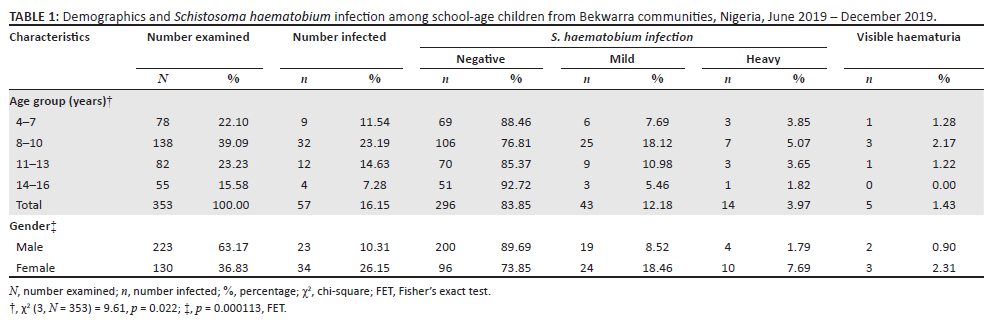
This study enrolled 353 school-age children within the age range of 4-16 years (Table 1). They consist of 223 (63.17%) boys and 130 (36.83%) girls. The overall prevalence was 16.15%. A total of 43 (12.18%) children had a mild infection, while 14 (3.97%) had a heavy infection; of this group with heavy infection, 2 (1.43%) had visible urinary haematuria. S. haematobium prevalence was highest in children 8-10 years old (n = 32, 23.19%), and lowest in children 14-16 years old (n = 4, 7.28%). There was a significant association between the infection rate and the age of the children (p = 0.022). In addition, the highest rate of S. haematobium infection was observed in girls (n = 34, 26.15%), while boys had an infection rate of 23 (10.31%). A significant association was observed between the gender and infection rate (p < 0.001).
The mean calcium serum level was significantly (p = 0.001) lower in heavily-infected children when compared to children without infection. Serum concentrations of iron (p < 0.001), copper and zinc were significantly lower in children with mild S. haematobium infection compared with children without infection. Furthermore, there were significant reductions in serum concentrations of iron (p < 0.001), zinc (p < 0.001) and copper (p < 0.002) in children with heavy S. haematobium infection when compared to children without infection. Bivariate correlation analysis showed a significant inverse correlation between the number of S. haematobium eggs/10 mL in urine and the levels of serum copper (r = −0.61, p < 0.001) and zinc (r = −0.41, p < 0.002). Also, an inverse correlation was found between the number of S. haematobium eggs/10 mL in urine and serum calcium (r = −0.24) and iron (r = −0.21) levels, but the correlations were not statistically significant (Table 2).
Discussion
This study provides baseline epidemiological data on urogenital schistosomiasis in school-age children in the Bekwarra villages of Cross River, Nigeria. Our findings suggest that urogenital schistosomiasis is a prevailing parasitic infection in our study setting, similar to reports of it being a significant cause of morbidity in Nigerian children in some riverine communities.38,391140,4142,43,44,4546,47,48
The age group with the highest burden of infection in this study is those children younger than 11 years old, and the infection prevalence peaked at 8-11 years, similar to reports by Olalubi and Olukunle.4950S. haematobium risk factors; nonetheless, infection prevalence was greater in girls. The higher prevalence in girls might be because the girls may routinely engage in house chores and associated activities, such as dish and cloth washing, fetching water from the stream for cleaning, bathing, and other domestic purposes, as well as the inherent anatomical differences between girls and boys.51S. haematobium infection in Uganda5253545556
Parasitic infections can cause nutrient loss, leading to poor nutritional status, which increases susceptibility to infection, creating a vicious cycle.57S. haematobium infection and micronutrient status. This observation indicates that the concentrations of calcium, iron, copper and zinc diminish as the infection intensity increases in school children. Although the report of Osazuwa et al.58S. haematobium infection, previous studies found no correlation between micronutrient status for calcium, copper and zinc with helminth infection.59,60,61,62
Limitations
Confounders, such as other Schistosoma species and microorganisms, were not examined; however, they might have influenced the data distribution in the research. The inability to analyse the snail host's water sources and objectively quantify school-age children's water-contact activities may restrict the interpretation of findings. Another limitation of the study was the difficulty in obtaining guardian permission due to superstitious concerns regarding the use of participants' urine samples.
Conclusion
This study found a relatively low incidence of urinary schistosomiasis infection. Providing potable water in the study communities will reduce exposure to infected water, thereby reducing transmission. There were significant differences established between sex and age and urinary schistosomiasis infectious diseases. These findings showed that urogenital schistosomiasis causes considerable morbidity and may be one of the contributing reasons to malnutrition in school-age children residing in Bekwarra LGA, Cross River State. Routine mass treatment will decrease morbidity and gradually eradicate the disease in the communities. Therefore, there is a need for continual disease evaluation, provision of basic health education, implementation of broad-based health care policy, and development of socioeconomic infrastructures including providing safe and clean water for drinking through government agencies and cooperating organisation collaborations. These are essential in endemic areas to reduce infection transmission.
Competing interests
The authors declare that they have no financial or personal relationships that may have inappropriately influenced them in writing this article.
Authors' contributions
E.I.E. wrote the original draft. E.I.E. and S.E.O. co-designed the study, and managed the literature search. S.E.O. vetted the manuscript, and supervised the laboratory analysis. A.O. managed the statistical analyses. S.E.O. and O.S.E. administered the questionnaire, managed specimen collection and carried out the laboratory analysis. All authors read and approved the final manuscript.
Sources of support
This research received no specific grant from any funding agency in the public, commercial or not-for-profit sectors.
Data availability
The datasets are not publicly available but are available from the corresponding author, E.I.E., upon reasonable request.
Disclaimer
The views and opinions expressed in this article are those of the authors and do not necessarily reflect the official policy or position of any affiliated agency of the authors.
Acknowledgements
The authors thank school teachers in Bekwarra Local Government Area, Nigeria, who assisted in participant recruitment. Appreciation goes to Mrs. Nneka Vivien Olerimi who also contributed in both advisory and manuscript review roles.
References
-
1.Utzinger J, Becker SL, Lieshout L van, Dam GJ van, Knopp S. New diagnostic tools in schistosomiasis. Clin Microbiol Infect 2015;21(6):529-542. https://doi.org/10.1016/j.cmi.2015.03.014
» https://doi.org/10.1016/j.cmi.2015.03.014 -
2.Idris OA, Wintola OA, Afolayan AJ. Helminthiases; prevalence, transmission, host-parasite interactions, resistance to common synthetic drugs and treatment. Heliyon 2019;5(1):e01161. https://doi.org/10.1016/j.heliyon.2019.e01161
» https://doi.org/10.1016/j.heliyon.2019.e01161 -
3.Colley DG, Bustinduy AL, Secor WE, King CH. Human schistosomiasis. Lancet (London, England) 2014;383(9936):2253-2264. https://doi.org/10.1016/S0140-6736(13)61949-2
» https://doi.org/10.1016/S0140-6736(13)61949-2 - 4.World Health Organization. Schistosomiasis: Number of people treated worldwide in 2013. Wkly Epidemiol Rec Relev épidémiologique Hebd 2015;90(05):25-32.
-
5.Montresor A, Mupfasoni D, Mikhailov A, et al. The global progress of soil-transmitted helminthiases control in 2020 and World Health Organization targets for 2030. PLoS Negl Trop Dis 2020;14(8):e0008505. https://doi.org/10.1371/journal.pntd.0008505
» https://doi.org/10.1371/journal.pntd.0008505 -
6.Wang X-Y, He J, Juma S, et al. Efficacy of China-made praziquantel for treatment of Schistosomiasis haematobium in Africa: A randomized controlled trial. PLoS Negl Trop Dis 2019;13(4):e0007238. https://doi.org/10.1371/journal.pntd.0007238
» https://doi.org/10.1371/journal.pntd.0007238 -
7.Abdulkadir A, Ahmed M, Abubakar BM, et al. Prevalence of urinary schistosomiasis in Nigeria, 1994-2015: Systematic review and meta-analysis. African J Urol 2017;23(3):228-239. https://doi.org/10.1016/j.afju.2016.11.004
» https://doi.org/10.1016/j.afju.2016.11.004 -
8.Ihejirika OC, Nwaorgu OC, Ebirim CI, Nwokeji CM. Effects of intestinal parasitic infections on nutritional status of primary children in Imo State Nigeria. Pan Afr Med J 2019;33:34. https://doi.org/10.11604/pamj.2019.33.34.17099
» https://doi.org/10.11604/pamj.2019.33.34.17099 -
9.Oluwole AS, Ekpo UF, Karagiannis-Voules D-A, et al. Bayesian geostatistical model-based estimates of soil-transmitted helminth infection in Nigeria, including annual deworming requirements. PLoS Negl Trop Dis 2015;9(4):e0003740. https://doi.org/10.1371/journal.pntd.0003740
» https://doi.org/10.1371/journal.pntd.0003740 -
10.Adenowo AF, Oyinloye BE, Ogunyinka BI, Kappo AP. Impact of human schistosomiasis in sub-Saharan Africa. Brazilian J Infect Dis an Off Publ Brazilian Soc Infect Dis 2015;19(2):196-205. https://doi.org/10.1016/j.bjid.2014.11.004
» https://doi.org/10.1016/j.bjid.2014.11.004 - 11.Nebe OJ, Anagbogu IN, Ngige EN, et al. Epidemiological mapping of schistosomiasis and soil transmitted helminthiasis in 19 states and the federal capital territory (FCT), Nigeria. Am J Trop Med Hyg 2017;95(5):559.
-
12.Echazú A, Bonanno D, Juarez M, et al. Effect of poor access to water and sanitation as risk factors for soil-transmitted helminth infection: Selectiveness by the infective route. PLoS Negl Trop Dis 2015;9(9):e0004111. https://doi.org/10.1371/journal.pntd.0004111
» https://doi.org/10.1371/journal.pntd.0004111 -
13.Ogbonna CC, Dori GU, Nweze EI, Muoneke G, Nwankwo IE, Akputa N. Comparative analysis of urinary schistosomiasis among primary school children and rural farmers in Obollo-Eke, Enugu State, Nigeria: Implications for control. Asian Pac J Trop Med 2012;5(10):796-802. https://doi.org/10.1016/S1995-7645(12)60146-1
» https://doi.org/10.1016/S1995-7645(12)60146-1 - 14.Babatunde TA, Asaolu SO, Sowemimo OA. Urinary schistosomiasis among pre-school and school aged children in two peri-urban communities in Southwest Nigeria. J Parasitol vector Biol 2013;5(7):96-101.
-
15.Abou-Zeid AH, Abkar TA, Mohamed RO. Schistosomiasis infection among primary school students in a war zone, Southern Kordofan State, Sudan: A cross-sectional study. BMC Public Health 2013;13(1):643. https://doi.org/10.1186/1471-2458-13-643
» https://doi.org/10.1186/1471-2458-13-643 -
16.Inobaya MT, Olveda RM, Chau TN, Olveda DU, Ross AG. Prevention and control of schistosomiasis: A current perspective. Res Rep Trop Med 2014;2014(5):65-75. https://doi.org/10.2147/RRTM.S44274
» https://doi.org/10.2147/RRTM.S44274 -
17.Kabuyaya M, Chimbari MJ, Manyangadze T, Mukaratirwa S. Schistosomiasis risk factors based on the infection status among school-going children in the Ndumo area, uMkhanyakude district, South Africa. South African J Infect Dis 2017;32(2):67-72. https://doi.org/10.1080/23120053.2016.1266139
» https://doi.org/10.1080/23120053.2016.1266139 -
18.Lwanga F, Kirunda BE, Orach CG. Intestinal helminth infections and nutritional status of children attending primary schools in Wakiso District, Central Uganda. Int J Environ Res Public Health 2012;9(8):2910-2921. https://doi.org/10.3390/ijerph9082910
» https://doi.org/10.3390/ijerph9082910 -
19.Arigony ALV, Oliveira IM de, Machado M, et al. The influence of micronutrients in cell culture: A reflection on viability and genomic stability. Biomed Res Int 2013;2013:597282. https://doi.org/10.1155/2013/597282
» https://doi.org/10.1155/2013/597282 - 20.Roohani N, Hurrell R, Kelishadi R, Schulin R. Zinc and its importance for human health: An integrative review. J Res Med Sci 2013;18(2):144-157.
-
21.Wessells KR, Brown KH. Estimating the global prevalence of zinc deficiency: Results based on zinc availability in national food supplies and the prevalence of stunting. PLoS One 2012;7(11):e50568. https://doi.org/10.1371/journal.pone.0050568
» https://doi.org/10.1371/journal.pone.0050568 -
22.Voskaki I, Arvanitidou V, Athanasopoulou H, Tzagkaraki A, Tripsianis G, Giannoulia-Karantana A. Serum copper and zinc levels in healthy Greek children and their parents. Biol Trace Elem Res 2010;134(2):136-145. https://doi.org/10.1007/s12011-009-8462-2
» https://doi.org/10.1007/s12011-009-8462-2 -
23.Altobelli GG, Noorden S Van, Balato A, Cimini V. Copper/Zinc superoxide dismutase in human skin: Current knowledge. Front. Med 2020;7:183. https://doi.org/10.3389/fmed.2020.00183
» https://doi.org/10.3389/fmed.2020.00183 -
24.Marquardt ML, Done SL, Sandrock M, Berdon WE, Feldman KW. Copper deficiency presenting as metabolic bone disease in extremely low birth weight, short-gut infants. Pediatrics 2012;130(3):e695-e698. https://doi.org/10.1542/peds.2011-1295
» https://doi.org/10.1542/peds.2011-1295 -
25.Wazir SM, Ghobrial I. Copper deficiency, a new triad: Anemia, leucopenia, and myeloneuropathy. J community Hosp Intern Med Perspect 2017;7(4):265-268. https://doi.org/10.1080/20009666.2017.1351289
» https://doi.org/10.1080/20009666.2017.1351289 -
26.Abbaspour N, Hurrell R, Kelishadi R. Review on iron and its importance for human health. J Res Med Sci [serial online]. 2014;19(2):164-174. c2014 [cited 2014 Feb]. Available from: https://pubmed.ncbi.nlm.nih.gov/24778671
» https://pubmed.ncbi.nlm.nih.gov/24778671 -
27.Desalegn A, Mossie A, Gedefaw L. Nutritional iron deficiency anemia: Magnitude and its predictors among school age children, Southwest Ethiopia: A community based cross-sectional study. PLoS One 2014;9(12):e114059. https://doi.org/10.1371/journal.pone.0114059
» https://doi.org/10.1371/journal.pone.0114059 -
28.Weaver CM, Alexander DD, Boushey CJ, et al. Calcium plus vitamin D supplementation and risk of fractures: an updated meta-analysis from the National Osteoporosis Foundation. Osteoporos Int 2016;27(1):367-376. https://doi.org/10.1007/s00198-015-3386-5
» https://doi.org/10.1007/s00198-015-3386-5 -
29.Imdad A, Bhutta ZA. Effects of calcium supplementation during pregnancy on maternal, fetal and birth outcomes. Paediatr Perinat Epidemiol 2012;26:138-152. https://doi.org/10.1111/j.1365-3016.2012.01274.x
» https://doi.org/10.1111/j.1365-3016.2012.01274.x -
30.Bhutta ZA, Das JK, Rizvi A, et al. Evidence-based interventions for improvement of maternal and child nutrition: what can be done and at what cost?. Lancet 2013;382(9890):452-477. https://doi.org/10.1016/S0140-6736(13)60996-4
» https://doi.org/10.1016/S0140-6736(13)60996-4 - 31.Iboyi MO, Moses J, Azua ET. Determination of urinary schistosomiasis among school children in selected schools in Bekwarra Local Government Area, Cross River State, Nigeria using rapid diagnostic methods. WNOFNS 2022;43:83-95
-
32.Ritchie LS. An ether sedimentation technique for routine stool examinations. Bull U S Army Med Dep [serial online]. 2017;23:1948. c2017 [cited 2017 Apr]. Available from: https://www.cabdirect.org/cabdirect/abstract/19480801031
» https://www.cabdirect.org/cabdirect/abstract/19480801031 - 33.Lawiye JL, Vandi PV, Godly C, Midala AL, Watirahel P, Enamola W. Prevalence and risk factors of schistosoma haematobium infections among primary school children in yola north local government, Adamawa State, Nigeria. African J Biomed Res 2020;23(1):51-55.
- 34.Cheesbrough M. Parasitological tests. Dist Lab Pract Trop countries, Part 1999;1:220-221.
-
35.Pybus J, Feldman FJ, Bowers Jr. GN. Measurement of total calcium in serum by atomic absorption spectrophotometry, with use of a strontium internal reference. Clin Chem 1970;16(12):998-1007. https://doi.org/10.1093/clinchem/16.12.998
» https://doi.org/10.1093/clinchem/16.12.998 -
36.Ibadi A, Ali D, Abdulsahib H. Determination of copper, iron, and nickel in serum of myocardial infarction patients by flame atomic absorption spectrometry. Int J Adv Res 2018;6(5):150-157. https://doi.org/10.21474/IJAR01/7018
» https://doi.org/10.21474/IJAR01/7018 - 37.Amare B, Tafess K, Ota F, et al. Serum concentration of selenium in diarrheic patients with and without HIV/AIDS in Gondar, Northwest Ethiopia. J AIDS Clin Res 2011;2(128):2.
-
38.Ekanem EE, Akapan FM, Eyong ME. Urinary schistosomiasis in school children of a southern nigerian community 8 years after the provision of potable water. Niger Postgrad Med J 2017;24(4):201-204. https://doi.org/10.4103/npmj.npmj_136_17
» https://doi.org/10.4103/npmj.npmj_136_17 -
39.Amuta EU, Houmsou RS. Prevalence, intensity of infection and risk factors of urinary schistosomiasis in pre-school and school aged children in Guma Local Government Area, Nigeria. Asian Pac J Trop Med 2014;7(1):34-39. https://doi.org/10.1016/S1995-7645(13)60188-1
» https://doi.org/10.1016/S1995-7645(13)60188-1 -
40.Umoh NO, Nwamini CF, Inyang NJ, et al. Prevalence of urinary schistosomiasis amongst primary school children in Ikwo and Ohaukwu Communities of Ebonyi State, Nigeria. Afr J Lab Med 2020;9(1):812. https://doi.org/10.4102/ajlm.v9i1.812
» https://doi.org/10.4102/ajlm.v9i1.812 -
41.Tobin EA, Eze GU, Isah EC, Okojie PW. Prevalence of urinary schistosomiasis among school children in a rural community in South-South, Nigeria. West Afr J Med [serial online]. 2013;32(2):115-120. c2013 [cited 2013 Apr 01]. Available from: http://europepmc.org/abstract/MED/23913499
» http://europepmc.org/abstract/MED/23913499 -
42.Ouedraogo H, Drabo F, Zongo D, et al. Schistosomiasis in school-age children in Burkina Faso after a decade of preventive chemotherapy. Bull World Health Organ 2016;94(1):37-45. https://doi.org/10.2471/BLT.15.161885
» https://doi.org/10.2471/BLT.15.161885 -
43.Kayuni SA, O'Ferrall AM, Baxter H, et al. An outbreak of intestinal schistosomiasis, alongside increasing urogenital schistosomiasis prevalence, in primary school children on the shoreline of Lake Malawi, Mangochi District, Malawi. Infect Dis poverty 2020;9(1):121. https://doi.org/10.1186/s40249-020-00736-w
» https://doi.org/10.1186/s40249-020-00736-w -
44.Bocanegra C, Gallego S, Mendioroz J, et al. Epidemiology of schistosomiasis and usefulness of indirect diagnostic tests in school-age children in Cubal, Central Angola. PLoS Negl Trop Dis 2015;9(10):e0004055. https://doi.org/10.1186/s40249-020-00736-w
» https://doi.org/10.1186/s40249-020-00736-w - 45.Person B, Ali SM, A'Kadir FM, et al. Community knowledge, perceptions, and practices associated with urogenital schistosomiasis among school-aged children in Zanzibar, United Republic of Tanzania. PLoS Negl Trop Dis 2016;10(7):e0004814.
-
46.Babatunde TA, Sowemimo SO. Urinary schistosomiasis among pre-school and school aged children in two peri-urban communities in Southwest Nigeria. J Parasitol Vector Biol [serial online]. 2013;5(7):96-101. c2013 [cited 2013 Jul 31]. Available from: http://www.academicjournals.org/JPVB
» http://www.academicjournals.org/JPVB -
47.Noriode RM, Idowu ET, Otubanjo OA, Mafe MA. Urinary schistosomiasis in school aged children of two rural endemic communities in Edo State, Nigeria. J Infect Public Health 2018;11(3):384-388. https://doi.org/10.1016/j.jiph.2017.09.012
» https://doi.org/10.1016/j.jiph.2017.09.012 -
48.Abdulkareem BO, Habeeb KO, Kazeem A, Adam AO, Samuel UU. Urogenital schistosomiasis among schoolchildren and the associated risk factors in selected rural communities of Kwara State, Nigeria. J Trop Med 2018;2018:6913918. https://doi.org/10.1155/2018/6913918
» https://doi.org/10.1155/2018/6913918 -
49.Olalubi OA, Olukunle BF. Prevalence and risk factors of schistosoma haematobium infections among primary school children in Igbokuta Village, Ikorodu North Local Government, Lagos State. IOSR J Nurs Heal Sci 2013;2(6):62-68. https://doi.org/10.9790/1959-0266268
» https://doi.org/10.9790/1959-0266268 -
50.Oyeyemi OT, Jesus Jeremias W de, Grenfell RFQ. Schistosomiasis in Nigeria: Gleaning from the past to improve current efforts towards control. One Heal 2020;11:100183. https://doi.org/10.1016/j.onehlt.2020.100183
» https://doi.org/10.1016/j.onehlt.2020.100183 - 51.Samie A, Nchachi DJ, Obi CL, Igumbor EO. Prevalence and temporal distribution of schistosoma haematobium infections in the Vhembe district, Limpopo Province, South Africa. African J Biotechnol 2010;9(42):7157-7164.
-
52.Kazibwe F, Makanga B, Rubaire-Akiiki C, et al. Transmission studies of intestinal schistosomiasis in Lake Albert, Uganda and experimental compatibility of local Biomphalaria spp. Parasitol Int 2010;59(1):49-53. https://doi.org/10.1016/j.onehlt.2020.100183
» https://doi.org/10.1016/j.onehlt.2020.100183 -
53.Hassan AO, Amoo AOJ, Akinwale OP, Deji-agboola AM, Adeleke MA, Gyang PV. Current status of urinary schistosomiasis in communities around the Erinle and Eko-Ende Dams and the implications for schistosomiasis control in Nigeria. S Afr J Infect Dis 2015;29(4):137-140. https://doi.org/10.1080/23120053.2014.11441588
» https://doi.org/10.1080/23120053.2014.11441588 - 54.Salem OAC, Alassane MT. Prevalence and parasite load of urinary schistosomiasis in schoolchildren in the Wilaya of Gorgol in Mauritania. Med Trop Rev du Corps sante Colon 2011;71(3):261-263.
-
55.Senghor B, Diallo A, Sylla SN, et al. Prevalence and intensity of urinary schistosomiasis among school children in the district of Niakhar, region of Fatick, Senegal. Parasit Vectors 2014;7:5. https://doi.org/10.1186/1756-3305-7-5
» https://doi.org/10.1186/1756-3305-7-5 -
56.Geleta S, Alemu A, Getie S, Mekonnen Z, Erko B. Prevalence of urinary schistosomiasis and associated risk factors among Abobo Primary School children in Gambella Regional State, southwestern Ethiopia: A cross sectional study. Parasit Vectors 2015;8(1):1-9. https://doi.org/10.1186/s13071-015-0822-5
» https://doi.org/10.1186/s13071-015-0822-5 -
57.Amare B, Ali J, Moges B, et al. Nutritional status, intestinal parasite infection and allergy among school children in northwest Ethiopia. BMC Pediatr 2013;13:7. https://doi.org/10.1186/1471-2431-13-7
» https://doi.org/10.1186/1471-2431-13-7 -
58.Osazuwa F, Ayo OM, Imade P. A significant association between intestinal helminth infection and anaemia burden in children in rural communities of Edo state, Nigeria. N Am J Med Sci 2011;3(1):30. https://doi.org/10.4297/najms.2011.330
» https://doi.org/10.4297/najms.2011.330 -
59.Celiksoz A, Kilic E, Yazar S, Saraymen R. Teniasis: Effect on element status of children. Biol Trace Elem Res 2006;114(1-3):217-223. https://doi.org/10.1385/BTER:114:1:217
» https://doi.org/10.1385/BTER:114:1:217 - 60.Friis H, Ndhlovu P, Kaondera K, et al. Serum concentration of micronutrients in relation to schistosomiasis and indicators of infection: A cross-sectional study among rural Zimbabwean schoolchildren. Eur J Clin Nutr 1996;50(6):386-391.
-
61.Berhe N, Halvorsen BL, Gundersen TE, Myrvang B, Gundersen SG, Blomhoff R. Reduced serum concentrations of retinol and alpha-tocopherol and high concentrations of hydroperoxides are associated with community levels of S. mansoni infection and schistosomal periportal fibrosis in Ethiopian school children. Am J Trop Med Hyg 2007;76(5):943-949. https://doi.org/10.4269/ajtmh.2007.76.943
» https://doi.org/10.4269/ajtmh.2007.76.943 -
62.Osei A, Houser R, Bulusu S, Joshi T, Hamer D. Nutritional status of primary schoolchildren in Garhwali Himalayan villages of India. Food Nutr Bull 2010;31(2):221-233. https://doi.org/10.1177/156482651003100205
» https://doi.org/10.1177/156482651003100205

Accepted: 08 Mar. 2023
Published: 31 May 2023