Instability absorption by tertiary educators: Technology adoption under conditions of fragility in the Liberian higher education sector
Abstract
Digital transformation in higher education is frequently framed in terms of access and adoption. Such framings generally failed to consider how digital higher education systems function under conditions of persistent infrastructural instability and constrained institutional capacity. This study examines Liberian educators' experiences of digital provision under conditions of fragility in the country's higher education sector. Based on data from interviews and a survey with 22 educators across 11 Liberian tertiary institutions, the research found that continuity is sustained to a great extent not through the provision of technological systems and user acceptance of those systems, but rather through educators' adaptations to the unstable state of the technological infrastructure. The educators' responses fall into four main instability absorption categories-responsibility displacement; non-institutional and informal communication infrastructures; communicative labour; and uneven digital labour-and the study proposes the instability absorption model (IAM) to explain how these absorption practices sustain digital education delivery. The model frames technology adoption under conditions of fragility as a process of sustained operationalisation, where systems continue functioning through continuous human absorption of infrastructure disruption.
digital transformation; higher education; Liberia; technology adoption; resource-constrained environments; responsibility displacement; communication infrastructures; communicative labour; digital labour; instability absorption model (IAM)
1. Introduction
Higher education institutions across Sub-Saharan Africa are increasingly reliant on digital technologies for expanding access, improving teaching quality, strengthening research capacity, and supporting national development agendas. Global and continental policy frameworks emphasise digital transformation as central to educational inclusion (UNESCO, 2023; World Bank, 2023). However, in specific African national contexts, the implementation of digital initiatives in higher education settings unfolds under material and institutional conditions characterised by fragility. This study focuses on Liberian higher education as a context in which fragility is pronounced.
The Liberian higher education sector is overseen by the National Commission on Higher Education (NCHE), which recognises 81 higher education institutions: 13 public, 33 private, and 35 faith-based (NCHE, n.d.). The system is anchored by the University of Liberia, alongside private institutions such as Cuttington University and the African Methodist Episcopal University. Collectively, the 81 institutions serve a student population estimated at over 50,000 individuals (World Bank, 2017, 2023). Meanwhile, the broader Liberian operating environment is characterised by constrained electricity access, uneven internet connectivity, and limited technical support capacity, all of which directly affect the feasibility of sustained digital provision in tertiary education (Government of Liberia, 2022; NCHE, n.d.; World Bank, 2017, 2023).
Studies of higher education in fragile and post-conflict contexts have found that resource constraints, infrastructural disruption, and limited institutional support shape teaching quality, digital provision, and staff development needs (Abdulkerim et al., 2022; Barikzai et al., 2025). As one of its efforts to address such challenges, Liberia participates in the West and Central African Research and Education Network (WACREN)-through the Liberia Research and Education Network (LRREN). WACREN and LRREN aim, inter alia, to improve institutional digital connectivity and to enable research collaboration through shared digital services. Liberian national policy initiatives, such as the National Digital Transformation Strategy (Government of Liberia, 2022), emphasise connectivity expansion and digital skills development. At the institutional level, universities have introduced learning management systems such as Moodle, used within the ULOnline platform, alongside tools such as Google Classroom and mobile-orientated systems including mElimu. However, platforms are often inconsistently maintained.
This context raises important questions about (1) how digital provision is sustained at Liberian higher education institutions in the absence of stable infrastructure, and (2) how responsibility for that provision is distributed across actors at the institutions. This study sought answers to these questions by interviewing and surveying 22 educators from across 11 Liberian higher education institutions.
Research questions
This study was guided by the following questions:
• How do educators in Liberia's higher education institutions describe the usefulness and usability of digital technologies in their institutional contexts?
• What institutional, infrastructural, and governance conditions shape educators' ability to adopt and sustain digital teaching practices?
• How does educators' use of non-institutional communication platforms support or compensate for gaps in institutional provision?
• How do educators negotiate responsibility, workload, and support in sustaining digital practices in their environments?
2. Conceptual framing
For the purposes of this study, educational technology adoption was conceptualised as a socially embedded and institutionally mediated process rather than an individual behavioural decision. To arrive at this conceptual framing, we engaged selectively with established technology adoption frameworks, including the technology acceptance model (TAM) (Davis, 1989; Davis et al., 1989), the unified theory of acceptance and use of technology (UTAUT) (Venkatesh et al., 2003, 2012), and diffusion of innovation (DOI) (Rogers, 2003). These frameworks provide widely used constructs such as perceived usefulness, ease of use, facilitating conditions, social influence, and diffusion processes. However, such models often privilege individual cognition and behavioural intention, while treating organisational structures, infrastructural reliability, and governance arrangements as secondary or background conditions (Avgerou, 2008; Selwyn, 2016; Straub, 2009). In resource-constrained higher education contexts, such analytical orientations are insufficient.
Accordingly, we were drawn to perspectives in the social shaping of technology (SST) tradition, in which technologies are conceptualised as socially constructed and institutionally embedded (MacKenzie & Wajcman, 1999; Orlikowski, 2000). The SST approach emphasises the reciprocal relationship between technological artefacts and social structures, highlighting how organisational norms, power relations, and institutional arrangements shape technological outcomes. However, while SST explains how technologies and institutions co-evolve, it does not fully account for the ongoing work required to stabilise technological systems in contexts where formal infrastructures are unreliable. We addressed this limitation by shifting analytical attention from co-construction to maintenance. Specifically, we examined how educators' communication practices can function as a form of infrastructural labour-labour through which digital systems are actively sustained, repaired, and made workable in everyday institutional contexts.
The study was further informed by information and communication technology for development (ICT4D) scholarship, which foregrounds the roles of context, governance, and institutional capacity in shaping technological trajectories (Avgerou, 2008; Heeks, 2010; Unwin, 2009). ICT4D research has consistently shown that digital initiatives introduced without coherent support structures tend to produce uneven outcomes and depend on local adaptation. However, while ICT4D scholarship effectively identifies structural constraints, it tends to emphasise gaps, deficits, and inequalities without fully explaining how digital provision continues to function despite these limitations. Thus, the present study drew on insights from information infrastructure scholarship, which conceptualises infrastructure as relational, embedded, and sustained through practice (Bowker & Star, 1999; Bowker et al., 2010; Star & Ruhleder, 1996).
In summary, the aforementioned theoretical resources guided the conceptual framing of the study in the following ways. TAM, UTAUT, and DOI sensitised the analysis to educators' accounts of usefulness, usability, social influence, facilitating conditions, and adoption processes. SST directed attention to the institutional and organisational arrangements that shape technologies in practice. ICT4D scholarship drew focus to resource constraints, governance, infrastructure, and institutional capacity. And information-infrastructure scholarship ensured attention to the communicative and coordinative work required of educators to keep digital systems functioning when system-functioning is fragile.
3. Research design
Participant sample
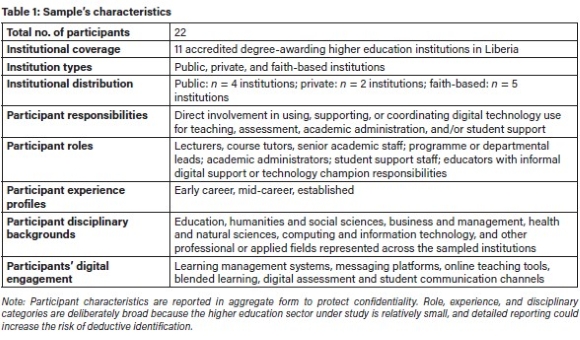
The study participants were 22 educators from across 11 Liberian higher education institutions, with the 11 entities represented comprising public (n = 4), private (n = 2), and faith-based institutions (n = 5). Selected participants were all educators with direct experience of educational-technology use, support, and/or coordination. A purposive, stratified sampling strategy (Patton, 2015) was used to ensure representation across the 11 institutions. Within each institutional category, maximum-variation principles guided selection, with attention to role, disciplinary background, experience, and digital engagement. Participants were recruited through institutional contact points, professional networks, and direct invitations where appropriate. Table 1 provides an overview of the sample's characteristics.
Data collection
Semi-structured interviews were conducted with the 22 participants. The interviews focused on participants' experiences with the use of digital platforms; infrastructural disruption; institutional support; use of non-institutional communication channels; peer support; student coordination; and additional labour involved in sustaining digital provision. With participants' consent, interview data was recorded and documented for analysis, with identifying details removed during transcription and preparation of the dataset.
In addition, a short descriptive survey was used to capture contextual information on access, connectivity, platform use, and sources of technical support. The survey provided contextual information that supported interpretation of the interview findings and helped to situate participants' accounts within their institutional and infrastructural conditions.
Data analysis
The interview data was analysed using reflexive thematic analysis (Braun & Clarke, 2022). The first stage comprised familiarisation with the interview transcripts, field notes, and contextual survey responses. Transcripts were read repeatedly to develop a close understanding of participants' descriptions. During familiarisation, preliminary analytic notes were made on recurring issues such as unreliable electricity, unstable internet access, platform-switching, WhatsApp-based coordination, peer support, student troubleshooting, additional workload, and repeated adaptation to system failure.
The second stage was the initial coding of the interview data. Codes were generated inductively from participants' accounts, with cognisance of the study's concern with educators' experiences of adoption, institutional capacity, communication channels, and performance of infrastructural labour. Coding captured both descriptive content and more interpretative meanings. Descriptive codes included electricity disruption, connectivity failure, platform breakdown, use of WhatsApp, peer assistance, lack of training, and limited technical support. Interpretative codes included responsibility-shifting, hidden labour, accountability without authority, non-institutional infrastructure, normalised disruption, anticipatory adjustment, and adaptive containment. The coding process was recursive, meaning that earlier transcripts were revisited as later transcripts revealed new patterns or sharpened the interpretation of existing codes.
The third stage consisted of grouping related codes into broader analytical categories. The fourth stage comprised developing candidate themes and reviewing them against the full dataset. The themes were refined through repeated movement between coded extracts, the wider dataset, and the research questions. This process resulted in five final themes:
• infrastructural fragility as a structuring condition of educators' technology adoption;
• institutional support gaps resulting in responsibility displacement to educators;
• educators' use of non-institutional and informal communication infrastructures as compensatory systems;
• uneven digital labour and structural dependency on educators; and
• educators' adaptive stabilisation without institutional learning.
The final stage of analysis moved from thematic description to conceptual synthesis, with the five themes examined in relation to one another.
Reflexivity and ethics
Field notes documented analytical decisions and emerging interpretations. Ethical approval was obtained from the University of Liberia Institutional Review Board (ULIRB) prior to data collection, under approval reference UL-IRB/JCT-CH/196/26. Participants were assured of anonymity and confidentiality, and provided informed consent. Identifying details were removed from the data to protect anonymity.
4. Findings and analysis
Theme 1: Infrastructural fragility as a structuring condition of educators' technology adoption
In the interview data, infrastructural fragility emerges not as an occasional disruption but as a structuring condition that reorganises the operational foundations of digital teaching across the 11 Liberian higher education institutions. Infrastructure does not simply fail intermittently; it functions as a baseline condition of uncertainty. Electricity supply, internet connectivity, and access to functional digital systems are experienced as unstable variables in terms of which academic work has to be continually recalibrated. Although participant responses consistently identified electricity and connectivity as major constraints, their accounts also showed variation in how these constraints are experienced. Some described disruption as a routine inconvenience to be worked around, while others framed it as a deeper institutional condition that undermines planning, credibility, and confidence in digital provision.
Electricity and connectivity as baseline constraints
Educator 2 stated: "You can plan a whole online session, but if the power goes, everything stops. It is not a surprise anymore" Planning therefore becomes short-term and defensive, with digital sessions structured around fallback options rather than assumed continuity. As educator 11 explained: "Sometimes the internet is there in the morning and gone by afternoon. You cannot rely on it." Under these conditions, reliability becomes the decisive variable. When connectivity fluctuates within a single day, synchronous engagement becomes precarious, deadlines become negotiable, and sequences of learning activity remain provisional.
Adoption as infrastructural contingency
Technology adoption was typically described by the educators as conditional and reversible rather than linear or cumulative. Educator 8 stated: "I use the platform when it works. When it does not, we move on." This reflects a pattern of contingent engagement in which digital systems are used pragmatically, based on immediate functionality; they are not embedded as stable institutional tools. Educator 16 captured the tension between institutional expectation and material reality as follows: "The institution expects online submission, but the infrastructure does not support it consistently." Technology adoption is therefore suspended between institutional policy mandate and infrastructural feasibility.
Anticipating breakdown as institutionalised precaution
A defining feature of the environment described by the educators is the routinisation of anticipatory labour. The educators do not simply respond to breakdown; they plan for it as a structural inevitability. As educator 4 stated: "You always have a backup plan. That is how you survive." Backup strategies function as primary planning mechanisms rather than secondary safeguards. Materials are duplicated, instructions are sent in advance, and alternative communication channels are prepared. Educator 21 highlighted the reputational implications of this environment: "Students think we are disorganised, but they do not see what we are dealing with."
This finding contains an important tension. On one level, backup strategies demonstrate resilience, professional commitment, and adaptive competence. On another level, they show that infrastructural failure has become normalised within everyday teaching design. Digital continuity is being produced not by infrastructural reliability but by precautionary practice.
Theme 2: Institutional support gaps resulting in responsibility displacement to educators
The educator responses showed that support gaps at their institutions do not simply constrain their technology adoption; they redistribute responsibility for sustaining the adoption. While expectations to integrate digital tools remain institutionally articulated, the organisational structures required to support these expectations are partial, inconsistent, or fragile. This produces a pattern of responsibility displacement, in which the burden of stabilising digital practice shifts from institutional systems to individual educators. Educators' accounts showed variation in how this displacement is experienced. Some regard limited support as an unavoidable feature of working in a constrained environment, while others interpret it as a deeper institutional failure to match digital expectations with operational capacity.
Episodic training and fragile capacity-building
Training was described by the educators as irregular and event-based, typically organised around the introduction of new platforms rather than embedded as continuous professional development. As educator 9 stated: "We get training when a new system comes [...] and then you are on your own" Educator 17 echoed this point, stating: "They assume once you attend the training, you are fine. But the real problems start after" It was said that these "real problems" emerge during routine use, when platforms malfunction or students encounter access barriers.
Responsibility displacement in everyday practice
It was found that in the absence of reliable institutional support, educators absorb the tasks of troubleshooting and student technical guidance as routine components of their work. As educator 6 stated: "If students cannot access the system, they come to you. You have to find a solution, even if it is not your job" Responsibility shifts downwards by default, because refusing to engage would disrupt teaching continuity. Over time, this displacement becomes normalised. Educator 13 stated: "You do not complain anymore. You just fix what you can and move on." This statement captures an important tension-that educators' willingness to intervene sustains digital provision-but it also reduces the visibility of institutional gaps by making individual problem-solving appear routine.
Accountability without authority
A further dimension of responsibility displacement identified in the data is misalignment between accountability and authority. The educators are expected to deliver digital teaching outcomes yet have limited influence over the systems through which these outcomes are achieved. As educator 10 stated: "We are expected to deliver online, but we have no say in the system itself" Educator 18 observed: "Most of the work is explaining to students why things are not working." These practices show how educators absorb the visible consequences of infrastructural and organisational shortcomings. This produces accountability without authority, where individuals are held responsible for outcomes that they lack the structural capacity to control.
Theme 3: Educators' use of non-institutional and informal communication infrastructures as compensatory systems
The educators' responses also pointed to the fact that where institutional systems prove unreliable, non-institutional and informal communication channels become the operational infrastructure of teaching. Non-institutional messaging platforms and informal peer networks do not merely supplement institutional systems; they function as compensatory systems that sustain academic activity. Participants' accounts carried the following tension: non-institutional and informal communication channels are often valued because they are immediate, familiar, and accessible, yet the same practices also reveal the weakness of institutional systems.
WhatsApp as infrastructural substitution
Participants consistently described WhatsApp as the most dependable medium for academic coordination because of its accessibility, low data requirements, and widespread familiarity among both educators and students. As educator 7 explained: "If the [university] platform is down, we do not even wait anymore. We just move to WhatsApp." The phrase "we do not even wait anymore" indicates that this shift is no longer merely reactive but has become anticipatory and routine. In the words of educator 12: "We use WhatsApp for everything now. Timetables, announcements [...] even assessments sometimes" The platform that remains consistently functional, WhatsApp, assumes institutional-infrastructure status in practice, performing essential functions such as distributing materials, coordinating communication, and maintaining the sequencing of academic activity.
Informal peer networks as distributed technical capacity
Participant responses also pointed to informal communication practices for technical support. It was stated that rather than relying on institutional IT structures, educators typically turn to colleagues for troubleshooting and problem-solving. As educator 3 stated: "You ask a colleague [...] That is how we learn." This indicates that technical knowledge is embedded within everyday interaction rather than in institutional training structures. Educator 19 stated: "The person helping you is not trained officially. They just know because they struggled before." While this distributed capacity stabilises practice in the short-term, it also introduces structural vulnerability. Continuity becomes dependent on the availability, willingness, and prior experience of specific individuals rather than on consistent institutional support.
Non-institutional communication as responsibility buffer
Non-institutional communication also functioned as a buffer that protected the student experience from the visible effects of institutional instability. When systems failed, educators absorbed the burden of explanation, mediation, and reassurance. As educator 5 explained: "When it fails, students come to us [...] So we explain and calm things down." Educator 14 captured the central contradiction: "It helps us survive, but it also hides the problem."
Linguistic layering and sociolinguistic negotiation in non-institutional communication
The non-institutional communication modalities described by the educators also reflect Liberia's multilingual context. While English remains the formal language of instruction, Liberian English and Indigenous languages such as Kpelle, Bassa, Gio, Kru, and Mano are actively used in relational and situational exchanges. Liberian English frequently appears in WhatsApp communication to clarify meaning, soften directives, and facilitate immediacy during moments of uncertainty or disruption. Indigenous languages tend to surface in more localised interactions, particularly among individuals who share linguistic and cultural backgrounds. These linguistic shifts are not incidental but functional, enabling more effective coordination and mutual understanding where technical systems are unstable.
This theme therefore presents non-institutional and informal communication as both enabling and problematic. On one level, WhatsApp groups, peer networks, and multilingual exchanges demonstrate practical agency, responsiveness, and locally grounded coordination. On another level, they show how institutional systems are being bypassed, substituted, or stabilised through non-institutionalised labour.
Theme 4: Uneven digital labour and structural dependency on educators
It was found that technology adoption is being sustained through an uneven distribution of labour, with responsibility concentrated around particular educators. Rather than being evenly distributed or formally organised, the work required to stabilise digital systems accumulates around those perceived as capable, available, or willing to assist. Continuity therefore becomes dependent on discretionary effort rather than institutional capacity. Participants' accounts also reveal variations in how this labour was understood. Some frame it as collegial support and localised expertise, while others describe it as an unrecognised burden that intensifies existing inequalities within institutional hierarchies.
Informal technology champions and labour concentration
Across institutions, a small number of educators have emerged as informal technology champions, becoming default points of contact for troubleshooting and system support. As educator 15 stated: "Once people know you can handle the system, everything comes to you." What begins as occasional collegial assistance gradually becomes a sustained expectation, embedding technical support within routine academic responsibilities. These roles are neither formally recognised nor contractually defined. The absence of formal acknowledgement or workload adjustment means that this labour remains unstructured and uncompensated.
Contractual exposure and other asymmetries
Uneven labour distribution is further shaped by employment status and organisational hierarchy. Junior staff and those on short-term or part-time contracts reported limited capacity to refuse additional coordination and support tasks. In the words of educator 20: "As a junior lecturer, you cannot say no" This highlights the manner in which precarity increases exposure to unassigned responsibilities. Variations across academic disciplines also contribute to this asymmetry. Educator 12 stated: "Some departments are expected to run a hybrid [mix of online and offline] delivery model, but the support is the same for everyone"
Normalisation and invisibility of digital labour
Tasks such as troubleshooting system failures, managing communication channels, and maintaining informal coordination structures have been absorbed into educators' workloads. As educator 6 explained: "You do not think of it as extra work anymore." In the words of educator 18: "When things work, nobody asks how much effort it took to make them work" Successful continuity therefore conceals much of the educators' work that produces it, rendering the labour required to sustain digital systems largely invisible.
Theme 5: Educators' adaptive stabilisation without institutional learning
It was found that educators' continuous adaptation prevents system collapse but does not translate into systemic strengthening or institutional learning. While digital education is sustained through educators' ongoing adjustment, these adjustments remain institutionally localised and non-cumulative. Resilience in this context is compensatory rather than transformative, enabling systems to function without resolving the structural conditions that produce instability. The educators' adaptive practices demonstrate professional resourcefulness and commitment, but the same practices also allow institutional fragility to remain manageable enough so that the institution can avoid deep reform.
Micro-adaptation as system survival
When electricity fails or platforms malfunction, educators deploy alternative materials, switch communication channels, or reconfigure teaching activities in real time. As educator 4 stated: "We just adjust and continue. There is no other option" This indicates that adaptation is driven by necessity rather than strategic choice. These micro-adaptations enable teaching to proceed but do not alter the structural conditions that generate disruption. These responses are enacted at the level of practice rather than embedded within institutional systems.
Normalisation of fragility
Over time, fragility has become normalised as an expected feature of institutional life. Rather than being experienced as exceptional, breakdown is integrated into routine anticipation. As educator 13 stated: "You expect problems. That is just how it is" This reflects the internalisation of instability as a baseline condition. The system continues to function because educators absorb volatility as a permanent feature of their working environment, allowing fragility to persist without triggering sustained institutional response.
Resilience as containment: A reform trap
On one level, the educators' resilience can be read as evidence of their commitment, creativity, and practical agency. On another level, the findings suggest that resilience also operates as containment, because the pressure that might otherwise expose systemic weakness is absorbed through continuous adjustment at the level of practice. This dynamic can be understood as a reform trap. The more effectively that educators manage disruption through adaptive practices, the less visible the need for structural change becomes.
5. Analytical synthesis: Instability absorption model (IAM)
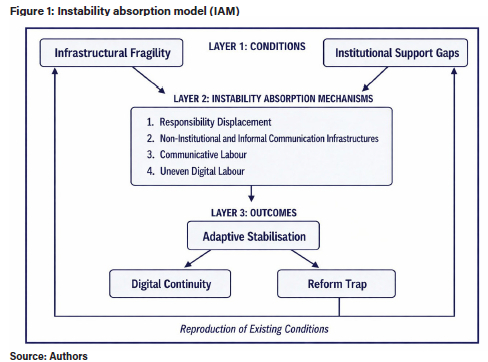
Figure 1 brings the five themes together into a single conceptual representation of how digital-education continuity is being sustained by educators under conditions of institutional fragility at the 11 Liberian higher education institutions from which participants were drawn.
As seen in Figure 1, the model is grounded in Layer 1's two interacting conditions:
• infrastructural fragility; and
• institutional support gaps.
In response to these conditions, the educators participate, as seen in Layer 2, in four core instability absorption mechanisms:
• responsibility displacement;
• non-institutional and informal communication infrastructures;
• communicative labour; and
• uneven digital labour.
The three outcomes, as seen in Layer 3, are:
• adaptive stabilisation;
• digital continuity; and
• reform trap.
The ultimate outcome, as seen at the bottom of Figure 1, is reproduction of existing conditions.
The IAM thus captures both the enabling and problematic dimensions of the findings. For example, educators' reliance on non-institutional and informal communication infrastructures-i.e., the use of WhatsApp functionalities and the use of peer-support channels-demonstrates educator agency, professional commitment, and practical resilience. But, at the same time, these communication infrastructures reveal how institutional fragility becomes normalised when digital-education continuity depends on non-institutional and informal communication as an instability absorption mechanism-along with the other three instability absorption mechanisms set out in the model: responsibility displacement, communicative labour, and uneven digital labour. The model therefore frames technology adoption under conditions of fragility not as a linear process of implementation or acceptance, but rather as a system of interdependent infrastructural and communicative dynamics activated under constraint.
The IAM also speaks directly to the literature reviewed earlier. While technology acceptance and diffusion models remain useful for identifying perceived usefulness, usability, facilitating conditions, and adoption processes, the findings of this study, as mapped in the IAM, show that acceptance and diffusion constructs do not fully explain how digital provision remains operational when the enabling conditions for use are unstable. As seen in the model, sustained technology adoption and use under conditions of fragility depend not only on acceptance and diffusion, but also on instability absorption elements such as responsibility displacement, non-institutional and informal communication infrastructures, communicative labour, and uneven digital labour. Arguably, the most crucial of the four instability absorption mechanisms that our study identified is communicative labour. The communicative labour makes the other three instability absorption mechanisms possible.
6. Conclusion
This study examined how educational-technology adoption is sustained within Liberian higher education institutions operating under conditions of infrastructural instability and constrained institutional capacity. We found that, in this context, digital continuity is not achieved through technological provision, adoption, and use alone. Rather, as set out in the IAM, digital operationalisation is sustained to a great extent through instability absorption mechanisms driven by educators, specifically responsibility displacement, non-institutional and informal communication infrastructures, communicative labour, and uneven digital labour.
The findings of this study have clarified that technology adoption in conditions of fragility is a complex process of sustained operationalisation rather than one of discrete uptake. Accordingly, the IAM that we propose captures how this sustained operationalisation is achieved when instability is absorbed to a great extent by communicative labour, which in turn animates three other instability absorption mechanisms: responsibility displacement, non-institutional and informal communication infrastructures, and uneven digital labour.
Funding declaration
The authors received no funding for the research detailed in the article or for preparation of the article.
Data availability statement
The data generated and analysed during this study are not publicly available because they contain confidential qualitative interview material and contextual information that could compromise participant and institutional anonymity. Anonymised excerpts relevant to the findings are included in the article. Further enquiries may be directed to Agnes Reeves-Taylor, at
AI declaration
No generative AI tools were used in the research or preparation of this submission. Hemingway Editor, Miro (v0.11.154, RealtimeBoard, Inc.), and Connected Papers were used for copy-editing, manual figure layout, and literature-mapping, respectively. Per AJIC policy, such tools do not require disclosure, but are listed here for completeness.
Competing interests declaration
The authors have no competing interests to declare.
Author contributions declaration
Both authors contributed jointly to conceptualisation, data collection and analysis, data curation, writing revisions, project leadership, and project management. Writing of the initial draft was undertaken by Olajide Jolugbo. Validation, student supervision, and funding acquisition were not applicable to this study.
References
- Abdulkerim, S., Nasır, A., Parkinson, T., Marais, D., Altaha, R., & Shaban, F. (2022). Enhancing higher education teaching and learning in northern Syria: Academic development needs of teaching staff at free Aleppo and Sham universities. International Journal of Educational Research Open, 3, 100143. https://doi.org/10.1016/j.ijedro.2022.100143
- Avgerou, C. (2008). Information systems in developing countries: A critical research review. Journal of Information Technology, 23(3), 133-146. https://doi.org/10.1057/jit.2008.17
- Barikzai, S., Bharathi S, V., & Perdana, A. (2025). Digital learning initiatives forging inclusive education in post-conflict nations. Cogent Education, 12(1), 2457904. https://doi.org/10.1080/2331186X.2025.2457904
- Bowker, G. C., & Star, S. L. (1999). Sorting things out: Classification and its consequences. MIT Press. https://doi.org/10.7551/mitpress/6352.001.0001
- Bowker, G. C., Baker, K., Millerand, F., & Ribes, D. (2010). Toward information infrastructure studies: Ways of knowing in a networked environment. In J. Hunsinger, L. Klastrup, & M. Allen (Eds.), International handbook of internet research (pp. 97-117). Springer. https://doi.org/10.1007/978-1-4020-9789-8_5
- Braun, V., & Clarke, V. (2022). Thematic analysis: A practical guide. SAGE. https://doi.org/10.53841/bpsqmip.2022.1.33.46
- Galimova, E. G., Oborsky, A. Y., Khvatova, M. A., Astakhov, D. V., Orlova, E. V., & Andryushchenko, I. S. (2024). Mapping the interconnections: A systematic review and network analysis of factors influencing teachers' technology acceptance. Frontiers in Education, 9, 1436724. https://doi.org/10.3389/feduc.2024.1436724
- Government of Liberia. (2022). National digital transformation strategy. Government of Liberia.
- Heeks, R. (2010). Development 2.0: The IT-enabled transformation of international development. Communications of the ACM, 53(4), 22-24. https://doi.org/10.1145/1721654.1721664
- Kleine, D. (2013). Technologies of choice? ICTs, development, and the capabilities approach. MIT Press. https://doi.org/10.7551/mitpress/9061.001.0001
- MacKenzie, D., & Wajcman, J. (1999). The social shaping of technology (2nd ed.). Open University Press.
- Malterud, K., Siersma, V. D., & Guassora, A. D. (2016). Sample size in qualitative interview studies: Guided by information power. Qualitative Health Research, 26(13), 1753-1760. https://doi.org/10.1177/1049732315617444
- National Commission on Higher Education (NCHE). (n.d.). Approved universities & colleges. https://nche.info/universities-colleges
- Naveed, Q. N., Choudhary, H., Ahmad, N., Alqahtani, J., & Qahmash, A. I. (2023). Mobile learning in higher education: A systematic literature review. Sustainability, 15(18), 13566. https://doi.org/10.3390/su151813566
- Patton, M. Q. (2015). Qualitative research and evaluation methods (4th ed.). SAGE.
- Rogers, E. M. (2003). Diffusion of innovations (5th ed.). Free Press.
- Selwyn, N. (2016). Education and technology: Key issues and debates (2nd ed.). Bloomsbury. https://doi.org/10.5040/9781474235952
- Star, S. L., & Ruhleder, K. (1996). Steps toward an ecology of infrastructure: Design and access for large information spaces. Information Systems Research, 7(1), 111-134. https://doi.org/10.1287/isre.71.111
- UNESCO. (2022). Action track 4: Digital learning and transformation: Transforming Education Summit. https://www.unesco.org/en/transforming-education-summit
- UNESCO. (2023). Global education monitoring report 2023: Technology in education: A tool on whose terms? https://doi.org/10.54676/ASZJ9193
- UNESCO. (2024). UNESCO Forum on Higher Education in Africa: Background document. https://indico.un.org/event/1014732/attachments/20010/57231/Background%20document-Africa-HE%20Forum%20FINAL.pdf
- Unwin, T. (Ed.). (2009). ICT4D: Information and communication technology for development. Cambridge University Press. https://doi.org/10.1017/CBO9780511808449
- Unwin, T., Naseem, A., Pawluczuk, A., Shareef, M., Spiesberger, P., West, P., & Yoo, C. (2020). Education for the most marginalised post-COVID-19: Guidance for governments on the use of digital technologies in education. EdTech Hub. https://doi.org/10.5281/zenodo.4311100
- Venkatesh, V., Morris, M. G., Davis, G. B., & Davis, F. D. (2003). User acceptance of information technology: Toward a unified view. MIS Quarterly, 27(3), 425-478. https://doi.org/10.2307/30036540