Bridging global and local influences: Kenya's emerging approach to AI governance
Abstract
The rapid adoption of artificial intelligence (AI) has intensified demand for national AI governance frameworks that balance innovation with ethical, legal, and societal safeguards. Emerging economies such as Kenya face the dual challenge of seeking to foster AI-driven growth while at the same time managing numerous risks. This study explores Kenya's emerging approach to AI governance, as represented by its Artificial Intelligence Strategy 2025-2030 and Artificial Intelligence Bill of 2026. Through policy-legislative content analysis, the study examines the degree to which Kenya's approach is both transplanting and localising the orientation and provisions of the EU's influential AI governance instrument, the Artificial Intelligence Act of 2024. The research also applies a contextual-adaptation analysis to examine the extent to which Kenya's AI governance approach is geared towards its particular national needs.
artificial intelligence (AI); AI governance; Kenya AI Strategy 2025-2030; Kenya Artificial Intelligence Bill; 2026; EU AI Act of 2024; policy-legislative content analysis; contextual-adaptation analysis; policy-legislative transplantation; policy-legislative localisation
1. Introduction
Kenya is widely recognised as a digital innovation leader in East Africa, a status reflected in indicators such as mobile money adoption rates; active regulatory experimentation, including sandbox frameworks; and the emergence of artificial intelligence (AI)-enabled platforms spanning agriculture, fintech, and public services (World Bank, 2019). While earlier discourse often centred on the 2007 launch of the mobile money platform M-PESA, contemporary Kenyan innovation has evolved into more sophisticated AI-driven digital ecosystems (M-PESA, n.d.). Today, for example, platforms such as M-KOPA employ data-driven and AI-enabled predictive analytics to assess creditworthiness for, inter alia, solar energy systems and smartphone financing among unbanked and underbanked populations (Emanuel-Burns, 2025; M-KOPA, n.d.). Similarly, M-PESA increasingly relies on machine learning techniques for fraud detection, risk monitoring, and service optimisation (The Kenyan Wall Street, 2025).
As AI applications continue to permeate Kenya's critical sectors such as finance, energy, and digital credit markets, the demand for a robust and contextualised governance framework has become increasingly urgent-so as to ensure ethical, inclusive, and accountable innovation (Government of Kenya, 2025). This trajectory aligns with Kenya Vision 2030, which positions technology and innovation at the core of national development, with the objective of accelerating economic growth and addressing persistent challenges, including food insecurity and inequitable access to healthcare (Government of Kenya, 2007). However, while the Kenyan government acknowledges the transformative potential of AI, the country currently lacks a dedicated, legally binding AI framework. Existing legal instruments, most notably the Data Protection Act (Republic of Kenya, 2019), provide important safeguards against harmful automated decision-making and misuse of personal data, but they were not designed to govern the full spectrum of AI-specific risks, including algorithmic bias, opacity, accountability gaps, and post-deployment monitoring.
Significant recent AI policy-legislative moments in Kenya have been the 2025 release of the Kenya Artificial Intelligence Strategy 2025-2030 (Government of Kenya, 2025) and the 2026 tabling in Senate of the Artificial Intelligence Bill (Republic of Kenya, 2026a). Together, these two documents signal Kenya's ambition to position itself as a continental leader in responsible and ethical AI adoption. The EU, meanwhile, has taken a pioneering stance in AI governance through its 2024 Artificial Intelligence Act, a landmark law that has set a globally influential precedent for the governance of AI systems (EU, 2024). The central matters that this study explored were: the extent to which Kenya's emerging AI governance trajectory is moving towards direct transplantation of European regulatory norms, and the extent to which the trajectory is adapting to the contextual particularities of the country's digital ecosystem.
The distinction between policy-legislative transplantation and localisation adopted in this study is as follows: transplantation refers to the adoption of a foreign governance model's structural architecture, definitions, and compliance mechanisms with minimal adaptation; localisation, by contrast, involves selectively drawing on a foreign model's underlying principles while recalibrating specific obligations, definitions, institutional arrangements, and enforcement mechanisms to reflect the receiving jurisdiction's legal traditions, institutional capacity, and socioeconomic realities.
2.
MethodologyThe study adopted a blended methodological approach, combining a policy-legislative content analysis with a contextual-adaptation analysis.
Policy-legislative content analysis
The policy-legislative analysis drew on two sets of documents. The first set comprised the 2024 EU AI Act and interpretations of its compliance architecture. The second set comprised Kenya's 2019 Data Protection Act, the 2025 AI Strategy, and the 2026 AI Bill, which together constitute the current direction of AI governance in Kenya (Government of Kenya, 2025; Republic of Kenya, 2019; 2026a). Policy-legislative content analysis was undertaken to identify equivalents and divergences between the EU and Kenyan AI governance directions.
Contextual-adaptation analysis
The contextual-adaptation analysis was based on a lens that I conceived of for this study. The lens, based on insights from comparative AI governance scholarship (Floridi et al., 2018; Jobin et al., 2019) and literature on responsible AI for development (Gwagwa et al., 2021; Plantinga et al., 2024), is premised on three core propositions:
• that global AI governance norms are not universally applicable and require adaptation to a national digital ecosystem through localised contextual calibration;
• that effective AI governance adaptation requires explicit engagement with a national digital ecosystem's socioeconomic realities, cultural complexities, and institutional capacity; and
• that the goal of adaptation is not rejection of global standards but rather their re-articulation in forms that are operationally feasible and locally legitimate.
The contextual-adaptation analysis explored the extent to which Kenya's emergent AI governance approach is orientated towards the specific needs of the country's digital ecosystem.
3.
Findings from the policy-legislative content analysisEU
The EU AI Act arguably represents the world's most comprehensive and influential AI governance legislative intervention to date. The Act introduces a structured, risk-based classification of AI systems, distinguishing between unacceptable, high, limited, and minimal risk applications (EU, 2024). For high-risk AI systems deployed in sensitive domains-such as critical infrastructure, employment and human resource management, creditworthiness assessment, healthcare, and the administration of justice- the Act mandates extensive pre-market conformity assessments, quality management systems, and detailed technical documentation (EU, 2024). The broader European regulatory philosophy is anchored in accountability, traceability, transparency, and meaningful human oversight, positioning the EU AI Act as a global benchmark for responsible AI governance (Jobin et al., 2019). Recent guidance to firms by Szeliga et al. (2025) illustrates how the EU embeds privacy-by-design and security-by-design into the AI lifecycle, including adversarial robustness-testing and continuous post-deployment monitoring.
Kenya
At the time of writing in mid-2026, Kenya's Data Protection Act of 2019 still constitutes the primary legal safeguard against harmful automated decision-making, requiring transparency in automated dataprocessing and granting individuals the right not to be subject to decisions based solely on automated systems where such decisions produce significant legal or social effects (Republic of Kenya, 2019). The Act's role as Kenya's de facto AI governance instrument reflects a common pattern in jurisdictions where the development of AI-specific legislation has lagged behind the pace of AI deployment: In the absence of a purpose-built AI statute, a data protection law becomes the primary legal safeguard (Plantinga et al., 2024).
Kenyan- and African-focused scholarly analysis has found that data protection law alone is insufficient to address the full spectrum of AI-related risks, particularly those relating to algorithmic accountability, sector-specific harms, and lifecycle governance (Gwagwa et al., 2021; Plantinga et al., 2024; Tacheva & Ramasubramanian, 2023). The 2025 introduction of the AI Strategy 2025-2030, and the tabling in early 2026 of the AI Bill (Senate Bills No. 4 of 2025, under Senate deliberation at the time of writing), marked significant steps in the emergence of Kenya's AI governance approach.
Content comparison between the EU and Kenyan policy-legislative frameworks
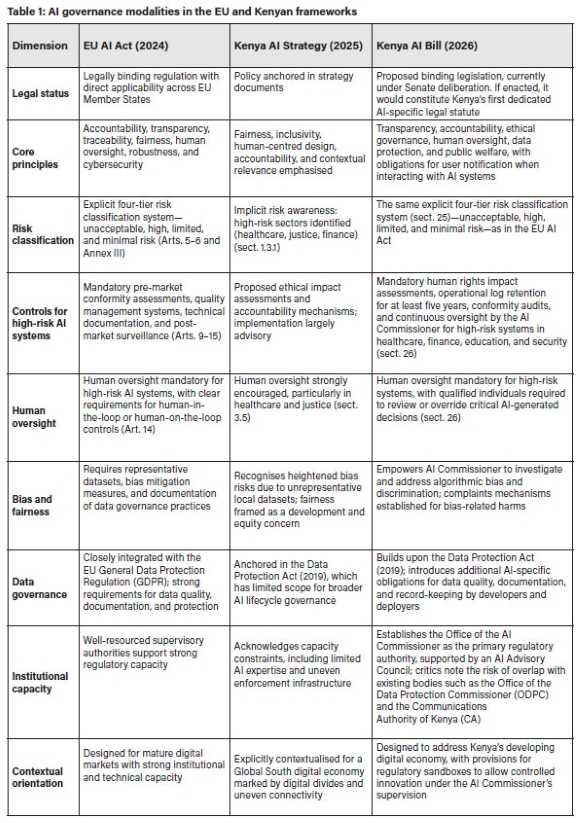
Table 1 provides an overview of the similarities and differences between the EU AI Act and Kenya's emerging AI governance framework as represented by the 2025 AI Strategy and the 2026 AI Bill.
As seen in Table 1, analysis of the EU's 2024 AI Act alongside Kenya's 2025 AI Strategy and 2026 AI Bill suggests that Kenya's AI governance trajectory is neither a straightforward regulatory transplantation of the EU model nor a fully localised, independent Indigenous framework. The trajectory is one of adoption of the EU's structural logic, particularly its risk-based classification architecture, combined with a recalibration of obligations, institutions, and enforcement mechanisms to reflect Kenya's socioeconomic realities, institutional capacity, and development priorities.
The EU AI Act institutes a four-tier risk classification system-unacceptable, high, limited, and minimal risk (Arts. 5-6 and Annex III)-and imposes rigorous compliance obligations for high-risk applications. In Kenya, the AI Strategy of 2025 signals an intent to adopt a risk-sensitive approach, but these remain aspirational rather than legally enforceable, leaving high-impact sectors such as healthcare, education, and digital finance without formal oversight. The Kenyan AI Bill of 2026 marks a significant step towards translating these policy aspirations into binding legal obligations. The Bill introduces an explicit four-tier risk classification framework-categorising AI systems as unacceptable, high, limited, or minimal risk (sect. 25)- which is closely aligned with the EU AI Act's model and thus represents an example of policy-legislative transplantation.
However, as seen in Table 1, the 2026 Kenyan Bill's provisions for controls on high-risk systems differ from the EU AI Act's provisions, thus representing an example of policy-legislative localisation. In terms of section 26 of the 2026 Bill, high-risk systems, including those deployed in healthcare, finance, education, and security, are to be subject to mandatory human rights impact assessments, detailed operational logging, and conformity audits conducted under the authority of the proposed Office of the Artificial Intelligence Commissioner. In the EU AI Act's Articles 9-15, high-risk systems are subject to mandatory pre-market conformity assessments, quality management systems, technical documentation, and post-market surveillance.
Additional examples of Kenyan policy-legislative localisation are discussed below.
4. Findings from the contextual-adaptation analysis
The contextual-adaptation analysis found that, in general terms, Kenya's AI Strategy selectively draws from EU norms while advocating Kenyan-centred implementation, and Kenya's AI Bill is modelled on the EU AI Act's risk-based classification structure while seeking to adapt obligations to Kenya's institutional and socioeconomic context-thus, as stated above, there is a mix of policy-legislative transplantation and localisation. Kenya can thus be said to be drawing conceptual inspiration from the EU while simultaneously advocating for localised governance approaches that prioritise, inter alia, data sovereignty, cultural relevance, inclusive innovation, and environmentally sensitive implementation grounded in national development priorities-all necessary to ensure that AI governance measures remain consistent with Kenya's constitutional commitments to social justice and equity. The promotion of digital inclusion and supporting AI innovation in local languages such as Kiswahili seem clearly to fall among the localisation necessities.
Whereas the EU Act's risk priorities are focused on public security and biometric surveillance, the Kenyan AI Strategy's high-risk concerns include a focus on automated credit-scoring and decision-support systems within the informal economy, where unmitigated algorithmic bias may exacerbate financial exclusion (EU, 2024; Government of Kenya, 2025). Key risk-management elements articulated in section 1.3.1 of the Kenyan Strategy include mandatory ethical impact assessments for high-risk AI systems, alongside clearly defined accountability and oversight mechanisms (Government of Kenya, 2025). Kenya's requirement for AI-readiness assessment (section 3.5 of the Strategy) further underscores the centrality of human-centred design, particularly in high-risk sectors such as healthcare and justice. Notably, the Strategy's emphasis on fairness and bias mitigation responds directly to the heightened vulnerability of Global South environments, where unrepresentative datasets and structural inequalities can amplify algorithmic harm (Gwagwa et al., 2021; Tacheva & Ramasubramanian, 2023).
Kenya's approach to human oversight also shows alignment in principle with the EU approach, but there are differences in practice. The EU requires mandatory human-in-the-loop controls for high-risk systems, whereas Kenya strongly encourages human-centred design, particularly for critical applications in healthcare and justice. Meanwhile, it must be remembered that, compared to most EU nations, Kenya's pool of AI specialists is limited, and its institutional capacity is limited-thus presenting challenges to effective human oversight in Kenya (Government of Kenya, 2025; Plantinga et al., 2024). Implementation challenges of this sort highlight why EU-style accountability mechanisms cannot simply be transplanted into the Kenyan context-and must instead be localised. The EU AI Act's provision for pre-market conformity assessments presupposes qualified technical auditors, established testing infrastructure, and well-resourced supervisory bodies-none of which is currently present to a sufficient degree in Kenya.
The findings also suggest that Kenya's emerging approach seeks to balance the need for innovation with ethical and socioeconomic priorities. Regulatory sandboxes, sector-specific guidelines, and contextualised definitions of high-risk AI have the potential to allow Kenya to experiment responsibly with localisation and contextual adaptation while gradually building the legal, technical, and institutional foundations required for full implementation.
5. Discussion
If enacted, Kenya's 2026 AI Bill would represent the country's first legally enforceable, AI-specific governance framework, moving the country from aspirational strategy towards a regulated-compliance environment. Structurally, the framework envisioned by the 2026 Bill closely mirrors the EU AI Act's risk-based architecture, suggesting policy-legislative transplantation at the level of design. However, the Bill's specific obligations, including its emphasis on human rights impact assessments, five-year operational logs, and the establishment of a dedicated AI Commissioner rather than reliance on existing sector regulators, reflect policy-legislative localisation, via contextual adaptations calibrated to the particularities of the Kenyan digital ecosystem.
Sequencing
The findings highlight that Kenya is at a critical juncture in the evolution of its AI governance approach, moving from a reactive stance grounded in data protection (the Data Protection Act of 2019) towards a proactive and strategically guided framework through the 2025 AI Strategy and the 2026 AI Bill. This transition will be further shaped by two additional policy instruments currently under development: the National Data Governance Policy (Republic of Kenya, 2026b) and the Kenya AI and Emerging Technologies Policy (Indeje, 2026). These instruments, once finalised, will be critical to the evolution of Kenya's AI governance approach, as they are expected to clarify treatment of data ownership, treatment of cross-sectoral data-sharing arrangements, and the broader policy context within which AI-specific legislation must operate. The sequencing of these two policy instruments relative to enactment of the Senate's 2026 AI Bill therefore deserves careful attention from policymakers and legislators.
Premature legislation could entrench governance structures before the foundational policy architecture on which they depend has been consolidated. This concern does not diminish the value of the AI Bill of 2026. Rather, the concern supports the need for a coherently phased approach in which policy finalisation and legislative development proceed in a coordinated fashion.
Operationalisation
Kenya faces notable AI governance operational challenges that are, for the most part, not present in Europe. Uneven digital connectivity, scarcity of high-quality localised datasets, and gaps in secure domestic data infrastructure constrain Kenya's ability to operationalise the technical standards that underpin safe AI deployment (Government of Kenya, 2025; Plantinga et al., 2024). It is important to note, however, that the goal is not for Kenya to replicate the EU's specific technical compliance architecture wholesale. The EU AI Act was designed for a multinational regional bloc with mature institutional infrastructure, deep regulatory capacity, and well-resourced supervisory authorities-conditions that differ substantially from Kenya's context as a developing, single-country jurisdiction. Rather than treating EU technical standards as a direct transplantation target, Kenya can selectively draw on the EU AI Act's underlying rationale, ensuring data quality, system security, and deployment accountability while calibrating specific requirements to its own institutional capabilities, sectoral priorities, and resource constraints.
In addition, commentators have raised concerns that the 2026 Kenyan Bill's definitions of key concepts such as "AI system" and "harm" remain insufficiently precise, and that the enforcement model concentrates broad supervisory powers without providing the technical standards or interpretative guidance necessary for consistent application (MMS Advocates, 2026; The Kenyan Wall Street, 2026). AI-specific liability frameworks and robust enforcement mechanisms are therefore still developing in Kenya and will likely require supplementary regulatory guidance and significant institutional capacity to be effective in practice.
Technical robustness
Kenya's technical robustness presents a significant implementation gap. Kenya's digital infrastructure faces limitations, particularly outside urban centres, and local datasets are often incomplete or unrepresentative, which can exacerbate bias and inequities (Government of Kenya, 2025; Gwagwa et al., 2021; Plantinga et al., 2024). This highlights the importance of investing in secure domestic data ecosystems, digital infrastructure, and localised AI capacity building to ensure that systems are both reliable and contextually appropriate.
Institutional oversight
Kenya's AI governance currently lacks a dedicated institutional authority responsible for AI oversight, coordination, and enforcement (Gwagwa et al., 2021; KICTANet, 2026; Plantinga et al., 2024). Kenya's regulatory landscape for AI is, at the time of writing in mid-2026, fragmented across several bodies with adjacent but non-AI-specific mandates: the Office of the Data Protection Commissioner (ODPC) governs personal data processing, the Communications Authority of Kenya (CA) regulates electronic communications and broadcasting, and the Competition Authority of Kenya (CAK) addresses market conduct. While each of these bodies possesses relevant institutional expertise, none is designed to address the full lifecycle of AI systems, including pre-deployment risk classification, algorithmic auditing, sector-specific compliance monitoring, and post-deployment surveillance. This structural gap has meant that AI systems deployed in high-impact sectors such as digital finance, healthcare, and agriculture have operated in a regulatory vacuum with respect to AI-specific oversight obligations.
The AI Bill of 2026 directly addresses this by proposing the establishment of the Office of the Artificial Intelligence Commissioner as the primary regulatory body, supported by an Advisory Committee on Artificial Intelligence comprising representatives from government, industry, and civil society (Republic of Kenya, 2026a). The Commissioner's proposed mandate is broad, encompassing risk classification, conformity audits, management of regulatory sandboxes, complaint handling, and research on emerging AI trends. While existing bodies such as the ODPC provide an important foundation, their mandates do not extend to the full lifecycle of AI systems. Commentators have nonetheless raised concerns that the proposed institutional architecture, with its provision for both an Office of the AI Commissioner and an Advisory Committee on AI, risks creating regulatory fragmentation and mandate overlap with existing bodies such as the ODPC and the CA, potentially increasing compliance costs for local innovators (KICTANet, 2026; The Kenyan Wall Street, 2026).
These concerns about regulatory fragmentation and compliance costs deserve serious engagement. The case for relying on existing institutions rather than creating a new AI Commissioner rests on legitimate grounds: the ODPC has established operational infrastructure and enforcement experience in data-related matters; the CA has technical expertise in platform regulation and digital services; and the CAK is well-positioned to address algorithmic market-power concerns. A coordinated, multi-agency model, in which AI governance responsibilities are distributed across these bodies under a shared statutory framework, could theoretically reduce duplication and avoid the resource demands of establishing an entirely new regulatory institution.
However, I am of the view that the institutional framework set out in the 2026 Bill-a dedicated Office of the AI Commissioner supported by the Advisory Committee on AI-is the more appropriate institutional response for Kenya at this juncture. In the AI Bill, the proposed Commissioner is not conceived of as a standalone enforcer but rather as a coordinating authority operating alongside the ODPC and the CA, which has the potential to reduce rather than multiply duplication. To address resource concerns, institutional design should nonetheless reflect Kenya's capacity constraints by adopting a phased model: initially concentrating the Commissioner's operational mandate on high-impact domains such as digital finance, healthcare, and public sector decision-support systems, while progressively expanding scope as institutional capacity matures.
6. Conclusions
The Kenya AI Strategy 2025-2030, supported by the Data Protection Act (2019) and the provisions proposed in the AI Bill of 2026-along with still-in-development National Data Governance Policy (Republic of Kenya, 2026b) and the Kenya AI and Emerging Technologies Policy-have the potential to establish a substantive foundation for ethical, inclusive, and accountable AI adoption (Republic of Kenya, 2019; 2026a; 2026b; Government of Kenya, 2025).
One of the most important current dimensions of the emergence of Kenya's AI governance approach is sequencing. Enacting the AI Bill before the National Data Governance Policy and the Kenya AI and Emerging Technologies Policy are finalised risks creating a legislative framework that is structurally sophisticated but contextually underdetermined. It is therefore recommended that the AI Bill's refinement and enactment be coordinated with the finalisation of these policy instruments.
There is also the matter of regulation. For the AI Bill of 2026, if enacted, to function as genuinely contextually tailored legislation it will need to be accompanied by supplementary regulations that address Kenya's specific sectoral risks, provide precise definitional guidance, and establish implementation timelines calibrated to the capacity of local institutions and innovators (see KICTANet, 2026). Sectors of Kenya's AI ecosystem are at varying stages of readiness. High-risk domains such as digital finance, healthcare, and public-sector decision-support may justify early, targeted regulatory intervention, whereas the broader AI landscape may benefit from slower regulatory implementation.
Funding declaration
The author did not receive any funding for the research detailed in this article or for preparation of the article.
AI declaration
The author did not use any AI tools in the research or in preparation of this article.
Competing interests declaration
The author has no competing interests to declare.
African Antitrust. (2026, March 18). Kenya's Artificial Intelligence Bill, 2026: Building a practical and coherent framework for AI regulation and governance. https://africanantitrust.com/2026/03/18/antitrust-adjacent-kenyas-artificial-intelligence-bill-2026-building-a-practical-and-coherent-framework-for-ai-regulation-and-governance
Emanuel-Burns, C. (2025, June 23). How M-Kopa is creating pathways to financial inclusion. Connecting Africa. https://www.connectingafrica.com/fintech/how-m-kopa-is-creating-pathways-to-financial-inclusion
European Commission (EC). (2021). Proposal for a regulation laying down harmonised rules on artificial intelligence. https://digital-strategy.ec.europa.eu/en/library/proposal-regulation-laying-down-harmonised-rules-artificial-intelligence
European Union (EU). (2024). Artificial Intelligence Act. https://eur-lex.europa.eu/eli/reg/2024/1689/oj/eng
References
- Floridi, L., Cowls, J., Beltrametti, M., Chatila, R., Chazerand, P., Dignum, V., Luetge, C., Madelin, R., Pagallo, U., Rossi, F., Schafer, B., Valcke, P., & Vayena, E. (2018). AI4People: An ethical framework for a good AI society: Opportunities, risks, principles, and recommendations. Minds and Machines, 28(4), 689-707. https://link.springer.com/article/10.1007/s11023-018-9482-5
- Government of Kenya. (2007). Kenya Vision 2030. https://vision2030.go.ke
- Government of Kenya. (2019). Digital Economy Blueprint: Powering Kenya's Transformation. Ministry of Information Communications and Technology. https://repository.kippra.or.ke/items/7611aa16-73e8-44ca-8c16-e894066a9802
- Government of Kenya. (2022). The Kenya National Digital Master Plan 2022-2032. Ministry of ICT, Innovation and Youth Affairs. https://cms.icta.go.ke/sites/default/files/2022-04/Kenya%20Digital%20Masterplan%202022-2032%20Online%20Version.pdf
- Government of Kenya. (2025). Kenya Artificial Intelligence Strategy 2025-2030. Ministry of ICT, Innovation and Youth Affairs. https://ict.go.ke/sites/default/files/2025-03/Kenya%20AI%20Strategy%202025%20-%202030.pdf
- KICTANet. (2026). Memorandum on the Artificial Intelligence Bill, 2026 (Senate Bills No. 4 of2025). https://www.kictanet.or.ke/document/memorandum-on-the-artificial-intelligence-bill-2026-senate-bills-no-4-of-2025
- Indeje, D. (2026, February 12). Kenya's AI & Emerging Technologies Policy: Government perspectives. KICTANet. https://www.kictanet.or.ke/kenyas-ai-emerging-technologies-policy-government-perspectives
- M-KOPA. (n.d.). https://www.m-kopa.com
- MMS Advocates. (2026, March 23). Commentary on Artificial Intelligence Bill 2026: Opportunities, risks, and recommendations for Kenya. https://mmsadvocates.co.ke/commentary-on-artificial-intelligence-bill-2026-opportunities-risks-and-recommendations-for-kenya
- Republic of Kenya. (2019). Data Protection Act No. 24 of 2019. https://www.kentrade.go.ke/wp-content/uploads/2022/09/Data-Protection-Act-1.pdf
- Republic of Kenya. (2026a). The Artificial Intelligence Bill, 2026. Kenya Gazette Supplement No. 15 (Senate Bills No. 4). https://www.parliament.go.ke/sites/default/files/2026-04/The%20Artificial%20Intelligence%20Bill%2C%202026%20%28Senate%20Bills%20No.4%20of%202025%29_0.pdf
- Republic of Kenya. (2026b). Draft Final National Data Governance Policy. Ministry of Information, Communications and the Digital Economy. https://ict.go.ke/sites/default/files/2026-05/Draft%20Final%20National%20Data%20Governance%20Policy%20May%2025%202026.pdf
- M-PESA. (n.d.). About us. https://www.m-pesa.africa/about-us
- Szeliga, A., Tujakowska, A., & MacuraTargosz, S. (2025). AI governance: A framework for responsible and compliant artificial intelligence. Sottysinski Kawecki & Szlezak Law Firm. https://skslegal.pl/en/ai-governance-a-framework-for-responsible-and-compliant-artificial-intelligence