Al-adoption attitudes in Southern Africa's higher education sector: A pilot survey using the capability, opportunity, motivation and behaviour (COM-B) model
Abstract
Artificial intelligence (AI) drives innovation but faces numerous potential challenges to adoption. This pilot survey applied the capability, opportunity, motivation and behaviour (COM-B) model to examine AI adoption attitudes in the Southern African higher education sector. The study sought to evaluate the extent to which the COM-B framework, rooted in behavioural science, can generate AI-adoption insights that would be complementary to insights generated by established information systems (IS) adoption models, such as the technology acceptance model (TAM) and the unified theory of acceptance and use of technology (UTAUT). Potential facilitators and barriers with respect to adoption of AI tools adoption were mapped against COM-B domains to develop a 10-point Likert-type scale survey that was piloted with 33 individuals working in the Southern African higher education sector. The findings identified key facilitators of AI as adequate technological infrastructure, readiness to address clients' ethical concerns, and beliefs that AI tools benefit clients. The dominant barrier identified was clients' potential ethical concerns regarding AI use in decision-making.
artificial intelligence (AI); adoption; higher education sector; Southern Africa; capability; opportunity; motivation and behaviour (COM-B) model
1. Introduction
Artificial intelligence (AI) is acknowledged as being a catalyst for socioeconomic development, propelling technological innovation across various sectors and fostering economic growth (Brynjolfsson & McAfee, 2014). In areas such as healthcare, education, and finance, AI applications offer the promise of greater efficiency and enhanced decision-making. However, these positive outcomes are often counterbalanced by challenges, including limited expertise, scarce resources, and unresolved ethical dilemmas (Binns, 2018). Understanding the core factors that drive AI adoption is critical for formulating effective implementation strategies.
Recent studies have highlighted the increasing importance of end-user attitudes and perceptions in shaping AI adoption outcomes, even within environments that possess strong IT infrastructure (Cocosila & Archer, 2017; Dwivedi et al., 2019). For instance, it has been found that sceptical end-user attitudes towards the accuracy or ethical implications of AI in healthcare often outweigh users' technical capabilities and create adoption barriers (Binns, 2018). Other factors found to be linked to AI-adoption resistance include fears of job displacement and concerns over AI's mimicking of human roles in education (Akinwalere & Ivanov, 2022). Recent advances in generative, agentic, and robotic AI are enabling increasingly adaptive human-machine interactions, thus adding complexity to the cognitive and behavioural factors influencing technology adoption (Obrenovic et al., 2024).
In behavioural science, the capability, opportunity, motivation and behaviour (COM-B) model is used to understand factors leading to behaviour change (Cane et al., 2012; Michie et al., 2011). While frequently applied in healthcare settings, including nursing and psychology (de la Fuente Tambo et al., 2024; Luo et al., 2024), COM-B has generally not been used in the context of behaviour change linked to adoption of technology. Technology adoption is typically explored through information systems (IS) models, and, in particular, through the technology acceptance model (TAM), and the unified theory of acceptance and use of technology (UTAUT).
The core aim of this pilot study was to explore the extent to which applying the COM-B model to the analysis of AI-adoption attitudes could generate findings that would complement findings from IS-focused frameworks, such as TAM and UTAUT. Our view is that expansion of the analytic lens for AI adoption to include capability, opportunity, motivation and behaviour domains has the potential to allow IS frameworks to offer more nuanced insights. The emphasis of COM-B on individual capability, environmental opportunities, and motivational factors would appear to make it well-suited for exploring socio-technical attitudes (Michie & West, 2013), and thus applicable to identifying individual end-user attitudes towards AI adoption. Also, although COM-B has been successfully used in South Africa to describe adoption of non-technological elements (see Marsh et al., 2021), the model's applicability to the country's technology-focused settings remains unexplored.
In South Africa, wide and systemic socio-economic inequalities create an environment characterised by a strong tension between AI's innovative potential and wide disparities in end-user capacity to harness this potential. While South Africa is emerging as a regional leader in AI innovation, particularly through startups focused on social impact (Dada & Van Belle, 2023; Opesemowo & Adewuyi, 2024), persistent disparities in education, income, and digital literacy have the potential to hinder broad adoption (Ganapathy et al., 2024). While these challenges are global, they are especially pronounced in South Africa, influencing not only infrastructure access but also adoption attitudes-thus pointing to the need for the application of behavioural science frameworks, such as COM-B, that are sensitive to context-specific behavioural barriers to, and facilitation of, AI adoption.
A strong argument in the existing literature is that to fully capture the complex interplay between infrastructure access and behavioural intent, especially in contexts marked by inequality, existing IS-oriented technology adoption frameworks may need to be expanded to include behavioural intent (Sohn & Kwon, 2020). One such potential expansion is through incorporation of the COM-B behaviour-change framework. Accordingly, the pilot study discussed in this article explored the extent to which the COM-B framework's constructs, rooted in behavioural science, can be effectively applied to understanding AI adoption, thus complementing insights from established IS-focused technology acceptance models.
The context for the pilot study was the Southern African higher education sector. Through piloting a COMB-focused AI adoption survey in this sector as a test case, we explored the extent to which the COM-B framework could capture barriers to and facilitators of AI adoption in a socially complex setting. Rather than seeking to replace established IS models such as TAM and UTAUT, we sought to determine the extent to which COM-B may offer complementary insights by focusing on behavioural drivers.
The COM-B model was chosen for deployment in this study because it provides a framework for understanding how individual capability (e.g., psychological and physical), motivation (e.g., habits, emotions), and environmental opportunities (e.g., infrastructure and social norms) interact to influence behaviour change (Michie et al., 2011). Like TAM (Davis, 1989), COM-B accounts for both individual and environmental factors. However, unlike TAM, which emphasises cognitive beliefs, such as perceived usefulness and ease of use, COM-B prioritises emotional and automatic motivational drivers, including impulses, emotions, and habits that influence behaviour (Michie et al., 2011; West & Michie, 2021). It is our view that drivers of this nature can be particularly relevant in AI-adoption contexts, because these contexts involve controversial and/or unresolved issues such as algorithmic bias, lack of transparency, misinformation, employment and ethical concerns linked to matters of autonomy and surveillance.
2. Study design
Identification of Al-adoption barriers and facilitators
An exploratory literature review was conducted to identify known barriers to, and facilitators of, AI adoption (e.g., infrastructure, training, ethical matters) in South Africa. AI was broadly defined as any digital system or algorithm that supports or automates decision-making in a professional capacity. The healthcare-sector literature was particularly valuable, as it extensively covers behavioural issues that align with the COM-B framework. The literature search was conducted using Google Scholar with keywords such as "artificial intelligence," "machine learning," "implementation science," "barriers to AI implementation/adoption," "healthcare South Africa," and "complication/risk prediction" Boolean operators (AND, OR) were used to refine the searches. Inclusion criteria required articles to be published within the past 10 years and to have a minimum of 10 citations.
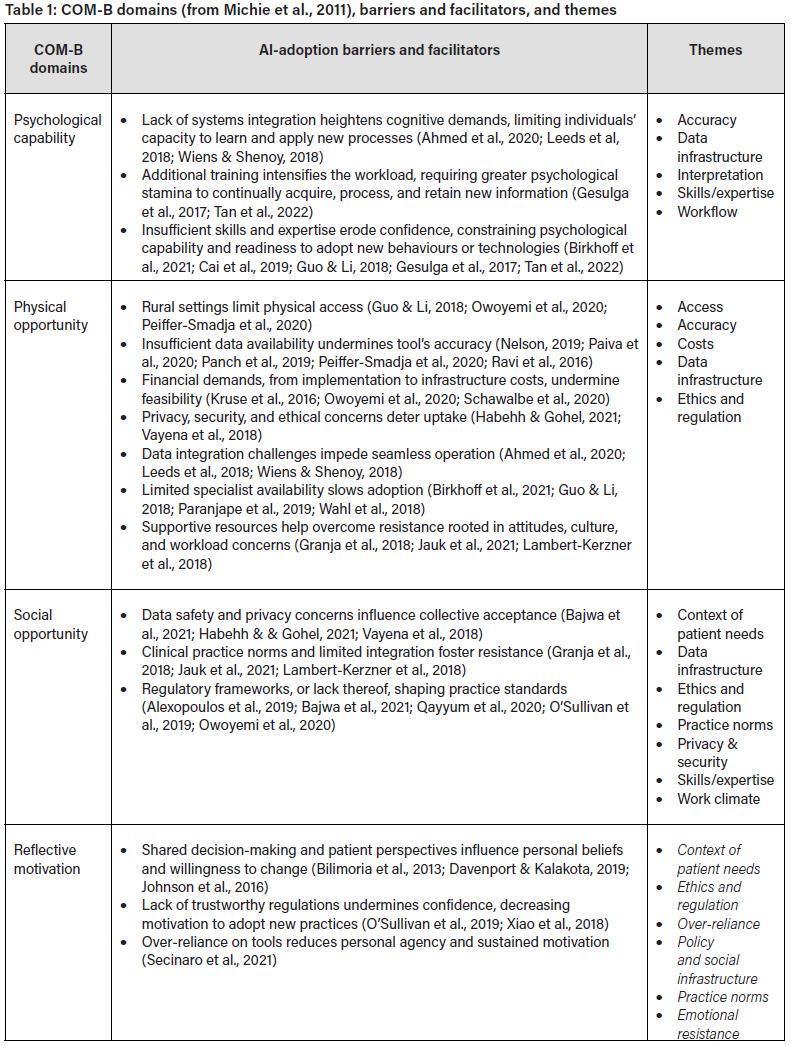
A deductive thematic analysis (Braun & Clarke, 2006), guided by the COM-B framework, was applied to the literature-review findings. Using a codebook built from COM-B domain definitions set out by Michie et al. (2011) and supplemented with constructs from the theoretical domains framework (TDF) (Cane et al., 2012), we coded relevant examples of barriers and facilitators according to four COM-B domains:
• psychological capability;
• physical opportunity;
• social opportunity; and
• reflective motivation.
The two remaining domains-automatic motivation, which captures habitual reactions, and physical capability, which captures physical behaviours-were excluded, as they are less relevant to AI adoption in professional contexts where adoption is generally intentional and cognitively mediated. An inductive analysis then grouped these examples into broader themes (see column 3 in Table 1), for example, "accuracy" "data infrastructure', "interpretation', "skills/expertise" and "workflow',' which translated sector-specific insights into transferable concepts. These themes informed the first iteration of the survey instrument.
Development of survey instrument
To develop the survey instrument, we began with an initial pool of 28 open-ended items derived from the thematic analysis (described above) of literature on AI adoption, implementation barriers, and behavioural constructs aligned with the COM-B framework. The survey items were refined through an iterative, consensus-based process by our interdisciplinary team, which brought together expertise in qualitative research, information systems, and implementation science. We prioritised face and content validity, conceptual clarity, and full coverage of the key behavioural domains.
This process involved merging overlapping items, removing redundant or overly narrow items, and revising or splitting unclear items to better reflect distinct concepts. We also adapted the wording to ensure that each item aligned with its intended COM-B domain while still remaining broadly applicable across professional sectors-by, for example, replacing healthcare-specific terms such as "patient" and "clinical work" with more neutral alternatives such as "client" and "job tasks'! These revisions preserved the theoretical integrity of the COM-B domains while enhancing the instrument's relevance across various professional contexts, including, but not limited to, higher education.
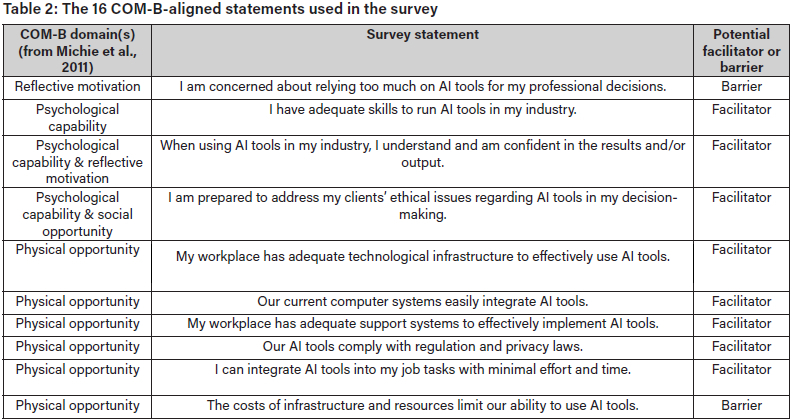
The Al-adoption barriers and facilitators identified in the literature were then mapped to the COM-B domains to generate 16 statements that could be surveyed via a 10-point Likert-type scale, with the scale measuring level of agreement with the statement (with 1 being the lowest level of agreement). The final 16 survey items used in the survey (see Table 2 below) explored factors influencing AI adoption in professional settings in terms of four COM-B domains drawn from Michie et al. (2011): psychological capability, physical opportunity, social opportunity, and reflective motivation.
• Psychological capability refers to an individual's perceived knowledge, skills, and cognitive abilities. In the context of AI, this includes understanding how to interpret AI outputs and operate AI tools effectively.
• Physical opportunity refers to environmental resources, time, and infrastructure. In the context of AI, this includes adequate infrastructure for data integration, data sharing, and privacy safeguards.
• Social opportunity refers to cultural norms, social influences, and peer support. In the context of AI, this includes clinical practice norms, workplace climate, regulatory frameworks, and best practices.
• Reflective motivation captures beliefs, attitudes, and intentions. In the context of AI, this includes trust in AI and ethical concerns.
Survey administration
In November 2024, the pilot survey was electronically distributed via Qualtrics, an online survey platform that enables secure distribution and collection of questionnaire responses (Qualtrics, 2024)1, to 100 higher education employees affiliated with the Southern African Association for Institutional Research (SAAIR)2, a regional professional body comprising university staff and faculty. SAAIR membership spans a wide range of institutions (e.g., research-intensive, teaching-focused, rural, and urban universities) across the Southern African region. The target respondents worked primarily in academic planning, institutional research, and policy roles, and had all previously expressed an interest in AI. The survey was administered shortly after a SAAIR conference forum focused on the impact of generative AI in higher education. As such, the potential respondents were likely to have a working knowledge of AI and a shared context for interpreting the survey questions. Of the 100 individuals contacted, 32 responded, yielding a 32% response rate. The survey had five demographic questions, covering age, job sector, job title, years of experience, and country of origin, followed by the 16 COM-B-framed items that respondents scored via a 10-point Likert-type scale. The scale ranged from 1 = strongly disagree to 10 = strongly agree.
Data analysis
The dataset generated by the survey responses on the Qualtrics platform was analysed using median scores, interquartile ranges (IQRs), and coefficient of quartile variations (CQVs). Medians highlighted central tendencies, with higher values indicating stronger agreement with the survey statement. Interquartile ranges (IQRs) were used to describe the spread of the data, indicating the range within which the middle 50% of responses fell. The coefficient of quartile variation (CQV) assessed relative variability around the median, with higher CQV values indicating greater relative dispersion within the data. Medians of 7 or above (on the 1-10 scale) were interpreted as indicating strong agreement with the survey statement. Medians between 5 and 6, near the midpoint of the scale, indicated neutral or mixed levels of agreement. Medians below 5 signified disagreement. CQV values below 0.4 indicated a strong consensus among respondents, while values above 0.6 suggested divergent views and lower consensus.
3. Results and discussion
Respondent demographics
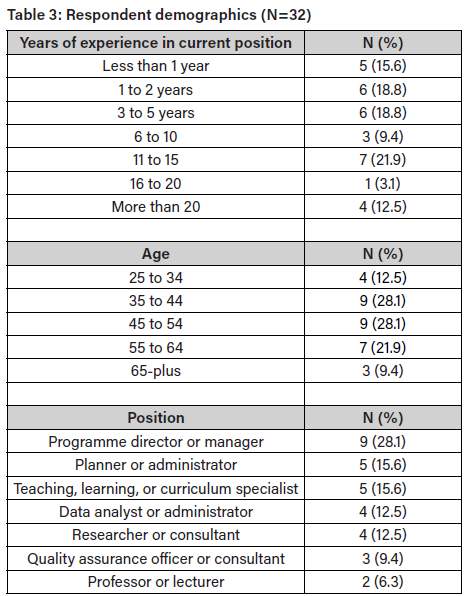
As shown in Table 3, the respondents' years of experience in their current positions ranged between less than a year and more than 20 years, with the largest subgroup (7 respondents) having 11 to 15 years of experience. The ages of the respondents ranged between 25 and 65-plus, with the largest numbers of participants being in the 35-44 and 45-54 age bands. Respondents held diverse positions, with the role of programme director or manager being the most common (9 respondents), followed by planner or administrator (5 respondents), and teaching, learning or curriculum specialist (5 respondents), data analyst or administrator (4 respondents), researcher or consultant (4 respondents), quality assurance officer or consultant (3 respondents) and professor or lecturer (2 respondents).
Findings from COM-B-aligned survey items
Potential facilitators of AI adoption
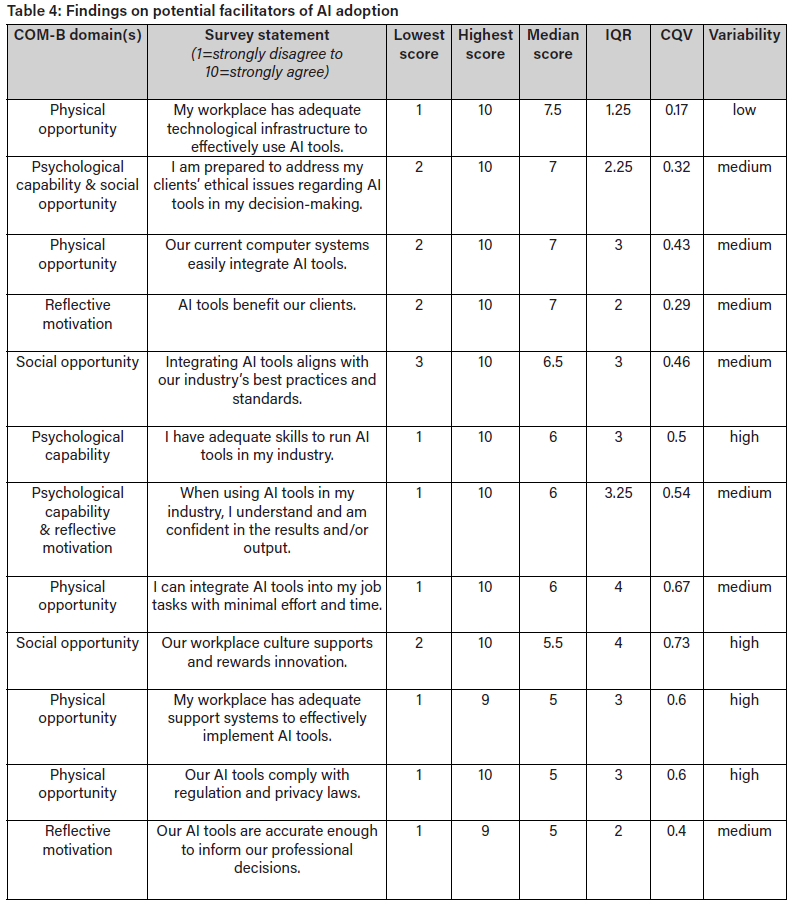
Median scores for potential facilitators on the 10-point Likert-type scale ranged from 5 to 7.5 (Table 4). The highest median score (7.5) indicated agreement on the presence of adequate technological infrastructure for using AI tools. Three other potential facilitators received strong median scores (7): preparedness to address clients' ethical issues regarding AI tools in the respondents' decision-making; the ability of the respondents' computer systems to integrate AI tools; and the benefit that respondents felt AI offered to their clients.
The lowest median scores (5) were observed for three factors: having adequate workplace support systems to effectively implement AI tools; ensuring AI tools comply with regulations and privacy laws; and confidence that AI tools are accurate enough to inform professional decisions. CQVs ranged from 0.17 to 0.73. The highest consensus (CQV = 0.17) pertained to the presence of adequate technological infrastructure, while the lowest consensus (CQV = 0.73) related to beliefs about workplace culture supporting innovation.
Through examining medians and CQVs simultaneously, it was found that three of the four items with high medians also reflected strong consensus, as indicated by CQVs below 0.4. These were: the presence of adequate technological infrastructure for using AI tools (median = 7.5, CQV = 0.17); preparedness to respond to clients' ethical concerns (median = 7, CQV = 0.32); and the benefit AI tools provide to clients (median = 7, CQV = 0.29). There was less consensus on the ease of respondents' computer systems integrating AI tools (median = 7, CQV = 0.43).
Potential barriers to AI adoption
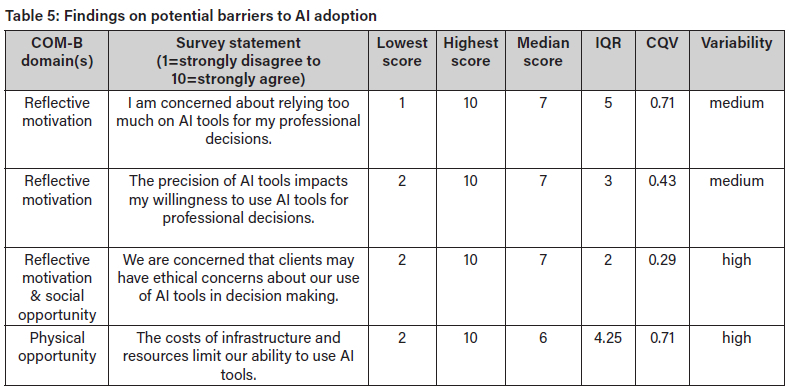
Median scores for potential barriers on the 10-point Likert-type scale ranged from 6 to 7 (Table 5). The higher median score (7) indicated agreement on three potential barriers: concerns about overreliance on AI for professional decisions; the uncertain precision of AI tools affecting willingness to use them; and clients' ethical concerns about using AI in decision-making. The lower median score (6) was observed for the barrier posed by costs of infrastructure and resources. CQVs ranged from 0.29 to 0.71. The highest consensus (CQV = 0.29) pertained to concern about clients' ethical concerns, while the lowest consensus (CQV = 0.71) related to concerns about overreliance on AI and about the costs of infrastructure and resources.
Through examining medians and CQVs together, we were able to identify one potential barrier with both a high median and a strong consensus (a CQV below 0.4). That potential barrier was that clients may have ethical concerns about the use of AI tools in decision-making (median = 7; CQV = 0.29). There was less consensus about two other potential barriers that had high median scores: overreliance on AI (median = 7; CQV = 0.71) and costs of infrastructure and resources (median = 6; CQV = 0.73).
4. Conclusions and limitations
The results of this pilot study, as set out above, suggest that the COM-B model offers a potentially useful behaviourally grounded lens for evaluating AI adoption, thus potentially complementing traditional IS models such as TAM and UTAUT. Deployment of the COM-B model has the potential to contribute to the understanding of technology adoption's behavioural-intention construct-a construct that, in existing technology-adoption frameworks, is often limited to variables such as ease of use and perceived usefulness. In the evolving landscape of AI, the application of the COM-B model in adoption research has the potential to help assess readiness by identifying gaps in capability, opportunity, and motivation.
Because it was a pilot exercise, this study had several limitations. The small sample size (n = 33), and narrow focus on a particular grouping of Southern African higher education professionals, restricted generalisability. The sample was also not large enough to support formal psychometric validation. While COM-B is a widely validated framework, future research should assess the reliability and validity of this specific model in the AI adoption context via larger, more diverse samples. Also, the survey did not collect information on which AI tools respondents used or how they defined AI, which may have introduced variability in interpretation. Additionally, some education-specific or sectoral nuances may not have been fully captured. We recommend that future studies include items capturing respondents' AI usage and definitions and incorporate sector-specific validation. We also acknowledge that only a few items were used to assess each COM-B construct, which may have limited internal consistency. Also, the use of a 10-point Likert-type scale, despite offering granularity, may have introduced ceiling and/or floor effects.
AI declaration
The authors acknowledge the use of ChatGPT v4.0 to assist with editing and grammar, and Scholar GPT was used to assist with identifying literature.
Competing interests declaration
The authors have no competing interests to declare.
Data availability statement
The data supporting the findings of this study is available upon written request to the first-listed author at:
Funding
This was unfunded work as part of a collaboration between the University of Missouri and University of the Western Cape.
Authors' contributions
M.E.P: Conceptualisation, methodology, data collection and analysis, validation, data curation, writing and revisions of the manuscript, student supervision, project management, project leadership activities. J.B.: Conceptualisation, methodology, data collection and analysis, validation, data curation, manuscript revisions, student supervision.
I.C.: Conceptualisation, methodology, validation, manuscript revisions.
Ahmed, Z., Mohamed, K., Zeeshan, S., & Dong, X. (2020). Artificial intelligence with multi-functional machine learning platform development for better healthcare and precision medicine. Database: The Journal of Biological Databases and Curation, 2020, baaa010. https://doi.org/10.1093/database/baaa010
References
- Akinwalere, S. N., & Ivanov, V. (2022). Artificial intelligence in higher education: Challenges and opportunities. Border Crossing, 12(1), 1-15. https://doi.org/10.33182/bc.v12i1.2015
- Alexopoulos, C., Lachana, Z., Androutsopoulou, A., Diamantopoulou, V., Charalabidis, Y., & Loutsaris, M.A. (2019). How machine learning is changing e-government. In ICEGOV 2019: Proceedings of the 12th International Conference on Theory and Practice of Electronic Governance (354-363). https://doi.org/10.1145/3326365.3326412
- Bilimoria, K. Y., Liu, Y., Paruch, J. L., Zhou, L., Kmiecik, T. E., Ko, C. Y., & Cohen, M. E. (2013). Development and evaluation of the universal ACS NSQIP surgical risk calculator: A decision aid and informed consent tool for patients and surgeons. Journal of the American College of Surgeons, 217(5), 833-42.e423. https://doi.org/10.1016/j.jamcollsurg.2013.07.385
- Birkhoff, D. C., van Dalen, A. S. H. M., & Schijven, M. P. (2021). A review on the current applications of artificial intelligence in the operating room. Surgical Innovation, 28(5), 611-619. https://doi.org/10.1177/1553350621996961
- Binns, R. (2018). Fairness in machine learning: Lessons from political philosophy. Proceedings of Machine Learning Research, 81, 149-159. https://proceedings.mlr.press/v81/binns18a.html
- Braun, V., & Clarke, V. (2006). Using thematic analysis in psychology. Qualitative Research in Psychology, 3(2), 77-101. https://doi.org/10.1191/1478088706qp063oa
- Brynjolfsson, E., & McAfee, A. (2014). The second machine age: Work, progress, and prosperity in a time of brilliant technologies. W. W. Norton & Company.
- Cai, C. J., Winter, S., Steiner, D., Wilcox, L., & Terry, M. (2019). "Hello AI": Uncovering the onboarding needs of medical practitioners for human-AI collaborative decision-making. In Proceedings of the ACM on Human-Computer Interaction, 3 (CSCW) (1-24). https://doi.org/10.1145/3359206
- Cocosila, M., & Archer, N. (2017). Practitioner pre-adoption perceptions of Electronic Medical Record systems. Behaviour & Information Technology, 36(8), 827-838. https://doi.org/10.1080/0144929X.2017.1303083
- Dada, O.A & Van Belle, J.P. (2023) Factors influencing the establishment of technology innovation hubs: A structured literature review. In The 9th Annual ACIST Proceedings. https://digitalcommons.kennesaw.edu/acist/2023/presentations/4
- Davenport, T., & Kalakota, R. (2019). The potential for artificial intelligence in healthcare. Future Healthcare Journal, 6(2), 94-98. https://doi.org/10.7861/futurehosp.6-2-94
- Davis, F. D. (1989). Perceived usefulness, perceived ease of use, and user acceptance of information technology. MIS Quarterly, 13(3), 319-340. https://doi.org/10.2307/249008
- Davis, F. D., Granić, A., & Marangunić, N. (2024). The Technology Acceptance Model: 30 years of TAM. Springer International Publishing. https://doi.org/10.1007/978-3-030-45274-2
- de la Fuente Tambo, D., Moreno, S. I., & Ruiz, M. A. (2024). Barriers and enablers for generative artificial intelligence in clinical psychology: A qualitative study based on the COM-B and theoretical domains framework (TDF) models. Research Square. https://doi.org/10.21203/rs.3.rs-5309244/v1
- Ganapathy, A., Heeks, R., & Iazzolino, G. (2024). Theorizing digital inclusion and inequalities in ICT4D: Insights and implications for future research. GDI Digital Development Working Paper No. 107. https://www.gdi.manchester.ac.uk/research/publications/di
- Gesulga, J. M., Berjame, A., Moquiala, K. S., & Galido, A. (2017). Barriers to electronic health record system implementation and information systems resources: A structured review. Procedia Computer Science, 124, 544-551. https://doi.org/10.1016/j.procs.2017.12.188
- Granja, C., Janssen, W., & Johansen, M. A. (2018). Factors determining the success and failure of ehealth interventions: Systematic review of the literature. Journal of Medical Internet Research, 20(5), e10235. https://doi.org/10.2196/10235
- Huy, L. v., Nguyen, H. T., Vo-Thanh, T., Thinh, N. H. T., & Thi Thu Dung, T. (2024). Generative AI, why, how, and outcomes: A user adoption study. AIS Transactions on Human-Computer Interaction, 16(1), 1-27. https://doi.org/10.17705/1thci.00198
- Johnson, A. E., Ghassemi, M. M., Nemati, S., Niehaus, K. E., Clifton, D. A., & Clifford, G. D. (2016). Machine learning and decision support in critical care. In Proceedings of the IEEE, 104(2), 444-466. https://doi.org/10.1109/JPROC.2015.2501978
- Keyworth, C., Epton, T., Goldthorpe, J., Calam, R., & Armitage, C. J. (2020). Acceptability, reliability, and validity of a brief measure of capabilities, opportunities, and motivations ("COM-B"). British Journal of Health Psychology, 25(3), 474-501. https://doi.org/10.1111/bihp.12417
- Korpelainen, E., & Kira, M. (2013). Systems approach for analyzing problems in IT system adoption at work. Behaviour & Information Technology, 32(3), 247-262. https://doi.org/10.1080/0144929X.2011.624638
- Kruse, C. S., Kristof, C., Jones, B., Mitchell, E., & Martinez, A. (2016). Barriers to electronic health record adoption: A systematic literature review. Journal of Medical Systems, 40(12), 252. https://doi.org/10.1007/s10916-016-0628-9
- Lambert-Kerzner, A., Ford, K. L., Hammermeister, K. E., Henderson, W. G., Bronsert, M. R., & Meguid, R. A. (2018). Assessment of attitudes towards future implementation of the "Surgical Risk Preoperative Assessment System" (SURPAS) tool: A pilot survey among patients, surgeons, and hospital administrators. Patient Safety in Surgery, 12, 12. https://doi.org/10.1186/s13037-018-0159-z
- Leeds, I. L., Rosenblum, A. J., Wise, P. E., Watkins, A. C., Goldblatt, M. I., Haut, E. R., Efron, J. E., & Johnston, F. M. (2018). Eye of the beholder: Risk calculators and barriers to adoption in surgical trainees. Surgery, 164(5), 1117-1123. https://doi.org/10.1016/i.surg.2018.07.002
- Luo, C., Yang, C., Yuan, R., Liu, Q., Li, P., & He, Y. (2024). Barriers and facilitators to technology acceptance of socially assistive robots in older adults: A qualitative study based on the capability, opportunity, and motivation behavior model (COM-B) and stakeholder perspectives. Geriatric Nursing, 58, 162-170. https://doi.org/10.1016/i.gerinurse.2024.05.025
- Marsh, R. J., Brent, A. C., & De Kock, I. H. (2021). Understanding the barriers and drivers of sustainable construction adoption and implementation in South Africa: A quantitative study using the Theoretical Domains Framework and COM-B model. Journal of the South African Institution of Civil Engineering, 63(4), 11-23. https://doi.org/10.17159/2309-8775/2021/v63n4a2
- Michie, S., van Stralen, M. M., & West, R. (2011). The behaviour change wheel: A new method for characterising and designing behaviour change interventions. Implementation Science, 6, 42. https://doi.org/10.1186/1748-5908-6-42
- Michie, S., & West, R. (2013). Behaviour change theory and evidence: A presentation to Government. Health Psychology Review, 7(1), 1-22. https://doi.org/10.1080/17437199.2011.649445
- Nelson, G. S. (2019). Bias in artificial intelligence. North Carolina Medical Journal, 80(4), 220-222. https://doi.org/10.18043/ncm.80.4.220
- Obrenovic, B., Gu, X., Wang, G., Godinic, D., & Jakhongirov, I. (2024). Generative AI and human-robot interaction: Implications and future agenda for business, society, and ethics. AI & Society, 40, 677-690. https://doi.org/10.1007/s00146-024-01889-0
- Opesemowo, O. A. G., & Adewuyi, H. O. (2024). A systematic review of artificial intelligence in mathematics education: The emergence of 4IR. Eurasia Journal of Mathematics, Science & Technology Education, 20(7), em2478. https://doi.org/10.29333/ejmste/14762
- O'Sullivan, S., Nevejans, N., Allen, C., Blyth, A., Leonard, S., Pagallo, U., Holzinger, K., Holzinger, A., Sajid, M. I., & Ashrafian, H. (2019). Legal, regulatory, and ethical frameworks for development of standards in artificial intelligence (AI) and autonomous robotic surgery. The International Journal of Medical Robotics and Computer Assisted Surgery, 15(1), e1968. https://doi.org/10.1002/rcs.1968
- Owoyemi, A., Owoyemi, J., Osiyemi, A., & Boyd, A. (2020). Artificial intelligence for healthcare in Africa. Frontiers in Digital Health, 2, 6. https://doi.org/10.3389/fdgth.2020.00006
- Paiva, J. O. v., Andrade, R. M. C., de Oliveira, P. A. M., Duarte, P., Santos, I. S., Evangelista, A. L. P., Theophilo, R. L., de Andrade, L. O. M., & Barreto, I. C. H. C. (2020). Mobile applications for elderly healthcare: A systematic mapping. PloS one, 15(7), e0236091. https://doi.org/10.1371/iournal.pone.0236091
- Panch, T., Mattie, H., & Celi, L. A. (2019). The "inconvenient truth" about AI in healthcare. npj Digital Medicine, 2, 77. https://doi.org/10.1038/s41746-019-0155-4
- Paranjape, K., Schinkel, M., Nannan Panday, R., Car, J., & Nanayakkara, P. (2019). Introducing artificial intelligence training in medical education. JMIR Medical Education, 5(2), e16048. https://doi.org/10.2196/16048
- Peiffer-Smadja, N., Rawson, T. M., Ahmad, R., Buchard, A., Georgiou, P., Lescure, F. X., Birgand, G., & Holmes, A. H. (2020). Machine learning for clinical decision support in infectious diseases: A narrative review of current applications. Clinical Microbiology and Infection, 26(5), 584-595. https://doi.org/10.1016/j.cmi.2019.09.009
- Polyportis, A., & Pahos, N. (2024). Understanding students' adoption of the ChatGPT chatbot in higher education: The role of anthropomorphism, trust, design novelty and institutional policy. Behaviour & Information Technology, 44(2), 315-336. https://doi.org/10.1080/0144929X.2024.2317364
- Qayyum, A., Qadir, J., Bilal, M., & Al-Fuqaha, A. (2021). Secure and robust machine learning for healthcare: A survey. IEEE Reviews in Biomedical Engineering, 14, 156-180. https://doi.org/10.1109/RBME.2020.3013489
- Ravi, D., Wong, C., Deligianni, F., Berthelot, M., Andreu-Perez, J., Lo, B., & Yang, G. Z. (2017). Deep learning for health informatics. IEEE Journal of Biomedical and Health informatics, 21(1), 4-21. https://doi.org/10.1109/JBHI.2016.2636665
- Schwalbe, N., & Wahl, B. (2020). Artificial intelligence and the future of global health. Lancet, 395(10236), 1579-1586. https://doi.org/10.1016/S0140-6736(20)30226-9
- Secinaro, S., Calandra, D., Secinaro, A., Muthurangu, V., & Biancone, P. (2021). The role of artificial intelligence in healthcare: A structured literature review. BMC Medical Informatics and Decision Making, 21(1), 125. https://doi.org/10.1186/s12911-021-01488-9
- Siau, Keng and Wang, W. (2018). Building trust in artificial intelligence, machine learning, and robotics. Cutter Business Technology Journal, 31(2), 47-53. https://ink.library.smu.edu.sg/sis_research/9371
- Sohn, K., & Kwon, O. (2020). Technology acceptance theories and factors influencing artificial intelligence-based intelligent products. Telematics and Informatics, 47, 101324. https://doi.org/10.1016/i.tele.2019.101324
- Tan, T. F., Li, Y., Lim, J. S., Gunasekeran, D. V., Teo, Z. L., Ng, W. Y., & Ting, D. S. (2022). Metaverse and virtual health care in ophthalmology: Opportunities and challenges. Asia-Pacific Journal of Ophthalmology, 11(3), 237-246. https://doi.org/10.1097/APO.0000000000000537
- Vayena, E., Blasimme, A., & Cohen, I. G. (2018). Machine learning in medicine: Addressing ethical challenges. PLoS medicine, 15(11), e1002689. https://doi.org/10.1371/iournal.pmed.1002689
- Venkatesh, V., Morris, M. G., Davis, G. B., & Davis, F. D. (2003). User acceptance of information technology: Toward a unified view. MIS Quarterly, 27(3), 425-478. https://doi.org/10.2307/30036540
- Wahl, B., Cossy-Gantner, A., Germann, S., & Schwalbe, N. R. (2018). Artificial intelligence (AI) and global health: How can AI contribute to health in resource-poor settings? BMJ Global Health, 3(4), e000798. https://doi.org/10.1136/bmigh-2018-000798
- West, R., & Michie, S. (2021). A brief introduction to the COM-B model of behaviour and the PRIME theory of motivation. Qeios, 3, 1-5. https://www.qeios.com/read/WW04E6.3
- Wiens, J., & Shenoy, E. S. (2018). Machine learning for healthcare: On the verge of a major shift in healthcare epidemiology. Clinical Infectious Diseases, 66(1), 149-153. https://doi.org/10.1093/cid/cix731
- Xiao, C., Choi, E., & Sun, J. (2018). Opportunities and challenges in developing deep learning models using electronic health records data: A systematic review. Journal of the American Medical Informatics Association, 25(10), 14191428. https://doi.org/10.1093/jamia/ocy068