Regulation in pursuit of artificial intelligence (AI) sovereignty: China's mix of restrictive and facilitative modalities
Abstract
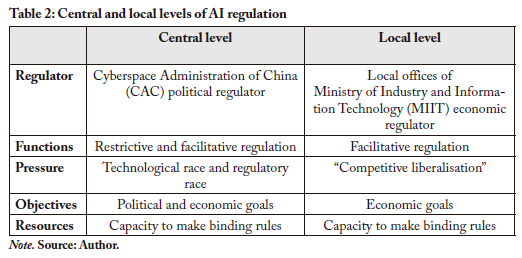
With the geopoliticisation of the digital economy, the realisation of artificial intelligence (AI) sovereignty is increasingly influenced by the geopolitical manoeuvrings into which a state is drawn. China, the EU, and the US currently form the three poles of AI in the world. The EU has emerged as a global leader in AI regulation, and the US is currently a world leader in AI innovation. The research outlined in this article explored how China's regulators are responding to these two currents of geopolitical pressure, from the EU and the US. The study found that China's response manifests as a dual-track AI regulatory approach, comprising (1) a mix of restrictive and facilitative regulation at the central level; and (2) facilitative regulation at the local level.
artificial intelligence (AI); AI sovereignty; restrictive regulation; facilitative regulation; China; EU; US
 Thumbnail