Regulation in pursuit of artificial intelligence (AI) sovereignty: China's mix of restrictive and facilitative modalities
Abstract
With the geopoliticisation of the digital economy, the realisation of artificial intelligence (AI) sovereignty is increasingly influenced by the geopolitical manoeuvrings into which a state is drawn. China, the EU, and the US currently form the three poles of AI in the world. The EU has emerged as a global leader in AI regulation, and the US is currently a world leader in AI innovation. The research outlined in this article explored how China's regulators are responding to these two currents of geopolitical pressure, from the EU and the US. The study found that China's response manifests as a dual-track AI regulatory approach, comprising (1) a mix of restrictive and facilitative regulation at the central level; and (2) facilitative regulation at the local level.
artificial intelligence (AI); AI sovereignty; restrictive regulation; facilitative regulation; China; EU; US
1. Introduction
With the rollout of general-purpose artificial intelligence (AI) systems such as ChatGPT-4, AI is acquiring the potential to radically revamp the future of human life in the same way that electricity did in the late 19th century and early 20th century. Countries that are slow to participate in AI technological innovation will struggle to catch up with the forerunners due to the exorbitant opportunity costs incurred by the catch-up process. The EU lags behind the US and China in foundational models, since the US and China have, respectively, developed 73% and 13% of the world's foundational AI models (Meyers & Springford, 2023). It can be argued that the opportunity costs for the EU to catch up are sufficiently high that its best path forward will be to exploit existing foundational models rather than seeking to develop its own (Meyers & Springford, 2023).
The evolutive nature of AI unleashes high pressure on national governments, urging them to "move fast and break things", as the Meta motto puts it (Taneja, 2019). The AI-sustained digital economy has been largely geopoliticised (Ma, 2019; Qiu, 2023). Geopoliticisation denotes the process of territorialisation of digital platforms, a process where geographical borders become faultlines of confrontation, and algorithms and data, respectively, become trenches and machine guns (Qiu, 2023). The geopoliticisation of the digital economy in general, and of AI in particular, complicates national governments'efforts to pursue national sovereignty in these areas, as these terrains are characterised by a mix of interstate imitation and competition.
AI-centred geopolitical competition has two components: a technological race and a regulatory race (Ma, 2024b; Ma & Hu, 2024). The US and the EU are China's two largest geopolitical rivals in AI. The competition between the "Beijing Effect", the "Brussels Effect" (Bradford, 2020) and the "California Effect" (Vogel, 1997) illustrates the pressure that the US and the EU are wielding on China (Arner et al., 2022). Therefore, the process by which China seeks to achieve AI sovereignty is also a process of resistance against geopolitical pressure from the US and the EU.
Belli (2023) defines "AI sovereignty" as a country's capacity "to understand, muster and develop AI systems, while retaining control, agency, and ultimately, self-determination over such systems" (2023, p. 23). Belli identifies "key AI sovereignty enablers (KASE)", which include state establishment of an appropriate regulatory framework (2023, p. 33). Accordingly, this study explored, through the lens of AI regulation, the ways in which China is pursuing AI sovereignty in the current geopolitical context characterised by competition with the EU (on regulatory matters) and with the US (on matters of innovation).
The study found that China's regulatory response to these pressures has been the pursuit of a mix of two regulatory modes: restrictive regulation in response to European pressure, and facilitative regulation in response to US pressure. This distinction between restrictive and facilitative regulation is grounded in the understanding that regulation does not always produce restrictive effects. It can also produce facilitative effects, enlarging the freedom of action of regulated entities (Ma, 2024a; Ma & Hu, 2024; Veljanovski, 2010). Accordingly, this article understands restrictive and facilitative regulation as encompassing the formal and informal rules, practices, and norms intended to, respectively, narrow or enlarge regulated entities' freedom of action.
2. EU and US positions in AI geopolitics
Since 2013, the EU has pursued what it refers to as "strategic autonomy" (EU-SA), which can be understood as "the capacity of the EU to act autonomously-that is, without being dependent on other countries-in strategically important policy areas" (Damen, 2022, p. 1). This EU-SA strategy aims to defend European interests in a hostile geopolitical environment, and, since 2019, its priority has been to mitigate the EU's dependence on foreign supply chains (Damen, 2022).
The EU established itself as a world leader in the regulation of digital economy matters through its General Data Protection Regulation (GDPR) of 2016.1 Its regulatory pace increased in about 2019, when the new EU leadership, led by current EU President Ursula von der Leyen, took office. The result was two landmark Acts, the Digital Markets Act (DMA) of 20222 and the AI Act of 2024.3 The GDPR and the two Acts have produced numerous influential constructs-including the GDPR's "adequacy assessments", the DMA's "gatekeepers", and the AI Act's "risk-based regulation"-that demonstrate the EU's tremendous norm-setting power in the regulation of the digital economy. This period from 2019 onwards has also seen the release of the EU's Ethics Guidelines for Trustworthy AI (hereafter "EU Ethics Guidelines"), released by the EU High-Level Expert Group on AI in April 2019, further solidifying the EU's influence.4 Thus, the EU has clear regulatory power in the global AI race.
Because AI-related risks remain uncertain globally, the extent to which a country has the "regulatory power" to stem risks will influence its position in geopolitical competition (Hadjiyianni, 2021; Ma & Hu, 2024). The EU has become a global regulatory power (Bradford, 2019), a status providing it with important regulatory "soft power".
The US is the leading power with respect to technological innovation in the global AI race, and it can rely on this position to exert pressure on its geopolitical rivals such as China. As the birthplace of AI, the US holds advantages unequalled by other countries or regions. In May 2022, CB Insights released the list of the global top 100 AI firms, one of the most authoritative lists in the world, and 72 firms on the list were from the US (CB Insights, 2022). The mushrooming of tech firms in the US benefits from firms' relatively easy access to capital. As Zuboff (2019) argues, the capital for supporting the US platform economy tends to be patient money, i.e., investors are prepared to invest in risk-taking entrepreneurs and firms with the potential to create huge value in the long term. This has stimulated the growth of technology-intensive and capital-intensive AI firms.
The establishment of US technological power in AI is also connected to its superiority in the development of the cutting-edge technologies on which AI depends. The manufacture of GPUs (graphics processing units), which are indispensable to deep learning, is a telling example. Intel and Nvidia, two US producers of GPUs, occupy, respectively, 64% and 20% of the global market (CB Insights, 2022). AMD, another US GPU producer, has more than 10% global market share. The US dominance of GPU production gives it chokehold-control over the development of the AI sector in many parts of the world. China, even though it is the second-strongest AI-innovation power in the world, has limited capacity, compared to the US, to produce powerful GPUs. The Chinese government relies on domestic companies such as Huawei to manufacture GPUs, but these GPUs are not as powerful as Intel's.
On three occasions-in October 2022, October 2023, and March 2024-the US Commerce Department's Bureau of Industry and Security (BIS) has introduced export-control measures against China, restricting China's capacity to "both purchase advanced computing chips and manufacture advanced chips critical for military advantage".5 Restrictive measures such as these have helped to reinforce the US's position as the global hub of AI technological innovation.
3. China's regulatory responses
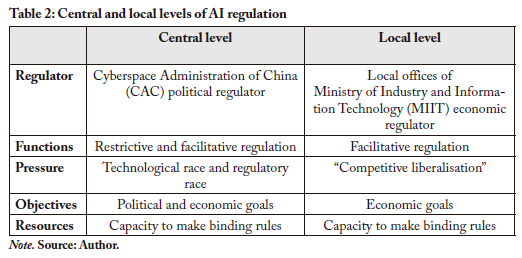
In scanning the Chinese regulatory environment for entities regulating AI matters, this study identified regulators at two levels-central (national) and local-pursuing different objectives and, accordingly, regulating AI firms differently. At the central level, the core regulator of AI matters is the Cyberspace Administration of China (CAC), which is a political regulator.6 At the local level, AI regulation is in the hands of local offices of the Ministry of Industry and Information Technology (MIIT), which is an economic regulator.7
This study found that such an institutional layout, characterised by the leadership of political regulators at the central level and the leadership of economic regulators at the local level, constitutes the Chinese reaction to the US and European pressures. For this reason, Chinese AI regulation is of a dual-track nature, unfolding at the central and local levels of governance.
Regulation at the central level
Central-level regulation, by the CAC, bears the brunt of the geopolitical pressure resulting from international technological and regulatory races. Created in 2011, the CAC was initially responsible for content regulation and cybersecurity. It is a party institution reporting directly to President Xi Jinping, the Secretary-General of the Chinese Communist Party (CCP). Since its inception, the CAC has progressively become the most powerful regulator in China in respect of cybersecurity, data protection, online content, and AI. The CAC is a suigeneris regulator (Creemers, 2015), meaning that while it does endeavour to create a favourable business environment for Chinese tech firms, it is, above all, a security-orientated institution, ensuring that online content, data, and digital infrastructure do not threaten national security and one-party rule (Ma, 2023). Given the preeminence of its political responsibilities in cybersecurity and propaganda, the CAC is more a political regulator than an economic regulator. It can sacrifice short-term economic benefits where necessary to protect the CCP's political interests (e.g., social stability) (Hou, 2019).
The year 2015 is generally considered the starting point of Chinese AI development (Zeng et al., 2020, p. 322). China began accelerating its regulation of AI in 2019, and since then has consistently issued restrictive rules in response to AI's potential ethical, legal, social, and technological risks. In February 2019, Wang Zhigang, China's Minister of Science and Technology, announced the creation of the National New Generation AI Governance Committee of Experts (hereafter "AI Governance Committee").8 Composed of experts from universities, research institutions, and private-sector companies, this AI Governance Committee is mandated to promote research on AI-related legal, ethical, and societal issues. It is also charged with deepening international cooperation and exchanges on AI governance matters between China and other countries.
In June 2019, the AI Governance Committee published eight AI governance principles: harmony and human-friendliness; equity and justice; tolerance and sharing; respect of privacy; security and controllability; common responsibilities; openness and coordination; and agile governance.9 These eight principles reflected the Chinese government's reaction to the EU Ethics Guidelines for Trustworthy AI of 2019. Advancing a human-centric approach to AI governance, the EU Ethics Guidelines for Trustworthy AI require that AI systems satisfy seven requirements "in order to be deemed trustworthy": human agency and oversight; technical robustness and safety; privacy and data governance; transparency; diversity, non-discrimination and fairness; societal and environmental well-being; and accountability.10 Although they use different words, both sets of principles emphasise human oversight of AI, justice, tolerance of diversity, and transparency. These overlaps suggest policy learning by Chinese regulators from their European counterparts.
In an apparent further response to European regulatory power on matters of AI ethics, in 2020, the CCP Central Committee and the State Council mandated the creation of the National Ethical Commission for Science and Technologies.11 Moreover, in September 2023, the Ministry of Science and Technology (MST), the Ministry of Education, and eight other ministries issued Methods for Ethical Assessments of Science and Technology (Experimentation).12 Article 2 of this document sets out four types of scientific and technological activities that need ethical assessments before being conducted, including, inter alia, activities in which human beings are objects of measurement and observation and activities implying the use of human biological information and data. Here we see the Chinese government's efforts to lay down ethical norms and standards for AI.
In January2022, the CAC published the Regulation ofAlgorithmic Recommendations in Internet-Based Information Services.13 This regulation addresses issues such as: adolescents' addiction to applications such as Douyin (the Chinese version of TikTok); big data-enabled price discrimination; and leakage of consumers' personal information. The regulation requires service providers to inform consumers about algorithmic profiling and to allow consumers the option of refusing personalised services. In December 2022, the CAC, the MIIT, and the Ministry of Public Security co-released the Regulation of the Deep Synthesis of Internet-Based Information Services.14 The regulation requires providers of deep synthesis services to establish mechanisms for conducting ethical assessments of the algorithms they use, in order to protect users' personal information and to prevent telemarketing fraud. With these 2022 instruments, it can be argued that China's central regulators were regulating reactively, appearing to learn from (and respond to) European practices.
There have also been instances where China's central regulators have appeared to be regulating more proactively, releasing new rules based not only on EU norms but also on the specificities of the Chinese politico-economic reality. One example of this tendency is the Provisory Regulation of Generative AI, adopted in July 2023 by the CAC and six other ministries, which is by far the most comprehensive AI regulation in China.15 It takes inspiration from the EU AI Act of2024, stipulating in Article 3 that China must regulate AI based on the types of AI systems and the level of risk that they pose to society. However, Article 3 also stipulates that China must adopt a "tolerant and prudent" ("baorongshenshen') regulatory approach to AI, in contrast to the more interventionist regulatory approach of the EU.
This difference in emphasis represented by Article 3 can be attributed to the difference between the reality facing Chinese central regulators and the reality facing the EU. The dominant AI firms in the EU are American, and the EU's stringent risk-based AI regulation favours Europe's small AI firms, whose activities are much less likely to run afoul of the EU regulations than those of the giant US firms. Meanwhile, the AI giants in China are Chinese firms and, accordingly, Chinese central regulators seek to avoid hurting national champions through increased regulatory compliance costs. Chinese central regulators' reactive and proactive regulation of AI since 2019 has served the Chinese ambition to "arrive to the center of the global stage" (People's Daily, 2017). The restrictive elements of Chinese central regulators' AI regulation serve at least two goals. First, they signal Chinese commitment to building responsible AI, thus potentially mitigating China's image as a country seeking technological innovation at any cost. Second, the restrictive elements of China's centralised AI regulation achieve both reactive and proactive goals in response to EU regulation, demonstrating both learning from the EU as well as innovation of its own.
At the same time, we have also seen above the facilitative dimension of the AI regulation approach pursued by China's central regulators, as demonstrated by Article 3 of the 2023 Provisory Regulation of Generative AI-an article that seeks to ensure that AI regulation does not unnecessarily undermine the progress of China's powerful AI firms.
This parallel mobilisation at the central level, of both restrictive and facilitative approaches to AI regulation, demonstrates the Chinese ambition to become an alternative regulatory power to the EU, advancing a strategy in which regulators in emerging economies can stem AI-related risks but not at the price of reducing their AI development opportunities.
Regulation at the local level
With respect to socio-economic governance, China is, in some respects, highly decentralised (Fu, 2018, p. 51). This decentralisation originates from the fiscal reforms of 1994, which adjusted the distribution of fiscal control between Beijing and local governments. In terms of the reforms, local governments were required to give a greater portion of locally collected taxes to the central government in Beijing, and, at the same time, to shoulder greater spending responsibilities. These greater spending responsibilities pressured localities to seek more revenue sources through, inter alia, facilitating local firms' operating conditions. Local governments were granted broad discretionary power in elaborating economic policies in their respective jurisdictions.
Functioning as profit-driven private corporations (Oi, 1992), local governments engaged in "competitive liberalisation" (Yang, 2012), a process in which local governments competed with each other to liberalise their business environments. Their objectives were to outperform other localities socioeconomically, for the good of their localities and as an indispensable condition for local officials to obtain opportunities for professional promotion.
Similar dynamics are currently at play in Chinese AI regulation. While central regulators pursue a mix of political and economic objectives, local regulators, having scant competencies in political matters (Ma, 2024a),seek to pursue, above all, economic objectives. Therefore, AI regulation at the local level is spearheaded by economic regulators in the form of local outposts of the MIIT, the National Development and Reform Commission (NDRC), and the MST. These local regulators bear different names. For instance, while the local outposts of the MIIT in cities such as Shanghai and Wuhan are called the Department of Economy and Industrialisation (DEI), they are called the Department of Industry and Informatisation (DII) in cities such as Shenzhen and Qingdao.
Chinese local governments are highly entrepreneurial in pursuing facilitative AI regulation-advancing and experimenting with innovative policy initiatives to boost their AI industry and outperform their competitor localities. In turn, Beijing subsequently codifies and promotes the facilitative policy initiatives and practices that bear fruit at the local level. This central-local dynamic in facilitative AI regulation is illustrated in Figure 1.

As illustrated in Figure 1, in the domain of facilitative AI regulation, regulatory measures released by Beijing are more often than not the codification of the policy innovations advanced by local governments (Ma, 2024a, p. 22; Rocca, 2006, p. 111). At the same time, local governments can still adjust facilitative regulations released by Beijing to better serve local objectives (Ma, 2024a, p. 210). In this sense, it can be argued that local regulators, rather than central regulators, are the drivers of the innovative modalities of Chinese facilitative AI regulation. Moreover, it can be argued that all Chinese national AI champions have started as local champions (Ma, 2024b).
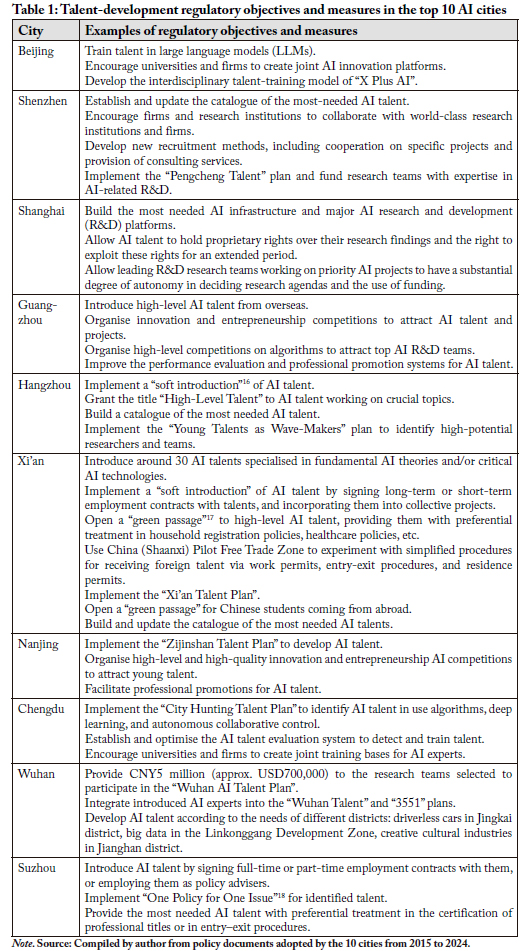
One illustration of how the aforementioned competitive liberalisation unfolds at the local level in AI regulation is in the sphere of regulation aimed at developing AI talent, which is an element identified in the aforementioned KASE framework (Belli, 2023). Table 1 below shows the talent-focused AI regulatory objectives and measures of the 10 Chinese cities with the strongest AI sectors. This ranking of the top 10 AI cities is based on the Research Report on Chinese Cities' Ranking of AI Competitiveness, co-released by Chinese data service provider HSMAP, private-sector think tank TMTPost, and e-commerce provider JD Group (HSMAP, 2024).
The fourth-ranked AI city, Guangzhou, has an Action Plan for Promoting the Industrial Development of the New Generation of AI (2020-2022) (Guangzhou DII, 2020), which calls for Guangzhou to select several priority sectors in the AI industry and to nurture highly competitive large and unicorn companies in each selected sector. The AI policy documents adopted by the other nine AI cities also emphasise the development of local AI champions. Linked to this quest for AI champions, all 10 cities emphasise, as seen in Table 1, the development of AI talent. Accordingly, competitive liberalisation comes into play between the cities.
There are many similarities across the AI talent-development policies in the 10 cities. All of them encourage cooperation between universities, firms, and research institutions, allowing researchers at universities to undertake part-time jobs at firms so as to transform their research findings into industrial applications. All the policies provide differentiated incentives for AI talent involved in R&D activities. AI talents can obtain large amounts of research funding if they work in areas identified by the local governments as AI priority areas, or if their activities correspond with national AI priorities. This differentiated support for R&D teams illustrates how, under Chinese state capitalism, regulators implement "orchestrated competition" and prioritise funding to firms that are the most likely to improve the overall competitiveness of the Chinese economy (Yeo, 2020).
The regulatory efforts of the top 10 AI cities towards the development of AI talent also demonstrate entrepreneurial regulation, i.e., experimentation with regulatory methods for developing AI talent. For example, both Shenzhen and Shanghai, the second- and third-strongest AI cities, allow (1) researchers to hold proprietary rights over their research findings and the right to exploit these rights for an extended period; and (2) research teams working on the city's priority AI projects to have a decisive say in funding management and fixing research agendas.19
Local regulators' entrepreneurship in developing facilitative AI regulations has helped to build a supportive regulatory environment for AI firms. To harness local governments' entrepreneurship, in 2020, the MST released Guidelines on Building National Innovation and Development Sites (NIDS) for the New Generation of AI, aiming to build around 20 NIDS by 2023 (MST, 2020). These NIDS are areas where municipalities can elaborate upon and test innovative AI regulatory measures. The MST's stated objectives with the NIDS are to support effective AI regulatory instruments, incubate national AI R&D hubs, and generate best practices that can be reproducible in other Chinese municipalities. By December 2021, China had a total of 18 NIDS.20 Based on my online search in late 2024, it appears that no new NIDS have been created in the subsequent years. The NIDS project illustrates Beijing's reliance on local regulators' entrepreneurship to spearhead effective facilitative regulation of AI. Table 2 summarises the dynamics of Chinese AI regulation's central and local levels.
Assessment of China's dual-track AI regulation
While dual-track AI regulation characterises the Chinese way of managing the AI sector, it is comparatively less present in the EU and the US. The EU, as opposed to its Member States, centralises the competencies in restrictive and facilitative regulations. In addition, the EU's overwhelmingly restrictive regulatory framework prevents, to a great extent, Member States' facilitative measures from producing the expected effects. Therefore, the EU defacto practises single-track AI regulation. For the US, both federal and state regulators can release restrictive and facilitative regulations e.g., the California AI Transparency Act of 2024.21 The relations between federal and state regulators, on the one hand, and between regulators in different states, on the other, tend to be tenuous. The reason is that one state can autonomously roll out its regulations, and its regulators do not rely on outperforming their counterparts in other states to obtain professional promotions. This lack of division of labour between federal and state regulators results in regulatory silos, with regulators at each level working in their own domain.
With respect to its effectiveness, China's dual-track AI regulation creates important institutional flexibility, allowing central and local regulators to overcome common challenges while at the same time operating in their respective policy terrains. The central regulators' spearheading role in restrictive regulation helps to build China's image as a responsible AI power. Meanwhile, the fact that central regulators allow local regulators to lead facilitative regulation incentivises risk-taking by AI firms. Chinese firms' breakthroughs in AI chips provide a telling example. To help firms to overcome technological bottlenecks, central and local regulators have synergistically released supportive policies. This is paying off, as the quality of Chinese chips continues to improve. For instance, the Huawei Ascend 910C chip is matching the performance of the Nvidia H100 chip and is being purchased by Chinese tech firms such as Tencent, Baidu, and Alibaba (Mak, 2024). Even though it remains true that Nvidia's products can be used in more diverse situations than Huawei's, Chinese authorities' targeted support is allowing Huawei (and other Chinese chip manufacturers) to make some significant technological breakthroughs.
China's dual-track AI regulation also has weaknesses. Ferocious interjurisdictional competition can lead to the waste of resources devoted to R&D activities. More precisely, when trying to outperform each other, local governments tend to invest in similar sectors: it is easier for the central government to evaluate their performance if they work in policy areas that are similar to those of their neighbours.
For example, since OpenAI's release of the ChatGPT-3.5 generative-AI tool in November 2022, Chinese local governments have been intensively competing with each other to release their own generative-AI large language models (LLMs). Cities and provinces without competitive advantages in AI have also been betting on the potential of generative-AI LLMs, while they could have used their resources to support sectors with greater potential to boost local economic development. In October 2024, Henan province released the Henan AI+ Action Plan for 2024-2026,22which requires Henan to build its capacity to train LLMs during this period. This objective will be difficult to fulfil: as an agricultural province, Henan has no leading tech firms to rely on, in contrast to Shenzhen or Hangzhou. The gains (if any) that Henan can obtain from LLMs can be expected to be offset by the costs related to the introduction of external AI firms for training LLMs.
Therefore, while interjurisdictional competition helps to improve the Chinese AI industry's overall competitiveness, it also runs the risk of reducing the efficiency of local investments, with excessive local competition sometimes driving local governments to overuse or misuse their resources.
4. Conclusions
This study analysed the ways in which China seeks to achieve its AI sovereignty through an AI regulatory framework set against the backdrop of the geopoliticisation of AI. The study was grounded in the understanding that the regulatory frameworks for AI in a given country mirror the geopolitical pressures that it faces. The study found that China has adopted a dual-track AI regulation strategy as a reaction to the regulatory and technological pressures that, respectively, the EU and the US are imposing. This Chinese dual-track AI regulation is unfolding at the central and local levels.
As the primary bearers of geopolitical pressure, China's central regulators mobilise restrictive regulation to resist European regulatory pressure, and facilitative regulation to resist US technological pressure. At the local level, where geopolitical pressure does not directly affect regulators, a competitive-liberalisation dynamic among local governments indirectly helps central regulators to mitigate US technological pressure. Local-level policy competition for introducing facilitative regulatory measures helps to boost national-level technological and policy innovation, fostering competitiveness in the Chinese AI industry as a whole.
The geopoliticisation of the digital economy has diversified the factors that can influence a country's chances of achieving its digital sovereignty. Diversification of the factors requires nations to compete along several tracks. China's dual-track AI regulation (restrictive and facilitative regulation at the central level and facilitative regulation at the local level) is a case in point.
Following on from this analysis of the Chinese case, it would be useful to examine the European and US cases through a similar lens. US and European AI regulators also face dual geopolitical pressures-from both the regulatory and technological races (Ma & Hu, 2024). Can these two jurisdictions also be expected simultaneously to pursue-or are they already pursuing-a mix of restrictive and facilitative regulation in pursuit of AI sovereignty? Will the geopoliticisation of AI produce-or is it already producing-regulatory convergence between China, the EU, and the US? Future researchers can pursue these research questions and shed more light on the impacts of geopoliticisation on AI regulation in varying politico-economic contexts.
Funding
Funding for this study was received from the FGV Law School 2024 CyberBRICS Fellowship Program.
Data availability
The data supporting the results of this study is available upon written request to the author at
AI declaration
The author did not use any AI tools for conducting the research or writing the article.
Competing interests
The author has no competing interests to declare.
Acknowledgements
The author thanks Luca Belli, Larissa Galdino de Magalhaes Santos, Nicolo Zingales, Nikhil Pahwa, AJICs editorial team, and the two anonymous reviewers for their comments and suggestions.
References
- Arner, D. W., Castellano, G., & Selga, E. (2022). The transnational data governance problem. Berkeley Technological Law journal, 37, 623-700. https://doi.org/10.2139/ssrn.3912487
- Belli, L. (2023). Exploring the key AI sovereignty enablers (KASE) of Brazil, towards an AI sovereignty stack. Pre-print version. In Carnegie Endowment for International Peace (Ed.), Digital Democracy Network Conference 2023 essay collection. Buenos Aires. https://doi.org/10.2139/ssrn.4465501
- Bradford, A. (2020). The Brussels effect: How the European Union rules the world. Oxford University Press. https://doi.org/10.1093/oso/9780190088583.001.0001
- CB Insights. (2022). AI 100: The top AI companies in 2024. https://www.cbinsights.com/learn/ai-100-2024
- Damen, M. (2022). EU strategic autonomy 2013-2023: From concept to capacity. EU Strategic Autonomy Monitor. https://www.europarl.europa.eu/thinktank/en/document/EPRS_BRI(2022)733589
- Fu, D. (2018). Mobilizing without the masses: Control and contention in China. Cambridge University Press. https://doi.org/10.1017/9781108354707
- Guangzhou Department of Industry and Informatisation (DII). (2020, March 3). Guangzhou Action Plan for Promoting the Industrial Development of the New Generation of AI (2020-2022).
- Hou, Y. (2019). The private sector in public office. Cambridge University Press. https://doi.org/10.1017/9781108632522
- HSMAP. (2024, June 25). Top 100 AI cities in competitiveness: Which city is number 1? https://m.ofweek.com/a6i/2024-06/ART-201700-8500-30638652.html
- Ma, A. (2019). L'IA en Chine: Etat des lieux. Constructif, 54, 33-37. https://doi.org/10.3917/const.054.0033
- Ma, A. (2023). La régulation du numérique: Chine, Etats-Unis, France. Fondation pour l'Innovation Politique. https://www.fondapol.org/etude/la-regulation-du-numerique-chine-etats-unis-france
- Ma, A. (2024a). China as a double-bind regulatory state: How internet regulators' predicament produces regulatees' autonomy. Palgrave Macmillan. https://doi.org/10.1007/978-981-99-8857-0
- Ma, A., & Hu. Y. (2024). Toward international governance of artificial intelligence: Theoretical foundations, current dilemmas, and exploration of models. News and Writing, 1, 69-80.
- Mak, M. (2024, August 15). Huawei overcomes bottlenecks to challenge Nvidia: Rollout of the new AI chip Ascend 910C. Techreport, https://techreport.com/cn/news/huawei-breaks-through-the-blockade-to-challenge-huidas-dominance-new-ai-chip-shengteng-910c-is-launched
- McGregor, R. (2010). The party: The secret world of China's communist rulers. Penguin.
- Meyers, Z., & Springford, J. (2023). How Europe can make the most of AI. Centre for European Reform. https://www.cer.eu/sites/default/files/pb_ZM_JS_ai_econ_14.9.23.pdf
- Ministry of Science and Technology (MST). (2020, October 29). Guidelines on Building National Innovation and Development Sites for the New Generation of AI.
- Oi, J. C. (1992). Fiscal reform and the economic foundations of local state corporatism in China. World Politics, 45(1), 99-126. https://doi.org/10.2307/2010520
- People's Daily. (2017, November 16). Opening the new journey for China and the world to co-create a bright future. https://www.gov.cn/xinwen/2017-11/16/content_5240040.htm
- Qiu, J. L. (2023). Three approaches to platform studies: Cobweb, billiard balls, and ant societies. Social Media + Society, 9(3), 1-13. https://doi.org/10.1177/20563051231193304
- Rocca, J. (2006). La condition chinoise: La mise au travail capitaliste à l'âge des reformes (1978-2004). Karthala. https://doi.org/10.3917/kart.rocca.2006.01
- Shanghai People's Congress Standing Committee. (2022). Shanghai Regulation for Promoting AI Industrial Development.
- Shenzhen People's Congress Standing Committee. (2020). Shenzhen Regulation on Scientific and Technological Innovation.
- Shenzhen People's Congress Standing Committee. (2022). Shenzhen Regulation for Promoting AI Industrial Development.
- Taneja, H. (2019, January 22). The era of "move fast and break things" is over. Harvard Business Review, https://hbr.org/2019/01/the-era-of-move-fast-and-break-things-is-over
- Veljanovski, C. (2010). Economic approaches to regulation. In The Oxford handbook of regulation (pp. 16-38). https://doi.org/10.1093/oxfordhb/9780199560219.003.0002
- Vogel, D. (1997). Trading up: Consumer and environmental regulation in a global economy. Harvard University Press.
- Yang, D. L. (2012). Beyond Beijing: Liberalization and the regions in China. Routledge.
- Yeo, Y. (2020). Varieties of state regulation: How China regulates its socialist market economy. Harvard University Press. https://doi.org/10.2307/jj.5232933
2 https://digital-markets-act.ec.europa.eu/index_en
3 https://artificialintelligenceact.eu/the-act
4 https://www.europarl.europa.eu/cmsdata/196377/AI%20HLEG_Ethics%20Guidelines%20for%20Trustworthy%20AI.pdf#
5 https://www.bis.gov/press-release/commerce-releases-clarifications-export-control-rules-restrict-pr-cs-access-advanced
6 https://www.cac.gov.cn
7 https://www.miit.gov.cn
8 https://www.most.gov.cn/kjbgz/201903/t20190328_145889.html
9 https://www.gov.cn/xinwen/2019-06/17/content_5401006.htm
10 https://www.europarl.europa.eu/cmsdata/196377/AI%20HLEG_Ethks%20Guidelines%20for%20Trustworthy%20AI.pdf
11 https://www.gov.cn/zhengce/2022-03/20/content_5680105.htm
12 https://www.most.gov.cn/xxgk/xinxifenlei/fdzdgknr/fgzc/gfxwj/gfxwj2023/202310/t20231008_188309.html
13 https://www.gov.cn/zhengce/2022-11/26/content_5728941.htm
14 https://www.gov.cn/zhengce/zhengceku/2022-12/12/content_5731431.htm
15 https://www.gov.cn/zhengce/zhengceku/202307/content_6891752.htm
16 In China, "soft introduction" is the opposite of "hard introduction", which is the conventional practice that firms or governmental institutions mobilise for developing high-level talent. It means that an organisation will not provide new talent with household registration (hukou) or a permanent position, which are symbols of "hard introduction". Instead, it will resort to flexible channels allowing it to use the intellectual capacities of the talent without making a long-term employment commitment. This method benefits second-tier and third-tier cities where household registration is not attractive to AI talent. These cities have difficulty harnessing the potential of "hard introduction" to attract promising talent and must use "soft introduction".
17 Chinese public authorities frequently use the term "green passage" in their policy documents to denote privileged treatment for designated firms, civil organisations, or groups of individuals because of their particular contributions to local development (e.g., talent that local governments need the most can obtain local household registration on a priority basis).
18 "One Policy for One Issue" is policy jargon commonly used by local governments. It means that instead of treating firms or citizens in a generalised way, local governments implement policies in a differential manner, based on the requirements of each specific regulated entity.
19 See Shanghai People's Congress Standing Committee (2022), Article 25; Shenzhen People's Congress Standing Committee (2022), Article 25; and Shenzhen People's Congress Standing Committee (2020), Article 37.
20 https://baike.baidu.com/item/国家新一代人工智能创新发展试验区/24559080
21 https://leginfo.legislature.ca.gov/faces/billNavClient.xhtml?bill_id=202320240SB942
22 https://www.henan.gov.cn/2024/10-29/3079408.html