Integration of AI tools into management and governance of humanitarian projects in conflict-affected North-West Nigeria
Abstract
Humanitarian projects in conflict zones face extreme complexity caused by, inter alia, volatility, fragmentation, and accountability pressures. Such complexity often renders conventional project implementation approaches inadequate. This study, focused on the conflict zone of North-West Nigeria, investigated the extent to which artificial intelligence (AI) tools can enhance the effectiveness of management governance and governance of humanitarian projects. Grounded in sociotechnical systems (STS) theory, the study surveyed 300 project personnel across Kebbi, Katsina, and Jigawa States, and conducted interviews with 25 of the personnel. Statistical analysis of the quantitative data from the survey found that the adoption of AI tools had a statistically significant correlation with project management effectiveness (β = .46, p < .001), with organisational readiness and ethical governance found to serve as significant partial mediators. The qualitative findings from the interview data identified AI tools' positive roles in project management and governance-through support for (human-led) decision support, transparency, and anticipatory governance-but also revealed tensions around equity, attentional displacement, and the marginalisation of national actors.
artificial intelligence (AI); AI tools; humanitarian projects; project management; project governance; conflict zones; sociotechnical systems (STS) theory; North-West Nigeria; Kebbi; Katsina; Jigawa
1. Introduction
Humanitarian-project implementation in conflict-affected regions constitutes a challenge of paramount importance, requiring the simultaneous navigation of uncertainty, operational insecurity, and intensified donor accountability pressures. In North-West Nigeria, specifically Kebbi, Katsina, and Jigawa States, a complex mix of armed banditry, farmer-herder conflicts and cross-border criminality has created a humanitarian crisis with severe access constraints (UNHCR, 2023). Within this volatile environment, project managers are tasked with delivering humanitarian assistance while also ensuring robust governance, adaptive risk management, and verifiable transparency.
An important evolution in scholarship on AI in project management and governance is the reconceptualisation of AI tools from being automation engines to being partners to human decision-makers. Marnewick and Marnewick (2020) explain how AI applications can enhance project management and governance by fostering improvements in data integrity, in auditability, and in strategic oversight, particularly in complex projects. Other literature emphasises Al's potential for dynamic resource reallocation in response to changing project conditions, a capability that is particularly valuable in unstable environments (KPMG, 2020; Müller et al., 2022). Such studies shift the focus from replacing human judgment to augmenting it within structured frameworks. In the management and governance of humanitarian projects, the AI tools used typically include applications supporting the following four functions: predictive analytics; monitoring and evaluation (M&E); reporting and accountability; and decision support.
Predictive-analytics tools
These tools process multidimensional data, including conflict-incident reports, weather patterns, market prices, and population-displacement metrics, to forecast risks before they materialise. For instance, in North-West Nigeria, organisations use machine learning models trained on historical banditry patterns to predict high-risk periods for staff movements and supply convoys (Meier, 2015).
Monitoring and evaluation (M&E) systems
These systems employ computer vision and natural language processing (NLP) to analyse satellite imagery, social media, and field reports, enabling real-time tracking of project implementation. The UN's use of AI-augmented damage assessment in conflict zones demonstrates how these tools can enhance situational awareness while reducing the exposure of personnel to security risks (UN OCHA, 2022).
Reporting and accountability platforms
These platforms automate data aggregation from disparate field sources into standardised donor dashboards, creating auditable trails of resource allocation and expenditure. These systems address the intensified accountability pressures that humanitarian actors face while potentially introducing new tensions around data simplification.
Decision-support systems
These systems integrate these capabilities to present actionable recommendations to human decision-makers, such as optimal resource reallocation when security incidents disrupt planned distributions.
Particularities of humanitarian-project management and governance in conflict settings
Project management and governance in humanitarian projects in conflict settings are often fundamentally distinct from what is required in commercial projects. Humanitarian projects are much more likely to be characterised by, inter alia, dynamic ethical imperatives, highly politicised operating environments, and acute security risks (Betts et al., 2015). In conflict zones, information asymmetries and rapid contextual shifts render traditional, linear project tools inadequate (UN OCHA, 2022). Scholars increasingly advocate for adaptive, data-informed project management and governance mechanisms that prioritise resilience and stakeholder accountability over rigid plan adherence (Maxwell et al., 2022; Sandvik et al., 2014). Barnett (2023) highlights the tension between the need for rapid adaptation in conflict settings and the requirements for accountability and transparency demanded by donors and affected communities. The value proposition of AI in humanitarian project management and governance is AI tools' ability to assist human decision-makers in addressing the above-mentioned challenges in the following ways:
• Information asymmetry: Humanitarian actors often lack real-time visibility of rapidly changing conditions, and AI-enabled sensing and analysis can reduce this asymmetry.
• Anticipatory capacity: Traditional project tools are retrospective, while AI tools' predictive capabilities enable proactive rather than reactive management and governance.
• Accountability and transparency: Donors and affected communities demand frequent and clear evidence of resource use, and AI-enabled traceability systems can help to provide this (while, as seen in the next sub-section, potentially introducing new forms of surveillance that require careful ethical navigation).
Ethical complexities of AI use in project management and governance
As stated above, AI-enabled systems can strengthen project accountability and transparency. Among other things, AI tools support enhanced data accuracy, real-time compliance-tracking, and traceable decision logs (Bannister & Connolly, 2020; Müller et al., 2022). However, this integration can introduce ethical risks, including risks of algorithmic bias, data protection vulnerabilities, and the potential for "accountability washing" where human responsibility is obscured (Stahl et al., 2016). These risks necessitate robust, context-specific governance safeguards-a concern reflected strongly in African digital ethics discourse (Bah et al., 2024; Eke et al., 2023). Recent scholarship emphasises the importance of contextually appropriate AI that respects local knowledge systems and addresses power imbalances in humanitarian settings (Fayehun et al., 2023; Mulder, 2023). Mulder (2023) highlights how externally driven localisation can create legitimacy paradoxes, where local actors must navigate contradictory demands-a dynamic that risks being amplified when AI tools are introduced without adequate attention to local ownership and ethical safeguards.
Nigerian empirical context: Adoption amidst structural constraints
Emerging Nigerian empirical studies document a growing, yet uneven, adoption of AI tools in project management and governance. Some studies highlight persistent constraints, including critical infrastructure gaps (e.g., unstable power, limited internet), skill deficits, and socio-cultural hesitancy (Adeleke et al., 2023; Akinola & Ogunbayo, 2024). Other studies, such as that by Lawal et al. (2024), demonstrate AI's positive impact on coordination in Nigerian projects. But there is a scarcity of focused research on its application within the country's humanitarian sector, particularly in conflict zones. This underscores the novelty and contribution of the present study, which builds on recent Nigerian scholarship examining digital innovation pathways in non-governmental sectors.
3. Theoretical lens and conceptual model
This study was guided by sociotechnical systems (STS) theory, which posits that organisational outcomes are optimised when social (human, organisational) and technical (technology, tools) subsystems are jointly designed and mutually adaptive (Trist, 1981). This theory, which places a strong emphasis on understanding the mediating roles of social and technical dimensions, offers a lens for exploring AI's impact on project effectiveness that is not direct but mediated by social subsystems: namely, organisational readiness (skills, infrastructure, culture) and ethical governance (policies, oversight, values). This framework moves beyond a technocentric view to analyse AI as an embedded element within a complex organisational and ethical landscape.
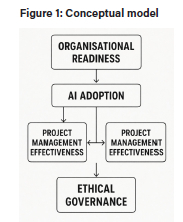
The conceptual model developed to guide the study, as illustrated in Figure 1, is grounded in STS theory and proposes that AI adoption influences project management and governance effectiveness, both (1) directly and (2) indirectly through two mediators (organisational readiness and ethical governance). The model thus posits three parallel pathways (one direct, two indirect) for the influence of AI adoption:
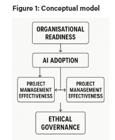
• A direct pathway from AI adoption to project management effectiveness, representing the pure technical contribution of AI tools, enhanced data analytics, predictive capabilities, and automated reporting that improve decision-making regardless of organisational context.
• An indirect pathway through organisational readiness, capturing how AI adoption prompts investments in staff training, technological infrastructure, and supportive organisational cultures, which are investments that independently enhance project outcomes.
• An indirect pathway through ethical governance, reflecting how AI adoption necessitates the development of data protection protocols, bias detection procedures, human oversight mechanisms, and accountability frameworks, which are safeguards that improve project effectiveness by preventing errors and ensuring responsible action.
This multi-pathway model reflects the core insight of STS theory: technology and social systems co-evolve, and optimal outcomes require joint optimisation of both subsystems. The model guides both the measurement strategy (identifying appropriate constructs for each pathway) and the analytical approach (testing mediation through bootstrapped confidence intervals).
4. Methodology
Research design
A convergent parallel mixed-methods design was employed, where quantitative and qualitative data were collected concurrently, analysed independently, and integrated at the interpretation stage to provide comprehensive validation and richer insight (Biedenbach & Müller, 2023; Creswell & Clark, 2017). This design is particularly suited to exploring complex phenomena where numerical trends require contextual, narrative explanation.
Sample and data collection
Quantitative strand
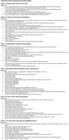
A sample of 300 humanitarian project personnel (100 each from Kebbi, Katsina, and Jigawa) was obtained via stratified random sampling based on organisation type (UN agency, international NGO, national NGO) and project role (managerial, technical, field). Participants completed a structured survey questionnaire administered electronically and in-person. The response rate was 72%. The full questionnaire is provided in Appendix A.
Qualitative strand
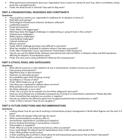
Twenty-five key informant interviews were conducted with project managers (n = 12), donor representatives (n = 6), and ICT officers (n = 7), selected through purposive sampling to capture diverse, expertise-based perspectives. Interviews followed a semi-structured protocol (Appendix B) and lasted 45-75 minutes.
Measurement and variables
All constructs were measured using validated 5-point Likert scales (1 = Strongly Disagree, 5 = Strongly Agree). Instruments were pre-tested with 30 humanitarian workers who were not in the final sample, leading to minor wording adjustments.
Independent variable: AI adoption (8 items; α = .87)
AI adoption was measured as the extent to which organisations use AI tools for humanitarian project management functions. The scale assessed the use of AI for predictive analytics, real-time monitoring, automated reporting, and decision support. Sample items were: "Our organisation uses AI tools for predictive risk analysis" and "We utilise machine learning to anticipate supply chain disruptions".
Mediating variables
Organisational readiness (6 items; α = .82) was conceptualised as institutional capacity to absorb, integrate, and sustain AI technologies. The scale assessed four dimensions: human capital readiness (staff skills and training), technological infrastructure (hardware, software, connectivity), cultural readiness (openness to innovation), and resource commitment (budget and leadership support). A sample item was: "Our staff have adequate training to use AI tools effectively'!
Ethical governance (6 items; α = .80) was defined as institutional mechanisms ensuring AI systems operate in accordance with humanitarian principles, data protection standards, and accountability requirements. The scale captured policy frameworks, data stewardship, algorithmic accountability, and human oversight. A sample item was: "We have clear protocols for ethical review of AI-driven decisions'
STS theory justifies these as mediators because AI's governance impact is hypothesised to operate through the social and structural conditions, readiness, and ethics that enable technology to translate into improved outcomes (Trist, 1981). Both scales demonstrated acceptable convergent and discriminant validity in confirmatory factor analysis.
Dependent variable: Project management effectiveness index (PMEI)
The dependent variable was a composite index calculated as the mean of three standardised sub-scales: risk management (5 items, α = .85), governance and accountability (6 items, α = .88), and transparency and donor confidence (4 items). With regard to validation, all items loaded > 0.70 on a single factor in principal component analysis, explaining 68% of variance, confirming the index's construct validity.
Data analysis strategy
Quantitative analysis
The quantitative analysis was conducted using SPSS/Stata. Descriptive statistics and scale reliability were computed. Common method bias (CMB) was assessed using Harmon's single-factor test, which showed the first factor explained 38.2% of variance (< 50% threshold), suggesting that CMB was not a severe threat (Podsakoff et al., 2003). Pearson correlation examined bivariate relationships. Hierarchical multiple regression tested the predictive model. Mediation analysis used the bootstrapping method (Preacher & Hayes, 2008) with 5,000 resamples to test indirect effects. One-way ANOVA explored inter-state differences.
Qualitative analysis
For the qualitative analysis, interviews were transcribed and subjected to thematic analysis following Braun and Clarke's (2006) six-phase approach using NVivo 14, employing a hybrid inductive-deductive approach to identify patterns related to AI's governance role.
Ethical considerations
The study received approval from the University of Uyo's Research Ethics Committee. Informed consent was obtained from all participants, with special measures to ensure confidentiality and security given the conflict-affected context. Data was anonymised and stored securely.
5. Findings and analysis
Descriptive statistics and scale reliability
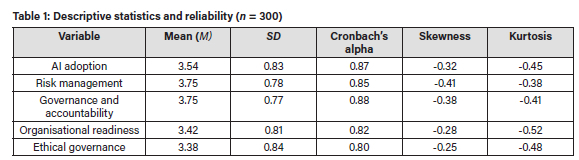
Table 1 presents descriptive statistics for all study variables. All constructs demonstrated high internal consistency, with Cronbach's Alpha values well above the 0.70 threshold. The mean scores provide insight into the current state of AI adoption and related organisational factors in North-West Nigeria's humanitarian sector.
Significance of these statistics for humanitarian practice
• AI adoption (M = 3.54) indicates that, on average, respondents moderately agree that their organisations use AI tools. Adoption is underway but not yet universal. The standard deviation of 0.83 shows reasonable variation; some organisations are further ahead, others are behind.
• Risk management and governance and accountability (both M = 3.75) received the highest scores, suggesting that respondents generally agree that their organisations demonstrate competent risk management and robust governance practices. These traditional humanitarian competencies remain strong even as AI adoption progresses.
• Organisational readiness (M = 3.42) falls between "Neutral" and "Agree', suggesting that while organisations have made progress in building capacity for AI, significant gaps remain in skills, infrastructure, or cultural readiness. This aligns with qualitative findings about training needs and infrastructure constraints.
• Ethical governance (M = 3.38) is the lowest mean, indicating that ethical frameworks for AI, data protection protocols, bias mitigation procedures, and human oversight mechanisms are the least developed area. This finding is particularly significant given ethical governance's role as a mediator of AI's effectiveness.
• All skewness and kurtosis values fall within acceptable ranges (-1 to +1), confirming that the data are approximately normally distributed and suitable for parametric statistical tests.
Results from correlation analysis
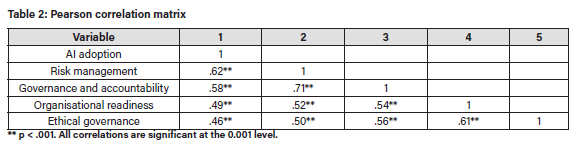
What these statistical relationships reveal about humanitarian practice
The correlation matrix shows that all five variables move together; organisations that are strong in one area tend to be strong in others. But the pattern of relationships tells a more nuanced story:
• AI adoption o risk management (.62): Organisations using AI more extensively report a significantly stronger ability to anticipate and manage risks. This suggests that AI's predictive capabilities are translating into tangible risk management benefits. A project manager in Katsina explained: "The AI system analyses patterns from the past five years and gives us risk probabilities for each road each day. We now move from reaction to anticipation'
• AI adoption o governance and accountability (.58): Higher AI adoption is associated with more robust governance practices. Organisations embracing AI tend to have stronger documentation, oversight, and accountability mechanisms, or perhaps the AI tools themselves enhance these governance functions.
• AI adoption o organisational readiness (.49): Organisations with greater AI adoption have invested more in staff skills, infrastructure, and supportive cultures. This makes intuitive sense: you cannot use what you are not prepared to implement.
• AI adoption o ethical governance (.46): The positive but slightly weaker correlation suggests that while AI-adopting organisations have developed some ethical frameworks, ethics may be lagging behind technology, which is a concern given the risks that AI poses in humanitarian contexts. A national NGO director observed: "Many organisations adopt AI without building readiness or ethics first. They get the technology because donors fund it, but they have not trained staff or established protocols."
• Risk management o governance and accountability (.71): The strongest correlation reveals that organisations that are good at managing risks are also strong in governance. These capabilities reinforce each other: both require disciplined information flows and decision protocols.
• Organisational readiness o ethical governance (.61): Organisations investing in technical capacity also tend to invest in ethical safeguards. This is encouraging: readiness and ethics appear to develop together rather than one developing at the expense of the other.
Results from hierarchical regression and mediation analysis
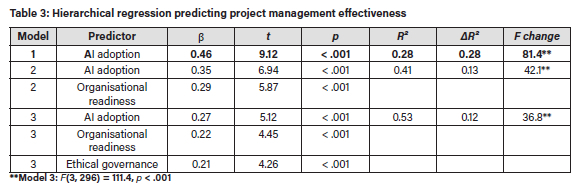
What hierarchical-regression findings reveal
• Model 1 (AI adoption alone): AI adoption alone explains 28% of the differences in project management effectiveness between organisations. This is substantial, comparable to knowing that a student's study hours explain 28% of why some students get higher grades. The standardised coefficient (β = .46) means that when AI adoption increases meaningfully, project effectiveness increases by nearly half a standard deviation, a practically significant impact.
• Model 2 (adding organisational readiness): When organisational readiness enters the picture, AI's direct contribution drops from .46 to .35, while readiness itself contributes significantly (.29). Together, they explain 41% of effectiveness differences, a 13% improvement. This tells us the following: Part of why AI improves effectiveness is because organisations that adopt AI tend to be more ready, and readiness itself matters. But AI still contributes beyond readiness.
• Model 3 (adding ethical governance): Adding ethical governance increases explained variance to 53%, meaning that these three variables together account for over half of why some organisations manage projects more effectively than others. AI's coefficient drops further to .27, while both mediators remain significant (.22 and .21). This reveals the following: AI's influence on effectiveness runs partly through strengthening organisational readiness and ethical governance. The technology does not simply work on its own; it enables and is enabled by these human and structural factors.
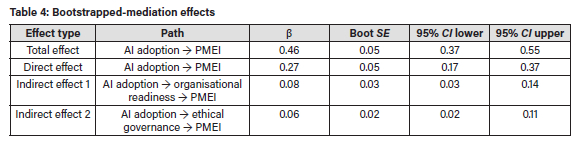
What mediation-analysis findings reveal
The mediation analysis moves beyond asking "does AI work?" to answer the more important question: "How does AI actually improve humanitarian project management in conflict zones?" The core finding is as follows: AI's value flows through two distinct kinds of pathways, direct and indirect, and understanding this distinction matters profoundly for practice:
The direct pathway (β = .27): The technology itself helps: Consider a project manager in Katsina who receives an AI-generated alert predicting road closures based on recent bandit activity patterns. She reroutes a food convoy, avoiding a potential attack. This is AI working directly, since the technology's analytical capability produced actionable information that human judgment alone might have missed. The direct effect of .27 represents this pure technical contribution: better data, faster pattern recognition, and more accurate predictions. This pathway accounts for approximately 59% of AI's total observed impact.
The indirect pathway through organisational readiness (β = .08): AI forces capacity building: Before that project manager can act on the AI alert, her organisation had to invest in training staff to interpret AI outputs, upgrade internet connectivity, and create response protocols. These investments in readiness, prompted by AI adoption, independently enhance project management beyond the AI tools themselves. This pathway accounts for about 17% of AI's total effect. A national NGO programme manager described this dynamic: "When we first got the AI reporting system, we realised our staff did not know how to use it. We had to invest in training. We realised our internet in field offices was too slow, we had to upgrade. The AI adoption itself forced us to become more capable. And now that we have those capabilities, our whole operation runs better, not just the AI part."
The indirect pathway through ethical governance (β = .06): AI demands accountability: A different project manager receives an AI recommendation to prioritise certain villages for food distribution. Before acting, she consults an ethics protocol requiring human review. She notices that the model may be biased because it lacks data from communities beyond mobile network coverage. She overrides the recommendation and sends a field team to verify needs directly. This pathway, accounting for about 13% of AI's effect, represents how AI necessitates oversight mechanisms that themselves improve outcomes by preventing mistakes. A project manager explained: "We had an ethics protocol requiring human review of all AI recommendations. That protocol caught a major error: the AI recommended deprioritising a community because its data was incomplete, but our field staff knew displaced families had arrived there. Without the protocol, we would have followed the AI and created harm. The 13% mediation effect, that is what saved us."
The combined insight: Together, the indirect pathways account for 30% of AI's relationship with project effectiveness. This is not a statistical curiosity but a practical revelation: when a humanitarian organisation adopts AI, nearly one-third of the benefit comes not from algorithms alone but from how adopting AI transforms organisations, making them more capable, more disciplined, and more accountable.
Results from state-level comparison
One-way ANOVA revealed no statistically significant differences in AI adoption levels across the three states: Kebbi (M = 3.48, SD = 0.79), Katsina (M = 3.57, SD = 0.85), Jigawa (M = 3.57, SD = 0.86); F(2, 297) = 0.56, p = .57. However, understanding what "AI adoption" means in practice requires understanding each state's unique conflict dynamics.
Kebbi State (M = 3.48)
Kebbi's challenges are dominated by cross-border criminality along the Niger frontier and armed banditry affecting agricultural communities. Project managers use predictive analytics primarily to anticipate farming season violence and model safe corridors for cross-border supply chains. A logistics coordinator explained: "In Kebbi, our biggest risk is unpredictability during planting and harvest seasons. The AI tools analyse patterns from the past three years, which villages were attacked, when, and what the security response was, and give us probabilities we can plan around." The slightly lower mean may reflect more rural, harder-to-reach areas where connectivity for real-time AI applications remains inconsistent.
Katsina State (M = 3.57)
Katsina faces the most intense and sustained banditry activity. Project managers emphasise AI's role in real-time threat assessment and staff security. A project manager described this role as follows: "In Katsina, we cannot afford to be reactive. The AI system integrates data from security agencies, community networks, and social media to update risk scores for each operational area daily. When the risk score crosses our threshold, we do not move staff that day, regardless of planned activities."
Jigawa State (M = 3.57)
Jigawa's conflict dynamics include farmer-herder tensions and spillover violence, but with more predictable patterns. Project managers report using AI primarily for resource allocation efficiency and donor reporting, rather than acute security prediction. An ICT officer explained: "Our focus is making sure limited resources reach the maximum number of people. The AI helps us analyse needs assessment data across 200+ communities and optimise where we send mobile health teams. It also automatically generates donor reports, freeing staff for field monitoring."
What the statistical homogeneity means
The finding of no significant differences tells us something important: AI adoption is driven more by organisational factors than location-specific conditions. International NGOs and UN agencies deploy similar tools across their entire portfolios. However, this homogeneity masks profound inequities within states. A national NGO director in Katsina stated: "The average of 3.57 in Katsina combines international NGOs scoring 4.5 and national NGOs scoring 2.5. The mean is mathematically correct but practically misleading. The real story is not about states; it is about who has resources and who does not."
Integration of survey (quantitative) findings with interview (qualitative) findings
This section weaves together quantitative patterns with qualitative evidence to explore how AI functions as a project management and governance tool in the lived experience of humanitarian actors.
Understanding the AI adoption-effectiveness relationship ( β = .46)
The quantitative analysis established that AI adoption significantly predicts project management effectiveness. But what does "more effective" mean in practice? Qualitative data reveals three concrete mechanisms.
Mechanism 1: Anticipation replaces reaction
In the words of a project manager in Katsina: "Before AI, we were always responding to crises after they happened. Now we receive risk forecasts that let us act before the crisis. Last month, the AI predicted a 65% probability of attack on the Funtua road based on patterns we had never noticed, attacks spike three days after full moons. We rerouted our convoy. Three days later, that road was attacked. The .46 effect size, that is us. That is supplies arriving safely because we anticipated" A logistics coordinator in Kebbi added: "Our AI flagged that heavy rains predicted for the following week, combined with increased bandit activity, would likely close our main supply route. We had three days' warning. We moved two weeks of food into our warehouses before the road became impassable. The statistics show AI predicts effectiveness; I can tell you exactly what that looks like: children eating because food arrived on time"
Mechanism 2: Decision quality improves
An ICT officer explained: "The AI does not make decisions; it gives us better information for decisions we must make anyway. When deciding which communities to prioritise for mobile health teams, the AI analyses needs data from 200+ locations and flags where malnutrition is rising fastest. We still make the final decision, but with information we could never assemble manually."
Mechanism 3: Accountability becomes auditable
In the words of a donor representative, addressing the relevance of AI to donor confidence: "When partners use AI, they can show us why they made decisions. They can say, 'We rerouted because our model showed X, Y, and Z factors converging' This creates an audit trail for adaptive management. We trust partners more when we understand their logic."
Explaining the mediation pathways
The mediation analysis revealed that organisational readiness and ethical governance account for 30% of AI's effect. Qualitative data explains why.
The readiness pathway: AI forces capacity-building
A national NGO programme manager said: "We had to invest in training. We realised we needed someone who understood data, we hired a new staff member" An ICT officer confirmed: "Organisations cannot just buy AI software and expect magic. You need infrastructure. You need skills. You need leadership that supports innovation. The organisations in our survey with high readiness scores are the ones where AI actually works."
The ethics pathway: Trust requires safeguards
A project manager explained: "Early in our AI use, we had an incident. The system recommended prioritising certain villages based on malnutrition data. But the data was incomplete, it missed newly displaced families. Because we had an ethics protocol requiring human review, a staff member caught the error. The protocol saved us. Now we see ethical governance not as a constraint but as something that makes AI work better" A donor representative emphasised: "We will not fund AI projects without strong ethical frameworks. Why? Because when things go wrong, and they will, someone must be responsible. If an organisation cannot show us how they oversee AI, how they protect data, how they prevent bias, we cannot take the risk."
The central tensions: What the numbers cannot show
Across all interviews, the following tensions emerged that quantitative data alone cannot capture:
Empowerment and marginalisation: An international NGO programme manager celebrated AI's benefits, while a national NGO director stated: "Meanwhile, we cannot afford these tools. In coordination meetings, international partners bring AI-generated maps and forecasts. We bring our community knowledge. Guess whose information is treated as credible? The technology creates a hierarchy where those with AI are heard and those without are silenced, even when we know the context better"
Efficiency and burden: While a donor representative praised the AI dashboards, a field officer described the same dashboards differently: "I spend more time looking at my phone entering data than looking at the community. The system demands information, and I provide it, but I am not sure the community benefits from my attention being on the screen rather than on them."
Clarity and obfuscation: An ICT officer emphasised AI's transparency, while a programme manager cautioned as follows: "But the dashboard cannot show us whether people felt respected during distribution. It cannot show community tensions. We risk optimising for what the machine can measure while ignoring what matters."
The human-in-the-loop imperative: A field officer offered this reflection: "The algorithm can suggest where needs are greatest. It can calculate efficiency. It can optimise resources. But it cannot understand dignity. It cannot know that in this community, because of their history, distributing food in the morning rather than afternoon matters. It cannot feel the tension in a conversation and decide to pause. These are human things. The AI is a tool. But the work itself, the work of being with people in crisis, that is human work. It must remain human work."
6. Discussion
Theoretical contribution: AI as embedded governance infrastructure
The central theoretical contribution is support for the reconceptualisation of AI as not a stand-alone technical tool, but as an embedded project management and governance infrastructure whose effects are realised through organisational and ethical subsystems. First, it challenges technocentric narratives treating AI as a direct solution to management challenges. The finding that 30% of AI's effect operates through readiness and ethics demonstrates that technology alone is insufficient. Organisations investing in AI without concurrent investment in capabilities and safeguards capture only about 70% of AI's potential value. Second, it specifies mechanisms through which AI influences governance outcomes: anticipatory capacity (predictive analytics enabling proactive risk management), accountability infrastructure (automated reporting creating auditable decision trails), and decision support (AI augmenting rather than replacing human judgment). Third, it reveals the double-edged nature of AI-enabled governance. While informants affirmed AI's value, they also identified tensions: measurable outputs displacing meaningful outcomes; data entry burden on field staff; marginalisation of national actors; and risk that "human oversight" becomes performative. These qualifications complicate simplistic accounts of AI as unambiguously beneficial.
Analytical insights: How AI transforms governance in conflict contexts
Beyond confirming that AI matters, the findings reveal qualitatively distinct ways in which AI transforms governance, specifically in conflict-affected humanitarian operations:
Insight 1: AI enables governance under extreme uncertainty: In conventional project management, governance assumes relatively stable environments. In North-West Nigeria, volatility is the norm. AI's predictive capabilities allow organisations to govern not by following fixed plans but by continually sensing and responding to changing conditions.
Insight2: AI creates auditable adaptation: Donors historically struggle to fund adaptive management because adaptation looks like deviation from plans. AI tools create audit trails documenting why adaptations occurred, risk forecasts, supply chain analyses, and needs assessments, transforming adaptation from unapproved change to evidence-based response.
Insight 3: AI redistributes epistemic authority: AI adoption shifts whose knowledge counts. International NGOs with AI produce maps and forecasts that are treated as authoritative. National NGOs without such tools bring experiential knowledge that is systematically devalued. This redistribution has profound implications for power dynamics in humanitarian partnerships.
Insight 4: AI makes visible the invisible, and invisible the visible: AI renders certain phenomena visible: malnutrition trends across 200 villages, or patterns in security incidents. But it risks rendering other phenomena invisible: community trust, dignity in aid delivery, or the quality of human relationships. The field officer who described spending "more time looking at my phone than looking at the community" captured this paradox.
Limitations and future research
First, cross-sectional design limits causal claims. Longitudinal research tracking of organisations as they mature in AI use would strengthen evidence of causal direction. Second, self-reported data on ethically sensitive topics may be subject to social desirability bias. Future research could incorporate organisational records, donor audits, or community perspectives. Third, the focus on organisational perspectives leaves the beneficiary viewpoint unexplored. How do the affected communities experience AI-influenced governance? This is a critical gap. Fourth, AI is treated as a composite construct rather than examining specific applications. Future research could disaggregate AI types, predictive analytics, computer vision, and natural language processing, to identify which one generates which effects. Fifth, the North-West Nigeria context limits direct generalisability. Comparative studies across conflict regions could illuminate how varying dynamics shape AI integration.
7. Conclusion
This research establishes that in conflict-affected North-West Nigeria, AI tools enhance humanitarian project effectiveness by functioning as an embedded management governance infrastructure. The study's central contribution is demonstrating that AI's value is to a great extent realised through organisational readiness and ethical governance. Approximately 30% of AI tools' total effect operates through these pathways, meaning that organisations investing in AI must concurrently invest in the human and structural capabilities that enable technology to translate into improved outcomes.
Funding declaration
No funding was received for the research or for preparation of this article.
Data availability statement
The quantitative dataset analysed during this study, including survey responses from 300 participants, is available from the corresponding author, Akaninyene O. Unaam, upon reasonable written request sent to
AI declaration
The authors did not use any GenAI tools in the research or in preparation of this submission.
Competing-interests declaration
The authors have no competing interests to declare.
Author contributions declaration
A. O. U.: Conceptualisation; methodology; investigation; resources; data curation; formal analysis (qualitative); writing - original draft; writing - review and editing; project administration.
E. A. U.: Methodology (quantitative instruments); software; formal analysis (quantitative); data curation; writing -original draft (quantitative sections); writing - review and editing; visualisation (tables and figures)
References
Acknowledgements
The authors extend sincere gratitude to the humanitarian-project personnel and key informants in Kebbi, Katsina, and Jigawa States for their participation and insights, and to local humanitarian coordinating bodies for facilitating access. Appreciation is also expressed to colleagues at the University of Uyo's Department of Business Management for their constructive feedback during the research design and writing of this article.
2. Literature review
- Adeleke, A. G., Okafor, E. C., & Sulaiman, M. A. (2023). Digital transformation challenges in Nigeria's public sector: The role of institutional voids and workforce readiness. Journal of Science and Technology Policy Management, 14(2), 345-364. https://doi.org/10.1108/JSTPM-03-2022-0045
- Akinola, O. A., & Ogunbayo, B. F. (2024). Digital innovation and organizational adaptation in Nigerian non-governmental sectors. Journal of African Business, 25(1), 123-145. https://doi.org/10.1080/15228916.2023.2188567
- Bah, A., Jallow, B., & Sesay, S. (2024). Decolonizing humanitarian technology: Towards ethical AI in African crisis response. African Journal of Science, Technology, Innovation and Development, 16(1), 45-62. https://doi.org/10.1080/20421338.2023.2287456
- Bannister, F., & Connolly, R. (2020). The trouble with transparency: A critical review of openness in e-government. Policy & Internet, 12(3), 334-354. https://doi.org/10.1002/poi3.229
- Barnett, M. (2023). The humanitarian fix: Navigating accountability in an age of digital transformation. Journal of Humanitarian Affairs, 5(1), 12-28. https://doi.org/10.7227/JHA.0054
- Betts, A., Bloom, L., & Weaver, N. (2015). Refugee innovation: Humanitarian innovation that starts with communities. Humanitarian Innovation Project, University of Oxford. https://www.rsc.ox.ac.uk/files/files-1/refugee-innovation-web-5-3mb.pdf
- Braun, V., & Clarke, V. (2006). Using thematic analysis in psychology. Qualitative Research in Psychology, 3(2), 77-101. https://doi.org/10.1191/1478088706qp063oa
- Cohen, J. (1988). Statistical power analysis for the behavioral sciences (2nd ed.). Routledge. https://doi.org/10.4324/9780203771587
- Creswell, J. W., & Clark, V. L. P. (2017). Designing and conducting mixed methods research (3rd ed.). SAGE.
- Dwivedi, Y. K., Hughes, L., Ismagilova, E., Aarts, G., Coombs, C., Crick, T., Duan, Y., Dwivedi, R., Edwards, J., Eirug, A., Galanos, V., Ilavarasan, P. V., Janssen, M., Jones, P., Kar, A. K., Kizgin, H., Kronemann, B., Lal, B., Lucini, B., Medaglia, R., ... Williams, M. D. (2021). Artificial intelligence (AI): Multidisciplinary perspectives on emerging challenges, opportunities, and agenda for research, practice and policy. International Journal of Information Management, 57, 101994. https://doi.org/10.1016/j.iijnfomgt.2019.08.002
- Eke, D. O., Wakunuma, K., & Akintoye, S. (Eds.) (2023). Responsible AI in Africa: Challenges and opportunities. Palgrave Macmillan. https://doi.org/10.1007/978-3-031-08215-3
- Fornell, C., & Larcker, D. F. (1981). Evaluating structural equation models with unobservable variables and measurement error. Journal of Marketing Research, 18(1), 39-50. https://doi.org/10.1177/002224378101800104
- KPMG. (2020). AI in project management: A new era of decision-making. https://assets.kpmg.com/content/dam/kpmg/xx/pdf/2020/06/ai-in-proiect-management.pdf
- Lawal, Y. A., Ayanleke, A. O., & Oshin, I. I. (2024). The impact of AI techniques on human-AI interaction quality in proiect management: A mixed-methods study. Organization and Human Capital Development, 3(2), 1-17. https://doi.org/10.31098/orcadev.v3i2.2307
- Lokuge, S., Sedera, D., Grover, V., & Dongming, X. (2019). Organizational readiness for digital innovation: Development and empirical test of a construct. Information & Management, 56(3), 445-461. https://doi.org/10.1016/j.im.2018.09.001
- Marnewick, C., & Marnewick, A. L. (2020). The role of artificial intelligence in proiect management success. International Journal of Managing Projects in Business, 13(4), 695-714. https://doi.org/10.1108/IJMPB-12-2018-0261
- Maxwell, D., Bailey, S., Harvey, P., Walker, P., & Sharbatke-Church, C. (2022). Preventing corruption in humanitarian assistance: Final research report. Feinstein International Center, Tufts University.
- Meier, P. (2015). Digital humanitarians: How big data is changing the face of humanitarian response. Routledge. https://doi-org.proxy.bib.uottawa.ca/10.1201/b18023
- Mulder, F (2023). The paradox of externally driven localisation: A case study on how local actors manage the contradictory legitimacy requirements of top-down bottom-up aid. Journal of International Humanitarian Action, 8(7), 1-19. https://doi.org/10.1186/s41018-023-00139-0
- Nunnally, J. C. (1978). Psychometric theory (2nd ed.). McGraw-Hill.
- Parasuraman, A. (2000). Technology Readiness Index (TRI): A multiple-item scale to measure readiness to embrace new technologies. Journal of Service Research, 2(4), 307-320. https://doi.org/10.1177/109467050024001
- Podsakoff, P. M., MacKenzie, S. B., Lee, J. Y., & Podsakoff, N. P. (2003). Common method biases in behavioral research: A critical review of the literature and recommended remedies. Journal of Applied Psychology, 88(5), 879-903. https://doi.org/10.1037/0021-9010.88.5.879
- Preacher, K. J., & Hayes, A. F. (2008). Asymptotic and resampling strategies for assessing and comparing indirect effects in multiple mediator models. Behavior Research Methods, 40(3), 879-891. https://doi.org/10.3758/BRM.40.3.879
- Trist, E. (1981). The evolution of socio-technical systems: A conceptual framework and an action research program. Ontario Quality of Working Life Centre. https://sistemas-humano-computacionais.wdfiles.com/local--files/capitulo%3Aredes-socio-tecnicas/Evolution_of_socio_technical_systems.pdf
- UN High Commissioner for Refugees (UNHCR). (2023). Nigeria: North-west situation. UNHCR Operational Data Portal. https://data.unhcr.org/en/situations/nigeriasituationnorthwest
- UN Office for the Coordination of Humanitarian Affairs (UN OCHA). (2022). Humanitarian needs overview: Nigeria. https://www.unocha.org/publications/report/nigeria/humanitarian-needs-overview-2022-february-2022
- Vinuesa, R., Azizpour, H., Leite, I., Balaam, M., Dignum, V., Domisch, S., Felländer, A., Langhans, S. D., Tegmark, M., & Fuso Nerini, F. (2020). The role of artificial intelligence in achieving the Sustainable Development Goals. Nature Communications, 11(1), 233, 1-10. https://doi.org/10.1038/s41467-019-14108-y