Roles of a WhatsApp group in fostering a Kenyan agricultural community of practice (CoP)
Abstract
WhatsApp groups have been found to serve as valuable platforms for livelihood development in numerous African settings and also beyond the continent. This study explores the roles played by a Kenyan agricultural WhatsApp group, the Agri-Society Network, in supporting engagement and collaboration by its users. The study surveyed 174 group members, via an online questionnaire, in order to explore the members' experiences of, and views on, participation in the group. The findings were analysed through the lens of the community of practice (CoP) framework (Wenger, 1998), and specifically the framework's dimensions of mutual engagement, joint enterprise, and shared repertoire. The survey found that the majority of the group members used the group daily or several times a week; that the primary uses of the group were to share information/resources and to ask questions; that the most popular discussion categories were general peer discussions, followed by discussions of farming techniques or marketing opportunities; and that the main perceived benefits were networking opportunities, problem-solving, skills development, and market access. The main challenges faced by group users were the lack of reliable connectivity and the sharing of irrelevant content. The findings indicate the presence of strong elements of mutual engagement, joint enterprise, and shared repertoire, thus indicating that the Agri-Society Network WhatsApp group can be regarded as an example of a CoP.
WhatsApp; agriculture; farming; peer discussions; networking; problem-solving; skills development; market access; community of practice (CoP); mutual engagement; joint enterprise; shared repertoire; Kenya
1. Introduction
The internet and mobile networks have transformed the provision and dissemination of agricultural information in Kenya (Ireri, 2021). Kenyan online services, including social media, are now flooded with information that a farmer can access, and farmers can easily post information about their practices. In 2024, it was estimated that more than 10 million Kenyans had access to social media networks, a threefold increase since 2014 (Statista, 2025). It was also found that Kenyan social media users were using WhatsApp and TikTok most frequently, with WhatsApp, used by 86.8% of those on social media, being the most popular social media platform in the country (Statista, 2025).
Social media platforms have been found to be useful in helping Kenyan farmers acquire fundamental information on matters such as breeding, seed selection, markets, and the use of appropriate practices (Irungu et al., 2015). When information circulates in groups of individuals or entities sharing common goals and behaviours, these groups can be referred to as communities of practice (CoPs). The CoP concept was first proposed by Lave and Wenger (1991) and was then popularised by Wenger (1998). The concept has since been deployed, by Wenger and others, in numerous contexts, including agricultural settings. CoPs are groups of individuals who work in similar and related fields, share common interests and objectives, and engage in communication and knowledge enhancement processes (Vincent et al., 2018). Keir et al. (2021) have found that social media networks complement the development of CoPs as platforms for boosting the provision and dissemination of information and resources. Social media networks offer platforms for conversation among individuals who might not have been familiar with each other, thus generating a linked, informed, and knowledgeable community with common interests.
In Kenya, agriculture is a critical sector that contributes 33% to the GDP, and the majority (70%) of rural residents are employed in the sector (FAO, 2024). This study explored participation by Kenyan small-scale farmers in the Agri-Society Network WhatsApp group. In the group, which had 248 members at the time of the study in late 2024, users engage in information-sharing and discussion on agricultural matters. The research, conducted through an online questionnaire, examined the group members' engagement patterns and modes of interaction when using the group, as well as the perceived impact of the group on members' agricultural knowledge; the perceived main benefits derived from using the group; the challenges that members face when seeking to communicate via the group; and the members' recommendations for improving the group. As part of the data analysis, the study explored the extent to which the Agri-Society Network exhibits three elements that are considered to be core features of CoPs: mutual engagement, joint enterprise, and shared repertoire.
2. Literature review
Communities of practice (CoPs)
As Wenger (2011) writes, "[c]ommunities of practice are groups of people who share a concern or a passion for something they do and learn how to do it better as they interact regularly" (2011, p. 1). CoPs are groupings in any discipline that aim to share knowledge and learning within that discipline. Wenger's conceptualisation emphasises three key elements that define CoPs: mutual engagement, joint enterprise, and shared repertoire (Mercieca, 2016; Mercieca & McDonald, 2021; Wenger, 1998). Mutual engagement refers to ongoing, meaningful interactions and relationships among CoP members (Gijbels et al., 2021; Wenger, 1998). Joint enterprise refers to a sense of shared purpose that connects CoP members and fosters collaboration (Gijbels et al., 2021; Wenger, 1998). The shared repertoire comprises the shared knowledge, concepts, tools, language, and practices developed over time within the CoP to support the members' work (Gijbels et al., 2021; Wenger, 1998).
CoPs and social media
Social media platforms such as WhatsApp, Facebook, and X (formerly Twitter) have been found to be among the most useful tools for developing and managing CoPs, especially in rural and low-resource areas (Dai et al., 2017; McLoughlin et al., 2017; Moodley, 2019), because social media increase the potential for the virtual realisation of commonalities in objectives in practice (Kavoura, 2014). Via social media tools, knowledge transfer can occur synchronously among participants in diverse locales, including participants in rural and resource-limited environments (Mhlanga & Ndhlovu, 2023; Nampijja, 2021). Sivakumar et al. (2023) establish the shift in knowledge construction that is taking place through social media platforms, which allow people to create knowledge-saturated communities to share information, ideas, and best practices regardless of geographical location.
Social media groups intuitively support the tasks necessary for (formal and informal) knowledge acquisition, which is at the core of the CoP concept. Through instant messaging, individual members of a social media group can support each other, share experiences, and exchange information on best practices in real time. Social media groups facilitate ongoing learning and practice development (Hanekom, 2019).
Social media and agricultural CoPs
The rapid information dissemination that social media groups enable is crucial for knowledge-sharing on farming and agricultural marketing matters including, for example, information on weather patterns and on the prices of agricultural products in local markets. Text, images, videos, and voice-messages are all ideal for sharing information in social media groups, and the transmission of such information is critical in agriculture, where much of the knowledge acquisition and knowledge-sharing is based on practice (Thakur et al., 2017).
A study by Eduafo et al. (2024) found that social media networking assists farmers in accessing correct, timeous information, which is fundamental in managing market forces and mitigating the risks inherent in farming. A study by Morepje et al. (2024) found that social media platforms aid in overcoming agricultural market-access barriers by directly connecting farmers to buyers, suppliers, and other sector participants.
However, at the same time, social-media-based agricultural communities are not without challenges. A study by Sandeep et al. (2022) found that while social media communities can democratise information access, they can also create information overload for individuals, especially when the information flow is unregulated and unfocused. This can lead to the spreading of inaccurate information on a particular topic and to member disengagement from certain community discussions. Another challenge, as identified in the Mokhtar et al. (2022) study, is the sometimes-low level of digital literacy among rural farmers in regions such as Sub-Saharan Africa, due to limited access to and use of digital technologies and digital skills early in life.
WhatsApp and CoPs
WhatsApp is the most commonly used form of social media for agricultural groupings in developing-world settings (Sandeep et al., 2022). Hence, WhatsApp is a communication and learning tool that fits well with the concept of CoPs (Hanekom, 2019). For example, the acquisition of expertise via a CoP depends in part on the availability of mentors, and the simplicity and ubiquity of WhatsApp allow for the kinds of long-term informal interactions on which mentoring depends (Farnsworth et al., 2016).
According to Nain et al. (2019), WhatsApp has revolutionised the dissemination of information in agriculture because WhatsApp groups allow farmers and agribusinesses to share crucial information on best practices, market opportunities, and new farming techniques. Group communication in WhatsApp also enables participants to maintain their business relationships with suppliers and other stakeholders as they update on the trends, regulations, and innovations within the agricultural sector (Patel et al., 2020). Participation in WhatsApp groups also improves farmers' market access because the groups give real-time production information and provide for the quick dissemination of, and response to, such information, allowing farmers to make timely and optimal decisions (Patel et al., 2020). Networking has been identified as another core dimension of agricultural CoPs that is fostered by WhatsApp groups (Patel et al., 2020).
3. Research design
This study used an explorative case-study design to examine members' use of the Agri-Society Network WhatsApp group. This WhatsApp CoP was created by a passionate small-scale livestock farmer/student in August 2024. The farmer began by inviting an initial 24 people he knew well to the group, and then increased membership by inviting individuals he met at agriculture and agribusiness fairs, with the membership having grown to 248 at the time of this study. Data for the study was collected through a structured Google Form online survey that was made available via the group. The survey had six sections, covering the following: demographics; engagement patterns; perceived benefits; challenges; recommendations; and final reflections. The vast majority of the questions were closed-ended, with only three questions being open-ended, as follows:
• Can you share an example of how this group has positively impacted your work?
• What improvements would you suggest for the WhatsApp group to be more effective?
• Are there additional tools or features you'd like to see integrated with the WhatsApp group?
The survey was conducted for two weeks in November-December 2024, and elicited responses from 174 of the 248 members who were in the group at the time of the data collection, thus achieving a 70% response rate. The study's methods and potential implications were explained to the participants by the group's administrator through the group chat, and there was unanimous approval by the group's members for the study to take place. The members were told that their participation was optional and that they could quit at any time without any consequences or explanations. The respondents' anonymity was maintained, as personally identifiable information was not recorded. Group membership was verified via the mobile numbers of CoP WhatsApp users and not via their names. The survey design allowed participants to skip any question that they deemed sensitive and/or irrelevant to their individual practice.
The survey findings were analysed in terms of the extent to which they corresponded to the three core features of CoPs outlined above: mutual engagement, joint enterprise, and shared repertoire. The responses to the closed-ended questions generated quantitative data. The responses to the open-ended responses were subjected to thematic analysis guided by the framework of Braun and Clarke (2006), whereby responses were coded and grouped into common themes.
4. Findings
Participant demographics
The demographic analysis of the 174 survey responses revealed that the Agri-Society Network had a diverse membership. In terms of age, 30% (n = 52) of the respondents were aged 18-24, 29% (n = 50) were aged 25-34, and 16% (n = 28) were aged 45 and older. In terms of gender representation within the group, 62.2% (n = 108) of the survey participants identified as male, and 37.8% (n = 66) as female.
The respondents were from 27 of the 47 counties of Kenya, with the largest percentage of participants being from the counties of Nairobi (9.2% (n = 16)), Kisii (14% (n = 24)), Kiambu (8.6% (n = 15)), Kisumu (8% (n = 14)), and Nakuru (7.5% (n = 13)); there were smaller but still significant percentages from the counties of Uasin Gishu, Meru, Mombasa, Nyeri, Machakos, and Kakamega. The other counties represented, but with very small numbers of participants or with a single participant, were Bungoma, Nyandarua, Kericho, Murang'a, Nyamira, Eldoret, Kitui, Homabay, Narok, Embu, Kirinyaga, Laikipia, Makueni, Migori, Siaya, and Trans Nzoia.
With respect to their primary roles in agriculture, 32.2% (n = 56) of the respondents identified as agribusiness entrepreneurs, followed by farmers (24.1% (n = 42)), consultants/advisors (18.4% (n = 32)), students (16.1% (n = 28)), and family business operators (9.2% (n = 16)).
Group participation
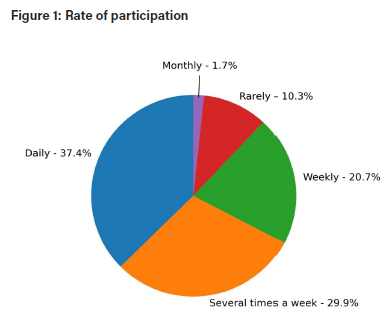
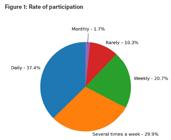
As seen in Figure 1, 37.4% (n = 65) of respondents indicated that they used the WhatsApp group daily, while another 29.9% (n = 52) did so several times a week; 20.7% (n = 36) were weekly users, 1.7% (n = 3) were monthly users, and 10.3% (n = 18) categorised their use as "rarely'!
Content engagement
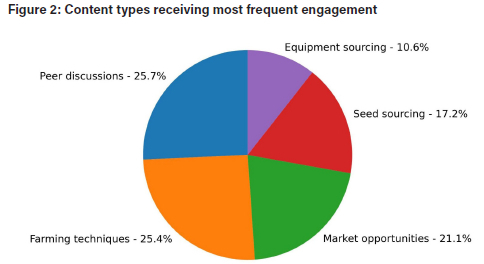
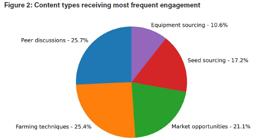
Figure 2 shows the content types that the participants said they most frequently engaged with in the WhatsApp group. The most popular content type was peer discussions, with 25.7% (n = 45) of the respondents indicating this was the content that they most frequently engaged with, followed by farming techniques (25.4% (n = 44)), marketing opportunities (21.1% (n = 37)), equipment sourcing (10.6% (n = 18)), and seed sourcing (17.2% (n = 30)).
Modes of interaction
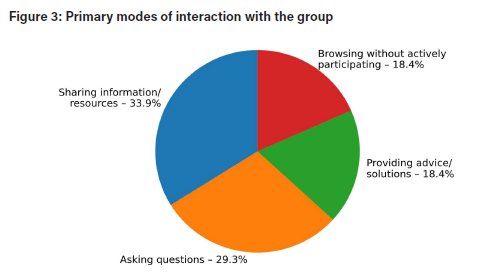
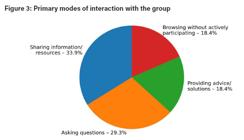
With respect to the participants' primary modes of interaction with the group, it was found, as seen in Figure 3, that 33.9% (n = 59) primarily shared information and resources, 29.3% (n = 51) primarily asked questions, 18.4% (n = 32) primarily provided advice or solutions, and 18.4% (n = 32) primarily browsed without actively participating.
Benefits of participation
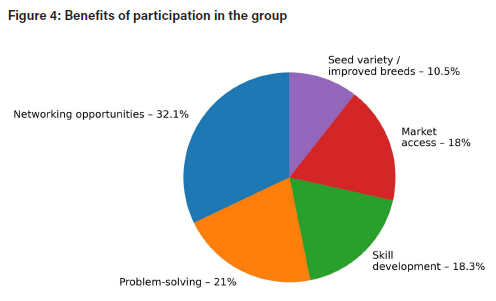
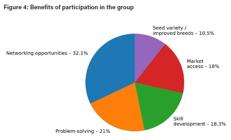
With respect to the perceived benefits from participation in the WhatsApp group, it was found, as shown in Figure 4, that 32.1% (n = 56) of respondents identified networking opportunities as their primary benefit, 21% (n = 37) identified problem-solving, 18.3% (n = 32) identified skill development, 18% (n = 32) identified market access, and 10.5% (n = 18) identified seed variety/improved breeds.
Challenges to participation
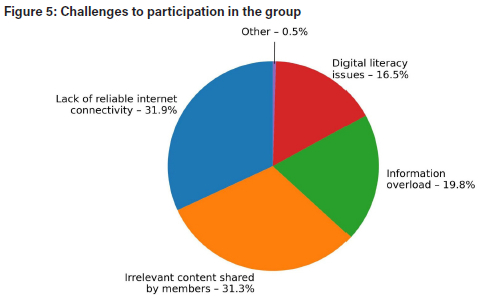
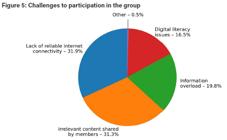
With respect to challenges faced by study participants when using the WhatsApp group, it was found, as seen in Figure 5, that the greatest challenges were lack of reliable connectivity (ranked highest by 31.9% (n = 56) of respondents) and irrelevant content shared by members (31.3% (n = 54)). Information overload (19.8% (n = 34)) and digital literacy issues (16.5% (n = 29)) were ranked highest by fewer respondents.
Members' recommendations
In response to the open-ended questions seeking recommendations on potential improvements and possible additional tools, increased organisation or moderation of content was the most common recommendation, mentioned in more than 40% of the replies. Specific recommendations were to have focused Q&A sessions on certain topics; to create content rules to filter out irrelevant posts and minimise repetitive content; and to have posts providing regular (e.g., weekly) updates or highlights. With respect to additional tools, there was interest in adding features that would facilitate organisation and interaction, such as task management tools to schedule and receive reminders; content curation tools to save and categorise shared information; and polling and survey tools to get group feedback on certain group features. Most of the recommendations were, therefore, clearly linked to addressing the identified challenges (cited above) of irrelevant content and information overload.
Members' impact stories
The survey questionnaire's open-ended question regarding impact-can you share an example of how this group has positively impacted your work?-yielded some compelling impact stories.
A female vegetable farmer from Narok County wrote that the group had helped her to transition from subsistence to commercial farming. Initially, she had difficulty contacting buyers and did not have a reliable source for farming advice. After joining the Agri-Society Network WhatsApp group, she received advice on irrigation practices that were applicable to her area, which is semi-arid, and advice on the most suitable varieties of vegetables. Additionally, through the group she met individuals who wanted to buy her produce, which assisted her commercialisation efforts. As she wrote in her questionnaire response: "Sold produce faster through shared market leads"
A male coffee farmer from Nyeri County wrote that before becoming a member of the WhatsApp group, he struggled to find buyers for his beans. With the help of the group, he had now contacted several additional bulk buyers, thus expanding his income. He had also benefited from group members' expertise in post-harvest handling, thus ensuring better-quality beans and fewer spoilt ones.
A female mango farmer in Kitui County wrote about how she secured a buyer for her fruit through the group, thus increasing profits for her enterprise. She wrote: "Secured a buyer for my mangoes through the group, thus increasing profits."
A male maize farmer from Homabay County wrote that the group had helped him to overcome challenges with the cost of farm inputs and with the transport of farm produce to markets in major towns.
Another male maize farmer, from Nakuru County, wrote: "I can consult with agricultural experts in the group and even get free advice without travelling to some far-off agricultural office."
A male tomato farmer from Nakuru County wrote of his improved pest control through participation in the group: "Managed to rid my tomatoes of disease through an organic pest control method learned via a video shared in the group."
A male poultry farmer from Kiambu County wrote: "I found a mentor through this group who has helped me expand my poultry farm and improve my operations."
5. Analysis
In this section, the findings are analysed through the lenses of three core elements of the CoP framework: mutual engagement, joint enterprise, and shared repertoire.
Mutual engagement
As explained above in the literature review, Wenger's (1998) conceptualisation of mutual engagement refers to CoP members' ongoing, meaningful interactions and relationships. The findings from this study provide several examples of such engagement among members of the Agri-Society Network WhatsApp group, e.g., in the findings that the majority of the respondents used the group daily or several times a week; that the primary identified uses of the group were to share information and resources and to ask questions; that the most popular discussion category was general peer discussions; and that the main perceived benefit was networking opportunities. Also pointing to strong mutual engagement were statements in the users' written impact stories, e.g., "I can consult with agricultural experts in the group [...]" and "I found a mentor through this group [...]"
Joint enterprise
In Wenger's (1998) CoP framework, joint enterprise refers to a shared purpose connecting CoP members. A strong shared-purpose dimension can be seen in the several findings that point to group members' desire to achieve improved marketing of their agricultural products. This shared purpose is clear in the survey finding that one of the most popular discussion categories was marketing opportunities, and the finding that one of the main perceived benefits of group participation was market access. This shared purpose is also present in the user-impact stories-all of which mention elements of improved market access-of the vegetable farmer from Narok County, the coffee farmer from Nyeri County, the mango farmer in Kitui County, and the farmers from Homabay County.
The Agri-Society Network WhatsApp group members are clearly united by a shared need to increase the income they generate from their activities. Another, and linked, shared-purpose dimension is seen in the findings pointing to the need to improve farming practices (e.g., pest control, post-harvest handling).
Shared repertoire
According to Wenger (1998), a CoP's shared repertoire comprises its shared knowledge, concepts, tools, language, and practices. In the findings, the strongest shared-repertoire dimension is knowledge. The shared knowledge referenced in the findings includes knowledge of marketing opportunities, available transport, pest-control techniques, irrigation practices, and post-harvest handling. An example of a specific knowledge artefact shared in the group is the video, referred to by the male tomato farmer from Nakuru County, which the farmer said had helped him to rid his tomatoes of disease by using an organic pest-control technique. The findings also point to the fact that the knowledge shared in the CoP is often expert knowledge, as evidenced in the impact-story statements: the Nakuru County maize farmer's statement that "I can consult with agricultural experts in the group [...]" and the Nyeri County coffee farmer's mention that he had benefited from group members' expertise in post-harvest handling.
6. Conclusion and recommendations
The findings of this study indicate that the Agri-Society Network WhatsApp group has features that make it an example of an agricultural CoP. The study respondents pointed to the CoP being used as a means by which experiential, contextualised, and specialised knowledge is shared, thus helping farmers to transform the ways in which they practise agriculture and market their agricultural products. The study findings also point to measures that could be taken to potentially improve the functioning of this WhatsApp group and other similar virtual CoPs in Kenya.
Internet connectivity
In response to the challenge of unreliable internet connectivity identified in the study, the Kenyan national and county governments can take steps to improve connectivity in the country's remote rural areas.
Moderation
In response to the challenge of irrelevant content being posted, the group administrator could introduce elements of moderation by establishing content parameters and taking down content that does not fit within the parameters.
Digital literacy
In response to digital-literacy challenges, e-learning modules could be offered to the group, covering, inter alia, the use of all of WhatsApp's functionality, and creating, packaging, and sharing information items.
Enhanced networking
Kenyan agricultural organisations could engage members of the Agri-Society Network WhatsApp group in virtual networking events such as mentoring sessions, webinars, and workshops-so as to ensure optimal engagements and relationships among members, including innovative business relationships and entrepreneurial linkages between experienced farmers and newcomers.
Funding declaration
This study received no financial support.
Data availability statement
The raw data collected from the 174 respondents is available upon written request to the author at
AI declaration
No AI was used in conducting the study. Grammarly was used to improve the grammar in the submission.
Competing interests declaration
The author has no competing interests to declare.
Acknowledgements
The author acknowledges the guidance and support provided by Prof. Paul Mbutu of Daystar University and the research assistant services, in data-gathering and data analysis, provided by Eric Maina Macharía.
References
- Abiri, R., Rizan, N., Balasundram, S. K., Shahbazi, A. B., & Abdul-Hamid, H. (2023). Application of digital technologies for ensuring agricultural productivity. Heliyon, 9(12), e22601. https://doi.org/10.1016/j.heliyon.2023.e22601
- Braun, V., & Clarke, V. (2006). Using thematic analysis in psychology. Qualitative Research in Psychology, 3(2), 77-101. https://doi.org/10.1191/1478088706qp063oa.
- Collier, P., & Dercon, S. (2014). African agriculture in 50 years: Smallholders in a rapidly changing world? World Development, 63, 92-101. ,https://doi.org/10.1016/j.worlddev.2013.10.001
- Dai, M., He, W., Tian, X., Giraldi, A., & Gu, F. (2017). Working with communities on social media. Online Information Review, 41(6), 782-796. https://doi.org/10.1108/oir-01-2016-0002
- David, C. (2020). Community, crowdsourcing, and commerce: WhatsApp Groups for agriculture in Kenya [Master's thesis, University of Ottawa]. https://ruor.uottawa.ca/items/f148b0a2-b4f0-43fc-a513-0ec89c5eead3
- Dilleen, G., Claffey, E., Foley, A., & Doolin, K. (2023). Investigating knowledge dissemination and social media use in the farming network to build trust in smart farming technology adoption. Journal of Business & Industrial Marketing, 38(8), 1754-1765. https://doi.org/10.1108/jbim-01-2022-0060
- Dlela, M. (2024). The role of social media in empowering rural economies: A case study of Kenya. Komitmen: Jurnal Ilmiah Manajemen, 5(2), 31-39. https://doi.org/10.15575/jim.v5i2.38741
- Eduafo, I., Osei, C. K., Bakang, J. E. A., & Tham-Agyekum, E. K. (2024). Could social media be a game-changer in improving agricultural extension delivery in Ghana? Heliyon, 10(12), e33293. https://doi.org/10.1016/j.heliyon.2024.e33293
- Farnsworth, V., Kleanthous, I., & Wenger-Trayner, E. (2016). Communities of practice as a social theory of learning: A conversation with Etienne Wenger. British Journal of Educational Studies, 64(2), 139-160. https://doi.org/10.1080/00071005.2015.1133799
- Food and Agriculture Organisation of the United Nations (FAO). (2024). Kenya at a glance. https://www.fao.org/kenya/fao-in-kenya/kenya-at-a-glance/en
- Ghanad, A. (2023, August 24). An overview of quantitative research methods. International Journal of Multidisciplinary Research and Analysis, 06(08), 3794-3803. https://doi.org/10.47191/ijmra/v6-j8-52
- Gijbels, D., Endedijk, M., & Hirschler, T. (2021). Communities of practice: Jean Lave and Etienne Wenger. In F. Dochy, D. Gijbels, M. Segers, & P. van den Bossche (Eds.), Theories of workplace learning in changing times (2nd ed., pp. 146-154). Routledge. https://doi.org/10.4324/9781003187790-8,
- Greenhow, C., & Lewin, C. (2018). Social media and education: Reconceptualizing the boundaries of formal and informal learning. In N. Selwyn & E. Stirling (Eds.), Social media and education: Now the dust has settled (pp. 6-30). Routledge. https://doi.org/10.4324/9781315121697-2
- Heiss, R., Nanz, A., & Matthes, J. (2023). Social media information literacy: Conceptualisation and associations with information overload, news avoidance and conspiracy mentality. Computers in Human Behavior, 148, 107908. https://doi.org/10.1016/j.chb.2023.107908
- Ireri, D. M. (2021). Role of ICT in the dissemination and access of agricultural information by smallholder farmers in South Eastern Kenya. Acta Informatica Malaysia, 5(1), 31-41. https://doi.org/10.26480/aim.01.2021.31.41
- Irungu, K. R. G., Mbugua, D., & Muia, J. (2015). Information and Communication Technologies (ICTs) attract youth into profitable agriculture in Kenya. East African Agricultural and Forestry Journal, 81(1), 24-33. https://doi.org/10.1080/00128325.2015.1040645,
- Kanjina, S. (2021). Farmers' use of social media and its implications for agricultural extension: Evidence from Thailand. Asian Journal of Agriculture and Rural Development, 11(4), 302-310. https://doi.org/10.18488/journal.ajard.2021.114.302.310
- Kavoura, A. (2014). Social media, online imagined communities and communication research. Library Review, 63(6/7), 490-504. https://doi.org/10.1108/lr-06-2014-0076
- Keir, A., Bamat, N., Hennebry, B., King, B., Patel, R., Wright, C., Scrivens, A., ElKhateeb, O., Mitra, S., & Roland, D. (2021). Building a community of practice through social media using the hashtag #neoEBM. PLOS ONE, 76(5), e0252472. https://doi.org/10.1371/journal.pone.0252472
- Kosasih, A., & Sulaiman, E. (2024). Digital transformation in rural settings: Unlocking opportunities for sustainable economic growth and community empowerment. Journal of Sustainable Tourism and Entrepreneurship, 5(2), 129-143. https://doi.org/10.35912/joste.v5i2.2278
- Lave, J., & Wenger, E. (1991). Situated learning: Legitimate peripheral participation. Cambridge University Press. https://doi.org/10.1017/CBO9780511815355
- McLoughlin, C., Patel, K. D., O'Callaghan, T., & Reeves, S. (2017). The use of virtual communities of practice to improve interprofessional collaboration and education: Findings from an integrated review. Journal of Interprofessional Care, 32(2), 136-142. https://doi.org/10.1080/13561820.2017.1377692
- Mercieca, B. (2016). What is a community of practice? In J. McDonald & A. Cater-Steel (Eds.), Communities of practice: Facilitating social learning in higher education (pp. 3-25). Springer. https://doi.org/10.1007/978-981-10-2879-3 1
- Mercieca, B., & McDonald, J. (2021). Sustaining communities of practice with early career teachers. Springer. https://doi.org/10.1007/978-981-33-6354-0
- Mhlanga, D., & Ndhlovu, E. (2023). Digital technology adoption in the agriculture sector: Challenges and complexities in Africa. Human Behavior and Emerging Technologies, 2023, 951879, 1-10. https://doi.org/10.1155/2023/6951879
- Mokhtar, W. N. H. W., Izhar, T. A. T., Zaini, M. K., & Hussin, N. (2022). The importance of digital literacy skills among farmers for sustainable food security. International Journal of Academic Research in Progressive Education and Development, 11(1), 235-246. https://doi.org/10.6007/ijarped/v11-i1/12104
- Moodley, M. (2019). WhatsApp: Creating a virtual teacher community for supporting and monitoring after a professional development programme. South African Journal of Education, 39(2), 1-10. https://doi.org/10.15700/saje.v39n2a1323
- Morepje, M. T., Sithole, M. Z., Msweli, N. S., & Agholor, A. I. (2024). The influence of e-commerce platforms on sustainable agriculture practices among smallholder farmers in Sub-Saharan Africa. Sustainability, 16(15), 6496. https://doi.org/10.3390/su16156496
- Nain, M. S., Singh, R., & Mishra, J. R. (2019). Social networking of innovative farmers through WhatsApp messenger for learning exchange: A study of content sharing. The Indian Journal of Agricultural Sciences, 89(3), 556-558. https://doi.org/10.56093/ijas.v89i3.87605
- Nardi, P. M. (2018). Doing survey research. Taylor & Francis. https://doi.org/10.4324/9781315172231
- Oetzel, M. C., & Spiekermann, S. (2014). A systematic methodology for privacy impact assessments: A design science approach. European Journal of Information Systems, 23(2), 126-150. https://doi.org/10.1057/ejis.2013.18
- Patel, N., Dixit, A. K., & Singh, S. R. K. (2020). Effectiveness of WhatsApp messages regarding improved agricultural production technology. Indian Journal of Extension Education, 56(1), 54-58.
- Richardson, P. E., & Wilson, S. (2024). Evaluating a women's digital inclusion and storytelling initiative through the lens of empowerment. Digital Geography and Society, 7, 100092. https://doi.org/10.1016/j.diggeo.2024.100092
- Rubin, D., & Manfre, C. (2014). Promoting gender-equitable agricultural value chains: Issues, opportunities, and next steps. In A. Quisumbing, R. Meinzen-Dick, T. Raney, A. Croppenstedt, J. Behrman, & A. Peterman (Eds.), Gender in agriculture (pp. 287-313). Springer. https://doi.org/10.1007/978-94-017-8616-4_12
- Sandeep, G. P., Prashanth, P., Sreenivasulu, M., & Madavilata, A. (2022). Effectiveness of agricultural information disseminated through social media. Indian Journal of Extension Education, 58(2), 186-190. https://doi.org/10.48165/ijee.2022.58244
- Shambare, R. (2014). The adoption of WhatsApp: Breaking the vicious cycle of technological poverty in South Africa. Journal of Economics and Behavioral Studies, 6(7), 542-550. https://doi.org/10.22610/jebs.v6i7.515
- Sivakumar, A., Jayasingh, S., & Shaik, S. (2023). Social media influence on students' knowledge sharing and learning: An empirical study. Education Sciences, 13(7), 745. https://doi.org/10.3390/educsci13070745
- Smith, S. U., Hayes, S., & Shea, P. (2017, March 21). A critical review of the use of Wenger's community of practice (CoP) theoretical framework in online and blended learning research, 2000-2014. Online Learning, 21(1), 209-224. https://doi.org/10.24059/olj.v21i1.963
- Statista. (2025, July 10). Number of internet users in Kenya from 2014 to 2029. https://www.statista.com/forecasts/1145397/internet-users-in-kenya
- Thakur, D., Chander, M., & Sinha, S. (2017). WhatsApp for farmers: Enhancing the scope and coverage of traditional agricultural extension. International Journal of Science, Environment and Technology, 6(4), 2190-2201.
- van Quaquebeke, N., Salem, M., van Dijke, M., & Wenzel, R. (2022). Conducting organizational survey and experimental research online: From convenient to ambitious in study designs, recruiting, and data quality. Organizational Psychology Review, 12(3), 268-305. https://doi.org/10.1177/20413866221097571
- Vincent, K., Steynor, A., Waagsaether, K., & Cull, T. (2018). Communities of practice: One size does not fit all. Climate Services, 11, 72-77. https://doi.org/10.1016/j.cliser.2018.05.004
- Wenger, E. (1998). Communities of practice: Learning, meaning, and identity. Cambridge University Press. https://doi.org/10.1017/CBO9780511803932
- Wenger, E. (2011). Communities of practice: A brief introduction. STEP Leadership Workshop, University of Oregon, October. https://scholarsbank.uoregon.edu/items/6baf09ba-c319-4949-acef-cb220dc2953a
- White, D., Meyers, C., Doerfert, D., & Irlbeck, E. (2014). Exploring agriculturalists' use of social media for agricultural marketing. Journal of Applied Communications, 98(4), 1-14. https://doi.org/10.4148/1051-0834.1094