Perceived competency of final-year medical students in managing acute medical emergencies: A cross-sectional questionnaire study
BACKGROUND: Medical interns often respond to acute medical emergencies, yet little is known about their practical and perceived preparedness. Local and international literature has shown that junior doctors often lack hands-on experience and confidence, which may impact patient safety and doctor wellbeing. OBJECTIVES: To determine final-year medical students' exposure to acute medical emergencies in an undergraduate programme in South Africa (SA), as well as their self-perceived competency in identifying and managing these emergencies. METHODS: An online questionnaire was shared with all 345 final-year students at the end of 2024. Participants rated ten medical emergencies from the University of the Witwatersrand MB BCh curriculum for exposure (score 0 - 3; maximum (max) 30) and perceived competency in identifying and managing them (score 1 - 4; max 40). Descriptive statistics, non-parametric tests, logistic regression and correlation were used to explore associations. RESULTS: A total of 78 responses were received. Participants had a median age of 25 years, and 66% were female. Overall, 28.2% of participants recorded high exposure scores (≥20). High identification scores (≥30) were reported by 53.8% of participants, while only 21.8% recorded high management scores (≥30). Exposure scores were positively correlated with both identification and management scores (Spearman's rank-order correlation (ρ)=0.53 and 0.54, respectively; p<0.001). Statistical significance was set at p<0.005. CONCLUSION: Junior doctors' self-perceived competency remains low despite moderate theoretical training and practical exposure. Extended emergency medicine rotations, simulation-based training, workplace assessments and student roles in active care should be included in the curriculum. To inform curriculum reform, future studies should evaluate other universities' curricula, use longitudinal designs and measure objective competency.
Self-perceived competency; medical students; acute medical emergencies; experiential learning; clinical exposure; interns; supervision
Perceived competency of final-year medical students in managing acute medical emergencies: A cross-sectional questionnaire study
M F CarrimI; S R PattinsonII; J ZampariniIII
IMB BCh; Department of Internal Medicine, Faculty of Health Sciences, School of Clinical Medicine, University of the Witwatersrand, Johannesburg, South Africa
IIMB ChB, MHSE; Unit for Undergraduate Medical Education (UUME), Faculty of Health Sciences, School of Clinical Medicine, University of the Witwatersrand, Johannesburg, South Africa
IIIMB ChB, FCP (SA), MMed (Int Med), FRCP; Department of Internal Medicine, Faculty of Health Sciences, School of Clinical Medicine, University of the Witwatersrand, Johannesburg, South Africa
BACKGROUND: Medical interns often respond to acute medical emergencies, yet little is known about their practical and perceived preparedness. Local and international literature has shown that junior doctors often lack hands-on experience and confidence, which may impact patient safety and doctor wellbeing.
OBJECTIVES: To determine final-year medical students' exposure to acute medical emergencies in an undergraduate programme in South Africa (SA), as well as their self-perceived competency in identifying and managing these emergencies.
METHODS: An online questionnaire was shared with all 345 final-year students at the end of 2024. Participants rated ten medical emergencies from the University of the Witwatersrand MB BCh curriculum for exposure (score 0 - 3; maximum (max) 30) and perceived competency in identifying and managing them (score 1 - 4; max 40). Descriptive statistics, non-parametric tests, logistic regression and correlation were used to explore associations.
RESULTS: A total of 78 responses were received. Participants had a median age of 25 years, and 66% were female. Overall, 28.2% of participants recorded high exposure scores (≥20). High identification scores (≥30) were reported by 53.8% of participants, while only 21.8% recorded high management scores (≥30). Exposure scores were positively correlated with both identification and management scores (Spearman's rank-order correlation (ρ)=0.53 and 0.54, respectively; p<0.001). Statistical significance was set at p<0.005.
CONCLUSION: Junior doctors' self-perceived competency remains low despite moderate theoretical training and practical exposure. Extended emergency medicine rotations, simulation-based training, workplace assessments and student roles in active care should be included in the curriculum. To inform curriculum reform, future studies should evaluate other universities' curricula, use longitudinal designs and measure objective competency.
Keywords: Self-perceived competency, medical students, acute medical emergencies, experiential learning, clinical exposure, interns, supervision
Medical internship ('internship') in South Africa (SA) is designed to bridge the gap between the theoretical knowledge acquired at medical school and the practical skills required of competent medical doctors.[1] However, limited attention has been paid to the challenging transition from medical student to intern in SA.[2] In addition, SA's service delivery burden and resource limitations exacerbate the difficulty of this transition, with high levels of burnout and depression reported among junior doctors.[3,4]
Interns often face acute medical emergencies unsupervised. Despite having adequate theoretical knowledge, studies have shown that a lack of hands-on experience compromises confidence and patient outcomes.[1] A SA study revealed that 4.4% of interns felt they compromised patient care on a daily basis owing to perceived shortfalls in their training.[1] A Johannesburg-based study conducted in 2014, which assessed a broad range of clinical skills among medical interns, found that confidence in performing procedures improved with increased prior exposure.[3] This is not unique to SA - globally, there is concern regarding the preparedness of junior doctors to manage acute medical emergencies.[5] These findings underline the need for adequate undergraduate preparation to ensure patient safety and effective clinical practice.
Undergraduate training
The University of the Witwatersrand in Johannesburg (Wits University) requires undergraduate medical students to acquire core competencies to identify and treat acute medical conditions.[6] Although students complete a two-week emergency medicine rotation, it is unclear whether this is sufficient to provide adequate exposure and experience. The Health Professions Council of South Africa (HPCSA) encourages practical exposure as part of undergraduate training but does not list emergency care as a core competency, leaving universities to determine its inclusion in their curricula.[7] Competent doctors must possess theoretical knowledge combined with practical experience; therefore, experiential learning comprises active participation in the clinical setting to develop competence.[8] Miller's pyramid for the assessment of medical education is divided into four stages: the first level represents theoretical knowledge ('knows'), followed by application ('knows how'), skills competency ('shows') and real-world performance ('does'). Undergraduates must complete all four stages to be considered competent doctors.[9]
Internship in South Africa
Internship in SA is intended as a supervised vocational training period during which junior doctors consolidate their progression through Miller's pyramid from 'knows' and 'knows how' to 'shows' and 'does'. Yet supervision varies across provinces and hospitals owing to limited resources, including staffing constraints, and high doctor-to-patient ratios.[9,10] After hours, interns may manage acute medical emergencies alone until senior support arrives, requiring graduates to be equipped to handle such emergencies from the onset of internship.[11] This mismatch between the intended gradual development of competence and the realities of service delivery highlights the importance of assessing whether graduates are adequately prepared to manage emergencies at the point of transition.
A Cape Town study found that one-third of medical students expressed concerns about independently managing acute medical emergencies, as they felt theoretically prepared but lacked practical experience; this contributed to insecurity and fear regarding task readiness.[12] Subjective unpreparedness has been linked to burnout, emotional exhaustion and depression among interns.[13,14] There is limited literature exploring the exposure of medical graduates and their perceived competency in identifying and managing acute medical emergencies in SA. Investigating these factors may reveal gaps in the undergraduate curriculum, which could improve newly qualified doctors' competence in managing acute medical emergencies and their subjective preparedness, ultimately improving patient care and the wellbeing of junior doctors.
Methods
Objectives
To explore the self-perceived preparedness of final-year medical students at Wits University, Johannesburg, in managing acute medical emergencies. Objectives included: (i) determining medical students' self-reported exposure to acute medical emergencies; and (ii) exploring their self-perceived competency in identifying and managing acute medical emergencies toward the end of their undergraduate training.
Study design
This was a cross-sectional quantitative study using an online survey to gather data. The survey included ten acute medical emergencies selected from a list of core competencies in the Wits University MB BCh curriculum.[6] The emergencies were selected based on a combination of factors, including curriculum content, the burden of disease in local settings, and areas identified in the literature as important for early clinical competency.[15,16] In addition, these emergencies reflect conditions that junior doctors are likely to encounter during internship, making them relevant to undergraduate training and real-world preparedness.
Study participants
The study was conducted within the Faculty of Health Sciences at Wits University. All 345 final-year medical students were invited to participate during the final two months of 2024, and 78 students completed the online survey. This translated to a 90% confidence interval (CI) and an 8% margin of error, exceeding the minimum CI of 80% and margin of error of 10% considered adequate for online survey responses.[17]
Data collection
Data were collected using an online survey administered via Google Forms (Google, USA). The researcher-developed survey, aligned with the Wits curriculum and relevant literature, was distributed digitally through university channels. Responses were anonymous and accessible only to the researchers. The survey was conducted during the final 2 months of undergraduate training in the 2024 academic year.
Data analysis
Data were analysed using Stata 18 (StataCorp, USA). Descriptive statistics were used to describe the medical students enrolled in the study. Frequencies and percentages were used to summarise categorical variables, while medians and interquartile ranges (IQRs) were used for continuous variables.
Data analyses to address the different outcomes were conducted as follows:
Exposure to acute medical emergencies
A scoring system ranging from 0 to 3 was used to assess participants' exposure to the ten acute medical emergencies. In this system, 0 indicated no exposure, 1 attendance at a tutorial, 2 observation of management, and 3 active management under supervision. Scores were then tallied across the ten emergencies to yield a maximum overall exposure score of 30. A total score of ≥20 out of 30 was used to reflect that a participant had at least observed or actively managed most of the selected emergencies (i.e. two‑thirds or more), reflecting sufficient experiential learning. This threshold is consistent with competency-based education principles, which prioritise adequate rather than exhaustive exposure to clinical scenarios.[18]
Self-perceived competency in identifying and managing acute medical emergencies
A four-item Likert-type scale was used to assess participants' self-perceived competency in both identifying and managing the ten acute medical emergencies. The maximum total score for each domain was 40. The Likert-type scale ranged from 1 to 4, where 1 indicated not competent, 2 competent with a registrar present, 3 competent with a handbook available, and 4 fully competent without immediate supervision, while recognising that the appropriate use of algorithms, checklists and guidelines form part of competent practice. A score of ≥30 out of 40 (75%) indicated that a participant felt at least 'competent with a handbook' for most scenarios. This threshold aligns with competency levels commonly used in clinical skills assessments and workplace-based evaluations, including objective structured clinical examinations (OSCEs) and entrustable professional activities (EPAs), which often set passing levels between 70 - 75%.[18,19]
The internal consistency of all three scales (exposure, identification and management) was assessed using Cronbach's alpha. Internal consistency refers to the degree to which items within a scale measure the same underlying concept, in this case exposure and self-perceived competency in identifying and managing acute medical emergencies. A Cronbach's alpha of >0.7 was considered acceptable. The Wilcoxon rank-sum test was used to compare median identification and management scores by exposure category and gender, while the Kruskal-Wallis test was used to compare exposure, identification and management scores by age. Spearman's rank-order correlation (ρ) was used to assess the relationships between exposure, identification and management scores.
Ethical considerations and approval
Ethical approval to conduct the study was obtained from the University of the Witwatersrand Human Research Ethics Committee (Medical) (ref. no. M241022). Permission to conduct the study was also obtained from the Course Director for the undergraduate programme, the Chair of the School of Clinical Medicine, and the Deputy Registrar of the University of the Witwatersrand, Johannesburg. All participants provided informed consent prior to completing the survey. Participation was voluntary and consent was obtained electronically.
Results
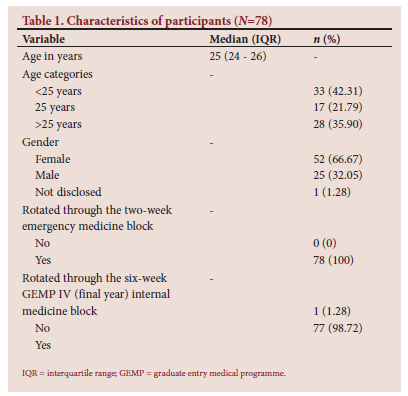
A total of 78 responses were received from a class of 345 final-year medical students (22.6%). The median age of the cohort was 25 years (IQR 24 - 26). All participants had completed the two-week emergency medicine rotation (Table 1).
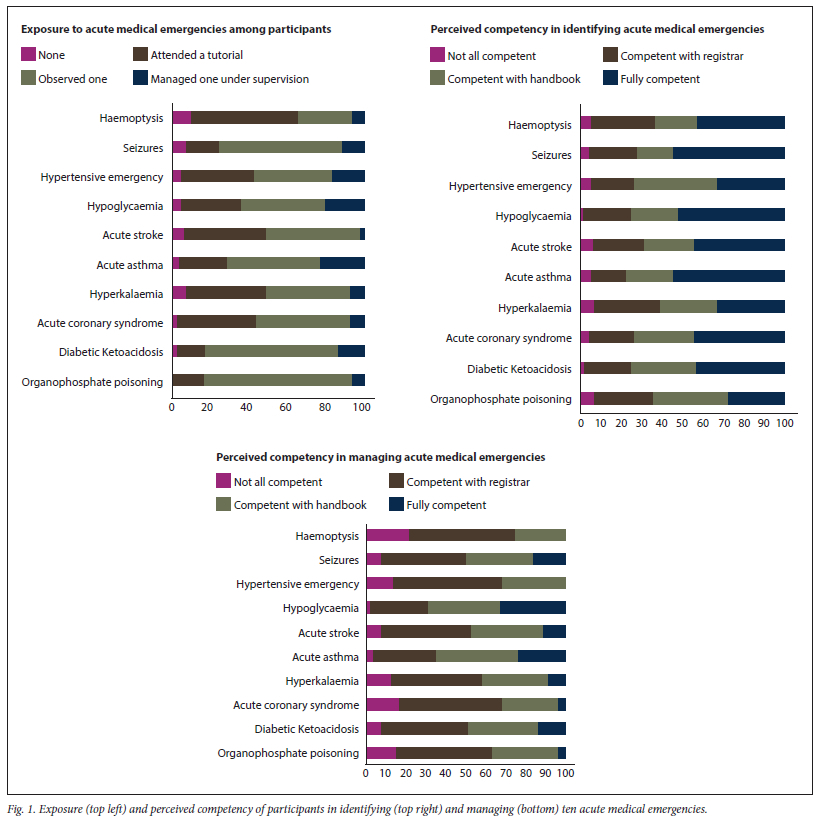
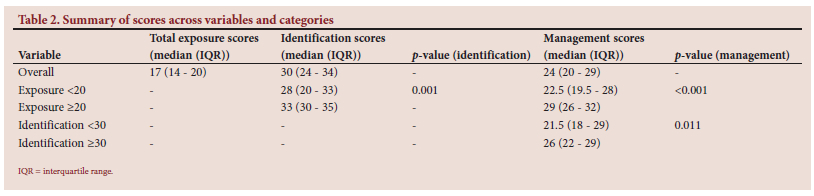
The median overall exposure to acute medical emergencies score was 17/30 (Table 2). A total of 22 (28.2%) participants obtained scores of ≥20 (95% CI 19.79 - 39.75). The study had 98% power with ±10% precision. Exposure scores demonstrated appropriate internal consistency (Cronbach's alpha=0.828), with no significant differences by age or gender. An overview of participants' exposure and perceived competency for individual emergencies is illustrated in Fig. 1.
The overall identification scores demonstrated high internal consistency (Cronbach's alpha=0.959), with a median identification score of 30. A score of ≥30 indicated that participants were at least competent to identify most emergencies with the use of a handbook, with 53.85% of participants (42/78; 95% CI 42.65 - 64.49) meeting this criterion (Table 2). No significant differences were observed by age or gender.
Participants with higher overall exposure scores had significantly higher self-perceived competency scores for identifying acute medical emergencies compared with those with lower overall exposure scores. Spearman's rank-order correlation showed a positive correlation between identification and exposure scores (Spearman's ρ=0.534) (Fig. 2).
The median overall competency in managing acute medical emergencies score was 24/40. Internal consistency remained high (Cronbach's alpha=0.912). Overall, 21 (21.8%) participants (95% CI 13.90 - 32.49) scored ≥30 (Table 2). No statistically significant differences were observed by age or gender.
Participants with higher exposure (≥20) had moderately higher management scores (Spearman's ρ=0.535) (Fig. 2). Similarly, higher identification scores were associated with higher management scores (Spearman's ρ=0.532) (Fig. 2).
Discussion
In this study, overall exposure to acute medical emergencies among final-year medical students was moderate, with fewer than one-third (28.75%) of participants achieving an overall exposure score suggestive of active experience in managing such emergencies. This implies a low level of undergraduate exposure to acute medical emergencies.
Several barriers may hinder undergraduate medical students' exposure to acute medical emergencies. Medical students are often not viewed as integral members of the healthcare team and may be treated as mere observers in the clinical setting. Patients may also, at times, feel overwhelmed and reluctant to be seen by a student rather than a qualified doctor.[20,21] Furthermore, a culture that tends to reward strong performance in theoretical components may reduce motivation to acquire practical skills, given that this takes time away from theory-based learning.[22] This raises the question of whether students are making full use of available opportunities for practical learning, as they navigate competing priorities between gaining hands-on clinical experience and preparing for high-stakes assessments of their knowledge.
In this study, >50% of participants obtained scores of ≥30 for identifying acute medical emergencies. However, fewer participants (21.79%) achieved similar scores for management, highlighting a potential lack of practical experience in applying knowledge in a clinical setting. Increased levels of exposure were strongly correlated with higher levels of self-perceived competence in identifying and managing acute medical emergencies, emphasising the importance of experiential learning in developing clinical competency. Undergraduates require more than theoretical knowledge; they must be able to perform effectively in real-world settings.[23] This finding again highlights Miller's pyramid for the assessment of clinical competence, as the results demonstrate a gap between clinical application and knowledge acquisition.[9]
This study aligns closely with Jansen et al.,[16] who defined 120 essential acute care competencies relevant to the SA healthcare context using a modified Delphi technique. The authors identified an urgent need to ensure that newly qualified doctors are adequately equipped with the skills to practise in resource-limited settings.[16] The medical emergencies included in this survey were predominantly associated with non-communicable diseases, which account for 60% of deaths in SA. Conditions such as cardiovascular, renal, respiratory and diabetic diseases frequently present with acute decompensation and constitute a significant proportion of acute hospital admissions.[15] Given this clinical burden, one might expect medical students to have ample opportunity to gain practical experience during their training; however, the findings suggest that exposure at a level sufficient to build clinical confidence may be lacking. This shortfall may arise from limitations in curriculum design, assessment methods and a clinical culture that often marginalises students from active participation in patient care. Consequently, even in settings with a high volume of clinical encounters, many students complete their training without the practical experience required for workplace readiness.
The results highlight an important gap that warrants curriculum reassessment. Graduates are expected to enter practice as novices or advanced beginners within the Dreyfus model, with competence developing and consolidating during the internship period.[24] Although final-year students are not expected to achieve real-world performance, their limited exposure to emergencies remains concerning, given the responsibilities they assume as interns in SA. The structure of the curriculum means that multiple disciplines compete for limited time, leaving little scope for expanded exposure to emergencies. However, emergencies are distinct in that interns may be required to manage critically ill patients from the onset of internship. This mismatch, in which the most junior doctor may confront the most acutely ill patient, raises concerns for both patient safety and medicolegal risk. The study findings therefore underscore the unique importance of ensuring adequate undergraduate exposure to emergencies.
Recommendations for practice
Incorporation of competency-based frameworks: The curriculum should explicitly outline and incorporate a range of competencies, including medical knowledge, teamwork, professionalism and communication, drawing on frameworks such as CanMEDs.[25] To ensure these competencies are effectively addressed and refined throughout training, they should be executed through constructively aligned learning activities and assessments.[23,25]
Engaging in active patient care with clearly defined roles: Early participation of students in clinical decision-making and direct patient care under supervision should be prioritised during clinical exposure. Students are more likely to develop technical skills and the independence required for autonomous practice through hands-on training when recognised as valued contributors to patient care.[23]
Workplace-based assessments (WBAs): Evaluation processes should reflect professional, social and personal attributes, in addition to medical knowledge and skills. EPAs and other WBAs should be utilised to assess students' abilities to perform tasks independently and to encourage continuous learning and self-reflection. These approaches may also help mitigate examination pressure, as students often prioritise high-stakes assessments at the expense of gaining valuable practical experience.[19,26]
Training through simulation: Clinical rotations should be supported by realistic simulations to expose students to uncommon and high-stakes scenarios, thereby broadening their experience of acute medical emergencies.
Extended rotations in emergency care: While acknowledging the constraints of an already crowded curriculum, emergency medicine should be prioritised, as interns are required to manage emergencies from the outset of their training, and insufficient undergraduate preparation may compromise both patient safety and graduate wellbeing.
Ongoing curriculum review and adaptation: Continuous curriculum development in response to the evolving needs of students and hospitals should be supported by regular feedback mechanisms to identify and address areas of deficiency in a timely manner.
Introduction of an emergency skills logbook: An emergency skills logbook could be used to assess and monitor undergraduate students' exposure to acute medical emergencies throughout their clinical rotations. This may serve as a dynamic tool to track their progress, identify gaps in training and encourage students to actively seek opportunities to participate in and potentially manage emergencies under supervision.
Limitations
The survey achieved the predetermined sample size required for statistical significance, with 78 participants completing the questionnaire. However, this represents only 22.6% of the eligible cohort. The timing of data collection (during the final two months of the academic year) may have contributed to the low response rate, as participants were likely experiencing academic fatigue and heightened stress owing to the cumulative demands of their studies, final examinations and internship placement processes.
The low response rate also introduces the possibility of non-response bias, with the results potentially skewed if students who felt either more or less competent were more inclined to participate. This study explored self-perceived competency and, while this provides useful insights, it may not necessarily correlate with actual performance. In addition, responses were not validated against objective measures such as performance observations, logbooks or supervisor assessments.
Implications for future studies
Including other medical schools in the study population would improve the generalisability of the study across the SA medical education context and may support efforts toward standardising undergraduate training countrywide. Furthermore, incorporating objective assessments and comparing these with self-perceived competency may provide a more accurate reflection of true competence.
Future studies could also involve a panel of clinically experienced consultants and registrars to help establish a more relevant set of emergencies and thereby improve the validity of future surveys, as demonstrated by Jansen et al.[16]
Conclusion
Bridging the gap between theoretical knowledge and practical experience requires adequate hands-on exposure to prepare junior doctors for the realities of resource-limited settings. Curriculum reform that emphasises experiential learning may foster a generation of doctors better prepared to provide high-quality healthcare, thereby improving competence, reducing burnout and enhancing patient outcomes.
Data availability statement. Data are available upon reasonable request from the corresponding author.
Declaration. None.
Acknowledgments. We would like to thank the Unit for Undergraduate Medical Education (UUME) at the University of the Witwatersrand, Johannesburg, for their support in conducting this study.
Author contributions. All authors conceived the study and contributed to and approved the final manuscript. MFC collected the data, obtained ethical approval, performed the initial literature review, refined the data collection tools and critically appraised the findings. JZ and SP supervised the project, assisted in identifying and retrieving data, advised on the literature review and reviewed the final manuscript. This research forms part of the submission for MFC's Master of Medicine degree.
Conflicts of interest. None.
Funding. None.
References
-
1. Bola S, Trollip E, Parkinson F. The state of South African internships: A national survey against HPCSA guidelines. S Afr Med J 2015;105(7):535-539. https://doi.org/10.7196/SAMJNEW.7923
» https://doi.org/10.7196/SAMJNEW.7923 -
2. Padley J, Boyd S, Jones A, Walters L. Transitioning from university to postgraduate medical training: A narrative review of work readiness of medical graduates. Health Sci Rep 2021;4(2):e270. https://doi.org/10.1002/hsr2.270
» https://doi.org/10.1002/hsr2.270 -
3. Allen M. An analysis of the practical experiences and confidence in performing emergency medical skills in South African medical interns. MSc thesis. Johannesburg: University of the Witwatersrand, 2014. http://hdl.handle.net/10539/15295 (accessed 3 April 2025).
» http://hdl.handle.net/10539/15295 - 4. Sun GR, Saloojee H, Jansen van Rensburg M, Manning D. Stress during internship at three Johannesburg hospitals. S Afr Med J 2008;98(1):33-35.
-
5. Jen MH, Bottle A, Majeed A, Bell D, Aylin P. Early in-hospital mortality following trainee doctors' first day at work. PLoS One 2009;4(9):e7103. https://doi.org/10.1371/journal.pone.0007103
» https://doi.org/10.1371/journal.pone.0007103 - 6. University of the Witwatersrand, Faculty of Health Sciences. GEMP III and IV case competencies. Johannesburg: University of the Witwatersrand, 2013.
-
7. National Department of Health, South Africa. Health Professions Council of South Africa: Regulations relating to the registration of students, undergraduate curricula and professional examinations in medicine. Government Gazette No. 31886:R139, 19 January 2009. https://www.gov.za/sites/default/files/gcis_document/201409/31886139.pdf (accessed 1 April 2025).
» https://www.gov.za/sites/default/files/gcis_document/201409/31886139.pdf -
8. Yardley S, Teunissen PW, Dornan T. Experiential learning: AMEE Guide No. 63. Med Teach 2012;34(2):e102-e115. https://doi.org/10.3109/0142159X.2012.650741
» https://doi.org/10.3109/0142159X.2012.650741 -
9. Miller GE. The assessment of clinical skills/competence/performance. Acad Med 1990;65(Suppl 9):S63-S67. https://doi.org/10.1097/00001888-199009000-00045
» https://doi.org/10.1097/00001888-199009000-00045 -
10. Frambach JM, Manuel BAF, Fumo AMT, Van Der Vleuten CPM, Driessen EW. Students' and junior doctors' preparedness for the reality of practice in sub-Saharan Africa. Med Teach 2015;37(1):64-73. https://doi.org/10.3109/0142159X.2014.920490
» https://doi.org/10.3109/0142159X.2014.920490 -
11. Hutton L, Jenkins LS, Mash R, et al. Medical interns in district health services: An evaluation of the new family medicine rotation in the Western Cape of South Africa. BMC Med Educ 2023;23(1):412. https://doi.org/10.1186/s12909-023-04605-6
» https://doi.org/10.1186/s12909-023-04605-6 -
12. Jaschinski J, De Villiers MR. Factors influencing the development of practical skills of interns working in regional hospitals of the Western Cape province of South Africa. South Afr Fam Pract 2008;50(1):70-70d. https://doi.org/10.1080/20786204.2008.10873676
» https://doi.org/10.1080/20786204.2008.10873676 -
13. Bateman C. System burning out our doctors: Study. S Afr Med J 2012;102(7):593-594. https://hdl.handle.net/10520/EJC122921 (accessed 2 July 2025).
» https://hdl.handle.net/10520/EJC122921 -
14. Naidu K, Torline JR, Henry M, Thornton HB. Depressive symptoms and associated factors in medical interns at a tertiary hospital. S Afr J Psychiatr 2019;25(0):1322. https://doi.org/10.4102/sajpsychiatry.v25i0.1322
» https://doi.org/10.4102/sajpsychiatry.v25i0.1322 -
15. Statistics South Africa. Rising non-communicable diseases: A looming health crisis. Pretoria: Stats SA, 2023. https://www.statssa.gov.za/?p=16729 (accessed 2 July 2025).
» https://www.statssa.gov.za/?p=16729 -
16. Jansen MJ, Hartman N, Grant D. Undergraduate acute care clinical competencies for managing acute care cases in adult patients within a South African in-hospital environment: A modified Delphi study. Afr J Emerg Med 2024;14(3):231-236. https://doi.org/10.1016/j.afjem.2024.08.004
» https://doi.org/10.1016/j.afjem.2024.08.004 -
17. Suresh K, Chandrashekara S. Sample size estimation and power analysis for clinical research studies. J Hum Reprod Sci 2012;5(1):7-13. https://doi.org/10.4103/0974-1208.97779
» https://doi.org/10.4103/0974-1208.97779 -
18. Ten Cate O. Entrustability of professional activities and competency-based training. Med Ed 2005;39(12):1176-1177. https://doi.org/10.1111/j.1365-2929.2005.02341.x
» https://doi.org/10.1111/j.1365-2929.2005.02341.x -
19. Pangaro L, ten Cate O. Frameworks for learner assessment in medicine: AMEE Guide No. 78. Med Teach 2013;35(6):e1197-e1210. https://doi.org/10.3109/0142159X.2013.788789
» https://doi.org/10.3109/0142159X.2013.788789 -
20. Makins N, Naidoo T, Hassim T, et al. A cross-sectional study on factors influencing patient participation in undergraduate medical education in a public and private hospital in Johannesburg, South Africa. BMC Med Educ 2023;23(1):687. https://doi.org/10.1186/s12909-023-04663-w
» https://doi.org/10.1186/s12909-023-04663-w -
21. Beca IJP, Gómez BMI, Browne LF, Browne JS. Medical students as members of the health care team. Rev Méd Chil 2011;139(4):462-466. https://doi.org/10.4067/S0034-98872011000400007
» https://doi.org/10.4067/S0034-98872011000400007 -
22. Kirch SA, Sadofsky MJ. Medical education from a theory-practice-philosophy perspective. Acad Pathol 2021;8:23742895211010236. https://doi.org/10.1177/23742895211010236
» https://doi.org/10.1177/23742895211010236 -
23. Pattinson SR, Savelberg H, Atherley A. Not ready in the ways that count - A qualitative exploration of junior doctors' perceived preparedness for practice using Legitimation Code Theory. Adv Health Sci Educ Theory Pract 2024;30:795-814. https://doi.org/10.1007/s10459-024-10380-w
» https://doi.org/10.1007/s10459-024-10380-w - 24. Dreyfus SE, Dreyfus HL. A five-stage model of the mental activities involved in directed skill acquisition. Berkeley: University of California, 1980.
-
25. Frank JR, Snell L, Sherbino J, eds. CanMEDS 2015: Physician Competency Framework. Ottawa: Royal College of Physicians and Surgeons of Canada, 2015. http://www.royalcollege.ca/portal/page/portal/rc/canmeds/resources/publications (accessed 21 April 2025).
» http://www.royalcollege.ca/portal/page/portal/rc/canmeds/resources/publications -
26. Sturman N, Tan Z, Turner J. 'A steep learning curve': Junior doctor perspectives on the transition from medical student to the health-care workplace. BMC Med Educ 2017;17(1):92. https://doi.org/10.1186/s12909-017-0931-2
» https://doi.org/10.1186/s12909-017-0931-2

Accepted 13 October 2025