Faculty development programmes to enhance health professions education in Africa: A systematic review
Abstract
BACKGROUND: Faculty development programmes enhance the competencies of health professions educators in teaching, research, leadership and clinical practice. In Africa, where healthcare inequalities, disease burden and limited access to quality healthcare services persist, the need for skilled educators is paramount. However, limited evidence on the effectiveness and implementation of such initiatives across diverse African contexts hinder the development of sustainable, contextually appropriate programmes. Understanding existing faculty development programmes and their outcomes is crucial for transforming health professions education (HPE) and building the skilled healthcare workforce needed to achieve the African Union's Agenda 2063 aspirations and sustainable development goals (SDGs). OBJECTIVES: To systematically review and evaluate existing faculty development initiatives for health professions educators in African contexts and their associated outcomes. METHODS: A comprehensive systematic review was conducted using the uKwazi search engine across multiple databases. Full-text, peer-reviewed studies on faculty development programmes in Africa, published between 2015 and 2025, were included. The RE-AIM framework (Reach, Effectiveness, Adoption, Implementation, Maintenance) guided critical evaluation. Grey literature was also searched. Nine studies met the inclusion criteria. RESULTS: Programmes targeted diverse populations, including undergraduate and postgraduate students, academic personnel and healthcare professionals transitioning into academic roles. RE-AIM evaluation revealed strong reach to diverse target populations, effectiveness in improving teaching and research capabilities, successful adoption within institutional frameworks, variable implementation approaches and promising maintenance outcomes, including sustainable communities of practice. Programmes also fostered collaboration and incorporated culturally responsive approaches, such as ubuntu. CONCLUSION: Faculty development programmes demonstrate potential to strengthen HPE in Africa and support SDGs. While reach and effectiveness are strong, improvements are needed in implementation consistency and long-term maintenance planning. Detailed needs assessments, sustainable financing structures, interdisciplinary collaboration, culturally responsive approaches, strategic planning and scaling of evidence-based programmes to develop a qualified healthcare workforce are key to addressing Africa's health challenges and promoting sustainable development.
Health professions education; health professions educators; faculty development programmes; African Union Agenda 2063; sustainable development goals; systematic review
Overview of included studies
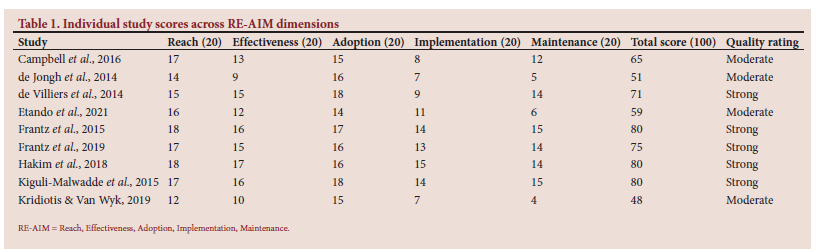
In this systematic review, nine articles met the inclusion criteria, providing insights into faculty development programmes for health professions educators in Africa. These programmes aimed to enhance various competencies, including teaching, research, leadership and clinical practice, aligning with the African Union's Agenda 2063 and the SDGs, particularly SDG 3 (good health and wellbeing) and SDG 4 (quality education). Five articles achieved a rating of ≥70%,[11-15] indicating strong implementation and evaluation according to RE-AIM criteria.
To ensure rigorous assessment of article quality within the RE-AIM framework, a systematic scoring methodology was developed. Points were allocated across the five RE-AIM dimensions, with a maximum of 20 points per dimension. Within each dimension, four criteria (5 points each) were assessed: for Reach, target population description, clarity of inclusion/exclusion criteria, participation rates and representativeness; for Effectiveness, outcome measures, reporting of statistical significance, attrition rates and documentation of negative outcomes; for Adoption, setting description, staff qualifications, barriers and facilitators, and organisational resources; for Implementation, intervention consistency, adaptation, cost reporting and implementation timeline; for Maintenance, long-term follow-up, programme institutionalisation, maintenance of individual behaviour and sustainability planning.
The study by de Jongh et al.[16] was published in 2014, just outside the stated timeframe (2015 - 2025), but was included owing to its foundational relevance to research integration in African HPE and its alignment with the review objectives.
Table 1 presents the individual scores for each study across the five dimensions, highlighting strengths and weaknesses in reporting quality. Supplementary Table 1 provides detailed descriptions of the programmes according to the RE-AIM dimensions.
Reach
The reach of these programmes extended to diverse target populations, including undergraduate and postgraduate students, academic staff, researchers and healthcare professionals transitioning into academic roles. This broad reach aligns with the African Union's Agenda 2063 aspiration to advance an education and skills revolution, promoting talent and skills development across various levels of healthcare education and practice. Eight of the nine articles focused specifically on building capacity in health professions educators,[14-21] with participants described as staff,[17] academics,[16,22] educators[11,13-15] and researchers.[12] Several programmes demonstrated comprehensive approaches to faculty development, targeting educators from diverse backgrounds across multiple African countries. The sub-Saharan Africa FAIMER Regional Institute (SAFRI) programme demonstrated exceptional reach, spanning across >10 African countries.[14,15]
Some programmes also included community members as participants,[17] reflecting the community-engaged nature of certain faculty development initiatives that emphasise social accountability in HPE. The Campbell et al.[17] study examined the Umthombo Youth Development Foundation (UYDF) model, which included students, community members, hospital staff and patients within a comprehensive educational partnership. While not traditional faculty development in the narrow sense, these programmes represent important innovations in preparing educators to engage effectively with communities and to understand the social determinants of health. These approaches align with the broader definition of faculty development adopted in this review, which acknowledges the diverse forms that faculty development may take across different African institutional contexts, particularly those emphasising social accountability in HPE.
Effectiveness
The effectiveness of the programmes was demonstrated through intended outcomes such as improved teaching methodologies, enhanced research capabilities and the integration of community engagement and social accountability principles into healthcare education. Reported outcomes also included the development of participants' capacity to become future educators and trainers, fostering sustainable knowledge transfer and skills development, in line with SDG 4 to increase the supply of qualified teachers.
All articles included in this study aimed to improve HPE across various focus areas, including community engagement,[17] research,[12-16] and learning and teaching.[10-12,14,17,21-23] Outcomes varied across studies and included enhanced ability to develop capacity,[22] increased institutional investment in education,[12] the development of sustainable communities of practice[23] and strengthened personal and professional capabilities contributing to collective capacity development.[14]
Several programmes demonstrated effectiveness in developing sustainable communities of practice, with participants reporting improved teaching skills, increased research productivity, career advancement and enhanced leadership capabilities. These benefits extended beyond individual participants to institutional and broader community impact.[14,23]
Adoption
The adoption of these programmes occurred within higher education institutions (HEIs) across Africa, with health professions educators and academic staff playing pivotal roles in their delivery. Alignment with existing educational structures, together with the involvement of experienced educators, contributes to the sustainability and scalability of these programmes, supporting African Union's Agenda 2063 aspiration to advance education and the skills revolution through collaborative efforts.
All included studies were conducted in HEIs across Africa, with the following geographic distribution: four studies in South Africa,[13,17,21,22] one in Zimbabwe,[11] two across multiple African countries[10,12] and two focused on pan-African faculty development programmes.[14,23] All studies utilised health professions educators to deliver programmes, with two studies[17,21] employing a peer-delivery model in which the target audience conducted the programmes themselves. Several programmes demonstrated successful adoption across multiple African countries, with strong institutional support and integration into existing educational frameworks, particularly the SAFRI programme, which showed exceptional adoption across diverse institutional contexts.[14,23]
Implementation
Implementation varied across programmes, with some assessing impact through follow-up assessments and others providing descriptive accounts of the initiatives. Reporting of implementation costs was inconsistent, although reliance on external funding sources was noted in several programmes. This underscores the need for sustainable financing mechanisms to ensure long-term viability, aligning with SDG 4 (increasing the supply of qualified teachers) and SDG 3 (strengthening capacity for early warning, risk reduction and the management of national and global health risks).
All nine studies focused on faculty development programmes at African universities. Six studies assessed programme impact,[11-14,22,23] while three provided descriptive accounts.[10,17,21] Reporting of implementation cost varied: three studies did not report costs,[13,21,22] one noted dependence on research funding,[17] another highlighted high internet costs in Africa as a barrier[10] and two studies described financial support programmes where costs depended on award amounts.[11,12] Several programmes demonstrated robust implementation with external funding support, ensuring quality delivery and sustainability planning.[14,23]
Maintenance
The maintenance and long-term impact of the programmes were explored through follow-up assessments, with recommendations for further research on initiative effectiveness and their potential to transform healthcare education. Several studies highlighted the potential for improved patient health outcomes and programme sustainability beyond initial funding periods, aligning with SDG 3 targets to ensure healthy lives and promote wellbeing for all.
Six studies that assessed intervention impact reported clear follow-up methods with stakeholders, including graduates[13,22] and university staff.[11,12,14,23] Among descriptive studies, one recommended follow-up evaluation of effectiveness,[10] while two others did not include such recommendations.[17,21] Eight studies recommended exploring long-term impact across various outcomes, including student voice,[13] community involvement,[13] HPE,[10,17] patient health outcomes,[22] programme sustainability[11,12] and continued development of communities of practice.[14,23]
Several programmes demonstrated strong maintenance outcomes, with participants continuing to engage in scholarly activities, to mentor others and to contribute to their home institutions and the broader HPE community long after programme completion.[14,23]
Discussion
This systematic review provides a comprehensive evaluation of faculty development programmes for health professions educators in Africa using the RE-AIM implementation science framework. The findings reveal both promising practices and critical gaps that should be addressed to optimise faculty development initiatives across the continent.
When examined through the RE-AIM framework, several critical insights emerge with important implications for future faculty development initiatives in Africa. The inclusion of studies on the SAFRI programme[14,23] provides valuable insight into comprehensive faculty development approaches that address both individual and collective capacity development. SAFRI is a two-year longitudinal faculty development programme that has trained health professions educators from across sub-Saharan Africa since 2008.
The ubuntu philosophy, as demonstrated in the SAFRI programme, offers a unique African perspective on faculty development that emphasises collective growth and mutual support.[14] Ubuntu, meaning 'I am because we are,' reflects interconnectedness and shared responsibility. This approach contrasts with traditional Western models that focus primarily on individual development, suggesting that culturally responsive programmes may be more effective in African contexts. It recognises that individual growth is inextricably linked to community development, which is particularly relevant for HPE, where healthcare delivery depends on collaborative practice.
Regarding 'Reach', the SAFRI programme has successfully engaged health professions educators from >10 African countries, representing diverse health professions including medicine, nursing, dentistry and allied health.[23] This broad reach demonstrates the potential of pan-African faculty development initiatives to address continental healthcare education needs while respecting diverse cultural and institutional contexts.
In terms of 'Effectiveness', the SAFRI programme showed significant positive outcomes, including enhanced teaching skills, increased research productivity, career advancement and leadership development.[14] Notably, it fostered sustainable communities of practice that continued to support participants long after programme completion, creating a multiplier effect extending benefits beyond individual participants to their home institutions and the broader HPE community.
However, several challenges emerged. Implementation inconsistencies across programmes highlight the need for standardised approaches that remain contextually sensitive. Variable reporting of costs and sustainability planning suggests that many programmes lack comprehensive implementation frameworks. Furthermore, although programmes demonstrate strong individual and institutional outcomes, their longer-term impact on patient care and health system strengthening requires further investigation.
Conclusion
This systematic review demonstrates that faculty development programmes for health professions educators in Africa have significant potential to enhance healthcare education and support SDGs. However, evaluation using the RE-AIM framework highlights key areas for improvement to maximise programme impact and sustainability.
Key findings indicate that, while programmes demonstrate strong reach across diverse target populations and effectiveness in improving teaching and research capabilities, gaps remain in implementation consistency and long-term maintenance planning. The most successful programmes, particularly the SAFRI initiative, demonstrate the value of culturally responsive approaches that incorporate African philosophies such as ubuntu, emphasising collective development alongside individual capacity building.
Based on these findings, future faculty development programmes in Africa should: (i) conduct comprehensive needs assessments to ensure relevance and cultural appropriateness; (ii) establish sustainable financing mechanisms to reduce dependence on external funding; (iii) foster interdisciplinary collaboration and communities of practice; (iv) incorporate culturally responsive pedagogical approaches; (v) implement robust evaluation frameworks assessing both short- and long-term outcomes; and (vi) develop systematic approaches to scaling successful programmes across institutions and countries.
Several programmes, particularly SAFRI, demonstrate valuable approaches to sustainable faculty development that create lasting communities of practice, extend impact beyond individual participants and align with African cultural values of collective growth and mutual support. These findings demonstrate how faculty development can serve as a catalyst for broader transformation in HPE across the continent. Policymakers and institutional leaders should prioritise strategic investment in evidence-based faculty development programmes, recognising their critical role in strengthening the healthcare workforce needed to address Africa's health challenges and achieve SDGs. The ubuntu philosophy of 'I am because we are' offers a compelling framework that recognises the interconnected nature of individual and collective capacity development in African contexts.
Future research should focus on developing standardised evaluation frameworks, investigating long-term impact on patient outcomes and health system strengthening and exploring innovative financing mechanisms for programme sustainability. Comparative studies assessing culturally responsive and traditional Western approaches to faculty development may also provide valuable insights for programme design and implementation.
Data availability statement. Data will be made available upon reasonable request.
Declaration. None.
Acknowledgements. We thank our research assistant (Kago Moganane) for assisting with the Covidence data review process.
Author contributions. Conceptualisation, formal methodology analysis and original draft preparation were conducted by all authors. JMF performed the final review and editing. All authors have read and agreed to the published version of the manuscript.
Funding. None.
Conflicts of interest. None.
References
-
1. Okoi O, Bwawa T. How health inequality affects responses to the COVID-19 pandemic in sub-Saharan Africa. World Dev 2020;135:105067. https://doi.org/10.1016/j.worlddev.2020.105067
» https://doi.org/10.1016/j.worlddev.2020.105067 -
2. African Union. Agenda 2063: The Africa we want. African Union, 2015. https://au.int/en/agenda2063/overview (accessed May 2025).
» https://au.int/en/agenda2063/overview -
3. Ayanore MA, Amuna N, Aviisah M, et al. Towards resilient health systems in sub-Saharan Africa: A systematic review of the English language literature on health workforce, surveillance, and health governance issues for health systems strengthening. Ann Glob Health 2019;85(1):113. https://doi.org/10.5334/aogh.2514
» https://doi.org/10.5334/aogh.2514 -
4. Steinert Y, Mann K, Anderson B, et al. A systematic review of faculty development initiatives designed to enhance teaching effectiveness: A 10-year update. Med Teach 2016;38(8):769-786. https://doi.org/10.1080/0142159X.2016.1181851
» https://doi.org/10.1080/0142159X.2016.1181851 -
5. Steinert Y, O'Sullivan PS, Irby DM. Strengthening teachers' professional development through faculty development. Acad Med 2019;94(7):963-968. https://doi.org/10.1097/ACM.0000000000002695
» https://doi.org/10.1097/ACM.0000000000002695 -
6. Fernandez N, Audétat MC. Faculty development program evaluation: A need to embrace complexity. Adv Med Educ Pract 2019;10:191-199. http://doi.org/10.2147/AMEP.S188164
» http://doi.org/10.2147/AMEP.S188164 - 7. Obwegeser N, Papadopoulos PM. Integrating research and teaching in the IS classroom: Benefits for teachers and students. J Inf Syst Educ 2016;27(4):249-258.
-
8. van Schalkwyk SC, Kiguli-Malwadde E, Budak JZ, Reid MJA, de Villiers MR. Identifying research priorities for health professions education research in sub-Saharan Africa using a modified Delphi method. BMC Med Educ 2020;20(1):443. https://doi.org/10.1186/s12909-020-02367-z
» https://doi.org/10.1186/s12909-020-02367-z -
9. Asamani JA, Bediakon KSB, Boniol M, et al. Projected health workforce requirements and shortage for addressing the disease burden in the WHO Africa Region, 2022 - 2030: A needs-based modelling study. BMJ Glob Health 2024;7(Suppl 1):e015972. https://doi.org/10.1136/bmjgh-2024-015972
» https://doi.org/10.1136/bmjgh-2024-015972 -
10. Maia LC, Antonio AG. Systematic reviews in dental research: A guideline. J Clin Pediatr Dent 2012;37(2):117-124. https://doi.org/10.17796/jcpd.37.2.h606137vj3826v61
» https://doi.org/10.17796/jcpd.37.2.h606137vj3826v61 -
11. Etando A, Amu AA, Haque M, et al. Challenges and innovations brought about by the COVID-19 pandemic regarding medical and pharmacy education especially in Africa and implications for the future. Healthcare 2021;9(12):1722. https://doi.org/10.3390/healthcare9121722
» https://doi.org/10.3390/healthcare9121722 -
12. Hakim JG, Chidzonga MM, Borok MZ, et al. Medical Education Partnership Initiative (MEPI) in Zimbabwe: Outcomes and challenges. Glob Health Sci Pract 2018;6(1):82-92. https://doi.org/10.9745/GHSP-D-17-00052
» https://doi.org/10.9745/GHSP-D-17-00052 -
13. Kiguli-Malwadde E, Talib ZM, Wohltjen H, et al. Medical education departments: A study of four medical schools in sub-Saharan Africa. BMC Med Educ 2015;15:109. https://doi.org/10.1186/s12909-015-0398-y
» https://doi.org/10.1186/s12909-015-0398-y -
14. Frantz JM, Bezuidenhout J, Burch VC, et al. The impact of a faculty development programme for health professions educators in sub-Saharan Africa: An archival study. BMC Med Educ 2015;15:28. https://doi.org/10.1186/s12909-015-0320-7
» https://doi.org/10.1186/s12909-015-0320-7 -
15. Frantz JM, Rhoda A, Murdoch-Eaton DB, Sandars JE, Marshall M, Burch VC. Understanding faculty development as capacity development: A case study from South Africa. Afr J Health Professions Educ 2019;11(2):53-56. https://doi.org/10.7196/AJHPE.2019.v11i2.1120
» https://doi.org/10.7196/AJHPE.2019.v11i2.1120 -
16. de Jongh JC, Frantz JM, Rhoda AJ. Integrating research into teaching and learning: Needs assessment for staff development. Afr J Health Prof Educ 2014;6(2):124-128. https://doi.org/10.7196/AJHPE.211
» https://doi.org/10.7196/AJHPE.211 -
17. Campbell LM, Ross AJ, MacGregor RG. The Umthombo Youth Development Foundation, South Africa: Lessons towards community involvement in health professional education. Afr J Health Prof Educ 2016;8(1):50-55. https://doi.org/10.7196/AJHPE.2016.v8i1.559
» https://doi.org/10.7196/AJHPE.2016.v8i1.559 -
18. Paramitha OCA, Mustofa RH, Narimo S, Suranto S, Narmanditya BS. The nexus of microteaching, perception of teaching profession, and interest in teaching careers: Insights from online field practice. In: Prayitno HJ, Ishartono N, Sidiq Y, Adhantoro MS, eds. Proceedings of the 5th International Conference on Education for All (ICEDUALL 2024). London: Springer Nature, 28 March 2025:240. https://doi.org/10.2991/978-2-38476-386-3_17
» https://doi.org/10.2991/978-2-38476-386-3_17 -
19. de Villiers M, van Schalkwyk S, Blitz J, et al. Decentralised training for medical students: A scoping review. BMC Med Educ 2017;17(1):196. https://doi.org/10.1186/s12909-017-1050-9
» https://doi.org/10.1186/s12909-017-1050-9 -
20. Fainstad T, Mann A, Suresh K, et al. Effect of a novel online group-coaching program to reduce burnout in female resident physicians: A randomised clinical trial. JAMA Int Med 2022;5(5):e2210752. https://doi.org/10.1001/jamanetworkopen.2022.10752
» https://doi.org/10.1001/jamanetworkopen.2022.10752 -
21. Westmoreland KD, Banda FM, Steenhoff AP, Lowenthal ED, Isaksson E, Fassl BA. A standardised low-cost peer role-playing training intervention improves medical student competency in communicating bad news to patients in Botswana. Palliat Support Care 2019;17(1):60-65. https://doi.org/10.1017/S1478951518000627
» https://doi.org/10.1017/S1478951518000627 -
22. Monekosso GL. A brief history of medical education in sub-Saharan Africa. Acad Med 2014;89(Suppl 8):S11-S15. https://doi.org/10.1097/acm.0000000000000355
» https://doi.org/10.1097/acm.0000000000000355 -
23. Monekosso GL. The teaching of medicine at the University Centre for Health Sciences Yaounde, Cameroon: Its concordance with the Edinburgh Declaration on medical education. Med Edu. 1993;27(4):304-320. https://doi.org/10.1111/j.1365-2923.1993.tb00275.x
» https://doi.org/10.1111/j.1365-2923.1993.tb00275.x

Accepted 3 February 2026