Student review of doctor-patient communication skills training in a South African undergraduate medical programme
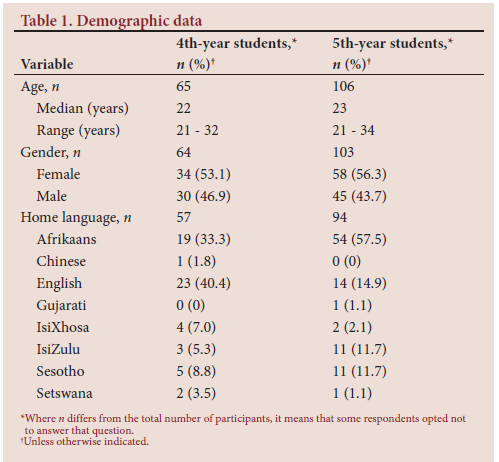
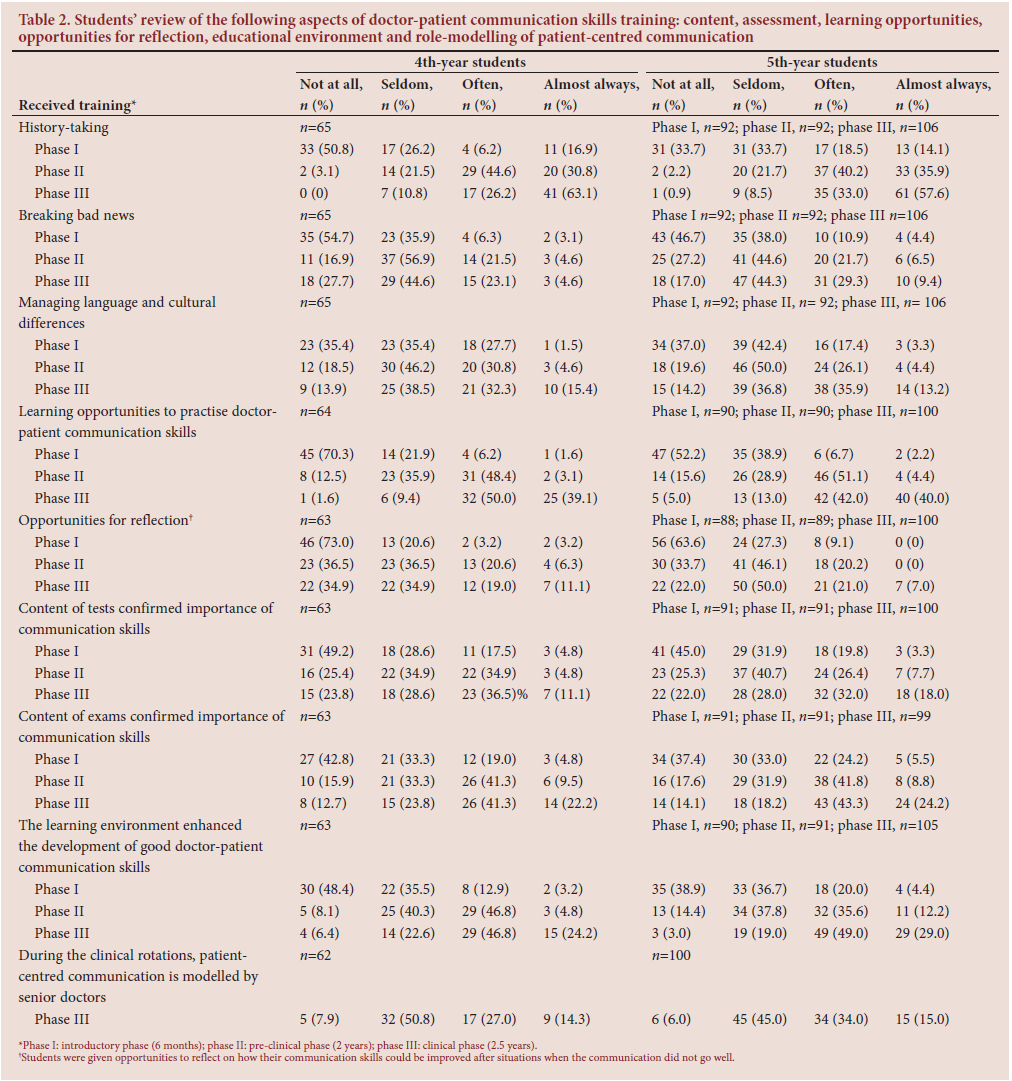
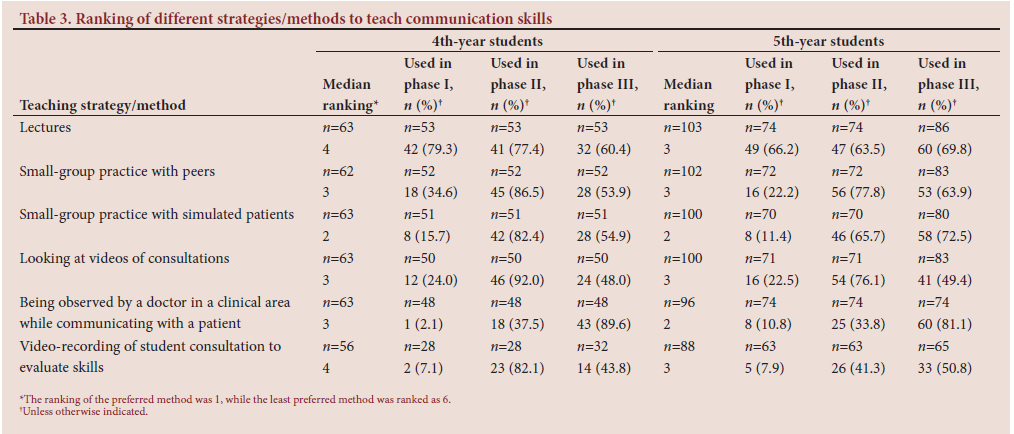
BACKGROUND. Barriers to the training of doctor-patient communication in the South African (SA) context have been well explored through qualitative research at several SA medical schools. However, this aspect of training has not been reviewed in a systematic way by a large number of students. A student review of doctor-patient communication skills training in the undergraduate medical programme of a medical school in SA was obtained to improve training and identify further research needs. OBJECTIVE. To investigate doctor-patient communication skills training in the undergraduate programme of a medical school in SA to identify shortcomings and further research needs. METHODS. A descriptive, cross-sectional design was used. Data were collected through an anonymous questionnaire based on Hardens extended vision of the curriculum. Printed anonymous questionnaires, distributed to all the fourth- and fifth-year undergraduate medical students, were analysed quantitatively. Open-ended questions were analysed qualitatively using grounded theory. RESULTS. The sample comprised 106/132 fifth-year students (response rate 80.3%) and 65/120 fourth-year students (response rate 54.2%). Frequent training in history-taking was reported by >75% of students, while >60% reported infrequent training in breaking bad news. More than 50% of participants indicated that senior doctors seldom or never modelled patient-centred communication in the clinical teaching milieu. Students preferred experiential learning to didactic methods. CONCLUSION. Medical students want to see patient-centred communication unequivocally modelled in the clinical setting. A greater emphasis on practical training in context-specific communication skills is required. Positive role-modelling is needed in the clinical environment.
Research • Afr. J. Health Prof. Educ. (Online) 14
(3)
• • https://doi.org/10.7196/AJHPE.2022.v14i3.1570 copy