Exploring the experiences of the lecturing and learning design teams during a collaborative programme co-design and first year of delivery of the Post-Graduate Diploma in Emergency Care
BACKGROUND: Learning about online learning is becoming increasingly important in higher education. A key aspect of online learning is ensuring the integration of good technology, pedagogy, and content. In 2021, the University of Cape Town (UCT)'s Division of Emergency Medicine (EM) offered the Post-Graduate Diploma in Emergency Care (PGDip EC) for the first time. The UCT Centre for Innovation in Learning and Teaching (CILT) provided support and guidance for the 18-month online design process. OBJECTIVES: This study considered how the EM lecturing team and CILT learning designers experienced the collaborative 18-month process of program design as well as the first year of the program being delivered. METHODS: Lecturers and learning designers involved in the program design and first year of the offering were invited to participate in semi-structured interviews. An appointed research assistant conducted seven interviews between December 2022 and April 2023. Interviews took place online and were recorded. The research team used framework-informed thematic content analysis to identify themes and patterns within the data. RESULTS: Six themes were developed: technology including familiarity with technology, new technologies and the need for technological support; transdisciplinary collaboration; student profile; purposeful planning; engagement, which included lecturer engagement and strategies, student participation, workload, scaling up the program and broader impact of the collaboration within the Division and broader. CONCLUSIONS: The design and delivery of the program contributed to the professional development of those involved. Both lecturers and learning designers gained new skills which are being applied across other courses and programs at the University. The outcomes of the study may be used to improve other online programs and further digitalisation of healthcare professional education.
Educational technology; learning design; online teaching; emergency medicine
Exploring the experiences of the lecturing and learning design teams during a collaborative programme co-design and first year of delivery of the Post-Graduate Diploma in Emergency Care
C CunninghamI; M HargovanII
IPhD; Division of Emergency Medicine, Department of Family, Community and Emergency Care, University of Cape Town, South Africa
IIMPH, MBBS; Division of Emergency Medicine, Department of Family, Community and Emergency Care, University of Cape Town, South Africa
BACKGROUND: Learning about online learning is becoming increasingly important in higher education. A key aspect of online learning is ensuring the integration of good technology, pedagogy, and content. In 2021, the University of Cape Town (UCT)'s Division of Emergency Medicine (EM) offered the Post-Graduate Diploma in Emergency Care (PGDip EC) for the first time. The UCT Centre for Innovation in Learning and Teaching (CILT) provided support and guidance for the 18-month online design process.
OBJECTIVES: This study considered how the EM lecturing team and CILT learning designers experienced the collaborative 18-month process of program design as well as the first year of the program being delivered.
METHODS: Lecturers and learning designers involved in the program design and first year of the offering were invited to participate in semi-structured interviews. An appointed research assistant conducted seven interviews between December 2022 and April 2023. Interviews took place online and were recorded. The research team used framework-informed thematic content analysis to identify themes and patterns within the data.
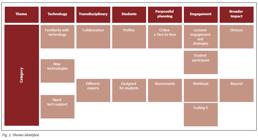
RESULTS: Six themes were developed: technology including familiarity with technology, new technologies and the need for technological support; transdisciplinary collaboration; student profile; purposeful planning; engagement, which included lecturer engagement and strategies, student participation, workload, scaling up the program and broader impact of the collaboration within the Division and broader.
CONCLUSIONS: The design and delivery of the program contributed to the professional development of those involved. Both lecturers and learning designers gained new skills which are being applied across other courses and programs at the University. The outcomes of the study may be used to improve other online programs and further digitalisation of healthcare professional education.
Keywords: Educational technology, learning design, online teaching, emergency medicine
Learning about online learning is becoming increasingly important in higher education institutions (HEIs). Fully online programs require no hybrid or in-person sessions, with all teaching and engagement conducted online.[1] An important consideration for online learning is the integration of good technology, pedagogy, and content.[2] This integration requires those involved in lecturing in the online space to have knowledge about educational technology and learning design, which is a skill that lecturers may need to acquire.[3]
For instance, the knowledge required to develop an online program includes understanding the affordances of the learning management system (LMS), interface design, media diversity and selection of learning technologies to enhance teaching, learning and assessment.[4] When offering a program online, lack of knowledge regarding technologies and learning design features may present a barrier to efficient program design. Furthermore, it has been shown that without support and training for lecturers, emerging technologies will remain underutilised or used only at a superficial and passive level.[5,6]
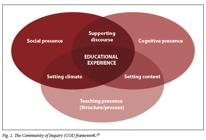
The Community of Inquiry (COI) framework (Fig. 1) is widely used to guide the design of online learning.[7] The COI framework was developed to define, describe and measure the elements of a collaborative and meaningful educational experience for learners. The premise is that online interaction between students and lecturers needs to be carefully crafted to create a sense of community, ensure critical reflection and enable knowledge construction for high-order learning.[3,7] The framework consists of three presences: social, cognitive and teaching. Social presence considers opportunities for students and lecturers to be perceived as 'real people' in the online space, and how engagement and communication will occur. Cognitive presence refers to how meaning is constructed and validated through sustained reflection. Teaching presence considers the design and organisation of the educational experience, for example the facilitation of discussion and instructional design. According to the COI framework, learning happens at the intersection of the social, cognitive and teaching presence, and through integration of technology, pedagogy and content.[7]
In 2021, the University of Cape Town (UCT)'s Division of Emergency Medicine (EM) offered the Post-Graduate Diploma in Emergency Care (PGDip EC) for the first time. The 1-year program is designed to be an interdisciplinary program, combining learning for doctors, nurses, and paramedics in one online space. The theoretical program has no clinical skills component and consists of six compulsory courses (see supplementary material 1).
The Division of EM received support from the UCT Centre for Innovation in Learning and Teaching (CILT). CILT guided the 18-month online design process, supporting pedagogically informed decisions regarding learning activities, the use of technology, and applying the ABC curriculum design process. The ABC curriculum design process uses Llaurillard's Conversational Framework to create a visual 'storyboard' outlining the type and sequence of learning activities.[8,9] CILT regularly offered academic staff development opportunities including quiz design, persona and empathy mapping workshops. Personas are user archetypes that include potential student career needs, expectations of the program, and personal details, whereas empathy mapping visually shows potential student attitudes, behaviours and barriers to studying. Using empathy mapping and personas during the learning design process helps to design a program that is sensitive to student needs, and pre-empts technological, learning and other barriers.[10]
This study considers how the EM lecturing team and CILT learning designers experienced the co-design during the 18-month process of design as well as the first year of the offering. It also explores the use of educational technology and how the online teaching space was experienced by the team.
Methods
A qualitative exploratory design was used. Semi-structured interviews were conducted with participants who met the inclusion criteria. The interview schedule (supplementary material 2) was adapted from COI surveys used by other research studies, focusing specifically on questions pertaining to the teaching presence.[7,11]
Context and study setting
EM is still a relatively new field of study in most of Africa, with limited out-of-hospital training, specialist emergency physician training and emergency nursing training.[12-15] The rationale for the fully online PGDip EC was, in part, to accommodate professionals who are interested in advancing their knowledge about emergency care but are unable to relocate or travel to a tertiary facility for hybrid or face-to-face teaching. This includes professionals working in remote and rural settings. The diploma also accommodates those who are unable to specialise (for a variety of reasons) or are not able or intending to take on a master's degree.
Study population
All full-time lecturers (n=7) and learning designers (n=3) who were involved in the 18-month online design process and the first year of offering were invited to participate in this study.
The EM team involved with the design of the diploma were all lecturers - the word 'lecturer' is used as the inclusion criterion was that participants had to fulfil lecturing duties on the program. However, it should be noted, as with most tertiary roles, that all lecturers on the team had other academic and research responsibilities. Guest lecturers and academic administrative staff were excluded from participating.
The EM team's interactions with the CILT team were managed by three learning designers, and only these learning designers were eligible for inclusion. All other CILT staff, including educational technologists and other learning management support staff, were excluded from participating.
Ethical considerations
Ethical approval was obtained from the UCT Human Research Ethics Committee (HREC ref. no. 482/2022). Informed consent was obtained prior to interviews and participants were given the option to withdraw before data analysis commenced. Participants were assigned codes during analysis, and all identifiable information was removed from the data prior to analysis. Data were kept confidential through password-protected files, with access restricted to the research team. Owing to the limited number of participants, no distinction was made between roles (lecturer or learning designer) during analysis.
Data collection
A research assistant with postgraduate training in qualitative research methods, as well as prior experience in conducting and analysing qualitative interviews, was appointed to conduct the data collection and perform the first rounds of data analyses. The research assistant received a list with the contact details for the ten potential participants. They were contacted via email, and reminders were sent at regular intervals. Two potential participants did not respond to the invite and reminders, with another expressing interest but not responding to scheduling an interview.
The research assistant conducted all the interviews, which took place between December 2022 and April 2023. Interviews were conducted online using MS Teams (Microsoft, USA). Each was recorded and lasted between 40 and 60 minutes. The research assistant transcribed the interviews.
Data analysis
Analysis followed framework-informed thematic content analysis, as described by Miles et al.[16] The semi-structured interview guide, informed by the COI framework, was used to develop a basic coding matrix that was revised inductively as new or recurrent themes developed in the data. NVivo version 12 (Lumivero, USA) was used to store data and conduct data analysis.
The transcripts were read to gain familiarity with the data, and coded sections of data were extracted into the coding matrix. Categories were then created from the codes through iterative coding cycles. Coding consistency was ensured through a combination of clear code definitions, intercoder reliability checks and reflexive practices. High-level categories were synthesised into themes, and the final step was to apply the themes that developed to the research objectives.
Trustworthiness and rigour
Credibility was ensured in that the team members had qualitative research experience, and the interview guide was developed from the COI framework. Data analysis was conducted by both researchers and data were situated within previous work done using the COI framework to ensure confirmability. Participants were offered the opportunity to read the transcripts for member-checking.
For dependability, an audit trail of methodological decisions regarding data collection and analysis was kept. A reflective journal was kept identifying preconceived ideas, and to keep track of opposing and other thoughts. Because one of the researchers was the program convener of the course, bias was reduced by employing a research assistant who interacted with potential participants, scheduled and conducted the interviews and removed all potentially identifiable information from the data. Contextual information and the clear boundaries of inclusion criteria ensure that readers can make informed inferences regarding the transferability of the co-design method to their settings.
Results
Seven interviews were conducted, including learning designers and lecturers. Six themes were identified and are depicted in Fig. 2.
Theme 1. Technology
As defined by the COI framework,[7] the theme Technology includes concepts pertaining to learning management systems and interface design, including media diversity and selection of learning methodologies. The categories identified in this study included familiarity with technology, new technologies, and the need for technological support.
Familiarity with technology
There wasn't any new tool for me for that process. We used what we had used before. I had exposure to everything we used. (P7)
Many participants were involved with online teaching prior to the PGDip EC; e.g. some experienced a forced shift to online teaching in the context of student protests, and during the COVID-19 pandemic. These experiences raised awareness of disparities in access to online learning among students and difficulties of assessments in the online space. Prior experience with online teaching also meant that the participants expressed familiarity with current technologies and the LMS. However, with regard to newer technologies or tools that do not form part of the LMS, some participants expressed greater hesitancy, calling themselves 'late adopters' (P2) or 'creatures of habit' (P4), or finding it 'daunting' (P6).
New technologies
Sometimes I found that people just use new technology because there's new technology... You don't need to use the new technology, if the other one works just fine. (P4)
... you need to know the tools to use beforehand, and you need to be very comfortable with it because things can go wrong, technically. (P5)
Participants cautioned that new technologies should be used discerningly, and that technologies should specifically add value in achieving learning outcomes. They also mentioned that prior knowledge of a tool is needed to enable troubleshooting when problems arise.
The need for technological support
...if you're going to go at the online space, you need an Edtech on staff or on consult. (P2)
...if you're going to do an online course, you do need the external support of a learner designer or unit... You can do it by yourself, it's just going to be so much harder. (P7)
Participants mentioned the importance of technological support, not only during the design phase but also during program delivery, e.g. during synchronised online sessions with students. They mentioned difficulties in managing synchronised online sessions while simultaneously problem solving.
Theme 2. Transdisciplinary collaboration
The staff were like, who are you? Why do we need you? It took a while for them to realise that we do have value. Sometimes the exercises can be silly, even to me as a learning designer. But if you don't get that foundation, it's really hard to do the rest of the process. (P7)
In hindsight, I would never go about trying to set up an online course without some engagement with these educational experts. Or actually, any course to be honest. There are people who are experts in this. (P2)
The EM team had not worked with learning designers prior to the development of the PGDip EC and some initial hesitation and scepticism about the methods used by the learning designers were reported. However, they soon came to appreciate the value of the collaborative process and expertise offered by the learning designers.
Theme 3. Student profile
...we strategically thought of the different students who could be coming on, and what would appeal to them, and how to include them. (P6)
We had this exercise where we had to make student profiles... that was really helpful. (P4)
We try to design a program, not individual courses... it is not uncommon for people to just focus on their course... we try to design the courses like puzzle pieces, and they all fit each other. (P7)
Participants mentioned the usefulness of developing profiles of potential students to guide the design process of student needs, difficulties, and motivations. They reported that the process helped them consider how students will learn and engage with course materials and that the process of developing student profiles ensured alignment between design and learning outcomes.
The lecturers and learning designers developing different courses of the PGDip EC held regular meetings to ensure that the six courses within the program had a similar 'look and feel' and a logical progression of content and alignment of assessment. These elements were viewed as beneficial for creating a cohesive learning environment and experience of the program.
Theme 4. Purposeful planning
...with online courses, you have (to) almost plan for the minute or for the moment. (P5)
For online you need more detail and more structure. (P6)
I think it is a lot more labour intensive to design the content and to deliver the lecture. If it's your subject area, you can walk into a classroom with nothing and come up with a lecture right there and then... you can't do that in an online course, especially if it is not synchronous learning. That's one of the things you have to really plan properly and plan very specifically, before you can actually execute. (P4)
Most participants mentioned the large amount of planning required when teaching in the online sphere, and that it required time and attention to detail. Considerations mentioned included planning for feedback processes, relationship building, ensuring structure across the course as a whole, and choosing teaching modalities for different types of content.
Assessment planning
Vula (LMS) broke in the exam... and you can't really trust the results. Is this a reflection of the students' knowledge, or is this a reflection of the system being broken? (P4)
We had a bit of an explosion in realising that we were trusting the students too much. (P6)
While the interview guide did not contain a question specifically about assessments, most participants mentioned that assessment in the online space is more complicated owing to concerns of academic integrity. It was mentioned that online assessments require additional considerations for technical challenges such as the LMS during assessment.
Theme 5. Engagement
Lecturer engagement and strategies
It's the sheer number of these comments and all these different platforms you have to engage with. (P2)
I don't think you can just do asynchronous only. You have to have virtual contact sessions or similar definitely. (P4)
Strategies regarding level and type of engagement were important considerations during the design phase. A key characteristic in the online space is how engagement occurs. Asynchronised forms of engagement in the PGDip EC included prerecorded lectures and participation on platforms such as forum discussions. Participants generally felt the workload to maintain asynchronous engagement was underestimated and the time it takes to respond to comments on forum discussions was mentioned a few times. Several participants expressed a preference for synchronous in-person teaching.
Synchronised 'contact' sessions were used to facilitate discussions and small group interactions, rather than for didactic teaching. Participants mentioned that the video function supported engagement, and when it was turned off (e.g. because of bandwidth issues), they struggled to gain a sense of human connection and gauge student understanding.
Several participants reported that students required a high degree of lecturer attention in the online space, and that it was difficult to schedule or plan for engagement. This 'hand holding' (P1) and 'spoon feeding and babying' (P6) was attributed to the background of the students - who were practitioners rather than academics - and to the nature and novelty of the online space for the students, as it was a first online experience for many students.
Student participation
They were surprisingly busy and chatting on it... Building in little tools, and weekly activities to engage the student felt a bit futile and painful upfront, but it did pay dividends and we did get them engaging. (P6)
It was a lot of engagement, and the students were never tired of it. (P5)
Participants were seemingly pleasantly surprised that the design principles to ensure interaction were successful, mentioning that the student participation exceeded their expectations.
Some participants felt that the social relationships between students grew beyond the structured online social interactions, with others reporting that elements of social presence and relationship were lacking.
One of the issues around this online space is that we don't get to know each other. (P4)
There was the risk of students feeling very isolated if they weren't connected already. (P2)
The workload student engagement creates in the online space
That's all good if they ask questions, but there is an actual human being on the other side; it's going to take a toll on that human being who has to reply to everything. (P1)
The thing that we underestimated is the amount of time that this online engagement takes... trying to make (the engagement) feel real takes a lot of time and you can't always box it in. (P5)
I just didn't have the time to keep going back and checking if there was something new or there was another question. (P2)
Several participants mentioned the difficulties of maintaining high levels of online engagement with students from a lecturing perspective. As an example, participants mentioned the differences between an in-person classroom setting, where announcements or responses to questions can be delivered to the entire group, as compared with online engagements, many of which were one-on-one and not in group settings. Furthermore, the time required to respond to online discussions and emails was noted as taking more time than in face-to-face settings.
Scaling it up
...from the outside, it sounds easy, when online, just to add more students, but it was exponential, the increased load. (P6)
You're tossing up scalability and access... versus having a much better relationship with the students. (P4)
It's the sheer number of these comments and all these different platforms that you have to engage with... and so I think when planning, you forget about the volume.' (P2)
Several participants mentioned barriers and concerns to growing the number of students on the program. Barriers included additional engagement on forums, time to build relationships with students, and using various platforms and tools.
Theme 6. Broader impact
In the Division of EM
I've subsequently replicated that process for another course... using the experience from the PGDip has really helped me to think about how to structure a course and how to scaffold properly. (P4)
There were a lot of clever little touches and more interactive things that we were shown that I learned and had taken to my other courses. (P6)
...what I experienced in the PGDip EC will be useful for other courses as well.' (P3)
The collaboration and learning about design had an impact beyond the PGDip EC. Lecturers reported using what they learnt in other courses within the Division, while the learning designers said that they developed new skills, e.g. coding to make the online learning platform more visually appealing.
Beyond the Division of EM
...going forward, I'm sure there's going to be many Health Science courses that would like to offer some component in the online form. And if they can learn from us - from whatever happened - that would be amazing and build from there, rather than starting from scratch. (P5)
...it (the program) opens up their mind to the whole healthcare system, and they are just one cog in it. (P1)
The process and collaboration to design a bespoke program suggests that significant value was created for improving the quality of online teaching offerings, both within the division and across the university.
Discussion
This study explored the perspectives of lecturers and learning designers whilst conceptualising and first year of offering a fully online program. It was viewed within the COI framework (Fig. 1), specifically considering the teaching presence.[7]
Advances in technology and connectivity continue to transform how teaching is delivered. Despite the possibilities offered by these advances, HEIs have been slow to broaden access to education via fully online programs.[6] Even though the COVID-19 pandemic necessitated emergency remote teaching and learning (ERT), many courses have since returned to hybrid or classroom-based learning.[17] However, it should be stressed that there is a pronounced difference between ERT that presented a time pressure to transition online without planning or designing content for the space v. the intentional design of an online program.
The PGDip EC was intentionally designed to be online with no in-person sessions, and perceptions regarding 'technology' were a key theme. Participants stated that educational technology, i.e. digital technologies used in education, should not be introduced as 'an end', but rather as means to optimise learning. That implies that the lecturer should engage with the affordances of different technologies and take time to familiarise themselves with the technologies used.[5] Participants also mentioned a need for support from learning designers and/or educational technologists when programs are first introduced online, and that there should be a plan in place for ongoing support once a program starts.
Planning online programs differs from in-person or even hybrid teaching in that it requires extensive 'minute by minute' detail and design, as seen in themes other than 'technology', including 'student needs', 'workload' and 'planning and engagement'. In addition to the time cost of online design, the lecturers felt that they were unfamiliar with the considerations for online teaching including, but not limited to instructional design, which refers to the systematic design, development and delivery of learning experiences.[1]
The relationship between the learning design and lecturing team were identified as a key driver for success. In the theme 'transdisciplinary' design, participants shared that the collaborative design process contributed significantly to the professional learning and development of all involved.
Once the program started, the level of student engagement exceeded the expectation of the participants. Student engagement is an important factor in ensuring success in online learning; higher levels of interactivity and engagement are not only related to higher course performance, but are also a primary predictor of academic retention.[18] The downside of high levels of engagement is that the lecturers struggled to keep up with the resulting workload, and most expressed concern that the degree of interaction and engagement built into the program would hamper the potential to grow the student numbers. This implies that a sustainable strategy for engagement and interaction should be mapped out prior to the commencement of an online program.[19] Potential strategies could be to optimise social-contextual facilitation of peer learning by increasing peer interactions.[3] Anecdotally, using tutors for the peer interactions was implemented in the second year of the program, relieving some of the pressure on the team.
Assessment and academic integrity were perceived to present challenges in the online space that requires a complete rethink from assessment methods in hybrid or face-to-face settings. Further studies are required to explore perceptions regarding trust, alternative assessment methods and preserving academic integrity.
Online education affords an increased reach and equity of postgraduate higher education.[5] This is achieved by eliminating geographical barriers for those in rural and remote settings, as well as broadening economic access, by affording full-time employees the opportunity to study without disruption to earning an income. As such, online programs have the potential to increase access to education. However, HEI need to understand that online program design and learning is distinctly different from face-to-face or hybrid learning and requires supportive collaboration between academic departments or divisions and learning designers and educational technologists.
This study contributes to the conversation on the online teaching environment, building on the body of knowledge on collaborative co-design between content experts and learning designers, and highlighting the importance of learning design and educational technology support, as these fields are becoming more prevalent and acknowledged as speciality fields in higher education.[1]
Limitations
The study has several limitations. The sample size was small and the results could not be triangulated, as there was only one set of data that relied on self-reporting. However, while the findings might not be transferable, the principles of the design processes followed are universal. The lack of role-specific analysis (lecturer and learning designer) may be seen as a limitation; however, owing to the small number of participants it was deemed a risk to maintaining anonymity. As the purpose of the study was about a collaborative process rather than role-specific perceptions, it is not seen as a major limitation.
The potential of researcher bias is a limitation, as one of the researchers is part of the academic team. Attempts to mitigate the risk included appointing an external research assistant responsible for all engagements with the participants, conducting interviews and stripping data from identifiable information. Yet, the potential threat to validity remains.
The study also excluded the student voice. As more healthcare-related programs move into the online space, it could be beneficial to explore student perspectives and experiences, particularly regarding engagement.
Conclusion
The design and delivery of the program contributed to the professional development of those involved. Both lecturers and learning designers gained new skills which are being applied across other courses and programs at the university. Effective collaboration between learning designers and lecturers during the planning phase of online design is an important contributing factor to developing online programs. Further research could include the student perception of purposeful learning design on the educational experience.
Data availability statement. Data are available from the authors on reasonable request.
Declaration. None.
Acknowledgements. The authors would like to acknowledge all the academics and learning designers involved in the study.
Author contributions. Conceptualisation and design of study: CC. Data collection: MH. Data analysis, interpretation of results and writing the article: MH and CC.
At the time of the study CC was the program convener, and MH was appointed as research assistant.
Funding. The study was funded by the UCT Start-up Emerging Researcher grant.
Conflicts of interest. None.
References
- 1. Pallitt N, Carr T, Pedersen J, Gunness S, Dooga J, eds. Perspectives on learning design in African higher education. ICEL 2018, 13th International Conference on e-Learning; 2018: Academic Conferences and Publishing Limited.
-
2. Mishra P, Koehler MJ. Technological pedagogical content knowledge: A framework for teacher knowledge. Teachers College Record 2006;108(6):1017-54. https://doi.org/10.1111/j.1467-9620.2006.00684.x
» https://doi.org/10.1111/j.1467-9620.2006.00684.x -
3. Anderson T, Dron J. Three generations of distance education pedagogy. Int Rev Res Open Distributed Learning 2011;12(3):80-97. https://doi.org/10.19173/irrodl.v12i3.890
» https://doi.org/10.19173/irrodl.v12i3.890 -
4. Ali S, Uppal MA, Gulliver SR. A conceptual framework highlighting e-learning implementation barriers. Inform Technol People 2018;31(1):156-180. https://doi.org/10.1108/ITP-10-2016-0246
» https://doi.org/10.1108/ITP-10-2016-0246 - 5. Ng'ambi D, Bozalek V, Gachago D. Empowering educators to teach using emerging technologies in higher education: A case of facilitating a course across institutional boundaries. In: Ivala E, ed. Proceedings of the 8th International Conference on e-Learning, Cape Town, South Africa. 2013:292-300. Academic Conferences International Limited.
-
6. Tarling I, Ng'ambi D. Teachers pedagogical change framework: A diagnostic tool for changing teachers' uses of emerging technologies. Br J Educ Technol 2016;47(3):554-572. https://doi.org/:10.1111/bjet.12454
» https://doi.org/:10.1111/bjet.12454 -
7. Garrison DR, Anderson T, Archer W. The first decade of the community of inquiry framework: A retrospective. Internet Higher Educ 2010;13(1-2):5-9. https://doi.org/10.1016/j.iheduc.2009.10.003
» https://doi.org/10.1016/j.iheduc.2009.10.003 - 8. Laurillard D. A conversational framework for individual learning applied to the 'learning organisation' and the 'learning society'. Systems Res Behav Sci 1999;16(2):113-122.
-
9. Young C, Perović N. Rapid and creative course design: As easy as ABC? Procedia - Social and Behavioral Sciences 2016;228:390-395. https://doi.org/10.1016/j.sbspro.2016.07.058
» https://doi.org/10.1016/j.sbspro.2016.07.058 -
10. Lilley M, Pyper A, Attwood S. Understanding the student experience through the use of personas. Innovation Teach Learning Information Computer Sci 2012;11(1):4-13. https://doi.org/10.11120/ital.2012.11010004
» https://doi.org/10.11120/ital.2012.11010004 -
11. Fiock H. Designing a community of inquiry in online courses. Int Rev Res Open Distributed Learning 2020;21(1):135-153. https://doi.org/10.19173/irrodl.v20i5.3985
» https://doi.org/10.19173/irrodl.v20i5.3985 -
12. Wallis LA, Garach SR, Kropman A. State of emergency medicine in South Africa. Int J Emergency Med 2008;1(2):69-71. https://doi.org/10.1007/s12245-008-0033-3
» https://doi.org/10.1007/s12245-008-0033-3 -
13. Brysiewicz P, Bruce J. Emergency nursing in South Africa. Int Emergency Nurs 2008;16(2):127-131. https://doi.org/10.1016/j.ienj.2008.01.001
» https://doi.org/10.1016/j.ienj.2008.01.001 -
14. Reynolds TA, Calvello EJ, Broccoli MC, et al. AFEM consensus conference 2013 summary: Emergency care in Africa - where are we now? Afr J Emergency Med 2014;4(3):158-163. https://doi.org/10.1016/j.afjem.2014.07.004
» https://doi.org/10.1016/j.afjem.2014.07.004 -
15. Mould-Millman N-K, Dixon J, Burkholder TW, et al. Fifteen years of emergency medicine literature in Africa: A scoping review. Afr J Emergency Med 2019;9(1):45-52. https://doi.org/10.1016/j.afjem.2019.01.006
» https://doi.org/10.1016/j.afjem.2019.01.006 - 16. Miles MB, Huberman AM, Saldana JM. Qualitative Data Analysis: A Methods Sourcebook, 4th ed. New York: Sage Publications, 2019.
-
17. Linnes C, Ronzoni G, Agrusa J, Lema J. Emergency remote education and its impact on higher education: A temporary or permanent shift in instruction? Educ Sci 2022;12(10):721. https://doi.org/10.3390/educsci12100721
» https://doi.org/10.3390/educsci12100721 -
18. Rienties B, Toetenel L. The impact of learning design on student behaviour, satisfaction and performance: A cross-institutional comparison across 151 modules. Computers Hum Behav 2016;60:333-341. https://doi.org/10.1016/j.chb.2016.02.074
» https://doi.org/10.1016/j.chb.2016.02.074 - 19. Russo T, Benson S. Learning with invisible others: Perceptions of online presence and their relationship to cognitive and affective learning. J Educ Technol Soc 2005;8(1):54-62.

Accepted 13 October 2025