The nowledge, attitudes, practices and barriers faced by the University of Namibia's medical students regarding undergraduate research
BACKGROUND. The University of Namibia's Bachelor of Medicine and Bachelor of Surgery (MB ChB) programme includes compulsory research as part of the undergraduate curriculum. Each student is required to complete a self-directed research project. OBJECTIVES. To determine the senior medical students' knowledge, attitudes, practices and barriers regarding their undergraduate research (UR) projects. METHODS. A descriptive cross-sectional study with an online self-developed questionnaire was employed and distributed to students in their fourth, fifth and sixth years of study. Data collection occurred over a 1-month period. RESULTS. Fourth-year (n=27/77), fifth-year (n=15/67) and sixth-year (n=28/80) students, totalling 70, participated. Most students (69%, n =48/70) did not find research interesting. Students felt that the research module did not prepare them well for the research project (73%, n =51/70) and respondents indicated a lack of research ideas (56%, n =39/70), with some needing to develop an original topic (64%, n =45/70). Students felt that there was poor collaboration between the research department and supervisors (77%, n =54/70). Communication with supervisors occurred through email (57%, n =40/70) and face-to-face meetings (37%, n =26/70). Insufficient time for consultation (74%, n =52/70) has been reported. Students chose cross-sectional studies (60%, n =40/70) to make data collection easier (74%, n =52/70). Students indicated that clinical exposure is prioritised in the curriculum (84.3%, n =59/70). CONCLUSION. UR is predominantly perceived as stressful and uninteresting, and student-supervisor engagement followed a 'just-in time' approach. Early scaffolding of research knowledge diminishes, with the emphasis on clinical content delivery. To foster a culture of research among students, a more scaffolded curriculum with protected research is required.
The nowledge, attitudes, practices and barriers faced by the University of Namibia's medical students regarding undergraduate research
J KuehneI; Q WesselsII; P ShikongoIII
IMB ChB, MPhil, MFamMed, Cert Health Sei Educ; Division of Family Medicine and Community Health, Faculty of Health Sciences and Veterinary Medicine, University of Namibia, Windhoek, Namibia
IIPhD (Anatomy), PhD (Health Sei Educ), FHEA Human, Biological and Translational Medical Sciences, Faculty of Health Sciences and Veterinary Medicine, University of Namibia, Windhoek, Namibia
IIIMB ChB; Division of Family Medicine and Community Health, Faculty of Health Sciences and Veterinary Medicine, University of Namibia, Windhoek, Namibia
BACKGROUND. The University of Namibia's Bachelor of Medicine and Bachelor of Surgery (MB ChB) programme includes compulsory research as part of the undergraduate curriculum. Each student is required to complete a self-directed research project.
OBJECTIVES. To determine the senior medical students' knowledge, attitudes, practices and barriers regarding their undergraduate research (UR) projects.
METHODS. A descriptive cross-sectional study with an online self-developed questionnaire was employed and distributed to students in their fourth, fifth and sixth years of study. Data collection occurred over a 1-month period.
RESULTS. Fourth-year (n=27/77), fifth-year (n=15/67) and sixth-year (n=28/80) students, totalling 70, participated. Most students (69%, n =48/70) did not find research interesting. Students felt that the research module did not prepare them well for the research project (73%, n =51/70) and respondents indicated a lack of research ideas (56%, n =39/70), with some needing to develop an original topic (64%, n =45/70). Students felt that there was poor collaboration between the research department and supervisors (77%, n =54/70). Communication with supervisors occurred through email (57%, n =40/70) and face-to-face meetings (37%, n =26/70). Insufficient time for consultation (74%, n =52/70) has been reported. Students chose cross-sectional studies (60%, n =40/70) to make data collection easier (74%, n =52/70). Students indicated that clinical exposure is prioritised in the curriculum (84.3%, n =59/70).
CONCLUSION. UR is predominantly perceived as stressful and uninteresting, and student-supervisor engagement followed a 'just-in time' approach. Early scaffolding of research knowledge diminishes, with the emphasis on clinical content delivery. To foster a culture of research among students, a more scaffolded curriculum with protected research is required.
Globally, the World Federation for Medical Education (WFME) outlined its standards with regard to medical research in undergraduate medicine, which focused on aspects such as approaches to the scientific method and a statement of responsibilities for teaching research.[1] Introducing research teaching into undergraduate medical education is considered important, as it improves critical reasoning and research skills,[2] prepares the graduate for future medical endeavours,[3,4] and improves the quality of a country's medical care. [2,5]
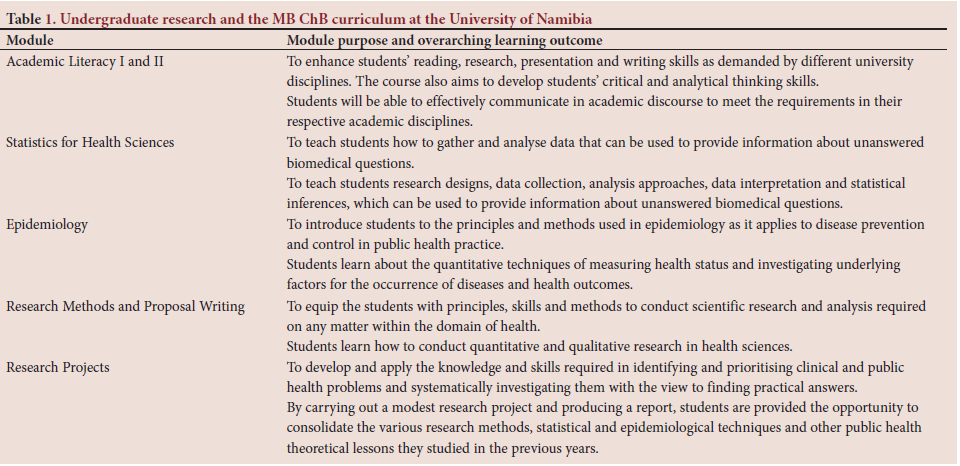
Since the inception of the medical school at the University of Namibia (UNAM) in 2010, undergraduate research (UR) has become a required component of the Bachelor of Medicine and Bachelor of Surgery (MB ChB) curriculum.[6] There are ~70 - 80 students enrolled per cohort in the 6-year MB ChB programme. The scaffolding of the research modules is: Academic Literacy (year 1), Statistics for Health Sciences (year 1), Epidemiology (year 3), Research Methods and Proposal Writing (year 3) and Research Projects (year 5) (Table 1).[6,7] Students write a de nova research proposal in their third year (Research Methods and Proposal Writing), which is assessed. During this phase, a supervisor can elect to participate in a student's proposed topic, or a student approaches a supervisor, or a student can adopt a project offered by a supervisor within the School of Medicine. Data collection commences once ethical approval has been obtained and typically occurs in the fourth year, although there is no formal curriculum element for this. The fifth year of the research project has no formal teaching and is solely dependent on student-supervisor engagement. Students are expected to submit a final report for assessment under the module Research Projects in their fifth or sixth academic year.
The medical school provides the students with computer rooms, internet access, WiFi and an online learning platform. Medical students' knowledge, attitudes, practices and barriers in relation to UR at Namibia's only medical school were explored in the current study. It is believed that the findings might shed light on the nature of UR and potential ways to improve it.
Methods
This descriptive cross-sectional study was conducted at the University of Namibia's School of Medicine from August to October 2023. It was done within the UR module. Ethical approval was obtained from the Ministry of Health and Social Services (MOHSS) (ref. no. 22/3/1/2), with institutional permission from the Research Committee for UR in the MB ChB programme. It used an online survey with quantitative elements and the statements were self-generated, based on past concerns expressed during student-lecturer forums. The survey statements were grouped under the following three themes: communication and collaboration related to UR; module facilitation and perceived knowledge; and general perceptions regarding UR. Medical students in the fourth, fifth and sixth years were approached verbally in class and via social media platforms, particularly the class WhatsApp groups. An electronic link directed the student to the questionnaire. A 3-point Likert rating scale was used by specifying their level of agreement and selecting either (1) disagree, (2) not certain/uncertain, or (3) agree. Electronic consent was offered to the student prior to the initiation of the questionnaire. The completed survey was then uploaded into a Google document. Data were transferred from the Google online survey form into a Microsoft Excel (Microsoft Corp., USA) spreadsheet. Students' levels of agreement to the statements were reported. One-way analysis of variance (ANOVA) was performed to compare the means between the three respective year groups and Tukey's honestly significant difference to interpret any statistical significance between groups. An independent two-sample t-test was used to establish significant differences between male and female responses. A value of p<0.05 at 0.5 and a 95% confidence interval (CI) were considered significant. Statistical analysis was done using SPSS version 28 (IBM Corp., USA).
Results
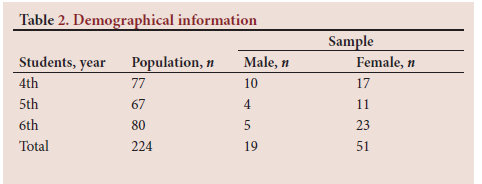
Seventy students responded to the questionnaire from 25 August to 1 September 2023 (Table 2). The number of students who responded were: fourth year (n=27/77), fifth year (n=15/67) and sixth year (n=28/80). There were 51 female and 19 male students, which reflects the demographics of the participants.
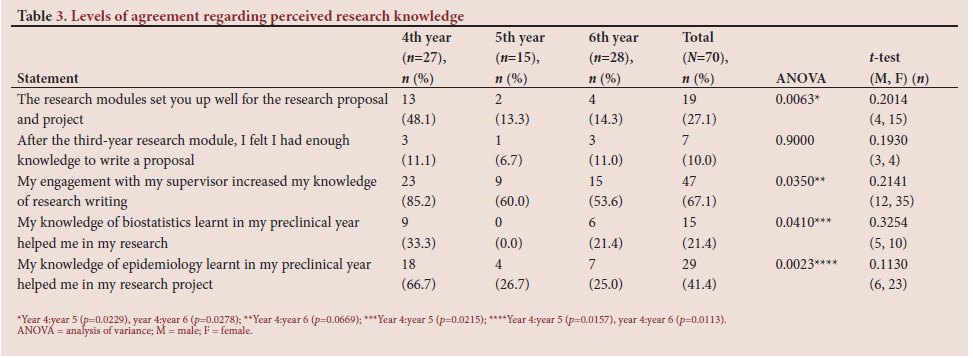
Students chose cross-sectional studies (60%, n=40/70), which were either quantitative (51%, n=36/70) or qualitative (40%, n=28/70). Overall, students felt that the research module did not prepare them enough for the research project (72.9%, n=51/70) and writing a proposal (90.0%, n=63/70) (Table 3). Yet, students largely agreed that their understanding of research writing increased with their supervisor's engagement (67.1%, n=47/70). Across all year groups, students did not express confidence in their knowledge of biostatistics (21.4%, n=15/70). Fourth-year knowledge of epidemiology demonstrated higher levels of agreement (66.7%, n=18/27) than the other academic years and the overall rating (41.4%, n=29/70). No statistically significant effect for sex was associated with the levels of agreement regarding students' perceived research knowledge. Significant ANOVA results point towards differences between year groups and perceptions regarding their module-facilitated and supervisor-mediated research knowledge. Tukey's post hoc comparisons indicate a significance between the respective academic years (Table 3).
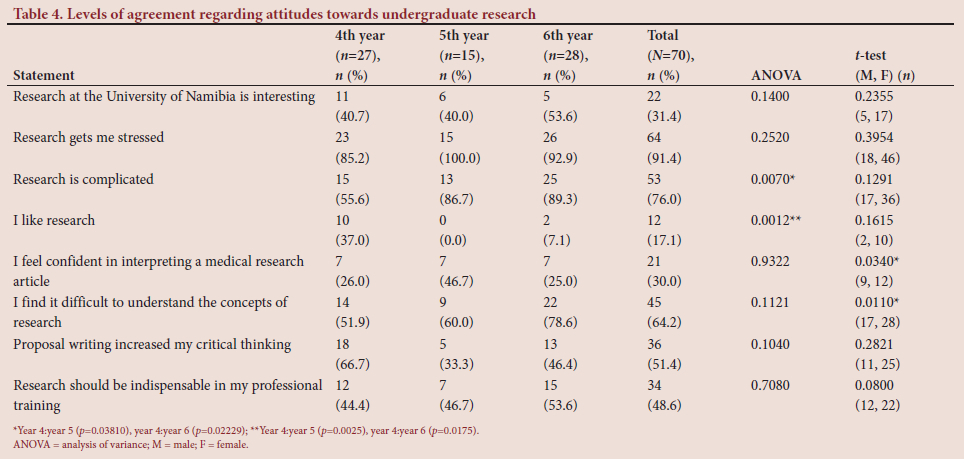
Most students did not find research interesting (68.6%, n=48/70) but thought that it was stressful (91.4%, n=64/70) (Table 4). Overall, students considered research to be complicated (76.0%, n=53/70). The concepts of research were overall regarded as challenging (64.2%, n=45/70), with a higher percentage of males (89.4%, n=17/19) than females (55.0%, n=28/51). This difference was found to be statistically significant (p=0.0110). Overall, few students enjoyed research (17.1%, n=12), with a significant difference between males (10.5%, n=2/19) and females (19.6%, n=10/51). Only 30.0% (n=21/70) agreed that they feel confident in interpreting a research article. Research writing was perceived as conceptually difficult (64.2%, n=45/70); yet, students agreed that the process increases critical thinking (51.4%, n=36/70). However, 34 respondents (48.6%) indicated that research is indispensable to their professional training. Between-group comparisons indicate significant differences in agreement related to research being complicated and students liking research.
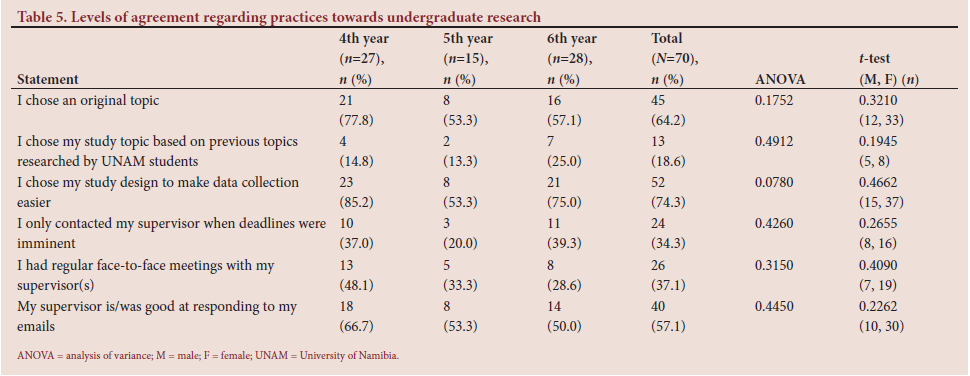
Some students chose an original topic (64.2%, (n45/70), while only 18.6% (n=13/70) indicated that they based their research on that of previous years (Table 5). The majority (74.3%, (n52/70) of students indicated that their topic was aimed at the ease of data collection. Students predominantly communicated with supervisors through email (57.1%, (n40/70), with a few having face-to-face meetings (37%, (n26/70) or contacting their supervisor when deadlines were imminent (34.3%, (n24/70). No statistically significant effect for sex was associated with the levels of agreement regarding students' perceived research practices.
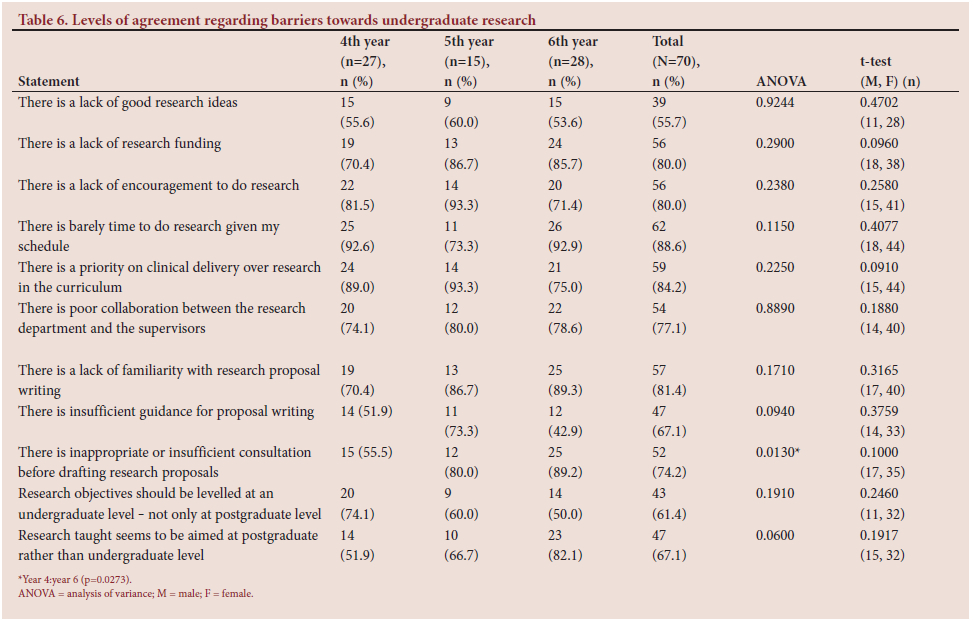
Respondents felt that there is both a lack of research ideas (55.7%, (n39/70) and research funding (80.0%, (n56/70) (Table 6). Students also indicated a lack of encouragement to do research (80.0%, (n56/70).
Importantly, students indicated that there is barely time for research during clinical rotations (88.6%, (n62/70) and that clinical content delivery is prioritised in the curriculum (84.2%, (n59/70). An additional barrier was poor collaboration between the research department and the supervisors (77.1%, (n54/70). Additional barriers include a lack of familiarity with research writing (81.4%, (n56/70), guidance (67.1%, (n47/70) and consultation (74.2%, (n52/70) during the proposal-writing process. Furthermore, students felt that the nature of research should be tiered at undergraduate level (61%, n=43/70), but the teaching was aimed at a quantitative postgraduate level (67.1%, n=47/70). Again, no statistically significant effect for sex was associated with the levels of agreement regarding students' perceived research practices.
Discussion
Research skills and critical reasoning are ideals broadcasted by research modules in an undergraduate medical school curriculum to prepare a graduate for future medical endeavours.[2] Early curricular placement of research methodology and biostatistics has been successful owing to reinforcement of prior learnt concepts.[8] However, introduction of research too early in the curriculum results in the 'vacuum of medical knowledge' in instances where the early academic programme has not exposed students to the medical literature and a contextually relevant frame of reference.[9,10] This medical vacuum exposes students' lack of insight and knowledge regarding research content and methodology. It has therefore been recommended that clinicians be involved in the teaching and/or course development of research to ensure clinically relevant content.[9] UR at UNAM relies on the prerequisite completion of both statistics and epidemiology before students' commencement of their research projects. Findings from the current study highlight students' perceived value of epidemiology in preparing them for research as opposed to statistics. This might be explained by real-life examples of clinical implications of the subject.
Medical students need protected time and adequate supervision to understand research; yet, publishing of their work is frequently desired.[6] At UNAM, the goal of UR is to equip students with the skills and competencies to conduct research. Competing with clinical rotations is a major barrier identified in the current study. This might explain the untimely collaboration between student and supervisor. Scaffolding or building of medical research into the curriculum needs to be driven by contextual realities of the other duties of medical students.[11]
The research supervisor is supposed to create a good research environment whereby there is continuous feedback. Supervisors present with various levels of supervision experience and/or formal training.[3] Research requires supervisors who are content and methodological experts. A Namibian study on research supervision at a satellite non-medical university campus highlighted the need for training of research supervisors.[11] Poor collaboration between the research department and the supervisors has been identified as a major hurdle. Finding supervisors with the right skill set is a major challenge.[9]
Practices of students at UNAM are shaped by the curriculum, supervision, adequate technical resources and competing interests regarding their time. These practices influence their choice of a study design that is not too expensive and leans towards questionnaire-based studies to make data collection easier. In the current study, medical students felt that there was a lack of research ideas and opted to develop an original topic. Students chose cross-sectional studies, most probably as these 'fit' into their schedule, especially as there is no ring-fenced time for collecting data. Retrospective studies would require good record-keeping in the healthcare system and prospective studies require longitudinal records within a study setting.[12] Secondary data sources might serve as a potential time-effective alternative. Furthermore, the establishment of small teams, which promotes engagement and understanding,[9] has the potential to complement the role of supervisors.
Research teaching in medical schools should aim to foster students' understanding of research methodologies and the critical scrutiny of research findings.[9] Findings from a South African study revealed that third-year students had a better knowledge than fourth-year students, as the junior students were able to remember most of the theory because the research module was presented in the third year.[13] Therefore, research teaching is more ring-fenced in the earlier years in medical school. Research as a subject should enthuse students to do research. A positive attitude towards research has been seen as a contributor to performing studies.[3] However, positive attitudes do not always correlate with increasing knowledge of research skills.
Conclusion
Insights of medical students in their research education journey are important to curriculum development. The findings from the current study highlight key gaps in students' research knowledge and practices due to time constraints. A lack of research ideas, supervision and dedicated research time was a major concern of students. Structured group work and the use of secondary data could alleviate topic saturation and ease supervisor burdens. To foster a culture of research and critical thinking among students, it is imperative to continue to review undergraduate medical education; scaffold research-related modules; understand the 'vacuum of medical knowledge'; find a balance between clinical education and research skills; and publish and present 'in-house' for academic accountability and transparency.
Data availability. The datasets generated and analysed during the current study will be made available upon reasonable request.
Declaration. None.
Acknowledgements. None.
Author contributions. All authors contributed to the study conception and design. Data analyses were performed by QW. JK and PS worked on the first draft of the manuscript; it was reviewed by QW. All authors read and approved the final manuscript.
Funding. None.
Confl cts of interest. None.
References
-
1. World Federation for Medical Education. Basic medical education - global standards for quality improvement. Explanatory note to guide the use of the standards, 2020. https://wfme.org/wp-content/uploads/2020/12/WFME-BME-Standards-2020.pdf (accessed 09 April 2025).
» https://wfme.org/wp-content/uploads/2020/12/WFME-BME-Standards-2020.pdf -
2. Pallamparthy S, Basavareddy A. Knowledge, attitude, practice, and barriers toward research among medical students: A cross-sectional questionnaire-based survey. Perspect Clin Res 2019;10(2):73-78. https://doi.org/0.4103/picr.PICR_1_18
» https://doi.org/0.4103/picr.PICR_1_18 -
3. Hart J, Hakim J, Kaur R, et al. Research supervisors' views of barriers and enablers for research projects undertaken by medical students; a mixed methods evaluation of a post-graduate medical degree research project program. BMC Med Educ 2022;22:370. https://doi.org/10.1186/s12909-022-03429-0
» https://doi.org/10.1186/s12909-022-03429-0 -
4. Bilal M, Haseeb A, Mari A, Ahmed S, Sher Khan MA, Saad M. Knowledge, attitudes, and barriers toward research among medical students of Karachi. Cureus 2019;11(9):e5599. https://doi.org/10.7759/cureus.5599
» https://doi.org/10.7759/cureus.5599 - 5. Haglin A. Why Medical Research is Important. Minneapolis: Hennepin Healthcare Foundation, 2020.
-
6. Kandingo MA, Zaire H, Wessels Q, et al. The approach to undergraduate research projects at Namibia's first school of medicine. Afr J Health Professions Educ 2023;15(2):2-5. https://doi.org/10.7196/AJHPE.2023.v15i2.1690
» https://doi.org/10.7196/AJHPE.2023.v15i2.1690 -
7. Jacobson C, Hunter CJ, Wessels Q. Biomedical research at Namibia's first school of medicine and pharmacy. Med Sci Educ 2013;23:135-140. https://doi.org/10.1007/BF03341818
» https://doi.org/10.1007/BF03341818 - 8. Clayden AD. Who should teach medical statistics, when, how and where should it be taught? Stat Med 1990;9:1031-1037.
- 9. Dommisse J, Joubert G. Profile of research methodology and statistics training of undergraduate medical students at South African universities. S Afr Fam Pract 2009;51(2):158-161.
-
10. Stander I. Teaching conceptual versus theoretical statistics to medical students. International Statistical Institute, 52nd session, 1999, Helsinki, Finland. https://iase-web.olg/docuinents/papeis/isi52/stail0219.pdf (accessed 09 April 2025).
» https://iase-web.olg/docuinents/papeis/isi52/stail0219.pdf -
11. Intja S, Nauyoma S. Undergraduate research projects supervision at the University of Namibia's Rundu campus: Supervisors' stances. Int J Res Publ 2022;92(¿473-489. https://doi.org/10.47119/IJRP100921120222679
» https://doi.org/10.47119/IJRP100921120222679 -
12. Cornett M, Palermo C, Wallace MJ, Diug B, Ward B. A realist review of scholarly experiences in medical education. Med Educ 2021;55(2):159-166. https://doi.org/10.1111/medu.14362
» https://doi.org/10.1111/medu.14362 -
13. Adefolalu AO, Mogosetsi NJ, Mnguni NM. Knowledge and attitudes of undergraduate medical students with regard to medical research at a South African university. Afr J Health Professions Educ 2018;10(4):205-209. https://doi.org/10.7196/AJHPE.2018.v10i4.1022
» https://doi.org/10.7196/AJHPE.2018.v10i4.1022

Accepted 19 December 2024