Enhance health service delivery through improved teaching of African languages: A call for policy reform
BACKGROUND: The gap between South Africa (SA)'s progressive language policy and its practical application in education perpetuates negative language ideologies towards African languages. This systemic failure hinders economic participation, access to, and service delivery for most of the population. Despite all twelve languages having official status, the historical devaluation of African languages continues in post-Apartheid SA. Within the education system, these languages are often framed as a problem that needs fixing, rather than a valuable resource. Inequality persists in the status of African languages in comparison with English and Afrikaans, especially within the education of health professions students. OBJECTIVES: To advocate for improved teaching of African languages to enhance health service delivery. This article calls for African languages education to be prioritised from basic through to tertiary education, as both a political and service delivery necessity that is transformative. METHODS: This article reports on secondary analysis of data that were originally gathered for a study on strategies used to navigate language discordance by occupational therapists (OTs) working in the public health sector in KwaZulu-Natal (KZN). Thematic analysis was used to analyse the data on policy recommendations. RESULTS: Two themes were generated, namely, 'educational reform as key: basic to tertiary education' and 'institutional reform: resources, supported development, and advocacy'. CONCLUSION: The education system across all levels from basic to tertiary is a key instrument that could shift language ideologies and support efficient implementation of the language policy in SA across sectors. This could improve economic participation.
South African language policy; health service delivery; language policy implementation reform; African languages education; language discordance
Enhance health service delivery through improved teaching of African languages: A call for policy reform
E K MarshallI; M C RamafikengII
IMSc OT; Marshall Occupational Therapy, Cape Town, South Africa
IIMSc OT, PhD; Division of Occupational Therapy, University of Essex, Wivenhoe Park, Colchester, UK
BACKGROUND: The gap between South Africa (SA)'s progressive language policy and its practical application in education perpetuates negative language ideologies towards African languages. This systemic failure hinders economic participation, access to, and service delivery for most of the population. Despite all twelve languages having official status, the historical devaluation of African languages continues in post-Apartheid SA. Within the education system, these languages are often framed as a problem that needs fixing, rather than a valuable resource. Inequality persists in the status of African languages in comparison with English and Afrikaans, especially within the education of health professions students.
OBJECTIVES: To advocate for improved teaching of African languages to enhance health service delivery. This article calls for African languages education to be prioritised from basic through to tertiary education, as both a political and service delivery necessity that is transformative.
METHODS: This article reports on secondary analysis of data that were originally gathered for a study on strategies used to navigate language discordance by occupational therapists (OTs) working in the public health sector in KwaZulu-Natal (KZN). Thematic analysis was used to analyse the data on policy recommendations.
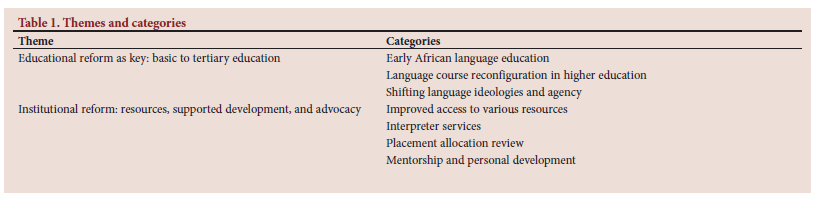
RESULTS: Two themes were generated, namely, 'educational reform as key: basic to tertiary education' and 'institutional reform: resources, supported development, and advocacy'.
CONCLUSION: The education system across all levels from basic to tertiary is a key instrument that could shift language ideologies and support efficient implementation of the language policy in SA across sectors. This could improve economic participation.
Keywords: South African language policy, health service delivery, language policy implementation reform, African languages education, language discordance.
At the dawn of South Africa (SA)'s democracy and drafting of the Constitution and subsequent policies, the necessity to elevate the status of African languages that had been sidelined was clear. Several policies such as the Language in Education Policy[1] and the National Language Policy Framework[2] were developed alongside establishment of the Pan South African Language Board (PanSALB) in pursuit of the 'development of the previously marginalised languages'.[3] The purpose was to rectify historical marginalisation of African languages, promoting multilingualism and rendering all languages their official status in SA. Despite this commendable progress towards redress, inclusivity, and democracy that received international appraisal,[4] implementation of these policies remains stunted. This gap between SA's progressive language policies and their practical application, particularly in education, perpetuates negative language ideologies towards African languages.[5]
The language policy in education plays a pivotal role in valorisation of indigenous languages by providing conditions and creating opportunities for them to thrive and compete with ex-colonial languages in the linguistic marketplace.[6] However, in SA, English and Afrikaans remain dominant as languages of teaching, commerce, and government,[7,8] therefore continuing the marginalisation of African languages. Across different levels of education, African languages are predominantly taught as language subjects or courses but rarely used as media of instruction.[4,9] For instance, Wildsmith[10] documented university-level African language projects (2009 - 2011), including teaching and development of isiZulu resources for health sciences students. However, Ramafikeng and Marshall[11] found that, a decade on, isiZulu teaching was described as brief and irrelevant for the occupational therapy (OT) practice, and this led to experiences of language discordance. Although the language policy in universities appears to support multilingualism, the subtle reinforcement of the dominance of English remains, thereby perpetuating inequalities.[4,12] Among others, students' multilingualism continues to be perceived as a 'problem'[13] that requires fixing[5] rather than a resource.
This systemic failure to implement the language policy and uphold the Batho Pele principles of access and information[14] extends beyond education, it hinders economic participation, access to and service delivery for most of the SA population. There is growing literature on the impact of language policies in multilingual contexts on economic participation.[15,16]
In SA, language discordance in health services is a consequence of poor implementation of the language policy. Consequences of language discordance include reduced quality health service delivery owing to inefficiency, decreased rapport-building, therapist-driven interventions, less comprehensive care provision, and misunderstandings of home programmes,[11] as well as more serious consequences, such as ethical and safety risks.[17] The adoption and implementation of language policies that disregard the actual linguistic diversity of multilingual, low-resource contexts can seriously restrict individuals' access to critical services, such as health, education, and participation in political and economic spheres.[15] This article contributes to this growing discourse on language policy and participation, drawing the focus to access to quality health care. The objective of this article is to advocate for improved teaching of African languages to enhance health service delivery. We advocate for the prioritisation of African language education at all levels, as both a political and service delivery necessity that is truly transformative.
Methods
This article reports on secondary analysis of data that was originally gathered for a study on strategies used to navigate language discordance by OTs working in the public health sector in KwaZulu-Natal (KZN).[18] The first author (EM) conducted the research for degree purposes under the supervision of the second author (MR). Prior to recruitment of eight participants using purposive sampling, ethical approval was obtained from the University of Cape Town and the KZN Department of Health (DoH). Semi-structured interviews were then used to collect data.[11]
Braun and Clarke's thematic analysis process[19] was employed to specifically draw out policy recommendations from the data, which includes acquainting oneself with the data, and line by line coding; the codes were then grouped into categories, reviewed and aggregated into main themes.
Results
Eight female OTs participated in the study[11,18] and their chosen pseudonyms are used below. They made recommendations for policy, institutional and individual changes on how to better navigate or eliminate language discordance. Two themes were generated from the secondary analysis, with categories as shown in Table 1.
Educational reform as key: basic to tertiary education
Most recommendations focused on educational reform as the key to addressing language discordance in health services. Participants unanimously emphasised the need for good quality education in African languages from basic to tertiary education. More specifically, the participants made a case for learning isiZulu (or other local languages) from a young age as they acknowledged that it takes time to learn a language. They recommended that learning an African language should be compulsory, like Afrikaans, that many of them learned, even though it was irrelevant to their context.
An example of the poor curriculum and teaching of African languages at school was given by Riley:
Ja, we did learn Zulu at school but no offence, we learnt literally 'hello, how are you' for the span of almost our entire conversational Zulu career, from grade 3 to grade 9. We learnt some body parts and stuff but that's not enough!
Good quality African languages instruction from an early age would equip learners with fundamental language skills, providing a solid foundation for subsequent learning of other African languages in higher education. The participants were aware that such a reform would probably be a long-term action; therefore they proposed other short- and medium-term action that would enable health professionals to navigate language discordance.
More detailed recommendations were for tackling the issue with current policies in place, by improving teaching of African languages at tertiary level, particularly to health sciences students. Participants expressed concerns about the course structure, citing issues with teaching methods, curriculum content and relevance to OT, and the length and timing of delivery. They agreed that the way they were taught isiZulu did not prepare them sufficiently for providing healthcare in an isiZulu-speaking context.
Their recommendations differed, but they advocated for a change to the length of the language course which was offered for one semester at the beginning of their degree. For instance, Demi suggested 'enforcing the language across the 4 years... as a yearlong course.' TDubbs agreed to the length, but with a slight modification: 'for the full 4 years, like a module a year, it doesn't have to be the whole year, but definitely more than just one semester of a language.' Moh added, 'or extended the Zulu course into two semesters.' These recommended changes to the length of the course were also supported with ideas on the timing of the offering if it was not throughout the 4 years of the degree. Some of the participants suggested doing the IsiZulu course later, either in third or fourth year of study, when it was more relevant to, and fresh for clinical practice. However, others recommended 'starting in your first year with basic sentence construction, understanding the different words and whatever, and then building on that every year.' (Riley)
To ensure that the language courses offered to OT students are fit for purpose, participants recommended that the content be relevant to the profession and tailored for everyday use. In addition, language teaching should be coupled with teaching on culture, as Libby stated: 'I think people need to be exposed to more than just a language, they need to be exposed to how the people live, their traditions, their cultures'. Moh suggested that learning about different cultures could begin with a diverse cohort, 'they need to be exposed to diversity and then only once they fall in love with that or once they are more accepting of that, then I think they would be open to learning a language.' The participants added that creating opportunities for learning other cultures among students would require students to not stick to their racial or linguistic groupings as was the case when the participants were students. TDubbs echoed the need for a more diverse OT community while acknowledging that there has been an increase in the training of African OTs, but that this was not yet enough.
Another curriculum change recommendation was added by Libby who said, 'perhaps they need to spend the time teaching how to learn a culture, the pedagogical mechanisms behind that learning', instead of focusing on learning additional languages as that would benefit students when they move to any province post qualification. In addition, Libby recommended:
Maybe a whole session needs to be spent on how do you do an interview without an interpreter and without the language abilities, what other techniques could you use? Could you use pictures? Could you ask people to show on diagrams or how do we express certain terminology using our body?
This would equip future practitioners with knowledge on how to navigate language discordance.
Lastly, participants recommended that at an individual level, students and therapists had to show agency by taking personal responsibility for learning other languages. Moh stated:
If you know that right after high school I'm going to study in Limpopo, where they speak Tshivenda, right when I'm still at home before I'm even going there, there's TV [television], there's internet ... so many resources that I can use to get started with me learning the language.
Monica added: 'it would be easier for us as therapists first to change, we cannot change the population that we'll be placed in, wherever we are placed.' They agreed that it is more helpful learning the language themselves as opposed to relying on an interpreter.
Institutional reform: resources, supported development, and advocacy
In addition to recommendations on educational reform, the participants had several pertaining to the institution. These were directed at the DoH and healthcare settings. The participants unanimously advocated for access to various resources to support communication.
Specific to the workplace, participants recommended that there be resources available to new OTs, to aid them in navigating language discordance. Libby suggested:
... if I've worked in a particular hospital, knowing that it's [language discordance] a problem for me, why don't I leave something behind that will help the next therapist coming in, be it visual aids or basic word dictionary, a self-created relevant one, or diagrams.
This suggestion challenges OTs to support each other, by sharing information and resources, therefore creating an opportunity to learn from each other. Monica added: 'what'll be very helpful is there should be more assessment tools, that are in our SA context and that use visual aids in order for them to do the assessment.' This highlights the need for tools that are contextually relevant, both linguistically and culturally. Participants advocated for these to be collaboratively developed by the DoH and the universities that have OT programmes. Monica asserts, 'UKZN-made assessment forms would help for it to be more continuous, where the students are continuing learning Zulu from first 'til fourth year,' and 'it's not only just a Zulu-speaking issue but I think it's for all of us as South Africans, that we use American OT resources.'
Other recommendations were for government level initiatives that supported continued learning of languages in the workplace. Riley commented, 'if the government had offered Zulu courses for free, especially on work time as opposed to your leave then maybe I would have done them.' Cassandra added, 'maybe contacts at the institution to offer lessons or send manuals so that you can learn the basics of the language.' In addition, some participants advocated for formal interpretation services. For instance, TDubbs said:
Ja, definitely having more readily available interpreters ... in that sense you are not taking away from another person's job or role or responsibility because they are hired purely for providing efficient communication between people.
Some participants recommended a more established programme for informal interpreters. For example, 'skills development is a good thing for all so if you find somebody that's willing to help you translate, why not upskill them?' (Demi) This recommendation was for existing non-health staff members to be incentivised to go for an interpretation course, and that interpretation then be included as one of their job tasks. Alternatively, 'there were matriculants who volunteered as interpreters to get references and work experience. I think you could look at a programme, an internship interpretation, translation kind of thing.' (Libby)
Participants also acknowledged potential barriers to establishing interpretation services. Libby commented: 'it would be amazing to have interpreters, but we know the budgets aren't there for it'. Therefore, to mitigate these constraints,
we should at least be having a network, each hospital should have one or two of the local languages and then there's perhaps a network telephonically, accessible if you've got an Ethiopian patient or whoever ... (Libby)
Some participants thought interpretation services may be useful at the beginning of one's career but 'then it would also make me very lazy to learn [isiZulu].' (Harsha)
Participants also recognised that African language proficiency was not a requirement for community service placement, a gap that could be addressed nationally. Cassandra commented:
I think more emphasis should be placed on considering the languages of the placement when you are applying for comm serve [community service], whether that's part of what the university does or if the Department [of Health] sends out some circulars emphasising that on the application.
Participants also considered the importance of therapists' own agency. Some participants recommend that one should start learning a language when they roughly know where they want to be placed, as TDubbs states: 'I chose Zulu because I knew, or I was hoping that I'd end up back in KZN.' However, other participants recognise that it is hard to pre-plan as it is not always guaranteed that one will be placed where they had intended to go. Although the participants stressed the value of paying more attention to the language proficiency required at different placements, their willingness to learn the language on the job helped them navigate language discordance, as described by Cassandra: 'being able to communicate wasn't a job requirement but if there was one for this post, it would have been, proficient in Zulu, so I thought, this is something that I need to do, I need to understand them'.
All the participants asserted that mentorship from more experienced OTs would be beneficial, as indicated by Cassandra:
Maybe we should ask OTs who have worked in a certain area who have had to adapt and they [were] in that community, like 10, 15 years but they found a way around that [language discordance] and maybe they can give us information for the new OTs.
In addition to mentorship on navigating language discordance, time was recognised as an important element. Libby said, 'affording our younger, newer therapists that opportunity, to slow down, to have a lower, smaller caseload initially, that they can use that time to navigate this discordance and frustration and this difference and difficulty', would be beneficial.
However, all the participants agreed that language discordance should not be a reason to provide poor quality services or to discontinue services. This demonstrates the participants' commitment to quality service delivery despite challenges.
Discussion
The findings advocate for reform at all levels: personal, institutional, and policy level. The recommendations align with growing literature on the impact of inefficient implementation of language policies across the continent.[6,15,16,20] In this study, participants recommended a change in teaching of African languages at all levels, with improved focus on the quality of teaching in early years. This call resonates with Ferguson's[21] view that education levels incrementally build on each other from primary to tertiary; therefore, language practices in lower levels of education shape expectations, attitudes, and practices in higher education.
A shift in language ideologies among health sciences students and professionals was also strongly recommended as it was believed to be instrumental in fuelling personal agency to learn African languages. However, the persistent devaluation of African languages as languages of economy perpetuates the negative ideologies as these languages are not recognised as transactional currencies.[20] For improved health service delivery, the findings suggested that proficiency in African languages should be used as a determining factor for allocation of community service placement. This resonates with one of Kamwangamalu's[6] intertwined conditions for legitimisation of African languages, making proficiency in African languages a prerequisite for employment in government and private sectors. There is growing research on proficiency in African languages as a resource for increased participation and success in education.[5,12,22,23] Centring African languages in education and training through implementation of language policies is therefore key to true transformation and improved economic participation for all in SA.
This article is timely as there is increasing recognition of language as a social determinant of health and its role in achieving health equity.[24,25] The findings contribute to this growing research by proposing improved implementation of the SA language policy as a means to achieving health equity. The article offers a unique contribution, health professionals' perspectives on implementation of the language policy.
The limitations of the original study are outlined in other publications[11,18] and include that data collection was done virtually because of the onset of the COVID-19 pandemic. However, limitations relevant to this article are that, although recommendations were part of the data collection, they were not the focus of the study. As a result, they were not extensively explored; therefore, further research on recommendations from health professionals on implementation of the SA language policy is needed.
Conclusion
Improved proficiency and legitimisation of African languages can improve access to services as more people would have access to information. Recognition of their full linguistic repertoire as their human capital would improve their participation in the socioeconomic landscape.
Further research on how language shapes access to health services from various stakeholders' perspectives, as well as its impact on service user outcomes across generations, is needed.
Declaration. No artificial-intelligence-assisted technologies were used in the production of this manuscript.
Acknowledgements. To all the study participants for their willingness to share their perspectives on language discordance and their recommendations about how to best navigate and reduce the negative ramifications of it.
Author contributions. EM was the primary researcher, under the supervision of MR. EM wrote the introduction and findings sections. MR wrote the methodology and the discussion, and both authors worked on the abstract and conclusion. Both authors reviewed the manuscript.
Funding. EM received funding for the last 2 years of her Master's research through the University of Cape Town's Foundation Contingency Award. However, the University of Cape Town did not play any role in the design of the study and collection, analysis, and interpretation of data or in writing this manuscript. The University of Essex covered the publication costs.
Conflicts of interest. None.
References
-
1. Department of Basic Education. Language in Education Policy, 1997 (Act No. 27 of 1996). Language in education policy. Pretoria: Department of Basic Education, 1997. https://www.education.gov.za/Portals/0/Documents/Policies/GET/LanguageEducationPolicy1997.pdf (accessed 10 March 2025).
» https://www.education.gov.za/Portals/0/Documents/Policies/GET/LanguageEducationPolicy1997.pdf -
2. Department of Arts and Culture. National language policy framework. Pretoria: Department of Arts and Culture, 2003. https://www.gov.za/sites/default/files/gcis_document/201409/langpolicyfinal0.pdf. (accessed 10 March 2025).
» https://www.gov.za/sites/default/files/gcis_document/201409/langpolicyfinal0.pdf -
3. Republic of South Africa. Pan South African Language Board Act 59 of 1995 amended as PANSALB Amendment Act of 1999. No.19960. Cape Town: Office of the President, 1999. https://www.pansalb.org/wp-content/uploads/PanSALB-Act.1999.pdf (accessed 11 March 2025).
» https://www.pansalb.org/wp-content/uploads/PanSALB-Act.1999.pdf -
4. Antia BE, van der Merwe C. Speaking with a forked tongue about multilingualism in the language policy of a South African university. Lang Policy 2018;18(3):407-429. https://doi.org/10.1007/s10993-018-9493-3
» https://doi.org/10.1007/s10993-018-9493-3 - 5. McKinney C. Language and power in post-colonial schooling: Ideologies in practice. New York: Routledge, 2016.
- 6. Kamwangamalu NM. Language Policy and Economics: The Language Question in Africa. London: Palgrave Macmillan UK, 2016.
-
7. Makalela L, McCabe R. Monolingualism in a historically black South African university: A case of inheritance. Linguist Educ 2013; 24(4):406-414. https://doi.org/10.1016/j.linged.2013.09.004
» https://doi.org/10.1016/j.linged.2013.09.004 -
8. Christie P, McKinney C. Decoloniality and model C schools: Ethos, language and the protests of 2016. Educ Chang 2017;21(3):1-21. https://doi.org/10.17159/1947-9417/2017/2332
» https://doi.org/10.17159/1947-9417/2017/2332 -
9. Maseko B, Siziba LP. Continuities or change? A synchronic and diachronic analysis of documented language policies of selected universities in South Africa. J Lang Tech Res 2023;14(2):304-313. https://doi.org/10.17507/jltr.1402.05
» https://doi.org/10.17507/jltr.1402.05 -
10. Wildsmith-Cromarty R. A problem-oriented, form-focused course design for teaching isiZulu as an additional language. S Afr J Afr Lang 2013;31(2):219-233. https://doi.org/10.2989/16073614.2013.815942
» https://doi.org/10.2989/16073614.2013.815942 -
11. Ramafikeng MC, Marshall E. Navigating language discordance in public health care in rural South Africa: A qualitative descriptive study of occupational therapists' perspectives. BMC Health Serv Res 2023;23(1):1-14. https://doi.org/10.1186/s12913-023-09658-3
» https://doi.org/10.1186/s12913-023-09658-3 -
12. Hurst E, Mona M. Translanguaging as a socially just pedagogy. Educ Chang 2017;21(2):126-148. https://doi.org/10.17159/1947-9417/2017/2015
» https://doi.org/10.17159/1947-9417/2017/2015 -
13. Council of Higher Education. South African higher education reviewed: Two decades of democracy. Pretoria: Council on Higher Education, 2016. http://www.che.ac.za/sites/default/files/publications/ (accessed 23 October 2017).
» http://www.che.ac.za/sites/default/files/publications/ -
14. Department of Public Service and Administration. The Batho Pele Vision. Pretoria: Department of Public Service and Administration, 2014. https://www.dpsa.gov.za/documents/Abridged%20BP%20programme%20July2014.pdf (accessed 11 March 2025).
» https://www.dpsa.gov.za/documents/Abridged%20BP%20programme%20July2014.pdf -
15. Reilly C, Scandurra R, ResCue E, Hermannsson K, Gayton A. Language and employment in Ghana: Capturing the multilingual reality. J Multiling Multicult Dev 2023;44(9):807-826. https://doi.org/10.1080/01434632.2023.2195853
» https://doi.org/10.1080/01434632.2023.2195853 -
16. Djité P. Gaps in sociolinguistic research in sub-Saharan Africa. Int J Soc Lang 2021;2021(267-268):91-98. https://doi.org/10.1515/ijsl-2020-0062
» https://doi.org/10.1515/ijsl-2020-0062 -
17. Elkington EJ, Talbot KM. The role of interpreters in mental health care. S Afr J Psychol 2016;46(3):364-375. https://doi.org/10.1177/0081246315619833
» https://doi.org/10.1177/0081246315619833 -
18. Marshall E. Strategies that occupational therapists in the public health sector in KwaZulu-Natal use to navigate language discordance: A qualitative descriptive study [MSc dissertation on the internet]. Cape Town: University of Cape Town, 2021. http://hdl.handle.net/11427/36481 (accessed 10 March 2025).
» http://hdl.handle.net/11427/36481 -
19. Braun V, Clarke V. Using thematic analysis in psychology. Qual Res Psychol 2006;3(2):77-101. https://doi.org/10.1191/1478088706qp063oa
» https://doi.org/10.1191/1478088706qp063oa -
20. Siziba L, Maseko B. Enabling the economics of African languages in language policies of South Africa and Zimbabwe. Afr J Inter/Multidisc Stud 2024;6(1):1-11. https://doi.org/10.51415/ajims.v6i1.1351
» https://doi.org/10.51415/ajims.v6i1.1351 - 21. Ferguson G. The medium of instruction in African education: The role of the applied linguist. In: Makoni SB, Kamwangamalu N, eds. Language and Institutions in Africa. Cape Town: CASAS, 2000: 95-109.
-
22. Abdulatief S, Guzula X. Crossing the frontier from oral to written translanguaging for epistemic access in natural science. Read Writ J Lit Assoc S Afr 2024;15(1):507. https://doi.org/10.4102/rw.v15i1.507
» https://doi.org/10.4102/rw.v15i1.507 -
23. Ramafikeng MC. Pedagogical translanguaging as a socially just strategy for multilingual students in occupational therapy. Educ Sci 2024;14(5):1-11. https://doi.org/10.3390/educsci14050462
» https://doi.org/10.3390/educsci14050462 -
24. Applebaum B, Robbins S. Language access and health equity: Changes under the Affordable Care Act. J Health Care Poor Underserved 2016;27(2):416-426. https://doi.org/10.1353/hpu.2016.0064
» https://doi.org/10.1353/hpu.2016.0064 - 25. Feuerherm E, Showstack RE, Santos MG, Martínez GA, Jacobson HE. Language as a social determinant of health: Partnerships for health equity. In Warriner DS, Miller ER, eds. Extending Applied Linguistics for Social Impact: Cross-disciplinary Collaborations in Diverse Spaces of Public Inquiry. London: Bloomsbury, 2021: 125-148.

Accepted 5 November 2025