Nurse educators' views on implementation and use of high-fidelity simulation in nursing programmes
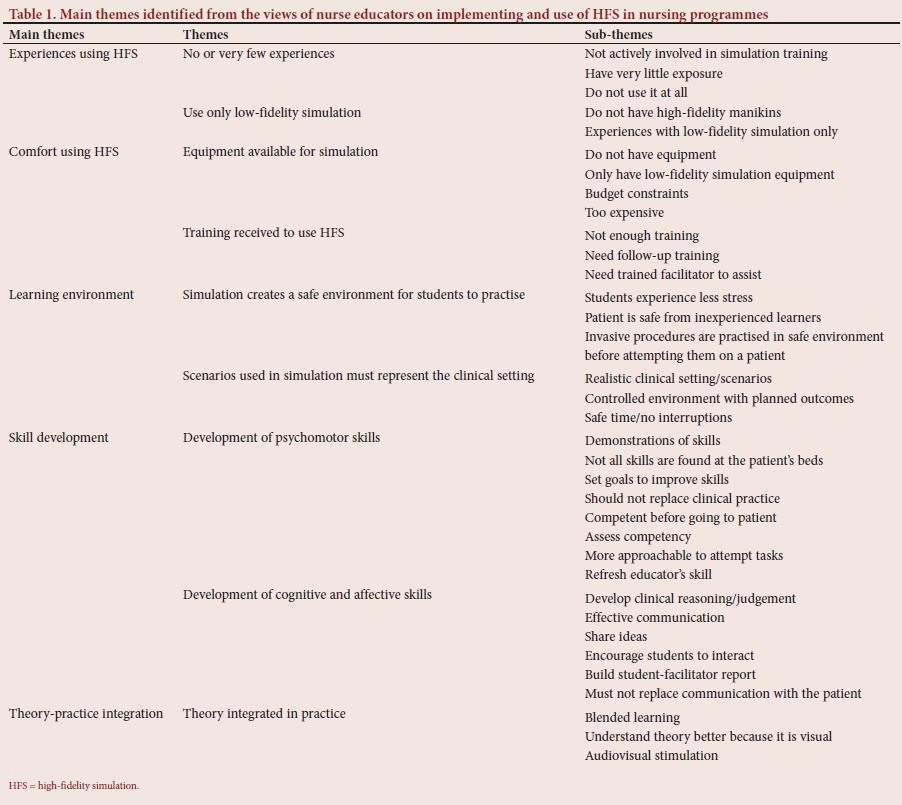
BACKGROUND. Clinical skills development of student nurses is a concern in nursing education owing to limited clinical exposure and learning opportunities. High-fidelity simulation as a teaching-learning strategy creates an environment where student nurses develop clinical skills through interactive participation. OBJECTIVES. The aim of this research study was to explore nurse educators' views of high-fidelity simulation as an educational approach in nursing programmes. METHODS. A qualitative descriptive design was used. Data were collected through individual semi-structured interviews. Data saturation occurred within 19 interviews. The population consisted out of 33 (N=33; n=19) nurse educators. Direct content analysis was done using Hsieh and Shannon's approach. The study was conducted at a South African private higher education institution. RESULTS. Five main themes were identified. The nurse educators had not been exposed to or had limited experience with high-fidelity simulation. Limited resources and/or the lack of nurse educators trained in high-fidelity simulation were identified. The nurse educators agreed that high-fidelity simulation would contribute to the enhancement of clinical skills development and theory and practice integration. CONCLUSION. High-fidelity simulation is not implemented owing to limited equipment or experience in using the equipment optimally. The nurse educators see high-fidelity simulation as a solution and valuable training method where clinical skills are developed before the student nurse is exposed to the private clinical environment.
Research • Afr. J. Health Prof. Educ. (Online) 12
(4)
• • https://doi.org/10.7196/AJHPE.2020.v12i4.1411 copy