
 Issuing Justice: Women Ulama, Fatwas, and the Ratification of Indonesia's Sexual Violence Crime Bill
Abstract
The ratification of the Sexual Violence Crime Bill in May 2022 reflects the collective efforts of diverse actors advocating for gender justice in Indonesia, including women ulama from the Congress of Indonesian Women Ulama (Kongres Ulama Perempuan Indonesia/KUPI). Central to this achievement is the KUPI's pioneering 2017 fatwa condemning sexual violence, which empowered women ulama to mobilize support for the bill. This article explores how KUPI's fatwa galvanized support for the Bill, helped to overcome resistance, and built lasting coalitions, thereby drawing attention to the overlooked role of women in issuing fatwas and in navigating and reshaping traditional religious frameworks to address gender-based violence. Using qualitative methods-including online observation, textual analysis, and interviews-I examine how women ulama challenge patriarchal interpretations of Islamic law and assert their authority in public religious discourse. I argue that, in social movements, fatwas can serve as internal innovations that offer shared moral guidance, unite actors, and act as mobilizing tools to drive policy change. This study contributes to a deeper understanding of female religious authority in Islamic jurisprudence and highlights shifting gender dynamics in contemporary Muslim societies, with a specific focus on Indonesia.
Fatwa on sexual violence; Sexual Violence Crime Bill; women's fatwa-making; Indonesian women ulama
Introduction
The plenary session of the Indonesian Republic of People's Representative Council (Dewan Perwakilan Rakyat Republik Indonesia/DPR), held on April 12, 2022, was led by the chairperson, Puan Maharani. This session, also attended by various women's organizations and Indonesian civil society networks, was set to ratify the Sexual Violence Crime Bill into law. After hearing the report on the results of the bill discussion from Willy Aditya from the DPR Legislative Body, Puan Maharani proceeded with the ratification.1
"Next, we ask each faction: can the Sexual Violence Crimes Bill be approved for ratification as a law?" Puan Maharani asked. The faction members responded, "Agreed". Hearing this, Puan immediately banged the gavel and said, "Thank you." The audience responded with applause and cheers of joy. Members of the women's organizations and civil society networks seated in the balcony waved enthusiastically, as did the chairperson. She then continued the process. "Next, we will ask all members again: can the Sexual Violence Crimes Bill be approved to be passed as a law?" she asked, once more receiving an affirmative response from the council members present. For the second time, she struck the gavel and was greeted by another warm response from the audience.2
"We felt pure joy and relief when six parliamentary factions expressed their agreement on the Sexual Violence Crime Bill," explained a representative from Rahima, a Muslim women's NGO based in Jakarta and part of the Congress of Indonesian Women Ulama network. Other representatives from the Civil Society Organizations sector appeared similarly overjoyed, embracing government officials, especially members of the factions that had championed the discussion from the beginning. Those from Rahima were moved to tears as they witnessed the bill's ratification.3
Indonesia made history by passing the Sexual Violence Crime Bill, following a lengthy process since its initial proposal in 2012 by the National Commission on Violence Against Women. Indonesia's legislative system allows the public to submit proposals to the Legislative Body that may then be advanced for discussion in the People's Representative Council (Dewan Perwakilan Rakyat/DPR) meetings and potentially adopted as a DPR initiative. This proposal can then be adopted by DPR factions, individual members, DPR commissions, the Regional Representative Council, or the government. In the case of the Sexual Violence Crime Bill, the draft was proposed as an initiative by Commission 8 and progressed through to ratification in the plenary session.4
While several laws in Indonesia address aspects of sexual violence, such as the Criminal Code, the Child Protection Law, and the Domestic Violence Law, they are limited in scope and fail to comprehensively define, prevent, and respond to sexual violence. The Criminal Code focuses mainly on physical violence and outdated moral categories, often resulting in inadequate justice for victims. Other laws either apply only to children or to domestic settings, leaving many cases unaddressed. In contrast, the Elimination of Sexual Violence Bill offers a comprehensive legal framework to address sexual violence by focusing on prevention, victim protection, and justice. It identifies nine forms of sexual violence: rape, sexual harassment, forced contraception, forced abortion, forced marriage, sexual torture, sexual exploitation, sexual slavery, and forced prostitution. The Bill outlines the main punishments for sexual violence, including imprisonment, social work, and rehabilitation, along with special sanctions like restitution, revocation of rights, and loss of professional or political status. It also includes victim-centered procedures, such as fair evidence handling, protection from criminalization, and access to recovery services before and after trial. The bill allows for multiple charges in complex cases and is essential for ensuring justice and legal certainty for victims.5
However, the journey toward the ratification of the Sexual Violence Crime Bill was far from smooth. The Bill was highly contested and attracted both strong support and opposition. Critics argue that certain articles-such as Article 6, addressing forced sexual intercourse, and Article 10, concerning forced marriage-could criminalize practices commonly carried out by family members, such as husbands or parents. Additionally, Article 12 on sexual exploitation raised concerns, as it focuses solely on forced sexual acts. Opponents worried that this could be interpreted as implicitly allowing consensual sexual activity outside of marriage, which they view as conflicting with moral and religious values.6
Willy Aditya, head of the team responsible for drafting and ratifying the Sexual Violence Crime Bill, noted two predominant phobias that surfaced in the DPR hearing room. First, "sexual consent phobia" that feared the possible opening of the door to zinā (sexual relations outside marriage) and premarital sex, as the Bill posited consensual sexual relations as outside the realm of criminal law. This fear failed to recognise how sexual consent affirms individual sovereignty over one's body. Second, "gender phobia" that viewed gender as a Western doctrine incompatible with religious values. These two phobias have become firmly established over time, particularly within patriarchal cultural and societal structures that regard sexuality as shameful, taboo, and obscene, consequently silencing victims of violence.7
Dina Afrianty (2021) suggests that the public policy debate on the criminalization of sexual violence has been influenced by religious doctrine and state ideology. The Pancasila principle of the "Belief in One God" is commonly understood to imply that policies, particularly on moral issues, should be grounded in religion, especially Islam. Certain perspectives on human and women's rights are rejected as Western ideas that clash with "Islamic values" and are, thus, viewed as unsuitable for shaping public policy. Indeed, it becomes clear that the inclusion of a progressive Islamic perspective that advocates for women's justice, such as the efforts of women ulama from the Congress of Indonesian Women Ulama network, is urgently needed in this debate.8
This article explores the groundbreaking KUPI fatwa condemning sexual violence, issued during the first congress in 2017 in Cirebon, West Java.9Issued amid the advocacy efforts for the Sexual Violence Crime Bill, the fatwa empowered women ulama to actively champion its passage, with their religious authority proving instrumental in addressing and overcoming resistance to the legislation. This political moment highlighted the growing recognition of women ulama's religious authority in society. Using qualitative methods, including online observations, textual analysis, and interviews, the discussion in this article aims to investigate how women ulama challenge conservative religious norms by issuing fatwas on sexual violence, and how the process of ratifying the Sexual Violence Crime Bill illustrates the KUPI fatwa's effectiveness as a tool for social policy.
In this article, I examine the KUPI fatwa on sexual violence, not only as a knowledge product resulting from KUPI's religious deliberations, but also by considering its formation process, including interactions among the parties involved and the dimensions that emerge from these interactions. To achieve relevant results, I focus on three elements while studying the KUPI fatwa. First, I consider women and their experiences as sources of knowledge. Second, I examine a multi-site approach to fatwa-making that involves looking at the sites where women ulama issue fatwas, contexts that, in the KUPI's case, are embedded within a social movement. Third, I explore doctrinal changes and ethical practices within the fatwa-making process.10 I contend that for social movements pushing for policy change, fatwas can serve as powerful internal tools that offer shared moral guidance and help unite and direct various actors. Beyond just raising awareness, movements need strong organizing structures to build coalitions, face opposition, and stay active over time. The KUPI's female ulama use fatwas as part of this structure, helping to mobilize people and strengthen the movement's efforts for lasting policy change.
This article begins with a brief introduction to the KUPI fatwa condemning sexual violence, emphasizing its key implications by recognizing women's experiences as a vital source of knowledge. The discussion then examines the role and significance of the KUPI fatwa within social movements advocating for policy change. Finally, the article's last section explores the essential aspects of doctrinal changes and ethical practices involved in the KUPI's fatwa-making process.
KUPI's Fatwa against Sexual Violence
The KUPI aims to restore women's authority in Islamic jurisprudence by empowering them to interpret religious texts and issue fatwas. Existing research on KUPI fatwas have examined the issues addressed in its congresses. Three major topics discussed during the first congress in 2017 were child marriage,11 sexual violence,12 and environmental destruction.13Among the issues discussed in the second congress in 2022 were forced marriage14 and female genital mutilation (FGM).15 The research broadly explained the KUPI trilogy method in fatwa-making that includes maʿrūf (goodness), mubādalah (hermeneutic of reciprocity), and keadilan hakiki perempuan (substantive or true justice of women). Additionally, these studies discuss the significance of the KUPI fatwas in promoting a gender-just society through fatwa-making.16
A fatwa is an Islamic legal opinion17 provided by an ulama or mufti (the one issuing the fatwa) as an answer to a question posed by a mustafti (the one asking the fatwa) formulated in line with established jurisprudential principles. However, a fatwa is not legally binding as the mustafti can either follow or leave the fatwa. The methods and the processes of issuing fatwas have evolved over time. The main parts of fatwa reasoning are the Qur'an and Hadith, and traditionalist ulama also include taqlīd, that is, an adherence to the authority of past scholars from one of the four canonical schools (madhhab).18 While fatwas were once issued solely by individual muftis, they are now often produced collectively by fatwa institutions that also, as in the Indonesian context, release various types of statements.19
In Indonesia, each fatwa-making body, such as the state-sanctioned Indonesian Ulama Council and Nahdlatul Ulama's Bahtsul Masail, follows its own unique methods and procedures for issuing religious rulings. This includes how they apply religious texts and principles to a fatwa. These methods shape how their fatwas are structured, usually resulting in written statements published in print or online. Typically, a fatwa responds to a question from someone seeking religious guidance. However, both the Indonesian Ulama Council and Bahtsul Masail also issue "fatwa-like" declarations that are not tied to a specific question but, instead, address broader societal issues or respond to laws.20 In addition to differences in methods and procedures, each fatwa institution uses its own processes and structure. The Indonesian Ulama Council, Bahtsul Masail, and KUPI even have their own terms for the steps and sections in their respective processes.
The KUPI addressed three major questions in its first congress-including one on sexual violence-through a process of discussion and consensus established in advance. These discussions involved both Muslim women scholars and activists from outside religious institutions. The KUPI uses the term "sexual violence" in its fatwa on the issue, emphasizing that such acts are prohibited both within and outside of marriage. The fatwa also highlights the important distinctions in Islamic law between rape and zinã (sexual relations outside marriage), particularly in terms of their definitions, the punishments applied, and the types of evidence required. Below is a summary of the KUPI's fatwa on sexual violence based on its written statements:
The questions are:
1. What is the Islamic law on sexual violence?
2. Is rape the same as zinā (sexual relations outside marriage) with regard to the aspects of definition, punishment, and evidence required in Islamic law?
3. What is the view of Islam towards government authorities and parties who have a responsibility to protect victims of sexual violence but do not fulfil their obligation? Does Islam contain the concept of imposing punishment for these offenders?
The religious positions and views are:
1. The law regarding sexual violence in any of its forms, as stated in the taṣawwur (description) and istidlāl (analytical and interpretative reasoning), is that sexual violence is ḥaram. This applies for sexual violence committed both inside and outside the bond of marriage;
2. Rape is not the same as zinā, seen from the viewpoint of definition, punishment, and required proof to prosecute;
3. The view of Islam towards state authorities and other parties who have a responsibility to protect victims of sexual violence but do not fulfil their responsibility and in some cases even act as perpetrators of sexual violence [is as follows]: a) The state has a responsibility to guarantee the fulfilment of all of its citizen's rights, including the rights of victims of sexual violence. If the state and/or law enforcement officers neglect this duty or create difficulties regarding the fulfilment of citizens' rights, the state has failed to uphold principles of justice and has committed despotic acts that contravene the Constitution of the Republic of Indonesia; b) In the case that the state or other parties who have a responsibility to protect become, in fact, perpetrators of violence- including perpetrators of sexual violence-the view of Islam is that the sins and the punishment for these perpetrators should become more severe (taghlīẓu al-ʿuqūbah). This is because these parties have carried out multi-layered violations: the violation of sexual violence itself and then the neglect to fulfil their responsibilities to protect victims and the rights of citizens. This applies both for state authorities and other parties who have been given a mandate to protect.21
The KUPI introduced a recent innovation in its approach to fatwa-making, evident in how fatwas are structured, the way questions and answers are formulated, the sources they draw upon, and the interpretative methods employed. The first notable innovation lies in the structure of the fatwas, as documented in the KUPI's report. Each fatwa includes the followings sections: taṣawwur (description), adillah (sources), istidlāl (analytical and interpretative reasoning), sikap dan pandangan keagamaan (religious positions and views), tazkiyah (recommendations), maraji' (references), and marāfiq (appendices).22 This structure differs from the typical structure of fatwas issued by the Indonesian Ulama Council (MUI) that consist of a brief issue description (deskripsi masalah), problem formulation (perumusan masalah) with specific questions, legal rulings/ḥukm (ketentuan hukum), which are the answers, and the foundational basis (dasar penetapan) such as Qur'anic verses, Hadiths, scholarly opinions (aqwāl al-'ulamā'), and previous MUI fatwas that reinforce the ruling.
The structure of the KUPI's fatwa on sexual violence places particular emphasis in the sections taṣawwur, adillah, and istidlāl. Unlike the MUI's brief issue summary, the taṣawwur serves as a critical component in the KUPI's fatwa structure, providing context for the issue with data and real-life experiences. This approach enables the KUPI to highlight the gendered nature of the issue and incorporate that perspective into its legal reasoning. This section also integrates the substantial part of its fatwa-making, namely the incorporation of women's lived experiences and the perspective of substantive or true justice (keadilan hakiki). These are not merely background elements, but integral to the analytical and interpretative process. This substantial part of the KUPI's methodology is a prerequisite for the process of fatwa production, enabling the KUPI to issue fatwas that are progressive, rooted in gender equality, and aimed at bringing benefit, especially for women.23
Another aspect is the formulation of questions and answers. Typically, fatwa requests begin with a question such as, "What is the legal judgment on...?" with the response directly addressing the question. However, the KUPI committee approached this differently. One major issue in discussions on sexual violence is the assumption that it only occurs in prohibited sexual relations, such as zinā (sexual relations outside marriage) or rape, often leading to a misunderstanding of what sexual violence is. This assumption also excludes marital rape from being recognized as sexual violence.24
As such, the KUPI's fatwa on sexual violence addresses three main questions: (1) What is the legal judgment on sexual violence?; (2) Are rape and zinā equivalent in terms of definition, punishment, and proof?; and (3) How does Islam regard state officials or other responsible parties who fail to protect victims of sexual violence-or who, in some cases, become perpetrators themselves? Does Islamic law acknowledge the possibility of aggravated punishment in such cases? Among these three questions, I focus specifically on the first two, as they aim to articulate an alternative Islamic legal perspective on marital rape. To respond, the KUPI drew on adillah (textual proofs) from the Qur'an, Hadith, aqwāl al-'ulamā' (sayings/commentary of religious scholars), and the Indonesian constitution. These sources emphasize equality in status and dignity between men and women, the responsibility to uphold individual autonomy and human rights, and the fundamental distinctions between rape and zinā that affect both the victim's protection and the offender's punishment. By using istidlāl (analytical and interpretative reasoning), the KUPI elaborated on these adillah, using data on sexual violence to support and form its conclusion that (1) all forms of sexual violence, both outside and within marriage, are haram (unlawful); and (2) rape is distinct from zinā in definition, punishment, and proof requirements.
As illustrated, the KUPI's fatwa on sexual violence is developed through an analytical process grounded in adillah and istidlāl. In analyzing these sources in relation to sexual violence, the KUPI integrates nine essential values25 with the Qur'anic and Prophetic principle/of compassion (kerahmatan), the framework of maqāṣid al-sharīʿa (objectives of shari'a), and the approaches of ma'rūf (goodness), mubādalah (hermeneutic of reciprocity), and keadilan hakiki (substantive or true justice). This methodology is evident in the fatwa's taṣawwur (description) and istidlāl (analytical reasoning) sections. The KUPI also incorporates international law and women's lived experiences, though these are not explicitly listed among the adillah to avoid resistance from broader Indonesian Muslim communities who are unfamiliar with the KUPI's approach and could reject the fatwas. 26
Indeed, it is important that the KUPI dp not to adopt a completely different methodology from other fatwa-making bodies in Indonesia given that the authority of the fatwa depends on adhering to a commonly accepted method of fatwa-making, namely scholarly legal judgement. This is particularly crucial as the KUPI is still in the process of establishing its own authority in this field.
The KUPI's Fatwa Advocating for the Sexual Violence Crime Bill
The KUPI's fatwa on sexual violence gained momentum when conservative groups challenged the ratification of the Sexual Violence Crime Bill. A key reason for the ten-year delay from the National Commission on Violence Against Women's (Komnas Perempuan) initial efforts to the law's enactment on 9 May 2022 was the impact of these conservative forces. The Prosperous Justice Party (Partai Keadilan Sosial, PKS), supported by Aliansi Cinta Keluarga (Family Love Alliance, AILA) significantly obstructed the law's progress until it was finally passed by parliament on 14 April 2022. PKS have argued that the law was insufficient, as it did not include punishments for zinā, premarital sex, and LGBTQ+ issues, behaviors it considers contradictory to Islamic norms.27
Monica Arnez and Eva Nisa highlight key reasons for the significance of the KUPI's fatwa in the discourse surrounding the Sexual Violence Crime Bill. First, sexual violence was the primary focus at the first KUPI congress, as the Sexual Violence Crime Bill is considered essential for safeguarding human dignity against such violence, aligning with the maqāṣid al-sharīʿa (objectives of shariʿa), particularly in protecting honor (hifẓu al-'irḍ), lineage (al-nasl), and life (al-nafs).28 Second, the KUPI's fatwa effectively addresses the objections from opponents of the Sexual Violence Crime Bill, specifically concerning the distinctions between marital rape and zinā, affirming that while both are prohibited in Islam, they are not the same.29
The KUPI clarified that rape is not a form of zinā but, rather, is considered ḥirāba, where the perpetrator forcibly compels the victim into non-consensual sexual intercourse, which is committing both zinā and coercion.30 Unlike some countries, such as Pakistan, where conservatives label rape as zinā-bi al-jabr (forced sexual relations outside marriage), the KUPI maintains that rape is distinct. Defined by jurists like Sayyid Sabiq, ḥirāba involves acts of public disruption, violence, or assault, including attacks on women (hatk al-'araḍ), theft, and destruction of property or agriculture. The KUPI's categorization of rape as hirāba aligns with Asifa Quraishi's perspective.31
The conservatives' rejection of the Sexual Violence Crime Bill was partly based on the assumption that it would trigger disharmony between husbands and wives, ultimately undermining the foundation of the family unit. Faqihuddin Abdul Kodir, a prominent figure in the KUPI, emphasized the need to address this misconception, saying: "The impression might be that the draft law merely ensures the security, comfort, and freedom of women in public spaces, which is then perceived as a threat to family resilience, as husbands could easily be reported".32
In response to such criticisms, the women ulama of the KUPI, represented by Badriyah Fayumi, another key KUPI leader, argued during a public hearing with the legislative body that both the public and domestic spheres are equally important as safe and comfortable spaces for everyone, especially women. She stressed that when women are unsafe in the domestic sphere or become victims of violence, this insecurity also threatens the foundations of the family.33
While Faqihuddin acknowledged that the KUPI's fatwa on sexual violence has not yet fully addressed the shared rights of men and women within the family context, he noted that as societal contexts and challenges evolve, it is crucial to adopt a family-centered perspective in addressing such issues. This includes recognizing that violence involving family members, whether as perpetrators or victims, deeply harms the family structure, making prevention efforts within the family essential.34
Nevertheless, the KUPI's fatwa on sexual violence serves as a key reference. As Sari Narulita from Alimat, one of the original KUPI organizers alongside Rahima and Fahmina, explains, "[w]hen AILA distorted the Sexual Violence Crime Bill by framing it as a religious issue, KUPI took the initiative to counter these accusations".35 The KUPI, along with the academic community and women's rights groups, participated in a public hearing with the People's Representative Council (Dewan Perwakilan Rakyat, DPR),36 to emphasize how postponing the bill would lead to more women becoming victims of gender-based violence, as witnessed between 2019 and 2020. They urged the DPR to review their evidence, comprised of a comprehensive study highlighting the empirical, theoretical, philosophical, and sociological justifications for a robust legal framework to address sexual violence.37
To clarify the position of the KUPI fatwa on sexual violence within the broader context of social movements (i.e. the context in which it was issued), I draw on Sydney Tarrow's definition of social movements as "collective challenges, based on common purposes and social solidarity, in sustained interaction with elites, opponents, and authorities". This definition is characterized by four empirical features: collective challenge, common purpose, social solidarity, and sustained interaction.38 Additionally, the organizational innovations seen in social movements of the 1960s, driven by both the sheer volume of new movements and significant internal developments, demonstrates how changes can emerge through innovative structures, strategies, and approaches within the movements themselves. Moreover, broader technological and social transformations result in expanded resources and networks, equipping organizers with unprecedented tools and connections that contributed to a dynamic landscape for organizational growth and change.39
Thus, I argue that within the social movements that advocate for policy change, fatwas serve as a form of "internal innovation"40 providing value-based guidelines to unify and direct all involved parties towards common goals. Indeed, social movements need more than just framing. Rather, they must bring people together, form coalitions, confront opposition, and ensure sustainability beyond peak mobilization. This highlights a key resource of "mobilizing structures". Through the authority of the KUPI's female ulama, fatwas can act as a mobilizing tool within the social movement structure to drive policy changes.41
In her presentation on how to use a fatwa in advocacy for the Sexual Violence Crime Bill, Rubiyanti Kholifah, the director of Asian Muslim Actions Network Indonesia, elaborates on how fatwas function as an internal innovation that mobilizes structures within the movement. The KUPI fatwa works in six key domains. First, after being established at the first KUPI, the fatwa was disseminated across the entire KUPI network, reaching educational institutions and government bodies. Organizations affiliated with the KUPI voluntarily conducted outreach in their constituencies. Second, guidance was developed based on the fatwa's arguments to support the urgent passage of and counter opposition to the Sexual Violence Crime Bill.42 Third, creative advocacy efforts, including KUPI webinars and inperson seminars, were organized to highlight the importance of the Sexual Violence Crime Bill. These initiatives aimed to spark conversations about the bill's significance among youth and women in remote areas. Fourth, a National Prayer led by women ulama was held to encourage national unity and promote well-being. Fifth, advocacy was conducted through Balcony Advocacy, empowering women leaders to confidently voice women's experiences and knowledge. And last, public hearings with parliament members provided a platform for women ulama to present their perspectives on the bill, fostering open dialogue with the members, including those from conservative Islamic parties. These hearings were streamed on platforms like YouTube, allowing the public to observe the political discourse in real-time.43
Grounding the KUPI's Fatwa in the Indonesian Public Muslim
The rise of social movements, like the KUPI, has been significantly supported by technological and social advancements, particularly the expansion of social media. Social media and television provide these movements with powerful platforms to communicate their messages widely and mobilize support without needing to build large-scale physical organizations.44 By using media to create impactful, memorable material and actions, such as civil rights demonstrations, the Sexual Violence Crime Bill, or the KUPI's fatwa on sexual violence, social movements are better placed to draw widespread attention, inspire public sympathy, and encourage others to join, making media itself a critical resource for growth and influence.
Efforts to promote the KUPI fatwa and progressive perspectives supporting the Sexual Violence Crime Bill ratification illustrate how the KUPI's fatwas by women ulama are not only ethical practices but also a push for doctrinal and policy shifts regarding sexual violence. This shift aims to reshape religious and cultural views that have traditionally overlooked women's rights in cases of sexual violence.45 A critical factor in perpetuating sexual violence is "rape culture", described by Buchwald et al. as a societal norm condoning both physical and emotional harm against women.46 Arnez and Nisa add that institutions like religious schools, offices, and police stations may create "secluded spaces" that, with limited transparency and restricted access, help to conceal unethical behaviors and enable abuse. Unlike the notion of "separate worlds" that addresses legal and moral boundaries, the "opacity of secluded spaces" highlights how isolation and power imbalances within these systems create conditions that facilitate unchallenged abuse.47
It was through the use of social media that the KUPI and its networks, including Rahima, Fahmina, and Alimat, were able to utilise the KUPI fatwa on sexual violence as a mobilizing tool. Indeed, Rahima and the KUPI have actively advocated for the ratification of the Sexual Violence Crime Bill since 2017. Their efforts began with a study of the bill, leading to campaigns and lobbying efforts. The KUPI formally presented its views to the DPR on October 3, 2018. However, due to the heated discussions and numerous issues related to Islam, the KUPI, in collaboration with Alimat and Rahima, documented their religious perspectives on sexual violence, the necessity of the Sexual Violence Crime Bill, and other topics that had raised public questions. 48 Since 2019, they contributed to drafting Daftar Inventaris Masalah (problem inventory list) for the Sexual Violence Crime Bill and created campaign materials that circulated throughout KUPI's network and grassroots communities. 49
In August 2020, the KUPI, Alimat, and Rahima published a pocketbook, titled Tanya Jawab Seputar RUU Penghapusan Kekerasan Seksual dari Pandangan Kongres Ulama Perempuan Indonesia (KUPI) (Questions and Answers Regarding the Bill on the Elimination of Sexual Violence from the Perspective of the Congress of Indonesian Women Ulama (KUPI)),50 that was shared with parliament, Islamic organizations, and CSOs to support the legalization of the bill and addressed questions from opposing parties. The book is divided into two parts. The first provides an introduction that outlines the context of sexual violence in Indonesia, the urgency of ratifying the Sexual Violence Crime Bill, and the purpose of the pocketbook. The second features a question-and-answer section of 21 questions, categorized into three groups, addressing various topics related to the Sexual Violence Crime Bill. The first group addresses basic questions concerning definitions, the scope of the bill, and its importance. Second were questions about the Islamic perspective on sexual violence and the state's role, with responses grounded in arguments from the Qur'an, Hadith, and aqwāl al-'ulamā (views of religious scholars). The third group listed questions addressing controversies raised by Muslim groups opposing certain aspects of the bill.
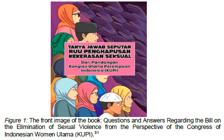
One of the questions in the pocketbook asks "Does this Sexual Violence Crime Bill legalize zinā and homosexuality (LGBT)?". The answer provided explains how this is a misunderstanding of the bill:
This is not true. The Final Bill does not address zinā, sexual orientation, or LGBTQ+ issues at all. The absence of discussion on these topics does not imply approval. The primary focus of the Final Bill is on all forms of sexual violence inflicted on victims, both inside and outside of marriage. It does not address sexual relations prohibited by Islam but instead focuses on nine specific acts of sexual violence: sexual harassment, sexual exploitation, forced contraception, forced abortion, rape, forced marriage, forced prostitution, sexual slavery, and sexual torture. These nine forms are concrete examples of violence reflected in the experiences and testimonies of sexual violence victims (Author's translation).52
Another question included in the pocketbook concerns the opposition from groups rejecting the Sexual Violence Crime Bill, who claim it would undermine the integrity of the family. They ask, "If the Sexual Violence Crime Bill is important in the eyes of Islam, why is there resistance from some Muslims? Is it true that it will damage the foundations of the family?". In response, the pocketbook provided the following explanation:
Absolutely not. The Final Bill aims to improve the quality of the relationship between husband and wife, encouraging them to view each other as partners who provide mutual affection, love, and happiness. It seeks to prevent a situation where one partner views the other solely as a means of satisfying sexual desires, which could lead to coercion and ultimately harm the marriage bond. The Qur'an outlines five pillars of a quality marital relationship. First, marriage is a strong bond (mīthāq ghalīẓ, An-Nisa, 4:21) that both parties must uphold with determination, words, and actions. Second, marriage is a partnership (zawāj), symbolized in the Qur'an by the imagery of a husband and wife being garments for one another (Al-Baqarah, 2:187). Third, spouses must treat each other with kindness and fairness (An-Nisa', 4:19). Fourth, they should engage in consultation and deliberation (tasyāwur, Al-Baqarah, 2:233). Fifth, there must be mutual willingness and consent (tarāḍin, Al-Baqarah, 2:233). Sexual violence violates these principles, making the marital bond fragile and prone to collapse. The Sexual Violence Crime Bill upholds these five pillars to ensure that acts of sexual violence do not undermine the foundation of marriage.53
This pocketbook is based on the KUPI fatwa on sexual violence, incorporating verses from the Qur'an used by the fatwa as its textual evidence (adillah). One such verse is Surah an-Nisa' [4:19] that emphasizes the importance of treating wives with kindness. The explanations in this book adopt the KUPI trilogy approach of maʿrūf (goodness), mubādalah (hermeneutic of reciprocity), and keadilan hakiki perempuan (substantive or true justice of women). Ma'rūf refers to values that are recognized, understood, accepted, appreciated, and supported by the Qur'an, Hadith, and common rationality. For instance, the five pillars of a quality marital relationship as outlined in the Qur'an are considered ma'rūf, that is, commonly acknowledged and agreed upon principles. As Faqihuddin Abdul Kodir, the leading figure of KUPI, explains, "We apply this concept of ma'rūf in the context of relationships through mubādalah, inviting both men and women to act toward achieving these shared goals". Mubādalah ensures that both men and women are equal participants and beneficiaries of these goals, while maintaining an awareness of biological and social differences, which is the essence of substantive or true justice for women.54 The publication of the pocketbook demonstrates that the KUPI fatwas can serve as a foundation for generating knowledge and creating contextually appropriate narratives. These can include other pocketbooks, social media content, and materials for religious lectures.
At the grassroots level, Rahima, the women's NGO affiliated with the KUPI, mobilized women ulama from various regions in Indonesia to educate and advocate using media campaigns countering the patriarchal narratives that opposed the Sexual Violence Crime Bill. A notable achievement of these grassroots efforts was seen in 2019 during a collaboration with the National Commission on Violence Against Women to create a safe space for women ulama to learn about the bill. Once informed, these women began sharing their knowledge within their communities. For instance, a woman ulama from Tasikmalaya, West Java, organized a discussion on "Reviewing the Importance of the Criminal Law against Sexual Violence Bill" that was attended by members of Nahdlatul Ulama Female Student Association and the Indonesian Islamic Student Movement in Tasikmalaya Regency. Similarly, another woman ulama from Madura, East Java, addressed the bill from an Islamic perspective to her community, which primarily consisted of stay-at-home mothers.55
The KUPI network also expressed their support for the bill on social media. For instance, @CherbonFeminist shared an infographic outlining five reasons for the urgent passage of the Sexual Violence Crime Bill.
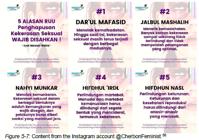
Five reasons why the Elimination of Sexual Violence Bill must be passed! First, dar'ul mafasid (preventing harm); sexual violence continues to occur in various forms. Second, jalbul mashalih (attracting public benefit); many victims remain unprotected and do not receive adequate support. Third, nahyi munkar (forbiding wrong); the various forms of sexual violence are harmful and must be prevented, with perpetrators facing deterrent sanctions. Fourth, hifdhul 'irdh (protection of dignity); human dignity must be safeguarded against all forms of harm, including violence. Fifth, hifdhun nasi (protection of offspring); the health and well-being of future generations must be protected from harmful influences (Author's translation).
The KUPI network's efforts to disseminate the KUPI fatwa on sexual violence reflects a commitment to transforming the fatwa from a formal written document into accessible products that cater to grassroots readers. This transformation involves, not only changes in form, but also in language. The active involvement of female ulama in this process highlights their role as cultural brokers, as defined by Clifford Geertz, navigating the critical connections between local systems and the broader context.57 These female ulama serve as active agents of social change, continually adapting to the evolving dynamics of politics, economics, and culture.
Conclusion
This article has discussed the historic passage of Indonesia's Sexual Violence Crime Bill in 2022, initiated by the National Commission on Violence Against Women in 2012. As elucidated above, the path to ratification faced challenges, including what has been referred to as "sexual consent phobia" and "gender phobia", terms that reflect the deep-rooted patriarchal norms that perceive female sexuality as taboo. Such perspectives hindered discussions on sexual consent and framed gender-related issues as Western ideologies incompatible with Islamic values. The article has highlighted the need for a progressive Islamic perspective in public policy debates such as was provided through the efforts of women ulama from the KUPI network during the ratification efforts of the bill.
In 2017, the KUPI issued a groundbreaking fatwa condemning sexual violence, empowering women ulama to advocate for the Sexual Violence Crime Bill. This fatwa illustrates the growing recognition of women ulama's religious authority and their role in challenging conservative norms. Indeed, the KUPI's efforts to reclaim women's juristic authority through fatwa-making signified a critical shift in Islamic interpretation, particularly regarding issues such as sexual violence. By employing a trilogy methodology that emphasizes goodness (ma'rūf), hermeneutic reciprocity (mubādalah), and substantive or true justice for women (keadilan hakiki), the KUPI distinguished itself from the existing male dominated fatwa institutions, such as the Indonesian Ulama Council. This differentiation is evident in the structure and formulation of the fatwas, as well as in the use of sources for legal reasoning (adillah and istidlāl).
Examining the KUPI fatwa on sexual violence through a gendered lens highlights the centrality of women's experiences as sources of knowledge and the evolving role of fatwa issuance in shaping social policy. It underscores the ethical practices and doctrinal shifts involved in the KUPI's fatwa-making process, once which challenges conservative interpretations, particularly on gender relation and sexual violence, and promotes a gender-just perspective within Islamic jurisprudence.
The fatwa also functions as a key component in broader social movements, aligning with Sydney Tarrow's definition of such movements as collective actions rooted in shared goals and social solidarity. As a form of "internal innovation", the fatwa offers value-based guidelines that unify diverse stakeholders and direct collective efforts toward policy change. The KUPI strategically disseminates the fatwa through its network, advocacy materials, webinars, and public hearings, mobilizing support, amplifying women ulama's voices, and engaging wider audiences in debates around the Sexual Violence Crime Bill. These mobilizing structures not only empower participants but also enhance the movement's capacity to confront resistance and maintain momentum, contributing to a more inclusive and transformative discourse on sexual violence in Indonesia.
Acknowledgement
I am sincerely thankful to all my interlocutors for generously sharing their time, insights, and lived experiences with me. I am also grateful for the support of the Gosling-Lim Postdoctoral Fellowship from the Association for Asian Studies, which enabled my affiliation with the Center for Southeast Asian Studies at the University of Michigan, Ann Arbor. This fellowship provided the time and resources necessary to complete the writing of this article. I also appreciate the continued support from my current institution, the Asia Research Institute at the National University of Singapore, which facilitated the final stages of manuscript revision. My heartfelt thanks go to Ziba Mir-Hosseini, Kamala Chandrakirana, Nico Kaptein, Faqihuddin Abdul Kodir, and Fatima Seedat, as well as to the anonymous reviewers and the journal editors, Megan Robertson and Scheherazade Khan, whose thoughtful feedback and critical engagement significantly strengthened this work.
References
- Abdul Kodir, Faqihuddin, Yulianti Muthmainnah, and Pera Soparianti. Tanya Jawab Seputar RUU Penghapusan Kekerasan Seksual dari Pandangan Kongres Ulama Perempuan Indonesia (KUPI). Alimat-Kupi-Komnas Perempuan, 2020.
- Abdul Kodir, Faqihuddin. Metodologi Fatwa KUPI: Pokok-Pokok Pikiran Musyawarah Keagamaan Kongres Ulama Perempuan Indonesia. Fahmina Institute, 2021.
- Abdul Kodir, Faqiuddin, Nor Ismah, Samia Kotele, Wakhit Hasyim, and Fadzila Din, "Maqāsid cum-Mubādalah Methodology of KUPI: Centering Women's Experiences in Islamic Law for Gender-Just Fiqh". Al-Ihkam: Jurnal Hukum dan Pranata Sosial, 19, no. 2, (2024): 519-45.
- Afni, Wilda Aulia Maulida, "Implementation of The CEDAW Convention on Sexual Violence Through the Congress of Indonesian Women Ulama," Proceeding of the International Conference of Gender and Feminism (2023) on "Feminist Theory and Practice: Efforts to Maintain Human Values", Center of Gender Studies, Universitas Jember, Indonesia.
- Afrianty, Dina. "Indonesia's fight for a law against sexual violence needs to involve a discussion of Islamic values." Melbourne Asia Review 8, (Dec. 2021).
- Agustina, Arifah Millati and Nor Ismah, "Challenging Traditional Islamic Authority: Indonesian Female Ulama and the Fatwa Against Forced Marriages." Journal of Islamic Law 5, No. 1, (2024): 125-146.
- Arnez, Monika and Eva Nisa, "Advocating for Change: Cultural and Institutional Factors of Sexual Violence in Indonesia." In Gender, Islam and Sexuality in Contemporary Indonesia, edited by Monika Arnez and Melani Budianta, 24-25. Springer, (2024).
- Bazikh, Moh. Rofqil, "Ecotheological Exegesis: A Study of Indonesian Women's Ulema Congress Opinion." Al-'Allāmah Journal of Scriptures and Ulama Studies 1, No. 1, (2024): 55-75.
- Buchwald, Emilie, Pamela R. Fletcher, and Martha Roth, (eds). Transforming a Rape Culture. Revised. Milkweed Editions, 2005.
- Geertz, Clifford, "The Javanese Kijaji: The Changing Role of a Cultural Broker". Comparative Studies in Society and History 2, No. 2, (Jan. 1960): 228-249.
- Hasyim, Syafiq. The Shariatisation of Indonesia: The Politics of the Council of Indonesian Ulama (Majelis Ulama Indonesia, MUI). Brill, 2023.
- Hidayatulloh, Taufik and Bahro Syifa, "Analysis Study of the Movement of the Indonesian Women's Ulama Congress (KUPI) in Against Sexual Violence and Child Marriage." SMART: Journal of Sharia, Tradition, and Modernity 2, Number 2, (2022): 127 - 142.
- Ismah, Nor. "Women Issuing Fatwas: Female Islamic Scholars and Community-Based Authority in Java, Indonesia." PhD diss., Leiden University, 2023.
- Ismah, Nor. "Women's Fatwa-Making in Indonesia: Gender, Authority, and Everyday Legal Practice." International Journal of Islam in Asia, 4 (2023): 75-97.
- Kaptein, Nico J. G. "The Voice of the 'Ulama': Fatwas and Religious Authority in Indonesia." Archives De Sciences Sociales Des Religions 49, 125 (Jan.-Mar 2004): 115-30.
- Kholifah, Rubiyanti. "KUPI from the Perspective of the International Community" presented at the Women Ulama Learning Visit pre online workshop organized by INFID, Fahmina, and KUPI, 19 September 2024.
- Kloos, David, and Nor Ismah. "Siting Islamic Feminism: The Indonesian Congress of Women Islamic Scholars and the Challenge of Challenging Patriarchal Authority." History and Anthropology 34, no. 5 (2023): 818-43.
- Mohamed, Zharin Zhafrael and Anizar Ayu Pratiwi, "Indonesian Muslim Feminism's Criticism of the Practice of Cutting Female Genitalia from a Human Rights Perspective," Journal of Islamic Mubadalah, 1, No. 1 (June 2024): 1-13.
- Rahmi, Atikah. "The Elimination of Sexual Violence Bill: Prevention Effort and Access to Justice for Victim," Advances in Social Science, Education and Humanities Research 592 (2021): 451-5.
- Quraishi, Asifa. "Her Honor: An Islamic Critique of the Rape Laws of Pakistan from Woman-Sensitive Perspective." Michigan Journal of International Law 18, 2, (1997): 287-320.
- Tim KUPI, ed. Dokumen Resmi Proses dan Hasil Kongres Ulama Perempuan Indonesia 25-27 April 2017. KUPI, 2017.
- Zulian, Pradana Boy. Fatwa in Indonesia: An Analysis of Dominant Legal Ideas and Mode of Thought of Fatwa-Making Agencies and Their Implications in the Post-New Order Period. Amsterdam University Press, 2018.
- YouTube
-
Metro TV, "DPR Sahkan RUU Tindak Pidana Kekerasan Seksual Jadi UU," news, April 12, 2022, Youtube, 10:17, https://www.youtube.com/watch?v=HekyjVoocgE.
» https://www.youtube.com/watch?v=HekyjVoocgE -
Willy Aditya, "Sidang Paripurna DPR Untuk Pengesahan RUU Tindak Pidana Kekerasan Seksual Terkendala Rapat Bamus," moderated by Edriana, interview, December 17, 2021, by Edriana News, Youtube, 31:47, https://www.youtube.com/watch?v=B11a8erOm_c.
» https://www.youtube.com/watch?v=B11a8erOm_c -
Baleg DPR RI Channel, "Live Streaming - Baleg DPR RI RDPU RUU Penghapusan Kekerasan Seksual," streamed live, July 13, 2021, Youtube, 04:02:19, https://www.youtube.com/live/YdqGl_pEeZk
» https://www.youtube.com/live/YdqGl_pEeZk
Interviews
Acceptance date 06/05/2025
1 See https://www.youtube.com/watch?v=HekyjVoocgE accessed 1 June 2024.
2 Ibid.
3 Pera Soparianti dan Andi Faizah, "Advocates Corner Series: Rahima's Journeyin Advocating for the Criminalisation of Sexual Violence in Indonesia," Musawah.org, 27 June 2022.
4 See Edriana's interview with Willy Aditya, https://www.voutube.com/watch?v=B11a8erOm_c accessed 1 June 2024.
5 Atikah Rahmi, "The Elimination of Sexual Violence Bill: Prevention Effort and Access to Justice for Victim," Advances in Social Science, Education and Humanities Research, volume 592 (2021): 452 and 454.
6 Faqihuddin Abdul Kodir, Yulianti Muthmainnah, and Pera Soparianti, Tanya Jawab Seputar RUU Penghapusan Kekerasan Seksual dari Pandangan Kongres Ulama Perempuan Indonesia (KUPI), (Jakarta: Alimat-Kupi-Komnas Perempuan, 2020), 30, 39, and 54.
7 See Edriana's interview with Willy Aditya.
8 Dina Afrianty, "Indonesia's fight for a law against sexual violence needs to involve a discussion of Islamic values", Melbourne Asia Review, December 1, Edition 8, (2021).
9 For a detailed explanation of the first Congress of Indonesian Women Ulama, please refer to David Kloos, and Nor Ismah, "Siting Islamic Feminism: The Indonesian Congress of Women Islamic Scholars and the Challenge of Challenging Patriarchal Authority." History and Anthropology 34, no. 5 (October 20, 2023): 818-43.
10 Nor Ismah, "Women's Fatwa-Making in Indonesia: Gender, Authority, and Everyday _Legal Practice, International Journal of Islam in Asia, 4 (2023): 75-97.
11 Taufik Hidayatulloh and Bahro Syifa, "Analysis Study of the Movement of the Indonesian Women's Ulama Congress (KUPI) In Against Sexual Violence and Child Marriage", SMART: Journal of Sharia, Tradition and Modernity, Volume 2, Number 2, (2022): 127-142.
12 Wilda Aulia Maulida Afni, "Implementation of The CEDAW Convention on Sexual Violence Through the Congress of Indonesian Women Ulama, Proceeding of the International Conference of Gender and Feminism 2023 on "Feminist Theory and Practice: Efforts to Maintain Human Values", Center of Gender Studies, Universitas Jember, Indonesia.
13 Moh. Rofqil Bazikh, "Ecotheological Exegesis: A Study of Indonesian Women's Ulema Congress Opinion", Al-'Allāmah Journal of Scriptures and Ulama Studies 1, No. 1, (2024): 55-75.
14 Arifah Millati Agustina and Nor Ismah, "Challenging Traditional Islamic Authority: Indonesian Female Ulama and the Fatwa Against Forced Marriages," Journal of Islamic Law 5, No. 1, (2024): 125-146.
15 Zharin Zhafrael Mohamed and Anizar Ayu Pratiwi, "Indonesian Muslim Feminism's Criticism of the Practice of Cutting Female Genitalia from a Human Rights Perspective," Journal of Islamic Mubadālah 1 No. 1 (June 2024): 1-13.
16 Faqihuddin Abdul Kodir, Metodologi Fatwa KUPI: Pokok-Pokok Pikiran Musyawarah Keagamaan Kongres Ulama Perempuan Indonesia, (Cirebon: Fahmina Institute, 2021).
17 Syafiq Hasyim, The Shariatisation of Indonesia: The Politics of the Council of Indonesian Ulama (Majelis Ulama Indonesia, MUI), (Leiden: Brill, 2023), 22.
18 Nico J. G. Kaptein, "The Voice of the 'Ulama': Fatwas and Religious Authority in Indonesia", Archives De Sciences Sociales Des Religions, 49e Année 125 (Jan-Mar 2004): 115-30.
19 Kaptein, "The Voice of the 'Ulama'.
20 Ibid. See also Pradana Boy Zulian, Fatwa in Indonesia: An Analysis of Dominant Legal Ideas and Mode of Thought of Fatwa-Making Agencies and Their Implications in the Post-New Order Period, (Amsterdam: Amsterdam University Press, 2018).
21 Tim KUPI, ed. Dokumen Resmi Proses dan Hasil Kongres Ulama Perempuan Indonesia 25-27 April 2017, (Cirebon: KUPI, 2017), 57 and 78-81.
22 Ibid, 52-54.
23 Faqiuddin Abdul Kodir, Nor Ismah, Samia Kotele, Wakhit Hasyim, and Fadzila Din, "Maqãsid cum-Mubādalah Methodology of KUPI: Centering Women's Experiences in Islamic Law for Gender-Just Fiqh." Al-Ihkam: Jurnal Hukum dan Pranata Sosial, 19, no. 2, (2024): 521-2.
24 Monika Arnez and Eva Nisa, "Advocating for Change: Cultural and Institutional Factors of Sexual Violence in Indonesia", in Gender, Islam and Sexuality in Contemporary Indonesia, eds. Monika Arnez and Melani Budianta, (Springer, 2024), 24-25.
25 The nine essential values are ketauhidan (monotheism), kerahmatan (compassion), kemaslahatan (social good), kesetaraan (equality), kesalingan (mutuality), keadilan (justice), kebangsaan (nationality), kemanusiaan (humanity), and kesemestaan (universality).
26 Tim KUPI, Dokumen Resmi Proses dan Hasil Kongres Ulama Perempuan Indonesia. See also Nor Ismah, "Women Issuing Fatwas: Female Islamic Scholars and Community-Based Authority in Java, Indonesia." PhD diss., Leiden University, 2023.
27 Arnez and Nisa, "Advocating for Change: Cultural and Institutional Factors", 24-25.
28 Tim KUPI, Dokumen Resmi Proses dan Hasil Kongres Ulama Perempuan Indonesia, 81.
29 Arnez and Nisa, "Advocating for Change: Cultural and Institutional Factors", 33-34.
30 Tim KUPI, Dokumen Resmi Proses dan Hasil Kongres Ulama Perempuan Indonesia, 83.
31 Asifa Quraishi, "Her Honor: An Islamic Critique of the Rape Laws of Pakistan from Woman-Sensitive Perspective," Michigan Journal of International Law 18, 2 (1997): 289 and 315, cited by Arnez and Nisa, "Advocating for Change: Cultural and Institutional Factors", 33-34.
32 Author's interview with Faqihuddin Abdul Kodir, 1 December 2024.
33 See https://www.youtube.com/live/YdqGl_pEeZk accessed 29 November 2024.
34 Author's interview with Faqihuddin Abdul Kodir, 1 December 2024.
35 Author's interview with Sari Narulita, 27 October 2024.
36 See https://www.youtube.com/live/YdqGl_pEeZk accessed 1 June 2024.
37 Dina Afrianty, "Indonesia's fight for a law against sexual violence".
38 Sydney Tarrow, Power in Movement, Social Movements and Contentious Politics, Second Edition, (New York: Cambridge University Press, 1998), 4.
39 Ibid, 131.
40 Ibid, 132.
41 Ibid, 123.
42 Rubiyanti Kholifah, "KUPI from the Perspective of the International Community," presented at the Women Ulama Learning Visit pre online workshop organized by INFID, Fahmina, and KUPI, 19 September 2024.
43 Ibid.
44 Tarrow, Power in Movement, Social Movements and Contentious Politics, 131.
45 Ismah, "Women's Fatwa-Making in Indonesia: Gender, Authority, and Everyday Legal Practice," 75-97.
46 Emilie Buchwald, Pamela R. Fletcher, and Martha Roth, (eds), Transforming a Rape Culture, revised, (Editions, 2005), xi.
47 Arnez and Nisa, "Advocating for Change: Cultural and Institutional Factors", 27.
48 Abdul Kodir, Muthmainnah, and Soparianti, Tanya Jawab Seputar RUU Penghapusan Kekerasan Seksual.
49 Shopariyanti dan Faizah, "Advocates Corner Series: Rahima's Journey". Author's interview with Pera Shopariyanti, 5 March 2023.
50 Abdul Kodir, Muthmainnah, and Soparianti. Tanya Jawab Seputar RUU Penghapusan _Kekerasan Seksual.
51 Source: a screenshot taken by the author.
52 Abdul Kodir, Muthmainnah, and Soparianti. Tanya Jawab Seputar RUU Penghapusan Kekerasan Seksual, 54-55.
53 Ibid, 26-27.
54 Author's interview with Faqihuddin Abdul Kodir, 1 December 2024
55 Pera Soparianti dan Andi Faizah, "Advocates Corner Series: Rahima's Journey".
56 Source: a screenshot taken by the author.
57 Clifford Geertz, "The Javanese Kijaji: The Changing Role of a Cultural Broker", Comparative Studies in Society and History, Vol. 2, No. 2, January, (1960): 228-249.
