Selective Violence-Blindness in the Word and the World: Analysing Roots, Exploring Interventions
Abstract
While, in theory, largely opposed to violence, the Church, conceived broadly, has historically and in contemporary times been complicit in the legitimation of various forms of violence. To make sense of this, this paper theorises the concept of selective violence-blindness as a phenomenon operating within the Church to legitimise violence enacted upon certain bodies. It does this through analysing and drawing connections between two examples. The first highlights hegemonic readings of Hagar's story in Genesis 16 to highlight selective violence-blindness in engagements with "the word". The second centres hegemonic readings of the genocide in Gaza to highlight selective violence-blindness in engagements with "the world". The paper begins with an exploration of these phenomena. It then offers a framework with which to analyse some of the factors producing this selective violence-blindness. Subsequently, the paper names and analyses three of these factors: coloniality, theological grand narratives, and a failure to recognise discourses as sites of struggle. Finally, drawing on scholars of black theology, Palestinian liberation theology, and black feminism, the paper proposes ways of addressing these factors through liberatory readings of both "the word" and "the world" that make visible and problematise the violence enacted upon certain bodies.
Violence; coloniality; black theology; feminist theology; gender; Palestine
Introduction
This paper emerges from two recent experiences of what, I argue, are inter-related phenomena. The first, reading a violence-ridden piece of scripture within a group context and, through a process of collective engagement, recognising that the violence in the scripture was completely unseen by, or somehow rendered invisible, to the majority of the readers. The second, being confronted with how significant parts of the Church, globally as well as locally in South Africa where this author is based, have failed to see, or have essentially rendered invisible, the genocidal violence that Israel has meted out upon Gaza since the 7th of October 2023.
These two experiences are examples of broader phenomena, namely what I term as selective violence-blindness1 within "the word", and selective violence-blindness within "the world". This play between "the word" and "the world" draws from Paulo Freire's work on adult literacy that he understands as not limited to simply reading and comprehending text. Essential to the kind of literacy Freire proposes is a deep social and contextual analysis, awareness, and comprehension, that is a reading of "the world" in addition to textual engagement or the reading of "the word".2 In this article's appropriation of Freire's conceptual contribution, "the word" represents the biblical text (and it is often known as such within popular Christian parlance as the shorthand for the word of God) and "the world" represents the realities of the present context, with specific reference to the context of the genocide in Gaza. In this regard, the analysis in this paper explores popular readings of "the word" and "the world", intentionally juxtaposing these to better to understand, not only how hegemonic power relations are reproduced in each, but also the ways in which these two processes are connected and potentially co-constitutive. The article, thereby, makes the argument that the hermeneutical lenses and the epistemic and theological orientations that determine what is seen in readings of scripture are the same hermeneutical lenses and epistemic and theological orientations that determine what is seen in readings of contextual realities, with important implications for those rendered inconsequential by these.
While much scholarship has either problematised readings of scripture that fail to recognise and, thus, legitimise the violence contained within it, or explored the theological justification of geopolitical violence, relatively few studies have placed these in direct conversation. This paper addresses that gap by analysing how similar patterns of selective violence-blindness shape both engagements with scripture and responses to the genocide in Gaza.
While the concept will be expanded upon within the article using the two highlighted cases to do so, when referring to selective violence-blindness, I am referring to cases of violence that largely go unseen, invisibilised, or without broad public recognition or outcry.3 The descriptor of "selective" recognises that this violence-blindness is not universal but operates differently from situation to situation. While certain kinds of violence are (made) very visible, other kinds of violence go unseen. In unpacking how and where this selective violence-blindness occurs, this article, drawing on critical race and gender scholars, highlights the ways in which interlocking systems of power render particularly gendered and racialised bodies marginal, and invisibilise the violence enacted against them. In light of this, the primary theoretical lenses informing this article's analysis are those offered by traditions of decoloniality, black feminism, and black theology. Decoloniality enables a recognition of the web of power relations that become internalised in a context of persistent coloniality,4 and influence, as I will argue, interpretations of both text and context. Black feminism, particularly that offered by bell hooks, enables a recognition of the interconnected and interlocking forms of subjugation connected to race, class, and gender.5 Black theology enables a recognition of the ways in which hegemonic theologies operate to oppress and subjugate particular (racialised, gendered, classed) bodies and is committed to theologies that centre and liberative for the oppressed.6 Taken together, these lenses form the theoretical underpinnings informing this article's analysis and shape the ways in which selective violence-blindness is theorised.
I begin by expanding upon the two experiences mentioned above that precipitated this analysis. The first, the phenomenon of selective violence-blindness within the biblical text, highlighting a recent experience of a communal reading of the story of Hagar. The second, the phenomenon of selective violence-blindness of the Church's response to the genocide in Gaza. Next, I propose a broad framework through which the factors enabling and sustaining these phenomena can be analysed. Using this framework, I then highlight and analyse three of these factors, namely what I think about as coloniality, theological grand narratives, and an uncritical acceptance of authoritative texts or a failure to recognise discourses as sites of struggle. Finally, drawing on scholars of black theology, Palestinian liberation theology, and black feminism, I propose ways of addressing these contributing factors towards readings of both "the word" and "the world" that make visible and intervene in the legitimation of the violence enacted upon subjugated bodies.
Selective violence-blindness in "the word": collective engagement with the story of Hagar as an example
I was recently invited to deliver a talk at a church service. My talk centred on the story of Hagar in Genesis 16:1-16. During the service, I read out the below passage of scripture in its entirety to the people in the room, and quote it in full to further the aim of this paper:
Now Sarai, Abram's wife, bore him no children. She had an Egyptian slave-girl whose name was Hagar, and Sarai said to Abram, "You see that the LORD has prevented me from bearing children; go in to my slave-girl; it may be that I shall obtain children by her." And Abram listened to the voice of Sarai. So, after Abram had lived for ten years in the land of Canaan, Sarai, Abram's wife, took Hagar the Egyptian, her slave-girl, and gave her to her husband Abram as a wife. He went in to Hagar, and she conceived; and when she saw that she had conceived, she looked with contempt on her mistress. Then Sarai said to Abram, "May the wrong done to me be on you! I gave my slave-girl to your embrace, and when she saw that she had conceived, she looked on me with contempt. May the LORD judge between you and me!" But Abram said to Sarai, "Your slave-girl is in your power; do to her as you please." Then Sarai dealt harshly with her, and she ran away from her.
The angel of the LORD found her by a spring of water in the wilderness, the spring on the way to Shur. And he said, "Hagar, slave-girl of Sarai, where have you come from and where are you going?" She said, "I am running away from my mistress Sarai." The angel of the LORD said to her, "Return to your mistress, and submit to her." The angel of the LORD also said to her, "I will so greatly multiply your offspring that they cannot be counted for multitude." And the angel of the LORD said to her,
"Now you have conceived and shall bear a son;
you shall call him Ishmael,
for the LORD has given heed to your affliction.
He shall be a wild ass of a man,
with his hand against everyone,
and everyone's hand against him;
and he shall live at odds with all his kin."
So she named the LORD who spoke to her, "You are El-roi"; for she said, "Have I really seen God and remained alive after seeing him?" Therefore the well was called Beer-lahai-roi; it lies between Kadesh and Bered.
Hagar bore Abram a son; and Abram named his son, whom Hagar bore, Ishmael. Abram was eighty-six years old when Hagar bore him Ishmael.7
After reading out this story, I put the following questions to the room: What is this story about and/or what are some of the ways in which you have heard this story preached or explained?
Having been part of various churches throughout my life, I was not surprised by the answers. Each respondent shared some version of how the story shows God's faithfulness to God's people, that God's promises always come to pass, how God is a God of miracles and so on. These responses are a fair representation of my own experience regarding how I have heard this passage preached in my time spent in churches. What I found confronting and disturbing was how not one response condemned, spoke about, or even acknowledged the layers of violence that are so overtly present within the text.
First, at a very basic level, what is unseen or invisibilised is the deeply dehumanising and unjust nature of the relationships of gendered, racialised, and classed exploitation that these characters are embroiled in. Hagar is essentially enslaved by Abram and Sarai. Second, also ignored or unseen are the deeply disturbing implications that are expressed in the Sarai having the power to "give" Hagar to Abraham to, essentially, rape and bear him a child (one that Sarai intends to steal and take credit for). When this story unfolds as planned and Hagar acts towards Sarai in a way that she does not like, the text says that Sarai "deals harshly" with Hagar; one can only imagine the actual situation that these two words describe, in itself being a site of erasure or invisibilisation or unseeing.8 Hagar then runs away for her and her child's safely. Finally, Hagar meets someone, who we are introduced to as the angel of the Lord, and this character sends Hagar back to her abusive situation, another dynamic that is invisibilised or unseen in our reading of the text.9
After this engagement, the question I was left with was why and how when many Christians read this text, do they not only not see the very present violence and deep injustice that exists throughout it, but actually see a story of goodness and faithfulness and hope? An analysis of this selective violence-blindness can shed necessary light on some of the mechanisms through which violent and oppressive ideologies are legitimised and perpetuated within churches and theologies.
The unseeing of violence in our world: Christians and the Gaza genocide as an example
The second example illustrating the phenomenon of violence-blindness (or at least the failure to acknowledge, name, and recognise violence), relates to large parts of the Church's response to Israel's genocidal violence on Gaza. At both a local (South African) and global level, this has manifested in the failure or unwillingness of many Christians to see, name, or recognise Israel's violent actions in Gaza and Palestine more broadly, and the failure of many Christians to speak out or act against this. It has also manifested in prayer and overt support for Israel, and a very selective recognition of violence. For example, Hamas' actions on October 7th recognised and condemned as violence, but Israel's violent actions before and since going unseen and rendered invisible. This despite the extremely visible nature of these actions since October 7th, with many referring to this as the first ever live-streamed genocide.
In my own South African context, some concrete examples of this have been the holding of Christian pro-Israel vigils outside of parliament,10, the organising of various prayer events where praying for Israel is central on the agenda,11 so called "peace missions" to Israel by Christian leaders,12 as well as the publishing of a statement by Christian leaders expressing their support for Israel and disagreement with the government's action of taking Israel to the International Court of Justice on charges of genocide.13
Moreover, there are many examples of what this has looked like more broadly. The open letter from Palestinian Christians to Western church leaders14 highlights the silence of church leaders regarding Israel's actions in Gaza and essentially the invisibilisation of violence towards Palestinians.
The authors highlight further that this invisibilisation is not restricted to the current context but stretches throughout the multi-decade history of Israeli settler colonialism and its resulting violence in Palestine. Munther Isaac makes reference to several instances of influential Christian leaders making public statements about the biblical impetus for support of Israel, asserting that the current so-called "conflict" began on October 7th, thus erasing almost a century of injustice against Palestinians and even expressing overt desire for the complete ethnic cleansing of Palestinians within Gaza and the West Bank.15 These examples show selective violence-blindness, specifically towards that inflicted by Israel upon Palestinians. Here, this violence is, at best, invisibilised and unseen and, at worst, justified and overtly supported. Again, these examples raise important questions around the mechanisms that enable this kind of violence-blindness. What factors are making it possible for Christians16 to fail to see the violence enacted upon Palestinians, to render this violence invisible or insignificant, and/or to justify and even desire and celebrate this violence?
The examples above make visible two parallel phenomena of selective violence-blindness. In both the sacred text and society, certain violence (particularly that enacted upon the body of the gendered, racialised, ethnic, classed other) is unseen, rendered invisible, or unworthy of outcry and, thus, made permissible, while other violence is not. The remainder of this paper analyses these phenomena and explores the factors that appear to enable and sustain them.
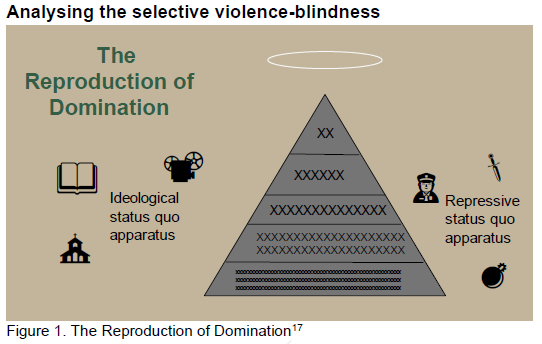
The above image, loosely adapted from Erlander's (1992) Manna and Mercy,18 provides a framework through which to analyse some of the ideas that I engage here. The pyramid is a broad strokes representation of a typical contemporary society's population depicting the unequal and hierarchical power relations present. The large and highly populated base is emblematic of the economically and otherwise marginalised majority upon whose labour the society largely depends. The small and minimally populated peak represents the wealthy minority. The middle layers of the pyramid represent those who find themselves somewhere in between these extremes. In essence, the pyramid depicts a reality where certain groups have power and means, and other do not, and where the privilege of some groups is tied into the oppression and exploitation of others. Most importantly for the purposes of the framework, the image makes the case that these unequal realities are sustained by the mechanisms depicted on the left and right.
I refer to the mechanism on the left as the ideological status quo apparatus. This draws from Louis Althusser's conceptualisation of the "ideological state apparatus"19. This concept formed a key aspect of Althusser's analytical framework that sheds light on the mechanisms through which capitalist society is reproduced.20 Within this framework, the ideological state apparatus creates the conditions for such reproduction ideologically, working through a range of institutions (the church, the classroom, the family etc.) to legitimise and normalise the capitalist structures of society along with its relations of exploitation and domination.
For purposes of decentering the state and making discursive space for the broad range of actors, sites, and institutions that do this work of ideological normalisation, I have renamed this the "ideological status quo apparatus". Embodied within this apparatus are all of the discursive, cultural, ideological, and theological mechanisms that legitimise and normalise the societal status quo with all of its dynamics of exploitation and domination. This apparatus is akin to what Palestinian theologian Mitri Raheb, in his analysis of how Israeli apartheid and occupation is upheld, conceptualises as the "software" that works to sustain the "hardware" of the occupation.21 As the image shows, the divine is also frequently appropriated as part of this software in service of the status quo with claims made that this reality is God-ordained.
Drawing again from Althusser, depicted on the right side of the image is what I am conceptualising as the repressive status quo apparatus. This embodies all of the institutions that function to maintain the status quo through violence and repression. This includes systems of police, military, and private security. These mechanisms are always present in various ways, but more actively come into play when the ideological status quo apparatus fails to maintain the social order.
Returning to the analysis of selective violence-blindness in "the word" and "the world", within this framework the three factors discussed below (coloniality, grand narratives, and discourses of the powerful) function as part of the ideological status quo apparatus doing the work of legitimising and sustaining the deeply unjust, unequal, and violent status quo.
Coloniality
The first factor that functions to enable and sustain the two phenomena under inspection is what scholars have conceptualised as coloniality. Coloniality refers to the lingering structures and relations of power that persist following political decolonization.22 The particularities of these power dynamics are Western or Euro-centric, White supremacist, patriarchal, classist/capitalist, and heteronormative.23 In a society characterised by coloniality, such ideas are hegemonic,24 reproduced in various ways through various sites. Through these processes of reproduction, these ideas, often subconsciously, become the lenses, ideologies, and worldviews through which readers of "the word" and "the world" understand and interpret these "texts". A failure to interrogate and challenge these lenses results in readings of "the word" and "the world" that are inherently racist, classist, sexist, homophobic, and other-phobic (with "other" referring to anyone outside of what is understood as Western); readings that favour and create positive associations with whiteness, maleness, West-ness, straight-ness, and wealth. These racist, classist, and patriarchal lenses are likely responsible, at least in part, for the fact that many readers of Genesis 16:1-16 do not bat an eyelid at the gendered and sexual violence present because the body bearing the brunt of it is simultaneously that of a foreign "other" (in terms of how she is presented in the story), a woman, and an enslaved person.25These colonial lenses enable selective violence-blindness through diminishing Hagar's humanity and deeming her story as unimportant and the violence enacted upon her as unworthy of outrage, attention, or even notice.
Another effect of these colonial lenses facilitating this kind of selective violence-blindness is what they allow or enable regarding how readers read themselves into the biblical text and which characters they identify with. Here, colonial lenses often function in tandem with the positionality of the reader as well as a lack of social analysis, allowing the reader to claim whatever position in the text benefits them at that point in time. In this regard, Masalha describes the way the story of David and Goliath is deployed in Israeli discourse, where it is presented "as a battle between a 'Jewish David and an Arab Goliath'"26. In this example, the racist and Orientalist27 lenses frame Palestine as the dangerous, powerful, and inhuman other, while Israel is framed as the innocent and powerless underdog, prevailing over the enemy against all odds. Such a reading is enabled only by a severe failure of social analysis that makes invisible Israel's actual position as settler colonial occupying power, supported and sustained by massive amounts of Western resources of all kinds.
Such a misidentification and misreading obscures and invisibilises the true nature of the violence occurring, enabling a dangerous "unseeing" of certain violences. The 1985 South African Kairos Document's28 analysis of church theology and violence is relevant here. The document critiques the Church's so-called commitment to non-violence. It argues that this stance was inconsistent, illustrated the Church's overt condemnation of violent popular resistance to the apartheid state, in tandem with its concurrent tacit support and legitimation of the apartheid military by sending chaplains to serve within it. In this, the document recognises and highlights another case of selective violence-blindness, that of the failure to see and recognise the violence that was being enacted upon the bodies of the black, non-Western "other". This shows, again, that coloniality, alongside certain positionalities and failures of social analysis, determines the kinds of violences that are seen and counted as violence and those that are not.
The above makes the case that coloniality obscures an accurate reading of "the word" and "the world", rendering certain forms of violence unseen and invisible. Thus, it should follow that decolonial commitments and orientations should assist in removing these blinders, enabling a more accurate "seeing" of this violence. In this regard, it is important to acknowledge the scholars of black, womanist, and Palestinian liberation theology (which, I would argue, are inherently decolonial disciplines) who have done crucial work both within the biblical text and in society in recognising, foregrounding, and making visible some of this obscured violence.
In this regard, Weems overtly names Genesis 16:1-16 and the story of Hagar held within as "a story of exploitation and persecution suffered by an Egyptian slave woman at the hands of her Hebrew mistress".29 Indeed, Phyllis Trible recognises the relationship between Sarai and Hagar as an oppressive one, marked by significant power differentials and overtly recognises the abuse of Hagar by Sarai, stating that "for Sarai, Hagar is an instrument, not a person".30 Along the same lines, Okuye names Sarai's treatment of Hagar as "oppression".31 Williams, also, importantly names Abram's actions towards Hagar as rape,32 as does Musa Dube, recognising that these actions "did not include consulting Hagar or getting her consent".33Finally, regarding the instruction from the so-called messenger of the Lord to Hagar to return to her abuser, Trible does not shy away from naming this as "a divine word of terror",34 acknowledging the violence inherent within it. In these readings, womanist authors also "offer readings of Hagar that create parallels with contemporary women"35 promoting "the notion of an intimate relationship between biblical Hagar and Black women".36
In a similar fashion, the work of Palestinian scholars highlights and foregrounds the oft obscured and invisibilised violence enacted upon Palestinians, challenging the colonial orientations that enable such invisibilisation. An example of this can be seen in scholars' refusal of the Zionist notion of Palestine as "a land without people for a people without a land" by emphasizing the invisibilised reality that long prior the creation of the state of Israel, Palestine was a "multi-ethnic, multicultural, and multireligious region",37 home to a vast and diverse people for generations. Similarly, Isaac overtly names racism and white supremacy as part of the structure enabling and sustaining the colonial theology of Christian Zionism that, on the one hand, justifies, legitimises, and sacralises Israeli settler colonialism and, on the other, invisibilises and justifies the oppression and ethnic cleansing of Palestinians.38 Nadera Shalhoub-Kevorkian exposes an additional layer of this invisibilisation of Palestinian suffering by highlighting the gendered dimension of Israeli settler-colonialism. She explores the ways "in which hegemonic economic, political, and patriarchal powers, including the mass media, ostracize Palestinian women and reproduce oppressive gender politics".39 In response to this invisibilisation, Shalhoub-Kevorkian explicitly highlights the violence that has been rendered unseen, as well as Palestinian women's resistance to this colonial subjection. Such decolonial interventions centre and insist upon a recognition and rejection of the violence enacted on Palestinians, invisibilised and justified by so many Christians across the globe.
What is it about these authors and their work that enables and even necessitates a naming and insistence on seeing the violence within "the word" and "the world" that many Christians cannot see, choose not to see, or make invisible? One explanation relates to the decolonial epistemological commitments and orientations of Palestinian, black, and womanist theologies. Black theology, Palestinian liberation theology, and black feminist scholarship position the oppressed and marginalised subject as the hermeneutical starting point in reading scripture or reading the world.40 Such an orientation refuses the hegemonic colonial lenses reproduced through various sites and mechanisms and allows for and insists upon the seeing and recognition of the violence enacted upon the othered woman's body within the Genesis text, and the Palestinian body in Gaza. Another explanation relates to the positionality of the authors. The authors' experience of occupying oppressed or marginalised identities enables them to see those who similarly occupy oppressed or marginalised identities within "the word" and "the world" in a way that those in positions of privilege often fail to do.41
Theological grand narratives
Another important factor enabling and facilitating selective violence-blindness in the biblical text and society at large relates to the internalized overarching narratives of the "reader" that shape the interpretations of all that is "read". When looking at both "the word" and "the world", these stories or narratives (often subconscious) govern and determine what is seen and unseen.
When it comes to violence-blindness in the story of Hagar, one of these theological grand narratives that plays a key role is the idea of God as good. This narrative causes the reader to conclude that anything that God is said to do or say in the text must be good or, at the very least, okay and justifiable.
In this way, when God is said to instruct Hagar to return to her abuser,42 the failure to see comes into play and the reader is unable to recognise this as what Trible refers to as terror, because they are told that God said it and, therefore, must be good or, at least, justifiable. This plays out similarly, as Raheb notes, in the reading of the genocide and settler colonialism that unfolds in the book of Joshua.43 This inhumane violence, which would go against any interpretation of international law today, is unseen, rendered invisible, or even deemed good because the God who is said to have ordered it has to be good. As an aside, the mental gymnastics required to hold these impossible tensions (and the impact of this) is another important dynamic that needs an analysis all of its own.
Another of these overarching narratives that relates particularly to the Hagar story is the idea that God is faithful and keeps Their promises. In light of this, anything done in the name of this faithfulness, even if that comprises of violence, abuse, and dehumanisation, is minimised and legitimated, because of ultimate importance is that God's promises will come to pass and God is proven faithful. Itumeleng Mosala's work on the Bible as a site of struggle is useful in thinking about this, particularly his assertion that "not every God of every biblical text is on the side of the poor".44 This intervention refuses a reading of the Bible through any overarching narrative and recognises that many things are going on within this text that are, at times, in opposition to each other.
An aspect of these theological grand narratives that prohibits the reader from seeing, recognizing, and condemning violence in the text, is the orientation of entering "the word" and "the world" with a concrete sense of predetermined heroes and villains. Often, through deep socialization, Christian readers will, upon entering into the Genesis story, largely have a pre-conceived clarity that Abraham is the story's hero. Therefore, when Abraham is complicit in enacting violence, this is dismissed as something not requiring attention or outrage and, in fact, particularly if the violence is going to move the hero closer to their destination, it has the reader's full support. Sarojini Nadar illustrates this dynamic powerfully in her analysis of the justification of the genocide of the Persian people in the book of Esther.45Through a reading that designates Esther as the story's hero, the massacre of 75,000 ethnic and racial "others" is at best invisibilised and, at worst justified, celebrated and even sacralised, as Nadar's "sacred economies of violence" framework shows.
It does not take much to close the distance between what is going on in these readings of scripture, and what is going on in the reading of Israel's genocide in Gaza. In the same way that Abraham is the predetermined hero in the Genesis text, Israel is the predetermined hero in the text of the Holy Land.46 One of the grand narratives that plays a part in this is dispensationalism and end times theologies that believe that, for Jesus to return, the state of Israel must occupy the Holy Land in its totality.47 This is the end point of the hero's journey and, thus, whatever must be done to get there is, at best, justifiable and rendered invisible and, at worst, celebrated and deemed good. Once again, Israel is David, a hero chosen by God for a time and purpose such as this, and Palestine is Goliath, the villain who seeks to get in the way of the hero's destination and must be resisted and destroyed at all costs.
These grand narratives determine what the reader is able to see and what remains obscured in their readings of both "the word" and "the world". They allow readers to gloss over and render unimportant or even justifiable the violence enacted against an enslaved foreign woman in the biblical text and, in the same vein, the violence against Palestinians in Gaza.
Failure to recognise discourses as sites of struggle
The failure to recognise certain powerful discourses as sites of struggle is an additional and important factor that allows violence within "the word" and "the world" to go unseen or be rendered invisible.
An important source of such powerful discourse is the Bible. In the 1980s in South Africa, Itumeleng Mosala critiqued the church, and even many of his fellow black liberation theologians, for their uncritical acceptance of the Bible as "simply the revealed "Word of God".48 He argued that in black theology at the time, while there was clear acknowledgement that biblical interpretation was a site of struggle or contestation, the Bible itself was seen as "uncritiquable" terrain. Within this framing, the site of struggle was at the level of interpretation rather that at the level of the text. The Bible was (and still is by many) believed to be a text of liberation, as long as it was interpreted correctly. This could, in fact, be seen as another "grand narrative" that disables a recognition of the ways in which the Bible itself is a site of injustice. The injustices present within or that result from the text, whether cases of violence or cases where the Bible's discourse represents elite interests, are swept under the rug or repositioned as just and good.
To counter this tendency, Mosala characterises the Bible itself as a site of struggle, carrying both strands of oppression and liberation and argues that for the bible to become liberating for the oppressed, the text needs to be liberated.49 Raheb's work is consistent with this understanding of the Bible as a site of struggle. Specifically, regarding the ways in which scripture has been mobilised in service of Israel's settler colonial project (as well as other settler colonial projects), he notes that, not only can the realm of biblical interpretation be problematic, but "the biblical texts themselves are very troublesome".50 He points particularly to the book of Joshua, terming it "the blueprint par excellence of a settler colonial ideology and theology".51 Such a framing similarly necessitates the liberation of the text of which Mosala speaks.
This work of liberating the text is broad but, in part, involves paying attention to and reading the power struggles within the biblical text itself listening for the voices that have been marginalised, silenced, or redacted and reading contemporary struggles for justice into these intra-textual struggles. In Mosala's words, "the category of struggle at all levels and through various phases of black history should be taken as the key hermeneutical factor".52With this starting point, Mosala's work
seeks to probe the nature of the struggles behind and beneath the text; the struggles in the pages, the lines, and the vocabulary of the text; the struggles that take places when readers engage the text by way of reading it; and the struggles that the completed text represents.53
This approach recognises and foregrounds the real social and material conditions out of which the text is produced, as well as the material and social conditions into which the text is inserting itself and being read. In thinking about the Hagar story, such an approach would necessitate the making visible of the power relations and power struggles present (and silenced) within the text. This approach would name and expose the neutralised language that obscures the significance of the violence enacted against Hagar, such as Genesis 16:4 that, rather than naming Abram's actions as rape, simply states that he "went in to Hagar",54 or Genesis 16:6 that, rather than detailing Sarai's abusive actions towards Hagar, simply says that "Sarai dealt harshly with her".55 Hagar's person and story become foregrounded and the oppressive violence that she faces become very visible. This, in turn, necessitates the foregrounding of the contemporary struggles that are present with us and the ways in which oppressive violence is taking place in our society today.
In terms of Gaza, various powerful theological and social discourses, aside from the Bible, that are disseminated in churches, media outlets, education institutions, and other such sites that form part of the ideological status quo apparatus, act to enable violence-blindness in the face of Israel's genocidal violence. These dominant discourses do the work of misrepresentation painting Israel as "good" and Palestine as "bad". In this regard, many have commented on the vast differences between the ways in which media outlets have represented the violence enacted by Palestinians versus the violence enacted by Israel in the current moment as well as in the past.56 These tendencies can also be seen in the way in which October 7th has been depicted as the start of the so-called "conflict", discursively painting over Israel's long history of violent settler-colonialism. Moreover, this can be seen in churches through the prevalent injunction to pray for Israel, alongside the implied notion that blessing Israel will result in being blessed and cursing Israel will result in being cursed.57 It also operates through discourses like that previously mentioned of Palestine being "a land without people", or the idea that Jews are the original and rightful inhabitants of Palestine.
Taken uncritically and misunderstood as not being sites of struggle result in unquestioning support of the state of Israel and its actions, through their rendering of the genocidal violence carried out in Gaza as invisible, unworthy of attention or outcry, and even justifiable and good. However, recognising them as sites of struggle would force questions around power: whose voices are silenced in these discourses? Who benefits from these discourses? Where are the alternate discourses and what are they saying? Why have the alternate discourses been so marginalised and silenced?
Again, in Mosala's words, for a reading of any discourse that gives an accurate story of the power dynamics at play, struggle must be "the key hermeneutical factor".58 In the absence of this, dominant texts or discourses, whether these are in the Bible, in the media, in churches, or any other sites, will enable and sustain the unseeing of injustices and violences against those on the margins.
Conclusion
All of these factors allow and facilitate a selective violence-blindness pertaining to violence taking place within the biblical text as well as within society more broadly. This enables a normalization, justification, and acceptance of such violence.
The two phenomena laid out in this article of selective violence-blindness in "the word" and "the world" are deeply connected in terms of both the factors that enable and sustain them, as shown above, as well as the ways in which they influence one another. This kind of unseeing and ability to invisibilise and ignore violence within the story of Hagar is not separate from the ways in which Christian theology functions to provide legitimisation and support, or at the very least permission, for Israel's violence, apartheid, settler colonialism, and now genocide. In fact, I argue that what one can justify (or invisibilise or ignore) in the Bible, one can justify (or invisibilise or ignore) in real life and vice versa. The dynamic illustrated previously regarding the reading of Hagar's story sheds light on a dynamic that has much wider implications than simply relating to practices of reading the Bible: that the invisibilising or unseeing of violence in scripture makes possible and facilitates the invisibilising or unseeing violence in the world.
In my analysis, I have shown and expounded on three factors that are central to the enabling and sustaining of these phenomena. First, coloniality and the hermeneutical lenses that it imposes on readings of "the word" and "the world". Second, the grand narratives that become hermeneutical determinants of all that is read within these two sites. And third, the failure to recognise dominant discourses, whether biblical texts or those disseminated through other sites of socialisation, as sites of struggle through which power is always being enacted and in which clashes of power are always taking place. These factors create the conditions in which the violence enacted upon Hagar and the violence enacted within Gaza can go unnoticed and/or accepted.
In a recent interview, when asked his opinion on why, even with such rich histories and legacies of black and liberation theologies, the South African Church continuously fails to challenge the various forms of injustice present in society, Itumeleng Mosala posits that this is because "We haven't audited colonialism, oppression, and apartheid... We haven't signed divorce papers on colonialism, and same with colonial theology".59 Classifying this as an auditing failure is useful. There is today a widespread awareness of the entanglement of colonialism and Christian mission across the globe, but the Church has largely failed to do the work of understanding the depths and specifics of this entanglement and the subsequent painstaking work of disentanglement necessary for a truly liberating faith. This auditing failure has resulted in a failure to acknowledge the ways in which coloniality lives on and shapes widespread (mis)readings of "the word" and "the world", determining what is seen and what goes unseen. Essentially, this auditing failure has resulted in a theology that, theoretically, positions itself in opposition to violence and injustice but for various reasons like the factors analysed above, in reality, works to covertly uphold the violence and injustice that it claims to oppose.
In this paper I have explored a dynamic that is integral to the function of such a theology, the dynamic of which I am thinking about as selective violence-blindness, within the sacred text but, more importantly, with devastating implications outside of this as well. I have also explored how various decolonial thinkers and scholars have combatted the factors enabling the unseeing of violence. In many ways, this boils down to questions about power and to the deliberate centering of voices, stories, and discourses of the oppressed, whether this is choosing to centre and listen to Hagar in the Genesis 16:1-16 narrative or choosing to centre and listen to Palestinians under Israeli occupation.
References
- African Christian Democratic Party. "ACDP participates in peace mission to Israel." Online Blog, 27 March 2024.
- Althusser, Louis. On the Reproduction of Capitalism: Ideology and Ideological State Apparatuses. Verso, 2014.
-
Aouragh, Miriyam. "Hasbara 2.0: Israel's Public Diplomacy in the Digital Age." Middle East Critique, 25, no.3 (2016): 271-297. Available at: https://doi.org/10.1080/19436149.2016.1179432
» https://doi.org/10.1080/19436149.2016.1179432 - Ateek, Naim. S. A Palestinian Theology Of Liberation: The Bible, Justice, and the Palestine-Israel Conflict. Orbis Books, 2017.
- Bidet, Jaques. Introduction: An Invitation to Reread Althusser. In On the Reproduction of Capitalism: Ideology and Ideological State Apparatuses, by Louis Althusser, xix-xxviii. Verso 2014.
-
Crump, Daniel M. "Echoes of Slavery, Racial Segregation and Jim Crow: American Dispensationalism and Christian Zionist Bible-Reading." Journal of Holy Land and Palestine Studies, 23, no.1 (2024): 1-17. Available at: https://doi.org/10.3366/hlps.2024.0324
» https://doi.org/10.3366/hlps.2024.0324 - Dube, Musa. "And Sarah Laughed-Observations on Bible, Aging and Postcoloniality." In Religion and Aging: Intercultural Explorations. Edited by Andrea Bieler, Matthias Stracke-Bartholmai, Angelika Veddeler. 121-138, Leipzig: Evangelische Verlagsanstalt, 2017.
- Erlander, Daniel. Manna and Mercy: A Brief History of God's Unfolding Promise to Mend the Entire Universe. Augsburg Fortress, 2018.
-
Falah, Ghazi-Walid. "The Portrayal of Palestinian and Israeli Suffering and Violent Incidents in Selected US Daily Newspapers." Journal of Holy Land and Palestine Studies, 22, no. 1(2023): 65-92. Available at: https://doi.org/10.3366/hlps.2023.0305
» https://doi.org/10.3366/hlps.2023.0305 - Feinberg, Tali. "Christian protesters - victims of violence outside Parliament." Jewish Report, 9 November 2023.
- Freire, Paulo. "Reading the World and Reading the Word: An Interview with Paulo Freire." Language Arts 62, no.1 (1985): 15-21
- Gamedze, Thandi. Figure 1. The Reproduction of Domination, 2025
- Gramsci, Antonio. Selections from the prison notebooks: The Civil Society Reader New York: International Publishers, 2003.
-
Grosfoguel, Ramon. "The epistemic decolonial turn: Beyond political-economy paradigms." Cultural Studies 21, no. 2-3 (2007): 211-223. Available at: https://doi.org/10.1080/09502380601162514
» https://doi.org/10.1080/09502380601162514 - Gunner, Goran and Smith, Robert. O. Comprehending Christian Zionism: Perspectives in Comparison. Fortress Press, 2014.
- hooks, bell. Feminist Theory from Margin to Center. South End Press, 1984.
- Hummel, Daniel. (2017). "The New Christian Zionism." First Things: A Monthly Journal of Religion and Public Life (2017): 9-11.
- ICEJSA. "SA Stands with Israel - Rallies - 12 & 19 Nov 2023." ICEJ Website, 5 November 2023.
- Isaac, Munther. "On the Use of Religion by Right-Wing Israeli and Christian Groups." In Resisting Exclusion: Global Theological Responses to Populism. Edited by Simone Sinn and Eve. Harasta, 181-188. The Lutheran World Federation, 2019.
- Isaac, Munther. Christ in the Rubble: Faith, the Bible, and the Genocide in Gaza. Eerdmans, 2025.
- Junior, Nayasha. Reimagining Hagar: Blackness and Bible. Oxford University Press, 2019.
-
Masalha, Nur. "Reading the Bible with the eyes of the Canaanites: Neo-Zionism, political theology and the land traditions of the Bible (1967 to Gaza 2009)." Holy Land Studies 8, 1 (2009): 55-108. Available at: https://doi.org/10.3366/E1474947509000407
» https://doi.org/10.3366/E1474947509000407 -
Mignolo, Walter D. "Introduction: Coloniality of power and de-colonial thinking." Cultural Studies, 21, no. 2-3 (2007): 155-167. Available at: https://doi.org/10.1080/09502380601162498
» https://doi.org/10.1080/09502380601162498 - Mosala, Itumeleng J. Biblical Hermeneutics and Black Theology in South Africa. William B. Eerdmans Publishing Company, 1989.
- Mosala, Itumeleng J. Interview with author, 2021.
- Nadar, Sarojini. "Stories are data with soul": Lessons from black feminist epistemology." In Routledge Handbook of Contemporary Feminism. Edited by Tasha Oren and Andrea L. Press, 34-45. Routledge, 2019.
-
Nadar, Sarojini. Gender, Genocide, Gaza and the Book of Esther. Routledge, 2025. Available at: https://doi.org/10.4324/9781003543367
» https://doi.org/10.4324/9781003543367 -
Ndlovu-Gatsheni, Sabelo. J. Empire, Global Coloniality and African Subjectivity. Berghahn Books, 2013. Available at: https://journals.co.za/content/latamrep/31/2/EJC197280
» https://journals.co.za/content/latamrep/31/2/EJC197280 -
Okoye, James C. "Sarah and Hagar: Genesis 16 and 21." Journal for the Study of the Old Testament 32, no. 2(2007): 163-175. Available at: https://doi.org/10.1177/0309089207085881
» https://doi.org/10.1177/0309089207085881 - Palestinian Christians. "A Call for Repentance: An Open Letter from Palestinian Christians to Western Church Leaders and Theologians." Global Ministries, 21 October 2023
- Raheb, Mitri. Faith in the Face of Empire: The Bible through Palestinian Eyes. Orbis Books, 2014.
- Raheb, Mitri. Decolonizing Palestine: The Land, The People, The Bible. Orbis Books, 2024.
- Rosenthal, Philip. "SA Christian leaders oppose ANC's govt's genocide case against Israel." Politicsweb, 2024.
- Said, Edward. Orientalism. 5th edition. Penguin Books, 2003.
-
Saiya, Nilay. "Onward Christian Soldiers: American Dispensationalists, George W. Bush and the Middle East." Holy Land Studies, 11, no. 2 (2012): 175-204. Available at: https://doi.org/10.3366/hls.2012.0044
» https://doi.org/10.3366/hls.2012.0044 - Shalhoub-Kevorkian, Nadera. Militarization and Violence against Women in Conflict Zones in the Middle East: A Palestinian Case Study. Cambridge University Press, 2009.
- Tamez, Elsa. The Woman Who Complicated the History of Salvation in New Eyes for Reading: Biblical and Theological Reflections by Women from the Third World, ed. John S. Pobee and Barbel von Wartenberg-Potter. World Council of Churches, 1986.
- Trible, Phyllis. Texts of terror: Literary-Feminist readings of Biblical narratives. Fortress Press, 1984.
-
Wang, Cynthia. "Victimhood in the Face of Media Ideological Battle: A Critical Discourse Analysis on the British Media's Coverage of Stabbing Incidents in the Israeli-Palestinian Conflict." Journal of Holy Land and Palestine Studies 16, no. 1 (2017): 79-98. Available at: https://doi.org/10.3366/hlps.2017.0153
» https://doi.org/10.3366/hlps.2017.0153 - Weems, Renita. Just a Sister Away: Understanding the Timeless Connection between Women of Today and Women in the Bible. 2nd edition. Warner Books, 2005.
- Williams, Delores. Sisters in the Wilderness: The Challenge of Womanist God. Orbis Books, 2013.
Acceptance date 18/12/2025
1 I recognise the cautions that disability studies scholars have raised regarding the use of blindness as a metaphor. In this article, however, I use this term analytically to highlight the phenomenon of the seemingly widespread inability to see certain forms of violence perpetrated against certain bodies.
2 Paulo Freire (1985). "Reading the World and Reading the Word: An Interview with Paulo Freire." Language Arts, 62, no.1 (1985): 15-21
3 It is useful to see this phenomenon on a spectrum, from selective violence blindness, where particular forms of violence enacted against certain bodies actually go unseen, to selective violence justification where the violence enacted against certain groups are seen and recognised, and, in this, supported and legitimized. Along the spectrum, this phenomenon has the effect of enabling violence against certain bodies, however, what differs is the level of consciousness and intention with which this is done.
4 Ramón Grosfoguel, "The epistemic decolonial turn: Beyond political-economy paradigms," Cultural Studies 21, no.2-3 (2007): 211-223. Available at: https://doi.org/10.1080/09502380601162514. Grosfoguel defines coloniality as "the continuity of colonial forms of domination after the end of colonial administrations" (219) captured in the "multiple and heterogeneous global hierarchies ('heterarchies') of sexual, political, epistemic, economic, spiritual, linguistic and racial forms of domination and exploitation" (217).
5 bell hooks, Feminist Theory from Margin to Center. (South End Press, 1984)
6 Itumeleng J. Mosala, "Biblical Hermeneutics and Black Theology in South Africa," (PhD diss. University of Cape Town, 1987).
7 Genesis 16:1-16, New Revised Standard Version
8 Phylis Trible, Texts of terror: Literary-Feminist readings of Biblical narratives. (Fortress Press, 1984). Trible sheds light on the reality depicted by these easily skipped over words. She makes the case that this is a strong description, "connoting harsh treatment" that parallels "the sufferings of the entire Hebrew population in Egypt" under the Pharoah's enslavement. Trible goes as far as to say that the description "depicts the torture of a lone Egyptian woman in Canaan, the land of her bondage to the Hebrews" (36).
9 These dynamics have been deeply explicated by authors like Trible in Texts of Terror: Literary-Feminist Readings of Biblical Narratives, Renita Weems, Just a Sister Away: Understanding the Timeless Connection between Women of Today and Women in the Bible. 2nd edition. (Warner Books, 2005, Elsa Tamez in her chapter The Woman Who Complicated the History of Salvation in New Eyes for Reading: Biblical and Theological Reflections by Women from the Third World, ed. John S. Pobee and Barbel von Wartenberg-Potter (World Council of Churches, 1986), and Delores Williams, Sisters in the Wilderness: The Challenge of Womanist God. (Orbis Books, 2013).
10 Tali Feinberg, "Christian protesters - victims of violence outside Parliament," (South African Jewish Report, 9 November 2023).
11 ICEJSA. "SA Stands with Israel - Rallies - 12 & 19 Nov 2023," (ICEJ Website, November 5, 2023).
12 African Christian Democratic Party. "ACDP participates in peace mission to Israel," (Online Blog, March 27, 2024)
13 Philip Rosenthal, "SA Christian leaders oppose ANC's govt's genocide case against Israel," (politicsweb, 2024).
14 Palestinian Christians. "A Call for Repentance: An Open Letter from Palestinian Christians to Western Church Leaders and Theologians," (Global Ministries, 21 October 2023).
15 Munther Isaac, Christ in the Rubble: Faith, the Bible, and the Genocide in Gaza. (Eerdmans, 2025).
16 Of course, this violence-blindness is not restricted to Christians, but I specify, here, as this is the particular phenomenon that I am analysing.
17 Thandi Gamedze, Figure 1. The Reproduction of Domination, 2025
18 Daniel Erlander, Manna and Mercy: A Brief History of God's Unfolding Promise to Mend the Entire Universe. (Augsburg Fortress, 2018).
19 Louis Althusser. On the Reproduction of Capitalism: Ideology and Ideological State Apparatuses. (Verso, 2014).
20 Jaques Bidet, "Introduction: An Invitation to Reread Althusser," in On the Reproduction of Capitalism: Ideology and Ideological State Apparatuses, by Louis Althusser. (Verso, 2014).
21 Mitri Raheb, Faith in the Face of Empire: The Bible through Palestinian Eyes. (Orbis Books, 2014).
22 Grosfoguel "The epistemic decolonial turn", 219. See also, Walter D. Mignolo, "Introduction: Coloniality of power and de-colonial thinking," Cultural Studies, 21, no. 2-3 (2007): 155-167. https://doi.org/10.1080/09502380601162498
23 Sabelo J. Ndlovu-Gatsheni, Empire, Global Coloniality and African Subjectivity. (Berghahn Books, 2013). Available at: https://journals.co.za/content/latamrep/31/2/EJC197280
24 Antonio Gramsci, Selections from the prison notebooks: The Civil Society Reader, (New York: International Publishers, 2003) 190-202.
25 See Trible, Texts of Terror, 9-36 ; Weems, Just a Sister Away, 1-22; Williams, Sisters in the Wilderness, 15-33.
26 Dur Nur Masalha, "Reading the Bible with the eyes of the Canaanites: Neo-Zionism, political theology and the land traditions of the Bible (1967 to Gaza 2009)," Holy Land Studies, 8, no.1 (2009): 67. Available at: https://doi.org/10.3366/E1474947509000407
27 Edward Said, Orientalism, 5th edition. (Penguin Books, 2003)
28 The South African Kairos Document was written in 1985 within the context of a deeply and increasingly repressive apartheid state. The document was framed as a challenge to the church, theorising the church and theology as sites of struggle and critiquing the kinds of theology emerging from the South African church for the role that these were playing in upholding the repressive apartheid status quo.
29 Weems, Just a Sister Away, 1.
30 Trible, Texts of Terror, 34
31 James C.Okoye, (2007). Sarah and Hagar: Genesis 16 and 21. Journal for the Study of the Old Testament, 32, no.2 (2007): 168. Available at: https://doi.org/10.1177/0309089207085881
32 Williams, Sisters in the Wilderness.
33 Musa Dube, "And Sarah Laughed-Observations on Bible, Aging and Postcoloniality," in Religion and Aging: Intercultural Explorations, edited by Andrea Bieler, Matthias Stracke, Angelika Veddeler, 121-138 (Leipzig: Evangelische Verlagsanstalt, 2017) 131.
34 Trible, Texts of Terror, 38
35 Nyasha Junior, (2019). Reimagining Hagar: Blackness and Bible. (Oxford University Press, 2019), 108.
36 Junior, Reimagining Hagar, 69
37 Raheb, Decolonizing Palestine, 60
38 Munther Isaac, "On the Use of Religion by Right-Wing Israeli and Christian Groups," in Resisting Exclusion: Global Theological Responses to Populism, edited by Simone Sinn and Eve Harasta, 181-188. (The Lutheran World Federation, 2019).
39 Nadera Shalhoub-Kevorkian, Militarization and Violence against Women in Conflict Zones in the Middle East: A Palestinian Case Study. (Cambridge University Press, 2009).
40 Naim Ateek, A Palestinian Theology Of Liberation: The Bible, Justice, and the Palestine-Israel Conflict. (Orbis Books, 2017). See also Itumeleng Jerry Mosala, Biblical Hermeneutics and Black Theology in South Africa. (William B. Eerdmans Publishing Company, 1989); Sarojini Nadar, "'Stories are data with soul': Lessons from black feminist epistemology," in Routledge Handbook of Contemporary Feminism, edited by Tasha Oren and Andrea Press, 34-45. (Routledge, 2019).
41 As an important disclaimer, it is essential to note that occupying oppressed or marginalised identities in no way makes a decolonial orientation inevitable. This is where Gramsci's theory of hegemony is useful (Gramsci, 2003). It shows the ways in which ideas that benefit society's powerful are normalised and positioned as common sense and, thus, taken on, accepted, and internalised by even those who are oppressed by these ideas. On the flip side, it is also important to note that occupying a privileged identity does not make a decolonial orientation impossible.
42 Trible, Text of Terror, 15-16
43 Raheb, Decolonizing Palestine, 53-92
44 Mosala, Biblical Hermeneutics, 8
45 Sarojini Nadar, Gender, Genocide, Gaza and the Book of Esther. (Routledge, 2025). Available at: https://doi.org/10.4324/9781003543367
46 This is the position deeply held in Christian Zionism and is widespread within the evangelical church in the United States as well in the Western world more broadly and increasing rapidly in the global South See (David M. Crump, "Echoes of Slavery, Racial Segregation and Jim Crow: American Dispensationalism and Christian Zionist Bible-Reading," Journal of Holy Land and Palestine Studies, 23, no. 1 (2024): 1-17. Available at: https://doi.org/10.3366/hlps.2024.0324; Göran Gunner and Robert O. Smith, Comprehending Christian Zionism: Perspectives in Comparison. (Fortress Press, 2014); Nilay Saiya, "Onward Christian Soldiers: American Dispensationalists, George W. Bush and the Middle East," Holy Land Studies 11, no. 2 (2012): 175-204. Available at; https://doi.org/10.3366/hls.2012.0044).
47 Crump, "Echoes of Slavery", 3-7 . See also, Saiya, 176-179"Onward Christian Soldiers",
48 Mosala, Biblical Hermeneutics, 5
49 Mosala, Biblical Hermeneutics, 4
50 Raheb, Decolonizing Palestine, 65
51 Raheb, Decolonizing Palestine, 65
52 Mosala, Biblical Hermeneutics, 6
53 Mosala, Biblical Hermeneutics, 6-7
54 Genesis 16:4 NRSV
55 Genesis 16:6 NRSV
56 See Miriyam Aouragh, "Hasbara 2.0: Israel's Public Diplomacy in the Digital Age," Middle East Critique, 25, no. 3 (2016): 271-297. Available at: https://doi.org/10.1080/19436149.2016.1179432; Ghazi-Walid Falah, "The Portrayal of Palestinian and Israeli Suffering and Violent Incidents in Selected US Daily Newspapers," Journal of Holy Land and Palestine Studies, 22, no. 1 (2023): 65-92. Available at: https://doi.org/10.3366/hlps.2023.0305; Cynthia Wang, "Victimhood in the Face of Media Ideological Battle: A Critical Discourse Analysis on the British Media"s Coverage of Stabbing Incidents in the Israeli-Palestinian Conflict," Journal of Holy Land and Palestine Studies, 16, no. 1 (2017): 79-98. Available at: https://doi.org/10.3366/hlps.2017.0153
57 Daniel Hummel "The New Christian Zionism." First Things: A Monthly Journal of Religion and Public Life, (2017): 9-11.
58 Mosala, Biblical Hermeneutics, 6
59 Interview with Itumeleng Mosala by author (2021)