A Conceptual Framework for National Dialogues: Applied Theories and Concepts
Abstract
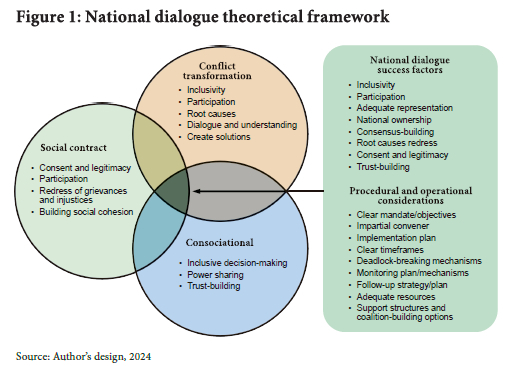
National dialogues are increasingly recognised as vital tools for resolving political conflicts, fostering state- and nation-building, enhancing social cohesion, and facilitating peaceful socio-economic and political transformation. Despite a growing body of literature examining national dialogues and their outcomes, there remains a gap in understanding their theoretical underpinnings and conceptualisations. This article addresses this gap by conducting a discursive analysis offering an alternative theoretical framework for national dialogues, drawing on three theories: social contract, consociationalism, and conlict transformation. Using secondary data from scholarly journals, reports, political agreements, and documented policies and strategies, this article assesses the theories' applicability in developing a robust conceptual framework for national dialogues. An analysis of each theory demonstrates that, while they approach peacebuilding from different angles, they share unique and common themes such as participatory governance, addressing root causes, and building trust and cooperation, which are essential in designing and implementing successful national dialogues. Leveraging the unique elements of each theory, the observed insights provide a more comprehensive approach to planning and implementing national dialogues, even in diverse socio-economic and political contexts. The findings' implications are pertinent to scholars in the field of peace studies, governments, political entities, civil society organisations, and international stakeholders engaged in national dialogue processes.
National dialogue; consociationalism; social contract theory; conceptual framework; political crisis; peacebuilding
 Thumbnail