Migrant Women in the Labor Force in South Africa: A Mixed-Methods Analysis
Abstract
Migrant women's participation in the labor force is shaped by intersecting inequalities of gender, migration status, and class. Despite these structural constraints, migrant women make significant economic and social contributions, sustaining households, communities, and key sectors of the economy. This study examines migrant women's access to the labor market, the working conditions, and the networks migrant women use to secure employment. Using a mixed-methods approach, the quantitative data was collected from 201 women migrants, and the qualitative data was collected from 20 women migrants through interviews. Five individuals living in Cape Town and Johannesburg participated in key informant interviews. Purposive sampling was used as a sampling technique. The qualitative and quantitative strands were integrated using explanatory sequential design. The findings revealed that while migrant women participate actively in the labor force (82.6%), their access to employment is often shaped by informal networks, legal status, and gendered labor market segmentation. Employment is predominantly concentrated in low-wage, insecure, and informal sectors (40.4%), with limited labor protections and exposure to exploitation. Working conditions are frequently characterized by long hours, low pay, and vulnerability to abuse, compounded by migrants' limited bargaining power and restricted access to formal employment channels. The study highlights the central role of social networks and intermediaries in facilitating job access, while also underscoring structural barriers that constrain migrant women's economic inclusion. These findings contribute empirical evidence to debates on migration, gender, and labor in South Africa and point to the need for targeted policy interventions to improve labor market access and working conditions for migrant women.
Migration; women; employment; South Africa
INTRODUCTION
Historically, mainstream migration discourses within the African continent have been heavily criticized for adopting a male-centric or gender-neutral lens that obscures the distinct experiences of women. To address this, feminist migration theories have increasingly challenged the traditional "push-pull" economic models by centering women as independent, active agents of mobility rather than passive dependents following male relatives (Mbiyozo, 2018). Scholarship focusing on African transnational movements demonstrates that women strategically deploy international migration to achieve economic autonomy, resist rigid traditional patriarchal norms, and forge new structural identities (Semu, 2020). However, while feminist migration frameworks highlight this agency, they also underscore the profound vulnerabilities unique to women's migration pathways. Women face disproportionate exposure to exploitation, restricted welfare access, and gender-based discrimination in both transit and destination labor markets, especially when migrating into highly unregulated and invisible sectors like domestic and care work (Mbiyozo, 2018).
To capture the multidimensionality of these experiences, recent African migration scholarship has heavily integrated intersectionality-a framework tracking how multiple axes of social stratification co-constitute one another. In the context of African displacement and integration, scholars argue that a migrant woman's lived reality cannot be understood through the lens of gender alone; instead, it is shaped by the simultaneous, compounding operations of gender, legal status, race, and cultural expectations (Mawire and Mokoena, 2025). For example, undocumented African women migrating to regional hubs like South Africa often confront "triple discrimination" fueled by intersecting systems of xenophobia, racism, and cultural patriarchy (Mbiyozo, 2018). By analyzing migration through an intersectional framework, contemporary literature exposes how institutional policies and border management structures reinforce inequalities, demonstrating that the structural inclusion or exclusion of African migrant women is dictated by their specific social location along these overlapping axes of power (Semu, 2020; Mawire and Mokoena, 2025).
Globally, migrant women are disproportionately represented in service sectors, particularly in care, domestic work, and personal services. The literature confirms that a large proportion of migrant women work in care and domestic roles, driven by global demand for such labor (Baison, 2021; Lightman, 2024). This pattern reflects broader sociological concepts like the global care chain, where female migrants provide care labor across borders (Gröschl, 2025).
Europe (especially Northern, Southern, and Western Europe) and Northern America consistently appear as major receiving regions for migrant workers. These regions concentrate a significant share of female migrant labor, particularly in service, domestic, and health-related sectors (Johnneson, 2025). The participation of migrant women in South Africa's labor force represents a critical intersection of gender, migration, and economic integration that has significant implications for both social policy and economic development. Historically, migration within and into South Africa was shaped by apartheid-era labor systems that predominantly mobilized male workers, while women's mobility was restricted or primarily associated with family reunification (Von Fintel and Moses, 2017). However, recent decades have witnessed a notable feminization of migration, as increasing numbers of women migrate internally and internationally in search of employment opportunities, often in contexts of limited formal labor absorption and persistent socio-economic inequalities (Von Fintel and Moses, 2017; Muzeza, 2023). In South Africa, migrant women's labor force participation is embedded within broader patterns of gendered labor market segmentation, where employment in informal and precarious sectors, such as domestic work and hospitality, is disproportionately common (Mfolo, 2023; Shamase and Sekaja, 2025).
Despite improvements in overall female labor force participation since the end of apartheid, women continue to face entrenched barriers including unequal access to formal employment, limited social protections, and culturally shaped domestic responsibilities that constrain economic participation (Weir-Smith and Dlamini, 2024). These challenges are compounded for migrant women whose legal status, intersectional disadvantages, and labor market marginalization often result in informality, low wages, and insecurity (Raniga and Fitshane, 2022; Zinatsa and Saurombe, 2022a, 2022b). Empirical studies (see, for example, Frattini and Solmone, 2022) further suggest that female migrant workers may increase competition for low-skill jobs, affecting both migrant and non-migrant women's employment prospects. Understanding these dynamics is essential for designing inclusive labor and migration policies that not only facilitate economic integration but also address gendered inequalities in the South African context. This article synthesizes empirical evidence on migrant women's labor force participation in South Africa, emphasizing the structural drivers, employment outcomes, and policy challenges illuminated in recent literature. The research also explores how these women navigate the host country's socio-economic landscape to build resilient, underground networks that sustain their families and themselves, which is rarely addressed in the literature. Research also fails to address the unique institutional barriers migrant women face, such as the non-recognition of foreign qualifications by professional bodies and the complex interplay of xenophobia and gender bias in formal corporate hierarchies, which this research addresses. The remaining parts of this paper are structured as follows: (a) literature review; (b) methodology; (c) findings, data, and analysis; (d) conclusion; and (e) recommendations.
The Global Compact for Safe, Orderly, and Regular Migration (2018) promises gender-responsive migration governance and decent work standards for migrant women through non-binding but widely endorsed policy commitments (Guild, 2018). At the continental and national levels, the Maputo Protocol to the African Charter on Human and Peoples' Rights affirms women's economic and labor rights and requires African Union (AU) member states to eliminate gender discrimination in employment (AU, 2003). Recent AU initiatives, including Model Laws on Labour Migration and Gender Equality, further encourage harmonization of gender-responsive migration governance across Africa. In South Africa, these commitments are reflected in the Constitution of the Republic of South Africa (RSA, 1996), which guarantees equality and prohibits discrimination based on gender and nationality, and in labor legislation that applies to all workers. The National Labour Migration Policy (2021/22) provides a comprehensive framework for managing labor migration in line with human rights and decent work principles, explicitly recognizing the vulnerability of migrant workers, including women, and promoting equal treatment, protection from exploitation, and improved labor market governance (DEL, 2021). Together, these global, continental, and national frameworks form an interconnected legal architecture aimed at safeguarding migrant women's labor rights, although implementation gaps remain a persistent challenge.
In the early 1990s, almost all countries in the world foregrounded the promotion of women's rights, expansion of labor policies, and care of women (United Nations, 1995a, 1995b; UN Economic and Social Council, 1995). Since the advent of democracy in South Africa, the government took a leading position by introducing significant policy changes pertaining to women's rights. In this regard, the adoption and implementation of legislation governing migrant women's labor as part of national policy were among the bold steps taken toward the extensive expansion of access to social security benefits and creative approaches to pressing social needs (Crush et al., 2005; Dodson and Crush, 2015).
International Labour Organization (ILO) data indicate that migrant women form a substantial share of the global migrant workforce. In 2022, migrants accounted for 4.7% of the world labor force, with about 64.9 million migrant women participating in destination countries' labor markets (ILO, 2024: 8). However, significant gender gaps persist: the employment-to-population ratio for migrant women was about 48.1% compared to 72.8% for migrant men, reflecting barriers to labor market access (2024: 8). Regions such as Eastern Europe, Northern America, and sub-Saharan Africa show migrant women's participation below their non-migrant counterparts, suggesting regional variation in labor market integration (2024: 33).
Empirical evidence from South Africa's official statistics reveals stark gender disparities in labor force participation among migrants. According to Statistics South Africa's Quarterly Labour Force Survey (QLFS) data, the proportion of employed female immigrants (18.2%) was substantially lower than that of male immigrants (45.8%) in 2022, highlighting persistent barriers to employment access for migrant women. Female migrant labor force participation is also lower than that of internal migrants, with broader patterns showing that women are more likely to be economically inactive or discouraged jobseekers compared to men, even when actively seeking paid work (Stats SA, 2022: 15). Zinatsa and Saurombe's (2022a, 2022b) studies, using qualitative research underscore the structural obstacles that constrain migrant women's access to the labor market. Studies of tied migrant women-who migrate primarily as dependents of male partners-demonstrate that despite possessing human capital, many tied migrant women experience labor market immobility, informality, and precarious employment conditions in South Africa. These labor market subjectivities are shaped by intersecting dynamics of gender, migrant status, and racial exclusion, which restrict formal employment opportunities, even when legal entitlement exists.
Regionally focused empirical work shows that labor force participation among African female migrants in Gauteng-South Africa's economic hub-is closely linked to socio-demographic characteristics, including education, marital status, and country of origin. Secondary data analysis of the 2001 and 2011 Population Censuses revealed that the majority of female migrants working in Gauteng come from Zimbabwe, hold secondary education, and are actively engaged in the labor force (Mfolo, 2023).
Types of work, occupations, and sectors
Data on sectoral employment of migrants highlight structural patterns in occupational segregation. Stats SA migration reports show that migrant workers in South Africa are concentrated in private households (18.4%), followed by construction and wholesale/retail trade, with variations in employment across sectors shaping men's and women's different labor market opportunities (Stats SA, 2024a, 2024b). Female migrants are disproportionately found in jobs within private households, a sector historically dominated by domestic work and care labor, suggesting a gendered occupational segregation reinforced by labor demand patterns (Stats SA, 2023: 30).
Academic theses focusing on specific provinces provide further evidence that informal and low-skilled work is the dominant form of employment for African female migrants. In Gauteng province, the largest share of African female migrants is employed in the informal sector as domestic workers or related helpers, underlining the concentration of migrant women in low-wage and casual occupations (Mfolo, 2023). Additionally, qualitative research into Zimbabwean women migrants working in the hospitality industry in South Africa reveals that many migrant women accept precarious, low-paid jobs in restaurants and related services. These occupations are characterized by low and irregular wages, long working hours, and unstable employment conditions-features typical of precarious labor markets that offer limited security or advancement (Muzeza, 2023).
Working conditions
Empirical literature (see Hlatshwayo, 2019; Baison, 2021; Johnson, 2022) consistently documents precarious working conditions faced by migrant women in South Africa.
Domestic service-a major source of employment for many migrant women-is often informal and poorly regulated, exposing workers to exploitation, lack of labor rights protection and unsafe conditions. Studies focusing on migrant domestic workers, such as Basotho women crossing the Lesotho-South Africa border, illustrate how the absence of formal support structures and union representation increases vulnerability, particularly for undocumented workers. These conditions magnify the risk of exploitation and socio-economic insecurity for migrant women engaged in domestic labor (Chakawa, 2025).
Quantitative statistics further show that gender disparities in employment extend to both internal and international migrant groups, with migrant women showing higher rates of economic inactivity and lower rates of employment relative to male counterparts. These disparities reflect structural barriers in labor market access and highlight how working conditions for migrant women are shaped by gendered labor market dynamics, documentation status, and social obligations that influence job-search behavior and participation (Stats SA, 2022).
Broader work in South Africa also points to the importance of coping and adaptation mechanisms in understanding migrant women's labor experiences. Survey-based research indicates that migrant women may accept any available job role-even those well below their skill level-to secure economic survival, in the face of non-acknowledgment of their qualifications due to strict labor policies and limited opportunities in the formal sector (Ncube et al., 2020).
Existing research often treats migrant women as a homogeneous group, failing to consider important subgroups such as country of origin, legal status (documented vs undocumented), educational level, and duration of stay in South Africa. This study fills this gap, because this information masks crucial differences in labor outcomes and barriers. By incorporating survey data with in-depth interviews, the study captured both patterns and lived experiences, enriching interpretation. The study also reflects the resilience of migrant women, despite the challenges.
METHODOLOGY
Social science researchers (including Babbie and Mouton, 2001; Babbie, 2008; Creswell, 2009; Beyene and Dinbabo, 2019) prefer the use of quantitative and qualitative research to determine whether there are differences, convergence, or some combination (Creswell, 2009: 213). This study employed a mixed-methods research design integrating both quantitative and qualitative approaches to provide a comprehensive understanding of migrant women's labor force participation in South Africa. The quantitative component consisted of a structured survey administered to 201 migrant women; however, the limitation is that it does not capture the diversity of migrant women across provinces and sectors. This survey collected socio-demographic information, labor force status, employment sector, working conditions, and perceptions of barriers to formal employment. Survey instruments were developed drawing on established labor and migration questionnaires used in South African contexts, adapted to reflect the specific experiences of migrant women. For the qualitative component, 20 in-depth interviews were conducted with a purposive sub-sample of survey respondents to explore subjective experiences of labor market integration. Additionally, to contextualize findings and incorporate expert perspectives, five key informant interviews (KIIs) were conducted with experts from the Scalabrini Institute for Human Mobility in Africa (SIHMA), one government official, an employer of migrant women, and a religious leader engaged in migrant support. KIIs are recognized as valuable for providing macro-level insights on policy, institutional practices, and community-level support mechanisms affecting migrant livelihoods (e.g., methodological approaches in broader migration studies).
Participants for both survey and interviews were recruited using purposive and snowball sampling; because of that, results cannot be generalized to all migrant women. Quantitative data were analyzed using descriptive statistics, while qualitative interview transcripts were coded thematically to identify recurring patterns and key themes related to labor force engagement. The integration of these methods enabled a robust empirical assessment of migrant women's labor market participation in South Africa, combining breadth with depth.
FINDINGS, DATA, AND ANALYSIS
Participants' background and demographic information
South Africa possesses a complicated migration history determined by historical, economic, and political aspects (Badewa and Dinbabo, 2023; Sithole et al., 2023). It is evident that since the fall of apartheid, migrants have chosen South Africa as their preferred destination on the continent, often traveling via other SADC (Southern African Development Community) countries. The main sending countries are Angola, Cameroon, Nigeria, Ghana, Côte d'Ivoire, and Senegal (Crush and Williams, 2002; Dinbabo and Carciotto, 2015).
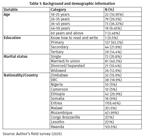
The empirical analysis clearly shows that most of the participants were between 26 and 35 years old (39.3%) and between 36 and 45 years (36.32%). A smaller proportion of participants were aged 18-25 years (10.95%) and 46-59 years (9.45%), while only 3.48% were 60 years or older. According to Stats SA's records based on Census 2001, 2011, and 2022, in 2001, the median age of women migrants was 37 years, whereas in 2011, the median age of women migrants had dropped slightly, which was 30 years. Based on the information obtained from Stats SA (2022), the median age of women migrants had increased slightly to 33 years in 2022. Besides, most participants had attained primary education (63.2%), followed by those with secondary education (21.9%). About 14.4% had attained tertiary education, while a very small number (0.5%) could only read and write. This configuration of educational levels has substantive implications for socio-economic outcomes: educational attainment is closely linked to labor market prospects, income potential, and health outcomes, with those holding tertiary qualifications typically exhibiting better employment rates and improved health indicators relative to less-educated counterparts. The field data also indicated that most of the participants were either married or in a union (40.3%), followed closely by single individuals (35.8%). Participants who were widowed accounted for 12.9%, while those divorced or separated made up 10.4%.
The demographic information included individuals from various nationalities, such as Ethiopians (20.9%), followed by Democratic Republic of the Congo (DRC) nationals (18.9%), and Zimbabweans (15.9%). Other represented nationalities included migrant women from Somalia (9%), Eritrea (8.46%), Nigeria (5%), Cameroon (5%), Mozambique (1.99%), Malawi (1.5%), Congo Brazzaville (1%), Lesotho (1%), and Rwanda (0.5%). According to different studies, including Crush and Williams (2002) and Dinbabo and Carciotto (2015), migrants have traveled to South Africa from nearly all other African countries, since the fall of apartheid.
Migrant women's status in South Africa
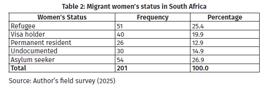
South Africa hosts a large number of refugees and asylum seekers, especially those who fled war-torn and politically unstable nations, including Somalia, DRC, Congo, Rwanda, and Ethiopia (Nzabamwita and Dinbabo, 2022; Sithole et al., 2023). These are people who leave their home countries to seek safety and protection. In this study, the majority of respondents were either asylum seekers or refugees, jointly constituting over 52% of the sample. Fewer respondents held either permanent residence or a relevant visa, accounting for 12.9% and 19.9% respectively. A notable portion-14.9%-selected "Undocumented" indicating that they were residing in South Africa without the necessary authorization from the Department of Home Affairs (DHA).
Duration of stay in South Africa
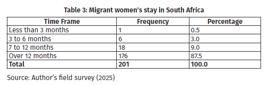
The data indicated that a significant majority of respondents (87.6%) have resided in South Africa for more than 12 months, suggesting a relatively well-established population within the sample. This was further underscored by the small proportions of participants who have been in the country for shorter periods: 9% for 6-12 months, 3% for 3-6 months, and just 0.5% for less than 3 months, out of a total sample size of 201 individuals. These findings point toward a community with extended engagement in the South African context, which may have implications for issues such as integration, access to services, and social inclusion.
Research on migrant settlement patterns supports the idea that longer durations of stay are often associated with greater degrees of social integration, language acquisition, and economic stability. For instance, Chikanda et al. (2020) argue that migrants who have remained in South Africa for longer periods tend to develop more robust support networks, gain better access to employment opportunities, and navigate institutional systems more effectively than newly arrived individuals. This aligns with the current findings, as the dominant presence of long-term residents in the sample may reflect a population that has begun to solidify its place within South African society.
Moreover, the low percentage of respondents who have been in the country for less than 12 months suggests limited recent inflows or possibly that the study captured a population that had already undergone initial resettlement. This could be indicative of a saturation point in migration for the surveyed group. According to Vearey (2016), studies on migrant populations often underrepresent newly arrived individuals due to their precarious living conditions, lack of formal documentation, and mobility, all of which can restrict their participation in research. The implications of this data are particularly relevant in policy and program design, as the needs and challenges faced by recent arrivals can differ markedly from those who have been in the country for longer. While long-term residents may seek pathways to permanent residency or integration, newer migrants often face acute challenges related to housing, employment, and legal status (De Haas, 2010).
Employment rate
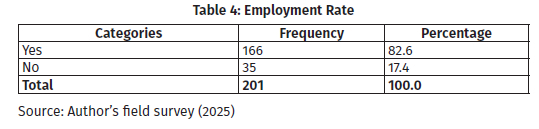
Many migrants move primarily for work opportunities-either to escape poverty or to remit income back to families in their home countries (Dinbabo and Carciotto, 2015; Dinbabo and Badewa, 2020). This high employment rate among migrants reflects patterns commonly discussed in migration literature, where economic motivations are a primary driver of migration (Castles et al., 2014). As such, a high labor force participation rate (like the 82.6% indicated) is not surprising.
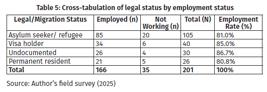
The field data shows that 82.6% of migrants are employed, while 17.4% are not working. The unemployed group reflected on structural and systemic barriers, including legal restrictions on work for asylum seekers or undocumented migrants, language barriers, non-recognition of qualifications, lack of local work experience, discrimination or xenophobia, and gender dynamics, where migrant women may be more likely to remain unemployed (Dustmann et al., 2016). According to the data presented in Table 4, 82.6% indicated that they work, while 17.4% stated that they do not work.
The study examines how participants' documentation status relates to their employment situation. The data show that 81% of the asylum seekers/refugees are employed. Visa holders (85%) have a better chance of getting a job; 86.7% of undocumented migrants are employed, and 80.8% of migrants with permanent residence status are also employed. The literature demonstrates that a female migrant's documentation status fundamentally dictates her employment reality because of the intersection with gendered and racialized barriers. Whether trapped by restrictive "dependent" visas or the total legal exclusion of being undocumented, these women are systematically funneled into informal, isolated, and highly feminized sectors- such as domestic work and elder care-where they face severe "brain waste" and professional deskilling. Ultimately, this lack of secure legal status strips them of regulatory protections and creates an invisible, precarious work environment where employers can weaponize the threat of deportation, locking migrant women into cycles of economic exploitation, substandard wages, and heightened vulnerability to workplace harassment and violence (Mawire and Mokoena, 2025).
Employment
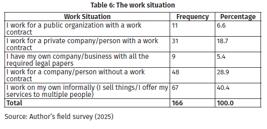
The field data clearly indicates that informal self-employment is the most common work situation, representing 40.4% of respondents. Working without a contract (28.9%) is more common than working with formal contracts in either the public or private sectors. Only 6.6% of respondents work for a public organization with a contract, and 18.7% for a private company with a contract. A small proportion (5.4%) legally own and operate their own businesses. The data also imply that a significant proportion of the workforce is engaged in informal or uncontracted work, which may indicate, on the one hand, economic instability and a lack of legal protections, or, on the other hand, a thriving informal economy. Only about 38.3% are in more formal, legally contracted employment (public or private sectors, and legal business owners).
In South Africa, asylum seekers and irregular or undocumented migrants participate in the informal economy as a survival strategy (Nkomo, 2019). Women work in the beauty industry as hairdressers, as domestic workers, and in sex work (Richter et al., 2014; Walker and Oliveira, 2015). The current study also confirms that undocumented migrants participate in the informal economy. Informal self-employment being the most common work situation for migrants (33.3%) aligns with literature that identifies informality as both a necessity and a vulnerability. As noted by Palmer (2017), many migrants turn to informal self-employment due to barriers in accessing formal employment, such as lack of legal documentation, recognition of qualifications, language barriers, and discrimination. Informal self-employment often lacks legal protection, social security, or access to credit and market opportunities. These migrants are effectively "working for themselves" but in a constrained environment, shaped by limited access to formal opportunities and systemic exclusion.
Nearly a quarter of respondents work without a contract, which highlights the precarity and exploitation risks that characterize many migrant work experiences. As Anderson (2010) discusses, the absence of contracts can mean undeclared work, lack of labor protections, and power imbalances that leave migrants vulnerable to wage theft, long hours, or sudden dismissal. Employers may exploit migrants' immigration status or their lack of legal recourse to avoid formal obligations. Only a small share of migrants (public: 5.5%, private: 15.4%) are employed with formal contracts, especially in the public sector. These findings echo studies by Causa et al. (2021), showing that migrants face limited upward mobility and underrepresentation in secure, high-quality jobs. Formal employment often requires documented status, proof of education, language proficiency, and social networks-barriers many migrants cannot easily overcome. A very small proportion of migrants legally own and operate businesses, which reflects both entrepreneurial potential and institutional obstacles. While some literature (for example, Kloosterman and Rath, 2001) praises migrant entrepreneurship as a driver of innovation and urban economic growth, others (for example, Jones et al., 2006) warn of self-exploitation and the marginal sectors in which these businesses often operate. Regulatory hurdles, lack of access to finance, and discrimination can keep migrant-owned businesses in low-revenue or unstable sectors.
How migrant women get work
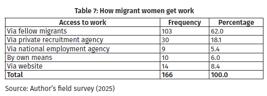
Studies show that migrants with more "bridging" social capital (ties with non-migrants, or with more established, formal actors) are more likely to also use formal job search methods, and to have better outcomes (higher wages, job quality) (Lancee and Sarrasin, 2015). Strong networks (especially "close ties") improve the likelihood of getting job offers via networks (Goel et al., 2020). The most common method migrant women get work is presented as follows: the majority (62%) found work via fellow migrants, suggesting strong reliance on social networks within migrant communities. Many studies find that friends, relatives, and co-nationals are primary sources of job leads, information about work, and referrals. In South Africa, for instance, research on Zimbabwean migrants in Cape Town found that referrals and vouching within migrant networks were key in opening up jobs (especially in the restaurant sector) (Silubonde, 2014). Similarly, undocumented Zimbabwean migrants in Johannesburg used social ties to overcome precarity in private security jobs (Singh, 2019).
Thus, the 62% figure aligns well with the broader consensus that social networks constitute the primary channel for many migrants in entering work, especially in less formal or segmented labor markets. The fact that 18.1% used private recruitment agencies and 5.4% used national employment agencies suggests that formal intermediaries play a secondary role in job placement for many migrants. This pattern is consistent with literature pointing out that formal agencies may require credentials, processes, documentation, or fees that are less accessible to migrants (Ahmed, 2011). Private agencies are more flexible or less stringent in screening; so, migrants might access them more than public agencies. Some studies show private recruiters working through informal networks or ethnic networks themselves (Bloch and McKay, 2015). About 8.4% secured jobs via websites (digital platforms) and 6% through their own efforts (applications, walking in, etc.); this suggests that formal impersonal channels still play a small role in migrant job finding. In the broader literature, use of online job boards or websites is more common in advanced labor markets, but migrants often lack local ties or digital literacy, which constrains uptake (Ahmed, 2011). Impersonal formal methods (like agency and public offices) are often dominated by locals with strong local credentials; migrants might be disadvantaged in competing through such channels (Ahmed, 2011).
A South African Department of Employment and Labor (DEL) official in a KII confirmed that migrant women are predominantly concentrated in three areas: domestic work, the hospitality sector (restaurants and hotels), and informal retail or micro-trading.
The vast majority of migrant women remain trapped in the informal economy- specifically domestic work and informal trading-where employers operate largely off the grid, away from statutory protections, and the concentration is largely driven by lower barriers to entry. (Participant from the South African DEL Office).
Workplace issues
The survey results revealed that 57 respondents (34,3%) did not report any workplace issues, making this the largest single group. This finding is important, as it suggests that while some workers experience challenges, a notable proportion perceives their work environment as relatively stable. However, the majority-nearly three-quarters of respondents-reported at least one workplace issue, which highlights the persistence of labor-related challenges in South Africa. The most prevalent issue was the lack of rest or annual leave; this was linked to unreasonable and compulsory after-hour work, which often involved excessive hours and violent employer behavior (26.5%); this affected more than one in four respondents. This aligns with existing literature, which shows that South African workers, particularly in low-wage sectors, often face excessive working hours with limited leave entitlements (Bhorat et al., 2020). Such practices undermine work-life balance and may contribute to fatigue, reduced productivity, and poor mental health.
Poor safety standards and health risks also emerged as major concerns. This is consistent with studies indicating that occupational health and safety compliance in South Africa is uneven, with higher risks in industries such as mining, agriculture, and construction (Clarke et al., 2019). Inadequate safety measures not only expose workers to accidents and long-term health hazards but also reflect gaps in the enforcement of workplace regulations. Less frequently reported issues, such as forced labor, workplace violence, and contract violations are nonetheless severe. The literature highlights that while such cases are relatively rare, they are often underreported due to fear of retaliation or lack of awareness of labor rights (Crush et al., 2024). Even at low prevalence, these issues represent serious human rights concerns.
Overall, the findings underscore that while some workplaces in South Africa appear to function without major challenges, the majority of workers face at least one form of exploitation or labor rights infringement. This reflects broader systemic issues in the South African labor market, including weak enforcement of labor laws, informal employment practices, and socio-economic inequalities.
Access to workplace leave benefits
The findings suggest that workplace leave benefits for migrants remain limited, with the majority of respondents excluded from access. Over half (68.1%) of respondents indicated that they do not benefit from any form of workplace leave, a figure that aligns with literature showing that migrant workers are often excluded from formal labor protections and benefits due to precarious employment, informal contracts, or discriminatory workplace practices (Crush et al., 2024).
Among those who do have access, sick leave emerges as the most common type of leave, selected by 17.4% of respondents. This trend reflects existing studies that show that while sick leave is sometimes extended to migrant workers, it is often limited in duration or informally negotiated rather than guaranteed by contract (Benach et al., 2010). Annual leave and maternity/paternity leave appear in only 10.4% and 8.5% of responses, respectively, and these are often accessible only in combination with sick leave rather than as standalone entitlements. This suggests that formalized entitlements such as paid annual leave and parental leave are less accessible to migrants, consistent with reports that migrants-especially in low-wage or informal sectors-face significant barriers to claiming these benefits (Socha-Dietrich and Dumont, 2021).
The combination of patterns provide further evidence of inequality. For example, while some workers benefit from multiple leave types (such as the 5.5% who have access to sick, maternity, and annual leave), these cases are rare and likely tied to employment in more formalized sectors. By contrast, only a handful reported maternity leave alone (0.5%) or annual leave alone (1.5%), underscoring how isolated access to these rights is uncommon for migrants.
In summary, the data reflects a dual reality also noted in international research: while a small portion of migrants employed in more formal or regulated environments may access a range of leave benefits, the majority remain excluded, with little to no entitlement. This exclusion reinforces broader vulnerabilities migrants face in the workplace, limiting their ability to balance health, family responsibilities, and rest, and exacerbating existing inequalities between migrant and non-migrant workers.
The employment official confirmed that migrant women are being exploited:
The most rampant violations we find regarding migrant women are no leaves, breaches of the National Minimum Wage Act and the Sectoral Determination for Domestic Workers. Employers routinely don't give migrant women leaves and they underpay them, knowing they are hesitant to complain. We also see massive non-compliance with the Compensation for Occupational Injuries and Diseases Act (COIDA) and the Unemployment Insurance Fund (UIF)- employers simply do not register them. Long hours, lack of overtime pay, and no formal contracts are standard infractions in these audits.
Access to medical insurance
According to Crush and Tawodzera (2014), migrants in Southern Africa encounter exclusion from formal health systems due to legal, financial, and administrative challenges. Similarly, research by Vearey (2016) emphasizes that the absence of medical insurance significantly limits migrants' ability to access healthcare services, particularly in cases of emergencies or chronic illness management. The limited insurance coverage among migrants can be attributed to precarious employment conditions, undocumented legal status, and the high cost of private healthcare. Studies further suggest that most migrants rely on out-of-pocket payments, community support networks, or public healthcare facilities, which are often overstretched and under-resourced (Hunter-Adams and Rother, 2017). This creates a situation where migrants are left vulnerable to untreated illnesses and long-term health inequalities.
The findings revealed that the majority of migrants (74.1%) do not have access to medical or health insurance, while only a small fraction (8.5%) reported being covered. This situation is consistent with existing literature, which highlights that migrants often face systemic barriers to healthcare access, including lack of insurance coverage. In conclusion, the data illustrates a significant gap in healthcare coverage for migrants, aligning with broader literature that stresses the urgent need for policy reforms to improve access to affordable health insurance and inclusive healthcare services.
Underutilization of professional skills due to non-recognition of qualifications
Recent scholarship on migrant women in South Africa indicates that underutilization of professional skills is closely linked to the non-recognition of foreign qualifications and structural barriers in the labor market. Migrants with overseas credentials often must undergo complex, lengthy, and costly evaluation processes with the South African Qualifications Authority (SAQA); yet many employers still fail to recognize or value these qualifications, thereby limiting skilled employment opportunities for migrant women despite their formal training (Crush et al., 2005). This non-recognition contributes to the phenomenon of deskilling or brain waste, where highly qualified migrant women are channeled into precarious, low-skilled, and poorly paid jobs that do not reflect their educational backgrounds, reinforcing gendered and xenophobic labor market segmentation. Studies further show that prejudices against foreign education and bias in recruitment practices exacerbate the exclusion of professional migrant women from appropriate roles, deepening economic marginalization and underemployment (Dietz et al., 2015). These dynamics not only underutilize valuable human capital but also constrain the broader socio-economic contributions migrant women could make to South Africa's economy.
The qualitative data obtained shows that even if migrant women are qualified and have professional skills, their qualifications are non-recognized. These participants spoke candidly about their experiences:
I am a graduate of nursing in Zimbabwe, but when I came to South Africa, I couldn't get a job in my qualification. Now I am working as a salesperson in a boutique for survival. (Participant from Zimbabwe).
I studied my Master's and PhD in South Africa, and I apply for positions in my area of study. And most of the time, I will be short-listed for interview[s], but I don't get employed, because I am not South African citizen. (Participant from Ethiopia).
Informal trading as a vehicle for independence
This theme echoes the literature that positions informal trading as a critical livelihood strategy for the unemployed in contexts of high formal unemployment. Informal trading provides direct income generation and reduces reliance on unstable formal job markets, enabling traders to exercise economic agency and contribute to household welfare (Willemse, 2011; Rogan, 2013). This is corroborated by Participant 9:
Since I began selling goods on the street, I am able to support my family without waiting for someone to hire me. I pay school fees and buy groceries from my earnings. (Participant 9, Somali woman).
At first, it was survival. But now, I am saving to expand-to buy more stock and maybe rent a small stall. (Participant 10, Congolese woman).
Although the informal sector is often labeled "survivalist," research shows that many traders hold entrepreneurial aspirations beyond immediate subsistence. Informal enterprises, especially in the street food sector, express desires to grow and innovate, challenging perceptions that they are only temporary survival strategies (Williams and Kedir, 2019). According to this participant:
Before, I had to wait for job opportunities that never came, Now, I decide when and how much I work. (Participant 8, Congolese woman).
Respondents frequently highlight autonomy as a central benefit of informal trading. Literature on informal economies points out that traders exercise individual agency and self-determination, especially where formal employment opportunities are scarce, making informal trading a route to self-managed economic activity (Willemse, 2011). This participant expressed her concerns:
The city officials sometimes move us on, and we have no permits or secure place to trade. I worry about fines and confiscations. (Participant 9, Somali woman).
Despite gains in autonomy and income, informal traders contend with structural constraints, such as regulatory hostility and lack of formal recognition. This reflects broader findings that poor policy environments and lack of supportive infrastructure can restrain the capacity of traders to fully leverage informal trading as a sustainable vehicle for independence (Willemse, 2011; Tshuma and Jari, 2013).
Interventions: NGOs, employers, and FBOs
Non-governmental organizations (NGOs) and faith-based organizations (FBOs) are increasingly recognized in the literature as critical grassroots actors, especially in contexts where migrants distrust formal institutions (Clarke and Ware, 2015). Churches' role as trusted spaces aligns with studies showing that relational and cultural legitimacy is central to women's empowerment. NGOs play a significant role in bridging the gap between policy intentions and lived realities. Many participants acknowledged that NGO-led training and advocacy programs contributed positively to their empowerment journey.
SA signed all conventions related to the protection of migrants. The constitution of SA also protects the rights of everyone, including migrant women. Besides that, there is [the] Immigration Act, which protects all migrants. There is also the Refugees Act and other various Acts and policies that protect the rights of migrants. In practice though, there are problems. You see, migrant women's rights are not protected. For example: when migrants approach the healthcare facilities, they are asked for ID or documents and a lot of other barriers, which limit their access to important services. So basically, there are quite a number of legal instruments, but the application is a challenge. (Expert 1 from SIHMA, Cape Town).
Related to opportunities for women migrants, another expert from SIHMA pointed out:
There are opportunities for women in general due to the initiatives related to reducing gender inequalities. But the opportunities are primarily for SA citizens, and a smaller chance of documented migrants could benefit. We see women helping their families and sending remittances, but there are a lot of works to be done when it comes to integrating migrant women in empowerment programs and projects. There are many organizations that support migrants. For example: in Scalabrini Centre, there are programs (hospitality courses, language and computer skill training) for migrants. (Expert 2 from SIHMA, Cape Town).
Related to migrant women's participation in the labor force, an employer and a church elder commented:
Most migrant women are concentrated in the informal sectors, because a lot of them are undocumented and which keeps them as disadvantaged. Most of them are domestic workers, restaurant waitresses, and [run] informal businesses. We support them financially and guide them how to get and renew their documents. (Church elder, Cape Town).
During the recent joint task force blitzes, inspectors act like we are running human trafficking rings. They point to missing UIF registrations or lack of written contracts for casual weekend staff. But the reality of the hospitality sector is that it's highly transient. Many migrant women use false identity numbers or asylum documents to get the job, because they are desperate. We don't have the biometric tools of Home Affairs to verify if a green ID book or an asylum paper is 100% genuine. When the Department finds a violation, the blame is placed entirely on the employer, ignoring the fact that the regulatory system itself is broken and confusing. (Employer, Cape Town).
The integration and socio-economic survival of migrant women in South Africa is heavily reliant on a complex support framework driven by institutional advocacy, faith-based networks, and localized employer dynamics. Scholars argue that South Africa's immigration policies systematically neglect gendered realities, leaving female migrants to navigate severe structural barriers when entering the labor force (Farley, 2019). To bypass this state-level exclusion, SIHMA and the Scalabrini Centre actively publish critical policy research and implement targeted vocational initiatives, such as the Women's Platform, which provides language and skills development to help women transition out of economic precarity (Assenza, 2019). In tandem, FBOs serve as vital alternative safety nets, offering legal counsel, entrepreneurial support, and essential psycho-social care to combat the isolation experienced by irregular migrant women, especially in instances of domestic service (Nicholson, 2018; Makhata and Masango, 2021). However, the daily labor reality for these women heavily depends on their employers. While restrictive national frameworks cause reluctance on the parts of many businesses and households to formalize contracts for refugees or asylum seekers (Nyabvudzi and Chinyamurindi, 2020), qualitative evidence shows that individual, sympathetic employers frequently operate through informal networks to shield female workers from xenophobic sweeps and extreme systemic exploitation (Baison, 2021).
CONCLUSION
At the global level, the protection of migrant women's labor rights is grounded in international human rights and labor standards frameworks. The convention on the Elimination of All Forms of Discrimination Against Women (CEDAW) obliges states to eliminate discrimination against women in employment and ensure substantive gender equality in law and practice (UN Women, 1979). The International Convention on the Protection of the Rights of All Migrant Workers and Members of Their Families (ICRMW) further establishes non-discrimination and basic labor protections for migrant workers irrespective of sex (Pécoud and De Guchteneire, 2006). Complementing these are key International Labour Organization (ILO) conventions, including Convention No. 97 and No. 143 on migrant workers, Convention No. 100 on equal remuneration, Convention No. 156 on workers with family responsibilities, and Convention No. 189 on domestic workers, which is particularly significant given the concentration of migrant women in domestic and care work (ILO, 1949; 1975; 1951; 1981; 2011).
This study examined the labor market participation and outcomes of migrant women in South Africa using empirical evidence. The findings indicate that migrant women are an important yet structurally disadvantaged segment of the labor force. While migrant women demonstrate relatively high rates of labor force participation, they are disproportionately concentrated in low-paid, informal, and insecure forms of employment. Compared to native-born women, migrant women face higher unemployment risks, lower earnings, and limited access to employment benefits and labor protections.
The analysis further shows that human capital characteristics such as education and work experience do not translate into equivalent labor market returns for migrant women, suggesting the presence of systemic barriers including discrimination, legal constraints related to migration status, and limited access to social and economic networks. These challenges are compounded by gendered norms and caregiving responsibilities, which further restrict migrant women's employment opportunities and upward mobility. Overall, the evidence underscores that migrant women contribute meaningfully to South Africa's economy but remain marginalized within the labor market. Addressing these disparities is not only a matter of social justice but also essential for inclusive economic growth and labor market efficiency.
RECOMMENDATIONSDrawing on the empirical evidence presented in this study, it is clear that migrant women in South Africa's labor force continue to face structural inequalities shaped by gender, migration status, and labor market segmentation. The findings highlight migrant women's concentration in low-paid and insecure work and higher level of economic vulnerability. These patterns point to gaps not only in labor market outcomes but also in the effectiveness of existing policy and institutional protections. Against this backdrop, this study proposes targeted, gender-responsive and migrationsensitive interventions aimed at improving labor market inclusion, strengthening legal protections, and advancing decent work opportunities for migrant women in South Africa.
Based on the findings, several policy and institutional recommendations emerge:
• Strengthening legal and labor protections: Policies should ensure that migrant women are protected under labor laws. Improved enforcement of minimum wage legislation, workplace safety standards, and antidiscrimination measures is critical, particularly in sectors with high concentrations of migrant women.
• Improving access to decent work and formal employment: Targeted labor market interventions, such as skills recognition programs, job placement services, and support for transitions from informal to formal employment can help migrant women access better-quality jobs that match their qualifications.
• Facilitating skills recognition and training: Mechanisms for recognizing foreign qualifications and prior work experience should be strengthened. In addition, tailored training and upskilling programs can improve migrant women's employability and earning potential.
• Enhancing access to social services and childcare: Expanding access to affordable childcare, healthcare, and social protection would reduce care-related constraints and enable migrant women to participate more fully and productively in the labor market.
• Promoting inclusive migration and labor policies: Migration policy should be better integrated with labor market planning, with explicit consideration of gender dimensions. Data collection efforts should also be improved to better capture the experiences of migrant women and inform evidence-based policymaking.
REFERENCES
LITERATURE REVIEW
- African Union (AU). 2003. Protocol to the African Charter on Human and Peoples' Rights on the Rights of Women in Africa. Maputo: African Union. Available at: https://au.int/en/treaties/protocol-african-charter-human-and-peoples-rights-rights-women-africa
- Ahmed, A. 2011. Belonging out of context: The intersection of place, networks and ethnic identity among retired British migrants living in the Costa Blanca. Journal of Identity and Migration Studies, 5(2).
- Anderson, B. 2010. Migration, immigration controls and the fashioning of precarious workers. Work, Employment and Society, 24(2): 300-317.
- Assenza, V. 2019. Organised social networks and the positive resettlement of female forced migrants: A case study of the Scalabrini Women's Platform and Congolese women in Cape Town. Cape Town: SIHMA.
- Babbie, E. 2008. The basics of social science research. New York: Thomson Wadsworth.
- Babbie, E. and Mouton, J. 2001. The practice of social research. Cape Town: Oxford University Press.
- Badewa, A.S. and Dinbabo, M.F. 2023. Multisectoral intervention on food security in complex emergencies: A discourse on regional resilience praxis in Northeast Nigeria. GeoJournal, 88(2): 1231-1250.
- Baison, P. 2021. 'Recruitment' and job-seeking mechanisms for Zimbabwean women care workers in the domestic services sector in South Africa. African Human Mobility Review, 7(1): 68-87.
- Benach, J., Muntaner, C., Chung, H. and Benavides, F.G. 2010. Immigration, employment relations, and health: Developing a research agenda. American Journal of Industrial Medicine, 53(4): 338-343.
- Beyene, N.L. and Dinbabo, M.F. 2019. An empirical evaluation of the link between women participation in Village Savings and Loans Association (VSLA) and Poverty Reduction in Ethiopia. Journal of Reviews on Global Economics, 8(1): 566-580.
- Bhorat, H., Lilenstein, K., Oosthuizen, M. and Thornton, A. 2020. Wage polarization in a high-inequality emerging economy: The case of South Africa (No. 2020/55). Working Paper, UNU/WIDER.
- Bloch, A. and McKay, S. 2015. Employment, social networks and undocumented migrants: The employer perspective. Sociology, 49(1): 38-55.
- Castles, S., De Haas, H. and Miller, M.J. 2014. The age of migration: International population movements in the modern world. London: Palgrave Macmillan.
- Causa, O., Luu, N. and Abendschein, M. 2021. Labour market transitions across OECD countries: Stylised facts. OECD Economics Department Working Papers, No. 1692. Paris: OECD Publishing. https://doi.org/10.1787/62c85872-en
- Chakawa, J. 2025. Human trafficking, by what means and purpose? Lesotho in the twenty-first century. Development in Practice, 1-10.
- Chikanda, A., Crush, J. and Tawodzera, G. 2020. Urban food security and South-South migration to cities of the Global South. In Crush, J., Frayne, B. and Haysom, G. (eds.), Handbook on urban food security in the Global South. Cheltenham, UK: Edward Elgar Publishing, pp. 261-281.
- Clarke, A., Ferrer, A. and Skuterud, M. 2019. A comparative analysis of the labor market performance of university-educated immigrants in Australia, Canada, and the United States: Does policy matter? Journal of Labor Economics, 37(S2): S443-S490.
- Clarke, M. and Ware, V.A. 2015. Understanding faith-based organizations: How FBOs are contrasted with NGOs in international development literature. Progress in Development Studies, 15(1): 37-48.
- Creswell, J.W. 2009. Mapping the field of mixed methods research. Journal of Mixed Methods Research, 3(2): 95-108.
- Crush, J. and Tawodzera, G. 2014. Medical xenophobia and Zimbabwean migrant access to public health services in South Africa. Journal of Ethnic and Migration Studies, 40(4): 655-670.
- Crush, J. and Peberdy, S. 2018. Refugee Entrepreneurship in South Africa. Migration Policy Series No. 76. Cape Town: Southern African Migration Programme (SAMP).
- Crush, J., Tawodzera, G., Salamone, M. and Ahmed, Z. 2024. Pandemic mobilities, livelihood disruptions, and food insecurities among Eastern Cape migrants in Cape Town and Johannesburg during COVID-19. African Human Mobility Review, 10(3): 85-104.
- Crush, J., Williams, V. and Peberdy, S. 2005. Migration in Southern Africa. Geneva: Global Commission on International Migration.
- De Haas, H. 2010. Migration and development: A theoretical perspective. International Migration Review, 44(1): 227-264.
- Department of Employment and Labour (DEL). 2021. National Labour Migration Policy. Pretoria: Department of Employment and Labour. Available at: https://www.labour.gov.za
- Dietz, B., Gatskova, K. and Ivlevs, A. 2015. Emigration, remittances and the education of children staying behind: Evidence from Tajikistan. IZA Discussion Papers 9515, IZA Network @ LISER.
- Dinbabo, M.F. and Badewa, A.S. 2020. Monitoring migration policy frameworks, treaties and conventions for development in Africa. Journal of African Union Studies, 9(1): 23-49.
- Dodson, B. and Crush, J. 2015. Migration and gender in Southern Africa. Cape Town: SAMP.
- Dustmann, C., Schönberg, U. and Stuhler, J. 2016. The impact of immigration: Why do studies reach such different results? Journal of Economic Perspectives, 30(4): 31-56.
- Farley, A. 2019. South African migration policy: A gendered analysis. Johannesburg: South African Institute of International Affairs.
- Frattini, T. and Solmone, I. 2022. The labour market disadvantages for immigrant women. VoxEU .https://cepr.org/voxeu/columns/labour-market-disadvantages-immigrant-women
- Goel, R.K., Ram, R., Schneider, F. and Potempa, A. 2020. International movements of money and men: Impact on the informal economy. Journal of Economics and Finance, 44(1): 179-197.
- Gröschl, S. 2025. Women without a voice: A commentary. Gender, Work and Organization, 32(3): 1385-1391.
- Guild, E. 2018. The UN Global Compact for Safe, Orderly and Regular Migration: What place for human rights? International Journal of Refugee Law, 30(4): 661-663.
- Hlatshwayo, M. 2019. Precarious work and precarious resistance: A case study of Zimbabwean migrant women workers in Johannesburg, South Africa. Diaspora Studies, 12(2): 160-178.
- Hunter-Adams, J. and Rother, H.A. 2017. A qualitative study of language barriers between South African health care providers and cross-border migrants. BMC Health Services Research, 17(1): 97.
- International Labour Organization (ILO). 1949. Right to Organise and Collective Bargaining Convention (No. 98). Geneva: International Labour Office.
- International Labour Organization (ILO). 1951. Equal Remuneration Convention (No. 100). Geneva: International Labour Office.
- International Labour Organization (ILO). 1975. Human Resources Development Convention (No. 142). Geneva: International Labour Office.
- International Labour Organization (ILO). 1981. Occupational Safety and Health Convention (No. 155). Geneva: International Labour Office.
- International Labour Organization (ILO). 2011. Decent Work for Domestic Workers Convention (No. 189). Geneva: International Labour Office.
- International Labour Organization (ILO). 2024. World Employment and Social Outlook: Trends 2024. Geneva: International Labour Office.
- Johnneson, K. 2025. Book Review: Human-centred economics: The living standards of nations by Richard Samans, ILO/Springer, 2024. Journal of Economics and Political Economy, 12(1): 61-66.
- Johnson, M.J. 2022. Single mother, migrant domestic workers: Exploring the coping experience of low-income Zimbabwean women raising their children in South Africa. Master's Thesis, University of Cape Town.
- Jones, T., Ram, M. and Edwards, P. 2006. Shades of grey in the informal economy. International Journal of Sociology and Social Policy, 26(9-10): 357-373.
- Kloosterman, R. and Rath, J. 2001. Immigrant entrepreneurs in advanced economies: Mixed embeddedness further explored. Journal of Ethnic and Migration Studies, 27(2): 189-201.
- Lancee, B. and Sarrasin, O. 2015. Educated preferences or selection effects? A longitudinal analysis of the impact of educational attainment on attitudes towards immigrants. European Sociological Review, 31(4): 490-501.
- Lightman, N. 2024. Converging economies of care? Immigrant women workers across 17 countries and four care regimes. Journal of Industrial Relations, 66(1): 79103.
- Makhata, M.B. and Masango, M.J. 2021. Illegal migrant Basotho women in South Africa: Exposure to vulnerability in domestic services. HTS Teologiese Studies/ Theological Studies, 77(2): a.6906.
- Mbiyozo, A.N. 2018. Gender and migration in South Africa: Talking to women migrants. ISS Southern Africa Report No 16. Institute for Security Studies (ISS).
- Mfolo, P.J. 2023. Labour force participation among African female migrants in South Africa: The case of Gauteng Province. Master's Thesis, University of the Western Cape.
- Muzeza, K. 2023. Feminisation ofmigration and precarious occupations: Zimbabwean women migrants in hospitality in South Africa. PhD Dissertation, University of Pretoria.
- Ncube, A., Bahta, Y.T. and Jordaan, A.J. 2020. Job market perceptions of African migrant women in South Africa as an initial and long-term coping and adaptation mechanism. Journal of International Migration and Integration, 21(4): 1165-1185.
- Nicholson, M. 2018. The role of faith-based organizations in immigrants' health and entrepreneurship. Centre for Migration Studies. Available at: http://cmsny.org/publications/2018smsc-nicholson
- Nkomo, T.S. 2019. Exploring Congolese refugees and asylum seekers' survival strategies in South Africa: Implication for social work practice. Journal of Human Behavior in the Social Environment, 29(4): 499-518.
- Nyabvudzi, T.G. and Chinyamurindi, W.T. 2020. Career development barriers in the post-settlement phase amongst women refugees: Implications for human capital development. Gender Questions, 8(1): 26 pages.
- Nzabamwita, J. and Dinbabo, M. 2022. International migration and social protection in South Africa. Cogent Social Sciences, 8(1): 2144134.
- Palmer, R. 2017. Jobs and skills mismatch in the informal economy. Research Paper. Rome: International Labour Organization (ILO). Available at: https://www.ilo.org/publications/jobs-and-skills-mismatch-informal-economy
- Pécoud, A. and De Guchteneire, P. 2006. Migration, human rights and the United Nations: An investigation into the obstacles to the UN Convention on Migrant Workers' Rights. Windsor Yearbook of Access to Justice, 24(2): 241-266.
- Raniga, T. and Fitshane, Z. 2022. Economic experience of migrant women residing in Gauteng, South Africa: A sustainable livelihood perspective. Social Work/ Maatskaplike Werk, 58(3): 239-271.
- Republic of South Africa (RSA). 1996. Constitution of the Republic of South Africa. Pretoria: Government Printers.
- Rogan, M. 2013. Poverty and headship in post-apartheid South Africa, 1997-2006. Social Indicators Research, 113(1): 491-511.
- Semu, L.L. 2020. The intersectionality of race and trajectories of African women into the nursing career in the United States. Behavioral Sciences, 10(4): 69.
- Shamase, L.Z. and Sekaja, L. 2025. Mothering away from home: Experiences of Zimbabwean domestic workers in South Africa. Frontiers in Sociology, 10: 1607624.
- Silubonde, T.R. 2014. Migrants' access to the labour market and ethnic niching: Case study of Zimbabweans employed in the Cape Town restaurant industry. Master's Thesis, University of Cape Town.
- Singh, C. 2019. Migration as a driver of changing household structures: Implications for local livelihoods and adaptation. Migration and Development, 8(3): 301-319.
- Sithole, S., Tevera, D. and Dinbabo, M.F. 2023. Emerging digital technologies and cross-border food remittances of Zimbabwean migrants in Cape Town, South Africa, during the early COVID-19 pandemic. MiFood Paper No. 9. MiFood Network.
- Socha-Dietrich, K. and Dumont, J.C. 2021. International migration and movement of nursing personnel to and within OECD countries - 2000 to 2018: Developments in countries of destination and impact on countries of origin. OECD Health Working Paper No. 125. Paris: OECD.
- Statistics South Africa (Stats SA). 2022. Report on migration statistics based on various data sources including Census 2022. Report 03-04-04. Pretoria: Statistics South Africa.
- Statistics South Africa (Stats SA). 2023. Migration profile report for South Africa - A country profile. Report 03-09-17. Pretoria: Statistics South Africa.
- Statistics South Africa (Stats SA). 2024a. Report on migration statistics based on various data. Pretoria: Statistics South Africa.
- Statistics South Africa (Stats SA). 2024b. South Africa's first migration report. Pretoria: Statistics South Africa.
- Tshuma, M.C. and Jari, B. 2013. The informal sector as a source of household income: The case of Alice town in the Eastern Cape Province of South Africa. Journal of African Studies and Development, 5(8): 250.
- United Nations (UN). 1995a. Beijing Declaration and Platform for Action. Fourth World Conference on Women, Beijing, China, 4-15 September 1995. New York: United Nations.
- United Nations (UN). 1995b. Report of the World Summit for Social Development. Copenhagen, 6-12 March 1995. New York: United Nations.
- United Nations Economic and Social Council (UNESC). 1995. Commission on the Status of Women: Report on the Thirty-Ninth Session (15 March-7 April 1995). Official Records, Supplement No. 6. Document E/1995/26. New York: United Nations.
- United Nations Women. 1979. Convention on the Elimination of All Forms of Discrimination Against Women (CEDAW). New York: United Nations.
- Vearey, J. 2016. Mobility, migration and generalised HIV epidemics: A focus on sub-Saharan Africa. In Thomas, F. (ed.), Handbook of migration and health. Cheltenham, UK: Edward Elgar Publishing, pp. 340-356.
- Von Fintel, D. and Moses, E. 2017. Migration and gender in South Africa: Following bright lights and the fortunes of others? Regional Science Policy and Practice, 9(4): 251-269.
- Walker, R. and Oliveira, E. 2015. Contested spaces: Exploring the intersections of migration, sex work and trafficking in South Africa. Graduate Journal of Social Science, 11(2): 129-153.
- Weir-Smith, G. and Dlamini, S. 2024. Hit the road: Spatial characteristics of labor absorption in South Africa. The Professional Geographer, 76(3): 331-342.
- Willemse, L. 2011. Opportunities and constraints facing informal street traders: Evidence from four South African cities. Town and Regional Planning, 59:7-15.
- Williams, C.C. and Kedir, A.M. 2019. Explaining cross-country variations in the prevalence of informal sector competitors: Lessons from the World Bank Enterprise Survey. International Entrepreneurship and Management Journal, 15(3): 677-696.
- Zinatsa, F. and Saurombe, M.D. 2022a. A framework for the labour market integration of female accompanying spouses in South Africa. SA Journal of Industrial Psychology, 48: 2006.
- Zinatsa, F. and Saurombe, M.D. 2022b. Tied migrant labour market integration in South Africa: Labour market subjectivities and intersectional inequalities. Frontiers in Psychology, 13. https://doi.org/10.3389/fpsyg.2022.806436
Accepted 08 August 2026
Published 31 August 2026