The Democratic Costs of South Africa's Zimbabwean Exemption Permit Process
Abstract
The Zimbabwean Exemption Permit (ZEP) process is most often analyzed through the lens of migration and the justice of South Africa's treatment of migrants, refugees, and asylum seekers. This discourse focuses on critically important issues yet remains incomplete in two important ways: first, it fails to interrogate the impact of the ZEP policy and process on South Africa's citizenship regime; and second, it does not connect the governance failures of the ZEP process with wider questions of democratic governance. In this article, I respond to these gaps, using a lens of democratic citizenship theory to analyze the ZEP process, as outlined in key public documents: public court documents in the case of Helen Suzman Foundation v Minister of Home Affairs and Others (Case 32323/2022), minutes of relevant parliamentary committee meetings recorded by the Parliamentary Monitoring Group (PMG), and public statements by the Department of Home Affairs (DHA). I argue that this analysis reveals a concerning lack of commitment by the DHA to the core democratic values of political equality, political representation, and the ability to plan and live a life according to one's conception of the good. This is evidenced in both the content and articulation of decisions within the policy process and the failures of democratic governance evident in the ad hoc decision-making, poor communication, shifting narratives, and a lack of public consultation.
Zimbabwe Exemption Permit; Democratic citizenship; South Africa; Department of Home Affairs; Democratic ethics
INTRODUCTION
In late 2021, the Department of Home Affairs (DHA) announced that following the imminent expiry of Zimbabwean Exemption Permits (ZEPs), they would not be renewed. Permit holders were granted a one-year "grace period" to leave South African or regularize their status through another route. The department has faced significant criticism for this decision and has been forced to extend the grace period twice and, by court order, to reconsider the decision following a fair process in line with the Promotion of Administrative Justice Act (3 of 2000). The department sought to appeal this ruling, but the special leave to appeal was dismissed by the High Court in June 2024 (Fraser, 2024). The permit was therefore set to remain in place until November 2025 and the department mandated to follow a procedurally fair and consultative process before any further decision is made (2024). Currently, the permit remains in place with a further extension until May 2027, as stipulated in Regulation Gazette No.11893 (RSA, 2025).
The ZEP is most often discussed in public discourse and academic literature through the lens of migration and the important question of the justice of how South Africa treats immigrants, refugees, and asylum seekers (Moyo, 2018, 2020; Nyakabawu 2021, 2022; Maziyanhanga and Majavu, 2023). The purpose of this article is to add to this discourse through shifting the lens of engagement. Current debates and analyzes are incomplete in at least two important ways: first, they fail to offer analysis of the impact of the ZEP policy and process on South Africa's citizenship regime; and second, discussions do not connect the governance failures of the ZEP process with wider questions of democratic governance. Overall, the ZEP discourse does not sufficiently engage with the impact of the permit regime on the democratic project of South Africa itself. Moreover, this engagement does not undermine the important focus on the impact on ZEP holders but rather, in the end, highlights new layers of the injustice of the ZEP regime for the holders while also importantly revealing the democratic costs for South African citizens. Through this new lens, I argue that the ZEP case reveals important features of how the South African Department of Home Affairs (DHA) has approached the concept of, and rights to, democratic citizenship in the post-apartheid era.2
The article offers an interdisciplinary, normative approach to an analysis of the ZEP process. It combines a close analysis of key documents to provide an empirical grounding with a political theory lens of normative analysis. Included documents were purposively selected to provide insight into the public record of how the Zimbabwean exemption process proceeded from its origin in 2009 to date (early 2026). These included public court documents in the case of Helen Suzman Foundation v Minister of Home Affairs and Others (Case 32323/2022); minutes of relevant parliamentary committee meetings recorded by the Parliamentary Monitoring Group (PMG), and public statements by the DHA. A 2011 report by the African Centre for Migration and Society, University of the Witwatersrand was included to capture insights on the early process. This documentary analysis aims to set out a comprehensive account of the process, and alongside this, an analysis of how the DHA characterized the exemption at different stages of its history. A reliance on public record is limited insofar as it does not capture the nuance of internal DHA conversations, nor the experiences of Exemption Permit holders themselves. It is appropriate, however, for the aims of this article to offer insight into what the DHA, through its actions and articulations, has conveyed about its approach to citizenship and its commitment to democratic principles.
This empirical basis is analyzed through the lens of democratic citizenship theory. The article does not set out an extensive theory of liberal democratic citizenship ethics but relies on three foundational principles inherent to the idea of liberal democracy: equal political representation, political equality, and the ability to plan a life in accordance with one's conception of the good. Despite deep disagreements among the theories of democracy, social justice, and freedom that are invested in liberal democracy, they share a commitment to freedom and equality, albeit in different forms (Pettit, 1999; Rawls, 1999; Stilz, 2011; Nussbaum, 2013; Hobden, 2021). This commitment grounds the central importance of an equal say in the rules that govern one and the freedom to live one's life according to one's own choices, without arbitrary interference and with conditions that secure one's human dignity and ability to make and carry out choices for the future. The choice of these three principles is reinforced by their protection in the South African Constitution's founding provisions, which commit to the values of "human dignity, the achievement of equality and the advancement of human rights and freedoms" as well as explicit mention of universal adult suffrage and equal citizenship (RSA, 1996: Ch1, s1 and 3). The ability to plan one's life in line with one's own conception of the good is enabled by democratic freedoms within the Bill of Rights, such as that of association, religion, or occupation, and the socio-economic rights that enable human dignity and agency to carry out one's plans (Liebenberg, 2005).
The paper proceeds in three key steps: first, I present the history of the ZEP process based on a close analysis of key public documents. Second, I analyze these documents alongside academic literature and identify the prominent arguments and framings of the issues. This analysis offers both deeper insight into the issues at stake and delineates the relatively narrow scope of the existing discourse that fails to fully appreciate the risks to democratic citizenship imposed by the extended temporariness of the permit, the continuous uncertainty for long-term residents, and the ad hoc nature of decisions around a central question of who is or is not entitled to become a citizen. Third, I respond to this gap through an analysis of the ZEP process through the lens of democratic citizenship theory, and fourth, through the lens of the values underpinning democratic governance. Taken together, these sections reveal the DHA's lack of due consideration for core democratic principles during the ZEP process, which not only harms ZEP holders but also risks undermining a robust conception of democratic citizenship in South Africa.
SETTING THE SCENE: A HISTORY OF THE ZIMBABWEAN EXEMPTION PERMIT
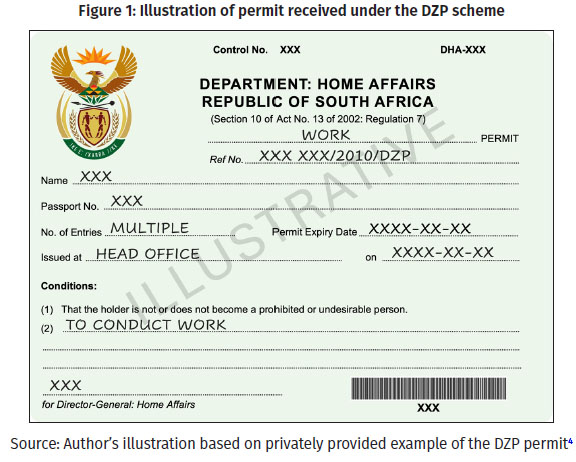
In April 2009, a special dispensation was put in place that protected Zimbabwean nationals from deportation and introduced a three-month visa-free entry system (Amit, 2011: 4). This was followed in September 2010 with the first opportunity to apply for a special permit (Amit, 2011: 4). Known as the DZP, more recent sources refer to this permit as the Dispensation of Zimbabwean Project (DHA, 2022: s10.1; HSF, 2022a: s20), while earlier sources cite the Documentation of Zimbabweans Project (PMG, 2011) or Documentation of Zimbabweans Process (Amit, 2011: 4). The significance of this ambiguity is discussed further below. For now, we can note that regardless of the name, the permit application process was considered an extension of the dispensation period introduced in 2009 that chiefly provided a moratorium on deportations (Amit, 2011). Undocumented Zimbabweans could apply for a work, study, or business permit under "relaxed requirements and shortened processes" if they could provide the core set of evidence: a valid Zimbabwean passport, proof of employment or registration at an educational institution or proof of running a business in South Africa (PMG, 2011). At the beginning of this process, it was required that applicants had arrived in South Africa before 1 May 2010; but reportedly this requirement was dropped during the implementation process (Amit, 2011: 5). There were significant difficulties in the process, particularly around applicants' ability to acquire a Zimbabwean passport within the short time frame. These challenges led to a relaxation of these requirements as a condition of submitting the application within the deadline (2011).3 At this stage, 242,731 applications were approved, granting these Zimbabweans the legal right to reside and work, study, or conduct a business between September 2010 when the formal documentation began to be issued and an expiry date of December 2014 (HSF, 2022a: s.23). While records are somewhat unclear, it appears that this exemption did not have a standalone permit format but rather used the standard work, study, or business permits in applicants' passports. While the permits had a particular reference number identifying the permits as a DZP, the explicit criteria on the physical permits were standard conditions of specifying the work or other purpose for which it is granted and, "that the holder is not or does not become a prohibited or undesirable person" (see Figure 1).

Official DHA statements from this time suggest a humanitarian narrative, with a focus on documentation and regularization of Zimbabwean migrants to offer them more certainty and protection. At a United Nations High Commissioner for Refugees (UNHCR) ExCom meeting in 2010, then DHA Minister Nkosazana Dlamini-Zuma described the documentation of Zimbabweans as an opportunity to "live in dignity in South Africa and to end the misery of living under the cloud of uncertainty and vulnerability" (RSA, 2010b). She adds that the government is "inspired by the large volumes of Zimbabwean nationals" attempting to take up this opportunity (RSA, 2010b). Following this meeting, the South African government published a statement describing how the United Nations (UN) High Commissioner for Refugees, Antonio Gutteres "heaped praises" on the "generous policy" to document Zimbabweans living in the country "allowing so many Zimbabweans to find new opportunities in South Africa" (RSA, 2010c). This framing aligns with the 2011 Home Affairs Parliamentary Portfolio Committee briefing on the (at the time titled) "Zimbabwean Documentation Project," where then Director-General (DG) Mkuseli Apleni declared the project a success on the grounds that,
… the main goal of the project was to provide rights to those Zimbabweans who had been employed in the country but were not granted protections due to their permit status. The people who had applied had gotten a chance at receiving fair treatment and at regularizing and legitimizing their stay in the country (PMG, 2011).
We should note here too, that in addition to the original dispensation permits not explicitly stating limiting conditions, the word "temporary" was completely absent from the early statement announcing the exemption by then DG, Mkuseli Apleni; instead, the emphasis is on regularization and documentation (RSA, 2010a).5
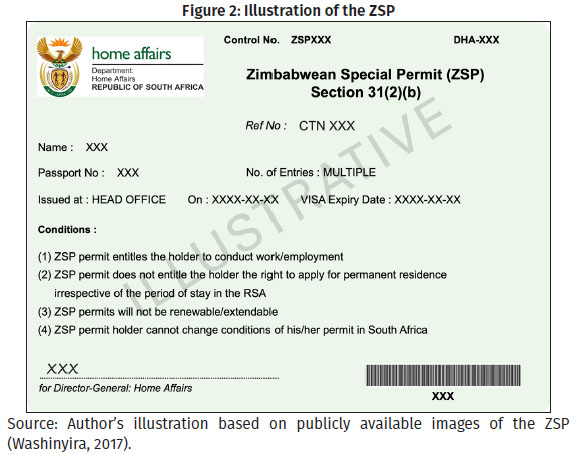
In August 2014, an announcement was made by the Minister of Home Affairs that the DZP would be replaced with the Zimbabwean Special Permit (ZSP) (HSF, 2022a: s25). Only existing DZP holders and those who had applied unsuccessfully and so remained on the system, were eligible to apply, and a new system run by an external provider was put in place (PMG, 2011). The use of a provider, Visa Facilitation Services (VFS) Global, followed a global pattern of outsourcing visa application processing and what has been termed the commercializing of the once public service of visa applications (Nehring and Hu, 2021). While the DZP application was free of charge, under VFS Global administration, the application fee now ranged between R800 and R1,350. At the time, the DHA indicated this removed cost from the department but failed to acknowledge that this cost was then shifted on to applicants (PMG, 2014). Additionally, the DHA did not directly engage with the question from an opposition party member on whether the "ZSP was designed to generate revenue for VFS," given how much revenue the handling fee would bring in (PMG, 2014). The requirements for the permit remained "a valid passport, proof of employment/proof of business registration, or, in the case of students, proof of registration from a learning institution" (PMG, 2014). In total, 197,790 ZSPs were granted with an expiry date of 31 December 2017 (HSF, 2022a: s27). At this stage, the permits received were in a new format that specifically labeled them as ZSPs, while also indicating whether they permitted work or study. Significantly, these permits included three explicit conditions in addition to the specification of work/study conditions. These were conditions that applied only to ZSP holders: the ZSP does not entitle the holder the right to apply for permanent residence, irrespective of the period of stay within South Africa; ZSPs will not be renewable or extendable; and ZSP holders cannot change conditions of their permit in South Africa (see Figure 2).
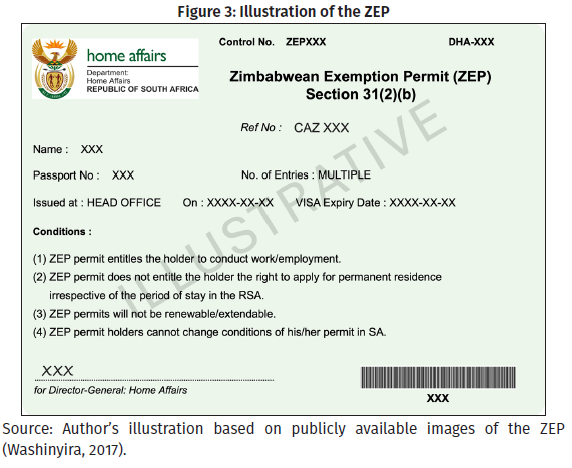
Again, only a few months before expiry, the minister announced in September 2017 that the ZSP would be replaced with the Zimbabwean Exemption Permit (ZEP) (HSF, 2022a: s.29). The terms of this permit did not change, but a new permit format indicated the new name (see Figure 3). The introduction of a new permit required ZSP holders to apply again with proof of employment, business, or study, and a valid passport, through VFS Global with a fee of R1,090. At this stage, after many years in South Africa, an increasingly common barrier for many applicants was the requirement to have a valid Zimbabwean passport, which, apart from lengthy waiting periods, is a notoriously expensive thing to acquire, particularly from outside the country (Vigneswaran et al., 2010: 471; Mubaiwa, 2020; Chirume, 2024). The number of ZEP holders decreased again to approximately 178,000 (Helen Suzman Foundation v Minister of Home Affairs 2023, s2).
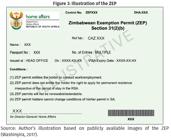
The 2017 permits were due to expire on 31 December 2021. This time, the announcement was made even later, on 25 November 2021, just over a month before the expiry and over the festive season, where many intend to travel back to Zimbabwe to see family (Washinyira, 2021). It was here that the first notice of termination of the permits was announced, with a one-year grace period to regularize through another route. The decision was made "behind closed doors" with no public consultation (Helen Suzman Foundation v Minister of Home Affairs 2023, s37). The option to regularize through another route is extremely difficult, given numerous legal and practical barriers, including systematic backlogs, such that the granting of a visa or waiver was not reasonably possible within one year (HSF, 2022a: s12-13).
The minister who made the 2021 expiry decision, Aaron Motsoaledi, staunchly defended his decision via the media and in the courts (Helen Suzman Foundation v Minister of Home Affairs 2023, s7). The DHA's answering affidavit in the case used the word "temporary" seven times in just three short paragraphs and 28 times in total (DHA, 2022: s189-191). The "always" temporary nature of the permit is a core part of the DHA's argument that the department has done no wrong in terminating the exemption either in the decision itself or in failing to publicly consult on the decision. The extent of the shift in discourse is evident in the argument that the voluntary agreement of ZEP holders to a temporary scheme means that it "does not lie in the mouth of the beneficiaries" of such a scheme to claim that removing it violates their rights (DHA, 2022: s191). The DHA answering affidavit also reveals a shift from South Africa's responsibility to provide protection to those living within its borders to an argument that Zimbabweans have a responsibility to return and contribute to Zimbabwe: "There was and is a need in Zimbabwe for its nationals to build a new and prosperous Zimbabwe" (DHA, 2022: s260).
The DHA minister has since changed to the Democratic Alliance's (DA's) Leon Schreiber as part of the post-2024 Government of National Unity.6 Schreiber initially extended the permit, as required by the court rulings and established an Immigration Advisory Board to advise on the matter (among other immigration issues) (DHA, 2025). At the time of writing, following the legal engagements described in the section above, the ZEP is still in place with a further extension until May 2027, as per Regulation Gazette No.11893 (RSA, 2025). The court-mandated deadline for a new procedurally just decision of November 2025 was not met. Instead, in October 2025, an 18-month extension was granted with acknowledgment that "critical stakeholders will need to be part of a consultation process" (RSA, 2025). The future of ZEP holders thus remains uncertain. Nevertheless, regardless of the DHA's next step, some central facts are certain: the permit has granted legal residence and a right to work for approximately 15 years for ZEP holders without a path to permanency. This includes the ability for children to remain with permit holders via other visa routes, or in some cases, their right to South African citizenship (LHR, 2023).
CURRENT LEGAL AND ACADEMIC DISCOURSEThere is currently a fairly heated public debate on the case of ZEPs. While it has come in and out of focus over the years, the 2021 decision to end the exemption has raised the stakes and also the temperature of the debate. The contentious and often hostile nature of the debate was further exacerbated by the intense focus on immigration as an issue in the 2024 South African national elections (HRW, 2024). In this section, I continue the close reading of relevant court documents and public statements but focus on the arguments presented around the rights of ZEP holders. I supplement this with the lens of academic scholarship on ZEPs in order to highlight and analyze the key issues, values, and principles that are drawn upon both in favor of and in opposition to the decision to end the permits. While this section analyzes, in one respect, some of the key wrongs of the DHA's approach to the ZEPs, it also importantly delineates and highlights the relatively narrow scope of this discourse.
This section addresses four themes in the discourse: procedural justice, the role of original objectives and intention, temporariness, and voluntariness. In the section that follows, I build from these observations to highlight deeper democratic worries that the DHA's actions warrant.
Procedural justice
The first and perhaps most prominent site of critical debate on the ZEP has been within the courts. Following the announcement that the permits would not be renewed, the Helen Suzman Foundation (HSF) took the lead in taking the DHA to court, resulting in the judgment in their favor in Helen Suzman Foundation v Minister of Home Affairs and Others (Case 32323/2022).7 The main focus of the legal arguments in this case were questions of procedural justice. The applicants argued that the Minister of Home Affairs had failed to embark on a fair and consultative process before making the decision: the process did not consult affected parties and did not demonstrate good cause for the decision made. In other words, it was argued to be "procedurally unfair and procedurally irrational" (HSF, 2022b: s12.1) in violation of the Promotion of Administrative Justice Act (3 of 2000) (PAJA). One of the key issues here was the PAJA provision that holds that "administrative action that materially and adversely affects an individual's rights or legitimate expectations must be procedurally fair" (Helen Suzman Foundation v Minister of Home Affairs 2023, s49). This includes adequate notice and a "reasonable opportunity to make representations" (HSF, 2022b: s49). Further, drawing on PAJA 4(1), where the administrative action "materially and adversely affects the rights of the public," an administrator "owes a duty of procedural fairness to the public at large" (Helen Suzman Foundation v Minister of Home Affairs 2023, s50). On the court's analysis, the DHA made no room for meaningful consultation in the decision-making process, allowing only after-the-fact representations and showing "notable disdain for the value of public participation" in their answering affidavit (Helen Suzman Foundation v Minister of Home Affairs 2023, s75). Significantly, the judgment goes on to elaborate that the DHA not only deemed ZEP holders not able to make representations on the merit of the decision itself (only to ask for exemptions to their own personal case), but "the views of civil society and the public are deemed unnecessary altogether" (Helen Suzman Foundation v Minister of Home Affairs 2023, s75). While the DHA consistently denied the charge of a failure to follow fair process, they were unable to provide evidence to support their claims that meaningful opportunity for representations had been created-mostly because even where there was some small level of engagement with those affected, it happened after the decision had been made and firmly communicated as unchangeable (Helen Suzman Foundation v Minister of Home Affairs 2023, s79). Ultimately, the court ruled that the Minister of Home Affairs had to reconsider the decision in a fair process in line with the Act and refused special leave to appeal.
This aspect of the debate is about the legality of procedure. However, the question of procedure is not just about processes themselves but an issue of how procedure impacts on the justice of an outcome, and the justice of how individuals and groups are treated by the administration of the state. These are both central questions of democratic governance and, importantly, grounded in constitutional rights available to "everyone" (RSA, 1996: Ch2, s33). Indeed, in an analysis of the ZEP processes, Shingirai Nyakabawu (2021) argues that the application processes amount to "legal violence." This violence is experienced through forced waiting-both physically in queues that were unsafe, and in waiting for adjudication where one's legal status was unstable, resulting in job insecurity and an inability to plan (Nyakabawu, 2022). Such waiting, for example, resulted in exclusion, not just from private institutions but in particular from the state-from teachers not being paid for marking Grade 12 examination scripts, to children being denied schooling, and traffic departments refusing licensing (Nyakabawu, 2021, 2022). Nyakabawu uses the lens of legal liminality to argue that the process of the ZEP applications, and particularly extended periods of waiting, resulted in an instability of status between "tentative lawfulness and more complete marginalization": they experience "inclusive exclusion" (2021: 4). This critique centers on process; while it relates to the discussion below on temporariness, it argues in particular that it was the repeated extensions and reapplications that shifted the permit from being empowering to exclusionary (Nyakabawu, 2021: 4).
Original objectives of the exemption permit
In its answering affidavit, the DHA outlines the key objectives of the exemption permit and draws our attention to the political aims behind the policymaking. The original permits, the "Dispensation of Zimbabweans Project" (DZP), aimed to regularize Zimbabweans living in South Africa illegally, curb the deportation of such Zimbabwean migrants, and provide amnesty to Zimbabweans who had obtained documents fraudulently (DHA, 2022: s105). A fourth reason is also provided, one that is often considered the most pressing, even by the DHA: to reduce pressure on the asylum seeker and refugee management systems (DHA, 2022: s105.3 and s119). Underlying these objectives is also an implicit claim that the permit intended to respond to a very particular crisis moment-"profound political instability in Zimbabwe, and a rare hyperinflation crisis," which has now passed (DHA, 2022: s261).
The court documents point to a factual disagreement on the socio-politico-economic conditions within Zimbabwe at the point of expiry and so a disagreement as to the impact on ZEP holders of effectively requiring them to return to Zimbabwe (Helen Suzman Foundation v Minister of Home Affairs 2023, s88-89). There is not space here to chart the levels of political (in)stability in Zimbabwe over 16 years since the permit was first announced; but suffice to say that while levels of political stability have fluctuated over the years, the overall levels of poverty and political oppression remain significant. In terms of current political stability justifying the expiration of the visa, the DHA has not offered clear evidence or argument as to a meaningful difference between the different decision points of 2014, 2017, and 2021. Perhaps more interesting for the discussions here, the DHA's attitude on this issue is in tension with its strong emphasis on the salience of the original intention of the permit. The DHA both wishes to argue that the conditions have changed significantly such as to shape the appropriate decision on the renewal of the permit. At the same time, it rejects arguments that highlight how time has changed other relevant features, such as the establishment of lives, families, and careers in South Africa, or the democratic arguments to follow.
In discussing guest worker programs, Carens comments on the evolution of European guest worker programs of the 1950s and 1960s into more permanent statuses: despite being admitted under terms that limited rights and foresaw their departure, "as time passed, European states acknowledged that the original terms of admission were simply no longer relevant and could not be enforced" (Carens, 2008: 419). Olsthoorn (2024: 8) describes this as the "acquisition model" of justice for denizens: that over time, through the meeting of some objective criteria such as those of fair play, denizens gain moral rights. As Maziyanhanga and Majavu (2023) emphasize, this case should draw upon Carens' argument that "the longer you stay, the stronger the claim to remain" (Carens, 2008: 422). This fairly uncontroversial principle in moral and political theory-that time can change our obligations-undermines the DHA's steadfast insistence that the original intentions of the exemption program remain the most salient ethical consideration. The judgment in the ZEP case draws upon this kind of reasoning, establishing as common cause between the parties that "as a consequence of being granted these permits, ZEP holders have established lives, families, and careers in South Africa" and that putting these at jeopardy has profound consequences for ZEP holders (Helen Suzman Foundation v Minister of Home Affairs 2023, s5). These consequences of time deeply shape the costs of losing the right to live and work in South Africa and so, should be a key consideration in the ethics of terminating the permit and in the process in which this termination is decided and implemented (Helen Suzman Foundation v Minister of Home Affairs, 2023).
I turn now to the first three objectives laid out in the answering affidavit-to regularize Zimbabweans living in South Africa illegally, curb the deportation of such Zimbabwean migrants, and provide amnesty to Zimbabweans who had obtained documents fraudulently. These objectives are ostensibly oriented toward assisting Zimbabweans and resonating with the DHA's public narrative at the start of the exemption, as detailed above. Recall too, that the original dispensation lowered some requirements for work, study, and business visas and used the same physical template so that these original permits did not include the later explicit limiting conditions written on the ZSPs and ZEPs, and the official statement on the introduction of the dispensation did not mention the word "temporary" at all. Attention to these objectives reveals not only a shift in discourse over time but a tension within the answering affidavit, setting out, on the one hand, these clearly long-term and permanent aims, such as regularization and amnesty, and on the other hand, a firm insistence that the intention for these permits was always that they would be temporary. There is clearly then a shift in political language around the permits indicative of a changing attitude to policy.
The fourth objective, a more pragmatic response to an overworked system, introduces a different framing of the permits but again reveals a tension between the DHA's actions and claims of an intentional temporary scheme. The department describes the asylum management system at the time (which was around 2008 and 2009) as "flooded" and, importantly, identifies the issue as the "unprecedented influx of Zimbabwean applicants, most of whom were ineligible for asylum as they were economic migrants" (DHA, 2022: s119).8 It is unclear how the department can determine that the majority were economic migrants given the applications were, on their description, not getting to the front of the queue to be assessed, and later in the same affidavit are framed as a response to the 2008 humanitarian crisis (DHA, 2022: s176.4). On the department's own admission, on a retrospective view, the DZP scheme was not successful on its own terms-while there were approximately 1.5 million undocumented Zimbabweans in South Africa at the time, fewer than 20% sought to regularize their stay through the DZP (DHA, 2022: s118). While not discussed in this answering affidavit, presumably this lies largely in the fact that many Zimbabweans had fled in crisis and so were more appropriately dealt with as asylum seekers-not those who could provide proof of work, study, or business ownership.9
The framing of the policy as about regularization and documentation suggests that while the permits had a clear expiry date, the solution as a whole was not intended to be temporary but to lead to the long-term regularization of Zimbabwean migrants in South Africa-or, at a minimum, this could have been the reasonable interpretation of an applicant at the time. While it was clear in the conditions of the later ZSPs and ZEPs that permit years of residency were not a route to permanent residency, it is not clear that this was explicit in the case of permits acquired during the DZP era. Importantly, it was this original decision to apply for a permit under the DZP that moved Zimbabweans into the exemption track and precluded asylum status or other routes to documentation. In addition, the focus on documentation and regularization, and the repeated extensions via new permit schemes in practice obscured any message that this was a short-term temporary status. In action, a commitment to an intention for the permit to be temporary would have required the DHA to act within the four years of the first DZP to capacitate the overwhelmed refugee and asylum system and provide a clear application path for permanency. Instead, the DHA relied on repeated, temporary, and ad hoc solutions for an extended period without developing a regularization plan or capacitating in order to implement it. This approach undermines the veracity of the claim that we should hold tightly onto the proclaimed initial intention of the program as morally salient. With this lens, the temporariness appears not to be intentional but rather a failure to enable a more viable solution. It is these failures that have framed the ZEP as a case of "permanent temporariness" (Carciotto, 2018) and prompted the arguments discussed below, that this permanent temporariness is both unjust and can be viewed as politically intentional.
Temporariness
Even if we take the more inclusive framing of 2009/2010 that seeks to regularize and save Zimbabweans from "living under the cloud of uncertainty and vulnerability," scholars argue that the fact of temporariness is aimed at exclusion despite the voiced inclusionary view (Moyo, 2018). Moyo argues against the ad hoc and ahistorical nature of the ZEP process (2018). On this view, the fact that those impacted are Zimbabweans is of salience: Moyo argues that the question of migration between Zimbabwe and South Africa has to be discussed in the context of a long history of movement and contiguous borderlands between these two regions (Moyo, 2018: 1142). While not emphasized by Moyo, we can also note here the amnesties of the 1990s offered, under certain conditions, to mineworkers and later more broadly to Southern African Development Community (SADC) citizens who had arrived in South Africa without authorization (Crush and Williams, 1999; Klaaren, 2001: 16). These amnesties would have included Zimbabweans and highlight the more welcoming and residence-based approach to citizenship in the early post-apartheid years (Klaaren, 2010; Hobden, 2020). The importance of the relationship between South Africa and Zimbabwe-the historic migration between regions and the colonial imposition of the border between them-is reinforced too by the SADC integration project that, Moyo argues, aims to permit free movement of people and to ultimately result in the elimination of borders (2018: 1142). While such an aim is clearly currently some way off implementation, Moyo's point stands that South African migration policy with regards to Zimbabwe is embedded in a particular historical context and, the argument implies, the historical and regional context motivate for more welcoming policy.10
Writing before the announced decision not to extend the ZEP further, Moyo targets the policy itself rather than the way it was ended. In doing that, he contends that the use of "ad hoc policies" like the DZP, ZSP, and ZEP to deal with migration is a serious indictment of the region's commitment to meaningful integration (2018: 1154). Implicit too, is the argument that it undermines a strategy of integration that is decolonial insofar as integration rejects colonial boundaries and logics of exclusion.11 Through interviews with ZEP holders, he builds an argument that the ZEP is a case of "humanitarian logic"-logic that appears humanitarian on the surface but in fact works toward exclusion: while the permits appear to open a new opportunity for documentation, Moyo argues that they were set up to ensure that ultimately, those receiving the permits would have to return to their country of origin (2018: 1149). On this view, the framing of Zimbabwean migrants as "temporary sojourners" seeks to exclude by virtue of depoliticization and invisibilisation (2018: 1151). In other words, the ad hoc and temporary solution, over these many years, attempted to take the issue off the political table and the individuals out of the formal processes of documentation.
Building from the argument presented by Moyo (2018), Maziyanhanga and Majavu (2023) critique the Zimbabwean exemption regime on the grounds of its indefinite temporariness, arguing that it is "not only undemocratic but … colonial" (2023: 6). Drawing heavily from Carens (2013), they argue that long-term migrants have a right to participate in forming the rules that govern them, and as such, immigration policies that exclude long-term migrants from access to permanent residence and citizenship are unjust (Maziyanhanga and Majavu, 2023: 6). Drawing also from arguments in Hobden's "Shrinking South Africa" (2020), the paper links the ZEP to wider issues of access to citizenship in South Africa, with a particular emphasis on access for African migrants (Maziyanhanga and Majavu, 2023: 5). Both Moyo (2018) and Maziyanhanga and Majavu (2023) draw from analogies to temporary workers and migrant workers. There is extensive literature on the ethics of temporary worker programs and guest worker visas.12 From a normative perspective, scholars of migration have identified such temporary labor migration programs as a dilemma between questions of domestic democratic justice and global justice -the so-called "rights versus numbers trade-off " (Olsthoorn, 2024: 5). The programs offer work opportunities across national boundaries, which can provide essential income for communities in low-income countries, yet the programs also create, as in the case of the ZEP, unequal rights protections between temporary workers, other forms of migrants, and citizens. While it is true that Carens (2008: 422) presents a convincing case for "the longer you stay, the stronger the claim to remain," he, alongside others, does not rule out the permissibility of temporary visas purely on the basis of their temporariness. Normative scholars have focused too on the kinds of worker rights and democratic representation required to justify such programs (Bauböck and Ruhs, 2022; Bloks and Häuser, 2024; Matamoros, 2025). While I do not engage within this debate here, we can note that there are arguably justified and democratically legitimate ways to facilitate temporary residence and temporary labor programs. This is the case even while it is clear, as Maziyanhanga and Majavu (2023) argue, that migrant labor policies employed by the apartheid regime were exploitative and unjust, and this legacy makes it harder to create the conditions for a just, temporary worker scheme in South Africa (Achiume and Last, 2021).
The DHA has sought to characterize ZEP holders as voluntarily agreeing to the terms of the permits in this way, thus presenting a narrative of voluntary, temporary migration (again revealing the DHA's shifting messaging on the humanitarian crisis versus voluntary economic migration). To be sure, the ZEP did require evidence of employment, study, or business ownership and an application, but the starting narrative of regularization and documentation for the undocumented situates ZEP holders as much more akin to refugees or asylum seekers than temporary workers. While many ZEP holders are employed in South Africa, this was not the original purpose of the exemption, and they were not actively encouraged to come work in South Africa, as is the case in many guest worker programs. Indeed, the original exemption was explicitly introduced to ease the asylum-seeker system that was buckling under the numbers of Zimbabweans seeking asylum in the period between 2004 and 2008. Both Moyo's (2018) and Maziyanhanga and Majavu's (2023) contributions focus on the injustices within the temporariness of this situation. Here, I add to this through drawing attention to the second important element of this claim of the DHA-the voluntary nature of taking up a ZEP.
Voluntariness
The department argues that "all ZEP holders were forewarned that the regime would come to an end at some point in the future" as a condition of the permit (DHA, 2022: s189). Not only this, but the ZEP holders accepted this condition and did not challenge it at the time (DHA, 2022: s189). The argument then is that the permit was "always temporary" and ZEP applicants agreed to the conditions of the permit, including this temporariness, when they applied (DHA, 2022: s191). In court documents, the DHA is at pains to highlight that not that many of the Zimbabwean migrants in the country at the time applied for the exemption-and this, it implies, adds to the claim of voluntariness-one did not have to apply, but chose to apply. There is no critical reflection however on the situation faced by undocumented individuals facing extensive delays in the refugee application process (and the associated costs of this) and the short-term but significant benefit of a legal right to work. The threat of deportation was also real at this time, given that the South African government had deported over 400,000 Zimbabweans in the previous five years (Nyakabawu, 2021: 2) and formally the 2009 dispensation that put a moratorium on deportations came to an end in May 2010 (PMG, 2011). There was not, at the time, full understanding of how the policy would unfold - as evidenced by the fact that the government itself clearly did not have a clear path in mind. For some, there was a dilemma between staying within the refugee and asylum system with no surety of when their case would be settled, or having three-year documentation within six months, with one application process.
Those who received a DZP were also free to return to Zimbabwe and then re-enter South Africa, whereas those on asylum permits were not permitted to do so-this, too, provided an incentive to make use of the DZP scheme (Nyakabawu, 2021: 11). The closer look at the original DZP process above also casts doubt on the DHA's assertion that the temporariness of the scheme was clearly communicated: the physical permits themselves did not indicate that they preclude ever attaining permanent residence; the narrative around the project was one of documentation and regularization; and the application process was characterized by confusion, shifting criteria, and uneven implementation across different application sites. While it cannot be established with certainty here, there is at least large room for doubt that applicants can be seen to have freely and with full information consented to their stay in South Africa to remain temporary permanently.
In this legal argument around voluntariness and temporariness, the focus of the DHA is on the implication that if it is a violation of rights to remove the ability to legally remain in South Africa at this point, then it will never be permissible to do so (DHA, 2022: s192 & s22). With this implication in mind, the department contends that the HSF is in fact arguing for permanent residence even if they deny this in their arguments. On the department's reading,
HSF appears to contend that since ZEP holders have lived and worked in the country for a decade and because their previous permits were renewed from time to time, this confers on ZEP holders a substantive legitimate expectation that their exemption permits will be renewed in perpetuity (DHA, 2022: s26).
It is assumed that this is not a reasonable argument to make, and further, that this is not a decision a court can make as it would "amount to an egregious breach of separation of powers" (DHA, 2022: s194). While it is not the argument made by the HSF, the discussion in the following section challenges the DHA's contention that this is an unreasonable analysis of the situation.
In this section, I analyzed current legal and academic discourse on the ZEP process and argued that there is a focus on procedural justice, the objectives of the permit, temporariness, and voluntariness. This analysis is valuable but remains incomplete. The following section responds to this gap through applying a democratic citizenship theory lens to the Zimbabwean exemption process. I argue that this lens reveals a concerning lack of commitment to democratic principles that harms both ZEP holders and the South African democratic project itself.
DEMOCRATIC CITIZENSHIP ETHICSThis section argues that the DHA's attitude and actions in the ZEP process undermine the South African state's commitment to building a robust democracy rooted in the political equality of citizens and constitutionally protected rights for all residing within South Africa. This position is similar to a widely held yet contested view in the literature, that follows Walzer's (1983) claim that the permanent temporariness of guest workers is not compatible with democratic politics. While this position is increasingly contested, the case of the ZEP is sufficiently different from the context of guest workers that the issue of democratic legitimacy and its core value of political equality remains a key concern.13 The above discussion has already touched on some aspects of democratic citizenship ethics: the way a decision-making or implementation process can affect the justness of how individuals are treated by a democratic government, a democratic government's responsibility to consider consistency between its internal policies and external commitments, and the question of what qualifies as meaningful political agency (and so consent) for those under the governance of a state. A more focused lens of democratic citizenship moves these arguments from a critique of the ZEP to the stronger claim that this kind of legal residency over time creates a claim to permanency. The DHA's (and often general public's) denial of this claim undermines our commitment to important features of the liberal democratic project as set out in the introduction: the ability to plan and live a life according to one's conception of the good, political representation, and political equality.
The ability to plan and live a life according to one's conception of the good
One of the key justifications for the liberal democratic state is that it provides a way for people with differing conceptions of the good-with different religions, priorities, ways of life-to live together, both safely and with the ability to live their lives according to these conceptions of the good (Rawls, 1999; Hobden, 2021). In addition to the protection of basic rights and freedoms, it is essential to have some form of stability to build a life in line with your own conception of the good. Many life plans, such as having children, building community, developing advocacy around an issue you care about, and building a career are undermined by conditions of precarity. ZEP holders have not just been threatened with the disruption of a settled life and enforced relocation after 15 years (for some children, their whole lives), but in addition have experienced a harm in the long-term uncertainty in how the DHA has handled the exemption though ad hoc decision-making and surprise, close-to-expiry announcements on the future of the permit. In particular, the current uncertainty around the non-renewal of the permits has placed ZEP holders in limbo since the announcement in 2021. While ZEP holders are not themselves citizens, recognizing that one of the purposes of democracy is to enable this ability to plan a life in line with one's conception of the good is revealing: a commitment to this democratic value would preclude willfully excluding long-term legal residents within our borders from this good.
The right to political representation
A second foundational democratic principle is that of political representation: that those who are governed have a say in the rules that will govern them (Walzer, 1983; Hobden, 2021). On a democratic account, this representation plays a key role in justifying both the power of the state to limit individuals' freedom and the individuals' obligations to obey the state's laws and tax systems. ZEP holders are long-term legal residents yet have not been able to participate in formal democratic processes nor pursue a route to do so. They are nevertheless held accountable to the same political obligation as the South African citizens among whom they live: obeying the full extent of the law and paying taxes. By virtue of the criteria for the ZEP, aside from those in full-time study, ZEP holders are employed or running a business, thus paying income tax as well as VAT. Many are working within and contributing to public institutions like state schools and hospitals. To be sure, some measure of "contribution" is not required to have a right to political representation, but it does point to the likelihood of permit holders taking up this right and the related responsibilities of naturalization should they be available to them. It highlights, too, the government's willingness to maintain a class of effective "denizens" or second-class citizens without political representation over an extended period of time. Taking responsibility for the democratic power of the state requires an unwavering commitment to ensuring that those governed in the long term have access to hold those in power to account. A failure to even identify this as a concern highlights how little the DHA prioritizes this democratic value.
Political equality
There are many ways and circumstances in which rights differentiation can be justified while still upholding the core democratic value of political equality. As Sharp (2025) argues, however, there is an important role for liberal democratic citizenship in publicly conferring an equal set of core rights such that it conveys an equal status (in a way an individualized package of rights would not be able to accessibly convey). The concern is that significantly different sets of rights between groups who live together in the long term undermine both the excluded persons' sense of themselves as political equals in this community, and also undermine the overall fact of political equality within the state, impacting existing citizens, too. ZEP holders live and work among South African citizens and engage with them in the public sphere but are permanently excluded from permanent residence or political representation and so publicly have fewer rights over the long term. While there is some debate over whether justice requires a path to full rights in the literature on guest workers and temporary labor programs, those who argue that access to full citizenship is not required, rely heavily on the real terms of strict temporariness (cf., for example, Matamoros, 2025: 97) or the rights protections of their source state (Bloks and Häuser, 2024). In the case of the ZEP, the long-term nature of their stay in combination with the precarious conditions in their source state work against these arguments. This clear normative conclusion, that long-term political rights differentiation undermines political equality, is in stark contrast to the DHA's indignance that the idea of permanent residence could even be put on the table for ZEP holders (DHA, 2022). Not only does the creation of long-term denizens show little concern for political representation as argued above, but it also fails to recognize the value of political equality and the wider ramifications for South African democracy of further exacerbating already entrenched political inequality.
DEMOCRATIC GOVERNANCEThe above discussion highlights that the DHA's approach to the ZEP process has given little to no consideration to key issues of democratic citizenship: political representation, political equality, and the ability to plan one's life according to one's conception of the good. Not only does this undermine the rights of the ZEP holders but signals a worrying disregard for the substance of democratic citizenship and the transformative commitments of the South African Constitution (RSA, 1996), to which South African citizens would do well to pay attention. Beyond this political caution, the story of the ZEP highlights that a state's approach to managing their borders impacts the state's own democratic project. Of course, from some perspectives, this resonates with familiar rhetoric around the need to protect the cultural homogeneity of a citizenry that is at risk from migration. Here, the point is importantly different: the nature of how this case has been handled by the government harmed not only the ZEP holders themselves but also undermined the government's commitment to key principles of democracy in both its actions and communication.14
Beyond the ideology that could be informing the approach, practical issues played an important role in shaping this outcome and its related impact on our democracy: from ad hoc decision-making, short time frames, poor communication along with shifting messages, and failure to provide opportunity for consultations. This means that separate to our considerations around the underlying agendas in the DHA's behavior, this case highlights how practical governance choices and failures can have a deep impact, not just on those they directly govern but on the health of our democracy as a whole. The analysis above illustrates how, for example, delays and poor communication lead to extended uncertainty, which undermines the ability to plan a life, an important democratic value. These delays and poor communication could just be a result of a failure to prioritize the issue or incompetence, yet they have a substantive impact. Similarly, the fact that these exemption permits began as a crisis management but did not transition into a long-term plan was not necessarily an intentional strategy. Yet the failure to proactively engage with a follow-up plan for the future of the permits has nevertheless created this permanent temporariness with the associated lack of political representation and political inequality. The failure to consistently and proactively follow a strategy could also be a feature of what Klaaren suggests is "the unsettled state of the executive branch of the state with respect to contemporary understanding of South African citizenship" (2017: 213). His discussion centers on legal action around the provision of social grants to permanent residents, yet its idea of "bureaucratic contestation" or inconsistencies indicating not just poor long-term management but a deeper uncertainty around the nature of South African citizenship offers a further lens on the underlying barriers to consistent, fair, and principle-informed policy and implementation (2017: 213).
The concern around an unsettled and contested understanding of citizenship is exacerbated by the arguable executive overreach in this process. This follows a pattern of the DHA creating and enforcing rules that it does not have the democratic or legal mandate to do. Relevant examples include the cases of the regulations of both the Citizenship Act and the Refugees Act that are arguably stricter than the provisions of the Acts themselves (Hobden, 2020).15 In this particular case, it can be argued that the Minister of Home Affairs has overreached by effectively overruling legislation and regulations on permanent residence through a clause in an exemption permit. While in practice, and in almost all other respects, the ZEP is the kind of legal residence that should lead to permanent residence, this is precluded purely through the condition attached to the exemption. While legislation and regulations have specific public consultation processes, the development of a standalone permit is an internal DHA process that does not. This discretion at the executive level leaves such processes without democratic scrutiny through public representatives in parliament or a public consultation process. The DHA has argued that these permits were voluntarily taken up; yet their shifting narratives and limited communication to holders undermine the legitimacy of the view that these permits can be seen as a free agreement with shared expectations. From a governance perspective, this highlights the extent to which process is not just a side issue of implementation but reflects (or fails to reflect) commitment to key democratic values such as political equality and representation. In responding to crisis migration situations, process concerns may not be high on the agenda, yet the ZEP case shows their impact and the importance of having principles of democratic citizenship at the forefront, even in cases of temporary crisis response.
CONCLUSION
This article presents an analysis that goes beyond the immediate protections of ZEP holders as they face the DHA's attempt to terminate the ZEP program. With the tools of political theory and the lens of democratic citizenship ethics and governance, it argues that a commitment to democratic principles grounds a responsibility to provide much more to ZEP holders-not just the right to stay on their current terms, but access to political representation and political equality in the form of permanent residence that can lead to naturalization as a South African citizen. Given the current climate of hostility toward foreign nationals, this may seem an impractical addition to the discourse-too far out of reach to be of value. The article invites us, however, to use this analysis to notice not just what the normative ideal is, but what it shows us about how the ZEP process has failed to illustrate commitment to democratic values and a substantive meaning of democratic citizenship. The substance of South African citizenship, its values, protections, and rights, are defined not just by how the state treats its existing citizens, but in how the state approaches access to this citizenship and protections of its key values of political equality and political representation for those who live in the long term, together, cooperating for mutual benefit under the laws of the land.
ACKNOWLEDGMENTS
Thank you to Jonathan Klaaren, the two anonymous African Human Mobility Review (AHMR) peer reviewers, and the participants of the following conferences for their critical engagement and feedback on earlier versions of this work: the 2023 South African Institute for Advanced Constitutional, Public, Human Rights and International Law Conference, The Right to Citizenship in South Africa's Constitutional Democracy; the 2025 MPC-GLOBALCIT Conference on Contested Boundaries: Migration and Citizenship Regimes in Comparative Perspective; and the 2025 Annual Conference of the South African Association of Political Studies. Thanks are also owed to the Helen Suzman Foundation for their work in the court papers that were central to this analysis, and the ZEP holders who I have met along the way who inspired this research.
REFERENCES
- Achiume, E.T. and Last, T. 2021. Decolonial regionalism: Reorienting Southern African migration policy. Third World Approaches to International Law Review, 2: 1-33.
- Amit, R. 2011. The Zimbabwean documentation process: Lessons learned. Research report. African Centre for Migration and Society (ACMS). Johannesburg: University of the Witwatersrand.
- Bauböck, R. and Ruhs, M. 2022. The elusive triple win: Addressing temporary labour migration dilemmas through fair representation. Migration Studies, 10(3): 528-552.
- Beukes, J., Chigwata, T. and De Visser, J. 2024. Unpacking the 2024 Government of National Unity in South Africa: Challenges, opportunities and lessons for stable coalition governance. Policy brief. Dullah Omar Institute. Bellville: University of the Western Cape.
- Bloks, S.A. and Häuser, D. 2024. Denizenship and democratic equality. Critical Review of International Social and Political Philosophy, 28(1): 60-80.
- Carciotto, S. 2018. The regularization of Zimbabwean migrants: A case of permanent temporariness. African Human Mobility Review, 4(1): 1101-1116.
- Carens, J. 2008. Live‑in domestics, seasonal workers, and others hard to locate on the map of democracy. Journal of Political Philosophy, 16(4): 419-445.
- Carens, J. 2013. The ethics of immigration. New York: Oxford University Press.
- Chirume, J. 2024. Anger at huge jump in Zimbabwean passport price. GroundUp News, 2 August. https://groundup.org.za/article/petition-on-zimbabwe-passport-price-gathers-1000-signatures/
- Crush, J. and Williams, V. 1999. The new South Africans?: Immigration, amnesties, and their aftermath. Working paper. Southern African Migration Project (SAMP). https://samponline.org/wp-content/uploads/2016/10/The-New-South-Africans.pdf
- Department of Home Affairs (DHA). 2015. Minister Malusi Gigaba announces new Lesotho special dispensation. https://www.gov.za/news/media-statements/minister-malusi-gigaba-announces-new-lesotho-special-dispensation-22-sep-2015
- Department of Home Affairs. 2022. Answering Affidavit. Helen Suzman Foundation v Minister of Home Affairs, Case no 32323/2022. https://hsf.org.za/publications/cases/hsf-minister-of-home-affairs-case-no-32323-2022/court-papers/director-general-of-dha-answering-affidavit.pdf
- Department of Home Affairs (DHA). 2023. Home Affairs on granting of exemptions to Lesotho and Zimbabwean nationals in terms of Immigration Act. https://www.gov.za/news/media-statements/home-affairs-granting-exemptions-lesotho-and-zimbabwean-nationals-terms
- Department of Home Affairs (DHA). 2025. Minister Leon Schreiber appoints Immigration Advisory Board. 1 April. https://www.dha.gov.za/index.php/statements-speeches/1881-minister-leon-schreiber-appoints-immigration-advisory-board
- Fraser, L. 2024. Big loss for Home Affairs in South Africa. BusinessTech, 19 June. https://businesstech.co.za/news/government/777718/big-loss-for-home-affairs-in-south-africa/
- Helen Suzman Foundation. 2022a. Heads of Argument. Helen Suzman Foundation v Minister of Home Affairs, Case no 32323/2022. https://hsf.org.za/publications/cases/hsf-minister-of-home-affairs-case-no-32323-2022/court-papers/hsf-heads-of-argument.pdf
- Helen Suzman Foundation. 2022b. Founding Affidavit. Helen Suzman Foundation v Minister of Home Affairs, Case no 32323/2022. https://hsf.org.za/publications/cases/hsf-minister-of-home-affairs-case-no-32323-2022/court-papers/zep-application-2-1.pdf
- Helen Suzman Foundation v Minister of Home Affairs, Case no 32323/2022, High Court Judgment 2023. https://hsf.org.za/publications/cases/hsf-minister-of-home-affairs-case-no-32323-2022/judgments/zep-judgement.pdf
- Hobden, C. 2020. Shrinking South Africa: Hidden agendas in South African citizenship practice. Politikon, 47(2): 159-175.
- Hobden, C. 2021. Citizenship in a globalised world. London: Routledge.
- Human Rights Watch (HRW). 2024. South Africa: Toxic rhetoric endangers migrants. 6 May. https://www.hrw.org/news/2024/05/06/south-africa-toxic-rhetoric-endangers-migrants
- Klaaren, J. 2010. Constitutional citizenship in South Africa. International Journal of Constitutional Law, 8(1): 94-110.
- Klaaren, J. 2001. Contested citizenship in South Africa. In Andrews, P. and Ellmann, S. (eds.), The post‑apartheid constitutions: Perspectives on South Africa's basic law. Johannesburg: Wits University Press.
- Klaaren, J. 2017. From prohibited immigrants to citizens: The origins of citizenship and nationality in South Africa. Cape Town: UCT Press.
- Lawyers for Human Rights (LHR). 2023. Zimbabwean Exemption Permits and children's rights: What you should know. https://www.lhr.org.za/lhr-resources/zimbabwean-exemption-permits-and-childrens-rights-what-you-should-know/
- Liebenberg, S. 2005. The value of human dignity in interpreting socioeconomic rights. South African Journal of Human Rights, 21(1): 1-31.
- Matamoros, M.J.C. 2025. Democratic justice and status inequality in temporary labor migration. Critical Review of International Social and Political Philosophy, 28(1): 81-100.
- Maziyanhanga, Z. and Majavu, M. 2023. A critical review of the Zimbabwe Special Temporary Residence Permits, 2010-2021. Politikon, 21 September: 1-16.
- Moyo, I. 2018. Zimbabwean Dispensation, Special and Exemption Permits in South Africa: On humanitarian logic, depoliticisation and invisibilisation of migrants. Journal of Asian and African Studies, 53(8): 1141-1157.
- Mubaiwa, K. 2020. A passport is a privilege in Zimbabwe. African Arguments, 28 July. https://africanarguments.org/2020/07/a-passport-is-a-privilege-in-zimbabwe/
- Parliamentary Monitoring Group (PMG). 2011. Zimbabwean documentation project: Briefing by Department of Home Affairs. 19 September. https://pmg.org.za/committee-meeting/13428/
- Parliamentary Monitoring Group (PMG). 2014. Zimbabwe Special Dispensation Permit: Department of Home Affairs update. 4 November. https://pmg.org.za/committee-meeting/17791/
- Republic of South Africa (RSA). 1996. Constitution of the Republic of South Africa. https://www.gov.za/documents/constitution/chapter-2-bill-rights#33
- Republic of South Africa (RSA). 2010a. Home Affairs Director‑General Mkuseli Apleni's statement on the implementation plan for the documentation of Zimbabweans. https://www.gov.za/news/media-statements/home-affairs-director-general-mkuseli-aplenis-statement-implementation-plan
- Republic of South Africa (RSA). 2010b. Statement by Dr Nkosazana Dlamini Zuma, Minister of Home Affairs of the Republic of South Africa, on the occasion of the 61st Executive Committee (EXCOM) meeting of the United Nations High Commissioner for Refugees (UNHCR), Geneva, Switzerland. https://www.gov.za/news/media-statements/statement-dr-nkosazana-dlamini-zuma-minister-home-affairs-republic-south
- Republic of South Africa (RSA). 2010c. United Nations High Commissioner for Refugees (UNHCR), Antonio Gutteres praises South Africa's migration policy and decision to document Zimbabweans. https://www.gov.za/news/media-statements/united-nations-un-high-commissioner-refugees-antonio-gutteres-praises-south
- Republic of South Africa (RSA). 2025. Regulation Gazette No. 11893. Vol. 722, No. 53484. Government of South Africa. https://www.dha.gov.za/images/notices/53484-7-10-ZEP-Notice.pdf
- Vigneswaran, D., Araia, T., Hoag, C. and Tshabalala, X. 2010. Criminality or monopoly? Informal immigration enforcement in South Africa. Journal of Southern African Studies, 36(2): 465-481.
- Walzer, M. 1983. Spheres of justice: A defence of pluralism and equality. New York: Basic Books.
Accepted 17 April 2026
Published 30 April 2026
3 See (Amit, 2011; PMG, 2011) for a more detailed discussion of this process, including discussion of how requirements shifted, uneven implementation across different sites of application, and the inefficient, confusing, and extremely long application process.
4 No specifically labeled DZP was identified through an extensive online search and informal engagement with personally known ZEP holders. This illustration is based on a permit, ostensibly a typical general work permit, provided by a ZEP holder as the first permit received under the DZP dispensation. It has a DZP reference number, confirming it as a valid example of this permit. This, alongside the language used in the Parliamentary Portfolio Committee briefing by the DHA at the time, informs the argument that the original dispensation/documentation project in 2010/2011 effectively provided work, study, and business permits under relaxed requirements, and the physical permits followed this template rather than a new standalone permit with specific limitations listed.
5 See also the quotes in the HSF Founding Affidavit from a range of ministers across the period of exemptions that gesture toward Pan African solidarity, note the contributions to society, and express support toward neighboring Zimbabwe (2022b: s20-32).
6 Note that this new "Government of National Unity" is distinct from South Africa's post-1994 Government of National Unity: it was formed among 11 parties following the 2024 national elections as a result of the failure of the African National Congress (ANC) to reach an outright majority and strategic framing of the need for coalition as an opportunity for cross-party unity (Beukes et al., 2024).
7 Two other cases were heard alongside this: Zimbabwean Immigration Federation v Minister of Home Affairs that introduced similar arguments to HSF, and African Amity and Twenty-Nine Others v Minister of Home Affairs and Two Others which, differing from the others, sought relief in the form of permanent residence. The focus here is on the HSF case, both because of its success and the availability of all relevant court documents.
8 Significantly, the DHA now offers the same reasoning for the introduction of the Lesotho Special Permit some years later in 2015 (DHA, 2023); although, as with the ZEP, the reasoning presented in 2015 is different (DHA, 2015).
9 See also Amit's discussion on other barriers to application, including possession of a passport and lack of clarity around the process (2011).
10 We can note here the relevant similarities in context with the Lesotho Exemption Permit.
11 See Achiume and Last (2021) for a wider argument on the tensions between decolonial aims, SADC's foundation and goals, and migration policy and practice in the region.
12 See, for example, the recent CRISPP special issue on "Justice for Denizens" and particularly the introduction that offers a conceptual map of this debate (Olsthoorn, 2024).
13 For example, views that external citizenship protects temporary workers from domination and provides social respect are significantly weakened in the case of a very weak external citizenship and the significant length of time living in the host country (Bloks and Häuser, 2024).
14 This argument follows a similar logic to Klaaren's warning that "South Africans concerned to fulfil the Constitution's ever-changing promise of transformation should resist the invitation to allow most refugees a second-class citizenship only and should instead explore diverse ways to include refugees in this open and democratic society at the southern end of Africa" (2017: 219).
15 Note this is different to, yet exacerbated by, overreach in implementation, such as border officials illegally denying transit visas to asylum seekers (Vigneswaran et al., 2010: 473) or refugee reception centers "withholding crucial information from applicants" (2010: 476).