Decomposing Remittances from International Migration over Human Capital Development: Lesson from Nigeria Experience
Abstract
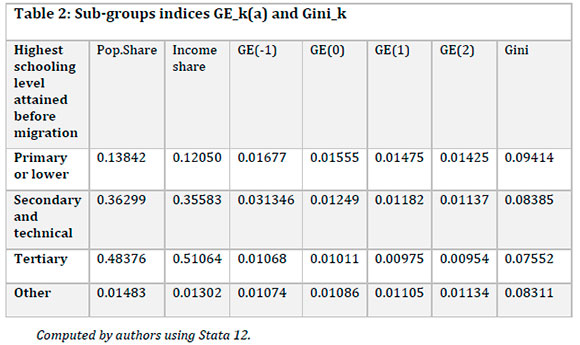
The aim of this study is to ascertain the distribution of international remittance inflow as opposed to the level attained in education before migration. The study uses the Gini coefficient decomposition analysis for the emigrants' remittances and the logistic regression model to ascertain the distribution of emigrants' remittances as opposed to the level of human capital development in education completed before migration. Evidence from the study shows that the level of education completed before migration contributes to the unequal distribution of remittances across the emigrating groups. The Gini coefficient for primary school or lower, secondary, technical, tertiary and other levels of education are 0.09, 0.08, 0.07 and 0.08 respectively with their corresponding Theil indices being 0.014, 0.011, 0.001 and 0.011 respectively. These statistics suggest that the advancement in human capital development in education before migration would reduce the inequality in remittance inflow. The policy implication of this finding supports the migration policies that encourage education before migration as it reduces the inequality in the remittances.
Nigeria; remittance; human capital development